 Quran
Quran
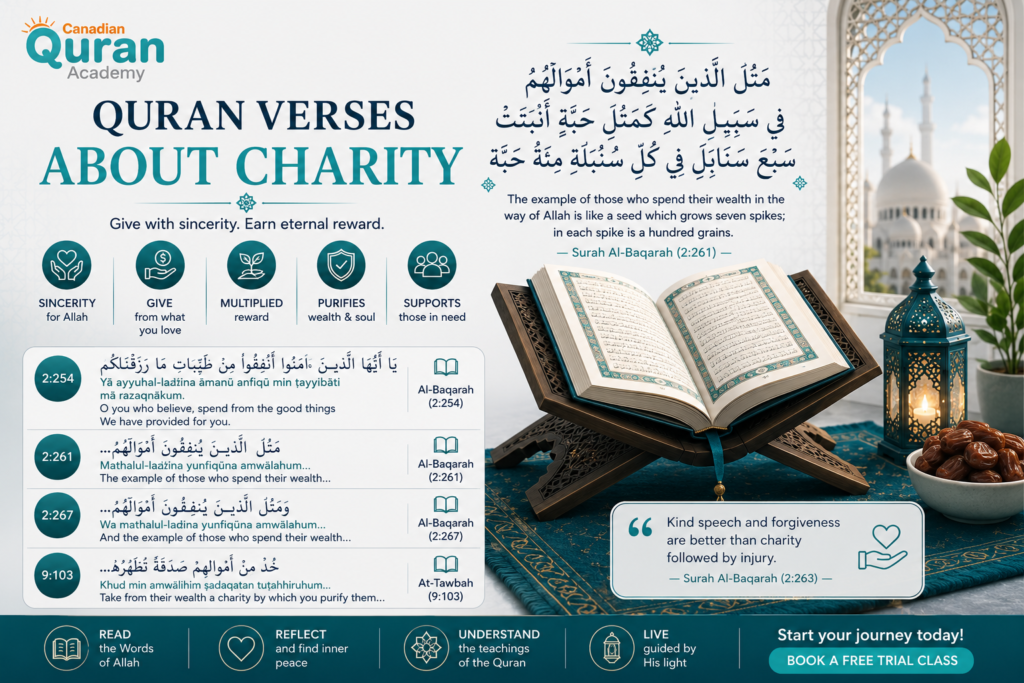
Charity is one of the most repeated themes in the Quran — not as a single command, but as an idea returned to again and again, from different angles, across more than a dozen surahs. If you’re looking for quran verses about charity in Arabic, this guide brings together the verses that matter most: the ones on giving in secret versus in public, the reward multiplied like a growing seed, the warning against giving to be seen, and the hadith that explain how the Prophet ﷺ described charity in his own words.
Each verse below appears in Arabic with tashkeel, a transliteration, an English translation, and a reference linked to Quran.com. Hadith are shown the same way, with the Arabic text, the collection they’re recorded in, and a link to Sunnah.com so you can verify the wording yourself.
What Does the Quran Say About Charity?
Charity in the Quran covers two related but distinct ideas: zakah (زكاة), the obligatory annual giving that is one of the five pillars of Islam, and sadaqah (صدقة), voluntary giving that can happen at any time, in any amount. The Quran uses a third, broader term — infaq (إنفاق), “spending” — to describe both.
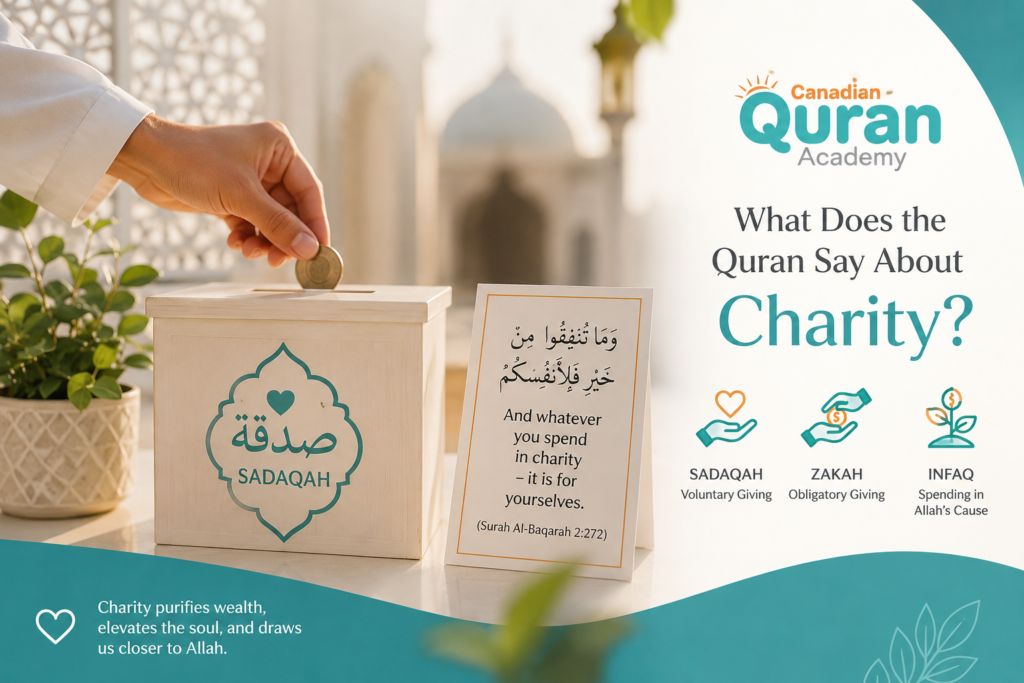
This is a distinction worth having clear before reading further, because several verses below use “spend” (tunfiqoon) in a general sense that includes both categories, while others speak specifically about zakah as a fixed, defined obligation.
يَـٰٓأَيُّهَا ٱلَّذِينَ ءَامَنُوٓاْ أَنفِقُواْ مِمَّا رَزَقۡنَٰكُم مِّن قَبۡلِ أَن يَأۡتِيَ يَوۡمٞ لَّا بَيۡعٞ فِيهِ وَلَا خُلَّةٌ وَلَا شَفَٰعَةٌ
Yaa ayyuhal lazeena aamanoo anfiqoo mimmaa razaqnaakum min qabli ai yaatiya yawmul laa bai’un feehee wa la khullatunw wa laa shafaa’ah.” (Surah Al-Baqarah 2:254)
“O you who have believed, spend from that which We have provided for you before there comes a Day in which there is no exchange and no friendship and no intercession.
The verse frames spending as time-sensitive — a Day is coming when money, favors, and connections stop working as currency, which is precisely why the command is placed before that warning, not after it.
Read also: Quran Verses About Angels in Arabic With Translation and Meaning
Verses on Charity Multiplying Like a Growing Seed
One of the most quoted images in the Quran on this subject is agricultural, not financial — charity described as a seed rather than a transaction.
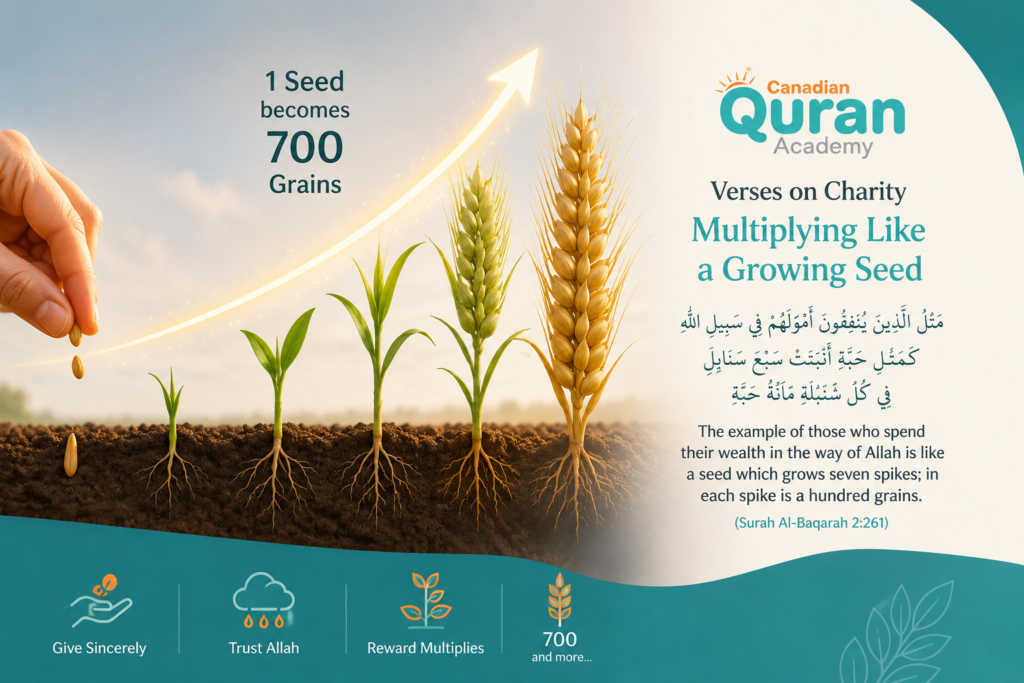
مَّثَلُ ٱلَّذِينَ يُنفِقُونَ أَمۡوَٰلَهُمۡ فِي سَبِيلِ ٱللَّهِ كَمَثَلِ حَبَّةٍ أَنۢبَتَتۡ سَبۡعَ سَنَابِلَ فِي كُلِّ سُنۢبُلَةٖ مِّاْئَةُ حَبَّةٖ
Masalul lazeena yunfiqoona amwaalahum fee sabeelil laahi kamasali habbatin ambatat sab’a sanaabila fee kulli sumbulatim mi’atu habbah.” (Surah Al-Baqarah 2:261)
“The example of those who spend their wealth in the way of Allah is like a seed which grows seven spikes; in each spike is a hundred grains.
The number isn’t symbolic decoration — seven spikes, a hundred grains each, is 700 units from one seed, and the Quran adds immediately afterward that Allah multiplies “for whom He wills,” meaning this figure is a floor, not a ceiling.
A second parable a few verses later extends the same image to a garden on high ground, which yields fruit whether it rains heavily or lightly:
وَمَثَلُ ٱلَّذِينَ يُنفِقُونَ أَمۡوَٰلَهُمُ ٱبۡتِغَآءَ مَرۡضَاتِ ٱللَّهِ وَتَثۡبِيتٗا مِّنۡ أَنفُسِهِمۡ كَمَثَلِ جَنَّةِۭ بِرَبۡوَةٍ أَصَابَهَا وَابِلٞ فَـَٔاتَتۡ أُكُلَهَا ضِعۡفَيۡنِ
Wa masalul lazeena yunfiqoona amwaalahu mubtighaaa’a mardaatil laahi wa tasbeetam min anfusihim kamasali jannatim birabwatin asaabahaa waabilun fa aatat ukulahaa di’faini.” (Surah Al-Baqarah 2:267)
“And the example of those who spend their wealth seeking the approval of Allah and assuring [reward for] themselves is like a garden on high ground which is hit by a downpour — so it yields its fruits in double.
The phrase “assuring [reward for] themselves” is doing real work here: it links the size of the harvest to the sincerity of the intention, not just the amount given — a point the next section builds on directly.
Reading these two parables side by side in Arabic, rather than only in translation, is where a lot of the nuance sits — the repeated root ن-ف-ق (n-f-q, “to spend”) ties the whole passage together in a way that’s easy to miss in English. This kind of close reading is exactly what students build up gradually in a structured Quran reading course, where the goal is comfort with the Arabic text itself, not just the meaning.
Book a FREE trial class in the Quran Reading Classes in Canada

Verses on How Charity Should Be Given
The Quran doesn’t only describe the reward of charity — it sets out conditions for it, and several consecutive verses in Al-Baqarah do this directly.
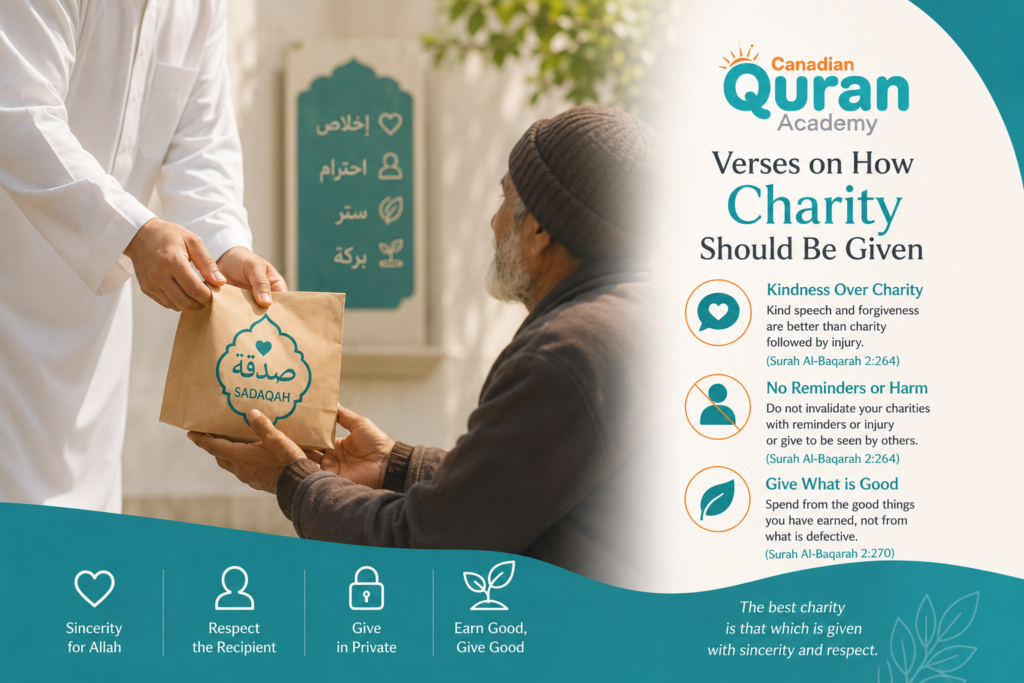
قَوۡلٞ مَّعۡرُوفٞ وَمَغۡفِرَةٌ خَيۡرٞ مِّن صَدَقَةٖ يَتۡبَعُهَآ أَذٗى
Qawlum ma’roofunw wa maghfiratun khairum min sadaqatiny yatba’uhaaa azaa.” (Surah Al-Baqarah 2:264)
“Kind speech and forgiveness are better than charity followed by injury.
This verse ranks the options plainly: it’s better to say nothing and give nothing than to give and then remind the recipient of it or cause them harm afterward.
The following verse extends the warning with a parable of its own — charity given to be seen, compared to dust-covered rock that a downpour leaves completely bare:
يَـٰٓأَيُّهَا ٱلَّذِينَ ءَامَنُواْ لَا تُبۡطِلُواْ صَدَقَٰتِكُم بِٱلۡمَنِّ وَٱلۡأَذَىٰ كَٱلَّذِي يُنفِقُ مَالَهُۥ رِئَآءَ ٱلنَّاسِ
Yaaa ayyuhal lazeena aamanoo laa tubtiloo sadaqaatikum bilmanni wal azaa kallazee yunfiqu maalahoo ri’aaa’an naas.” (Surah Al-Baqarah 2:264)
“O you who have believed, do not invalidate your charities with reminders or injury as does one who spends his wealth [only] to be seen by the people.
A separate verse states the quality standard for what’s given, not just the manner of giving:
يَـٰٓأَيُّهَا ٱلَّذِينَ ءَامَنُوٓاْ أَنفِقُواْ مِن طَيِّبَٰتِ مَا كَسَبۡتُمۡ وَلَا تَيَمَّمُواْ ٱلۡخَبِيثَ مِنۡهُ تُنفِقُونَ
Yaaa ‘ayyuhal lazeena aamanooo anfiqoo min taiyibaati maa kasabtum wa laa tayammamul khabeesa minhu tunfiqoon.” (Surah Al-Baqarah 2:270)
“O you who have believed, spend from the good things which you have earned, and do not aim toward the defective therefrom, spending [from that].
Taken together, these three verses build a working standard for accepted charity that most articles on this topic list as separate points without connecting them: give from what’s genuinely good, don’t follow it with a reminder or harm, and don’t let the intention slip toward being seen. Miss any one condition, and the Quran’s own parable is that the “harvest” disappears — the stone left bare by rain.
Live Class in Action
Watch how our instructors interact with students in real-time, focusing on interactive methods.
Start Your Quranic Journey in Canada
Join our vibrant community and learn with expert tutors through our flexible online platform.
Claim Your Free TrialRead also: Quran Verses In Arabic – Beautiful And Short 44 Verses
Quran Verses About Giving Charity in Secret and in Public
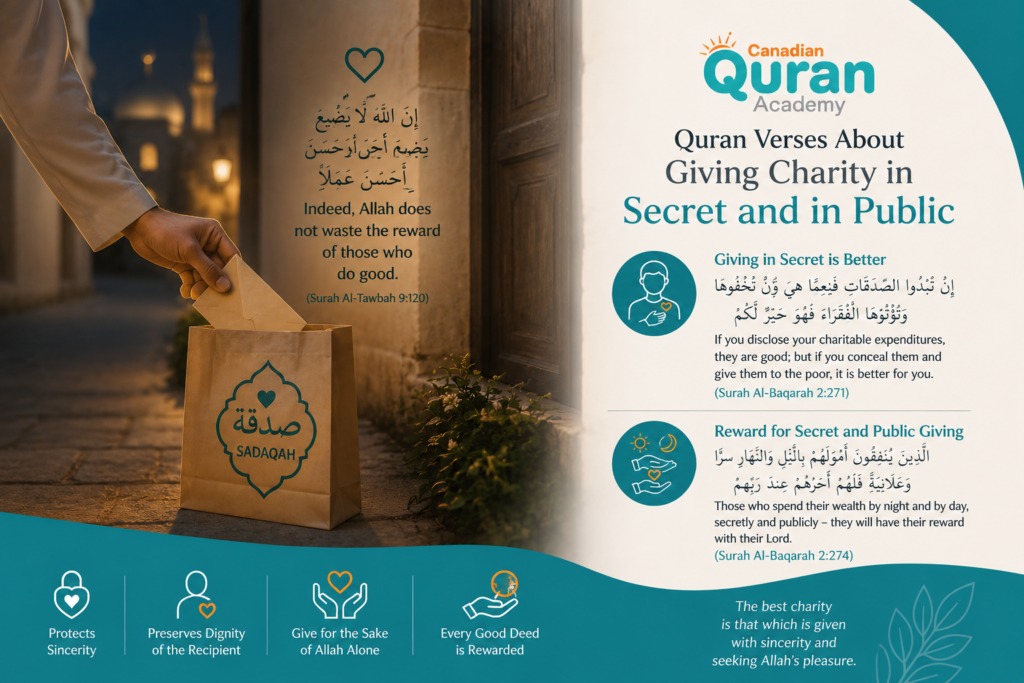
the Quran answers a question many believers ask: Is it better to give charity publicly or in secret? The verse explains that both are acceptable, but giving privately to those in need is generally better because it protects sincerity and preserves the dignity of the recipient.
إِن تُبۡدُواْ ٱلصَّدَقَٰتِ فَنِعِمَّا هِيَۖ وَإِن تُخۡفُوهَا وَتُؤۡتُوهَا ٱلۡفُقَرَآءَ فَهُوَ خَيۡرٞ لَّكُمۡ
In tubdus sadaqaati fani’immaa hiya wa in tukhfoohaa wa tu’toohal fuqaraaa’a fahuwa khayrul lakum.” (Surah Al-Baqarah 2:271)
“If you disclose your charitable expenditures, they are good; but if you conceal them and give them to the poor, it is better for you.
The verse doesn’t call public giving wrong — it calls it “good,” and calls secret giving “better,” which is a comparative, not a prohibition. Public charity has its own role in encouraging others, which is why the Quran doesn’t rule it out.
A later verse repeats the same theme with a slightly different phrasing, describing those who spend “by night and by day, secretly and publicly”:
ٱلَّذِينَ يُنفِقُونَ أَمۡوَٰلَهُم بِٱلَّيۡلِ وَٱلنَّهَارِ سِرّٗا وَعَلَانِيَةٗ فَلَهُمۡ أَجۡرُهُمۡ عِندَ رَبِّهِمۡ
Allazeena yunfiqoona amwaalahum billaili wan nahaari sirranw wa ‘alaaniyatan falahum ajruhum ‘inda Rabbihim” (Surah Al-Baqarah 2:274)
“Those who spend their wealth by night and by day, secretly and publicly — they will have their reward with their Lord.
Here, timing and visibility stop mattering altogether — the reward attaches to the giving itself, in any of the four conditions listed.
What the Quran Says About Charity and Interest (Riba)?
One verse places charity and riba (interest) side by side as opposites, and it’s short enough that many readers memorize it without realizing how much it’s doing:
يَمۡحَقُ ٱللَّهُ ٱلرِّبَوٰاْ وَيُرۡبِي ٱلصَّدَقَٰتِ
Yamhaqul laahur ribaa wa yurbis sadaqaat” (Surah Al-Baqarah 2:276)
“Allah destroys interest and gives increase for charities.
The Arabic root is the same word twice — ربو (r-b-w, “to grow”) — used to describe what riba claims to do and what sadaqah actually does, which is a deliberate wordplay in the original text that most translations can’t fully carry over.
Who Can Receive Zakah According to the Quran?
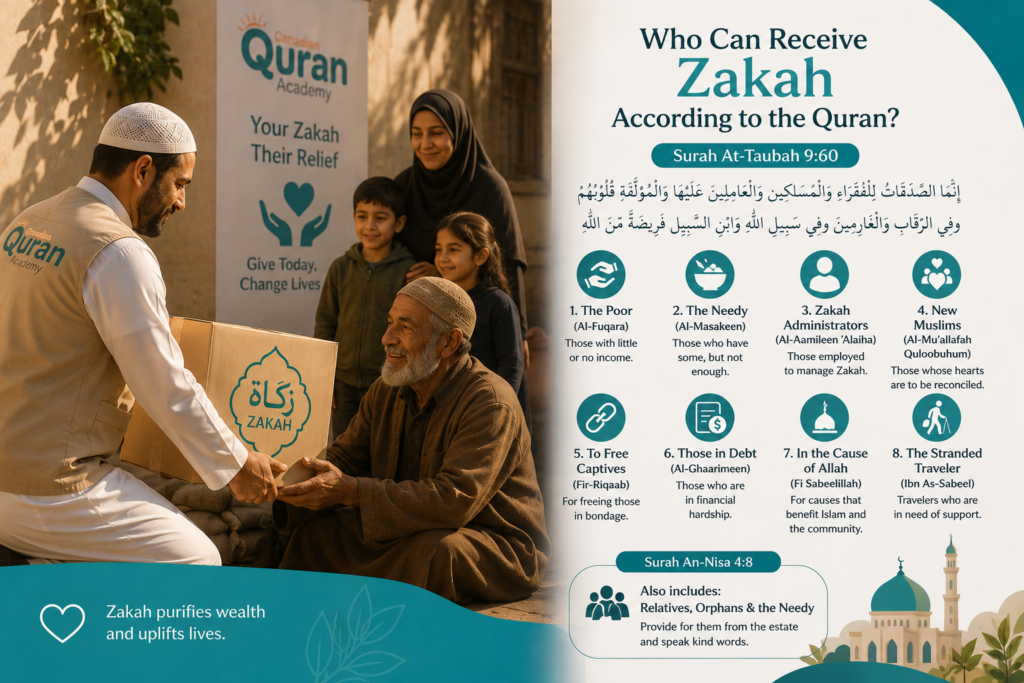
The Quran provides clear guidance on who is eligible to receive zakah. Rather than leaving the decision open-ended, it identifies eight specific categories of recipients, ensuring that zakah is distributed fairly and fulfills its intended purpose.
إِنَّمَا ٱلصَّدَقَٰتُ لِلۡفُقَرَآءِ وَٱلۡمَسَٰكِينِ وَٱلۡعَٰمِلِينَ عَلَيۡهَا وَٱلۡمُؤَلَّفَةِ قُلُوبُهُمۡ وَفِي ٱلرِّقَابِ وَٱلۡغَٰرِمِينَ وَفِي سَبِيلِ ٱللَّهِ وَٱبۡنِ ٱلسَّبِيلِ فَرِيضَةٗ مِّنَ ٱللَّهِ
Innamas sadaqaatu lilfuqaraaa’i walmasaakeeni wal ‘aamileena ‘alaihaa wal mu’al lafati quloobuhum wa fir riqaabi walghaarimeena wa fee sabeelil laahi wabnis sabeeli fareedatam minal laah.” (Surah At-Taubah 9:60)
“Zakah expenditures are only for the poor and for the needy and for those employed to collect it and for bringing hearts together and for freeing captives and for those in debt and for the cause of Allah and for the stranded traveler — an obligation imposed by Allah.
Note the word used here is sadaqaat, the same root as voluntary charity — a reminder that in the Quran’s own vocabulary, zakah is a category of sadaqah, not a separate word entirely, even though the two are treated as legally distinct in Islamic law.
A second verse addresses a narrower, less-discussed case — what relatives, orphans, and the needy are owed when an estate is being divided:
وَإِذَا حَضَرَ ٱلۡقِسۡمَةَ أُوْلُواْ ٱلۡقُرۡبَىٰ وَٱلۡيَتَٰمَىٰ وَٱلۡمَسَٰكِينُ فَٱرۡزُقُوهُم مِّنۡهُ وَقُولُواْ لَهُمۡ قَوۡلٗا مَّعۡرُوفٗا
Wa izaa hadaral qismata ulul qurbaa walyataamaa walmasaakeenu farzuqoohum minhu wa qooloo lahum qawlam ma’roofaa.” (Surah An-Nisa 4:8)
“And when [other] relatives and orphans and the needy are present at the division, then provide for them out of the estate and speak to them words of appropriate kindness.
This is a case verse — it doesn’t set a fixed amount, but it does set an expectation that’s easy to overlook when reading only the major zakah verses.
Why Should Children Learn Quranic Verses About Charity?
Teaching children the Quranic verses about charity from an early age helps shape their character long before they begin giving significant amounts of wealth. These verses instill values of generosity, gratitude, compassion, and responsibility, showing that every act of kindness—no matter how small—is meaningful in the sight of Allah. When children grow up hearing these verses regularly, they begin to see charity as a natural part of their daily lives rather than an occasional obligation.
Parents introducing these concepts at home often start with 2:261 (the seed) and the “half a date” hadith specifically, since both give children something concrete to picture rather than a number to memorize. A Quran course for kids that pairs short verses like these with simple explanation tends to make the concept stick faster than starting with the longer legal verses on zakah.
Book a FREE trial class in the Online Quran Classes for Kids in Canada

Experience Our Classrooms
Don’t just take our word for it—take a look inside! Watch the videos below to experience our engaging teaching methods and vibrant online classrooms firsthand.
Start Your Quranic Journey in Canada
Join our vibrant community and learn with expert tutors through our flexible online platform.
Claim Your Free TrialDeepen Your Quran Learning with The Canadian Quran Academy
Reading Quran verses about charity in Arabic is only the beginning. Understanding their meanings and reciting them with proper Tajweed helps these timeless teachings become part of your daily life. At The Canadian Quran Academy, qualified Quran teachers provide personalized one-on-one instruction to help students improve their recitation, strengthen their understanding of the Quran, and memorize verses with confidence.
The Canadian Quran Academy offers:
- Qualified, experienced Quran teachers with Ijazah and Tajweed expertise
- Personalized 1-on-1 online lessons for every age and skill level
- Step-by-step Quran recitation with live pronunciation correction
- Quran memorization and Tafsir programs to deepen your understanding
- Flexible scheduling for students across Canadian time zones
- A free trial lesson with no commitment required
Book your free trial lesson today and start learning Quran verses about charity in Arabic with confidence, proper Tajweed, and expert guidance.

Our Quran Courses
- Quran Online Academy
- Quran Recitation Classes
- Quran Reading Classes
- Online Quran Classes for Kids
- Quran Classes for Adults
- Quran Classes for Female/Sisters
- Learn Quran for Beginners
- Quran Memorization (Hifz) Course
- Hifz Classes for Adults
- Quran Memorization and Hifz for Kids
- Quran Hifz for Ladies
- Quran Ijazah Program
- Quran Qirat Learning Course
- Quran Tafsir Course
- Noorani Qaida Course
- Noorani Qaida Course for Kids
- Weekend Quran Classes
- Intensive Quran Course
- Al-Azhar Quran Course
- Online Tajweed Classes
- Tajweed Course for Kids
- Tajweed Course for Adults
- Tajweed Course for Ladies/Sisters
Start Your Quranic Journey in Canada
Join our vibrant community and learn with expert tutors through our flexible online platform.
Claim Your Free TrialConclusion
Quran verses about charity in Arabic cover more than one idea repeated in different words — they define what counts as charity (sadaqah and zakah), set conditions for how it should be given (from good things, without reminders, without seeking to be seen), and settle the question of secrecy versus public giving in favor of neither being wrong. The hadith add the everyday detail the Quran’s parables don’t spell out: half a date still counts, and giving doesn’t shrink what you have.
Reading these verses in Arabic — the same root repeated across a passage, the exact wording of a comparison — is where the meaning sits most precisely. Start with the shorter verses on giving in secret (2:271) and the “half a date” hadith, since both are self-contained, then move to the fuller zakah verse (9:60) once the basic vocabulary of infaq and sadaqah feels familiar.
Frequently Asked Questions
What is the difference between sadaqah and zakat in the Quran?
Zakat is a fixed, obligatory form of giving with defined recipients, named directly in Surah At-Taubah 9:60. Sadaqah is the broader term for voluntary charity, given in any amount, at any time — the Quran sometimes uses “sadaqah” to describe zakah as well, since zakah is technically a category within it.
Which Quran verse compares charity to a seed?
Surah Al-Baqarah 2:261 compares charity to a seed that grows seven spikes, each holding a hundred grains — a multiplied return the verse describes as the minimum, since Allah “multiplies for whom He wills” beyond that figure.
Does the Quran say secret charity is better than public charity?
Yes. Surah Al-Baqarah 2:271 states that disclosing charity is good, but concealing it and giving directly to the poor is better — a comparison, not a rule against giving openly.
What happens to charity given to show off?
Surah Al-Baqarah 2:264 compares charity given to be seen (riya) to dust on a smooth rock, wiped completely bare by rain — meaning the giver is left with nothing to show for it in the sight of Allah.
Is there a hadith about charity extinguishing sin?
Yes. A hadith narrated by Mu’adh ibn Jabal in Jami` at-Tirmidhi states that “charity extinguishes sin as water extinguishes fire,” part of a longer hadith on prayer, fasting, and charity together.
Does charity actually decrease a person’s wealth?
According to a hadith narrated by Abu Hurairah in Sahih Muslim, no — “charity does not decrease wealth” a statement that directly answers the practical concern behind the Quran’s growth parables in 2:261 and 2:267.






Leave a Reply