 Arabic
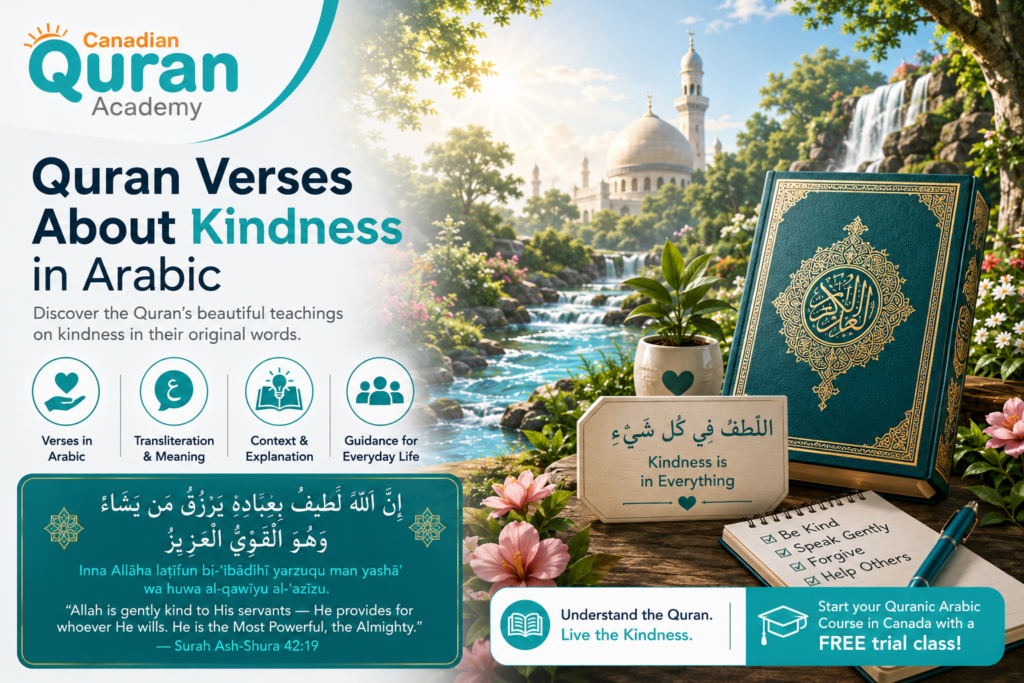
The Quran presents kindness as one of the defining qualities of a believer and one of the clearest signs of Allah’s mercy. If you’re searching for Quran verses about kindness in Arabic, you’ll find that the Quran speaks about kindness in many forms—from Allah’s gentle care for His creation to His commands to show compassion, forgiveness, patience, and respect toward parents, neighbors, strangers, and even enemies.
In this guide, you’ll discover authentic Quran verses about kindness in Arabic with full tashkeel, accurate English translations, explanations of their context and meaning, and references to the exact surah and ayah. By the end, you’ll have a clear understanding of how the Quran defines kindness and how these verses can be applied in everyday life.
Quran Verses About Allah’s Kindness in Arabic
Before looking at verses that command kindness between people, it helps to know that the Quran first describes kindness as one of Allah’s own names: Al-Lateef (اللَّطِيفُ), the Subtly Kind. This name appears seven times in the Quran, almost always paired with Al-Khabeer (the All-Aware) or Al-Hakeem (the All-Wise) — a pairing that signals Allah’s kindness is not vague softness, but precise, deliberate care that reaches what the human eye cannot.
1. Kindness Through Hardship
Sometimes Allah’s greatest acts of kindness arrive wrapped in difficulty rather than ease. The story of Prophet Yusuf (AS) reminds us that what looks like a setback today may be part of a mercy we only recognize years later.
إِنَّ رَبِّي لَطِيفٌ لِّمَا يَشَاءُ ۚ إِنَّهُ هُوَ الْعَلِيمُ الْحَكِيمُ
“Indeed, my Lord is subtle in fulfilling what He wills. He is truly the All-Knowing, the All-Wise.” (Surah Yusuf, 12:100)
Prophet Yusuf (AS) said this after being thrown into a well, sold into slavery, imprisoned on a false charge, and finally reunited with his family as a ruler of Egypt. He did not describe the ending as luck. He named the mechanism: Allah’s kindness had been working through every stage of the hardship, unseen until the end.
2. Allah Provides for His Servants
Allah’s provision is more than wealth or material blessings. This verse reveals that His care reaches every part of a believer’s life, delivered with wisdom, timing, and subtle kindness.
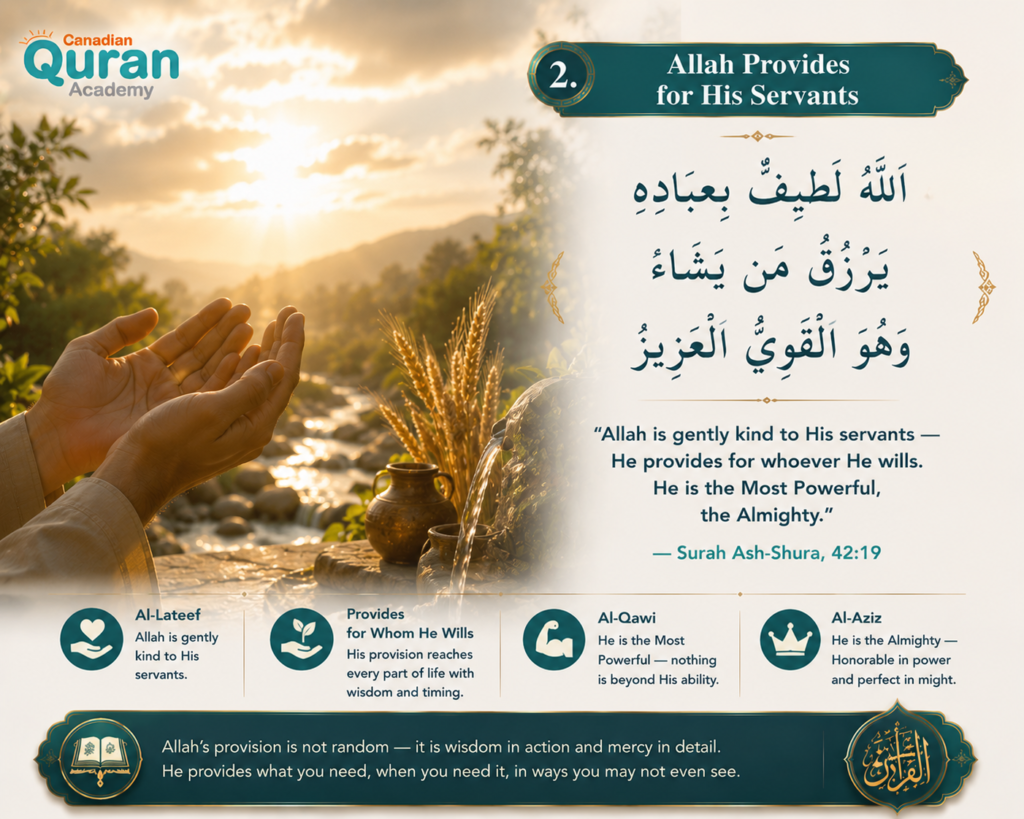
اللَّهُ لَطِيفٌ بِعِبَادِهِ يَرْزُقُ مَن يَشَاءُ ۖ وَهُوَ الْقَوِيُّ الْعَزِيزُ
“Allah is gently kind to His servants — He provides for whoever He wills. He is the Most Powerful, the Almighty.” (Surah Ash-Shura, 42:19)
The verse pairs Al-Lateef with Al-Qawi (the All-Powerful). Allah’s kindness here is not the gentleness of weakness — it is the chosen gentleness of the One who holds all power and still opts for care.
3. A Visible Sign of Invisible Kindness
Nature offers one of the clearest examples of how Allah’s kindness works quietly before it becomes visible. Rain falls in moments, but the transformation it creates unfolds gradually beneath the surface.
أَلَمْ تَرَ أَنَّ اللَّهَ أَنزَلَ مِنَ السَّمَاءِ مَاءً فَتُصْبِحُ الْأَرْضُ مُخْضَرَّةً ۗ إِنَّ اللَّهَ لَطِيفٌ خَبِيرٌ
“Do you not see that Allah sends down rain from the sky, and the earth becomes green? Indeed, Allah is Subtle, All-Aware.” (Surah Al-Hajj, 22:63)
Between the rain falling and the ground turning green, there is a process no one watches — seeds absorbing water in the dark, roots spreading below the surface. The verse uses this image deliberately: much of what Allah delivers to you was set in motion long before you noticed it.
4. Nothing Escapes His Subtle Awareness
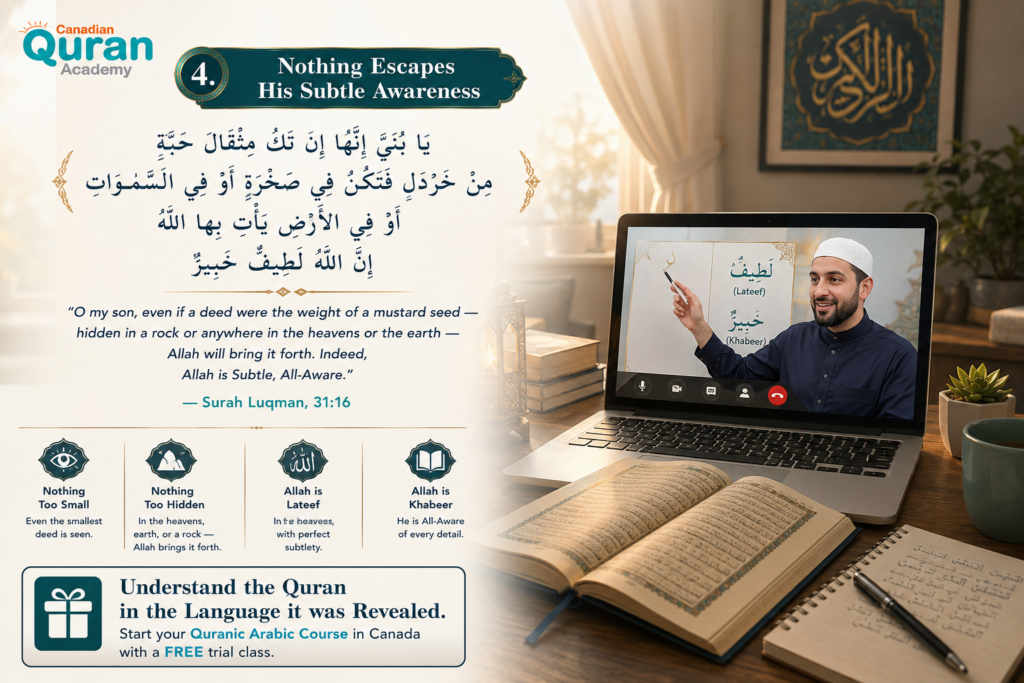
Every sincere action matters, no matter how small or hidden it may seem. Allah’s perfect awareness ensures that no good deed is ever forgotten and no act of righteousness is ever lost.
يَا بُنَيَّ إِنَّهَا إِن تَكُ مِثْقَالَ حَبَّةٍ مِّنْ خَرْدَلٍ فَتَكُن فِي صَخْرَةٍ أَوْ فِي السَّمَاوَاتِ أَوْ فِي الْأَرْضِ يَأْتِ بِهَا اللَّهُ ۚ إِنَّ اللَّهَ لَطِيفٌ خَبِيرٌ
“O my son, even if a deed were the weight of a mustard seed — hidden in a rock or anywhere in the heavens or the earth — Allah will bring it forth. Indeed, Allah is Subtle, All-Aware.” (Surah Luqman, 31:16)
Luqman the Wise said this to his son as a lesson in accountability. The same subtle awareness that reaches a hidden seed also reaches hidden acts of good — nothing small enough to go unnoticed by Allah, and nothing small enough to go unrewarded.
Reading these verses in translation gives you the meaning, but a lot of the precision — the exact shade of lateef versus rahman versus ra’uf — only becomes clear once you can read the Arabic directly. Canadian Quran Academy’s Quranic Arabic course is built for exactly this: understanding the words of the Quran as they were written, not only as they are translated.
Start your Quranic Arabic Course in Canada with a FREE trial class.
Read also: Quran Verses About Justice in Arabic
Quran Verses Commanding Kindness Between People
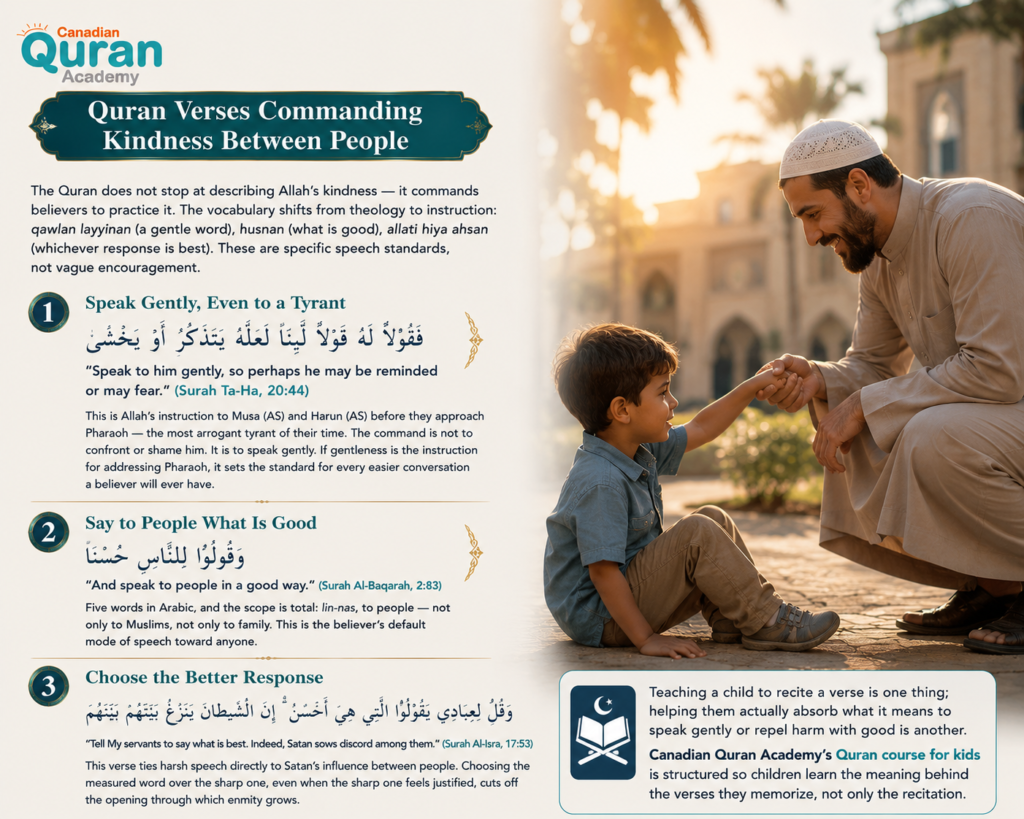
The Quran does not stop at describing Allah’s kindness — it commands believers to practice it. The vocabulary shifts from theology to instruction: qawlan layyinan (a gentle word), husnan (what is good), allati hiya ahsan (whichever response is best). These are specific speech standards, not vague encouragement.
1. Speak Gently, Even to a Tyrant
The Quran teaches that kindness in speech is not reserved for those who deserve it most. Even in the face of hostility and arrogance, gentle words remain a sign of strength, wisdom, and trust in Allah.
فَقُولَا لَهُ قَوْلًا لَّيِّنًا لَّعَلَّهُ يَتَذَكَّرُ أَوْ يَخْشَىٰ
“Speak to him gently, so perhaps he may be reminded or may fear.” (Surah Ta-Ha, 20:44)
This is Allah’s instruction to Musa (AS) and Harun (AS) before they approach Pharaoh — the most arrogant tyrant of their time. The command is not to confront or shame him. It is to speak gently. If gentleness is the instruction for addressing Pharaoh, it sets the standard for every easier conversation a believer will ever have.
2. Say to People What Is Good
Good character begins with good speech. This brief command establishes kindness as the believer’s default language, shaping every interaction with respect, dignity, and compassion.
وَقُولُوا لِلنَّاسِ حُسْنًا
“And speak to people in a good way.” (Surah Al-Baqarah, 2:83)
Five words in Arabic, and the scope is total: lin-nas, to people — not only to Muslims, not only to family. This is the believer’s default mode of speech toward anyone.
3. Choose the Better Response
Not every true response is the best response. The Quran encourages believers to choose words that heal rather than divide, recognizing that thoughtful speech protects relationships and prevents conflict before it begins.
وَقُل لِّعِبَادِي يَقُولُوا الَّتِي هِيَ أَحْسَنُ ۚ إِنَّ الشَّيْطَانَ يَنزَغُ بَيْنَهُمْ
“Tell My servants to say what is best. Indeed, Satan sows discord among them.”(Surah Al-Isra, 17:53)
This verse ties harsh speech directly to Satan’s influence between people. Choosing the measured word over the sharp one, even when the sharp one feels justified, cuts off the opening through which enmity grows.
Teaching a child to recite a verse is one thing; helping them actually absorb what it means to speak gently or repel harm with good is another. Canadian Quran Academy’s Quran course for kids is structured so children learn the meaning behind the verses they memorize, not only the recitation.
Book a FREE trial class in our Online Quran Classes for Kids in Canada.

Experience Our Classrooms
Don’t just take our word for it—take a look inside! Watch the videos below to experience our engaging teaching methods and vibrant online classrooms firsthand.
Start Your Quranic Journey in Canada
Join our vibrant community and learn with expert tutors through our flexible online platform.
Claim Your Free TrialRead also: Quran Verses About Jannah in Arabic
Kindness Turns an Enemy Into a Devoted Friend
Most people expect the Quran to say kindness is the right thing to do. Fewer expect it to describe exactly what kindness produces.
ادْفَعْ بِالَّتِي هِيَ أَحْسَنُ فَإِذَا الَّذِي بَيْنَكَ وَبَيْنَهُ عَدَاوَةٌ كَأَنَّهُ وَلِيٌّ حَمِيمٌ
“Repel evil with what is better, and the one between you and whom there was enmity will become as though he were a devoted friend.” (Surah Fussilat, 41:34)
This is arguably the most practical kindness verse in the Quran. It does not claim kindness is morally superior — it describes a real outcome: an actual enemy becomes waliyyun hameem, a close, warm companion. The condition attached matters: the verse says allati hiya ahsan, the best available response — not just any polite reply, but the deliberate, better choice, even when it costs something.
A common misreading of this verse treats it as a guarantee that kindness always changes people. It doesn’t promise that every hostile person softens. It describes what kindness is capable of producing — and sets that as the standard to aim for, regardless of the outcome in any single case.
The Quran’s Highest Standard of Kindness Begins at Home
Kindness in the Quran is not only about strangers or enemies — it applies with particular weight inside the family, especially toward parents.
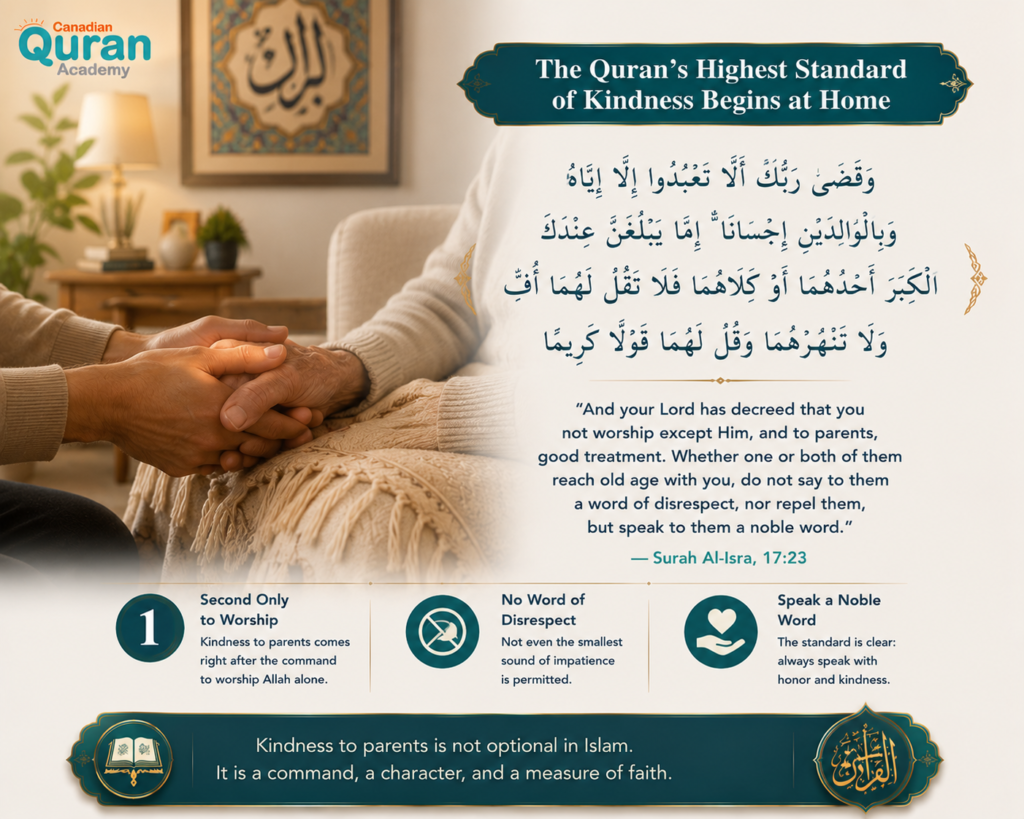
وَقَضَىٰ رَبُّكَ أَلَّا تَعْبُدُوا إِلَّا إِيَّاهُ وَبِالْوَالِدَيْنِ إِحْسَانًا ۚ إِمَّا يَبْلُغَنَّ عِندَكَ الْكِبَرَ أَحَدُهُمَا أَوْ كِلَاهُمَا فَلَا تَقُل لَّهُمَا أُفٍّ وَلَا تَنْهَرْهُمَا وَقُل لَّهُمَا قَوْلًا كَرِيمًا
“And your Lord has decreed that you not worship except Him, and to parents, good treatment. Whether one or both of them reach old age with you, do not say to them a word of disrespect, nor repel them, but speak to them a noble word.” (Surah Al-Isra, 17:23)
The verse places kindness to parents directly after the command to worship Allah alone — the second obligation, not an optional add-on. The standard given is exact: not even the smallest sound of impatience is permitted, regardless of how demanding the parent’s needs have become with age.
Allah’s Kindness Is Found in His Mercy and Forgiveness
Among the Quran verses about kindness, the forgiveness verses form their own category — the kindness described here is directed at people who have already done wrong.
قُلْ يَا عِبَادِيَ الَّذِينَ أَسْرَفُوا عَلَىٰ أَنفُسِهِمْ لَا تَقْنَطُوا مِن رَّحْمَةِ اللَّهِ ۚ إِنَّ اللَّهَ يَغْفِرُ الذُّنُوبَ جَمِيعًا ۚ إِنَّهُ هُوَ الْغَفُورُ الرَّحِيمُ
“Say: O My servants who have transgressed against themselves, do not despair of Allah’s mercy. Indeed, Allah forgives all sins. He is the Forgiving, the Merciful.” (Surah Az-Zumar, 39:53)
لَا يُكَلِّفُ اللَّهُ نَفْسًا إِلَّا وُسْعَهَا
“Allah does not burden a soul beyond that it can bear.” (Surah Al-Baqarah, 2:286)
Read together, these two verses define what divine kindness looks like when someone has fallen short: no requirement placed beyond a person’s real capacity, and no sin placed beyond the reach of forgiveness if the person returns to Allah. The Quran’s consistent position is that kindness is calibrated to human reality, not to an idealized standard no one can meet.
What Ties These Verses Together?
A pattern runs across every verse above: kindness in the Quran is never presented as weakness, and it is never optional politeness. It is strategic — it disarms enmity. It is structural — it is how Allah’s own care reaches His creation before anyone notices. And it is relational — it defines what is owed to parents, to strangers, and even to people who have wronged you.
A common mistake when reading these verses individually is treating each one as a separate, unrelated instruction — a verse for parents here, a verse for enemies there. Read as a set, they form something closer to a single rule: whenever a harsher response and a gentler one are both available, take the gentler one, because the gentler one is what the Quran consistently identifies as producing real change — in relationships, in reconciliation, and in how a person’s own character is judged.
If you are working toward memorizing these verses long-term rather than reading them once and moving on, Canadian Quran Academy’s Hifz program is built around structured, gradual memorization with a certified teacher correcting your recitation as you go.
Begin your Hifz journey in Canada with a FREE trial class.

Live Class in Action
Watch how our instructors interact with students in real-time, focusing on interactive methods.
Start Your Quranic Journey in Canada
Join our vibrant community and learn with expert tutors through our flexible online platform.
Claim Your Free TrialStart Understanding Quran Verses About Justice Through Authentic Tafsir
Reading a translation helps you understand the general meaning of the Quran verses about justice in Arabic. Studying them through authentic Tafsir reveals their context of revelation, linguistic precision, and the timeless principles of justice they establish. The Canadian Quran Academy offers personalized 1-on-1 Quran Tafsir classes with qualified instructors, helping you explore the deeper meanings of the Quran at your own pace.
- Qualified Quran Tafsir instructors with authentic Islamic scholarship
- Personalized 1-on-1 online lessons tailored to your knowledge level
- Study the historical context, linguistic meanings, and classical Tafsir of Quranic verses
- Flexible scheduling across all Canadian time zones — morning, evening, and weekend classes
- Programs for adults, youth, new Muslims, and lifelong learners
Book your FREE trial class today and begin your Quran Tafsir journey with The Canadian Quran Academy.

Our Quran Courses
- Quran Online Academy
- Quran Recitation Classes
- Quran Reading Classes
- Online Quran Classes for Kids
- Quran Classes for Adults
- Quran Classes for Female/Sisters
- Learn Quran for Beginners
- Quran Memorization (Hifz) Course
- Hifz Classes for Adults
- Quran Memorization and Hifz for Kids
- Quran Hifz for Ladies
- Quran Ijazah Program
- Quran Qirat Learning Course
- Quran Tafsir Course
- Noorani Qaida Course
- Noorani Qaida Course for Kids
- Weekend Quran Classes
- Intensive Quran Course
- Al-Azhar Quran Course
- Online Tajweed Classes
- Tajweed Course for Kids
- Tajweed Course for Adults
- Tajweed Course for Ladies/Sisters
Start Your Quranic Journey in Canada
Join our vibrant community and learn with expert tutors through our flexible online platform.
Claim Your Free TrialConclusion
Quran verses about kindness in Arabic work on two levels worth keeping separate. The first is theological: Allah is Al-Lateef, whose kindness reaches believers through paths they never see coming, as the story of Yusuf (AS) shows in full.
The second is practical: believers are commanded to speak husnan to all people, to show ihsan toward parents without even a sound of impatience, and to choose allati hiya ahsan when responding to harm — a choice the Quran says can turn a real enemy into a devoted friend.
None of this is decorative language. It is a specific, repeatable instruction for how to speak and act, backed by verses you can check yourself, one ayah at a time.
Frequently Asked Questions
What is the most important Quran verse about kindness in Arabic?
Many scholars point to Surah Fussilat 41:34 — “Repel with what is better, and the one between you and whom there was enmity will become as though he were a devoted friend” — as the clearest statement of what deliberate kindness produces in practice.
What does Al-Lateef mean in the Quran?
Al-Lateef (اللَّطِيفُ) is one of Allah’s names, appearing seven times in the Quran. It carries two meanings: that Allah’s knowledge reaches the finest hidden details, and that He delivers goodness to His servants through means they do not see coming.
Which surah talks about speaking kindly to others?
Several do. Surah Al-Baqarah 2:83 commands “speak to people in a good way.” Surah Al-Isra 17:53 instructs believers to “say what is best.” Surah Ta-Ha 20:44 commands gentle speech even toward someone in serious error, using Musa (AS) addressing Pharaoh as the example.
Is there a Quran verse about kindness to parents?
Yes. Surah Al-Isra 17:23–24 forbids even the smallest word of impatience toward parents and commands speaking to them with a noble word, connecting kindness to parents directly to the worship of Allah.
How can I learn these verses properly in Arabic?
The most reliable way is with a qualified teacher who corrects your pronunciation and explains the context you would miss in translation alone.





Leave a Reply