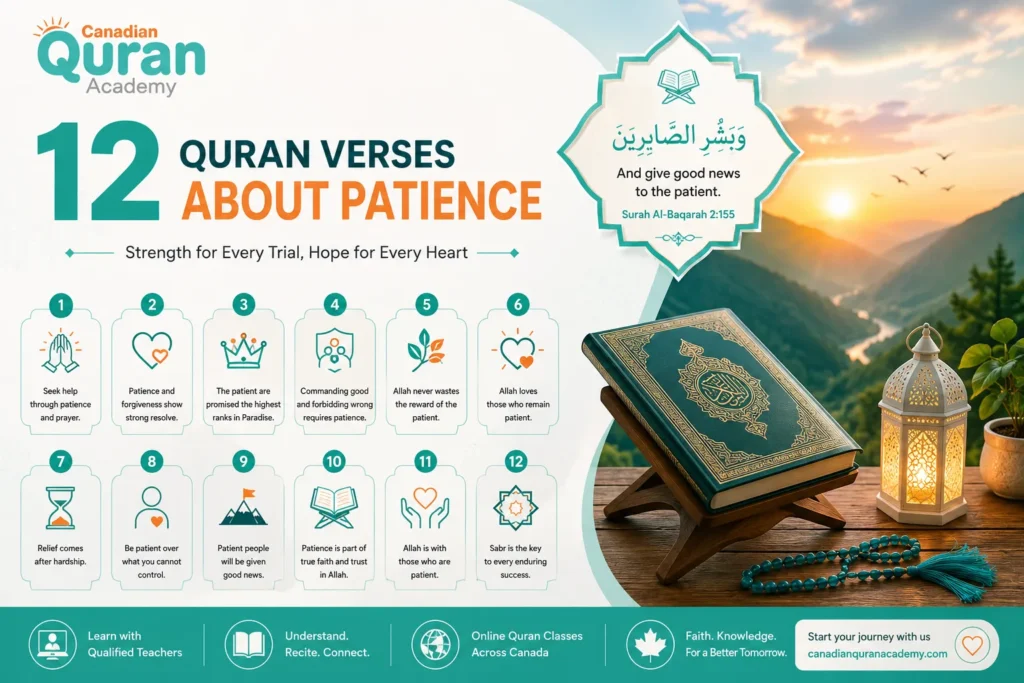
12 Quran Verses About Patience In Arabic And English
When life tests you — a loss, a delay, an illness, a plan that falls apart — the Quran doesn’t tell you to simply wait it out. It tells you to practice sabr, a specific, active form of patience described across dozens of Quran verses about patience in Arabic, each one written for a different kind of hardship. Some verses were revealed during moments of grief.
Others were revealed to comfort a Prophet facing rejection, or to prepare believers for the ordinary difficulties of daily life.
This article brings together the Quran’s key verses on patience in their original Arabic, with transliteration, translation, and the context behind each one. You’ll also see how these verses are meant to be applied, not just memorized, and where the language itself — the exact wording Allah chose — carries meaning that a translation alone cannot fully capture.
At Canadian Quran Academy, this is the starting point for how we teach these verses: understanding them in Arabic first, then learning to recite and internalize them correctly.
1. Seek Help Through Patience and Prayer
This is one of the first instructions the Quran gives for facing hardship: turn to prayer and patience together, not one without the other.
“Wa-staʿīnū biṣ-ṣabri waṣ-ṣalāh, wa innahā lakabīratun illā ʿalal-khāshiʿīn”
“And seek help through patience and prayer. Indeed, it is a burden except for the humble.” (Surah Al-Baqarah, 2:45)
The pairing repeats in 2:153: “Seek comfort in patience and prayer. Allah is truly with those who are patient.” Notice the structure — sabr is rarely left as a feeling to wait out; it’s consistently attached to an action.
2. Patience and Forgiveness Show Strong Resolve
When someone wrongs you, the Quran offers a specific two-part response rather than simply “let it go.”
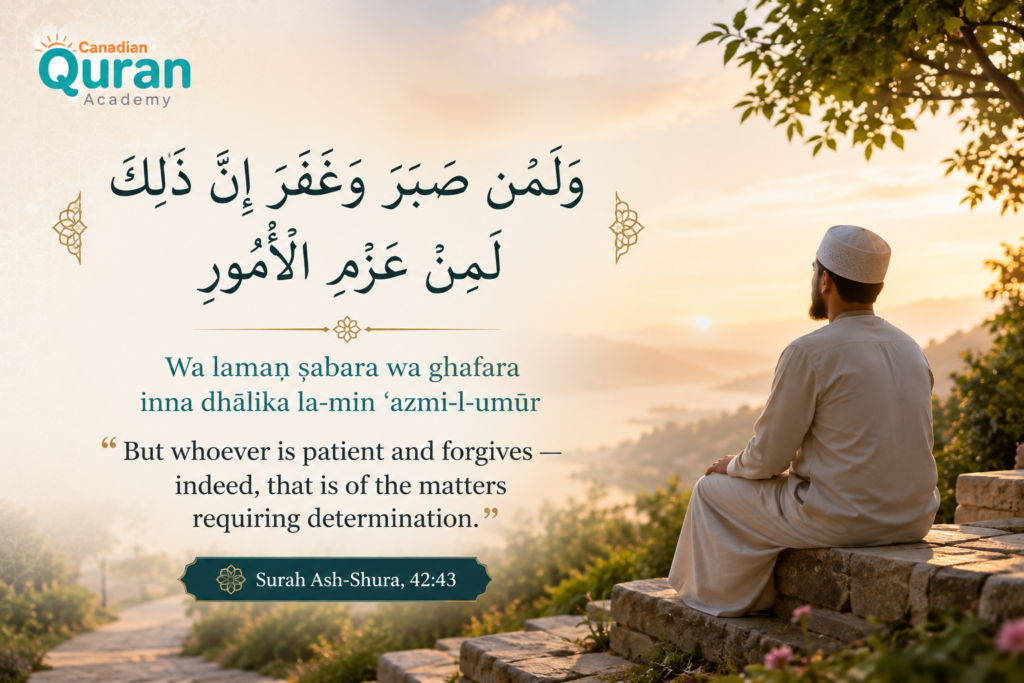
“Wa lamaṇ ṣabara wa ghafara inna dhālika la-min ʿazmi-l-umūr”
“But whoever is patient and forgives — indeed, that is of the matters requiring determination.” (Surah Ash-Shura, 42:43)
Here sabr is paired with forgiveness, not just endurance. The phrase ʿazm al-umūr (“matters requiring determination”) signals that this combination is treated as a deliberate, high-effort choice — not something that happens passively once anger simply fades.
“Ulāʾika yujzawna-l-ghurfata bimā ṣabarū wa yulaqqawna fīhā taḥiyyatan wa salāmā”
“Those will be awarded the elevated chamber for their perseverance, and will be received therein with greetings of peace.” (Surah Al-Furqan, 25:75)
Al-ghurfah refers to a specific elevated station in Paradise, not a generic reward. The verse links that elevation directly to sabr — a reminder that endurance is treated as a concrete cause, not a vague virtue.
Sabr here is framed as continued strength after a setback, not the absence of one — and it’s one of the few traits the Quran explicitly says Allah loves in a person.
“…And be steadfast. Indeed, Allah is with those who are steadfast.” (Surah Al-Anfal, 8:46)
The Arabic word maʿa (with) signals nearness and support, not distance — sabr is presented as what keeps people unified when disagreement threatens to pull them apart.
8. True Patience Comes Only Through Allah’s Help
This verse corrects a common assumption: that patience is purely a matter of personal willpower.
“And be patient, for your patience is only through Allah’s help…” (Surah An-Nahl, 16:127)
Sabr is presented as something a person can only sustain with Allah’s help — which is why the verse pairs patience with a direct instruction not to grieve or feel distressed.
“And We will surely test you with something of fear and hunger and a loss of wealth, lives, and fruits, but give good tidings to the patient — who, when disaster strikes them, say, ‘Indeed we belong to Allah, and indeed to Him we will return.'” (Surah Al-Baqarah, 2:155–156)
The response it prescribes, innā lillāhi wa innā ilayhi rājiʿūn, is why this exact phrase is recited at news of a death across the Muslim world.
10. The “Beautiful Patience” of Prophet Ya’qub (AS)
This is the exact moment Prophet Ya’qub (AS) responds to devastating, false news about his son.
“…So patience is most fitting. And Allah is the one sought for help against what you describe.” (Surah Yusuf, 12:18)
Scholars describe sabrun jameel as patience without panic, despair, or public complaint against Allah’s decree — not the absence of grief, but grief carried through trust rather than blame.
11. Patience Brings an Unlimited Reward
This is the verse most often memorized for its promise of a reward with no fixed limit.
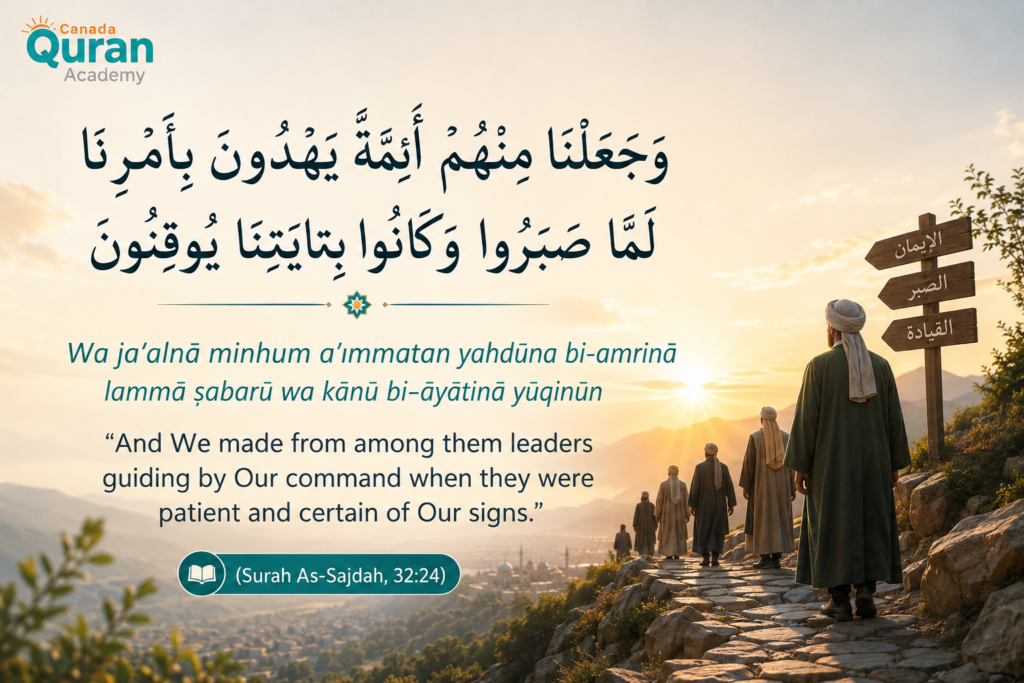
“And We made from among them leaders guiding by Our command when they were patient and certain of Our signs.” (Surah As-Sajdah, 32:24)
The condition for guiding others “by Our command” isn’t knowledge alone — it’s patience combined with certainty (yaqīn), which the verse treats as the foundation moral authority grows from.
How Muslims Apply These Verses When Facing Real Hardship?
Reading Quran verses about patience in Arabic is one thing. Using them in the middle of an actual difficult week is another. This section covers how to move from memorizing a verse to applying it.
A practical way to use this list is to sort a hardship into one of four categories, then reach for its matching verse rather than a generic one:
Worship and obedience (showing up for prayer when it’s hard) → verses 1 and 4
Loss or grief (death, illness, financial setback) → verses 9 and 10
Conflict, disagreement, or setback (disputes, battle losses, provocation) → verses 6 and 7
Delayed outcomes (waiting on a result you can’t control) → verses 5 and 11
Matching the situation to its specific verse — rather than defaulting to one favorite ayah for everything — tends to make the recitation feel more grounded, since each verse was revealed for a comparable circumstance in the first place.
Memorizing verses like these works best with guided repetition rather than solo reading. Canadian Quran Academy’s Quran Memorization (Hifz) Course is built around exactly this kind of verse-by-verse retention, so a passage like sabrun jameel stays accessible in moments that actually call for it.
Experience Our Classrooms
Don’t just take our word for it—take a look inside! Watch the videos below to experience our engaging teaching methods and vibrant online classrooms firsthand.
Start Your Quranic Journey in Canada
Join our vibrant community and learn with expert tutors through our flexible online platform.
Start Learning The Quran’s Verses On Patience With Canadian Quran Academy Today
Knowing these twelve verses is a starting point. Reciting them correctly, memorizing them with proper Tajweed, and understanding the Arabic behind each word is what makes them usable the next time patience is actually being tested.
Canadian Quran Academy pairs you with a qualified instructor for a live one-on-one class, so you learn these verses the way they were meant to be read — not just translated.
The Quran’s verses about patience in Arabic don’t ask for silent endurance — they describe an active response built on prayer, trust, and, in Prophet Ya’qub’s (AS) case, “beautiful patience” that carries grief without complaint.
From the unmeasured reward promised in Surah Az-Zumar to the command to stay unified in Surah Al-Anfal, each of these twelve verses was revealed for a specific kind of hardship, which is why sorting a difficulty into its matching category — worship, loss, conflict, or delayed outcome — makes them easier to apply rather than just recite.
Learning them in their original Arabic, through correct recitation and steady memorization, is what turns a verse you’ve read once into one you can actually reach for when it matters. Canadian Quran Academy’s instructors teach exactly this, verse by verse, at a pace built around the learner.
Frequently Asked Questions About Quran Verses on Patience in Arabic
The questions below cover what people most often ask after reading these Quran verses about patience in Arabic — from specific verse numbers to how to start memorizing them. Each answer gives the direct response first, so you can find what you need without rereading the full list above.
1. What is the most well-known Quran verse about patience?
Surah Az-Zumar 39:10 is among the most frequently cited: “Indeed, the patient will be given their reward without account.” It’s widely memorized because it promises an unlimited reward rather than a specific, measurable one.
2. How many times does the word “sabr” appear in the Quran?
The word sabr and its derivatives appear more than ninety times across the Quran. This frequency reflects how central patience is treated as a component of faith, not a side virtue.
3. What does “sabrun jameel” mean?
Sabrun jameel means “beautiful patience,” a phrase Prophet Ya’qub (AS) used in Surah Yusuf 12:18 after receiving false news of his son’s death. It describes patience held without panic, despair, or public complaint against Allah’s decree — while still allowing for grief.
4. Is crying allowed during a time that calls for patience?
Yes. Crying is a natural human response to loss, and the Prophet Muhammad (peace be upon him) himself cried at the deaths of loved ones. Sabr is about the internal and verbal response that follows, not about suppressing tears.
5. What’s the difference between patience and giving up?
Patience (sabr) pairs with continued right action, while giving up removes it. Verse 4 in the list above links sabr directly to maintaining prayer and continuing to encourage good, which is why Islamic teaching treats it as an active stance rather than passive resignation.
6. How can I start memorizing these verses?
Start with one short verse, such as verse 11 (Surah Az-Zumar, 39:10), and review it in short daily sessions rather than one long sitting. Canadian Quran Academy’s Quran Memorization (Hifz) Course is structured around this kind of spaced, verse-by-verse retention with a live instructor guiding pronunciation from the first session.
 Quran
Quran










Leave a Reply