 Quran
Quran
Patience is one of the defining qualities of a believer, and few themes receive as much emphasis in the Quran. Whether speaking about hardship, worship, perseverance, or trust in Allah, the Quran repeatedly presents sabr as the path that transforms trials into opportunities for spiritual growth and lasting reward.
Across the Quran, verses about patience reveal different dimensions of this virtue. Some offer comfort during times of loss, others encourage steadfastness in faith, while many promise Allah’s companionship, forgiveness, and immeasurable reward for those who remain patient. Reading these verses together provides a complete Quranic perspective on what true sabr means and how it shapes a believer’s life.
1. Seeking Allah’s Help Through Patience and Prayer
The Quran introduces patience not as passive endurance, but as a source of strength that believers can rely on in every trial.
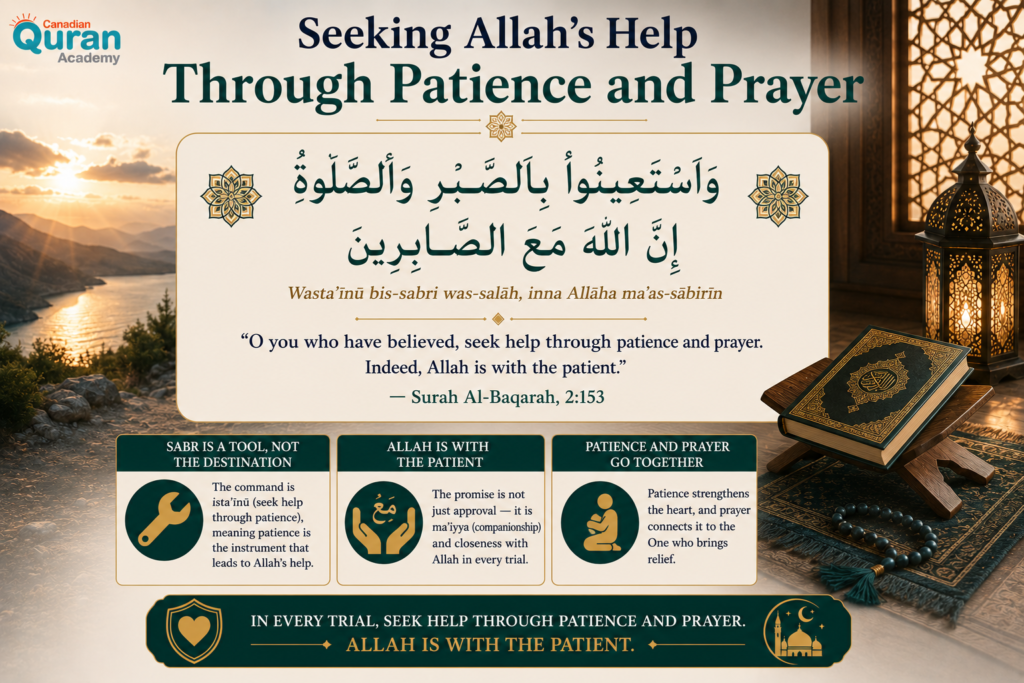
وَٱسۡتَعِينُواْ بِٱلصَّبۡرِ وَٱلصَّلَوٰةِۚ إِنَّ ٱللَّهَ مَعَ ٱلصَّـٰبِرِينَ
Wasta’īnū bis-sabri was-salāh, inna Allāha ma’as-sābirīn
“O you who have believed, seek help through patience and prayer. Indeed, Allah is with the patient.” — Surah Al-Baqarah, 2:153
This verse is among the most frequently cited Quranic verses on patience in Arabic for a specific reason: it does not merely praise sabr as a virtue — it presents it as a practical tool. The command is ista’īnū (seek help through patience), meaning sabr is not the destination; it is the instrument by which you reach Allah’s assistance.
The closing phrase — “Allah is with the patient” — uses ma’iyya (companionship), the same word describing Allah’s closeness to the Prophet ﷺ in the cave of Thawr. For a believer in hardship, no reassurance in the Quran is more complete.
2. Trials Are Certain, but So Is the Reward for the Patient
The Quran does not promise a life free from hardship. Instead, it prepares believers for life’s inevitable tests while offering glad tidings to those who face them with patience and trust in Allah.
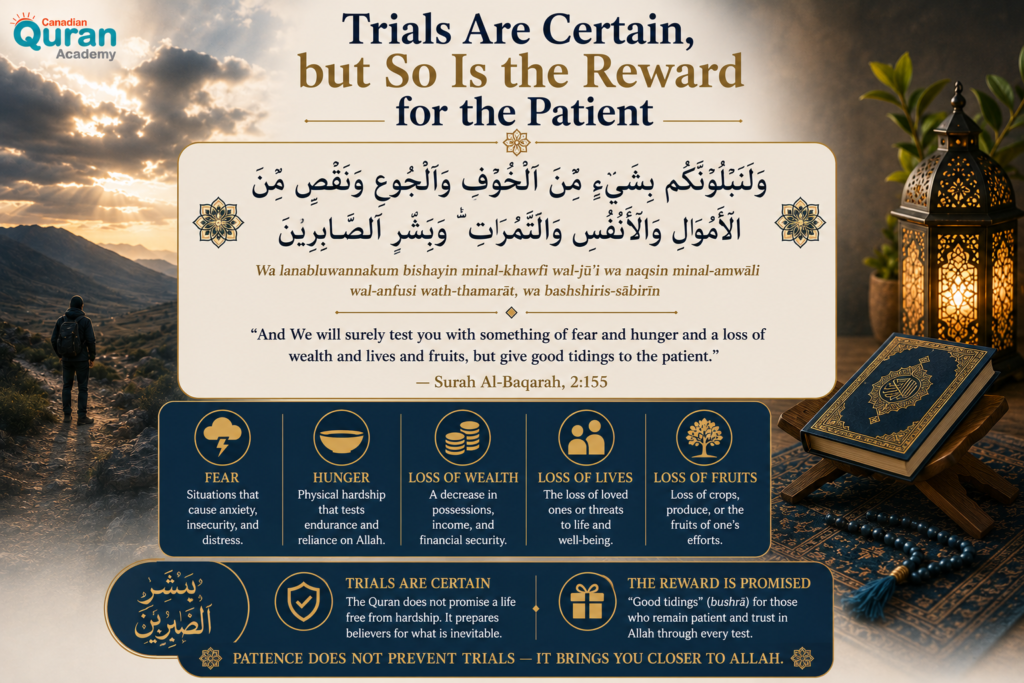
وَلَنَبۡلُوَنَّكُم بِشَيۡءٖ مِّنَ ٱلۡخَوۡفِ وَٱلۡجُوعِ وَنَقۡصٖ مِّنَ ٱلۡأَمۡوَٰلِ وَٱلۡأَنفُسِ وَٱلثَّمَرَٰتِۗ وَبَشِّرِ ٱلصَّـٰبِرِينَ
Wa lanabluwannakum bishayin minal-khawfi wal-jū’i wa naqsin minal-amwāli wal-anfusi wath-thamarāt, wa bashshiris-sābirīn
“And We will surely test you with something of fear and hunger and a loss of wealth and lives and fruits, but give good tidings to the patient.” — Surah Al-Baqarah, 2:155
This verse opens with one of the most honest statements in the Quran: We will surely test you. The Arabic lanabluwannakum uses a lam of emphasis and a nūn of tawkīd — both intensifiers — making the certainty of trial grammatically undeniable. The Quran does not present a life of ease as the believer’s portion.
The five categories listed — fear, hunger, loss of wealth, loss of lives, and loss of fruits — collectively cover every form of material and personal hardship a human being can face. The verse does not promise removal of those trials. It promises good tidings (bushrā) for those who meet them with patience.
Master Quran Qira’at with a FREE Trial Class

3. The Believer’s Response to Every Trial
The Quran teaches that patience is expressed not only through actions but also through words rooted in faith.
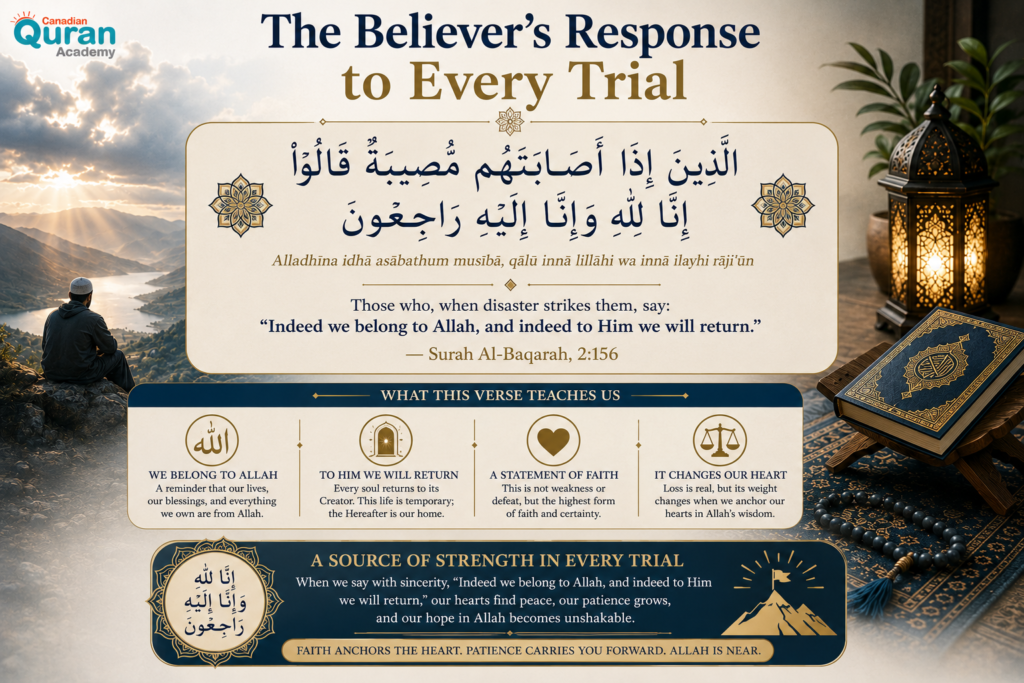
ٱلَّذِينَ إِذَآ أَصَـٰبَتۡهُم مُّصِيبَةٞ قَالُوٓاْ إِنَّا لِلَّهِ وَإِنَّآ إِلَيۡهِ رَٰجِعُونَ
Alladhīna idhā asābathum musība, qālū innā lillāhi wa innā ilayhi rāji’ūn
“Those who, when disaster strikes them, say: Indeed we belong to Allah, and indeed to Him we will return.” — Surah Al-Baqarah, 2:156
This verse — immediately following 2:155 — defines what the patient person does in the moment of trial. The phrase innā lillāhi wa innā ilayhi rāji’ūn is not a passive resignation; it is a theological statement of the highest order. It affirms that both the believer and everything they have lost belong to Allah, and that every soul returns to Him.
Scholars note that this statement recalibrates the believer’s relationship to loss: when you genuinely believe you are Allah’s, and that what has been taken was His to begin with, the weight of loss changes in kind. This is not emotional suppression — it is a grounding in reality that makes patience sustainable rather than forced.
Read More: Quran Verses About Soulmates in Arabic
4. The Quran’s Three Commands for Steadfastness
Rather than giving a single command to be patient, the Quran presents a complete framework for perseverance.
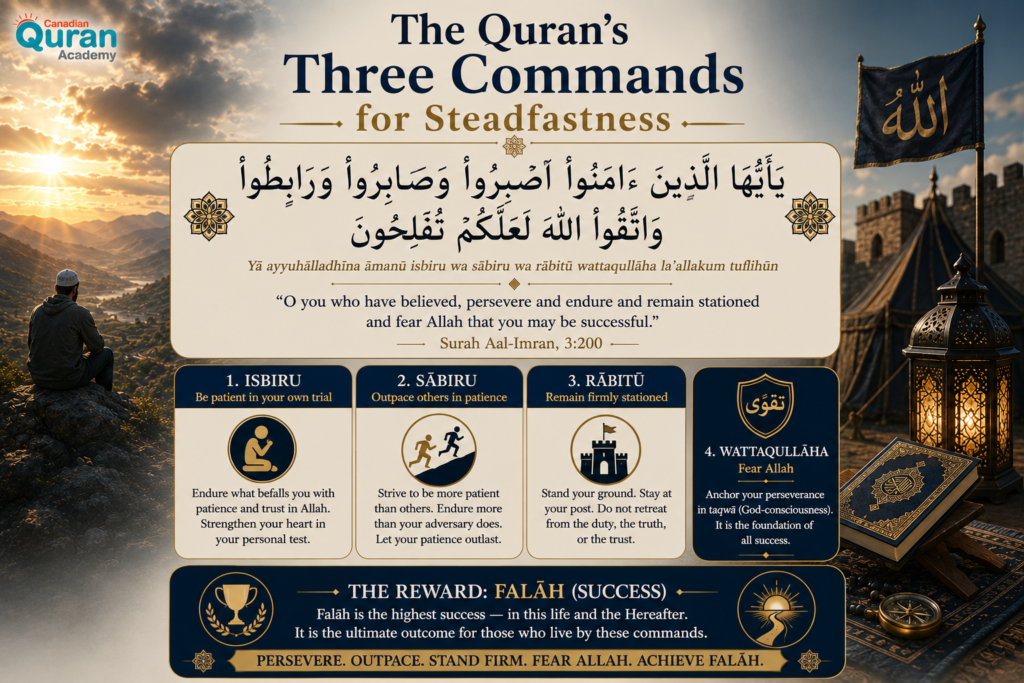
يَـٰٓأَيُّهَا ٱلَّذِينَ ءَامَنُواْ ٱصۡبِرُواْ وَصَابِرُواْ وَرَابِطُواْ وَٱتَّقُواْ ٱللَّهَ لَعَلَّكُمۡ تُفۡلِحُونَ
Yā ayyuhālladhīna āmanū isbiru wa sābiru wa rābitū wattaqullāha la’allakum tuflihūn
“O you who have believed, persevere and endure and remain stationed and fear Allah that you may be successful.” — Surah Aal-Imran, 3:200
This verse contains three distinct Arabic commands that most translations flatten into one. Isbiru means to be patient in your own trial. Sābiru (from musābara) means to actively outpace others in patience — to endure more than your adversary does. Rābitū means to remain firmly stationed at your post, not to retreat.
Together, these three commands form a framework for sabr that moves from the personal to the communal to the strategic. The final reward named — falāh (success, flourishing) — is the Quran’s highest term for worldly and eternal wellbeing. This is not the verse of quiet endurance; it is the verse of active, sustained, competitive patience.
Experience Our Classrooms
Don’t just take our word for it—take a look inside! Watch the videos below to experience our engaging teaching methods and vibrant online classrooms firsthand.
Start Your Quranic Journey in Canada
Join our vibrant community and learn with expert tutors through our flexible online platform.
Claim Your Free Trial5. Patience and Prayer as the Tools of the Humble
The Quran teaches that patience and prayer are powerful sources of strength, but benefiting from them requires a humble heart.
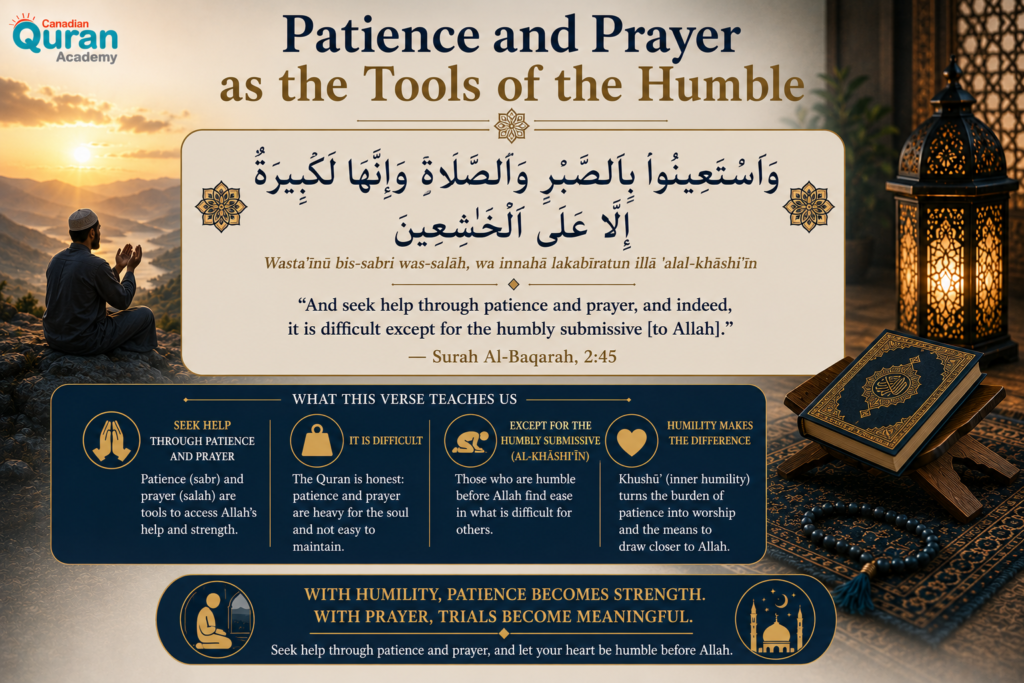
وَٱسۡتَعِينُواْ بِٱلصَّبۡرِ وَٱلصَّلَوٰةِۚ وَإِنَّهَا لَكَبِيرَةٌ إِلَّا عَلَى ٱلۡخَٰشِعِينَ
Wasta’īnū bis-sabri was-salāh, wa innahā lakabīratun illā ‘alal-khāshi’īn
“And seek help through patience and prayer, and indeed, it is difficult except for the humbly submissive [to Allah].” — Surah Al-Baqarah, 2:45
This verse and 2:153 share the same opening instruction — seek help through patience and prayer — but 2:45 adds a critical qualification: this is genuinely kabīr (heavy, difficult) for those who are not khāshi’īn (humbly submissive). The Quran is not describing patience as effortless. It acknowledges the weight of it — and identifies the internal condition that makes it bearable.
Khushū’ (submissiveness, inner humility before Allah) is what converts the burden of patience from something merely endured into something spiritually productive. When a person genuinely internalizes that they are in front of Allah in every moment, patience stops being performance and becomes worship.
Read More: Quranic Verses on Helping the Needy in Arabic and English
6. Patience Is Only Possible Through Allah’s Help
The Quran reminds believers that true patience is not achieved through determination alone.
وَٱصۡبِرۡ وَمَا صَبۡرُكَ إِلَّا بِٱللَّهِۚ وَلَا تَحۡزَنۡ عَلَيۡهِمۡ وَلَا تَكُ فِي ضَيۡقٖ مِّمَّا يَمۡكُرُونَ
Wasbir wa mā sabruka illā billāh, wa lā tahzan ‘alayhim wa lā taku fī dayqin mimmā yamkurūn
“And be patient, [O Muhammad], and your patience is not but through Allah. And do not grieve over them and do not be in distress over what they conspire.” — Surah An-Nahl, 16:127
This verse contains one of the most overlooked truths in all the Quranic verses on sabr: the ability to be patient is itself a gift from Allah. The phrase mā sabruka illā billāh (your patience is not except through Allah) eliminates the believer’s reliance on their own willpower as the primary mechanism of endurance.
This reframing is practically significant. When patience becomes hard — and the Quran already confirmed in 2:45 that it is hard — the believer does not force themselves harder by willpower. They ask Allah for the gift of sabr itself. This is why the du’ā’ “Our Lord, pour upon us patience” (2:250 and 7:126) appears in the Quran directly on the lips of those entering the most severe trials.

Fast-Track Your Quran Learning with a FREE Intensive Trial Class
7. The Patient Receive Their Reward Without Account
Patience occupies a unique place in the Quran’s promise of reward. Rather than assigning a fixed measure.
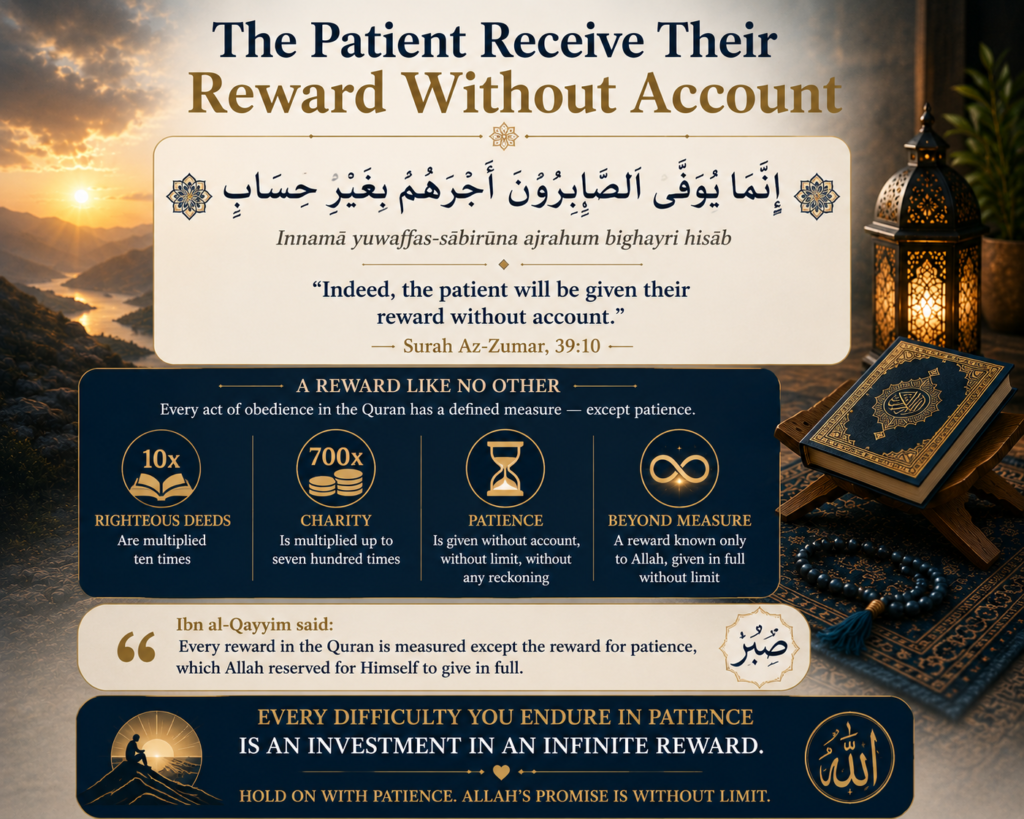
إِنَّمَا يُوَفَّى ٱلصَّـٰبِرُونَ أَجۡرَهُم بِغَيۡرِ حِسَابٖ
Innamā yuwaffas-sābirūna ajrahum bighayri hisāb
“Indeed, the patient will be given their reward without account.” — Surah Az-Zumar, 39:10
Every category of deed in the Quran has a defined multiplier — righteous deeds are multiplied ten times, charity up to seven hundred times, and so on. This verse stands apart: the reward for patience is described as bighayri hisāb — without any reckoning, without any upper limit, without a defined measure.
Ibn al-Qayyim commented on this verse by saying that every reward in the Quran is measured except the reward for sabr, which Allah reserved for Himself to give in full. This is the verse that, when its meaning is truly understood, transforms how a believer perceives every difficulty they endure.
Read More: Quranic Verses on Education in Arabic
8. Following the Prophets’ Example of Patience
The Quran presents the prophets as the greatest examples of steadfastness in the face of hardship.
وَكَأَيِّن مِّن نَّبِيّٖ قَٰتَلَ مَعَهُۥ رِبِّيُّونَ كَثِيرٞ فَمَا وَهَنُواْ لِمَآ أَصَابَهُمۡ فِي سَبِيلِ ٱللَّهِ وَمَا ضَعُفُواْ وَمَا ٱسۡتَكَانُواْۗ وَٱللَّهُ يُحِبُّ ٱلصَّـٰبِرِينَ
Wa ka’ayyim min nabiyyin qātala ma’ahu ribbiyyūna kathīr, famā wahanū limā asābahum fī sabīlillāh, wa mā da’ufū wa mas-takānū, wallāhu yuhibbus-sābirīn
“And how many a prophet [fought and] with him fought many religious scholars. But they never lost assurance due to what afflicted them in the cause of Allah, nor did they weaken or submit. And Allah loves the steadfast.” — Surah Aal-Imran, 3:146
The Quran gives three specific descriptions of what the prophets and those with them did not do: they did not wahan (lose heart, become hollow internally), they did not da’uf (weaken in action), and they did not istakāna (submit and collapse). These are three escalating stages of failure — and the verse confirms the prophets cleared all three.
Start Learning the Quran with a FREE Beginner Trial Class
9. Those Who Endure Patiently Will Have Great Reward
The Quran consistently links patience with action rather than passivity enduring hardships while continuing to do righteous deeds is a path to both Allah’s forgiveness and a tremendous reward.
إِلَّا ٱلَّذِينَ صَبَرُواْ وَعَمِلُواْ ٱلصَّـٰلِحَٰتِ أُوْلَـٰٓئِكَ لَهُم مَّغۡفِرَةٞ وَأَجۡرٞ كَبِيرٞ
Illalladhīna sabarū wa ‘amilus-sālihāt, ulā’ika lahum maghfiratun wa ajrun kabīr
“Except for those who are patient and do righteous deeds; those will have forgiveness and great reward.” — Surah Hud, 11:11
This verse establishes an important pairing that runs consistently through the Quranic verses on sabr: patience and righteous action (‘amal sālih) are mentioned together, not in isolation. Sabr is not a passive state of waiting; it is paired with ongoing productive action.
The dual reward — maghfira (forgiveness) and ajr kabīr (great reward) — addresses two dimensions of the believer’s need. Forgiveness covers what the person may have fallen short in during the period of hardship. Great reward covers the positive spiritual credit earned through enduring it.
10. The Quran’s Highest Standard of Patience
The Quran concludes its guidance on patience by directing believers to the greatest role models in history.
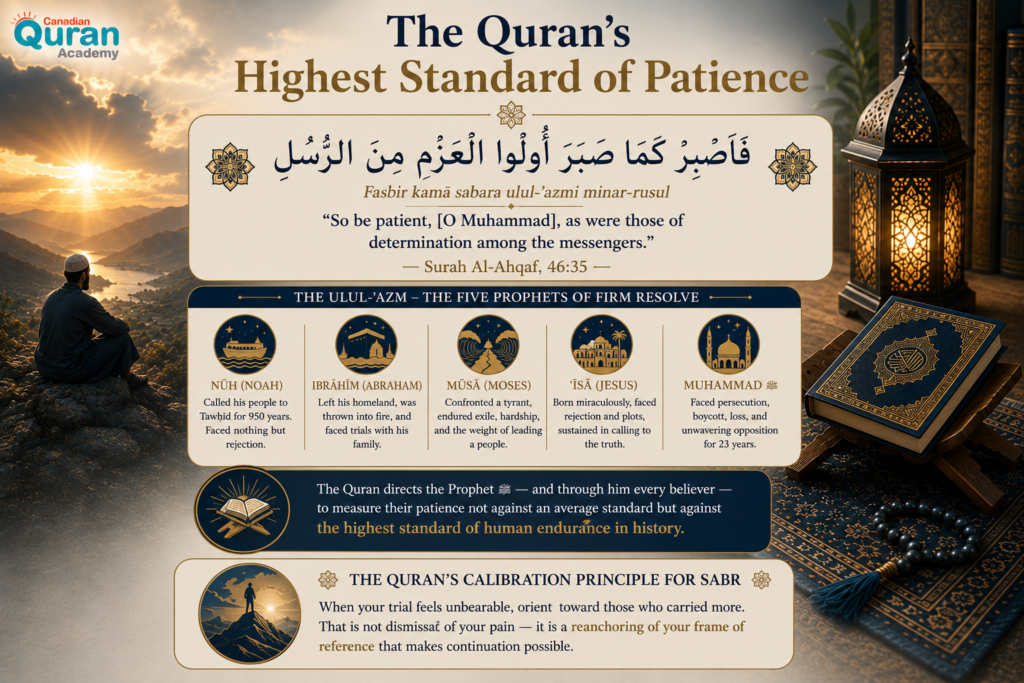
فَٱصۡبِرۡ كَمَا صَبَرَ أُوْلُواْ ٱلۡعَزۡمِ مِنَ ٱلرُّسُلِ
Fasbir kamā sabara ulul-‘azmi minar-rusul
“So be patient, [O Muhammad], as were those of determination among the messengers.” — Surah Al-Ahqaf, 46:35
This verse invokes the ulul-‘azm — the five prophets of firm resolve: Nūh, Ibrāhīm, Mūsā, ‘Īsā, and Muhammad ﷺ. Each endured trials of an order that dwarf anything an ordinary person faces: decades of rejection, exile, persecution, and loss. The Quran directs the Prophet ﷺ — and through him every believer — to measure their patience not against an average standard but against the highest standard of human endurance in history.
This is the Quran’s calibration principle for sabr: when your trial feels unbearable, orient toward those who carried more. That is not dismissal of your pain — it is a reanchoring of your frame of reference that makes continuation possible.
Live Class in Action
Watch how our instructors interact with students in real-time, focusing on interactive methods.
Start Your Quranic Journey in Canada
Join our vibrant community and learn with expert tutors through our flexible online platform.
Claim Your Free TrialUnderstand the Quran’s Verses on Patience with Canadian Quran Academy
Throughout this article, you’ve seen how the Quran speaks about patience through carefully chosen words, recurring roots, and powerful expressions. A single phrase such as “mā sabruka illā billāh” or “bighayri hisāb” carries layers of meaning that become clearer when you understand the Arabic behind the translation.
At Canadian Quran Academy, our goal is not simply to teach you how to read the Quran—it is to help you recognize how its language shapes its message.
- Follow Quranic vocabulary as it appears across different surahs.
- Understand how Arabic grammar strengthens the meaning of each verse.
- Recognize recurring Quranic roots and their different forms.
- Read the Quran with confidence through live one-on-one guidance.
- Progress step by step with qualified Al-Azhar graduates and Ijazah-certified teachers.
Book your FREE Trial Lesson with Canadian Quran Academy

Our Quran Courses
- Quran Online Academy
- Quran Recitation Classes
- Quran Reading Classes
- Online Quran Classes for Kids
- Quran Classes for Adults
- Quran Classes for Female
Start Your Quranic Journey in Canada
Join our vibrant community and learn with expert tutors through our flexible online platform.
Claim Your Free TrialConclusion
The Quranic verses on patience in Arabic form one of the most coherent and practically demanding sections of the Quran’s moral framework. Taken together, they convey a complete picture: trials are certain (2:155), the response is defined (2:156), the tools are given (2:153), the capacity for patience comes from Allah Himself (16:127), and the reward — unlike any other deed — is limitless (39:10).
Sabr in the Quran is not quietism. It is not simply enduring in silence until circumstances change. It is an active, sustained, Allah-conscious orientation that perseveres in obedience, resists collapse at every level (3:200), and draws its strength from the knowledge that every moment of it is seen, loved (3:146), and rewarded without measure.
The primary keyword to carry from this article: Quranic verses on patience in Arabic are not verses for difficult times only. They are the verses that shape the character of the believing person in every condition.
Frequently Asked Questions
The Quran’s teachings on patience cover its meaning, purpose, rewards, and practical application in a believer’s daily life. The following answers address some of the most common questions about sabr and the Quranic verses that highlight its importance.
What is the Arabic word for patience in the Quran?
The primary Arabic word for patience in the Quran is sabr (الصَّبْر), from the root ص-ب-ر. It appears in the Quran over 90 times and carries three dimensions: restraining oneself from panic, compelling oneself to continue in obedience to Allah, and holding back from resentment or complaint.
Which surah has the most verses about patience?
Surah Al-Baqarah contains the highest concentration of Quranic verses on patience in Arabic, including the foundational instructions in 2:45, 2:153, 2:155–157, and 2:177. Surah Aal-Imran and Surah Az-Zumar also contain major verses on sabr across different contexts.
What does the Quran say about the reward for patience?
The clearest statement on the reward for patience is Surah Az-Zumar, 39:10: “Indeed, the patient will be given their reward without account.” Unlike other categories of righteous deeds — which carry defined multipliers — the reward for sabr is described in the Quran as having no upper limit.
How do I use Quranic verses on sabr in daily life?
The most direct application is combining the statement innā lillāhi wa innā ilayhi rāji’ūn (2:156) at the moment of any loss or difficulty, and pairing sabr with prayer as instructed in 2:153. Making the du’ā’ from 2:250 — “Our Lord, pour upon us patience” — a regular personal supplication is also a direct Quranic method for building this capacity.
Can I learn to read these verses in Arabic online?
Yes.Canadian Quran Academy’s Quranic Arabic courses are specifically designed for English-speaking students who want to engage with the Quran in its original language. Live one-on-one sessions with qualified instructors begin from the foundation and progress at the student’s own pace. Afree trial lesson is available with no commitment.






Leave a Reply