 Quran
Quran
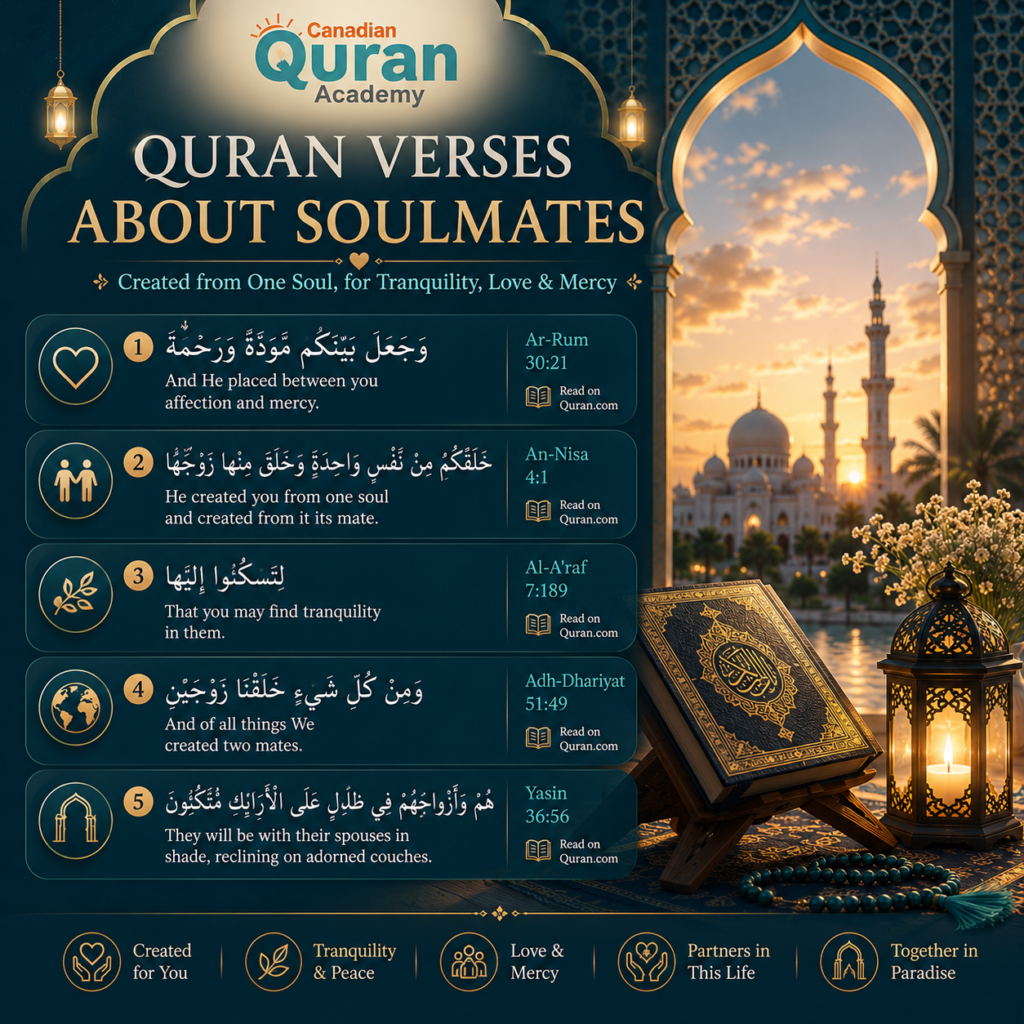
The Quran does not use a single word that maps neatly onto the English “soulmate.” What it describes is more specific: mates created from your own selves, drawn from one shared soul, so that you find rest in one another. If you are searching for Quran verses about soulmates in Arabic, these are the ayahs that carry that meaning — the ones about being created as a pair, finding tranquility in a partner, and being joined again in the next life.
This guide gathers those verses in their original Arabic with full tashkeel, alongside the English translation, surah name, and exact ayah number for accurate citation. Every verse links directly to its page on Quran.com so you can read it in full context.
We are covering Quran verses only here — no hadith — so every reference below comes straight from the Quran itself.
How the Quran Describes a Soulmate: Created From One Soul
Before listing verses, it helps to know what you are actually looking for. The Quran builds the idea of a soulmate on three linked words, not one. Reading them together turns a scatter of verses into a single arc.
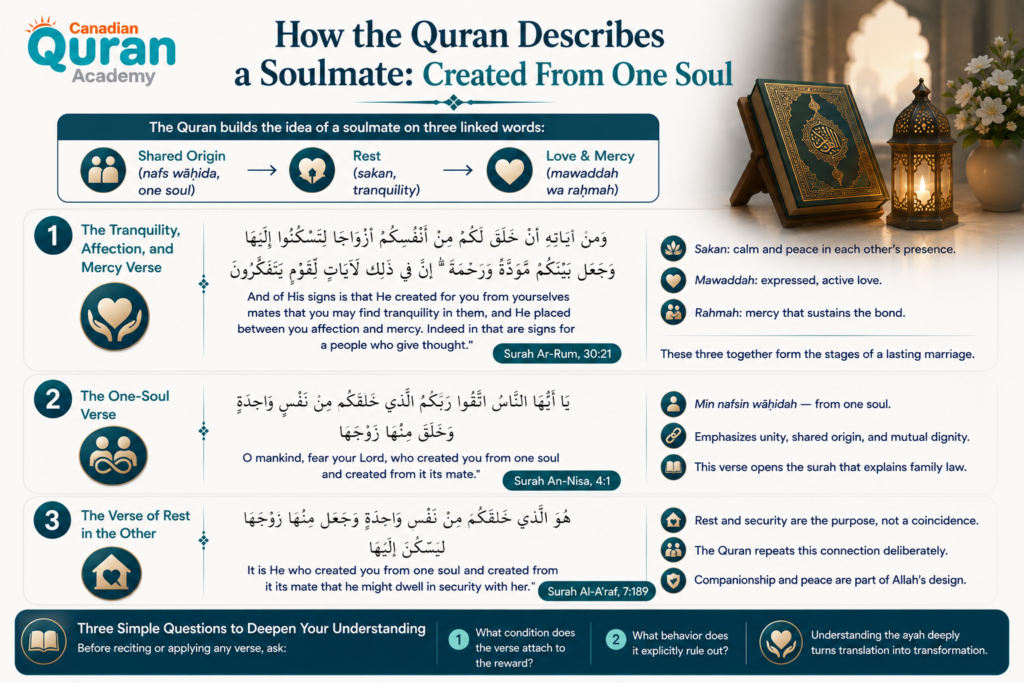
That arc runs: shared origin (nafs wāḥida, one soul) → rest (sakan, tranquility) → love and mercy (mawaddah wa raḥmah). The verses in this section each land on one part of it.
1. The Tranquility, Affection, and Mercy Verse
The Quran describes marriage as a relationship built on peace, love, and compassion rather than emotion alone. This verse presents the qualities that form a lasting bond between husband and wife, making it one of the most frequently quoted passages about marriage in the Quran.
وَمِنْ آيَاتِهِ أَنْ خَلَقَ لَكُم مِّنْ أَنفُسِكُمْ أَزْوَاجًا لِّتَسْكُنُوا إِلَيْهَا وَجَعَلَ بَيْنَكُم مَّوَدَّةً وَرَحْمَةً ۚ إِنَّ فِي ذَٰلِكَ لَآيَاتٍ لِّقَوْمٍ يَتَفَكَّرُونَ
“And of His signs is that He created for you from yourselves mates that you may find tranquility in them, and He placed between you affection and mercy. Indeed in that are signs for a people who give thought.” (Surah Ar-Rum, 30:21)
The verse names an emotional target, not just a fact. Sakan is the calm of simply being near your spouse; mawaddah is expressed, active love; rahmah is the mercy that carries a marriage once early intensity settles. Classical commentary reads these as three stages of the same bond — which is why this ayah, more than any other, is recited at Muslim weddings around the world.
2. The One-Soul Verse
The Quran traces the origin of husband and wife back to a shared beginning. By describing them as created from a single soul, it emphasizes unity, mutual dignity, and the deep connection that forms the foundation of marriage.
يَا أَيُّهَا النَّاسُ اتَّقُوا رَبَّكُمُ الَّذِي خَلَقَكُم مِّن نَّفْسٍ وَاحِدَةٍ وَخَلَقَ مِنْهَا زَوْجَهَا
“O mankind, fear your Lord, who created you from one soul and created from it its mate.” (Surah An-Nisa, 4:1)
The phrase min nafsin wāḥidah — from one soul — is the closest the Quran comes to the literal sense of “soulmate.” It frames the pair as sharing a source before any difference between them appears, which is why the verse opens the surah that later lays out family law.
3. The Verse of Rest in the Other
The Quran reinforces that one of marriage’s greatest purposes is tranquility. This verse repeats the theme of finding peace and security in one’s spouse, presenting emotional comfort and companionship as part of Allah’s design for marriage.
هُوَ الَّذِي خَلَقَكُم مِّن نَّفْسٍ وَاحِدَةٍ وَجَعَلَ مِنْهَا زَوْجَهَا لِيَسْكُنَ إِلَيْهَا
“It is He who created you from one soul and created from it its mate that he might dwell in security with her.” (Surah Al-A’raf, 7:189)
Seeing nafs wāḥidah and the root s-k-n appear together again is deliberate: the Quran presents companionship and security as the designed function of a spouse, not a lucky outcome.
Reading a verse like this in translation tells you what it says. Reading it in Arabic — and knowing why sakan was chosen over a broader word for peace — tells you why it was said that way. Walking through vocabulary and context like this, verse by verse, is exactly what one-on-one Quran courses for adults are built to do.

Read More: Quran Verses About Sadaqah in Arabic
Verses on Pairing as a Sign of Creation
A note before this section, because it changes how you read the verses: not every ayah with the word zawj is about romantic soulmates. Zawj means “pair” or “mate,” and the Quran applies it to plants, animals, and natural phenomena as much as to people.
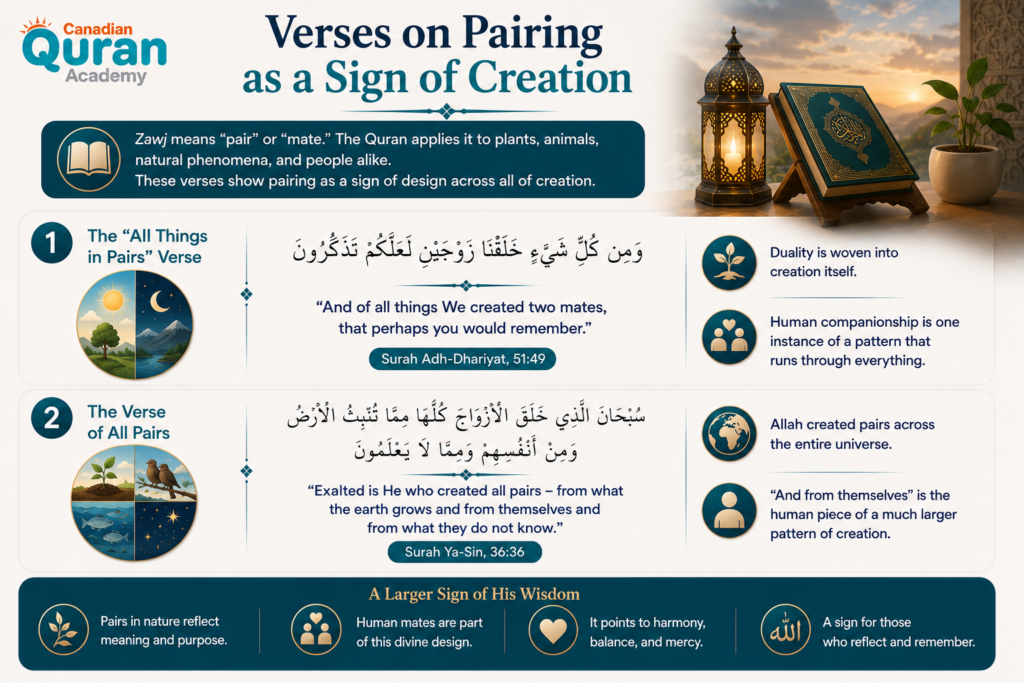
The verses below use pairing as a sign of design across all of creation. They are relevant to the soulmate theme because they place human mates inside a larger pattern — but read them as evidence of intentional pairing, not as verses about a specific partner.
1. The “All Things in Pairs” Verse
The Quran presents pairing as one of the fundamental patterns of creation. By describing everything as being created in pairs, it places human companionship within a broader sign of Allah’s wisdom and design.
وَمِن كُلِّ شَيْءٍ خَلَقْنَا زَوْجَيْنِ لَعَلَّكُمْ تَذَكَّرُونَ
“And of all things We created two mates, that perhaps you would remember.” (Surah Adh-Dhariyat, 51:49)
The verse presents duality as woven into creation itself. For the soulmate theme, its value is contextual: human partnership is one instance of a pattern that runs through everything.
2. The Verse of All Pairs
The Quran expands the concept of pairs beyond human relationships to the entire universe. It reminds believers that the pairing of spouses is one expression of a divine pattern that extends throughout creation, both seen and unseen.
سُبْحَانَ الَّذِي خَلَقَ الْأَزْوَاجَ كُلَّهَا مِمَّا تُنبِتُ الْأَرْضُ وَمِنْ أَنفُسِهِمْ وَمِمَّا لَا يَعْلَمُونَ
“Exalted is He who created all pairs — from what the earth grows and from themselves and from what they do not know.” (Surah Ya-Sin, 36:36)
The phrase wa min anfusihim — “and from themselves” — is the human piece of a much larger pattern. It echoes the “from yourselves” language of Ar-Rum 21 while placing it inside the whole of creation.
Understanding how a repeated word like zawj shifts meaning from one verse to the next is the kind of connected reading that structured Islamic studies courses for adults are designed to teach — so each verse is read against the others, not in isolation.

Experience Our Classrooms
Don’t just take our word for it—take a look inside! Watch the videos below to experience our engaging teaching methods and vibrant online classrooms firsthand.
Start Your Quranic Journey in Canada
Join our vibrant community and learn with expert tutors through our flexible online platform.
Claim Your Free TrialRead More: Quran Verses About Peace in Arabic
The Closeness Between Soulmates: The Garment Verse
The Quran describes the relationship between husband and wife through one of its most powerful metaphors. By comparing each spouse to a garment for the other, it highlights mutual closeness, protection, comfort, and support as essential qualities of a successful marriage.
هُنَّ لِبَاسٌ لَّكُمْ وَأَنتُمْ لِبَاسٌ لَّهُنَّ
“They are clothing for you and you are clothing for them.” (Surah Al-Baqarah, 2:187)
A garment covers, protects, warms, and stays closest to the body. The metaphor puts both partners in an identical role — neither is the covering and the other the covered. Its brevity and balance make it one of the most quoted images for the closeness people have in mind when they say “soulmate,” and it is short enough to memorize in a single sitting.
Verses on Soulmates Reunited in the Afterlife
Most collections of soulmate verses stop at this life. The Quran does not. Several verses describe righteous spouses entering Paradise together — which extends the bond past death for those who earn it.
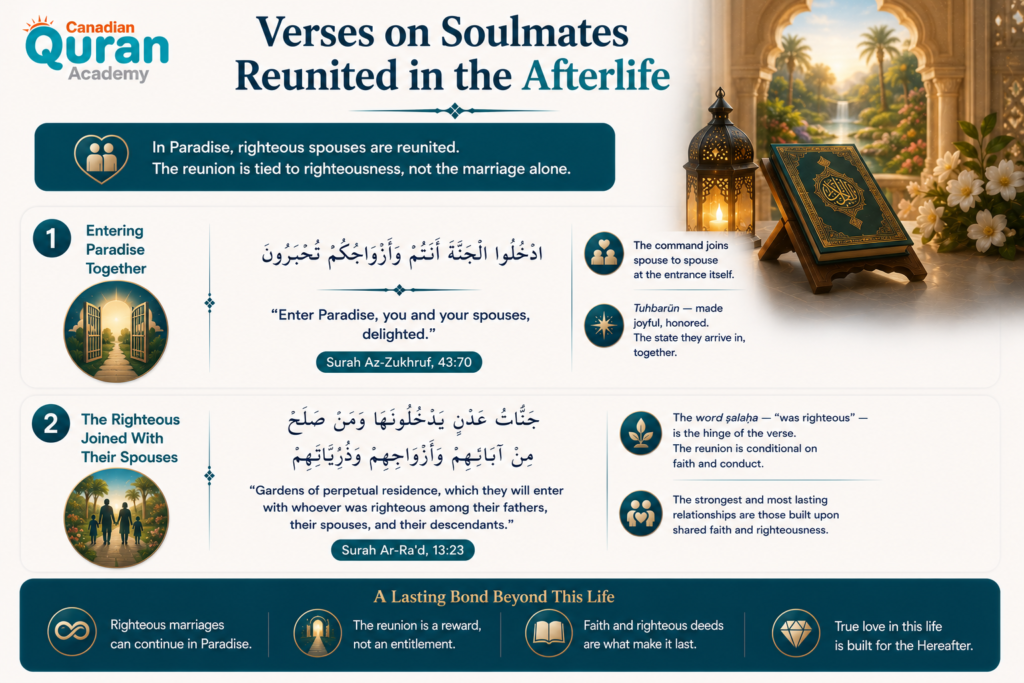
One condition runs through these verses: the reunion is tied to righteousness, not to the marriage alone. With that in mind, the ayahs are among the most moving on the subject.
1. Entering Paradise Together
The Quran portrays the ultimate reward of a righteous marriage as companionship that continues into the Hereafter. This verse shows believing spouses entering Paradise together, sharing the joy and honor prepared for them by Allah.
ادْخُلُوا الْجَنَّةَ أَنتُمْ وَأَزْوَاجُكُمْ تُحْبَرُونَ
“Enter Paradise, you and your spouses, delighted.” (Surah Az-Zukhruf, 43:70)
The command joins spouse to spouse at the entrance itself. Tuḥbarūn — made joyful, honored — describes the state they arrive in, together.
2. The Righteous Joined With Their Spouses
The Quran promises that righteous families will be reunited in Paradise. It teaches that the strongest and most lasting relationships are those built upon shared faith, righteousness, and obedience to Allah.
جَنَّاتُ عَدْنٍ يَدْخُلُونَهَا وَمَن صَلَحَ مِنْ آبَائِهِمْ وَأَزْوَاجِهِمْ وَذُرِّيَّاتِهِمْ
“Gardens of perpetual residence, which they will enter with whoever was righteous among their fathers, their spouses, and their descendants.” (Surah Ar-Ra’d, 13:23)
The word ṣalaḥa — “was righteous” — is the hinge of the verse. The reunion of soulmates here is conditional on faith and conduct, which is why the Quran frames a lasting bond as something built, not simply granted.
Read More: Quran Verses for Broken Hearts in Arabic
Praying for a Righteous Soulmate
The Quran not only describes the qualities of a righteous spouse but also teaches believers to pray for one. This beautiful supplication asks Allah to bless marriages with lasting joy, righteous families, and a life centered on faith and devotion.
وَالَّذِينَ يَقُولُونَ رَبَّنَا هَبْ لَنَا مِنْ أَزْوَاجِنَا وَذُرِّيَّاتِنَا قُرَّةَ أَعْيُنٍ وَاجْعَلْنَا لِلْمُتَّقِينَ إِمَامًا
“And those who say: ‘Our Lord, grant us from among our spouses and offspring comfort to our eyes, and make us an example for the righteous.'” (Surah Al-Furqan, 25:74)
This is a dua, not a description. The Arabic qurrat aʿyun — “coolness of the eyes” — is the Quran’s phrase for the deepest contentment, not a partner who is merely tolerated. The verse teaches believers to ask for that partner directly rather than wait passively for one to appear.
Getting a verse like this right for recitation matters, because a single shifted vowel can change a word’s meaning. That letter-by-letter correction is the core of Quran recitation courses, where pronunciation is fixed as you go rather than left to guesswork.

Live Class in Action
Watch how our instructors interact with students in real-time, focusing on interactive methods.
Start Your Quranic Journey in Canada
Join our vibrant community and learn with expert tutors through our flexible online platform.
Claim Your Free TrialDeepen Your Understanding of These Quran Verses with The Canadian Quran Academy
Understanding the translation of these verses is an excellent beginning. Studying their original Arabic with qualified guidance helps you appreciate the vocabulary, grammar, and deeper meanings that make each ayah unique.
The Canadian Quran Academy offers:
- Qualified, experienced Quran and Arabic instructors
- Personalized 1-on-1 sessions focused on Quranic Arabic, Tajweed, and verse-by-verse understanding
- Flexible scheduling across Canadian time zones — morning, evening, and weekend classes
- Programs for adults, children, women, and new Muslims at every level
- A structured learning approach that combines Quran recitation, Arabic vocabulary, and Tafsir
- Free trial lesson — no commitment required
Book your free trial lesson and begin studying these Quran verses in the original Arabic with expert guidance at The Canadian Quran Academy.
Our Quran Courses
- Quran Online Academy
- Quran Recitation Classes
- Quran Reading Classes
- Online Quran Classes for Kids
- Quran Classes for Adults
- Quran Classes for Female/Sisters
- Learn Quran for Beginners
- Quran Memorization (Hifz) Course
- Hifz Classes for Adults
- Quran Memorization and Hifz for Kids
- Quran Hifz for Ladies
- Quran Ijazah Program
- Quran Qirat Learning Course
- Quran Tafsir Course
- Noorani Qaida Course
- Noorani Qaida Course for Kids
- Weekend Quran Classes
- Intensive Quran Course
- Al-Azhar Quran Course
- Online Tajweed Classes
- Tajweed Course for Kids
- Tajweed Course for Adults
- Tajweed Course for Ladies/Sisters

Start Your Quranic Journey in Canada
Join our vibrant community and learn with expert tutors through our flexible online platform.
Claim Your Free TrialConclusion
Across Ar-Rum’s tranquility, affection, and mercy, An-Nisa’s origin from one soul, Al-A’raf’s rest in a partner, the garment verse of Al-Baqarah, and the reunion of righteous spouses in Az-Zukhruf and Ar-Ra’d, the Quran builds a consistent picture. These Quran verses about soulmates in Arabic describe a mate created from your own self, for calm, love, and mercy in this life — and, for the righteous, togetherness in the next.
The English word “soulmate” reaches for this idea. The Quran states it precisely, in words like nafs wāḥidah and sakan that a translation can only approximate. Whether you are memorizing these ayahs, citing them, or trying to understand the Quran’s view of partnership in full, reading them in the original Arabic is where the fuller meaning sits.
Frequently Asked Questions
Does the Quran talk about soulmates?
Yes, though not with that exact word. The Quran describes mates created “from yourselves” and “from one soul” so that partners find tranquility, affection, and mercy together — most directly in Surah Ar-Rum, 30:21.
What is the main Quran verse about soulmates?
The most quoted is Surah Ar-Rum, 30:21. It says God created mates from your own selves so you may find tranquility (sakan) in them, and placed between you affection (mawaddah) and mercy (rahmah).
Is there an Arabic word for “soulmate” in the Quran?
There is no single word that means “soulmate.” The closest terms are zawj (mate/pair) and nafs wāḥidah (one soul), from which the Quran says a spouse was created — as in Surah An-Nisa, 4:1.
Does the Quran say soulmates reunite in the afterlife?
Yes, for the righteous. Surah Az-Zukhruf, 43:70 and Surah Ar-Ra’d, 13:23 describe believing spouses entering Paradise together, with the reunion tied to their faith and conduct rather than the marriage alone.
Can I pray to find my soulmate?
Yes. Surah Al-Furqan, 25:74 teaches believers to ask God for spouses and children who are a “comfort to the eyes” (qurrat aʿyun), which is the Quran’s own model for praying for a righteous partner.
Not every verse with “zawj” is about a soulmate — why?
Because zawj means “pair” and the Quran uses it for plants, animals, and natural phenomena too, as in Surah Adh-Dhariyat, 51:49. Verses about a human soulmate are the ones tied to being created “from yourselves” for tranquility.





Leave a Reply