 Quran
Quran
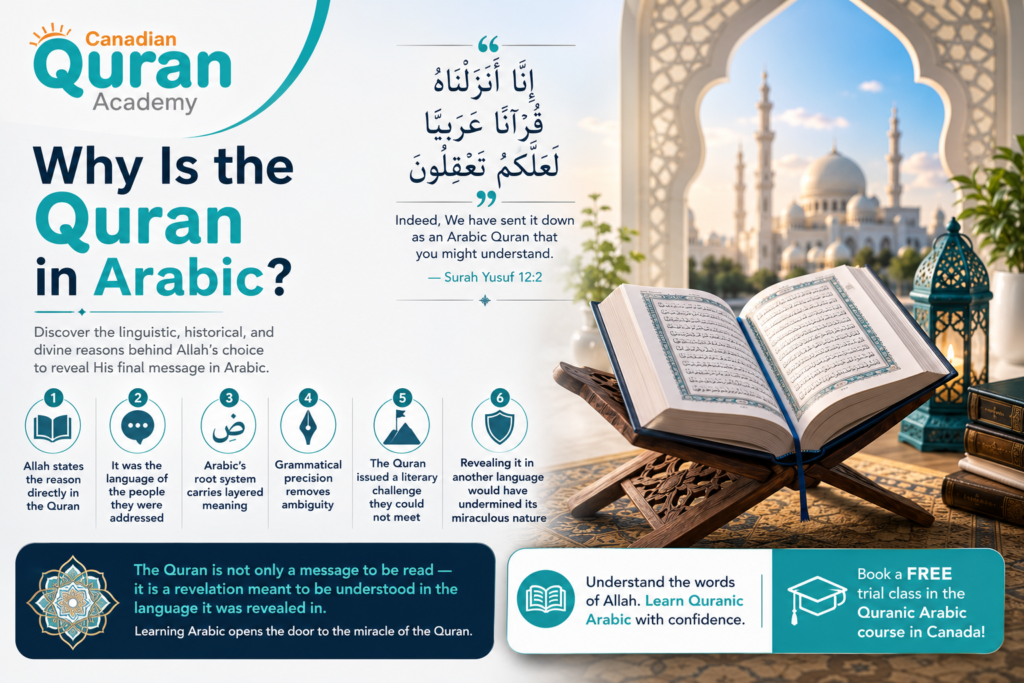
Every non-Arabic-speaking Muslim asks this question at some point. You recite words you don’t fully understand, and you wonder: why is Quran in Arabic, and only Arabic, when Allah could have revealed it in any language on earth?
The answer touches linguistics, history, preservation, and worship itself. Orientalist scholars who studied Arabic from the outside, without any religious obligation to admire it, still concluded that the language of the Quran stands apart. Understanding why is Quran in Arabic changes how you approach learning it — and why that learning matters.
This article walks through the textual, linguistic, and historical reasons behind Allah’s choice, using the Quran’s own words and authentic hadith as evidence.
Scholars point to several layers of reasoning behind this choice — some drawn directly from the Quran’s own verses, others from the language’s structure and history. The ten reasons below cover the textual, linguistic, and practical case for why is Quran in Arabic.
1. Allah States the Reason Directly in the Text
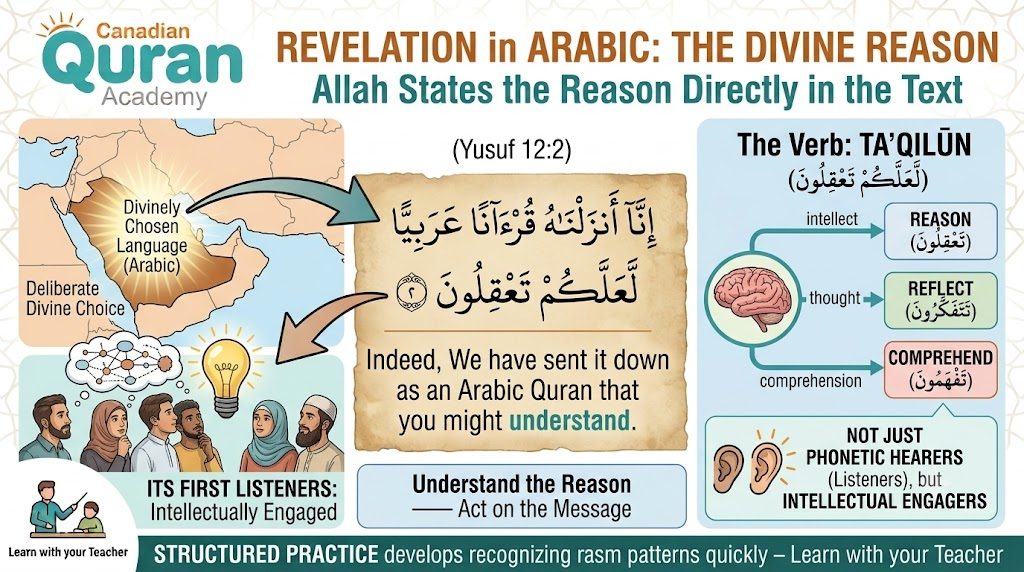
Rather than leaving Muslims to speculate about why the Quran was revealed in Arabic, Allah answers the question directly within the Quran itself. The language of revelation was a deliberate divine choice, and the reason is explicitly connected to human understanding.
إِنَّا أَنزَلْنَاهُ قُرْآنًا عَرَبِيًّا لَّعَلَّكُمْ تَعْقِلُونَ
Innā anzalnāhu qur’ānan ‘arabiyyan la’allakum ta’qilūn “Indeed, We have sent it down as an Arabic Quran that you might understand.” (Yusuf 12:2)
The verb ta’qilūn means to reason, reflect, and comprehend — not simply to hear. Arabic was selected as the language that would let its first listeners engage with the message intellectually, not just phonetically.
2. It Was the Language of the People First Addressed
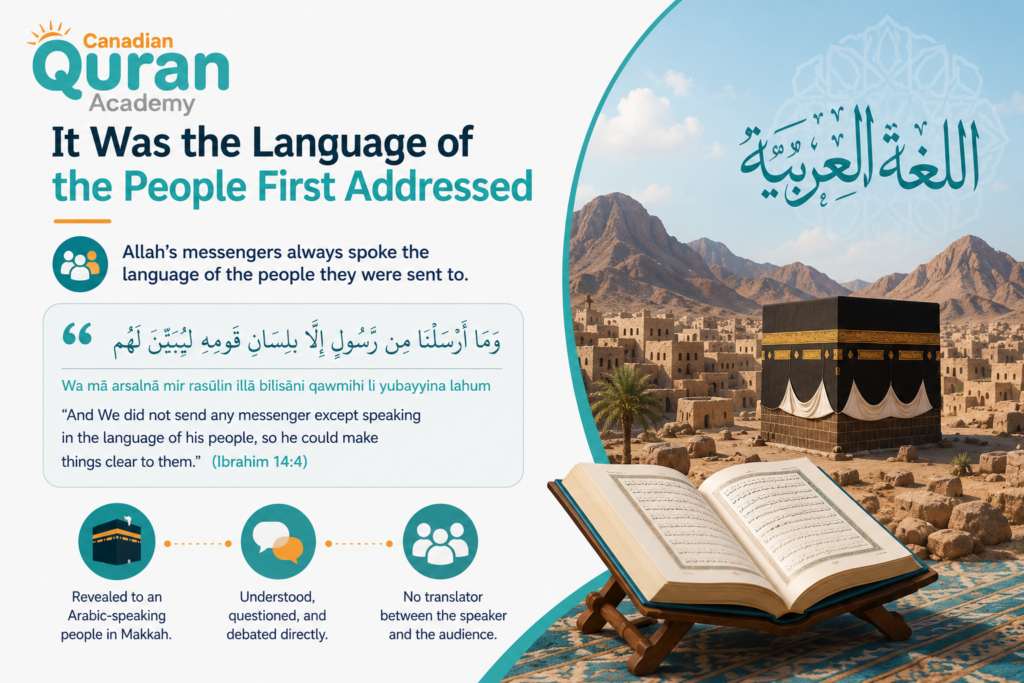
One of the clearest reasons the Quran was revealed in Arabic is that it was first sent to an Arabic-speaking people. Throughout history, Allah’s messengers spoke the language of the communities they were sent to, ensuring that the message could be understood without confusion or dependence on intermediaries. The Quran presents this as a consistent principle of divine revelation rather than something unique to Islam.
وَمَا أَرْسَلْنَا مِن رَّسُولٍ إِلَّا بِلِسَانِ قَوْمِهِ لِيُبَيِّنَ لَهُمْ
Wa mā arsalnā mir rasūlin illā bilisāni qawmihi li yubayyina lahum “And We did not send any messenger except speaking in the language of his people, so he could make things clear to them.” (Ibrahim 14:4)
The Prophet ﷺ was born into an Arabic-speaking community in Makkah. Revelation in that same language meant the message could be understood, questioned, and debated immediately — with no translator standing between the speaker and the audience.
Read also: The Importance of Arabic Language in the Quran
3. Arabic’s Root System Carries Layered Meaning
One of the defining features of Arabic is its root-based structure. Most words are built from three-letter roots that generate families of related meanings, giving Quranic vocabulary a depth that many other languages cannot fully capture. Take the root ر-ح-م (R-Ḥ-M), which produces الرَّحْمَٰن (Ar-Raḥmān), الرَّحِيم (Ar-Raḥīm), رَحْمَة (raḥmah, mercy), and رَحِم (raḥim, womb). These words are connected by the shared ideas of mercy, compassion, and care, allowing a single root to convey layers of meaning that often require several English words to explain.
This linguistic richness is one reason the Quran cannot be fully translated word for word. While translations communicate the general meaning, they cannot preserve the relationships between roots, the rhetorical nuances, or the multiple shades of meaning found in the original Arabic. For this reason, classical scholars have long described translations as interpretations of the Quran’s meaning, …while the Quran itself remains the Arabic revelation revealed by Allah. Students who study Quranic Arabic often discover these linguistic connections firsthand.
Book a FREE trial class in the Quranic Arabic course in Canada

4. The Grammatical Precision Removes Ambiguity
Classical Arabic is highly precise, with grammatical features that help preserve meaning and reduce ambiguity. Through its case-ending system (i’rab), the language identifies each word’s grammatical role, making relationships between words clear even when sentence order changes. This level of precision allows the Quran to communicate complex meanings with remarkable clarity.
Arabic also distinguishes between singular, dual, and plural forms, along with other grammatical details that many languages simplify or omit. These distinctions are especially important in verses dealing with legal rulings, inheritance, and acts of worship, where even small grammatical differences can affect interpretation. While translations convey the general meaning, they cannot always preserve this grammatical precision found in the original Arabic text.
Read also: WHY LEARN ARABIC IN CANADA?
Live Class in Action
Watch how our instructors interact with students in real-time, focusing on interactive methods.
Start Your Quranic Journey in Canada
Join our vibrant community and learn with expert tutors through our flexible online platform.
Claim Your Free Trial5. The Quran Issued a Literary Challenge Its Audience Could Not Meet
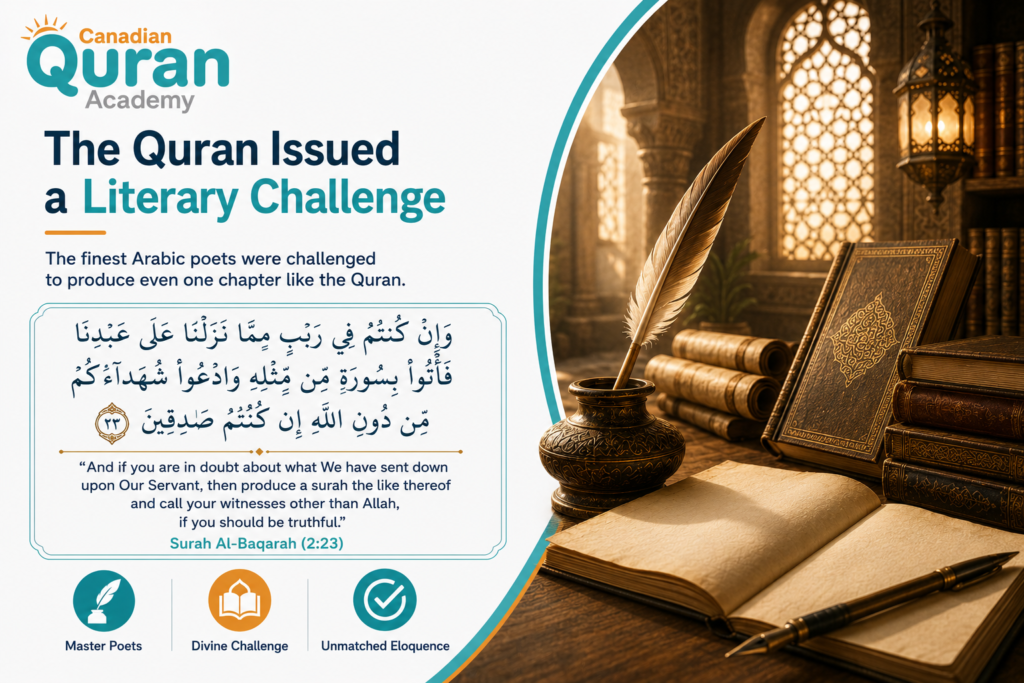
The Quran was revealed to a society that prized eloquence and poetry above almost anything else, then challenged their best poets directly.
وَإِن كُنتُمْ فِي رَيْبٍ مِّمَّا نَزَّلْنَا عَلَىٰ عَبْدِنَا فَأْتُوا۟ بِسُورَةٍ مِّن مِّثْلِهِ وَادْعُوا۟ شُهَدَاءَكُم مِّن دُونِ اللَّهِ إِن كُنتُمْ صَادِقِينَ
Wa in kuntum fī raybin mimmā nazzalnā ‘alā ‘abdinā fa’tū bisūratin min mithlihi wa ad’ū shuhadā’akum min dūnillāhi in kuntum sādiqīn “And if you are in doubt about what We have sent down upon Our Servant, then produce a surah the like thereof.” (Al-Baqarah 2:23)
No one accepted the challenge successfully — not then, and not since. That the finest Arabic wordsmiths of the time couldn’t match it is treated as direct evidence of the Quran’s divine origin.
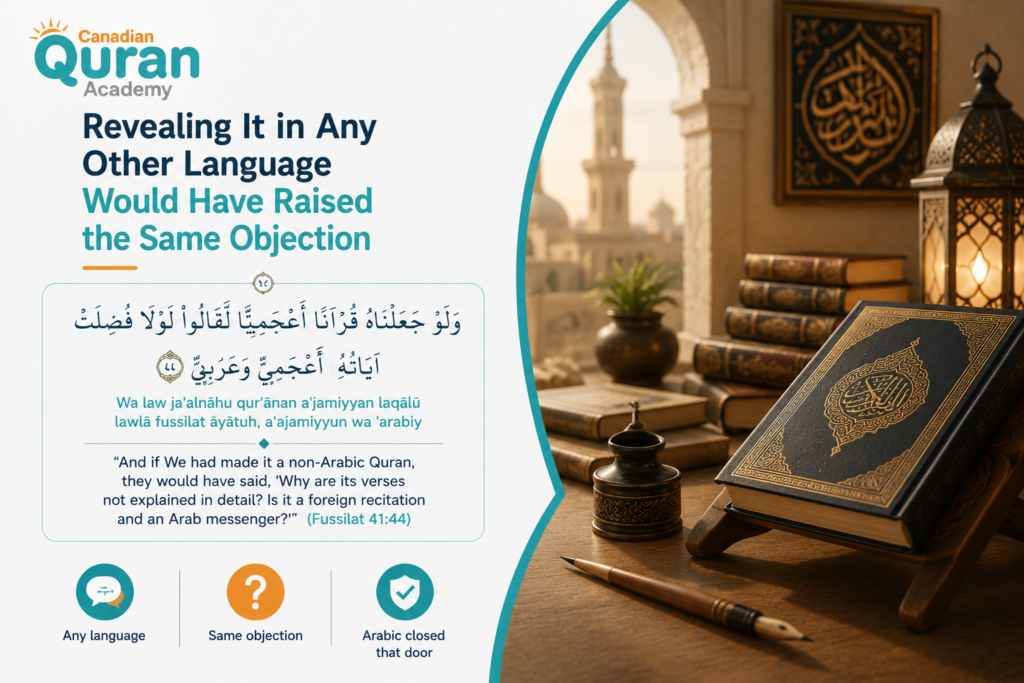
6. Revealing It in Any Other Language Would Have Raised the Same Objection
Allah addresses a hypothetical directly: what if the Quran had come in a non-Arabic language to Arabic speakers?
وَلَوْ جَعَلْنَاهُ قُرْآنًا أَعْجَمِيًّا لَّقَالُوا۟ لَوْلَا فُصِّلَتْ آيَاتُهُ ۖ أَأَعْجَمِيٌّ وَعَرَبِيٌّ
Wa law ja’alnāhu qur’ānan a’jamiyyan laqālū lawlā fussilat āyātuh, a’ajamiyyun wa ‘arabiy “And if We had made it a non-Arabic Quran, they would have said, ‘Why are its verses not explained in detail? Is it a foreign recitation and an Arab messenger?'” (Fussilat 41:44)
Whatever language the Quran had used, some objection about the mismatch between speaker and message would have followed. Arabic, as the Prophet’s ﷺ own language, closed that particular door.
7. Preservation Depends on Arabic’s Linguistic Stability
One of the reasons the Quran has remained unchanged is the remarkable stability of Classical Arabic. Unlike many languages that have undergone major shifts over the centuries, the language of the Quran has been preserved, allowing Muslims today to read and recite the same words revealed to the Prophet Muhammad ﷺ more than fourteen centuries ago.
This preservation is reinforced by the Quran’s continuous oral transmission. Each generation learns the Quran directly from qualified teachers through an unbroken chain of transmission (Sanad) tracing back to the Prophet ﷺ. The Ijazah system continues this tradition today, ensuring that both the wording and pronunciation of the Quran are preserved with accuracy.
Read also: How to Write Quran in Arabic?
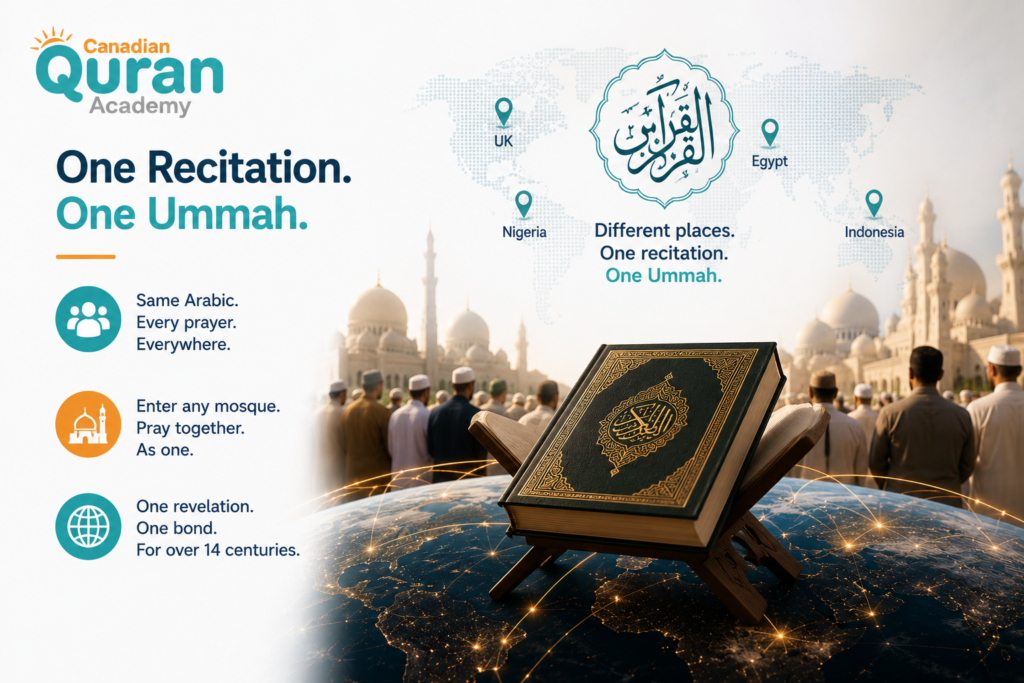
8. It Unifies Muslims Across Every Continent in One Recitation
One of the greatest wisdoms behind the Quran being preserved in Arabic is that it unites Muslims around the world in a single act of worship. Whether in Indonesia, Nigeria, the UK, Egypt, or any other country, Muslims recite the same Arabic verses in every prayer, following the same words and authentic rules of pronunciation. This shared recitation creates a unique spiritual bond that transcends culture, nationality, and native language.
This unity is practical as well as symbolic. A Muslim can enter a mosque anywhere in the world and join the congregational prayer without needing a translated text or different version of the Quran. By preserving one original Arabic revelation, Islam has maintained a universal form of worship for over fourteen centuries, allowing every generation to recite the same words revealed to the Prophet Muhammad ﷺ.
9. Reciting the Quran in Salah Requires the Arabic Text
Scholarly consensus (ijma’) holds that Surah Al-Fatiha and the recitation within Salah must be performed in Arabic — a translation does not fulfill this obligation.
The reasoning follows from what Salah actually is: direct address to Allah using His own words. Reciting a translation would mean praying with a human interpretation of divine speech rather than the speech itself, which is a different act entirely. This is one reason learning to read Arabic, even at a basic functional level, connects directly to fulfilling the obligation of prayer.
A guided course in Qira’at takes this a step further, training the different authentic recitation styles transmitted from the Prophet ﷺ himself.

10. The Reward for Recitation Is Tied to the Arabic Letters Themselves
The Prophet ﷺ specified that recitation reward is measured by the letter, not simply by comprehension.
عن عبد الله بن مسعود رضي الله عنه أن النبي ﷺ قال: “مَن قرأ حرفاً من كتاب الله فله به حسنة، والحسنة بعشر أمثالها
‘Abdullah ibn Mas’ud reported that the Prophet ﷺ said whoever recites a single letter from the Book of Allah receives one reward multiplied tenfold (Tirmidhi 2910).
The hadith goes on to clarify that this applies letter by letter — alif, lam, mim — not to whole words or concepts. That structure means a beginner sounding out Arabic letters slowly is still earning that reward with every correct letter, independent of how much of the meaning they currently grasp.
If you’re raising children with this in mind, a course built for young learners — like our Quran courses for kids — introduces letter recognition and correct pronunciation from the very first lesson, at a pace suited to their age.
Book a FREE trial class in the Online Quran Classes for Kids in Canada

Why Did Allah Reveal the Quran in Arabic Instead of Every Language?
This objection comes up often: if Islam is meant for everyone, why lock the message inside one language?
The Quran was revealed to the Prophet Muhammad ﷺ in the language his own community already spoke, the same way any teacher explains a lesson in the language their students understand. Revelation always had to happen in one living language — Arabic was the one spoken by the first audience receiving it.
Islam’s universality and the Quran’s Arabic-only revelation aren’t in conflict. Translations exist precisely to carry the message’s meaning to speakers of every other language, while the Arabic original stays fixed as the reference point those translations are checked against. Think of it as a single original map: copies can be redrawn in any language, but the original stays the authority everyone checks their copy against.
Deepening your grasp of that “original map” — rather than relying only on translation — is exactly what our Islamic studies courses for adults are built around, pairing Quranic Arabic with the broader Islamic sciences.
Experience Our Classrooms
Don’t just take our word for it—take a look inside! Watch the videos below to experience our engaging teaching methods and vibrant online classrooms firsthand.
Start Your Quranic Journey in Canada
Join our vibrant community and learn with expert tutors through our flexible online platform.
Claim Your Free TrialStart Learning Quranic Arabic with Canadian Quran Academy
Reading the Quran in its original Arabic is a journey that begins with a single step. You don’t need to be fluent in Arabic to get started—you simply need structured guidance, consistent practice, and qualified teachers who help you build a strong foundation at your own pace.
At Canadian Quran Academy, learners of all ages can progress from recognizing the Arabic alphabet to reading the Quran with confidence and proper pronunciation. Whether you’re beginning from scratch, improving your recitation through Tajweed, or exploring the science of Qira’at, the academy offers structured online courses designed to help you connect with Allah’s words as they were originally revealed.
Book your FREE trial session today

Our Arabic Courses
- Online Arabic Academy
- Online Arabic Course
- Classical Arabic Course
- Arabic Course for Beginners
- Advanced Arabic Course
- Quranic Arabic Course
- Arabic Grammar Course
- Modern Standard Arabic Course
- Arabic Conversation / Speaking Course
- Intensive Arabic Course
- Online Arabic Classes for Kids
- Arabic Classes for Adults
- Arabic Classes for Ladies
- Fusha Arabic Course
- Business Arabic Course
- Al-Azhar Arabic Course
- Madinah Arabic Course
- Learning Arabic for Non-Arabic Speakers
- Arabic Elementary School
- Arabic Intermediate School
- Arabic Lessons for Kindergarten
Start Your Quranic Journey in Canada
Join our vibrant community and learn with expert tutors through our flexible online platform.
Claim Your Free TrialConclusion
Why is Quran in Arabic comes down to a combination of divine explanation, linguistic precision, and historical necessity. Allah states directly that Arabic was chosen so people could understand and reflect on the message, and that choice matched the language already spoken by the Prophet’s ﷺ first community.
Arabic’s root system, grammatical precision, and phonetic depth then made that message nearly impossible to translate without losing something — while the language’s relative stability over fourteen centuries helped keep the text unaltered, verified through an unbroken chain of recitation.
None of this makes Islam exclusive to Arabic speakers. Translations carry the meaning to the rest of the world, while the Arabic original remains the fixed reference point behind every one of them — which is exactly why learning to read it, even gradually, connects you to the Quran in a way no translation fully replaces.
FAQs
Is the Quran Written in Arabic?
Yes. The Quran was revealed in Arabic to Prophet Muhammad ﷺ over 23 years, beginning in the 7th century CE. Every original manuscript, every memorized chain of transmission, and every copy used in prayer worldwide preserves this same Arabic text.
Is the Quran only in Arabic?
The original revealed text exists only in Arabic; translations into other languages are available but are treated by scholars as interpretations of meaning rather than the Quran itself.
Why is the Quran in Arabic and not another language?
The Quran states this was so its first audience — the Arabic-speaking community around the Prophet ﷺ — could understand and reflect on it directly, without needing translation.
Can I pray using a translation of the Quran instead of Arabic?
No, scholarly consensus holds that Quranic recitation within Salah, including Surah Al-Fatiha, must be in Arabic; a translation does not fulfill this requirement.
Why do most Muslims believe the Quran must be read in Arabic?
Because the Quran is regarded as the literal, unaltered speech of Allah, and any translation is considered a human interpretation rather than the divine wording itself.
Do I need to be fluent in Arabic to read the Quran?
No — reading the Quran correctly requires learning the alphabet, pronunciation, and basic Tajweed rules, which is a separate and more achievable skill than conversational fluency.






Leave a Reply