 Quran
Quran
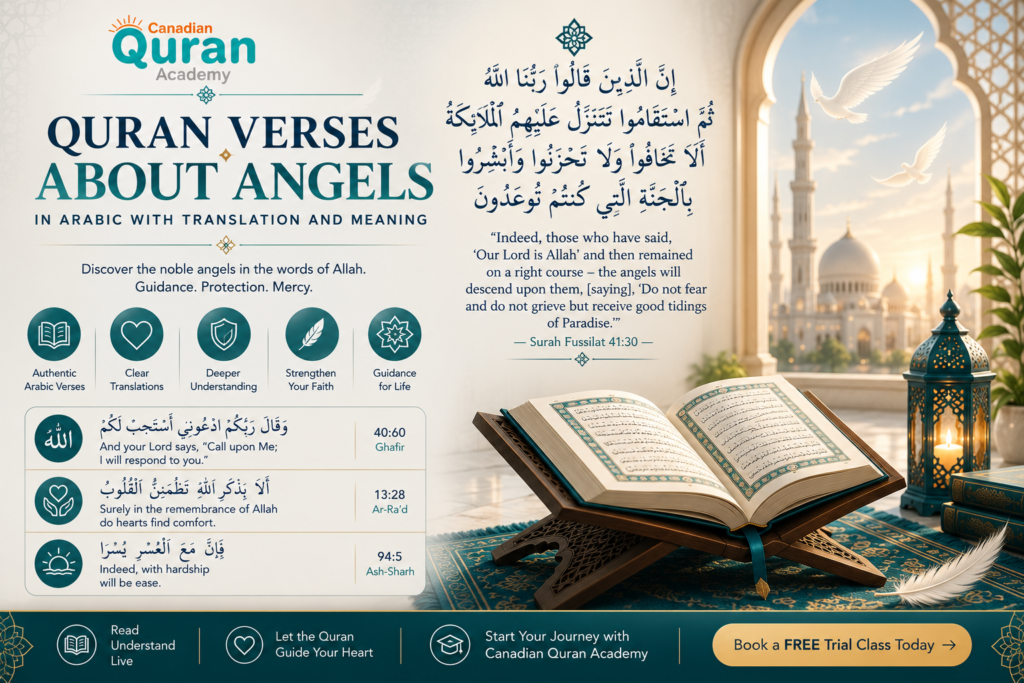
Angels appear in the Quran far more often than most readers realize — created from light, carrying out specific tasks, and mentioned by name in several surahs. If you’re searching for quran verses about angels in Arabic, this guide collects the verses that matter most: the ones on Adam’s creation, the angel of death, the angels named directly in the text, and the verses recited every day in the five daily prayers.
Each verse below is shown in Arabic, with a transliteration, an English translation, and the surah and ayah number linked directly to Quran.com so you can check the reference yourself.
What Does the Quran Say About Angels?
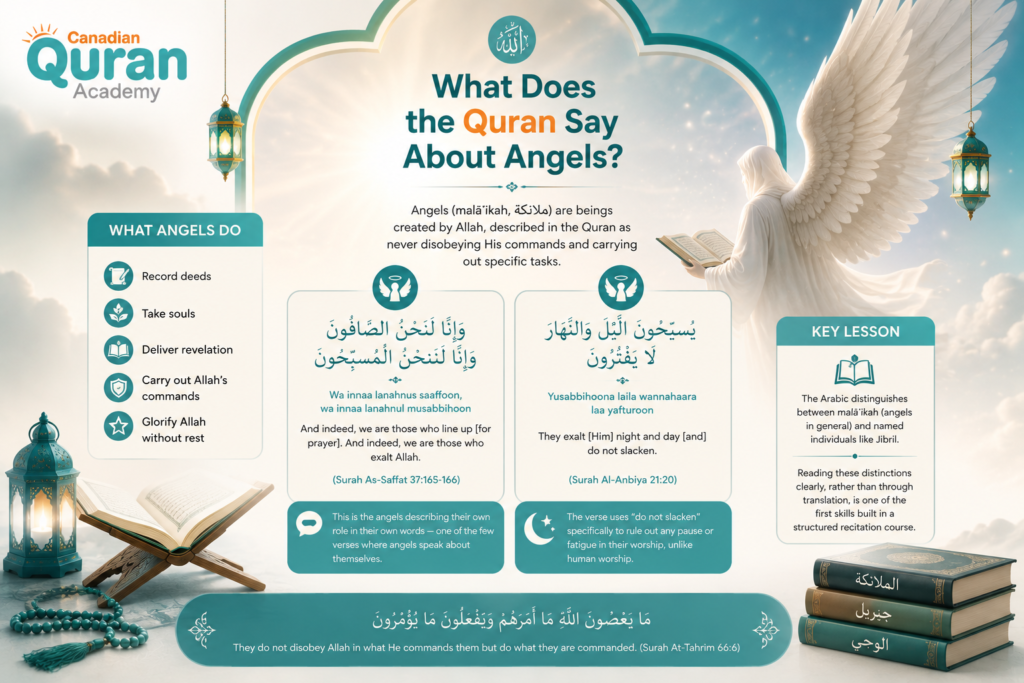
Angels (malāʾikah, ملائكة) are beings created by Allah, described in the Quran as never disobeying His commands and carrying out specific tasks — recording deeds, taking souls, delivering revelation, and glorifying Allah without rest. The Quran does not describe their physical form in detail, but it does describe their nature directly:
وَإِنَّا لَنَحْنُ الصَّآفُّونَ وَإِنَّا لَنَحْنُ الْمُسَبِّحُونَ
Wa innaa lanahnus saaffoon, wa innaa lanahnul musabbihoon “And indeed, we are those who line up [for prayer]. And indeed, we are those who exalt Allah.” (Surah As-Saffat 37:165-166)
This is the angels describing their own role in their own words — one of the few verses where angels speak about themselves rather than being spoken about.
A related verse describes them praising Allah continually, day and night:
يُسَبِّحُونَ اللَّيْلَ وَالنَّهَارَ لَا يَفْتُرُونَ
Yusabbihoona laila wannahaara laa yafturoon “They exalt [Him] night and day [and] do not slacken.” (Surah Al-Anbiya 21:20)
The verse uses “do not slacken” specifically to rule out any pause or fatigue in their worship, unlike human worship.
A common mistake among new students is treating every mention of “angel” in translation as referring to the same thing; the Arabic distinguishes between malāʾikah (angels in general) and named individuals like Jibril, which matters once you start reading the text in Arabic rather than translation alone. Reading these distinctions clearly, rather than through translation, is one of the first skills built in a structured recitation course.
Enroll in our Structured Quran Recitation Course with a FREE trial session
Verses on the Creation of Adam and the Angels’ Prostration
This is usually the first angel-related story students encounter, because it’s repeated across several surahs with slightly different details each time.
وَإِذْ قُلْنَا لِلْمَلَائِكَةِ اسْجُدُوا لِآدَمَ فَسَجَدُوا إِلَّا إِبْلِيسَ أَبَىٰ وَاسْتَكْبَرَ وَكَانَ مِنَ الْكَافِرِينَ
Wa iz qulnaa lilmalaaa’ikatis judoo li Aadama fasajadooo illaaa Ibleesa abaa wastakbara wa kaana minal kaafireen “And when We said to the angels, ‘Prostrate before Adam’; so they prostrated, except for Iblees. He refused and was arrogant and became of the disbelievers.” (Surah Al-Baqarah 2:34)
This is the shortest version of the story, and the one most students memorize first.
The same event is repeated with more detail on Allah’s reasoning in Al-Hijr:
وَإِذْ قَالَ رَبُّكَ لِلْمَلَائِكَةِ إِنِّي خَالِقٌ بَشَرًا مِّن صَلْصَالٍ مِّنْ حَمَإٍ مَّسْنُونٍ فَإِذَا سَوَّيْتُهُ وَنَفَخْتُ فِيهِ مِن رُّوحِي فَقَعُوا لَهُ سَاجِدِينَ فَسَجَدَ الْمَلَائِكَةُ كُلُّهُمْ أَجْمَعُونَ
Wa iz qaala Rabbuka lilmalaaa’ikati innee khaaliqum basharam min salsaalim min hama im masnoon… Fasajadal malaaa’ikatu kulluhum ajma’oon “And [mention] when your Lord said to the angels, ‘I will create a human being out of clay from an altered black mud’… So the angels prostrated — all of them entirely.” (Surah Al-Hijr 15:28-30)
Here the Quran explains the sequence directly: shaping, breathing the soul, then the command to prostrate — the reasoning is given, not just the order.
Sad 38:71-73 repeats this again almost word for word (Surah Sad 38:71-73); the wording is nearly identical to Al-Hijr, which is itself worth noticing when reading the two side by side. Iblis is the only exception in every version of this story — a detail the Quran repeats deliberately, since it separates angels (who obey without exception) from jinn (who can choose to disobey, as Iblis did):
وَإِذْ قُلْنَا لِلْمَلَائِكَةِ اسْجُدُوا لِآدَمَ فَسَجَدُوا إِلَّا إِبْلِيسَ كَانَ مِنَ الْجِنِّ فَفَسَقَ عَنْ أَمْرِ رَبِّهِ
Wa iz qulnaa lilmalaaa’ikatis judoo li Aadama fasajadooo illaaa Ibleesa kaana minal jinni fafasaqa ‘an amri Rabbih “And when We said to the angels, ‘Prostrate to Adam,’ and they prostrated, except for Iblees. He was of the jinn and departed from the command of his Lord.” (Surah Al-Kahf 18:50)
This is the one version that explicitly states Iblis was jinn, not an angel — a detail the other versions leave for the reader to know from elsewhere.
Verses that repeat across four different surahs like this one are a good early test of reading fluency — students in our weekend Quran classes often practice by comparing the slightly different wording of each version side by side.
Join our Weekend Quran Classes and enjoy a FREE trial class

Read also: Quran Verses In Arabic – Beautiful And Short 44 Verses
Verses on Angels as Guardians Who Protect and Comfort Believers
Several verses describe angels descending specifically to reassure and protect people of faith, not just to carry out tasks.
إِنَّ الَّذِينَ قَالُوا رَبُّنَا اللَّهُ ثُمَّ اسْتَقَامُوا تَتَنَزَّلُ عَلَيْهِمُ الْمَلَائِكَةُ أَلَّا تَخَافُوا وَلَا تَحْزَنُوا وَأَبْشِرُوا بِالْجَنَّةِ الَّتِي كُنتُمْ تُوعَدُونَ
Innal lazeena qaaloo Rabbunal laahu summas taqaamoo tatanazzalu ‘alaihimul malaaa’ikatu allaa takhaafoo wa laa tahzanoo wa abshiroo bil Jannatil latee kuntum too’adoon “Indeed, those who have said, ‘Our Lord is Allah’ and then remained on a right course — the angels will descend upon them, [saying], ‘Do not fear and do not grieve but receive good tidings of Paradise.'” (Surah Fussilat 41:30)
The condition here is specific — belief plus staying on a right course, not belief alone — before the angels’ reassurance is described.
A similar promise is repeated for those who die in a state of righteousness, entering Paradise through gates the angels open for them:
جَنَّاتُ عَدْنٍ يَدْخُلُونَهَا وَمَن صَلَحَ مِنْ آبَائِهِمْ وَأَزْوَاجِهِمْ وَذُرِّيَّاتِهِمْ ۖ وَالْمَلَائِكَةُ يَدْخُلُونَ عَلَيْهِم مِّن كُلِّ بَابٍ
Jannaatu ‘adiny yadkhu loonahaa wa man salaha min aabaaa’ihim wa azwaajihim wa zurriyyaatihim walmalaaa’ikatu yadkhuloona ‘alaihim min kulli baab “Gardens of perpetual residence; they will enter them with whoever were righteous among their fathers, their spouses and their descendants. And the angels will enter upon them from every gate.” (Surah Ar-Ra’d 13:23)
The detail of angels entering “from every gate” pictures a welcome that comes from every direction at once, not a single greeting.
This verse is often the one recited to someone going through a hard time, because it links steadfastness in faith directly to angelic reassurance — not a vague promise, but a described event.
Experience Our Classrooms
Don’t just take our word for it—take a look inside! Watch the videos below to experience our engaging teaching methods and vibrant online classrooms firsthand.
Start Your Quranic Journey in Canada
Join our vibrant community and learn with expert tutors through our flexible online platform.
Claim Your Free TrialVerses on the Angel of Death and What Happens After
The Quran doesn’t name the angel of death directly in the text (the name “Azrael” comes from later tradition, not the Quran itself), but it describes his role clearly.
قُلْ يَتَوَفَّاكُم مَّلَكُ الْمَوْتِ الَّذِي وُكِّلَ بِكُمْ ثُمَّ إِلَىٰ رَبِّكُمْ تُرْجَعُونَ
Qul yatawaffaakum malakul mawtil lazee wukkila bikum thumma ilaa rabbikum turja’oon “Say, ‘The angel of death will take you who has been entrusted with you. Then to your Lord you will be returned.'” (Surah As-Sajdah 32:11)
The word “entrusted” (wukkila) shows this task is assigned to one angel specifically, not to angels in general.
Another verse describes this moment for the righteous:
الَّذِينَ تَتَوَفَّاهُمُ الْمَلَائِكَةُ طَيِّبِينَ يَقُولُونَ سَلَامٌ عَلَيْكُمُ ادْخُلُوا الْجَنَّةَ بِمَا كُنتُمْ تَعْمَلُونَ
Allazeena tatawaf faahumul malaaa’ikatu taiyibeena yaqooloona salaamun ‘alai kumud khulul Jannata bimaa kuntum ta’maloon “The ones whom the angels take in death, [being] good and pure; [the angels] will say, ‘Peace be upon you. Enter Paradise for what you used to do.'” (Surah An-Nahl 16:32)
Here, the greeting “Peace be upon you” comes from the angels as they welcome the righteous. Just a few verses earlier (Surah An-Nahl 16:28), the same surah describes a very different reception for those who wronged themselves, emphasizing the contrast between the two outcomes.
And for those who wronged themselves, the same surah describes a harsher exchange just a few verses earlier (Surah An-Nahl 16:28); the wording there is confrontational rather than welcoming, which is the point of placing both verses close together in the same surah. Reading both verses side by side — and hearing the difference in tone read aloud — is exactly the kind of comparison a teacher works through with students in our recitation classes, where pacing and tone are corrected live rather than guessed at from a translation.
Start your Quran Recitation Classes in Canada with a FREE trial lesson

Verses That Name Specific Angels: Gabriel, Michael, and Others
Most references to angels in the Quran are general, but a small number name individual angels directly — and this distinction is worth knowing before you assume every angel mentioned is the same one.
مَن كَانَ عَدُوًّا لِّلَّهِ وَمَلَائِكَتِهِ وَرُسُلِهِ وَجِبْرِيلَ وَمِيكَالَ فَإِنَّ اللَّهَ عَدُوٌّ لِّلْكَافِرِينَ
Man kaana ‘aduwwal lillaahi wa malaaa’ikatihee wa Rusulihee wa Jibreela wa Meekaala fa innal laaha ‘aduwwul lilkaafireen “Whoever is an enemy to Allah and His angels and His messengers and Gabriel and Michael — then indeed, Allah is an enemy to the disbelievers.” (Surah Al-Baqarah 2:98)
This verse was revealed specifically responding to people who claimed to respect Allah and the other angels while treating Gabriel as an exception.
Jibril (Gabriel) is also identified as “the Trustworthy Spirit” who brought the Quran down to the Prophet’s heart:
نَزَلَ بِهِ الرُّوحُ الْأَمِينُ عَلَىٰ قَلْبِكَ لِتَكُونَ مِنَ الْمُنذِرِينَ بِلِسَانٍ عَرَبِيٍّ مُّبِينٍ
Nazala bihir Roohul Ameen ‘alaa qalbika litakoona minal munzireen bilisaanin ‘Arabiyyim mubeen “The Trustworthy Spirit has brought it down upon your heart, that you may be of the warners, in a clear Arabic language.” (Surah Ash-Shu’ara 26:193-195)
The title “Trustworthy Spirit” here refers to Gabriel without naming him directly — a phrasing tafsir scholars consistently link to this verse in Al-Baqarah.
Harut and Marut are named as two angels sent as a trial in Babylon — the verse is explicit that they warned people before teaching anything:
وَمَا يُعَلِّمَانِ مِنْ أَحَدٍ حَتَّىٰ يَقُولَا إِنَّمَا نَحْنُ فِتْنَةٌ فَلَا تَكْفُرْ
Wa maa yu’allimaani min ahadin hattaa yaqoolaaa innamaa nahnu fitnatun falaa takfur “But the two angels do not teach anyone unless they say, ‘We are a trial, so do not disbelieve [by practicing magic].'” (Surah Al-Baqarah 2:102)
The warning is given every single time, before any teaching happens — the choice to disbelieve afterward is entirely the person’s own.
Beyond these names, the Quran also refers to angels recording every human deed:
وَإِنَّ عَلَيْكُمْ لَحَافِظِينَ كِرَامًا كَاتِبِينَ
Wa inna ‘alaikum lahaafizeen, kiraaman kaatibeen “And indeed, [appointed] over you are keepers, noble and recording.” (Surah Al-Infitar 82:10-11)
These are the angels commonly known as Kiraman Katibin, though the Quran itself doesn’t use that exact title — it only describes their role.
Verses like these, with their clear names and specific details, are often easier to retain because they provide strong memory anchors This is one reason our Hifz program sequences these verses early rather than saving them for later.
Read also: HOW TO LEARN ARABIC FOR QURAN IN CANADA?
Verses on Angels Praising Allah and Sending Blessings on the Prophet
A recurring theme is that angels never tire of glorifying Allah, and they specifically ask Allah to bless the Prophet ﷺ — the same request the Quran then instructs believers to make too.
إِنَّ اللَّهَ وَمَلَائِكَتَهُ يُصَلُّونَ عَلَى النَّبِيِّ ۚ يَا أَيُّهَا الَّذِينَ آمَنُوا صَلُّوا عَلَيْهِ وَسَلِّمُوا تَسْلِيمًا
Innal laaha wa malaaa’ikatahoo yusalloona ‘alan Nabiyy; yaaa aiyuhal lazeena aamanoo salloo ‘alaihi wa sallimoo tasleemaa “Indeed, Allah confers blessing upon the Prophet, and His angels [ask Him to do so]. O you who have believed, ask [Allah to confer] blessing upon him and ask [Allah to grant him] peace.” (Surah Al-Ahzab 33:56)
This is one of very few verses where Allah, the angels, and believers are all described doing the same act toward the Prophet ﷺ in a single ayah.
A related verse describes angels asking Allah’s forgiveness for people on earth, not just for the Prophet:
وَالْمَلَائِكَةُ يُسَبِّحُونَ بِحَمْدِ رَبِّهِمْ وَيَسْتَغْفِرُونَ لِمَن فِي الْأَرْضِ
Walmalaaa’ikatu yusabbihoona bihamdi Rabbihim wa yastaghfiroona liman fil ard “And the angels exalt [Allah] with praise of their Lord and ask forgiveness for those on earth.” (Surah Ash-Shura 42:5)
This forgiveness request is described as general — for people on earth as a whole, not limited to believers only.
Read also: The 55 Names of the Holy Quran in Arabic
Why Belief in Angels Is a Pillar of Iman?
Belief in angels isn’t presented in the Quran as optional background detail — it’s listed alongside belief in Allah, the scriptures, and the messengers as a condition of faith itself.
آمَنَ الرَّسُولُ بِمَا أُنزِلَ إِلَيْهِ مِن رَّبِّهِ وَالْمُؤْمِنُونَ ۚ كُلٌّ آمَنَ بِاللَّهِ وَمَلَائِكَتِهِ وَكُتُبِهِ وَرُسُلِهِ
Aamanar-Rasoolu bimaaa unzila ilaihi mir-Rabbihee walmu’minoon; kullun aamana billaahi wa Malaaa’ikathihee wa Kutubhihee wa Rusulihee “The Messenger has believed in what was revealed to him from his Lord, and [so have] the believers. All of them have believed in Allah and His angels and His books and His messengers.” (Surah Al-Baqarah 2:285)
This verse places belief in angels second in the list, directly after belief in Allah and before the scriptures or messengers.
An-Nisa repeats the same requirement almost word for word, and adds a warning for those who reject it:
وَمَن يَكْفُرْ بِاللَّهِ وَمَلَائِكَتِهِ وَكُتُبِهِ وَرُسُلِهِ وَالْيَوْمِ الْآخِرِ فَقَدْ ضَلَّ ضَلَالًا بَعِيدًا
Wa mai yakfur billaahi wa Malaaa’ikatihee wa Kutubihee wa Rusulihee wal Yawmil Aakhiri faqad dalla dalaalam ba’eedaa “And whoever disbelieves in Allah, His angels, His books, His messengers, and the Last Day has certainly gone far astray.” (Surah An-Nisa 4:136)
Here the same five elements are restated as a warning rather than a description — rejecting any one of them is described as going far astray, not a small error.
It’s rare for the Quran to restate a list of obligations this precisely twice unless it wants the point to be unmistakable. For students working through Hifz, verses like this are usually introduced early precisely because they define a core belief in a single sentence rather than telling a longer story — they’re easier to memorize with full understanding on the first pass. Our weekend Quran classes are structured around exactly this kind of belief-verse before moving into longer narrative surahs, and students aiming to memorize the full Quran typically move into our Hifz program once the shorter, belief-based verses are solid.
Book a FREE session with one of our Ijazah-certified teachers
Live Class in Action
Watch how our instructors interact with students in real-time, focusing on interactive methods.
Start Your Quranic Journey in Canada
Join our vibrant community and learn with expert tutors through our flexible online platform.
Claim Your Free TrialMaster These Verses with The Canadian Quran Academy’s Qirat Program
Understanding these verses goes beyond reading the translation. With qualified guidance, you’ll learn their correct pronunciation, meanings, and the recitation rules that bring the Quran’s message to life.
The Canadian Quran Academy’s Qirat Program provides:
- Certified, experienced Quran teachers
- One-on-one personalized sessions
- Live correction of pronunciation and Tajweed
- A structured path to confident Quran recitation
- Free trial class — no commitment required
Book your free trial class today and start mastering the Quran with expert guidance.

Our Arabic Courses
- Online Arabic Academy
- Online Arabic Course
- Classical Arabic Course
- Arabic Course for Beginners
- Advanced Arabic Course
- Quranic Arabic Course
- Arabic Grammar Course
- Modern Standard Arabic Course
- Arabic Conversation / Speaking Course
- Intensive Arabic Course
- Online Arabic Classes for Kids
- Arabic Classes for Adults
- Arabic Classes for Ladies
- Fusha Arabic Course
- Business Arabic Course
- Al-Azhar Arabic Course
- Madinah Arabic Course
- Learning Arabic for Non-Arabic Speakers
- Arabic Elementary School
- Arabic Intermediate School
- Arabic Lessons for Kindergarten
Start Your Quranic Journey in Canada
Join our vibrant community and learn with expert tutors through our flexible online platform.
Claim Your Free TrialConclusion
Quran verses about angels in Arabic cover far more ground than the single story of Adam’s creation — from the angel of death and the angels who record every deed, to Gabriel, Michael, Harut and Marut named directly, to the belief that angels themselves ask Allah to bless the Prophet ﷺ and seek forgiveness for people on earth. Reading them in Arabic, with proper tashkeel and a teacher who can correct your recitation, is what turns a list of quotes into something you actually understand and can recite correctly.
Start with the verses on belief (2:285, 4:136) since they’re short and foundational, then move to the narrative verses on Adam’s creation and the angel of death once you’re comfortable with basic Quranic vocabulary.
Frequently Asked Questions
Are angels named directly in the Quran?
Yes — Gabriel (Jibril) and Michael (Mikal) are named in Surah Al-Baqarah 2:98, and Harut and Marut are named in Surah Al-Baqarah 2:102. Most other references use the general term malāʾikah without naming an individual angel.
What does the Quran say about the angel of death?
Surah As-Sajdah 32:11 states that “the angel of death… has been entrusted with you,” and describes the process of the soul being taken. The Quran does not use the name “Azrael” — that name comes from later Islamic tradition, not the Quranic text.
Why do angels prostrate to Adam in the Quran?
The prostration, described in Surah Al-Baqarah 2:34 and repeated in Al-Hijr, Ta-Ha, Al-Kahf, and Sad, was a command from Allah honoring Adam as His creation. All the angels obeyed except Iblis, who refused out of arrogance — a distinction the Quran uses to separate angelic obedience from jinn’s capacity to disobey.
Is belief in angels required in Islam?
Yes. Surah Al-Baqarah 2:285 and Surah An-Nisa 4:136 list belief in angels alongside belief in Allah, the scriptures, and the messengers as part of faith itself, not as optional detail.
Do angels in the Quran record human deeds?
Yes. Surah Al-Infitar 82:10-11 describes “keepers, noble and recording” appointed over every person — commonly referred to in Islamic tradition as Kiraman Katibin.
How many angels guard Hellfire according to the Quran?
Surah Al-Muddaththir 74:30 states there are nineteen angels appointed over the Fire — a specific number the Quran describes as a test for disbelievers and a means of strengthening believers’ faith.






Leave a Reply