 Quran
Quran
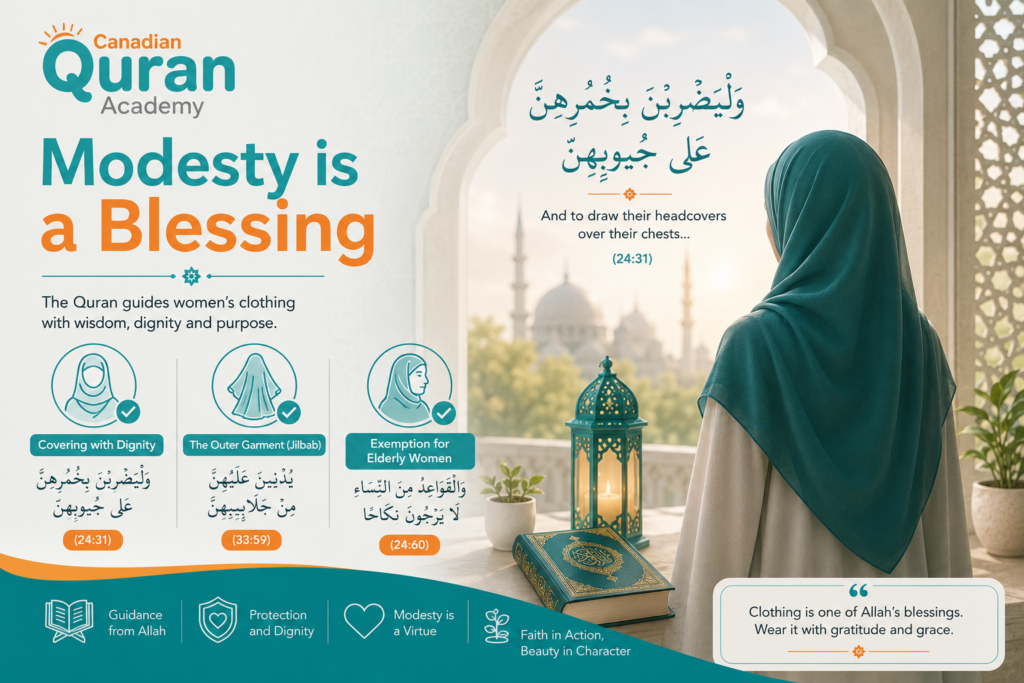
The Quran addresses women’s clothing through a collection of verses revealed in different contexts, each highlighting a specific aspect of modest dress and its purpose. Some verses introduce garments such as the khimar and jilbab, while others explain the principles of adornment, dignity, and the role of clothing as one of Allah’s blessings.
When these verses are read together, they provide a balanced understanding of women’s clothing in Islam rather than a single isolated ruling. The following Quranic verses present the primary passages related to women’s clothing in Arabic, along with their meanings and the context that helps explain each one.
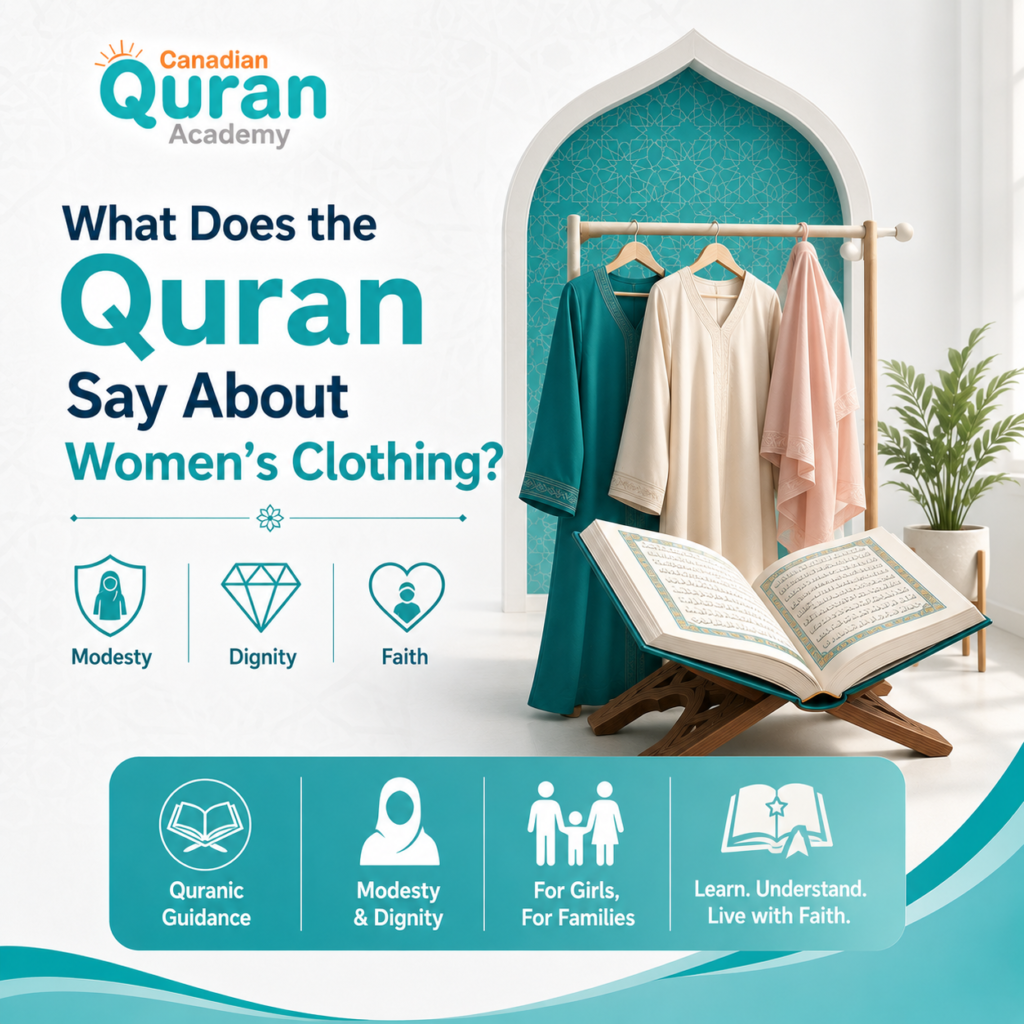
What Does the Quran Say About Women’s Clothing?
The Quran discusses women’s clothing within a broader framework of modesty, dignity, and faith. Rather than presenting clothing as a set of isolated rules, it explains how garments serve both practical and spiritual purposes: covering the body, preserving modesty, and reflecting Allah’s blessings upon His servants.
Understanding these verses requires looking at the Quran as a whole. Some passages outline specific guidelines for dress, while others emphasize the values of modesty, righteousness, and personal dignity that clothing is meant to support. Together, they provide a balanced Islamic perspective on women’s clothing rather than focusing on a single verse in isolation.
Parents introducing these verses to daughters at home often find it easier with some structure behind them — something the Islamic studies courses for kids at Canadian Quran Academy are built around, pairing memorization with age-appropriate explanation.
Verse on Hijab and Covering the Head and Chest
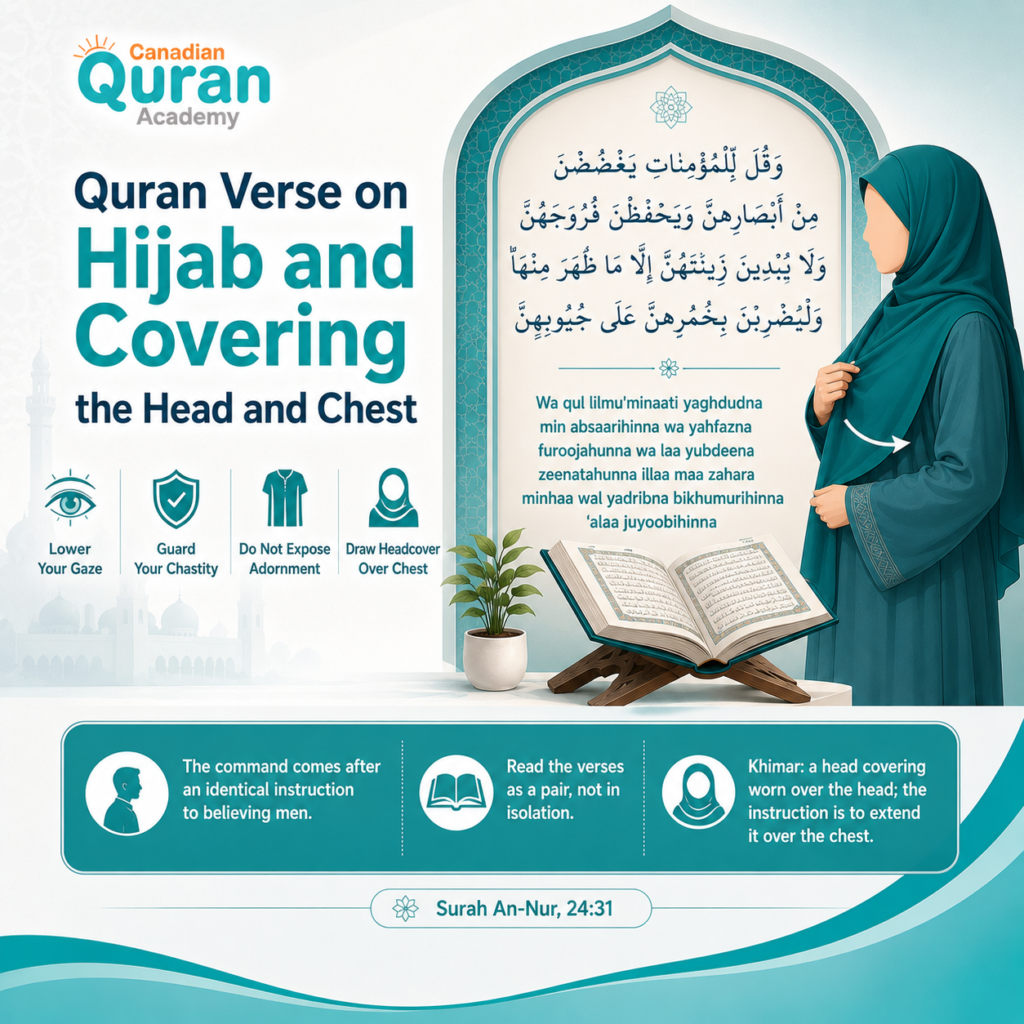
One of the most frequently cited Quranic verses about women’s clothing is found in Surah An-Nur. This verse establishes key principles of modesty by instructing believing women to lower their gaze, guard their chastity, and wear their head coverings in a way that also covers the chest. It highlights that modest dress is part of a broader ethic of faith, humility, and respectful conduct.
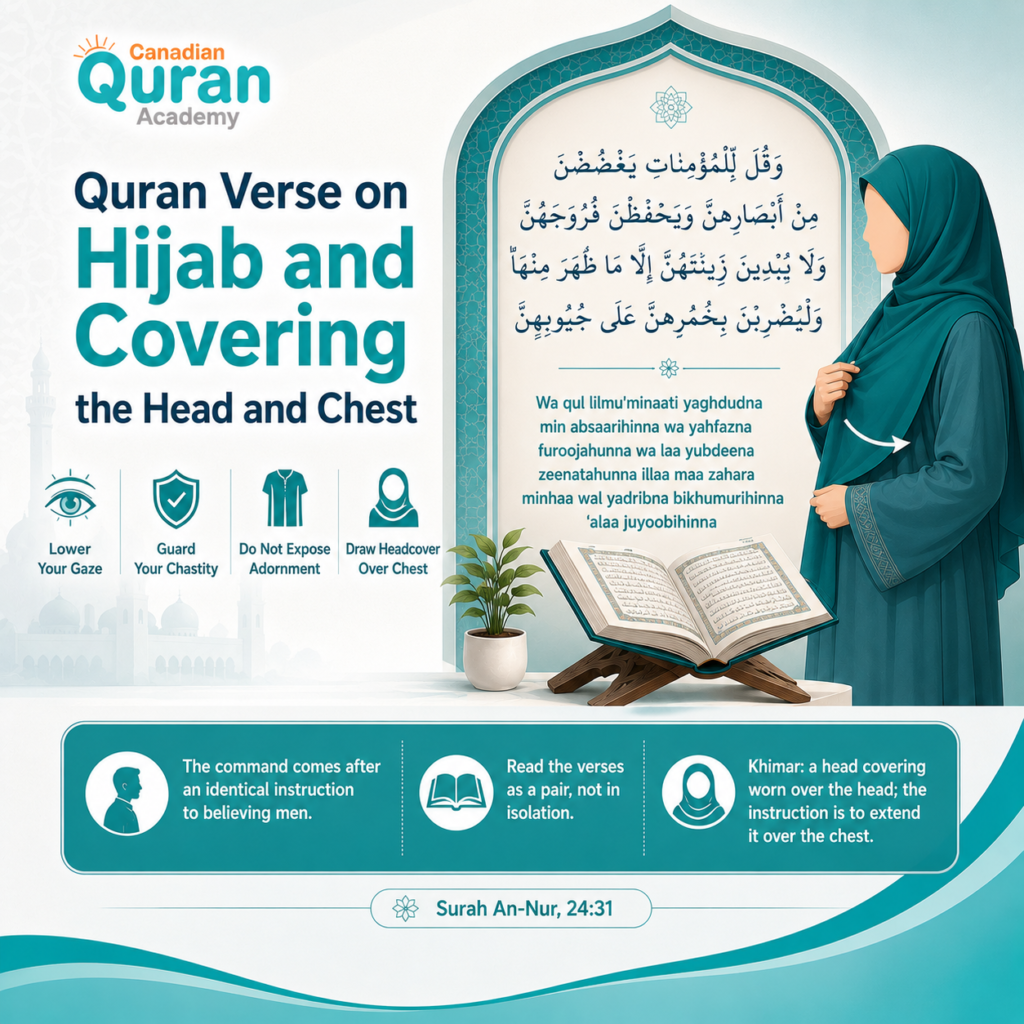
وَقُل لِّلۡمُؤۡمِنَٰتِ يَغۡضُضۡنَ مِنۡ أَبۡصَٰرِهِنَّ وَيَحۡفَظۡنَ فُرُوجَهُنَّ وَلَا يُبۡدِينَ زِينَتَهُنَّ إِلَّا مَا ظَهَرَ مِنۡهَاۖ وَلۡيَضۡرِبۡنَ بِخُمُرِهِنَّ عَلَىٰ جُيُوبِهِنَّۖ
Wa qul lilmu’minaati yaghdudna min absaarihinna wa yahfazna furoojahunna wa laa yubdeena zeenatahunna illaa maa zahara minhaa wal yadribna bikhumurihinna ‘alaa juyoobihinna
“And tell the believing women to lower their gaze and guard their private parts, and not expose their adornment except that which [necessarily] appears thereof, and to draw their headcovers over their chests…” (Surah An-Nur, 24:31)
The command comes right after a nearly identical instruction to believing men in the previous ayah to lower their gaze — the two verses are meant to be read as a pair, not the women’s verse in isolation. The word used for the head covering here, khimar, referred in the earliest tafsir sources to a cloth already worn over the head; the new instruction was to extend its ends over the chest rather than leaving it tucked behind the neck.
Experience Our Classrooms
Don’t just take our word for it—take a look inside! Watch the videos below to experience our engaging teaching methods and vibrant online classrooms firsthand.
Start Your Quranic Journey in Canada
Join our vibrant community and learn with expert tutors through our flexible online platform.
Claim Your Free TrialRead More: Quran Verses About Teachers in Arabic
Quran Verse About the Outer Garment (Jilbab)
Another key Quranic verse about women’s clothing appears in Surah Al-Ahzab, where Allah instructs believing women to wear the jilbab, an outer garment worn over their regular clothing. The verse emphasizes modesty in public life while also highlighting the wisdom behind this instruction: helping believing women be recognized for their dignity and reducing the likelihood of harassment.
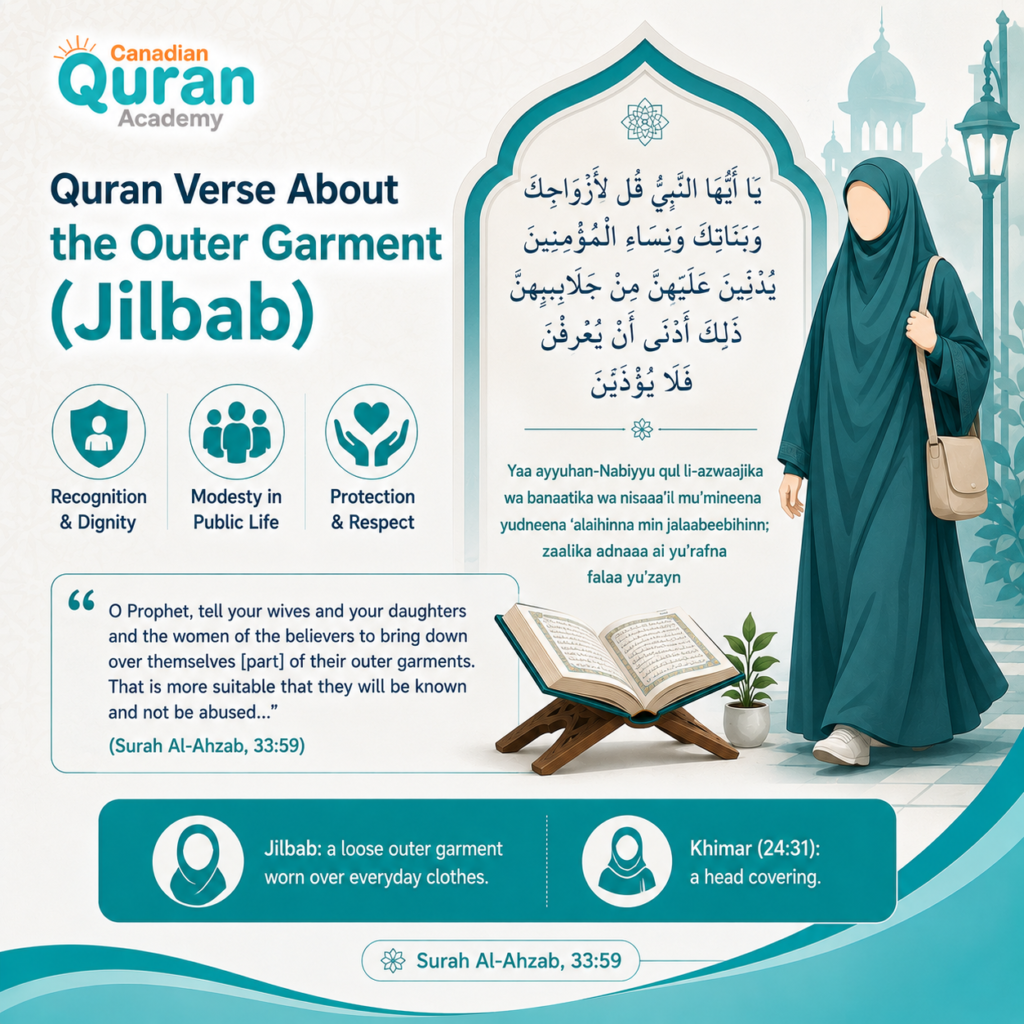
يَا أَيُّهَا النَّبِيُّ قُلْ لِأَزْوَاجِكَ وَبَنَاتِكَ وَنِسَاءِ الْمُؤْمِنِينَ يُدْنِينَ عَلَيْهِنَّ مِنْ جَلَابِيبِهِنَّ ذَلِكَ أَدْنَى أَنْ يُعْرَفْنَ فَلَا يُؤْذَيْنَ
Yaa ayyuhan-Nabiyyu qul li-azwaajika wa banaatika wa nisaaa’il mu’mineena yudneena ‘alaihinna min jalaabeebihinn; zaalika adnaaa ai yu’rafna falaa yu’zayn
“O Prophet, tell your wives and your daughters and the women of the believers to bring down over themselves [part] of their outer garments. That is more suitable that they will be known and not be abused…” (Surah Al-Ahzab, 33:59)
The verse explains the wisdom behind the command by linking the jilbab to recognition, dignity, and protection in public settings. Classical scholars described the jilbab as a loose outer garment worn over a woman’s everyday clothes, distinguishing it from the khimar mentioned in Surah An-Nur (24:31), which refers to a head covering. Together, these two verses address different aspects of modest dress, showing that the Quran discusses complementary garments rather than repeating the same instruction.
Quran Verse About the Exemption for Elderly Women
The Quran also acknowledges that modesty guidelines may vary according to a person’s stage of life. In Surah An-Nur, Allah grants a specific concession to elderly women who are no longer seeking marriage, while continuing to emphasize that modesty and dignity remain virtuous qualities. This verse illustrates the balance between ease and righteousness that characterizes Islamic teachings.
وَالْقَوَاعِدُ مِنَ النِّسَاءِ اللَّاتِي لَا يَرْجُونَ نِكَاحًا فَلَيْسَ عَلَيْهِنَّ جُنَاحٌ أَنْ يَضَعْنَ ثِيَابَهُنَّ غَيْرَ مُتَبَرِّجَاتٍ بِزِينَةٍ وَأَنْ يَسْتَعْفِفْنَ خَيْرٌ لَهُنَّ
Walqawaa’idu minan-nisaaa’il-laatee laa yarjoona nikaahan falaisa ‘alaihinna junaahun ai yada’na thiyaabahunna ghaira mutabarrijaatim bizeenatinw wa ai yasta’fifna khairul lahunn
“And women of post-menstrual age who have no desire for marriage — there is no blame upon them for putting aside their outer garments [but] not displaying adornment. But to modestly refrain [from that] is better for them…” (Surah An-Nur, 24:60)
This verse appears only a few ayahs after the primary verse on women’s dress in Surah An-Nur, highlighting that the Quran’s guidance considers different circumstances rather than applying every ruling identically to all women. While elderly women are granted a concession regarding their outer garments, the verse concludes by encouraging modest restraint as the better and more virtuous choice, reinforcing that humility and dignity remain central values in Islamic teachings.
Read More: Quran Verses About Soulmates in Arabic
Quran Verse About Modesty and the Garment of Taqwa
The Quran presents clothing as more than a physical necessity. It describes garments as one of Allah’s blessings, providing protection, modesty, and beauty, while reminding believers that the greatest garment is taqwa (God-consciousness). This verse broadens the discussion of Islamic clothing by connecting outward appearance with inward faith and character.
يَٰبَنِيٓ ءَادَمَ قَدۡ أَنزَلۡنَا عَلَيۡكُمۡ لِبَاسٗا يُوَٰرِي سَوۡءَٰتِكُمۡ وَرِيشٗاۖ وَلِبَاسُ ٱلتَّقۡوَىٰ ذَٰلِكَ خَيۡرٞۚ
Yaa Baneee Aadama qad anzalnaa ‘alaikum libaasai yuwaaree saw aatikum wa reeshanw wa libaasut-taqwaa zaalika khair
“O children of Adam, We have bestowed upon you clothing to conceal your private parts and as adornment. But the clothing of righteousness — that is best…” (Surah Al-A’raf, 7:26)
Unlike the verses that specifically address believing women, this verse is directed to all humanity, beginning with the words, “O children of Adam.” It teaches that clothing serves both practical and aesthetic purposes by covering the body and providing adornment. At the same time, the Quran points to a higher ideal by describing the garment of taqwa as the finest clothing of all. This reminder shows that while modest dress is important, true excellence ultimately comes from righteousness, sincerity, and reverence for Allah, which are the foundations of Islamic character.
Quran Verse About Modest Clothing and Avoiding Tabarruj
The Quran not only provides guidance on how believing women should dress but also warns against tabarruj—the deliberate display of beauty or adornment in a way that attracts unnecessary attention. This principle encourages modesty in both appearance and behavior, reflecting the broader Islamic values of dignity, humility, and respect.
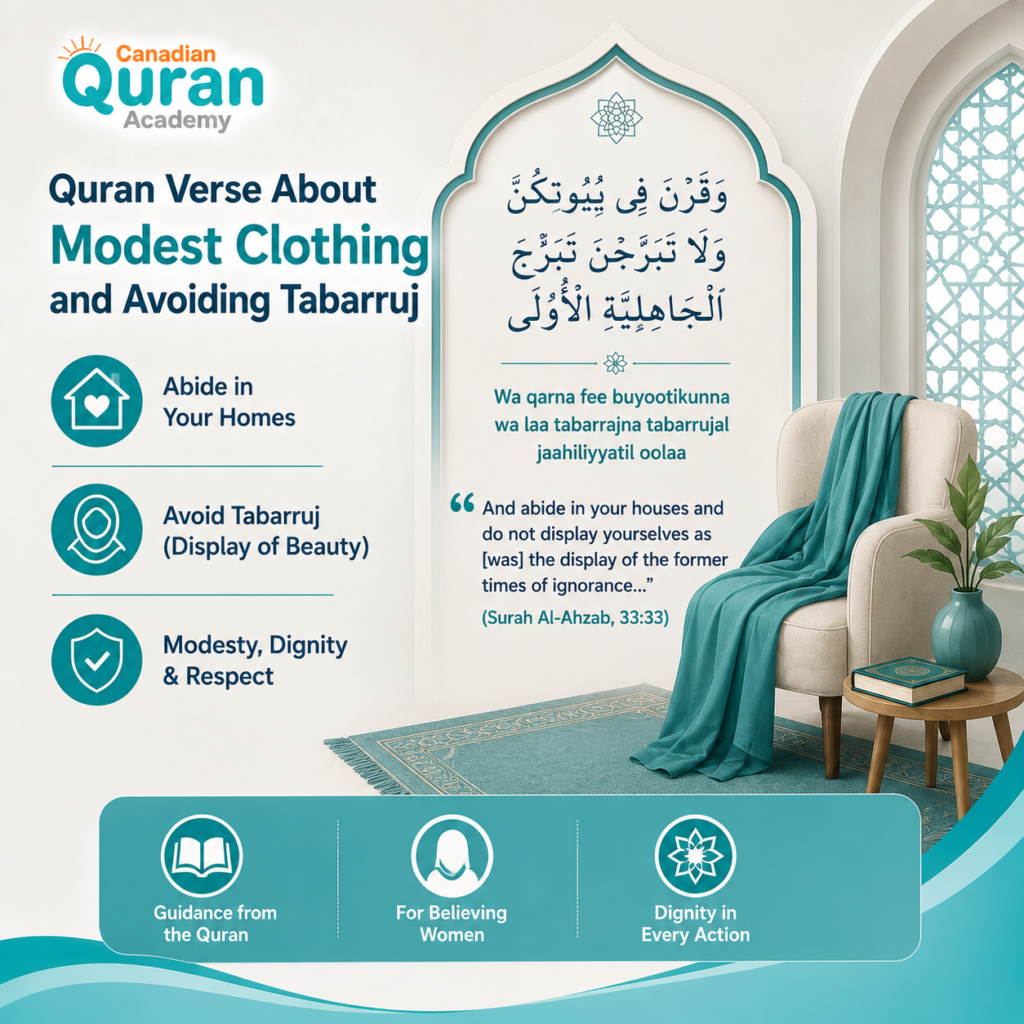
وَقَرْنَ فِي بُيُوتِكُنَّ وَلَا تَبَرَّجْنَ تَبَرُّجَ الْجَاهِلِيَّةِ الْأُولَى
Wa qarna fee buyootikunna wa laa tabarrajna tabarrujal jaahiliyyatil oolaa
“And abide in your houses and do not display yourselves as [was] the display of the former times of ignorance…” (Surah Al-Ahzab, 33:33)
Though addressed first to the Prophet’s wives, the verse is generally understood by commentators as establishing a principle for believing women more broadly, since the surah repeatedly uses the Prophet’s household as an example for the wider community. “Tabarrujal jaahiliyyah” — the display associated with the pre-Islamic era — is the specific behavior the verse contrasts with modest conduct at home and in public.
Reading a verse like this alongside its historical context is one of the things a live class adds that a translation alone can’t — something the Islamic studies courses for sisters are specifically structured around, with female teachers guiding the discussion.
Live Class in Action
Watch how our instructors interact with students in real-time, focusing on interactive methods.
Start Your Quranic Journey in Canada
Join our vibrant community and learn with expert tutors through our flexible online platform.
Claim Your Free TrialRead More: Quran Verses About Sadaqah in Arabic
Learn Quran Verses About Women’s Clothing with Qualified Quran Teachers
Understanding the Quran verses about women’s clothing in Arabic goes beyond reading a translation. Learning these verses with qualified Quran teachers helps you recite them correctly, understand their meanings within their Quranic context, and explore the key terms such as khimar, jilbab, and libas through authentic Islamic teaching.
At Canadian Quran Academy, we offer:
- Qualified Quran teachers experienced in Quran recitation, Tajweed, and Tafsir
- One-on-one online classes tailored to your learning level and goals
- Step-by-step Quran reading and Arabic lessons to help you understand Quranic vocabulary
- Flexible schedules for children, adults, beginners, and advanced students
- Courses in Quran recitation, Tajweed, Hifz, Quranic Arabic, and Islamic Studies
- A free trial class with no obligation
Book your free trial class today and start learning the Quran in Arabic with experienced teachers who help you understand every verse with confidence.
Our Quran Courses
- Quran Tafsir Course
- Noorani Qaida Course
- Noorani Qaida Course for Kids
- Weekend Quran Classes
- Intensive Quran Course
- Al-Azhar Quran Course
- Online Tajweed Classes
- Tajweed Course for Kids
- Tajweed Course for Adults
- Tajweed Course for Ladies

Start Your Quranic Journey in Canada
Join our vibrant community and learn with expert tutors through our flexible online platform.
Claim Your Free TrialConclusion
The Quran presents women’s clothing through several complementary verses rather than a single instruction. Together, these passages explain the purpose of the khimar and jilbab, outline guidance for different circumstances, and emphasize that clothing serves as a means of modesty, protection, dignity, and adornment. Reading these Quran verses about women’s clothing in Arabic alongside their translation helps readers understand how each verse contributes to the broader Islamic perspective on dress.
While these verses provide the Quranic foundation, understanding their context and terminology offers a deeper appreciation of their meaning. Studying the original Arabic, supported by reliable translation and explanation, allows readers to distinguish between different types of garments mentioned in the Quran and to see how the guidance on women’s clothing reflects both practical instruction and enduring spiritual values.
Frequently Asked Questions
The Quran addresses women’s clothing through several verses, each highlighting a different aspect of modest dress, adornment, and dignity. Below are concise answers to some of the most frequently asked questions about these Quranic teachings.
Which Quran verse is the most important about women’s clothing?
Surah An-Nur (24:31) is the primary Quranic verse about women’s clothing, instructing believing women to draw their head coverings over their chests. It is commonly read alongside Surah Al-Ahzab (33:59), which introduces the jilbab as an outer garment.
Which Quran verses talk about women’s clothing?
The main verses include Surah An-Nur (24:31), Surah Al-Ahzab (33:59), Surah An-Nur (24:60), Surah Al-A’raf (7:26), Surah Al-A’raf (7:31), and Surah Al-A’raf (7:32). Together, they discuss modest clothing, adornment, outer garments, and the spiritual significance of dress.
What is the difference between khimar and jilbab in the Quran?
The khimar mentioned in Surah An-Nur (24:31) is a head covering drawn over the chest, while the jilbab in Surah Al-Ahzab (33:59) is a loose outer garment worn over regular clothing. They refer to two different types of clothing.
Does the Quran allow women to wear beautiful clothing?
Yes. Surah Al-A’raf (7:31–32) encourages believers to wear appropriate adornment and explains that Allah created beautiful clothing and adornment for His servants. The Quran promotes modesty, not the prohibition of beauty.
Does the Quran mention clothing for older women?
Yes. Surah An-Nur (24:60) provides a concession for elderly women who are no longer seeking marriage regarding certain outer garments, while stating that maintaining modesty is still the better course.






Leave a Reply