 Quran
Quran
Reading a Quran verse about life for the first time can feel like the words were written with your exact situation in mind. That reaction is not accidental. The Quran addresses the human condition directly, and its verses on life — hayah (حَيَاة) — return to the same themes again and again: what this world actually is, why we are here, and how to hold both this life and the next in proper balance.
Quran verses about life in Arabic carry meaning that translation alone cannot fully deliver. A single Arabic word can shift depending on whether it is read in its classical Quranic sense or its modern usage, and that shift changes how the verse should be understood. This article walks through the Quran’s core verses on life, in Arabic with full diacritics, alongside their English meaning, their surah and ayah reference, and the context that makes each one useful rather than decorative.
What You’ll Learn in This Article
- The Quran’s core position on worldly life (al-dunya) and why it uses the language it does
- Key verses on the purpose of life and life as a test, with their exact surah and ayah references
- What the Quran says about the human lifecycle, from infancy to old age
- How the Quran compares this life to the Hereafter — and why it asks believers to balance both
- A relevant hadith on worldly life, with its narrator and source
What Does the Quran Say About the Nature of Worldly Life?
Al-dunya (الدنيا) is the Quranic term for worldly life — the immediate, tangible existence a person lives before death. The word appears in the Quran without a possessive pronoun in every instance; there is no verse that reads “your dunya” or “my dunya.” That grammatical choice is deliberate: this world is never described as belonging to anyone.
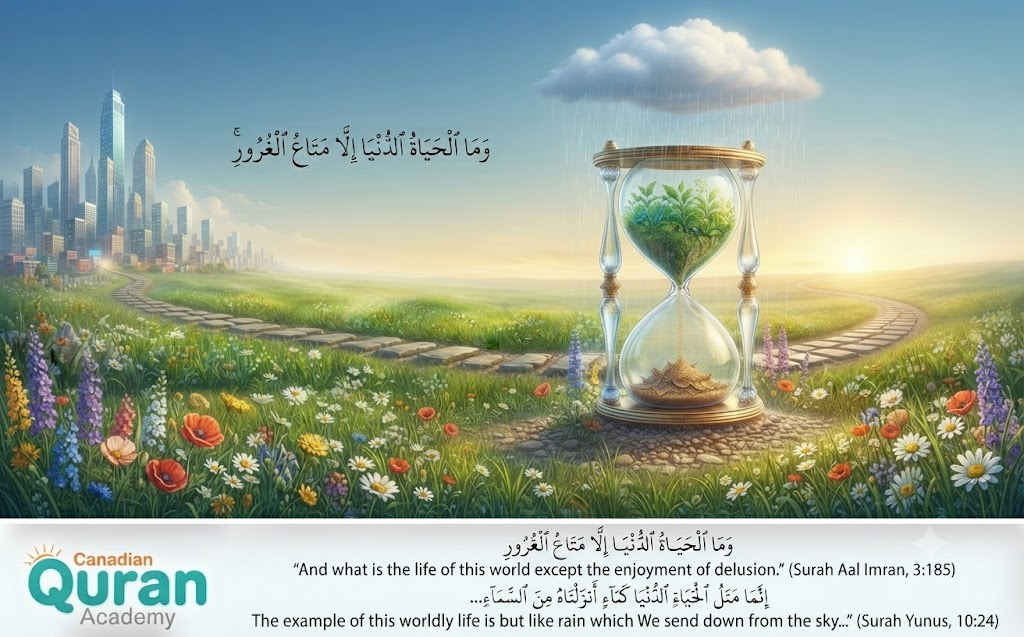
The verses below form the Quran’s clearest statement on what al-dunya actually is.
1. The World Is Described as a Delusion
This verse is the Quran’s shortest and most direct statement on worldly life.
“وَمَا الْحَيَاةُ الدُّنْيَا إِلَّا مَتَاعُ الْغُرُورِ”
“And what is the life of this world except the enjoyment of delusion.” (Surah Aal Imran, 3:185)
The phrase مَتَاعُ الْغُرُورِ (matāʿ al-ghurūr) describes something that appears valuable on the surface but holds nothing lasting underneath — comparable to packaging that looks appealing but is empty inside. The verse closes a longer passage on death and accountability, which makes its conclusion deliberate rather than incidental.
2. The World Is Compared to a Rain Shower
This verse delivers the same warning through a complete image rather than a single phrase.
“إِنَّمَا مَثَلُ الْحَيَاةِ الدُّنْيَا كَمَاءٍ أَنزَلْنَاهُ مِنَ السَّمَاءِ فَاخْتَلَطَ بِهِ نَبَاتُ الْأَرْضِ مِمَّا يَأْكُلُ النَّاسُ وَالْأَنْعَامُ”
“The example of this worldly life is but like rain which We send down from the sky, and the plants of the earth absorb it — those from which men and cattle eat.” (Surah Yunus, 10:24)
The verse continues by describing a harvest that looks permanent right before it disappears overnight. This is the Quran’s standing metaphor for worldly attachment: a cycle that looks stable from inside it and is clearly temporary from any distance.
Five Named Stages of Worldly Attachment
Where the previous verses warn in general terms, this one lists the specific stages worldly attachment moves through.
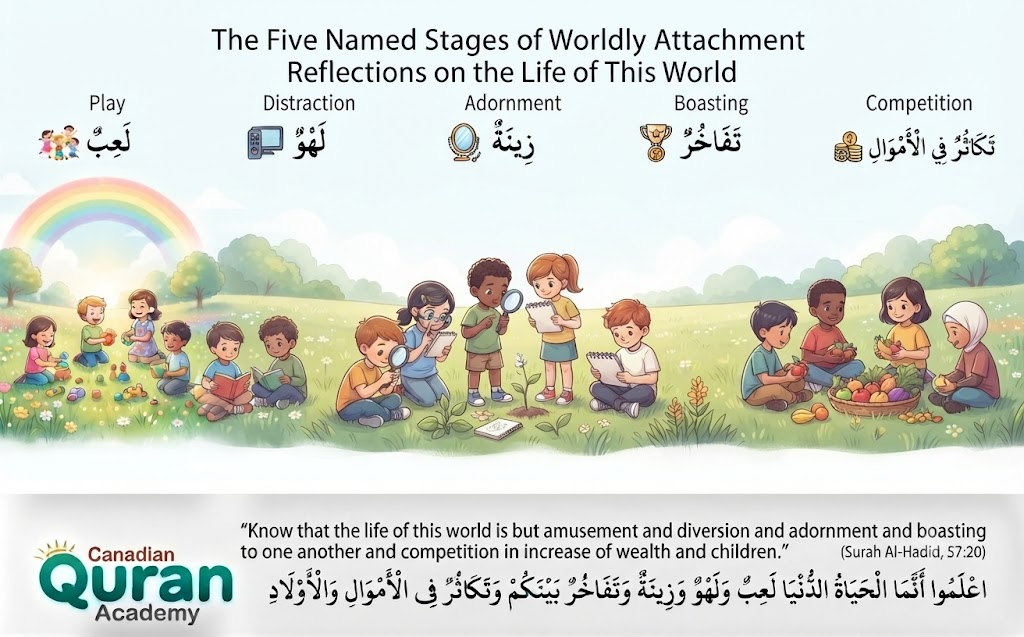
“اعْلَمُوا أَنَّمَا الْحَيَاةُ الدُّنْيَا لَعِبٌ وَلَهْوٌ وَزِينَةٌ وَتَفَاخُرٌ بَيْنَكُمْ وَتَكَاثُرٌ فِي الْأَمْوَالِ وَالْأَوْلَادِ”
“Know that the life of this world is but amusement and diversion and adornment and boasting to one another and competition in increase of wealth and children.” (Surah Al-Hadid, 57:20)
The five terms move in a clear sequence: play (لَعِبٌ), distraction (لَهْوٌ), decoration (زِينَةٌ), social rivalry (تَفَاخُرٌ), and accumulation (تَكَاثُرٌ). Each stage roughly matches a phase of human maturity, from a child’s instinct to an adult’s ambitions — and the verse treats all five as equally temporary.
Reading these verses in Arabic rather than only in translation is where their precision becomes visible — grammatical structure and word choice that a translation cannot fully preserve. This is the kind of detail covered step by step in the Quran reading course at Canadian Quran Academy, where students learn to follow the Arabic text directly rather than relying on translation alone.
Take your first Quran Reading class in Canada for FREE.

What Does the Quran Say About the Purpose of Life?
Before looking at how the Quran describes worldly life, it helps to answer a more basic question: why does human life exist at all? The Quran gives two connected answers — one about the reason for existence, and one about the mechanism through which that reason is tested.
1. Life’s Purpose Is Worship
This is the Quran’s most concise statement of purpose in the entire text.
“وَمَا خَلَقْتُ الْجِنَّ وَالْإِنسَ إِلَّا لِيَعْبُدُونِ”
“And I did not create the jinn and mankind except to worship Me.” (Surah Adh-Dhariyat, 51:56)
The verb لِيَعْبُدُونِ (li-yaʿbudūn) — “to worship” — carries a broader scope in classical Arabic than ritual prayer alone. It includes servitude, acknowledgment of divine authority, and the alignment of daily conduct with divine guidance. The verse defines the purpose of existence in eight Arabic words.
2. Life and Death Exist to Test Deeds
If worship is the reason, this verse explains the working mechanism: life functions as a test of quality, not quantity.
“الَّذِي خَلَقَ الْمَوْتَ وَالْحَيَاةَ لِيَبْلُوَكُمْ أَيُّكُمْ أَحْسَنُ عَمَلًا وَهُوَ الْعَزِيزُ الْغَفُورُ”
“[He] who created death and life to test you as to which of you is best in deed — and He is the Exalted in Might, the Forgiving.” (Surah Al-Mulk, 67:2)
The order of the verse itself carries meaning: death is mentioned before life. Classical commentators, including Al-Qurtubi, note that this sequence is intentional — death is framed as the reference point life is measured against, not the other way around. The phrase أَحْسَنُ عَمَلًا (aḥsanu ʿamalā) means “best in deed,” not “most in deed,” which shifts the standard from output to sincerity.
Read also: Quran Verses About Kindness in Arabic
Quran Verses on the Stages of Human Life
Beyond purpose, the Quran also maps the physical arc a person moves through — from infancy to old age, and from idle hope to earned outcome.
1. From Weakness to Strength and Back to Weakness
This verse compresses an entire human lifecycle into a single sentence.
“اللَّهُ الَّذِي خَلَقَكُم مِّن ضَعْفٍ ثُمَّ جَعَلَ مِن بَعْدِ ضَعْفٍ قُوَّةً ثُمَّ جَعَلَ مِن بَعْدِ قُوَّةٍ ضَعْفًا وَشَيْبَةً”
“Allah is the one who created you from weakness, then made after weakness strength, then made after strength weakness and white hair.” (Surah Ar-Rum, 30:54)
The word ضَعْف (ḍaʿf, weakness) is repeated three times, which frames physical strength as a temporary middle stage rather than a permanent condition — a direct correction to the illusion of permanence that youth and health tend to create.
2. A Person Earns Only What They Strive For
This short verse is treated by scholars as a complete statement on personal accountability.
“وَأَن لَّيْسَ لِلْإِنسَانِ إِلَّا مَا سَعَىٰ”
“And that there is not for man except what he strives for.” (Surah An-Najm, 53:39)
No one else’s effort transfers to your record, and your effort transfers to no one else’s. The verse rules out passive expectation as a strategy and places the entire weight of outcome on deliberate action.
A common mistake readers make with verses like these is stopping at the English meaning and treating the verse as a general proverb. The Arabic grammar — particularly the use of لَيْسَ (a negation verb) paired with إِلَّا (an exception particle) — is what gives the verse its absolute, no-exceptions force. That distinction is exactly what a structured Arabic and Quran recitation program is built to teach, which is one reason the Quran recitation course at Canadian Quran Academy pairs correct tajweed with grammatical explanation rather than teaching pronunciation alone.
Get your FREE trial class in our Quran Recitation Classes in Canada.

Experience Our Classrooms
Don’t just take our word for it—take a look inside! Watch the videos below to experience our engaging teaching methods and vibrant online classrooms firsthand.
Start Your Quranic Journey in Canada
Join our vibrant community and learn with expert tutors through our flexible online platform.
Claim Your Free TrialQuran Verses Comparing This Life and the Hereafter
The Quran does not treat worldly life as inherently evil. It consistently positions the Hereafter as the fuller, truer version of what this world only approximates. The comparison is reorientation, not rejection.
1. This World Is Play; the Hereafter Is the Real Life
This verse contains one of the most linguistically debated words in the Quran.
“وَمَا هَٰذِهِ الْحَيَاةُ الدُّنْيَا إِلَّا لَهْوٌ وَلَعِبٌ ۚ وَإِنَّ الدَّارَ الْآخِرَةَ لَهِيَ الْحَيَوَانُ ۚ لَوْ كَانُوا يَعْلَمُونَ”
“And this worldly life is not but diversion and amusement. And indeed, the home of the Hereafter — that is the [true] life, if only they knew.” (Surah Al-Ankabut, 29:64)
The word الْحَيَوَانُ (al-ḥayawān) means “animal” in modern Arabic, but in classical Quranic usage it denotes full, vibrant vitality — life in its most complete form. The verse is not comparing the Hereafter to this world as a better alternative; it is saying the Hereafter is the only place where existence is fully realized.
2. What Is With Allah Is Better and More Lasting
This verse makes the same comparison through reasoning rather than description.
“وَمَا أُوتِيتُم مِّن شَيْءٍ فَمَتَاعُ الْحَيَاةِ الدُّنْيَا وَزِينَتُهَا ۖ وَمَا عِندَ اللَّهِ خَيْرٌ وَأَبْقَىٰ ۚ أَفَلَا تَعْقِلُونَ”
“And whatever you have been given is [only] enjoyment of the worldly life and its adornment. And what is with Allah is better and more lasting; so will you not use reason?” (Surah Al-Qasas, 28:60)
The verse closes with a direct appeal to intellect — أَفَلَا تَعْقِلُونَ — framing the preference for the Hereafter as a rational conclusion rather than a matter of blind acceptance.
Read also: Quran Verses About Justice in Arabic
Quran Verses on Balancing This Life and the Next
The Quran’s position is not withdrawal from the world. A balanced life, in the Quranic model, means engaging with this world fully while keeping its final destination in view.
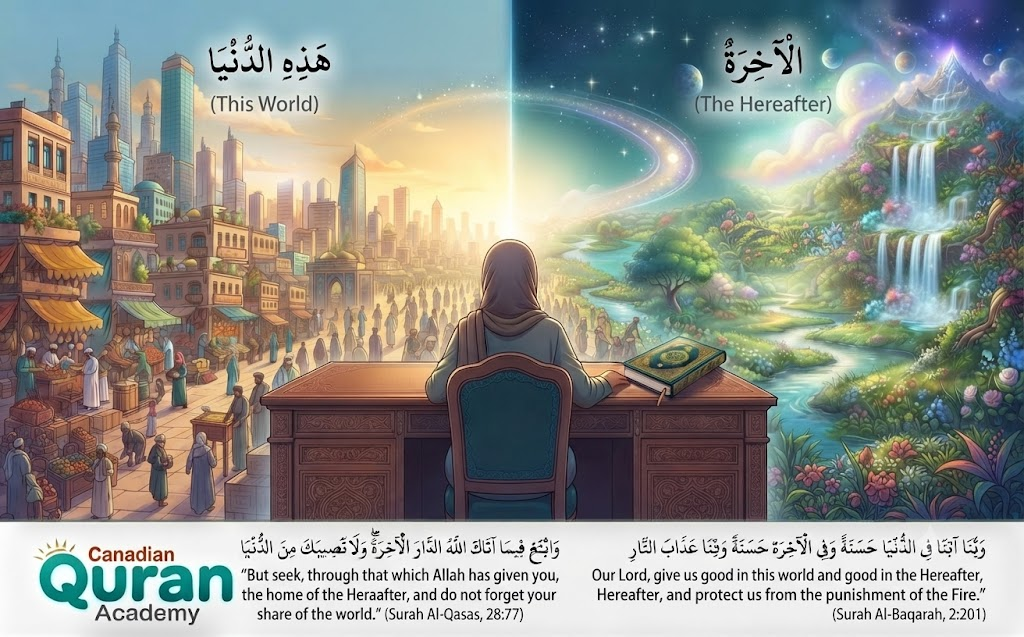
1. Seek the Hereafter Without Forgetting Your Share of This World
This verse was addressed to a specific man, Qarun, whose story gives the instruction concrete weight.
“وَابْتَغِ فِيمَا آتَاكَ اللَّهُ الدَّارَ الْآخِرَةَ ۖ وَلَا تَنسَ نَصِيبَكَ مِنَ الدُّنْيَا”
“But seek, through that which Allah has given you, the home of the Hereafter; and do not forget your share of the world.” (Surah Al-Qasas, 28:77)
نَصِيبَكَ مِنَ الدُّنْيَا (naṣībaka mina al-dunyā) means “your rightful portion of this world.” The verse does not instruct abandonment of worldly means — it instructs remembering that they are a portion, not the whole point.
2. The Dua for Good in Both Worlds
This verse is also one of the most widely recited supplications in the Islamic tradition.
“رَبَّنَا آتِنَا فِي الدُّنْيَا حَسَنَةً وَفِي الْآخِرَةِ حَسَنَةً وَقِنَا عَذَابَ النَّارِ”
“Our Lord, give us good in this world and good in the Hereafter, and protect us from the punishment of the Fire.” (Surah Al-Baqarah, 2:201)
This dua asks for hasanah (حَسَنَةً — good) in both dunya and akhirah in the same breath, which is the Quran’s own template for a balanced request: provision, health, and knowledge in this life, alongside protection and reward in the next.
Live Class in Action
Watch how our instructors interact with students in real-time, focusing on interactive methods.
Start Your Quranic Journey in Canada
Join our vibrant community and learn with expert tutors through our flexible online platform.
Claim Your Free TrialDeepen Your Understanding of Quran Verses About Life at The Canadian Quran Academy
Reading Quran verses about life in Arabic is the first step. Understanding their language, context, and timeless guidance requires qualified instruction. The Canadian Quran Academy helps students explore the Quran through authentic Arabic, Tafsir, and personalized one-on-one learning.
- Qualified instructors specializing in Quranic Arabic and Tafsir
- Personalized 1-on-1 online lessons tailored to your learning level
- Flexible scheduling across all Canadian time zones
- Programs for adults, children, beginners, and advanced learners
- FREE trial class — no commitment required
Book your FREE trial class today and start exploring the deeper meanings of the Quran with confidence.

Our Quran Courses
- Quran Online Academy
- Quran Recitation Classes
- Quran Reading Classes
- Online Quran Classes for Kids
- Quran Classes for Adults
- Quran Classes for Female/Sisters
- Learn Quran for Beginners
- Quran Memorization (Hifz) Course
- Hifz Classes for Adults
- Quran Memorization and Hifz for Kids
- Quran Hifz for Ladies
- Quran Ijazah Program
- Quran Qirat Learning Course
- Quran Tafsir Course
- Noorani Qaida Course
- Noorani Qaida Course for Kids
- Weekend Quran Classes
- Intensive Quran Course
- Al-Azhar Quran Course
- Online Tajweed Classes
- Tajweed Course for Kids
- Tajweed Course for Adults
- Tajweed Course for Ladies/Sisters
Start Your Quranic Journey in Canada
Join our vibrant community and learn with expert tutors through our flexible online platform.
Claim Your Free TrialConclusion
The Quran’s verses on life form a consistent, carefully built framework rather than a scattered list of warnings. Worldly life — al-dunya — is described as temporary and easily mistaken for permanent, existence is defined by worship and tested through deeds, the human lifecycle moves predictably from weakness to strength and back, and the Hereafter is consistently positioned as the fuller, truer version of life rather than its opposite. At the same time, the Quran does not ask believers to withdraw from this world — it asks them to hold their share of it without forgetting where it leads.
Reading these Quran verses about life in Arabic, rather than through translation alone, is where their precision becomes clear — the difference between الْحَيَوَانُ as “animal” and as “true vitality” is a single word that changes an entire verse’s meaning. The closer a reader gets to the original Arabic, the more directly these verses speak to their own life.
Frequently Asked Questions
What does the Quran say about life in Arabic?
The Quran describes worldly life (الحياة الدنيا) as temporary, capable of appearing more permanent than it is, and consistently secondary to the Hereafter. Central verses include Surah Al-Hadid, 57:20, which lists five stages of worldly attachment, and Surah Al-Mulk, 67:2, which defines life as a test of deed quality rather than quantity.
What is the most well-known Quran verse about life?
Surah Aal Imran, 3:185 — “وَمَا الْحَيَاةُ الدُّنْيَا إِلَّا مَتَاعُ الْغُرُورِ” — is widely cited as the Quran’s most direct statement on worldly life, translating as “the life of this world is nothing but the enjoyment of delusion.” Surah Al-Baqarah, 2:201, the dua for good in both worlds, is likely the most frequently recited verse on this theme.
How many times does the word دنيا (dunya) appear in the Quran?
The word دنيا appears in 115 places across the Quran. In every instance, it appears without a possessive pronoun, which many scholars read as a deliberate linguistic signal that worldly life belongs to no one on a permanent basis.
What does the Quran say about the purpose of life?
Surah Adh-Dhariyat, 51:56 states the purpose directly: “وَمَا خَلَقْتُ الْجِنَّ وَالْإِنسَ إِلَّا لِيَعْبُدُونِ” — “I did not create jinn and mankind except to worship Me.” Surah Al-Mulk, 67:2 adds a second layer: life also functions as a test of deed quality.
Does the Quran say it’s acceptable to enjoy this life?
Yes. Surah Al-Qasas, 28:77 explicitly instructs believers not to forget their share of the world. The Quran warns against excessive attachment to worldly life, not against engaging with it — the balance is captured directly in the dua of Surah Al-Baqarah, 2:201.
How can I understand these verses in their original Arabic instead of relying on translation?
Structured study of Quranic Arabic grammar and vocabulary is the most direct route. Even a foundational grasp of word roots and sentence structure reveals distinctions — such as why الدنيا never takes a possessive pronoun, or what الْحَيَوَانُ meant in classical usage — that a translation on its own cannot fully carry.




Leave a Reply