 Quran
Quran
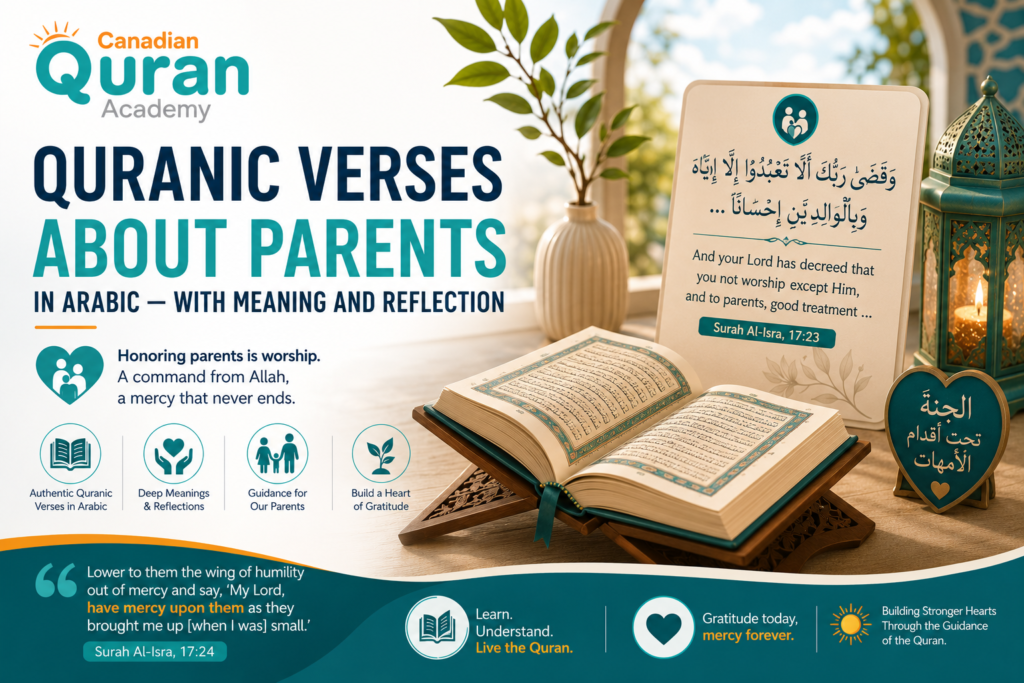
There is a detail in the Arabic language that stops many readers in their tracks the first time they notice it. The word for “womb” in Arabic — ar-raḥim (الرَّحِم) — shares the same three-letter root as the name of Allah, Ar-Raḥmān (الرَّحْمَن): The Entirely Merciful. That root is ra-ḥa-ma (ر-ح-م).
It is as if the language itself is telling us something profound: the first mercy we ever experience in this world arrives through our mothers. And it is no accident that the Quran — in verse after verse — places the command to honor parents directly alongside the command to worship Allah alone. This is not a suggestion. It is a qaḍā — a divine decree.
This article walks through the most significant Quranic verses about parents in Arabic, unpacks their precise meanings using the original Arabic vocabulary, and shows how each verse defines a complete standard of conduct that most Muslims have only partly understood.
The Quranic Verse That Pairs Worship of Allah with Honoring Parents
No verse establishes the Islamic framework for parent-child relations more completely than Surah Al-Isra, 17:23.
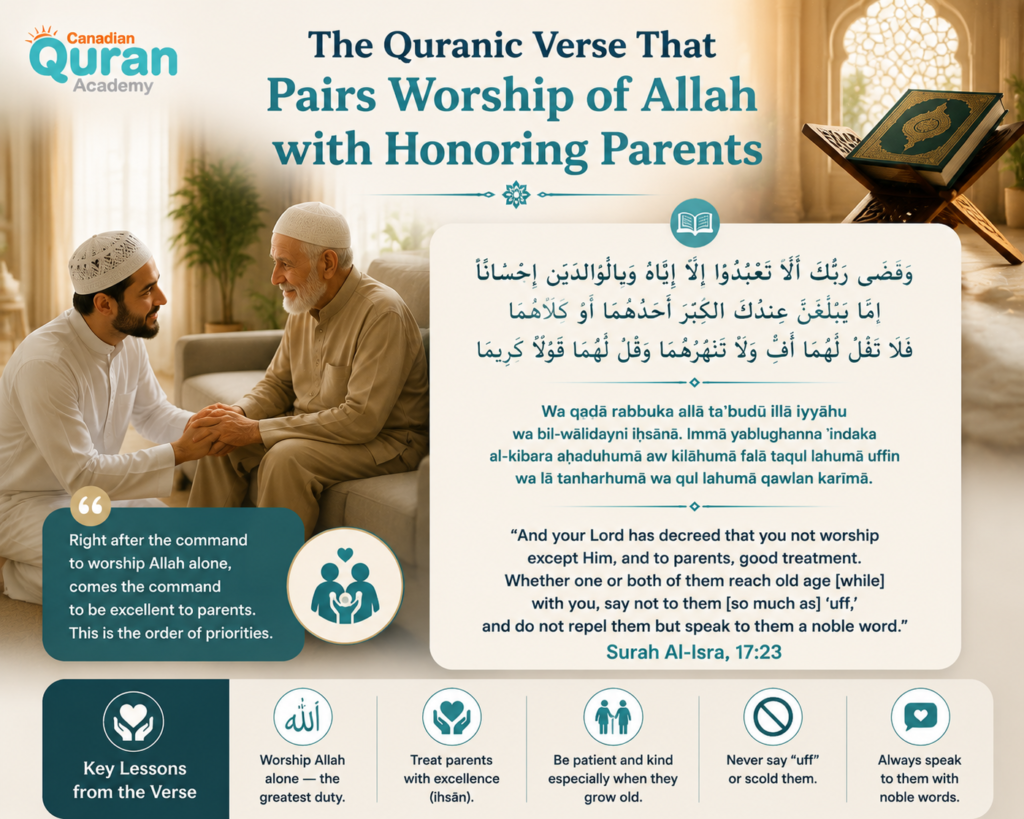
وَقَضَىٰ رَبُّكَ أَلَّا تَعْبُدُوا إِلَّا إِيَّاهُ وَبِالْوَالِدَيْنِ إِحْسَانًا ۚ إِمَّا يَبْلُغَنَّ عِندَكَ الْكِبَرَ أَحَدُهُمَا أَوْ كِلَاهُمَا فَلَا تَقُل لَّهُمَا أُفٍّ وَلَا تَنْهَرْهُمَا وَقُل لَّهُمَا قَوْلًا كَرِيمًا
Wa qaḍā rabbuka allā taʿbudū illā iyyāhu wa bil-wālidayni iḥsānā. Immā yablughanna ʿindaka al-kibara aḥaduhumā aw kilāhumā falā taqul lahumā uffin wa lā tanharhumā wa qul lahumā qawlan karīmā.
“And your Lord has decreed that you not worship except Him, and to parents, good treatment. Whether one or both of them reach old age [while] with you, say not to them [so much as] ‘uff,’ and do not repel them but speak to them a noble word.” — Surah Al-Isra, 17:23
The operative word here is iḥsān (إِحْسَانًا) — not just “kindness” or “goodness.” In classical Arabic, iḥsān denotes a level of excellence and beauty in conduct — proactive, anticipatory service that goes beyond what is required. It is the highest standard of moral behavior.
Then the verse descends into startling specificity. The word uff (أُفٍّ) is the smallest, most minimal expression of displeasure — the Arabic equivalent of an impatient sigh. Allah forbids even this. If a frustrated exhale is prohibited, the gravity of raised voices, harsh words, or neglect becomes self-evident. This is the Quran legislating the management of the smallest emotional reaction, not only the large ones.
The verse closes with qawlan karīmā (قَوْلًا كَرِيمًا) — “a noble word.” Karīm in Arabic does not simply mean “polite.” It means generous, honorable, and weighty. The command is not to speak neutrally to parents in old age, but to speak to them with the vocabulary of honor.
Read More: Quranic Verses About Parents in Arabic
A Powerful Quranic Image of Mercy Toward Parents
The verse that follows in Surah Al-Isra offers one of the most evocative images in the entire Quran.
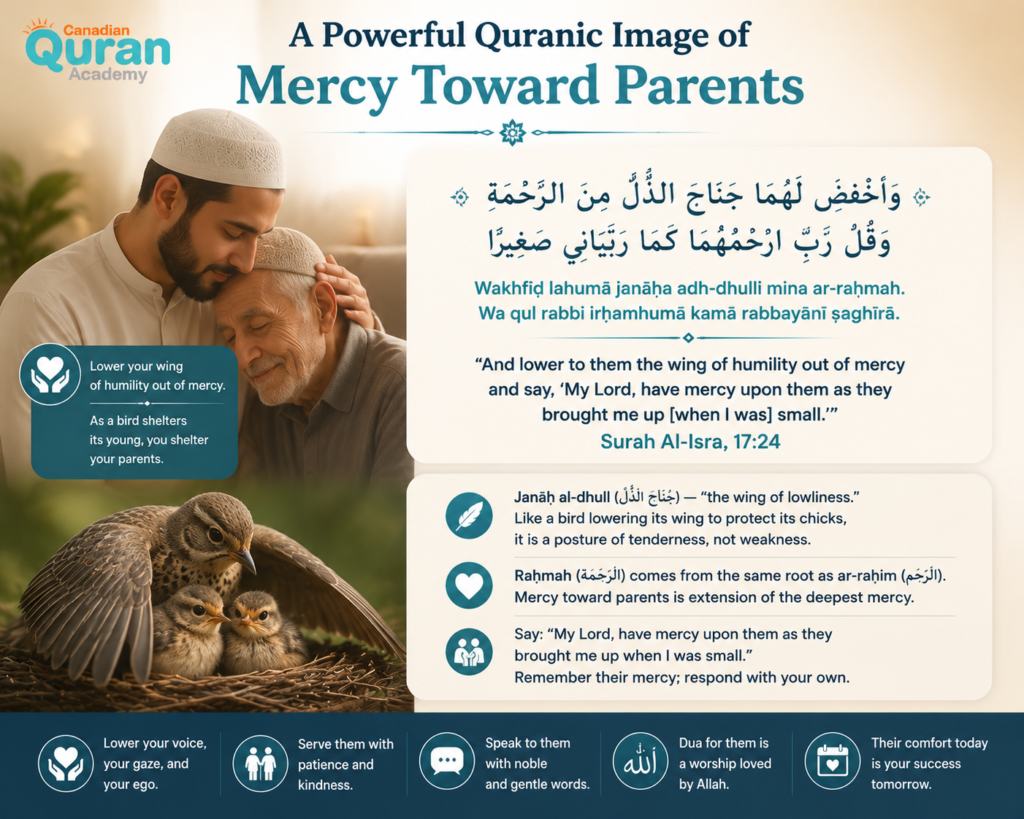
وَاخْفِضْ لَهُمَا جَنَاحَ الذُّلِّ مِنَ الرَّحْمَةِ وَقُل رَّبِّ ارْحَمْهُمَا كَمَا رَبَّيَانِي صَغِيرًا
Wakhfiḍ lahumā janāḥa adh-dhulli mina ar-raḥmah. Wa qul rabbi irḥamhumā kamā rabbayānī ṣaghīrā.
“And lower to them the wing of humility out of mercy and say, ‘My Lord, have mercy upon them as they brought me up [when I was] small.'” — Surah Al-Isra, 17:24
The phrase janāḥ al-dhull (جَنَاحَ الذُّلِّ) — literally “the wing of lowliness” — is not describing weakness. A bird lowers its wing to shelter its chicks from wind and rain; the posture is one of overwhelming protective tenderness, not defeat. Allah is directing children to adopt the same physical and emotional posture toward aging parents that a mother bird takes toward her young.
The raḥmah (mercy) mentioned here is precisely the same root as ar-raḥim — the womb — and Ar-Raḥmān. The humility is not born of obligation alone. It is born from love.
The du’a at the end — rabbi irḥamhumā kamā rabbayānī ṣaghīrā — is one of the most powerful supplications in the Quran. The word rabbayānī comes from the root r-b-b, the same root as Rabb (Lord). Parents “lorded over” us in the most loving sense — they raised, fed, formed, and sustained us when we were completely helpless. The du’a is an acknowledgment of that debt and a plea to Allah to repay it with His own mercy.
If you want to understand verses like these at the level of their Arabic vocabulary and not just their translation, structured Tajweed and Quran reading courses build the foundation you need to engage with the original text directly.
Perfect Your Quran Recitation with a FREE Online Tajweed Trial Class

The Quran’s Reminder of a Mother’s Endless Sacrifice
Two verses address the physical reality of motherhood with a directness that no cultural sentiment can match.
وَوَصَّيْنَا الْإِنسَانَ بِوَالِدَيْهِ حَمَلَتْهُ أُمُّهُ وَهْنًا عَلَىٰ وَهْنٍ وَفِصَالُهُ فِي عَامَيْنِ أَنِ اشْكُرْ لِي وَلِوَالِدَيْكَ إِلَيَّ الْمَصِيرُ
Wa waṣṣaynā al-insāna bi-wālidayhi ḥamalathu ummuhu wahnan ʿalā wahnin wa fiṣāluhu fī ʿāmayni anishkur lī wa li-wālidayka ilayya-l-maṣīr.
“And We have enjoined upon man [care] for his parents. His mother carried him, [increasing her] in weakness upon weakness, and his weaning is in two years. Be grateful to Me and to your parents; to Me is the [final] destination.” — Surah Luqman, 31:14
The phrase wahnan ʿalā wahn (وَهْنًا عَلَىٰ وَهْنٍ) — “weakness upon weakness” — is cumulative. Each layer of physical hardship during pregnancy compounds the one before it. The Quran is not romanticizing motherhood; it is acknowledging its biological reality with clinical precision and then commanding gratitude in response.
Notice that the command to be grateful is placed in a sequence: grateful to Allah, then to parents. The two are grammatically linked by a single wāw of conjunction (وَ). Gratitude to parents is an extension of gratitude to Allah — not a separate act, but part of the same spiritual orientation.
Surah Al-Ahqaf, 46:15 takes this further:
حَمَلَتْهُ أُمُّهُ كُرْهًا وَوَضَعَتْهُ كُرْهًا وَحَمْلُهُ وَفِصَالُهُ ثَلَاثُونَ شَهْرًا
Ḥamalathu ummuhu kurhan wa waḍaʿathu kurhan wa ḥamluhu wa fiṣāluhu thalāthūna shahrā.
“His mother carried him with hardship and gave birth to him with hardship, and his gestation and weaning [period] is thirty months.” — Surah Al-Ahqaf, 46:15
The word kurh (كُرْهًا) in Arabic means pain, difficulty, and aversion — a more acute and raw description than the “weakness” of the Luqman verse. This is the Quran using specific vocabulary to distinguish different dimensions of maternal hardship, not repeating the same point.
Achieve Your Hifz Goals with a FREE Quran Memorization Trial Class
Experience Our Classrooms
Don’t just take our word for it—take a look inside! Watch the videos below to experience our engaging teaching methods and vibrant online classrooms firsthand.
Start Your Quranic Journey in Canada
Join our vibrant community and learn with expert tutors through our flexible online platform.
Claim Your Free TrialRead More: Quran Verses About Nature in Arabic
The Quranic Limit on Obedience to Parents
A complete understanding of Quranic verses about parents in Arabic requires confronting the verse that most people know only in part.
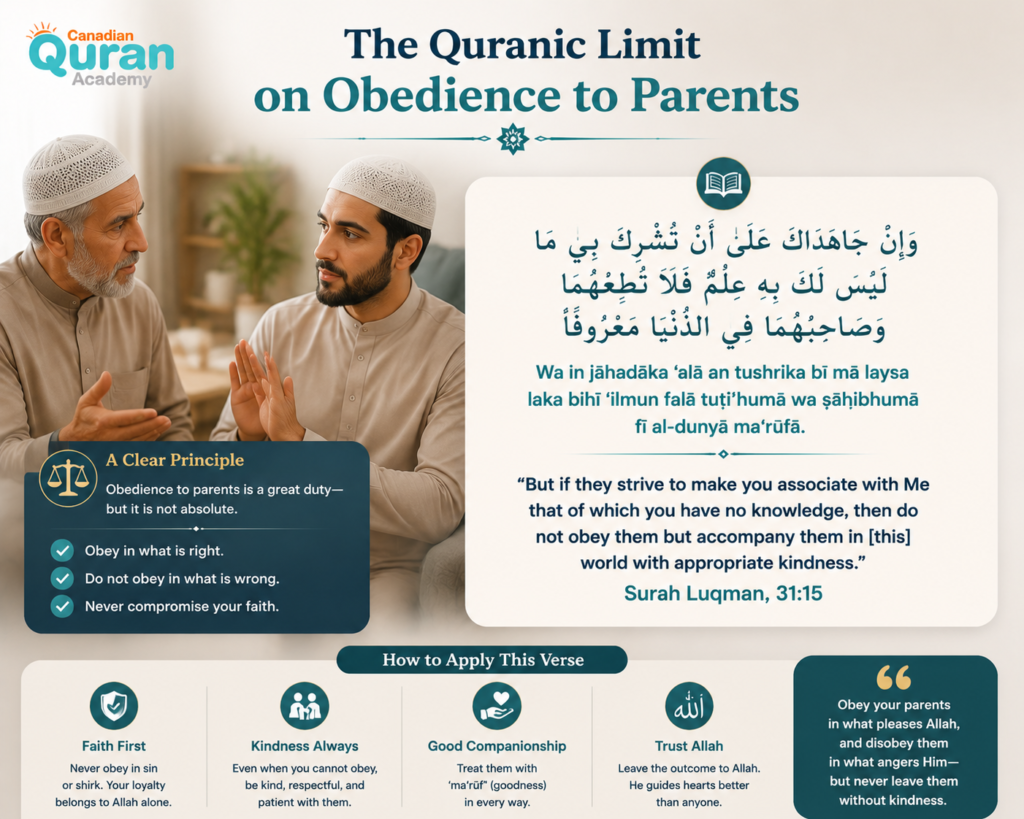
وَإِن جَاهَدَاكَ عَلَىٰ أَن تُشْرِكَ بِي مَا لَيْسَ لَكَ بِهِ عِلْمٌ فَلَا تُطِعْهُمَا ۖ وَصَاحِبْهُمَا فِي الدُّنْيَا مَعْرُوفًا
Wa in jāhadāka ʿalā an tushrika bī mā laysa laka bihī ʿilmun falā tuṭiʿhumā wa ṣāḥibhumā fī al-dunyā maʿrūfā.
“But if they strive to make you associate with Me that of which you have no knowledge, then do not obey them but accompany them in [this] world with appropriate kindness.” — Surah Luqman, 31:15
The Quran uses the word jāhada here — strive, exert effort, pressure — the same root as jihad. The verse is not describing mild suggestions from parents; it describes intense, sustained pressure. Even under that pressure, disobedience in matters of shirk is required — and yet the command immediately following is not abandonment or harshness.
Ṣāḥibhumā fī al-dunyā maʿrūfā (وَصَاحِبْهُمَا فِي الدُّنْيَا مَعْرُوفًا): “accompany them in this world with what is known to be right.” The word maʿrūf in Arabic means what is recognized by sound moral sense as good — kindness, care, provision, and warmth. Disobedience in what contradicts Allah’s command does not cancel kindness in worldly affairs. These two duties run in parallel.
This is the precision of the Quran’s moral framework: it does not force a binary between religious commitment and filial love. You can maintain both simultaneously, each in its proper domain.
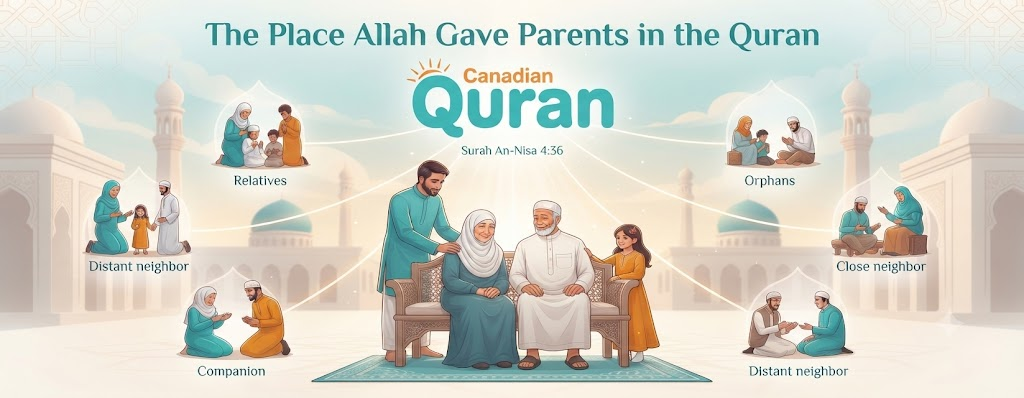
The Place Allah Gave Parents in the Quran
Surah An-Nisa, 4:36 situates the command to honor parents within a complete social ethics:
وَاعْبُدُوا اللَّهَ وَلَا تُشْرِكُوا بِهِ شَيْئًا ۖ وَبِالْوَالِدَيْنِ إِحْسَانًا وَبِذِي الْقُرْبَىٰ وَالْيَتَامَىٰ وَالْمَسَاكِينِ وَالْجَارِ ذِي الْقُرْبَىٰ وَالْجَارِ الْجُنُبِ وَالصَّاحِبِ بِالْجَنبِ وَابْنِ السَّبِيلِ
Waʿbudū-llāha wa lā tushrikū bihī shayʾan wa bi-l-wālidayni iḥsānā wa bidhī al-qurbā wa-l-yatāmā wa-l-masākīn…
“Worship Allah and associate nothing with Him, and to parents do good, and to relatives, orphans, the needy, the near neighbor, the neighbor farther away, the companion at your side, and the traveler…” — Surah An-Nisa, 4:36
The list moves outward from Allah to parents, then to relatives, then to orphans, neighbors, and travelers. This is not a random sequence. The Quran is mapping the expanding circles of moral responsibility — and parents sit at the very first ring, immediately after God. No other human relationship is positioned this close to the divine command.
A Quranic Portrait of the Prophets’ Kindness to Their Parents
One detail that most articles on this topic miss entirely: the Quran describes honoring parents as a quality of the Prophets themselves.
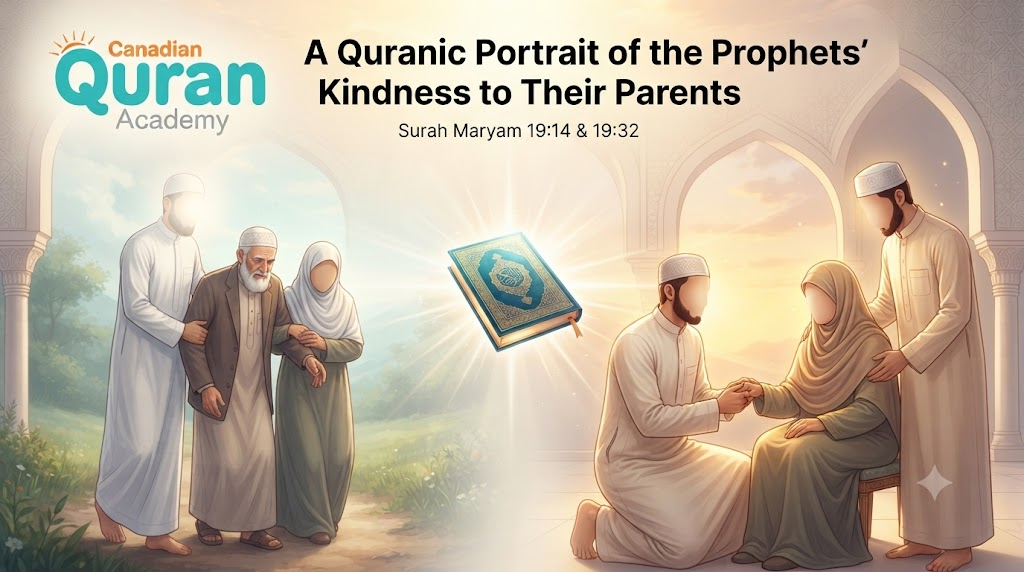
About Prophet Yahya (John) in Surah Maryam, 19:14:
وَبَرًّا بِوَالِدَيْهِ وَلَمْ يَكُن جَبَّارًا عَصِيًّا
Wa barran bi-wālidayhi wa lam yakun jabbāran ʿaṣiyyā.
“And dutiful to his parents, and he was not a tyrant or disobedient.” — Surah Maryam, 19:14
And about Prophet Isa (Jesus) in Surah Maryam, 19:32:
وَبَرًّا بِوَالِدَتِي وَلَمْ يَجْعَلْنِي جَبَّارًا شَقِيًّا
Wa barran bi-wālidatī wa lam yajʿalnī jabbāran shaqiyyā.
“And [made me] dutiful to my mother, and He has not made me a tyrant or wretched.” — Surah Maryam, 19:32
The Arabic word used in both verses is barr (بَرًّا). This is not iḥsān — excellence in conduct. Barr goes further. It describes a vast, encompassing goodness — the same root as al-birr used in the Hadith that equates righteous conduct with birr. That Allah chose to highlight this quality among all the noble traits of Yahya and Isa (peace be upon them) tells us something definitive: being devoted to parents is a prophetic character trait, a mark of the spiritually elevated, not merely a social obligation.
The Quranic Covenant That Commands Honor for Parents
The command to honor parents is not unique to the Ummah of Muhammad ﷺ.
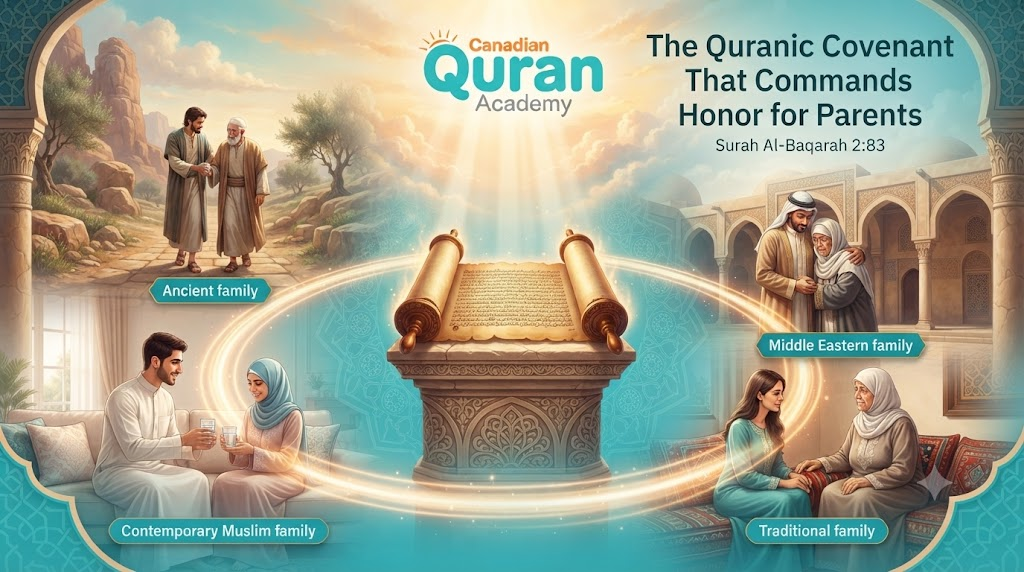
Surah Al-Baqarah, 2:83 records that it was part of the solemn covenant (mīthāq) taken from the Children of Israel:
وَإِذْ أَخَذْنَا مِيثَاقَ بَنِي إِسْرَائِيلَ لَا تَعْبُدُونَ إِلَّا اللَّهَ وَبِالْوَالِدَيْنِ إِحْسَانًا
Wa idh akhadhnā mīthāqa banī isrā’īla lā taʿbudūna illā-llāha wa bi-l-wālidayni iḥsānā.
“And [recall] when We took the covenant from the Children of Israel: Do not worship except Allah, and to parents, good treatment.” — Surah Al-Baqarah, 2:83
This verse establishes a principle that classical scholars like Ibn Kathir emphasized: the obligation of iḥsān toward parents is not a cultural norm or an Islamic innovation. It is a universal divine command that runs through every prophetic tradition. Its placement in the Israelite covenant — alongside the prohibition of shirk — confirms its standing as one of the foundational moral obligations of all revealed religion.
Read More: Quranic Verses on Trust in Allah in Arabic
The Du’a the Quran Places on Every Child’s Lips
Across Surah Al-Isra and Surah Ibrahim, the Quran teaches two specific supplications for parents — both worth memorizing:
From Surah Al-Isra, 17:24:
رَّبِّ ارْحَمْهُمَا كَمَا رَبَّيَانِي صَغِيرًا
Rabbi irḥamhumā kamā rabbayānī ṣaghīrā.
“My Lord, have mercy upon them as they brought me up when I was small.”
From Surah Ibrahim, 14:41:
رَبَّنَا اغْفِرْ لِي وَلِوَالِدَيَّ وَلِلْمُؤْمِنِينَ
Rabbanā ighfir lī wa li-wālidayya wa lil-muʾminīn.
“Our Lord, forgive me and my parents and the believers.”
Both supplications share a structural insight: the person making them is not only asking for their parents — they are placing themselves in the chain of divine mercy alongside them. You cannot sincerely ask Allah to forgive your parents while harboring contempt toward them. The du’a and the conduct it implies are inseparable.
For students who want to memorize and recite these supplications with correct pronunciation and intonation, Tajweed courses at Canadian Quran Academy provide the technical grounding to do so with confidence.
Master Tajweed with a FREE Online Trial Class
Live Class in Action
Watch how our instructors interact with students in real-time, focusing on interactive methods.
Start Your Quranic Journey in Canada
Join our vibrant community and learn with expert tutors through our flexible online platform.
Claim Your Free TrialDeepen Your Understanding of Quran Verses About Parents with Canadian Quran Academy
The Quran’s verses about parents are among its most profound teachings, combining commands, supplications, and timeless lessons on gratitude, mercy, and righteousness. Reading these verses in their original Arabic—and understanding their meanings—allows you to appreciate the depth, precision, and beauty of Allah’s words beyond any translation.
At Canadian Quran Academy, our certified instructors provide personalized one-on-one online Quran classes, helping students across Canada master Quran reading, Tajweed, and Quranic Arabic with confidence. Whether you are just beginning or seeking a deeper connection with the Quran, our flexible programs are designed to support learners of every age and level.
Book your FREE trial class today with Canadian Quran Academy and discover the beauty of the Quran in its original Arabic.
Our Quran Courses
- Quran Hifz Course for Ladies
- Quran Ijazah Program
- Quran Qirat Learning Course
- Quran Tafsir Course
- Noorani Qaida Course
- Noorani Qaida Course for Kids
- Weekend Quran Classes
- Intensive Quran Course
- Al-Azhar Quran Course
- Online Tajweed Classes
- Tajweed Course for Kids
- Tajweed Course for Adults
- Tajweed Course for Ladies
Start Your Quranic Journey in Canada
Join our vibrant community and learn with expert tutors through our flexible online platform.
Claim Your Free TrialConclusion
The Quranic verses about parents in Arabic do not simply command kindness — they construct a complete moral architecture. The obligation begins with iḥsān (excellence in conduct) and qawlan karīmān (noble speech), descends to the prohibition of even a frustrated sigh (uff), extends to the du’a that places parents under Allah’s mercy, and holds firm even when parents apply pressure against one’s faith — without ever permitting the withdrawal of care.
Three things emerge from reading these verses in their Arabic context rather than translation alone. First, the vocabulary the Quran uses — iḥsān, birr, maʿrūf, karīm — each carries a distinct level of moral elevation that single-word translations like “kindness” flatten. Second, the placement of parents immediately after Allah in multiple verses is a structural theological statement, not a rhetorical flourish. Third, the Quran frames this obligation as prophetic — what Yahya did, what Isa said, what the Israelite covenant demanded — giving it a scope that transcends any single tradition or culture.
The invitation of these verses is not to duty alone. It is to an orientation of mercy — toward your parents, toward their Creator, and toward yourself as someone who carries the legacy of their sacrifice.
Frequently Asked Questions
The Quran gives parents a unique and honored status, placing kindness to them among the greatest acts of faith and righteousness. Here are answers to some of the most frequently asked questions about Quranic verses on honoring parents and their meanings.
What is the most important Quranic verse about parents?
The most foundational Quranic verse about parents is Surah Al-Isra, 17:23, which places the command of iḥsān (excellent treatment) toward parents directly after the command to worship Allah alone. It specifies that even a sigh of impatience — the word uff in Arabic — is forbidden toward parents in old age, and commands that children speak to them only with qawlan karīmā (noble speech).
What does the Quran say about the mother specifically?
The Quran singles out the mother’s sacrifice twice with specific vocabulary. In Surah Luqman, 31:14, it describes pregnancy as wahnan ʿalā wahn — “weakness upon weakness.” In Surah Al-Ahqaf, 46:15, it uses the word kurh — hardship and pain — to describe both pregnancy and childbirth. Both verses directly follow with a command to gratitude, linking the mother’s physical sacrifice to the child’s spiritual duty.
Does the Quran require obedience to parents even if they are non-Muslim?
Yes. Surah Luqman, 31:15 explicitly states that even if parents exert intense pressure (jāhada) on their child to commit shirk, the child must not obey that specific command — but must still ṣāḥibhumā fī al-dunyā maʿrūfā (accompany them in this world with appropriate kindness). Religious disobedience in a matter of shirk does not cancel the obligation of kind, caring companionship in worldly life.
What is the Arabic du’a for parents from the Quran?
The primary Quranic du’a for parents is from Surah Al-Isra, 17:24: Rabbi irḥamhumā kamā rabbayānī ṣaghīrā — “My Lord, have mercy upon them as they brought me up when I was small.” A second du’a appears in Surah Ibrahim, 14:41: Rabbanā ighfir lī wa li-wālidayya wa lil-muʾminīn — “Our Lord, forgive me and my parents and the believers.”
Is honoring parents mentioned in the Quran as a universal command?
Yes. Surah Al-Baqarah, 2:83 records that honoring parents with iḥsān was part of the divine covenant (mīthāq) taken from the Children of Israel, placed alongside the prohibition of worshipping other than Allah. This establishes the command as a universal moral obligation across all prophetic traditions, not an instruction unique to Muslims alone.
What is the meaning of iḥsānin the context of parents?
Iḥsān (إِحْسَانًا) in Arabic goes beyond simple “kindness.” Its root carries the meaning of beauty and excellence — doing something at the highest level of quality. In the context of parents, it implies proactive, anticipatory care and generosity of spirit, not merely the absence of harm. Classical scholars understood it as the highest tier of moral conduct: doing good to parents even when they have not asked, and continuing to do so in ways that reflect both love and reverence.



Leave a Reply