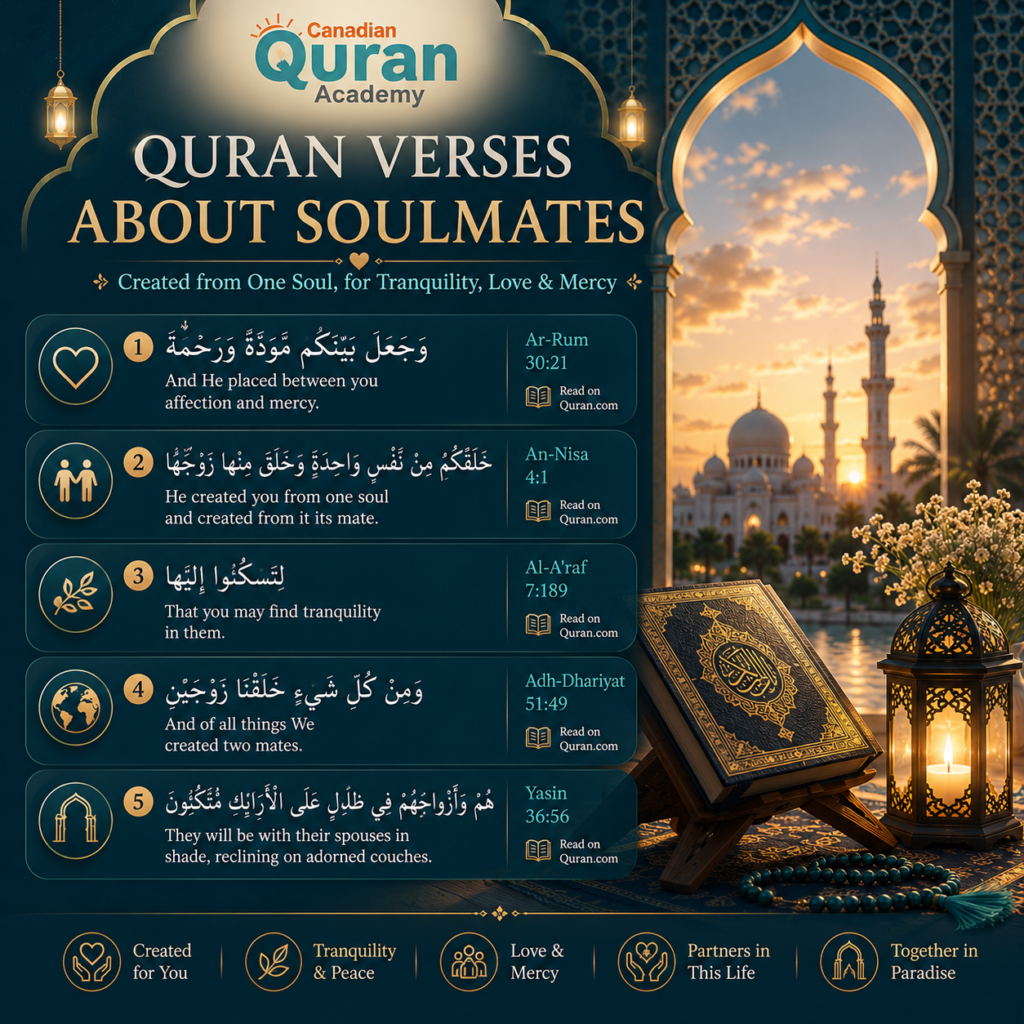
 Quran
Quran
Every Quran verse about love in Arabic carries a rhythm and meaning that a translation alone cannot fully capture. Reading the original Arabic wording — with its tashkeel (vowel marks) — lets you hear how Allah describes love, mercy, and companionship in the exact words revealed to the Prophet Muhammad ﷺ.
This article brings together the most quoted Quran verses about love in Arabic, covering tranquility, mercy, protection, honorable conduct, and the sanctity of the marital bond. Each verse appears here exactly as it is written in the Mushaf, in Arabic and English, with the surah name, ayah number, and a direct link to read the full surah on Quran.com.
Whether you’re preparing a khutbah, studying for your own marriage, or simply want to read the original Arabic text behind these teachings, you’ll find seven verses here with enough detail to actually understand what each one is teaching — not just what it says.
What You’ll Learn in This Article
- Seven Quran verses about love in Arabic, each with tashkeel, translation, and the surah and ayah number
- What these verses teach about tranquility, mercy, protection, and honorable conduct in marriage
- The specific difference between mawaddah and rahmah — two Arabic words most translations flatten into one
- A common mistake people make when trying to memorize verses on love
- Where to go if you want to learn to read or memorize these verses correctly
Quran Verses About Love in Marriage as Tranquility and Mercy
Two ayahs form the foundation of how the Quran frames the marital bond — both describe spouses as a means of finding rest, not just a legal contract.
1. Love and Mercy Between Hearts
One of the Quran’s most beautiful descriptions of marriage is that it is built on tranquility, affection, and mercy—qualities that allow love to endure through every stage of life.
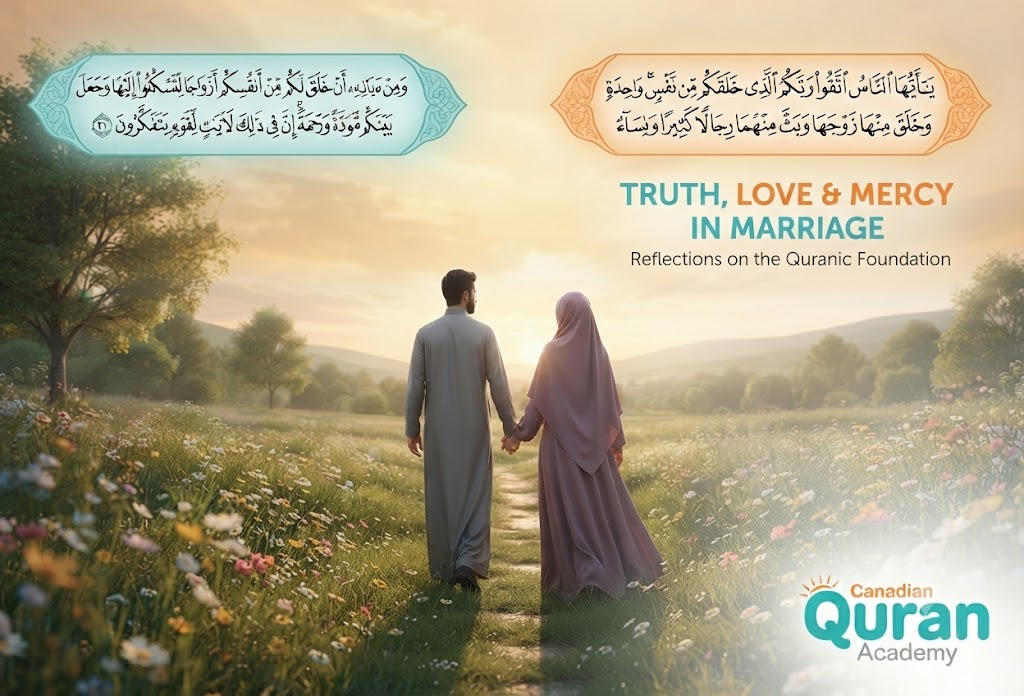
وَمِنْ آيَاتِهِ أَنْ خَلَقَ لَكُم مِّنْ أَنفُسِكُمْ أَزْوَاجًا لِّتَسْكُنُوا إِلَيْهَا وَجَعَلَ بَيْنَكُم مَّوَدَّةً وَرَحْمَةً ۚ إِنَّ فِي ذَٰلِكَ لَآيَاتٍ لِّقَوْمٍ يَتَفَكَّرُونَ
“And among His signs is this: that He created for you mates from among yourselves, that you may dwell in tranquility with them, and He has put love and mercy between your hearts. Verily, in that are signs for those who reflect.” (Surah Ar-Rum, 30:21)
This ayah names two distinct gifts placed between spouses: mawaddah (a warm, affectionate love) and rahmah (mercy — the kind that continues even through a partner’s flaws or hardship). Reflection (tafakkur) is the verse’s own instruction: it asks the reader to think through why a spouse brings calm, rather than to simply accept it as a fact. Classical commentators note that the verse describes spouses as created for one another — the calm isn’t incidental to the relationship, it’s presented as its purpose.
2. Men and Women Are Created From One Soul
Before speaking about the rights and responsibilities of marriage, the Quran reminds us that husband and wife share the same human origin, establishing their relationship on equality, dignity, and a common beginning.
يَـٰٓأَيُّهَا ٱلنَّاسُ ٱتَّقُوا۟ رَبَّكُمُ ٱلَّذِى خَلَقَكُم مِّن نَّفْسٍۢ وَٰحِدَةٍۢ وَخَلَقَ مِنْهَا زَوْجَهَا وَبَثَّ مِنْهُمَا رِجَالًۭا كَثِيرًۭا وَنِسَآءًۭ ۚ وَٱتَّقُوا۟ ٱللَّهَ ٱلَّذِى تَسَآءَلُونَ بِهِۦ وَٱلْأَرْحَامَ ۚ إِنَّ ٱللَّهَ كَانَ عَلَيْكُمْ رَقِيبًۭا
“O mankind, fear your Lord, who created you from one soul and created from it its mate and dispersed from both of them many men and women. And fear Allah, through whom you ask one another, and the wombs. Indeed, Allah is ever, over you, an Observer.” (Surah An-Nisa, 4:1)
This is the opening verse of Surah An-Nisa, and it’s often the first verse cited in a marriage khutbah for exactly this reason: it establishes that every spouse shares a single human origin. The verse moves in three steps — a shared origin, a mate created from it, and then “many men and women” dispersed from that pair — framing marriage as the mechanism through which humanity itself continues, not just a private arrangement between two people.
If you want to recite ayahs like these with correct pronunciation rather than reading them only in translation,Canadian Quran Academy’s Quran reading course walks you through Arabic letter sounds and tajweed rules from the first lesson, so verses like 30:21 and 4:1 are read the way they were revealed.
Book a FREE Trial Class in Our Quran Reading Classes in Canada

Read also: Quran Verses About Life in Arabic
Quran Verses About Love in Arabic on Companionship and Protection
the previous two verses describe why marriage brings peace. These next two describe how that peace is meant to be maintained, practically, once two people are already married.
1. Spouses as Garments for Each Other
The Quran captures the closeness of marriage with a single powerful metaphor, portraying spouses as a source of protection, comfort, and dignity for one another.
هُنَّ لِبَاسٌۭ لَّكُمْ وَأَنتُمْ لِبَاسٌۭ لَّهُنَّ
“They are clothing for you and you are clothing for them.” (Surah Al-Baqarah, 2:187)
A garment does three things: it covers flaws, it protects the wearer, and it sits close to the body. Classical commentators read all three meanings into this verse — spouses are meant to cover each other’s shortcomings from public view, protect each other physically and emotionally, and remain close rather than distant. The metaphor is mutual and reciprocal in the Arabic grammar itself: “they” are clothing “for you,” and “you” are clothing “for them” — the same sentence, applied in both directions.
2. Kindness Over Insisting on Rights
The strongest marriages are not sustained by demanding every right, but by choosing generosity, forgiveness, and kindness whenever possible—a principle the Quran repeatedly encourages.
وَأَن تَعْفُوٓا۟ أَقْرَبُ لِلتَّقْوَىٰ ۚ وَلَا تَنسَوُا۟ ٱلْفَضْلَ بَيْنَكُمْ ۚ إِنَّ ٱللَّهَ بِمَا تَعْمَلُونَ بَصِيرٌ
“And waiving [your right] is nearer to righteousness, so do not forget kindness between one another. Indeed, Allah is Seeing of what you do.” (Surah Al-Baqarah, 2:237)
This verse was revealed in the specific context of divorce settlements, discussing what a husband may waive of the dowry. But its principle is applied far more broadly to marriage in general: choosing kindness over insisting on every entitlement is described here as an act of taqwa (God-consciousness), not simply good manners. The verse closes with a reminder that Allah is watching — placing ordinary marital kindness on the same moral register as worship.
Memorizing verses like these so they come to mind naturally, rather than only reading them once, is a different skill from reading — it’s covered step by step in Canadian Quran Academy’s Hifz program, which builds retention through structured daily revision rather than repetition alone.
Join a FREE Trial Class for Quran Memorization in Canada

Experience Our Classrooms
Don’t just take our word for it—take a look inside! Watch the videos below to experience our engaging teaching methods and vibrant online classrooms firsthand.
Start Your Quranic Journey in Canada
Join our vibrant community and learn with expert tutors through our flexible online platform.
Claim Your Free TrialQuran Verses About Love in Arabic on Honorable Conduct and Boundaries
The Quran presents love as something to be honored, not merely felt. It provides guidance on approaching relationships with dignity, respecting boundaries, and building connections founded on trust, purity, and mutual respect.
1. Proposing With Dignity
Even the first step toward marriage is guided by the Quran with wisdom, teaching that genuine interest should be expressed with patience, respect, and consideration for another person’s circumstances.
وَلَا جُنَاحَ عَلَيْكُمْ فِيمَا عَرَّضْتُم بِهِ مِنْ خِطْبَةِ النِّسَاءِ
“And there is no blame upon you for that to which you indirectly allude concerning a proposal to women…” (Surah Al-Baqarah, 2:235)
This verse addresses a specific situation — expressing interest in marrying a woman who is still in her waiting period (iddah) after widowhood or divorce — and permits indirect, respectful allusion rather than an explicit proposal at that stage. The broader principle drawn from it is that pursuing marriage should be marked by discretion and respect for the other person’s circumstances, not urgency or pressure.
2. Protecting the Sanctity of the Bond
Alongside celebrating love and marriage, the Quran also establishes clear boundaries that protect trust, commitment, and the dignity of intimate relationships.
وَلَا تَقْرَبُوا الزِّنَا إِنَّهُ كَانَ فَاحِشَةً وَسَاءَ سَبِيلًا
“And do not approach unlawful sexual intercourse. Indeed, it is ever an immorality and is evil as a way.” (Surah Al-Isra, 17:32)
Notice the specific wording: the verse says “do not approach” rather than “do not commit.” Commentators point to this as deliberate — the instruction covers the pathway toward the act, not only the act itself, which is why it’s paired with earlier guidance on modesty and lowering the gaze in the same surah. Read alongside the verses on tranquility and mercy above, this ayah marks the boundary that protects what those earlier verses describe: a bond built on trust rather than one exposed to competing claims.
Marriage as the Practice of the Prophets
The lives of the prophets show that marriage is not merely a social institution—it is a noble tradition embraced by those chosen to convey Allah’s message.
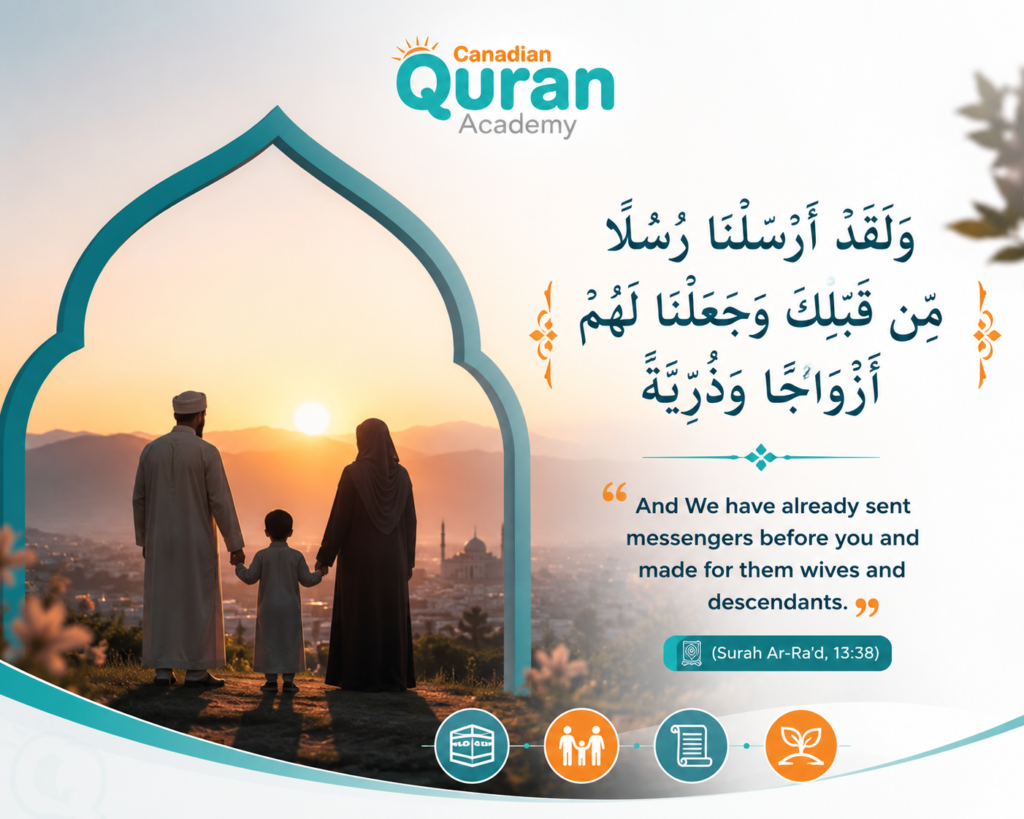
وَلَقَدْ أَرْسَلْنَا رُسُلًۭا مِّن قَبْلِكَ وَجَعَلْنَا لَهُمْ أَزْوَٰجًۭا وَذُرِّيَّةًۭ
“And We have already sent messengers before you and made for them wives and descendants.” (Surah Ar-Ra’d, 13:38)
This verse is often cited to make a specific point: marriage is not treated in the Quran as a lesser or purely worldly concern set apart from prophethood. Every messenger named in this verse had a wife and descendants, which is used to counter the idea — raised by some of the Prophet Muhammad’s ﷺ contemporaries — that a true messenger should live in isolation from ordinary family life.
Read also: Quran Verses About Kindness in Arabic
Why Reading These Verses in Arabic Matters?
This section answers: what changes when you read these verses in the original Arabic rather than only in English? Translation carries meaning; it doesn’t always carry precision. Mawaddah and rahmah in 30:21, for example, are two distinct Arabic words with different roots — most English translations render them both loosely as “love,” which flattens a distinction the ayah is deliberately making. The same is true of khitbah (a formal proposal) in 2:235, which carries legal and social weight in Arabic that “proposal” alone doesn’t convey in English.
A common mistake when memorizing verses on love is treating the Arabic text as something to sound out phonetically from a transliteration, without learning the actual letters. This works for short-term recall but breaks down quickly, because transliteration can’t represent Arabic’s makharij (points of articulation) or tashkeel accurately — two different Arabic letters often get flattened into the same Latin spelling. Someone reading “walaa taqrabuu” phonetically, for instance, has no way to tell from the Latin letters alone which Arabic sound the “q” or the “‘” is meant to represent.
The more reliable route is learning the Arabic alphabet and basic tajweed rules first, then attaching memorization on top of that foundation. This is also why parents introducing these verses to children often start with letter recognition rather than memorization directly — a child who can sound out هُنَّ لِبَاسٌ لَّكُمْ letter by letter retains it longer than one who has only heard it recited aloud. Canadian Quran Academy’s Quran course for kids is built around exactly that sequence.
Live Class in Action
Watch how our instructors interact with students in real-time, focusing on interactive methods.
Start Your Quranic Journey in Canada
Join our vibrant community and learn with expert tutors through our flexible online platform.
Claim Your Free TrialLearn to Read Quran Verses About Love in Arabic with The Canadian Quran Academy
Reading Quran verses about love in Arabic becomes far more meaningful when you can recite the original words with correct pronunciation and understand their meanings without relying solely on translation.
The Canadian Quran Academy offers:
- Qualified Quran teachers with expertise in Tajweed and Quranic Arabic
- Personalized 1-on-1 lessons tailored to your current reading level
- Step-by-step instruction in Quran reading, pronunciation, and Arabic foundations
- Flexible morning, evening, and weekend schedules across Canadian time zones
- A free trial lesson with no obligation
Book your free trial lesson today and begin reading Quran verses about love in Arabic with confidence, proper Tajweed, and a deeper understanding of Allah’s words.

Our Quran Courses
- Quran Online Academy
- Quran Recitation Classes
- Quran Reading Classes
- Online Quran Classes for Kids
- Quran Classes for Adults
- Quran Classes for Female/Sisters
- Learn Quran for Beginners
- Quran Memorization (Hifz) Course
- Hifz Classes for Adults
- Quran Memorization and Hifz for Kids
- Quran Hifz for Ladies
- Quran Ijazah Program
- Quran Qirat Learning Course
- Quran Tafsir Course
- Noorani Qaida Course
- Noorani Qaida Course for Kids
- Weekend Quran Classes
- Intensive Quran Course
- Al-Azhar Quran Course
- Online Tajweed Classes
- Tajweed Course for Kids
- Tajweed Course for Adults
- Tajweed Course for Ladies/Sisters
Start Your Quranic Journey in Canada
Join our vibrant community and learn with expert tutors through our flexible online platform.
Claim Your Free TrialConclusion
The Quran verses about love in Arabic covered here — 30:21, 4:1, 2:187, 2:237, 2:235, 17:32, and 13:38 — build a complete picture of how the Quran frames love: as tranquility and mercy between spouses, as mutual protection and forgiveness, as conduct marked by dignity rather than urgency, and as a bond worth safeguarding.
Reading these verses in their original Arabic, with correct tashkeel and pronunciation, brings out distinctions — like the difference between mawaddah and rahmah, or the precise wording in “do not approach” in 17:32 — that translation alone can miss. Whether your goal is personal reflection, teaching your children, or memorizing the Quran properly, starting with the Arabic text itself is what makes these verses stay with you.
FAQs
What is the most quoted Quran verse about love in Arabic?
Surah Ar-Rum, 30:21 is the most widely quoted verse on love and marriage in Arabic. It describes Allah placing mawaddah (love) and rahmah (mercy) between spouses and is commonly recited at Muslim weddings.
Are Quran verses about love always about marriage?
Most Quran verses that explicitly discuss love in the context of relationships focus on marriage rather than romantic love in general. Verses like 2:187 and 2:237 describe spousal duties and conduct specifically, while 2:235 addresses how a proposal should be approached.
What is the difference between mawaddah and rahmah in Surah Ar-Rum 30:21?
Mawaddah refers to a warm, affectionate love, while rahmah refers to mercy and compassion, especially the kind that continues even through hardship or a partner’s shortcomings. The verse places both between spouses, not one or the other.
Is the “clothing” verse (2:187) only about physical intimacy?
No. While Surah Al-Baqarah 2:187 does address the marital relationship broadly, classical commentary reads the “clothing” metaphor as covering protection, concealment of faults, and closeness — not physical intimacy alone.
Why does Surah Al-Isra 17:32 say “do not approach” instead of “do not commit”?
The Arabic wording deliberately covers the pathway toward the act, not only the act itself. This is why commentators connect it to broader guidance on modesty and conduct, rather than treating it as a single isolated prohibition.







Leave a Reply