 Quran
Quran
Many readers search for the verse in Quran about alcohol in Arabic expecting to find a single ayah. In reality, the Quran addresses alcohol across four separate revelations, each building on the one before it until the prohibition became final and absolute.
Understanding this sequence is the difference between reading one verse in isolation and understanding why Allah chose a gradual path to remove khamr (خمر) — the Arabic term for alcohol and any intoxicating drink — from early Muslim society.
This article gives you the Arabic text, transliteration context, and English meaning of each verse, in the order they were revealed, along with the reasoning classical scholars give for the gradual approach.
At Canadian Quran Academy, our Tafsir instructors are asked about this exact topic often, because it is one of the clearest examples in the Quran of law being introduced in stages rather than all at once.
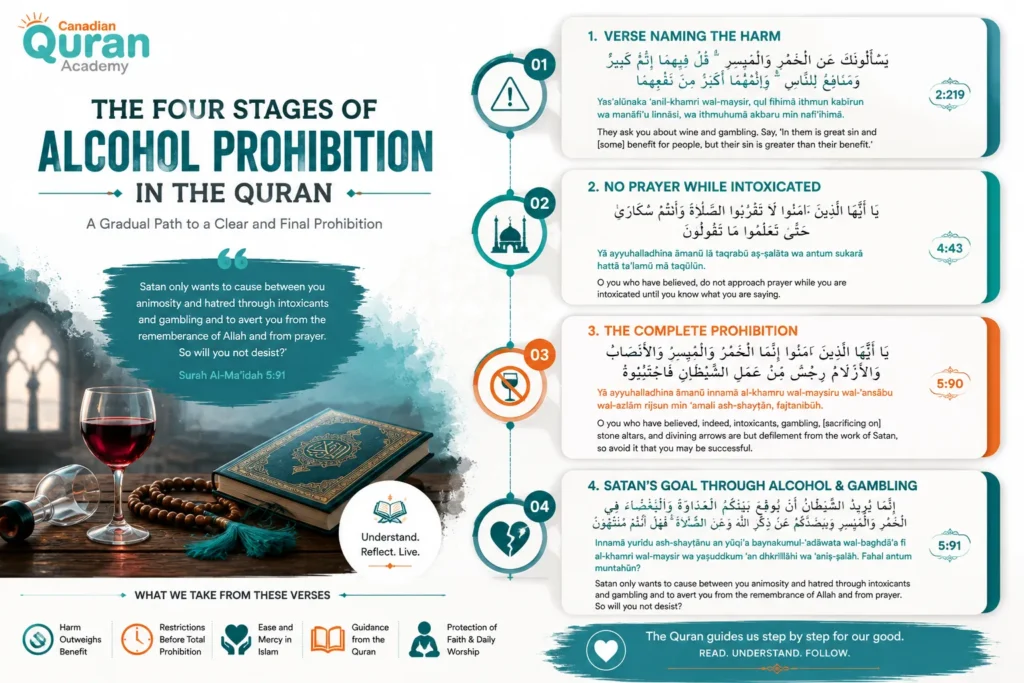
The Four Stages of Alcohol Prohibition in the Quran
Classical exegetes agree that the Quran did not ban alcohol in one announcement. Arabian society at the time of revelation was deeply attached to wine, so Allah addressed it across roughly three to four years, moving from a soft warning to a definitive command. Each stage below quotes the actual verse in quran about alcohol in arabic, followed by its meaning.
1. Verse Naming the Harm
This is the first verse revealed on the subject of alcohol, sent down as a direct answer after the Prophet’s ﷺ companions asked him about khamr and gambling.
يَسْأَلُونَكَ عَنِ الْخَمْرِ وَالْمَيْسِرِ قُلْ فِيهِمَا إِثْمٌ كَبِيرٌ وَمَنَافِعُ لِلنَّاسِ وَإِثْمُهُمَا أَكْبَرُ مِنْ نَفْعِهِمَا
“They ask you about wine and gambling. Say, ‘In them is great sin and [yet, some] benefit for people, but their sin is greater than their benefit.’ (Surah Al-Baqarah 2:219)
This was the first verse revealed on the subject, given as a direct answer after companions asked the Prophet ﷺ about khamr and gambling.
It does not forbid drinking outright; it states plainly that the harm outweighs any social or financial benefit. Some companions stopped drinking after this verse on their own judgment. Others continued, since no explicit prohibition had been given yet — a detail that matters for understanding the next stage.
2. No Prayer While Intoxicated
The second stage narrows the ruling to a specific setting rather than banning alcohol outright, and it was revealed after an incident involving prayer itself.
يَا أَيُّهَا الَّذِينَ آمَنُوا لَا تَقْرَبُوا الصَّلَاةَ وَأَنتُمْ سُكَارَىٰ حَتَّىٰ تَعْلَمُوا مَا تَقُولُونَ
“O you who have believed, do not approach prayer while you are intoxicated until you know what you are saying.” (Surah An-Nisa 4:43)
This verse followed an incident where a companion leading prayer while drunk misread the recitation.
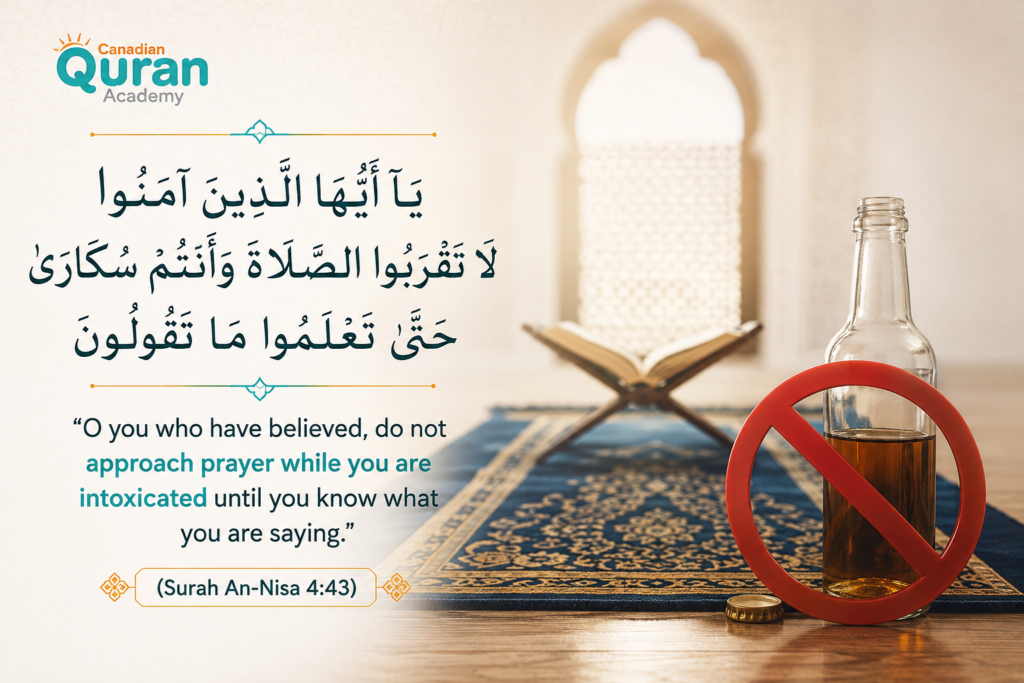
It restricts drinking around the five daily prayers rather than banning it entirely, which in practice pushed many Muslims toward giving it up gradually, since drinking at any point in the day risked overlapping with a prayer time.
Read also: 15 Quran Verses About Prayer In Arabic And English
Read Also: Quran Verses About Hijab in Arabic
3. The Complete Prohibition of Alcohol
The third stage removes every trace of ambiguity left by the first two verses and issues an unconditional command to stay away from alcohol entirely.
يَا أَيُّهَا الَّذِينَ آمَنُوا إِنَّمَا الْخَمْرُ وَالْمَيْسِرُ وَالْأَنصَابُ وَالْأَزْلَامُ رِجْسٌ مِّنْ عَمَلِ الشَّيْطَانِ فَاجْتَنِبُوهُ لَعَلَّكُمْ تُفْلِحُونَ
“O you who have believed, indeed, intoxicants, gambling, [sacrificing on] stone altars, and divining arrows are but defilement from the work of Satan, so avoid it that you may be successful.” (Surah Al-Ma’idah 5:90)
This is the verse most people mean when they search for the verse in quran about alcohol in arabic. It groups alcohol with idol worship and divination as rijs (defilement) and commands Muslims to avoid it entirely, not manage it in moderation.
Live Class in Action
Watch how our instructors interact with students in real-time, focusing on interactive methods.
Start Your Quranic Journey in Canada
Join our vibrant community and learn with expert tutors through our flexible online platform.
Claim Your Free Trial4. Satan’s Goal Through Alcohol And Gambling
The fourth stage explains the reasoning behind the prohibition, tying alcohol directly to broken relationships and neglected prayer, and closes the sequence with a rhetorical question.
إِنَّمَا يُرِيدُ الشَّيْطَانُ أَن يُوقِعَ بَيْنَكُمُ الْعَدَاوَةَ وَالْبَغْضَاءَ فِي الْخَمْرِ وَالْمَيْسِرِ وَيَصُدَّكُمْ عَن ذِكْرِ اللَّهِ وَعَنِ الصَّلَاةِ ۖ فَهَلْ أَنتُم مُّنتَهُونَ
“Satan only wants to cause between you animosity and hatred through intoxicants and gambling and to avert you from the remembrance of Allah and from prayer. So will you not desist?” (Surah Al-Ma’idah 5:91)
Classical commentators read the closing question as the strongest possible form of instruction, since it leaves no room to treat the ruling as open to interpretation.
When this verse was recited, Umar ibn al-Khattab is reported to have responded, “We have stopped, we have stopped,” (Jami` at-Tirmidhi 3049) and companions reportedly emptied jars of wine into the streets of Medina the same day.
Understanding why the Quran took this route requires more than reading the final verse alone — you need the sequence, and that is exactly what a structured Tafsir Course walks through ayah by ayah with supporting hadith and scholarly commentary.
Read also: 15 Quran Verses About Prayer In Arabic And English
Why the Quran Prohibited Alcohol Gradually?
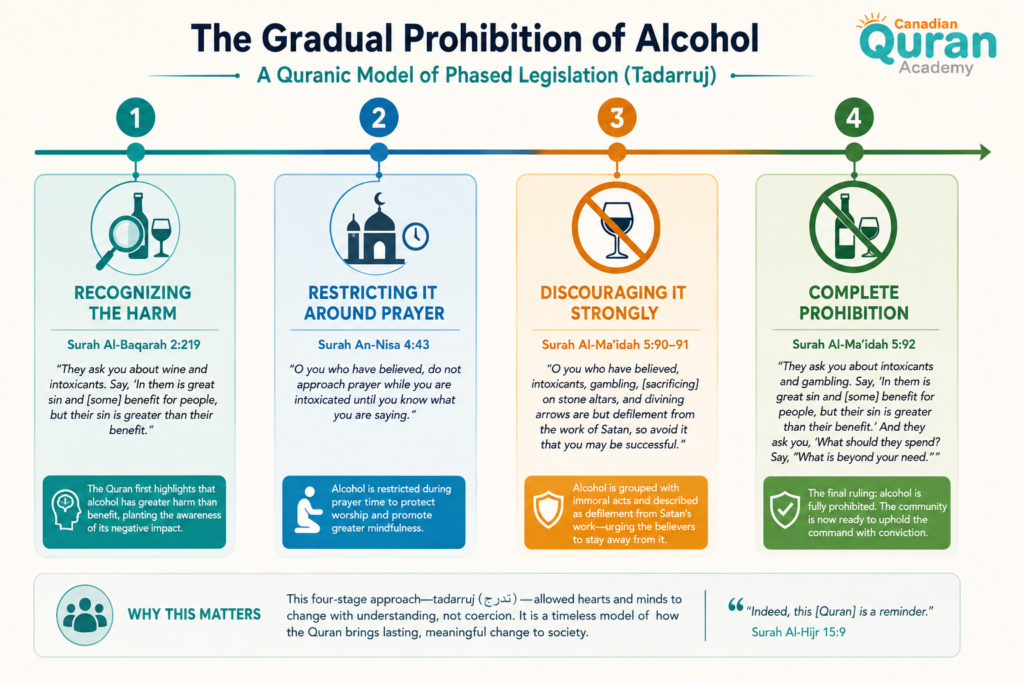
The gradual method here is not a minor detail — it is a recognized principle in Quranic legislation called tadarruj (تدرج), meaning phased implementation. Scholars explain it as a deliberate strategy for changing a deeply rooted social habit without breaking the community.
A habit as entrenched as alcohol consumption in pre-Islamic Arabia could not be removed by decree alone; sudden prohibition on addictive, socially normalized behavior tends to produce resistance or covert continuation rather than genuine change.
By first naming the harm, then restricting it around prayer, then banning it outright, the Quran gave the community time to internalize the reasoning before the final command arrived. This is a pattern practitioners of Islamic law point to when discussing how Sharia rulings on other social matters were introduced — not as an isolated case, but as a model.
Verse In Quran About Alcohol In Paradise
One detail that surprises many readers is that the Quran does mention wine favorably — but only in the description of Paradise, and only in a form entirely distinct from worldly alcohol.
أَنْهَارٌ مِّنْ خَمْرٍ لَّذَّةٍ لِّلشَّارِبِينَ
“Rivers of wine delicious to those who drink.” (Muhammad 47:15)
This verse describes Paradise as containing rivers of khamr that bring pleasure with no negative effect — no loss of reason, no hangover, no sin attached to it.
Classical commentators draw a direct contrast here: the same word, khamr, describes something harmful in this life and something purely enjoyable in the next, precisely because paradisiacal wine carries none of the intoxicating harm that justified its prohibition on earth.
This distinction matters for anyone studying the verse in quran about alcohol in arabic, since it shows the ruling was never about the word itself, but about the harm the substance causes.
Read Also: Quran Verses About Hardship in Arabic
How to Study These Verses in Arabic Properly?
Reading a translation gives you the meaning, but the legal and rhetorical weight of these verses sits in the Arabic wording itself — words like rijs (دفس/رجس, defilement), ijtanibu (فاجتنبوه, “avoid it” — a stronger command than “abstain”), and muntahun (منتهون, “will you desist”) carry force that gets softened in English.
Learning to read these terms directly, with correct tajweed and grammatical understanding, is what separates memorizing a translation from actually understanding revelation.
For readers building this skill from the ground up, Canadian Quran Academy’s Noorani Qaida Course establishes correct letter pronunciation first, and the Online Tajweed Classes then teach the recitation rules that apply directly to verses like Al-Ma’idah 90, where pauses and letter emphasis change how the ruling is voiced aloud.
Adult learners who want a flexible schedule often start with the Weekend Quran Classes or the Intensive Quran Course, depending on how quickly they want to progress.
Experience Our Classrooms
Don’t just take our word for it—take a look inside! Watch the videos below to experience our engaging teaching methods and vibrant online classrooms firsthand.
Start Your Quranic Journey in Canada
Join our vibrant community and learn with expert tutors through our flexible online platform.
Claim Your Free TrialRead also: 12 Quran Verses About Patience In Arabic And English
Study This Verse In Depth With A Qualified Teacher
Reading about the verse in quran about alcohol in arabic is a starting point. Understanding it the way classical scholars intended requires guided study with a teacher who can walk through the Arabic grammar, the reasons for revelation, and the connected hadith.
Canadian Quran Academy’s certified instructors teach exactly this kind of verse-by-verse study in live, one-on-one sessions.

Enroll in the Quran Tafsir Course today and study these four verses — and every other ruling in the Quran — with proper context instead of isolated translations.
Students aiming for certification to teach or lead recitation themselves can also look into the Quran Ijazah Program, which builds on Tafsir and Tajweed study with a formal chain of transmission.
Our Quran Courses:
- Quran Recitation Classes
- Quran Reading Classes
- Online Quran Classes for Kids
- Quran Classes for Adults
- Quran Classes for Female
- Learn Quran Course for Beginners
- Quran Memorization (Hifz) Course
- Hifz Classes for Adults
- Quran Memorization and Hifz Course for Kids
- Quran Hifz Course for Ladies
- Quran Ijazah Program
- Quran Qirat Learning Course
- Quran Tafsir Course

Start Your Quranic Journey in Canada
Join our vibrant community and learn with expert tutors through our flexible online platform.
Claim Your Free TrialConclusion
The verse in quran about alcohol in arabic is not one ayah but four, revealed in sequence over several years: Al-Baqarah 219 named the harm, An-Nisa 43 restricted drinking around prayer, and Al-Ma’idah 90-91 delivered the final, unconditional prohibition.
Surah Muhammad 47:15 then draws the line between worldly khamr and the harmless wine described in Paradise.
Read together, these verses show a deliberate, staged approach to changing behavior rather than an abrupt rule, and reading them in Arabic — not just in translation — is what reveals that reasoning fully.
Canadian Quran Academy’s Tafsir, Tajweed, and Qirat courses are built to help students work through exactly this kind of connected study, verse by verse, with a live instructor.

Frequently Asked Questions
The questions below cover what people most often ask after reading the verse in quran about alcohol in arabic, based on common searches and points the article above may not have fully answered.
Which surah has the main verse about alcohol?
The main and final verse prohibiting alcohol is in Surah Al-Ma’idah, verses 90-91. It states that intoxicants and gambling are “defilement from the work of Satan” and commands Muslims to avoid them completely, unlike the earlier two verses in Al-Baqarah and An-Nisa, which addressed the issue in more limited terms.
What does khamr mean in the Quran?
Khamr (خمر) means any intoxicating drink, not only grape wine specifically. Hadith literature (Bukhari and Muslim) defines it as anything that “covers the intellect,” derived traditionally from grapes, dates, wheat, barley, or honey, and the ruling extends to any substance that produces the same intoxicating effect.
Why didn’t the Quran ban alcohol immediately?
The Quran addressed alcohol in four stages over roughly three to four years because the habit was deeply embedded in Arabian society. This gradual method, known as tadarruj, allowed the community to understand the reasoning before the final, absolute prohibition arrived in Surah Al-Ma’idah.
Does the Quran mention wine in Paradise?
Yes. Surah Muhammad 47:15 describes rivers of khamr in Paradise that bring pleasure with no negative effect. Scholars explain this as an entirely different substance from worldly alcohol, since it carries none of the harm — loss of reason, addiction, disruption of worship — that justified the prohibition on earth.
Is the prohibition of alcohol in the Quran absolute?
Yes. After Surah Al-Ma’idah 90-91 was revealed, the ruling became final and is treated by the vast majority of Islamic legal schools as an unconditional prohibition, with no later verse relaxing it. Earlier verses addressing partial restrictions were superseded by this final ruling.
Where can I study these verses with proper Tafsir?
Canadian Quran Academy offers a dedicated Tafsir Course covering verses like these with full context, alongside Tajweed and Qirat courses for correct recitation. Live instructors guide students through the Arabic text, grammar, and the reasons each verse was revealed.





Leave a Reply