 Arabic
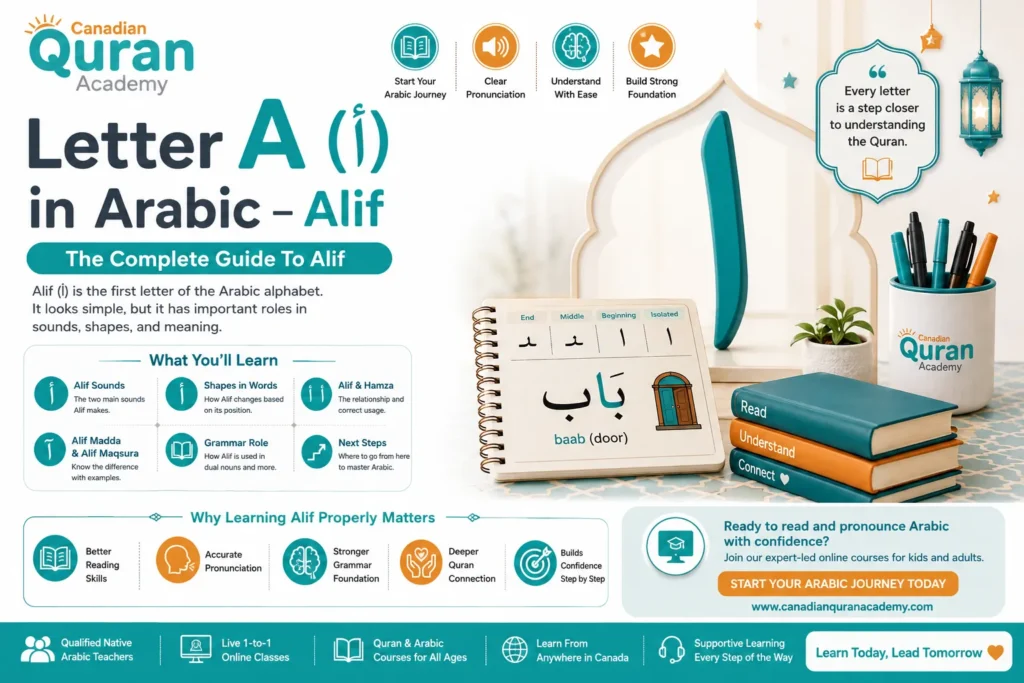
If you’re starting to learn Arabic, the first thing you’ll meet is the letter a in Arabic — Alif (أ), written simply as ا. It’s the very first letter of the Arabic alphabet, and understanding it properly now will save you confusion later, especially once you start reading Quranic Arabic.
At Canadian Quran Academy, this is exactly where every new student’s journey begins. Alif looks like a simple straight line, but it carries several different jobs depending on the marks placed on it and where it sits inside a word. Get those jobs clear from day one, and the rest of the alphabet becomes much easier to read.
This guide walks you through what Alif is, how it sounds, how its shape changes, and how it works in Arabic grammar — with real word examples throughout.
What you’ll learn in this article
- What the letter a in Arabic (Alif) is and the two main sounds it makes
- How Alif changes shape depending on its position in a word
- The relationship between Alif and Hamza (أ, إ, آ)
- The difference between Alif Madda (آ) and Alif Maqsura (ى)
- How Alif functions in Arabic grammar, including the dual noun ending
- Where to go next if you want to learn to read and pronounce Arabic properly
What Is the Arabic Letter Alif (أ)?
Alif is the first letter of the Arabic alphabet, written as a single vertical stroke: ا. It is considered the أ – Letter a in Arabic because it represents the long “aa” vowel sound, similar to the “a” in “father,” and it can also carry a glottal stop sound (Hamza) depending on the marks added to it.
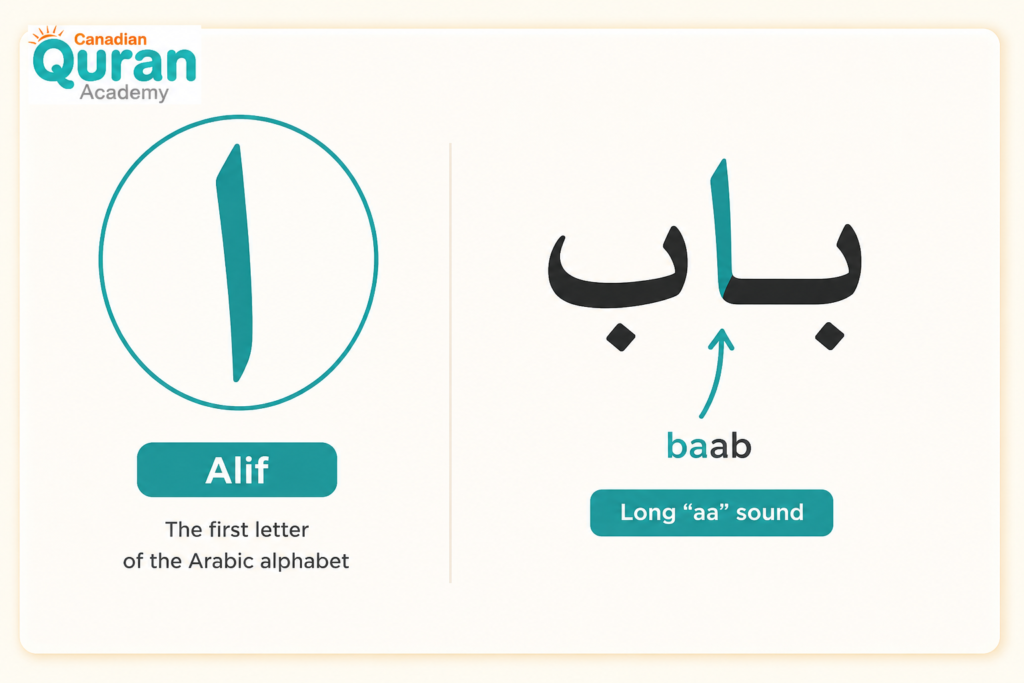
Unlike most Arabic letters, Alif has no dots and no variation for gender or number on its own — its role changes entirely based on context. That’s the first thing to understand: Alif itself is not the Hamza sound. Alif is the “seat” the Hamza sound often sits on, while the Hamza (ء) is the sound itself.
Alif As A Long Vowel
This is Alif’s most common job. When it appears plain, with no Hamza and no other mark, it lengthens the vowel sound of the letter before it.
- بَاب (baab) — door: the Alif stretches the “ba” sound into “baa”
- كِتَاب (kitaab) — book: the Alif stretches the “ta” sound into “taa”
A useful check when reading: if Alif appears in the middle of a word with no small hamza symbol above or below it, read it as a plain elongation of the vowel before it, not as a separate consonant sound.
Alif And The Hamza (أ, إ, آ)
When Alif carries a Hamza, it produces a short, sharp catch in the throat — similar to how English speakers start the word “apple” or “at.” The position of the Hamza mark tells you the vowel sound that follows it.
- Hamza above Alif (أ): pronounced with an “a” or “u” sound — أَرنب (arnab, rabbit), أُذن (uthun, ear)
- Hamza below Alif (إ): pronounced with an “i” sound — إِسلام (Islam)
- Hamza on the line (ء): written on its own between letters — سَمَاء (samaa’, sky)
A quick rule of thumb that helps most beginners: read the mark, not just the letter. Alif on its own is a vowel stretch; Alif with a Hamza above or below is a consonant sound with its own vowel attached.
Read Also: Letter Z ز In Arabic – How To Write, Pronounce, And Master Zay
How Alif Changes Shape in a Word?
Most Arabic letters connect to the letters on both sides of them and shift shape depending on where they sit — beginning, middle, or end of a word. Alif is the exception.
Alif is a non-connector letter. It joins to the letter before it but never connects forward to the letter that follows it, which is why every word containing Alif shows a visible break right after it.
Because Alif doesn’t connect forward, its four positional forms look almost identical, unlike letters such as Baa or Meem, which change shape dramatically:
| Position | Written form |
| Isolated (standalone) | ا / أ / إ |
| Initial (start of word) | ا / أ / إ |
| Medial (middle of word) | ـا / ـأ |
| Final (end of word) | ـا / ـأ |
Why Alif Never Connects To The Next Letter?
This single rule explains a lot of what looks confusing to new readers: whenever you see a small gap right after an Alif inside a word, that’s expected — it’s not a separate word, and it’s not a mistake in the font.
Recognizing non-connector letters early is one of the fastest ways to read Arabic more fluently, because it stops you from trying to force a connection that was never there in the first place.
This is one of the areas where a guided teacher genuinely speeds things up. In the Arabic Course for Beginners at Canadian Quran Academy, instructors walk new readers through every connector and non-connector letter with live correction, rather than leaving students to guess from a chart alone.
Read also: Letter Sad ص In Arabic – How To Pronounce, Write, And Recognize
How to Pronounce the Letter Alif?
Alif’s sound comes from a part of the mouth called جَوف (jawf) — the open, empty space of the throat and mouth. The sound starts from the chest and passes out through the lips without touching the tongue, teeth, or palate, similar to how “A” sounds in the English word “water.”
Pronunciation With Harakat (Fatha, Kasra, Damma)
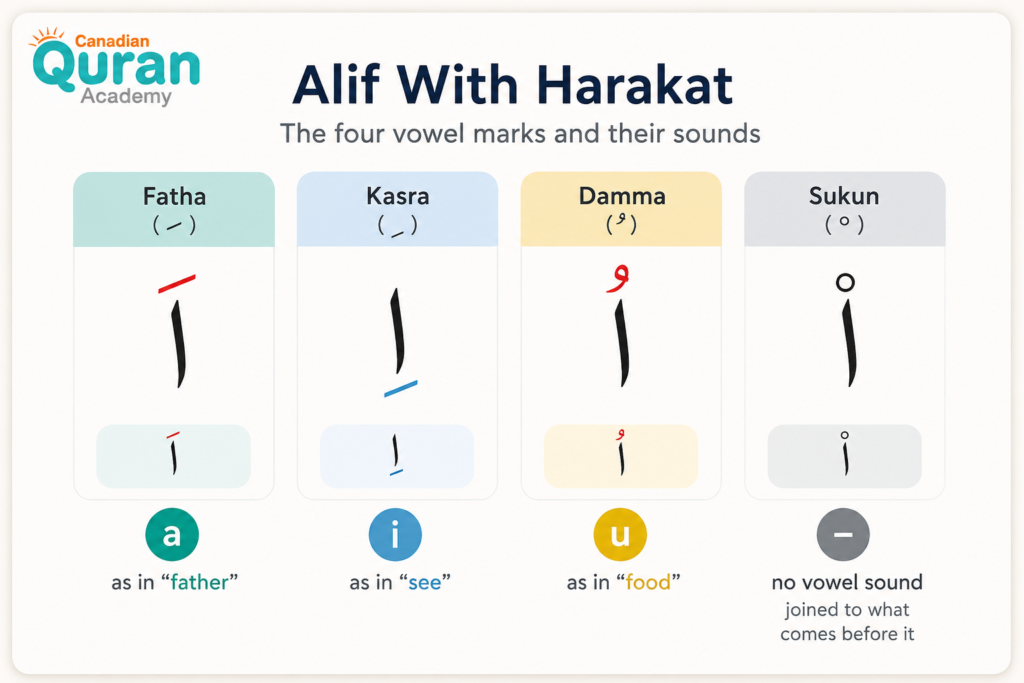
Alif’s exact vowel sound depends on the harakah (vowel mark) attached to the letter before it:
- Fatha (َ) — a short diagonal line above the letter, producing an “a” sound: أَ
- Kasra (ِ) — a short diagonal line below the letter, producing an “i” sound: إِ
- Damma (ُ) — a small comma-like mark above the letter, producing a “u” or “o” sound: أُ
- Sukun (ْ) — a small circle marking no vowel, showing the letter is joined directly to what comes before it
Common Mistakes Learners Make
A pattern practitioners see constantly in beginner classes: students confuse Alif (أ) with the letter Ayn (ع) because both are described as having “no clear point of articulation.”
The real difference is where the sound originates — Alif’s sound comes straight from the chest and is thin, while Ayn’s sound is produced further back, in the middle of the throat (وسط الحلق), and is noticeably thicker. Listening to both letters side by side, rather than reading a description of them, is what actually fixes this for most learners.
This kind of correction is hard to get right from an app or a static PDF, which is exactly why live pronunciation feedback matters.
If you’re serious about reading and reciting properly, the Quranic Arabic Course at Canadian Quran Academy pairs you with a teacher who corrects these sounds in real time, session by session.
Read Also: How To Learn Arabic In 5 Minutes In Canada?
Live Class in Action
Watch how our instructors interact with students in real-time, focusing on interactive methods.
Start Your Quranic Journey in Canada
Join our vibrant community and learn with expert tutors through our flexible online platform.
Claim Your Free Trial
Alif Madda (آ) and Alif Maqsura (ى): Knowing the Difference
Alif has two special variant forms that often confuse learners because they look unrelated to the basic ا shape.
Alif Madda (آ)
Alif Madda is technically a Hamza followed immediately by a plain Alif. Rather than writing them separately as “أا,” Arabic combines them into a single character topped with a wavy line: آ.
- آن (aan) — now
- قُرْآن (qur’aan) — Quran
Alif Maqsura (ى)
Alif Maqsura looks like the letter Yaa (ي) but without the two dots underneath. Despite the different shape, it makes the exact same long “aa” sound as a regular Alif — it’s a spelling convention used at the end of certain words, not a different sound.
- مُسْتَشْفَى (mustashfaa) — hospital
- حَتَّى (hattaa) — until
Knowing these two forms matters for reading fluency: if you only memorize the plain ا shape, both آ and ى will look like unrelated letters the first time you meet them in a real text, even though one is a Hamza-Alif combination and the other is simply an alternate spelling of the same long vowel.
Alif in Arabic Grammar
Beyond its role as a letter, Alif shows up in specific grammatical functions that Arabic learners run into once they move past the alphabet stage.
1. Alif al-Fariqa (The Differentiating Alif)
This is a small, silent Alif added after certain verbs ending in the plural “waw,” such as كتبوا (katabu — they wrote). It isn’t pronounced at all; its only job is to visually mark that the preceding waw is a plural verb ending, not a root letter of the word. Leaving it out is a common spelling mistake among learners writing Arabic for the first time.
2. Alif al-Tathniya (The Dual Alif)
Arabic has a grammatical form for exactly two of something — the dual — and Alif marks it at the end of a noun: قَلَمَان (qalamaan, two pens), كِتَابَان (kitaaban, two books). This is one of the features that sets Arabic apart from English grammar, since English only distinguishes singular and plural, with nothing in between.
Grammar details like these are where a structured curriculum pays off, rather than piecing rules together from scattered sources.
The Arabic Grammar Course at Canadian Quran Academy covers the dual, the differentiating Alif, and the rest of Arabic’s grammatical structure in sequence, building on what you already know rather than jumping around.
Read also: Quranic Verses About Parents in Arabic
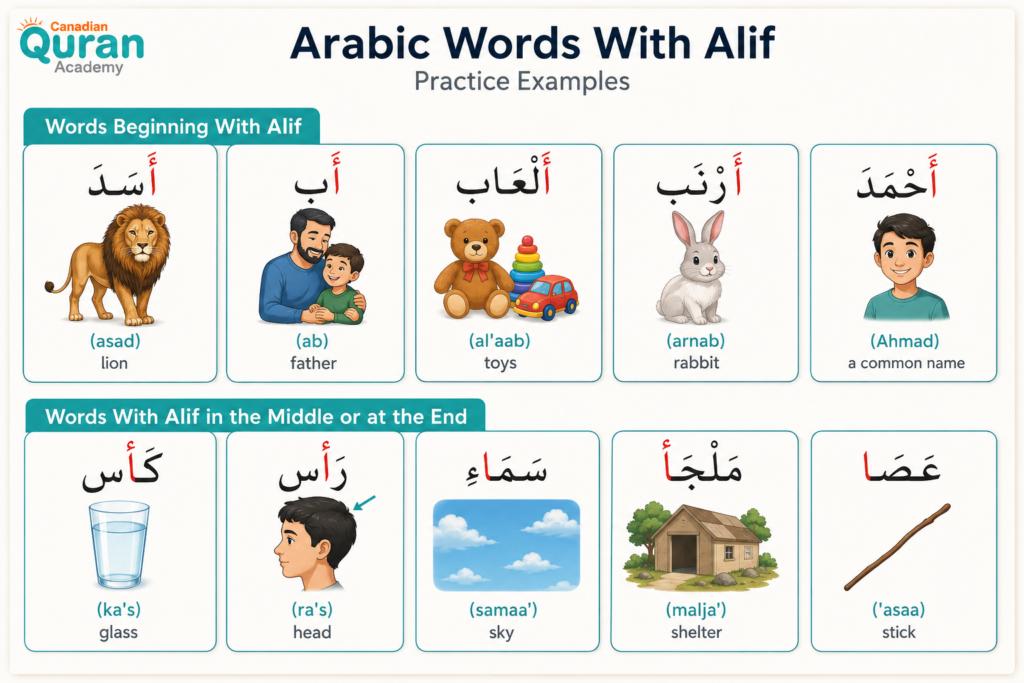
Arabic Words With the Letter Alif (Practice Examples)
Seeing the أ – Letter a in Arabic across real vocabulary is what turns rule memorization into actual reading ability.
Words Beginning With Alif:
- أَسَد (asad) — lion
- أَب (ab) — father
- أَلْعَاب (al’aab) — toys
- أَرْنَب (arnab) — rabbit
- أَحْمَد (Ahmad) — a common name
Words With Alif in the Middle or at the End:
- كَأْس (ka’s) — glass
- رَأْس (ra’s) — head
- سَمَاء (samaa’) — sky
- مَلْجَأ (malja’) — shelter
- عَصَا (‘asaa) — stick
One detail worth knowing early: Arabic nouns carry grammatical gender, and this affects the verb form used with them.
أب (ab, father) is masculine, while نافذة (nafidhah, window) is feminine — a distinction that has no direct equivalent in English and trips up a lot of new learners the first time they build a full sentence.
Read Also: The Arabic Letter Ha (ح)
Experience Our Classrooms
Don’t just take our word for it—take a look inside! Watch the videos below to experience our engaging teaching methods and vibrant online classrooms firsthand.
Start Your Quranic Journey in Canada
Join our vibrant community and learn with expert tutors through our flexible online platform.
Claim Your Free TrialStart Learning Arabic With Canadian Quran Academy Today
Reading about the letter a in Arabic is a good start — reading it out loud with a teacher who corrects you in real time is what actually makes it stick.
Canadian Quran Academy runs live, one-on-one online classes that take you from the very first letter, Alif, all the way through to reading, writing, and understanding full sentences.
Whether you’re a complete beginner, want to focus on Classical Arabic, or you’re ready to move into an Advanced Arabic Course, there’s a class built for where you are right now. Book a session and get personal feedback on your Alif, your Hamza, and every letter after it.
Our Arabic Courses:
- Online Arabic Academy
- Online Arabic Course
- Classical Arabic Course
- Arabic Course for Beginners
- Advanced Arabic Course
- Quranic Arabic Course
- Arabic Grammar Course
- Modern Standard Arabic Course
- Arabic Conversation / Speaking Course
- Intensive Arabic Course
- Online Arabic Classes for Kids
- Arabic Classes for Adults

Start Your Quranic Journey in Canada
Join our vibrant community and learn with expert tutors through our flexible online platform.
Claim Your Free TrialConclusion
The letter a in Arabic, Alif (أ), is far more than the first symbol in the alphabet. It functions as a long vowel, as the seat for the Hamza sound, and even as a grammatical marker for the dual noun form — three different jobs carried by one simple stroke, ا.
Once you can tell a plain Alif apart from a Hamza-carrying Alif, and recognize Alif Madda (آ) and Alif Maqsura (ى) on sight, reading Arabic script stops feeling like decoding and starts feeling like reading.
That foundation is exactly what Canadian Quran Academy builds with every new student, one letter at a time, with a real teacher checking your pronunciation as you go.

Frequently Asked Questions
The questions below cover what learners most often ask about the letter a in Arabic after their first lessons on Alif — from its basic sound to how it behaves in grammar and in Quranic reading.
1. What does the letter a in Arabic sound like?
The letter a in Arabic, Alif (أ), makes a long “aa” sound similar to the “a” in “father” when it appears plain, or a sharp glottal stop similar to the “a” in “apple” when it carries a Hamza (أ, إ).
2. Is Alif the same as Hamza?
No. Alif (ا) is the letter itself, while Hamza (ء) is a separate sound that can sit above, below, or on the same line as an Alif. Alif without any Hamza mark is simply a long vowel stretch, not a consonant sound.
3. What is the difference between Alif Madda and Alif Maqsura?
Alif Madda (آ) is a combined Hamza-plus-Alif written as one character with a wavy line on top, as in قُرْآن (Quran). Alif Maqsura (ى) looks like an undotted Yaa but makes the same long “aa” sound as a regular Alif, usually at the end of a word.
4. Why doesn’t Alif connect to the next letter?
Alif is a non-connector letter in Arabic script. It always joins to the letter before it but never links forward to the letter that follows, which is why a visible gap appears right after every Alif inside a word.
5. How can I practice writing and pronouncing Alif?
Practice writing ا in its isolated and connected forms, then read it aloud in real words like بَاب (baab) and أَسَد (asad) to hear both of its main sounds. Structured feedback from a teacher, such as in the Online Arabic Course at Canadian Quran Academy, catches mistakes that self-study alone often misses.
6. Do I need to learn Alif before starting Quranic Arabic?
Yes. Alif appears constantly in Quranic text, including in the word قُرْآن itself, and its correct pronunciation directly affects tajweed rules around vowel length. Canadian Quran Academy’s Quranic Arabic Course builds directly on solid letter recognition, starting with Alif.






Leave a Reply