 Arabic
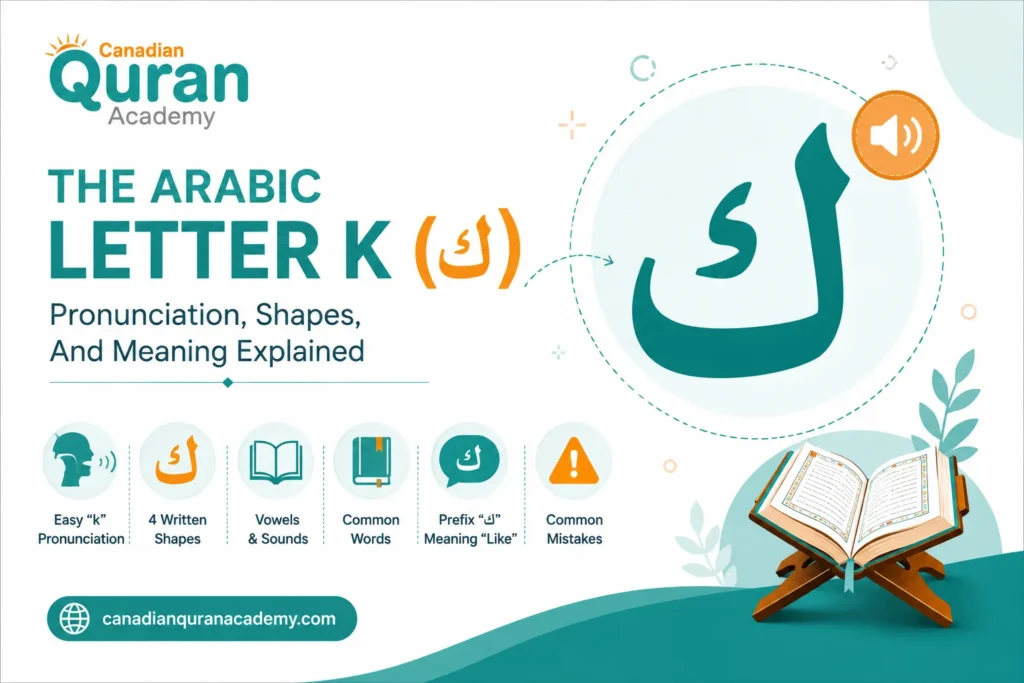
If you’ve just started learning Arabic, meeting the letter K is good news. The Arabic letter K — written ك and named Kaf — is the 22nd letter of the Arabic alphabet, and it sounds almost exactly like the English “k” in “kite” or “book.”
At Canadian Quran Academy, our instructors consistently see beginner students master this letter faster than almost any other, simply because it doesn’t require a new tongue position or an unfamiliar sound.
This guide covers how to pronounce ك correctly, how its shape changes depending on where it sits in a word, how it functions grammatically, and the common mistakes that trip up new learners. By the end, you’ll be able to recognize and read the Arabic letter K with confidence.
What You’ll Learn in This Article
- How to pronounce Kaf (ك) and why it’s easy for English speakers
- The four written forms of Kaf: isolated, initial, medial, and final
- How Kaf changes sound and appearance with short and long vowels
- Common words that use Kaf, from كتاب (book) to شكراً (thank you)
- The grammatical role of ك as a prefix meaning “like” or “as”
- The most common mistakes learners make with this letter, and how to avoid them
How To Pronounce The Arabic Letter K (ك)
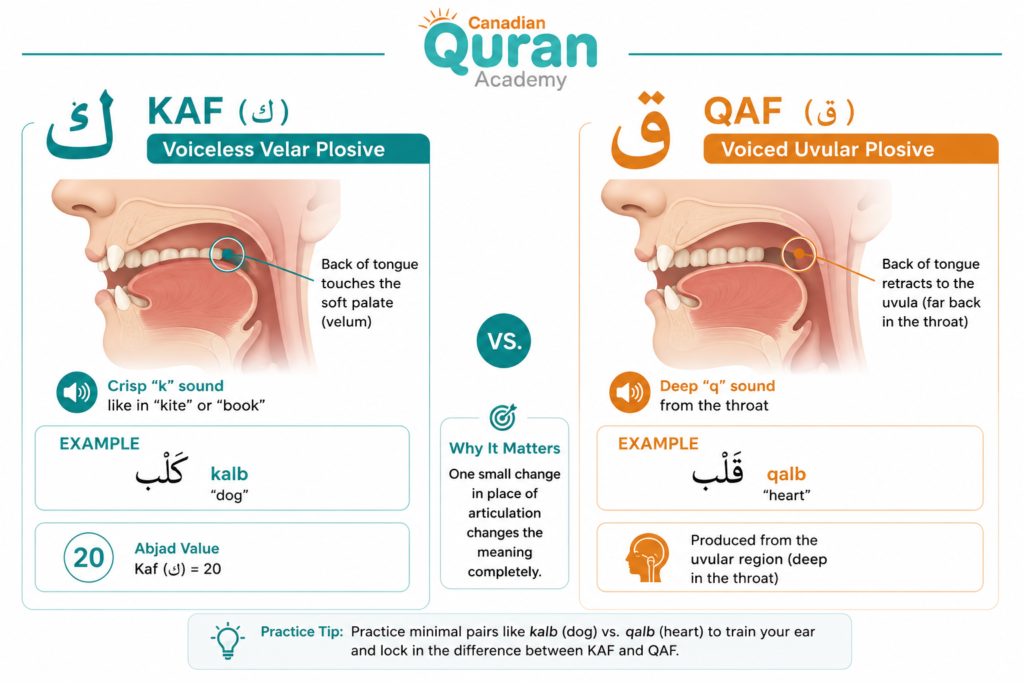
Kaf (ك) is a voiceless velar plosive — a crisp “k” sound produced by raising the back of your tongue to touch the soft palate (the velum, at the back of the roof of your mouth) and releasing a short burst of air. It is the exact same mechanism English speakers already use for the “k” in “kite,” “book,” or “take.”
In the Abjad numeral system, Kaf carries the numerical value of 20, a detail that shows up in classical Arabic manuscripts and numbering systems that predate Arabic numerals.
Because the sound transfers directly from English, Kaf is one of the letters where beginners can skip the usual trial-and-error period.
This is exactly the kind of quick, early win our Arabic Course for Beginners is built around: master the accessible letters first, then build toward the sounds that don’t exist in English.
Kaf Vs. Qaf: Two Letters That Are Easy To Confuse
Kaf is often mixed up with Qaf (ق), a completely different letter pronounced much deeper in the throat, from the uvular region.
The distinction matters because it changes meaning entirely.
كلب (kalb) means “dog,” while قلب (qalb) means “heart.” Practicing minimal pairs like these — words that differ only by this one letter — is the fastest way to train your ear to hear the difference.
Read Also: How To Learn Arabic For Quran In Canada?
The Four Written Forms Of Kaf
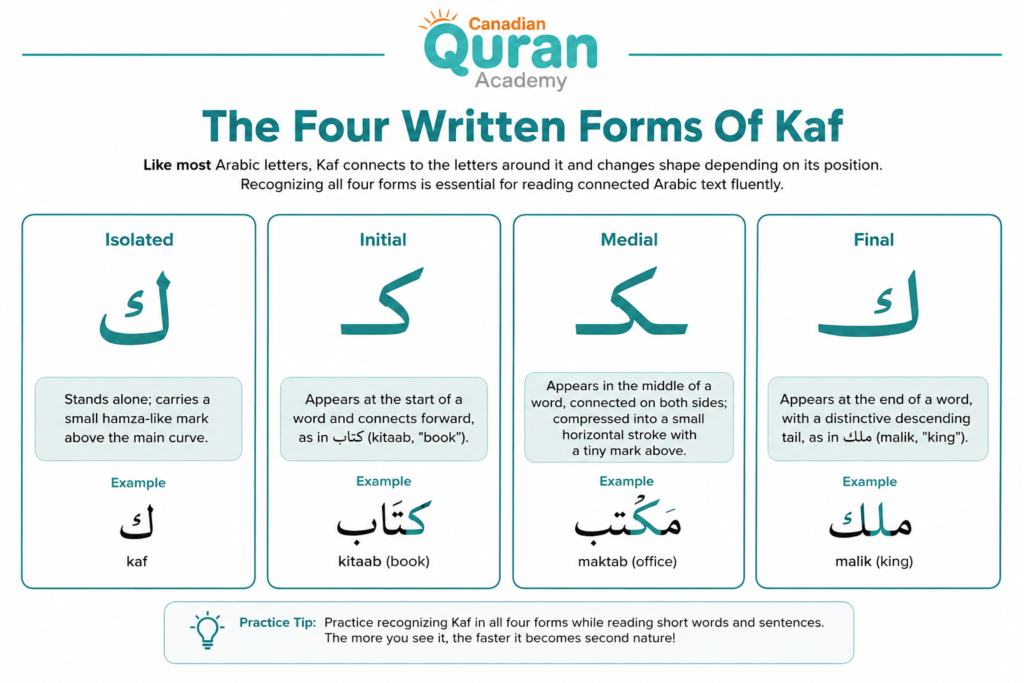
Like most Arabic letters, Kaf connects to the letters around it and changes shape depending on its position in a word. Recognizing all four forms is essential for reading connected Arabic text fluently.
| Position | Shape | Description |
| Isolated | ﻙ | Stands alone; carries a small hamza-like mark above the main curve. |
| Initial | ﻛ | Appears at the start of a word and connects forward, as in كتاب (kitaab, “book”). |
| Medial | ﻜ | Appears in the middle of a word, connected on both sides; compressed into a small horizontal stroke with a tiny mark above it. |
| Final | ﻚ | Appears at the end of a word, with a distinctive descending tail, as in ملك (malik, “king”). |
The bridge between these shapes is what makes reading Arabic feel difficult at first. Once you can spot Kaf in all four positions without hesitating, entire pages of text start to move faster.
Common Mistakes When Learning Kaf
Most learners run into the same three problems, and knowing them in advance saves a lot of frustration.
The medial form (ﻜ) is the most frequently missed, since it shrinks down to a small line with a tiny mark and bears little resemblance to the isolated letter. Repeated tracing of words like مكتب (maktab, “office” or “desk”) and سكن (sakana, “to reside”) is the most reliable fix.
Confusing Kaf with Qaf is the second common error, since both letters can look similar to an untrained eye in certain handwriting styles. Remembering that Kaf carries one small mark while Qaf carries two dots above it helps the distinction stick.
The third mistake is treating the prefixed ك as part of a word’s root rather than as a separate grammatical particle. We cover exactly this in the next section.
Read also: How To Pronounce The Arabic Letter Tha (ث) – A Complete Guide
Kaf with Short and Long Vowels (Harakat)
Kaf’s sound stays consistent no matter which vowel mark (harakat) is attached to it — only the vowel sound changes.
| Vowel | Form | Example | Meaning |
| Fatha (ke as “a”) | كَ | كَلْب (kalb) | dog |
| Damma (ke as “u”) | كُ | كُرَة (kurah) | ball |
| Kasra (ke as “i”) | كِ | كِتَاب (kitaab) | book |
| Sukoon (no vowel) | كْ | مَكْتَب (maktab) | office / desk |
Long vowels extend the same sound further: كَانَ (kaana, “he was”), كُوخ (kookh, “hut”), and سِكِّين (sikkeen, “knife”) all keep the same crisp “k” articulation regardless of length.
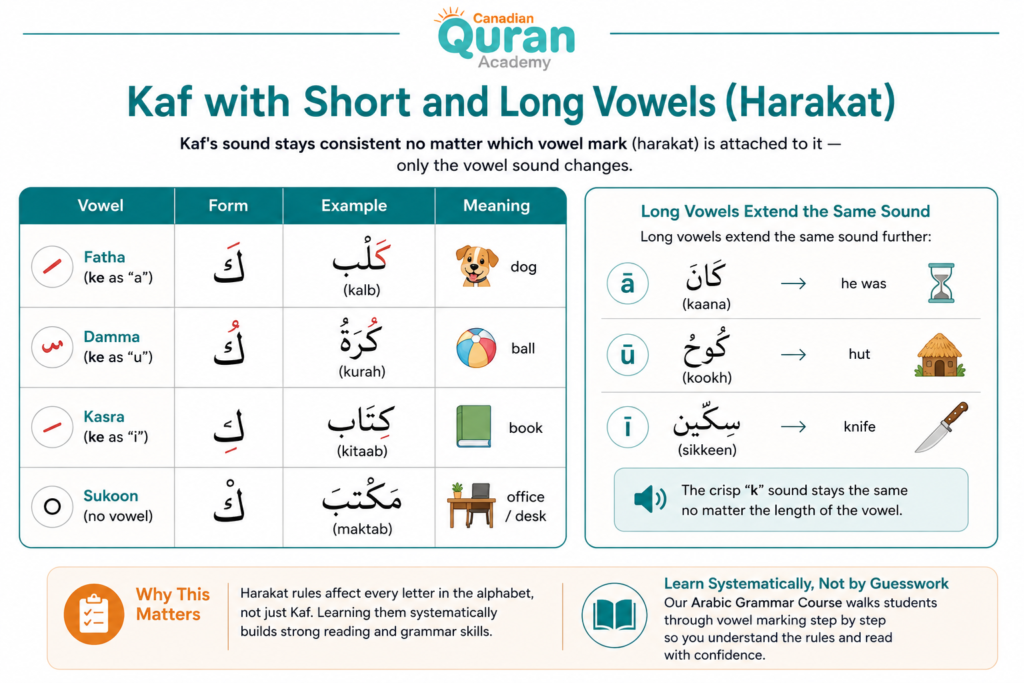
This is where structured grammar training pays off, since harakat rules affect every letter in the alphabet, not just Kaf. Our Arabic Grammar Course walks students through vowel marking systematically instead of leaving it to guesswork.
Live Class in Action
Watch how our instructors interact with students in real-time, focusing on interactive methods.
Start Your Quranic Journey in Canada
Join our vibrant community and learn with expert tutors through our flexible online platform.
Claim Your Free TrialCommon Words That Start With or Contain Kaf
Building vocabulary around a letter is one of the fastest ways to make it stick. These words appear constantly in everyday Arabic:
- كتاب (kitaab) — book
- كلب (kalb) — dog
- كبير (kabiir) — big / large
- ملك (malik) — king
- سمك (samak) — fish
- كرة (kura) — ball
- كوب (koob) — cup / glass
- شكراً (shukran) — thank you
Notice that شكراً places Kaf in its compressed medial form, making it excellent practice for the exact recognition skill covered above.
Read Also: Letter Ghayn In Arabic غ – Pronunciation, Positions, And Meaning
The Grammatical Role Of Kaf As “Like” Or “As”
Beyond being a regular consonant, Kaf (ك) also functions as a standalone grammatical particle when prefixed to a word, where it means “like,” “as,” or “similar to.”
For example, كالماء (ka-l-maa’) means “like water,” and جميل كالقمر (jamiil ka-l-qamar) means “beautiful like the moon” — a construction that runs throughout classical Arabic poetry and everyday speech alike.
Kaf can also attach to the end of a word as a suffix pronoun meaning “your” or “you,” as in kitabuk (“your book”). When you see ك at the start of a word, especially one following another word, it’s worth pausing to ask whether it’s functioning as this comparative particle rather than part of the root.
This dual role — consonant and grammatical particle — is exactly the kind of detail our Classical Arabic Course focuses on, since recognizing it changes how you read entire sentences, not just single words.
Read Also: Letter Ghayn In Arabic غ – Pronunciation, Positions, And Meaning
Regional Pronunciation: When Kaf Sounds Like “Ch”
Modern Standard Arabic keeps Kaf’s pronunciation consistent as a clear “k,” but several regional dialects handle it differently.
In parts of the Levant and in some Gulf and Bedouin dialects, Kaf can shift toward a “ch” sound (as in “church”) in certain grammatical contexts, particularly with the feminine possessive suffix كِ (“your,” feminine). This is a dialectal shift in pronunciation, not a change to the letter itself.
For learners, the practical order is to master the Modern Standard Arabic “k” sound first, since it’s the form used in media, formal writing, and communication across the Arab world. Our Modern Standard Arabic Course is built around exactly this foundation, so dialectal variations become easy additions later rather than sources of confusion now.
Read Also: How To Pronounce The Arabic Letter Tha (ث)
Experience Our Classrooms
Don’t just take our word for it—take a look inside! Watch the videos below to experience our engaging teaching methods and vibrant online classrooms firsthand.
Start Your Quranic Journey in Canada
Join our vibrant community and learn with expert tutors through our flexible online platform.
Claim Your Free TrialStart Learning Arabic Letters With Canadian Quran Academy Today
Reading Arabic fluently comes down to recognizing every letter’s forms instantly, and Kaf is one of the best letters to start building that skill on.
Canadian Quran Academy’s live, one-on-one classes take you through the entire alphabet with the same structured approach used in this guide — pronunciation, written forms, vowel marking, and grammar, all in order.

Book a free trial class with Canadian Quran Academy and start reading Arabic with real confidence, not guesswork.
Our Arabic Courses:
- Online Arabic Academy
- Online Arabic Course
- Classical Arabic Course
- Arabic Course for Beginners
- Advanced Arabic Course
- Quranic Arabic Course
- Arabic Grammar Course
- Modern Standard Arabic Course
- Arabic Conversation / Speaking Course
- Intensive Arabic Course
- Online Arabic Classes for Kids
- Arabic Classes for Adults

Start Your Quranic Journey in Canada
Join our vibrant community and learn with expert tutors through our flexible online platform.
Claim Your Free TrialConclusion
The ك – Arabic letter k written ك and pronounced Kaf, is one of the most approachable letters in the entire Arabic alphabet for English speakers. Its sound matches the English “k” exactly, its four written forms follow a learnable pattern once you’ve seen them side by side, and its grammatical role as the comparative particle “like” adds real depth once you notice it in context.
Keep practicing the medial form specifically, since it’s the one most likely to slip past you in connected text, and keep the Kaf-versus-Qaf distinction sharp since it changes word meaning entirely.
With consistent practice — the kind Canadian Quran Academy structures into every beginner course — the Arabic letter K becomes an automatic part of your reading and writing within a matter of weeks.

Frequently Asked Questions About the Arabic Letter K
Here are quick, direct answers to the questions learners ask most often about Kaf and its use in Arabic.
1. What does the Arabic letter K sound like?
Theك – Arabic letter k / Letter k in Arabic sounds exactly like the English “k” in “kite” or “book.” It’s a voiceless velar plosive, made by touching the back of the tongue to the soft palate and releasing a short burst of air.
2. Is Kaf the same as Qaf?
No, Kaf (ك) and Qaf (ق) are different letters with different sounds. Kaf matches the English “k,” while Qaf is produced deeper in the throat and has no direct English equivalent.
3. How many written forms does Kaf have?
Kaf has four forms depending on its position in a word: isolated (ﻙ), initial (ﻛ), medial (ﻜ), and final (ﻚ). Each form connects differently to the surrounding letters.
4. What does the prefix ك mean in Arabic grammar?
When attached to the front of a word, ك functions as a comparative particle meaning “like” or “as,” as in كالقمر (ka-l-qamar, “like the moon”). It is separate from Kaf’s role as a regular consonant.
5. Why does Kaf sometimes sound like “ch”?
In certain Levantine, Gulf, and Bedouin dialects, Kaf can shift toward a “ch” sound in specific grammatical contexts, especially with the feminine possessive suffix. This is a dialectal variation rather than a change to Modern Standard Arabic pronunciation.
6. Is the Arabic letter K hard to write?
Kaf is considered one of the easier letters to write once its four forms are learned, though the compressed medial form takes extra practice to recognize in connected text. Repeated tracing of common words like كتاب and مكتب speeds up recognition significantly.






Leave a Reply