 Arabic
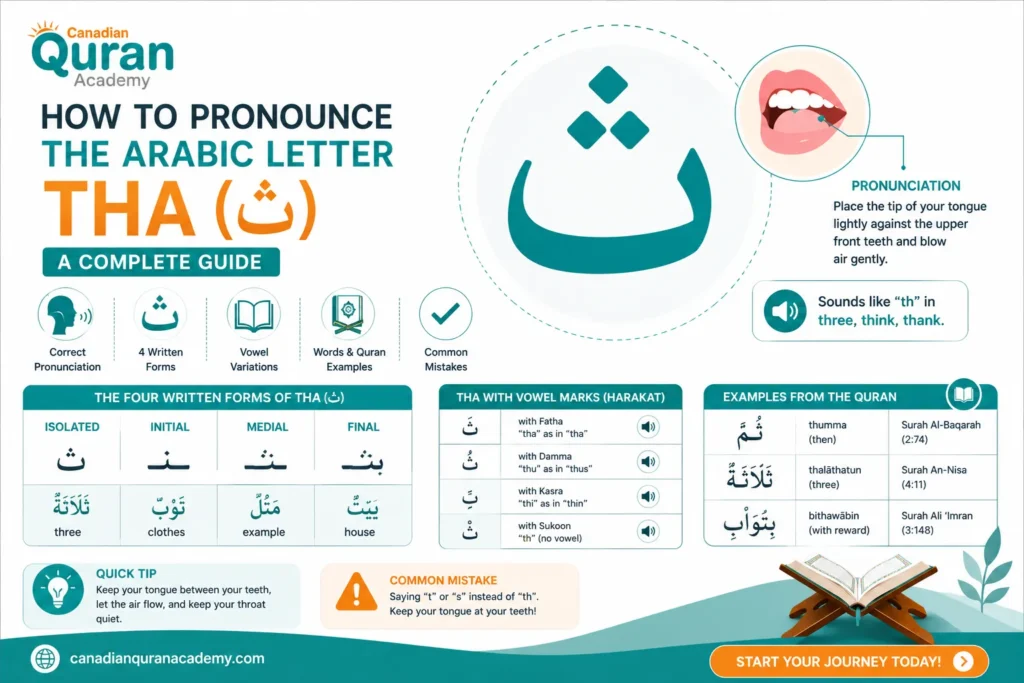
Say the English word “three” out loud. That soft, breathy sound at the start is almost identical to the Arabic letter tha (ث) — yet most new learners still mispronounce it as a hard “t” or a sharp “s.” Getting the Arabic letter tha right matters for more than accent: in Quranic recitation, swapping tha for a similar-sounding letter can change the meaning of a word entirely.
This guide walks you through everything you need to pronounce, write, and recognize the Arabic letter tha (ث) with confidence — the correct tongue position, its four written forms, how it behaves with vowel marks, and the words where you’ll meet it most often.
At Canadian Quran Academy, this is exactly the kind of foundational Tajweed detail our instructors correct in the first few lessons, because it’s easy to get wrong and just as easy to fix once you know what to listen for.
What you’ll learn in this article
- How to correctly place your tongue and teeth to produce the tha (ث) sound
- The four written forms of tha and how they connect to surrounding letters
- How tha changes sound with each Arabic vowel mark (harakat)
- Common Arabic words that use tha, including examples from the Quran
- The most frequent mistakes learners make with tha — and how to correct them
What Is the Arabic Letter Tha (ث)?
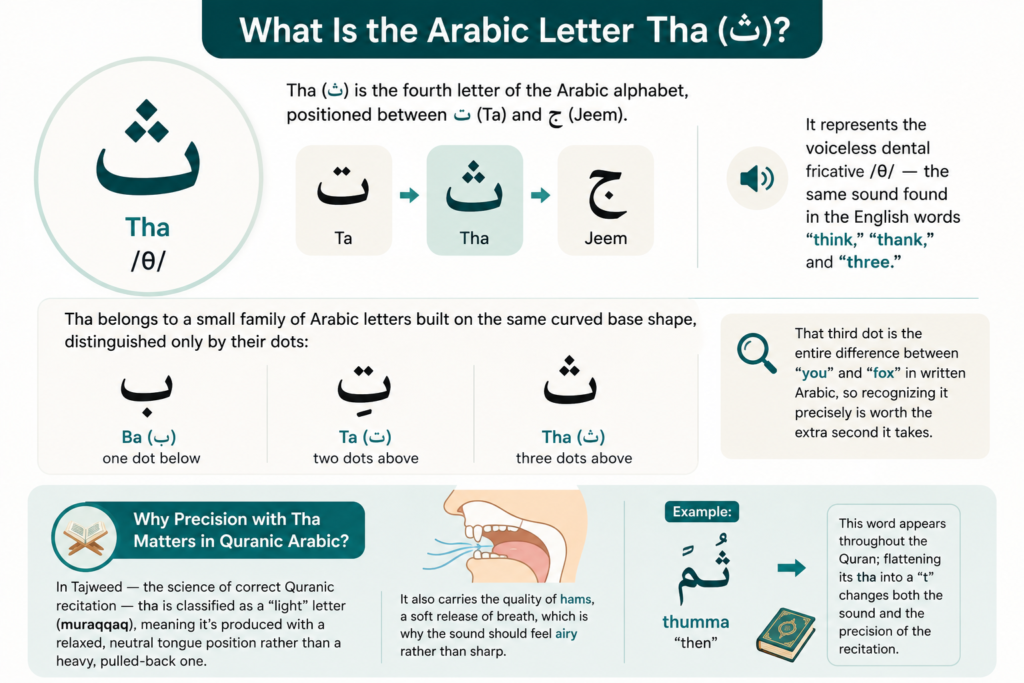
Tha (ث) is the fourth letter of the Arabic alphabet, positioned between ت (Ta) and ج (Jeem). It represents the voiceless dental fricative /θ/ — the same sound found in the English words “think,” “thank,” and “three.”
Tha belongs to a small family of Arabic letters built on the same curved base shape, distinguished only by their dots: Ba (ب) has one dot below, Ta (ت) has two dots above, and Tha (ث) has three dots above, arranged in a small triangle.
That third dot is the entire difference between “you” and “fox” in written Arabic, so recognizing it precisely is worth the extra second it takes.
Why Precision with Tha Matters in Quranic Arabic?
In Tajweed — the science of correct Quranic recitation — tha is classified as a “light” letter (muraqqaq), meaning it’s produced with a relaxed, neutral tongue position rather than a heavy, pulled-back one.
It also carries the quality of hams, a soft release of breath, which is why the sound should feel airy rather than sharp. A famous example is the word ثُمَّ (thumma, meaning “then”), which appears throughout the Quran; flattening its tha into a “t” changes both the sound and the precision of the recitation.
Read Also: Letter Ghayn In Arabic غ – Pronunciation, Positions, And Meaning
How to Pronounce the Letter Tha (ث) Correctly?
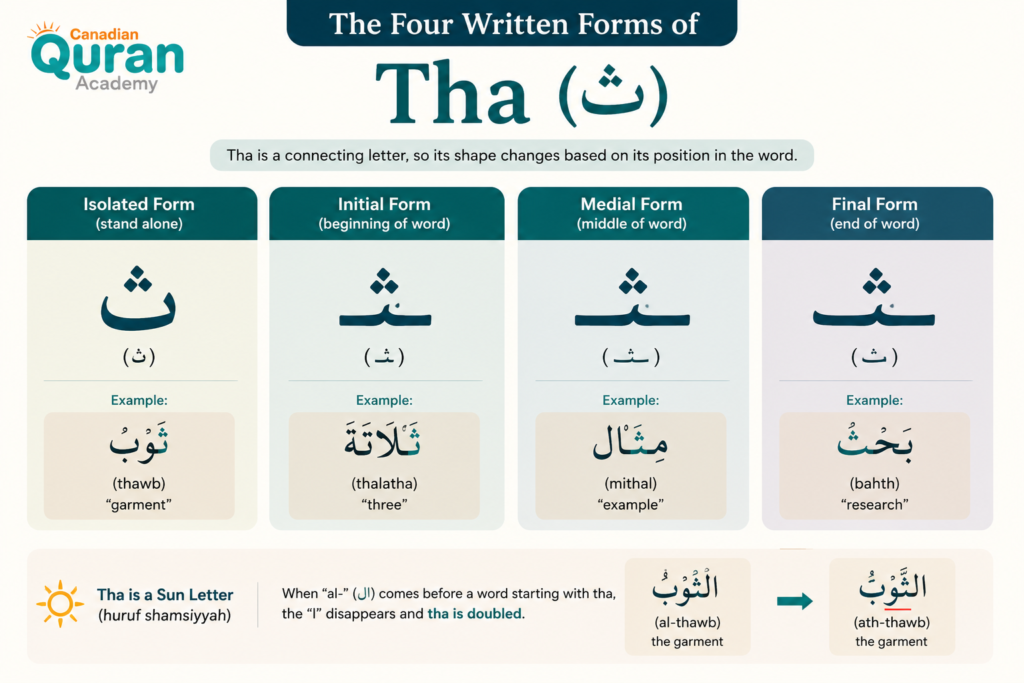
Place the tip of your tongue lightly against the edge of your two upper front teeth — in Arabic, these are called الثنايا العليا (al-thanaya al-‘ulya).
The tongue should not tuck behind the teeth (that produces a “t” sound) and should not pull away entirely (that produces an “s” sound). With the tongue in position, blow a steady, gentle stream of air past it. The friction of that air is what creates the “th” sound.
A simple way to self-correct is what our instructors call the three-point check: tongue visible at the teeth, air flowing continuously, no vocal cord vibration. If any one of the three is missing, the sound drifts toward a neighboring letter instead of tha.
Common Pronunciation Mistakes
The two most frequent substitutions are turning tha into Ta (ت) — a hard “t” made further back at the tongue ridge — or into Seen (س), a sharp whistling sound made with the tongue kept behind the teeth.
If you catch yourself saying “talata” or “salasa” instead of ثلاثة (thalatha, “three”), your tongue is staying too far back. Bring it forward until it touches the teeth, and the correct sound follows naturally.
It’s worth knowing that this substitution isn’t just a beginner’s error — several spoken Arabic dialects have shifted away from the classical tha over time.
Egyptian Arabic commonly renders it as “t” or “s” in everyday speech, and some Gulf and Levantine dialects show similar shifts. Modern Standard Arabic and Quranic recitation, however, preserve the original interdental sound, which is the version this guide — and Tajweed — requires.
Working through this kind of correction is much easier with live feedback than with an app or a book alone, which is why our Quran Recitation Classes put a Tajweed-certified instructor on the call to catch these substitutions in real time, one-on-one.
The Four Written Forms of Tha (ث)
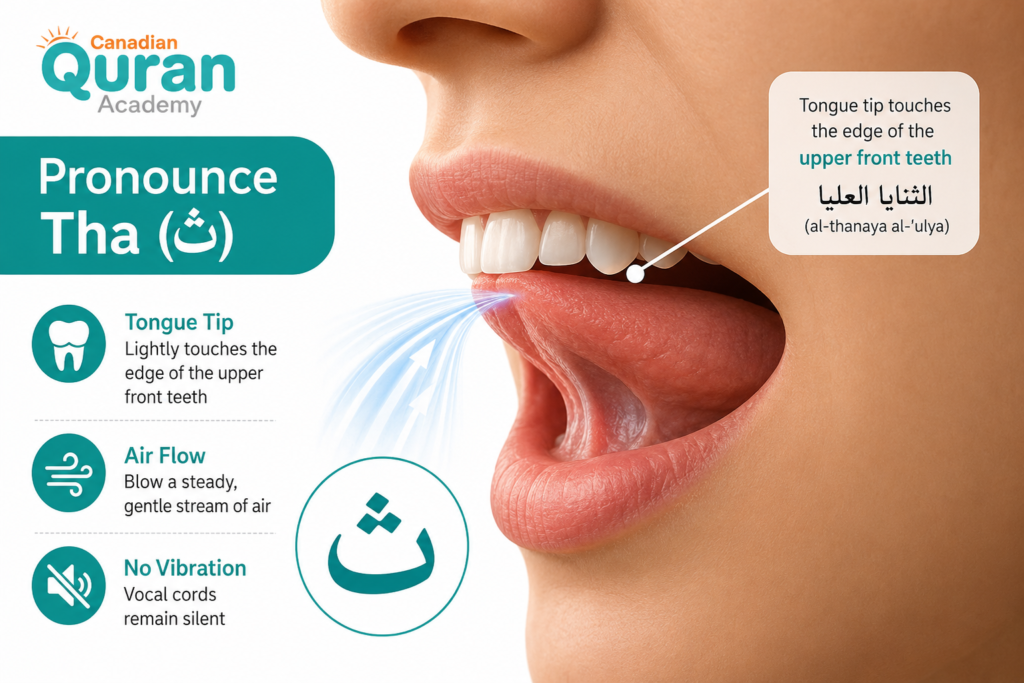
Tha is a connecting letter, so its shape shifts based on its position — a bridge principle that applies to nearly every letter in the Arabic alphabet, not just this one. Recognizing all four forms is what lets a learner move from spelling out individual letters to reading full words fluently.
The Isolated, Initial, Medial, and Final Forms
In its isolated form (ﺙ), tha stands alone with its full curved base and three dots visible above. In the initial position (ﺛـ), used when tha opens a word, the base is cut shorter and extends a connecting stroke toward the next letter — as in ثَلاثَة (thalatha, “three”).
In the medial position (ـﺜـ), tha connects on both sides and often appears as a small peak along the line, as in مِثَال (mithal, “example”). In the final position (ـﺚ), it returns to something close to its full shape but adds a tail connecting it to the letter before it, as in بَحْث (bahth, “research”).
Because tha connects on both sides, it’s classified as a “sun letter” (huruf shamsiyyah) — a detail with a practical consequence.
When the definite article “al-” (ال) is added to a word starting with tha, the “l” sound disappears and tha is doubled instead.
الثوب (al-thawb, “the garment”) is actually pronounced ath-thawb, not al-thawb. This is a small rule, but it trips up learners who read Arabic letter by letter instead of by sound.
Live Class in Action
Watch how our instructors interact with students in real-time, focusing on interactive methods.
Start Your Quranic Journey in Canada
Join our vibrant community and learn with expert tutors through our flexible online platform.
Claim Your Free TrialPracticing Tha with Vowel Marks (Harakat)
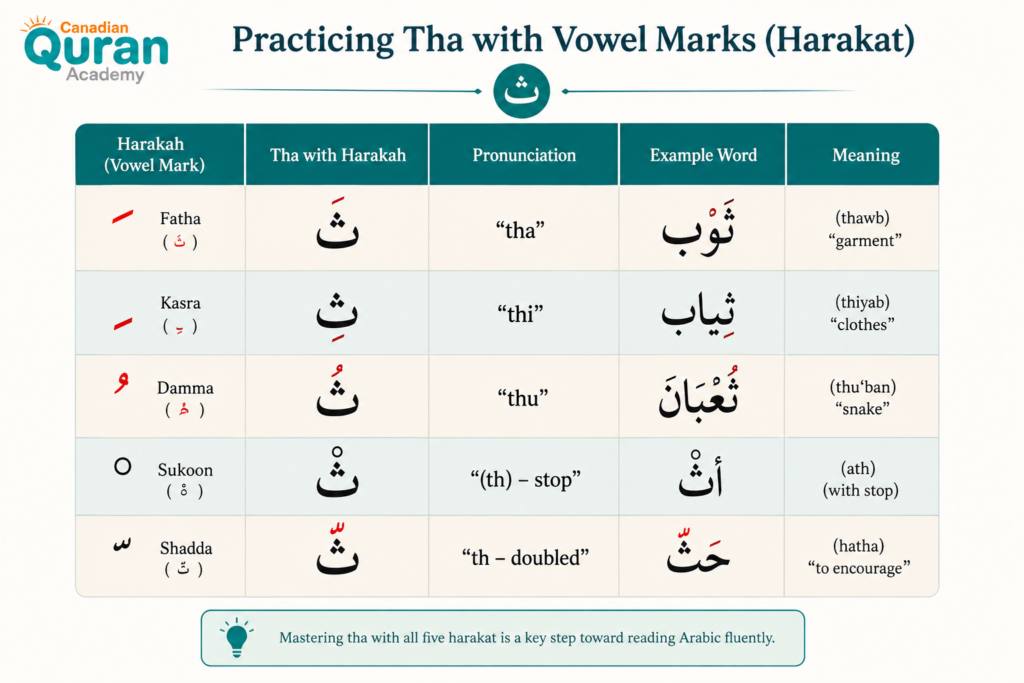
On its own, tha is a consonant sound only — it needs a harakah (vowel mark) to become part of spoken syllables. The four short vowel marks change the sound predictably, and mastering these combinations is what turns letter recognition into actual reading.
1. Tha with Fatha, Kasra, and Damma
With a fatha (a small diagonal line above the letter), tha is pronounced “tha,” as in ثَوْب (thawb, “garment”).
With a kasra (a line below the letter), it becomes “thi,” as in ثِياب (thiyab, “clothes”). With a damma (a small comma-like mark above), it becomes “thu,” as in ثُعْبَان (thu’ban, “snake”). Each of these three short vowels is held briefly — the sound should not be stretched unless a long vowel letter (alif, waw, or ya) follows.
Read Also: The Letter Dadh In Arabic (ض) – How To Pronounce, Write, And Master It
2. Tha with Sukoon and Shadda
A sukoon (a small circle above the letter) marks the absence of a vowel — the letter is pronounced and then stops, as in أثْ (ath).
Even without a following vowel, the breathy quality of tha should still be audible; it doesn’t become a silent stop. A shadda (a small w-shaped mark) doubles the letter, meaning it’s articulated twice in a single tongue movement, as in حَثَّ (hatha).
Reading tha correctly with all five marks — fatha, kasra, damma, sukoon, and shadda — is a strong signal that a learner has moved past memorization into genuine reading fluency.
Learners who are just starting with harakat altogether often benefit from a structured, step-by-step introduction rather than picking it up letter by letter on their own. Our Learn Quran Course for Beginners builds this exact skill from day one, pairing every new letter with guided vowel practice before moving to full words.
Read Also: The Arabic Letter Ha (ح)
Common Arabic Words with the Letter Tha (ث)
Seeing tha inside real words — rather than in isolation — is what makes the sound and shape stick. The examples below cover all three word positions.
Words at the Beginning, Middle, and End
At the start of a word: ثَلاثَة (thalatha, “three”), ثَعْلَب (tha’lab, “fox”), ثَلْج (thalj, “snow” or “ice”), ثَوْم (thawm, “garlic”). In the middle: مِثَال (mithal, “example”), تِمْثَال (timthal, “statue”), آثار (athar, “effects” or “ruins”). At the end: بَحْث (bahth, “research”), مِيرَاث (mirath, “inheritance”), بَرْغُوث (burghuth, “flea”).
A useful root to know is ث-م-ر (th-m-r), which relates to fruit and results — it produces ثَمَرَة (thamara, “fruit”) and, through a derived form, اسْتِثْمَار (istithmar, “investment”). Learning Arabic by root pattern like this, rather than word by word, is one of the more efficient ways to expand vocabulary once the letter itself is secure.
Read also: Verse In Quran About Alcohol In Arabic And English
Tha in the Quran and Tajweed
Tha appears throughout the Quran, and its correct articulation is a standard Tajweed checkpoint.
Beyond ثُمَّ (thumma, “then”), it appears in الكوثر (al-Kawthar, “abundance”), the name of the shortest surah in the Quran.
Reciting these words with a flattened or substituted tha is a common early mistake — one that a Tajweed instructor will typically flag in the first few sessions of structured recitation practice, well before it becomes a habit.
This is a good moment for a soft note: correcting letter-level habits like this is far easier with weekly, guided sessions than through self-study alone.
Whether you’re starting completely from scratch or brushing up specific letters, our Online Quran Classes for Kids and Quran Classes for Adults both begin with exactly this kind of letter-by-letter Tajweed foundation.
Tha vs Similar Letters: Avoiding Confusion
Even after you’ve learned tha’s own sound and shape, it’s easy to lose it again by drifting into a neighboring letter — this happens to nearly every learner at some point, and it’s one of the most common corrections given in early Tajweed lessons.
The two letters tha gets confused with most are Ta (ت) and Seen (س), one visually and one phonetically. Knowing exactly what separates tha from each one gives you a quick mental check whenever you’re unsure.
1. Tha vs Ta (ت)
Visually, Ta has two dots above; Tha has three, arranged in a triangle. Phonetically, Ta is a hard “t” made with the tongue against the ridge behind the upper teeth, while Tha is soft and made with the tongue at the edge of the teeth themselves. Confusing the two changes real words: ثَمَن (thaman, “price”) is not the same as the sound “taman.”
2. Tha vs Seen (س)
Seen produces a sharp, whistling “s” with the tongue held behind the teeth. Tha requires the tongue to come forward and touch the teeth, producing a softer, breathier sound.
Practicing minimal pairs — words that differ by only this one letter — is the fastest way to train your ear: say ثَلاثَة (thalatha) and then an invented parallel like “salasa,” and notice exactly where your tongue moves.
Read Also: The Importance of Arabic Language in the Quran
Experience Our Classrooms
Don’t just take our word for it—take a look inside! Watch the videos below to experience our engaging teaching methods and vibrant online classrooms firsthand.
Start Your Quranic Journey in Canada
Join our vibrant community and learn with expert tutors through our flexible online platform.
Claim Your Free TrialStart Learning Quranic Arabic with Canadian Quran Academy Today
Reading about tongue placement only goes so far — the fastest way to fix a letter like tha is to have a qualified instructor hear you say it and correct you on the spot.
Canadian Quran Academy pairs every student with a Tajweed-focused teacher who works through the Arabic alphabet methodically, letter by letter, until pronunciation becomes automatic rather than effortful.

Whether you’re a complete beginner, a parent looking for a class your child will actually enjoy, or an adult ready to finally get Tajweed right, Canadian Quran Academy has a course built for where you’re starting from.
Our Arabic Courses:
- Online Arabic Academy
- Online Arabic Course
- Classical Arabic Course
- Arabic Course for Beginners
- Advanced Arabic Course
- Quranic Arabic Course
- Arabic Grammar Course
- Modern Standard Arabic Course
- Arabic Conversation / Speaking Course
- Intensive Arabic Course
- Online Arabic Classes for Kids
- Arabic Classes for Adults

Start Your Quranic Journey in Canada
Join our vibrant community and learn with expert tutors through our flexible online platform.
Claim Your Free TrialConclusion
The Arabic letter tha (ث) is a small letter with an outsized effect on how clearly and correctly you read Arabic. Its sound is simply the “th” in “three,” produced by touching the tongue lightly to the upper teeth and letting air flow through.
Once you can recognize its four written forms, pair it correctly with each harakah, and avoid drifting into Ta or Seen, tha stops being a stumbling block and becomes a letter you read without thinking about.
Whether your goal is reading Arabic fluently, understanding Quranic Arabic, or reciting with correct Tajweed, mastering the Arabic letter tha is one of the foundational steps — and it’s a step that gets dramatically easier with consistent, corrected practice rather than self-study alone.

Frequently Asked Questions
Here are direct answers to the most common questions learners ask about the Arabic letter tha, based on what comes up most often in our beginner Tajweed lessons.
1. What sound does the Arabic letter tha (ث) make?
Tha (ث) makes the voiceless “th” sound heard in the English words “think” and “three.” It’s produced by placing the tongue tip against the upper front teeth and releasing a soft, continuous stream of air.
2. How many dots does the letter tha have?
The letter tha has three dots placed above it, arranged in a small triangle. This distinguishes it from Ta (ت), which has two dots above, and Ba (ب), which has one dot below.
3. Is tha the same as the letter Ta in Arabic?
No. Tha (ث) and Ta (ت) are different letters with different sounds. Ta is a hard “t” sound made at the tongue ridge, while tha is a soft “th” sound made with the tongue at the teeth.
4. Why do some Arabic speakers pronounce tha as “t” or “s”?
Several spoken Arabic dialects, including Egyptian Arabic, have shifted the classical tha sound toward “t” or “s” over generations. Modern Standard Arabic and Quranic recitation preserve the original interdental “th” sound.
5. What is a good example word to practice the letter tha?
ثَلاثَة (thalatha, meaning “three”) is a strong practice word because it contains tha twice, in both the initial and medial positions, letting you practice the sound and its shape changes in one word.
6. Does mispronouncing tha affect Quran recitation?
Yes. In Tajweed, tha must be pronounced with its correct breathy, interdental quality. Replacing it with “t” or “s” is considered a pronunciation error and can affect the precision of the recitation.






Leave a Reply