 Arabic
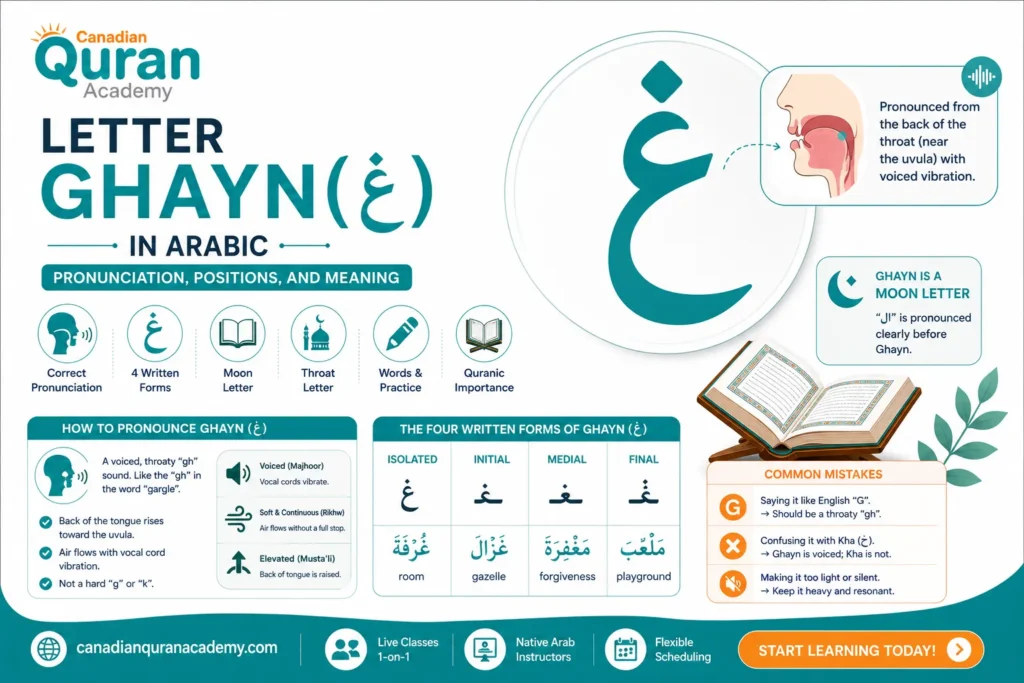
Say the word “gargle” out loud, then hold the sound right before the water hits the back of your throat. That buzzing, breathy vibration is close to how the letter Ghayn in Arabic غ actually sounds — and it has almost no equivalent in English.
Ghayn (غ) is the nineteenth letter of the Arabic alphabet, and it trips up nearly every English-speaking beginner in the same predictable ways. Most learners either flatten it into a hard English “G,” or they confuse it with its throat neighbor, Kha (خ). Neither is correct, and both are easy to fix once you understand exactly where and how the sound is made.
This guide breaks down the letter Ghayn in Arabic غ from every angle a learner actually needs: its place in the alphabet, its correct articulation point, its four written forms, real vocabulary, and its role in Quranic recitation.
If you want guided correction from a native-speaking instructor rather than working through it alone, Canadian Quran Academy’s Online Arabic Course covers Ghayn and every other Arabic letter with direct pronunciation feedback.
What you’ll learn in this article
- Where Ghayn sits in the Arabic alphabet and why it’s classified as a “moon letter”
- The exact articulation point (makhraj) and phonetic attributes (sifat) that produce its sound
- The three mistakes English speakers make most often, and how to correct each one
- How Ghayn is written in its isolated, initial, medial, and final forms
- Real vocabulary and a home practice routine for mastering the sound
- Why Ghayn’s pronunciation matters specifically in Quranic recitation and Tajweed
Where Does The Letter Ghayn Sit In The Arabic Alphabet?
Ghayn (غ) is the 19th letter of the 28-letter Arabic alphabet, positioned directly after Ayn (ع) and just before Faa (ف). Its name is pronounced “ghayn,” but — as with every Arabic letter — the name is not the sound you read aloud in words; only the consonant sound “gh” is voiced when reading.
The letter carries two classifications worth knowing from the start: it is a moon letter (حرف قمري) and a throat letter (حرف حلقي). Each classification affects how you read and pronounce it in real words.
1. Ghayn as a moon letter
Because Ghayn is a moon letter, the “ل” in the definite article “ال” stays pronounced clearly in front of it, rather than assimilating the way it does before sun letters like ت or د.
That’s why الغرفة (al-ghurfah, “the room”) keeps a clear “al-” sound, while a sun-letter word like الشمس (ash-shams, “the sun”) does not. This single rule explains a pattern learners see constantly but rarely have explained to them directly.
2. Ghayn as a throat letter
Ghayn belongs to the six huroof al-halq (throat letters), alongside Hamza (ء), Haa (ه), Ayn (ع), Haa (ح), and Kha (خ). Every letter in this group is produced somewhere in the throat rather than the mouth or tongue tip — which is exactly why English speakers, whose language has no throat consonants at all, need deliberate practice to produce them naturally.
Read Also: The Arabic Letter Ha (ح)
How do you pronounce the letter Ghayn in Arabic غ correctly?
The letter Ghayn in Arabic غ is a voiced uvular fricative: a continuous, buzzing sound produced when air passes through a narrow gap between the back of the tongue and the uvula, while the vocal cords vibrate throughout. It is not a stop sound like the English “g,” and it is not silent or whispered.
The makhraj (articulation point) of Ghayn
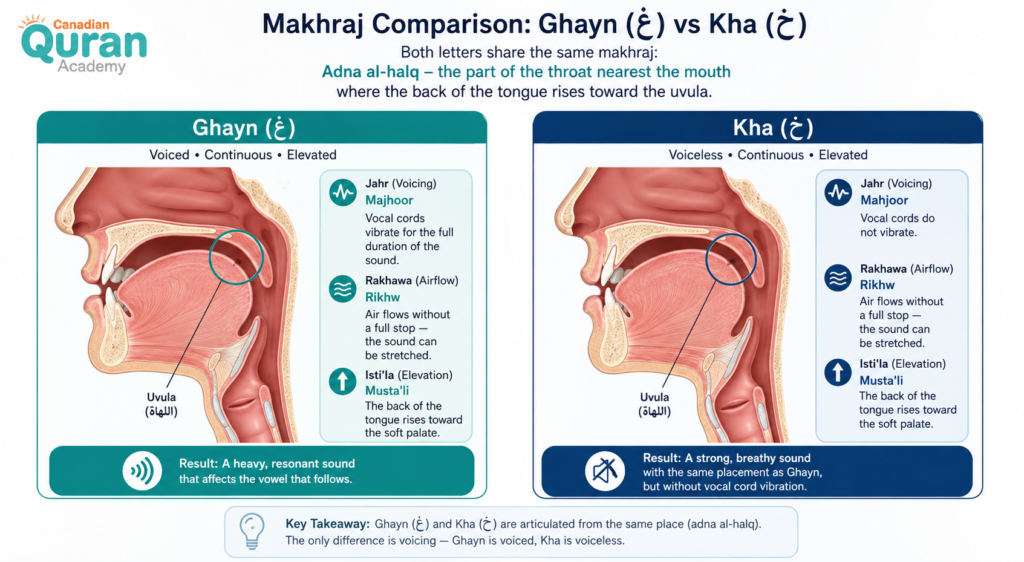
Ghayn’s makhraj is adna al-halq — the part of the throat nearest the mouth, where the back of the tongue rises toward the uvula.
This is the exact same articulation point used for Kha (خ), which is the main reason the two letters get confused so often. The difference between them has nothing to do with placement and everything to do with voicing, covered below.
| Attribute (Sifa) | Classification | What it means in practice |
| Jahr (voicing) | Majhoor (voiced) | Vocal cords vibrate for the full duration of the sound |
| Rakhawa (airflow) | Rikhw (soft/continuous) | Air flows without a full stop — the sound can be stretched |
| Isti’la (elevation) | Musta’li (elevated) | The back of the tongue rises toward the soft palate |
These three attributes combine to explain why Ghayn always sounds heavy and resonant, regardless of the vowel attached to it.
The elevation (isti’la) is the mechanism behind that heaviness: raising the back of the tongue narrows and reshapes the throat’s resonance space, which thickens the sound of the vowel riding on it — even when that vowel is normally light, like a kasrah.
What Mistakes Do English Speakers Usually Make With Ghayn?
English speakers tend to default to one of three predictable substitutions when they first meet the letter Ghayn in Arabic غ. Recognizing which one you’re making is the fastest route to fixing it.
| Common error | What learners do | Correct approach |
| Hard “G” substitution | Pronounce it like the “g” in “great” | Relax the tongue, stop the airflow from closing fully, add throat vibration |
| Kha (خ) confusion | Use the voiceless throat sound instead | Add vocal-cord vibration — Ghayn hums, Kha does not |
| Silent or whispered substitution | Skip or barely voice the letter | Engage the vocal cords fully — Ghayn is always voiced, never breathy |
A practical self-check: place two fingers gently on your throat while producing the sound. If you feel a steady vibration, you’re producing Ghayn correctly. No vibration at all means you’ve slipped into Kha; a clipped, stopped sound means you’ve defaulted to the English hard “g.”
This three-point check — placement, voicing, and continuity — is worth running on every new throat letter you learn, not just Ghayn. It catches the majority of beginner errors before they turn into habits.
If you’d rather have a native-speaking instructor catch these substitutions in real time, Canadian Quran Academy’s Arabic Course for Beginners is built specifically around correcting sounds English speakers find difficult, letter by letter.
Read Also: The Letter Dadh In Arabic (ض) – How To Pronounce, Write, And Master It
How Is The Letter Ghayn Written In Its Four Positions?
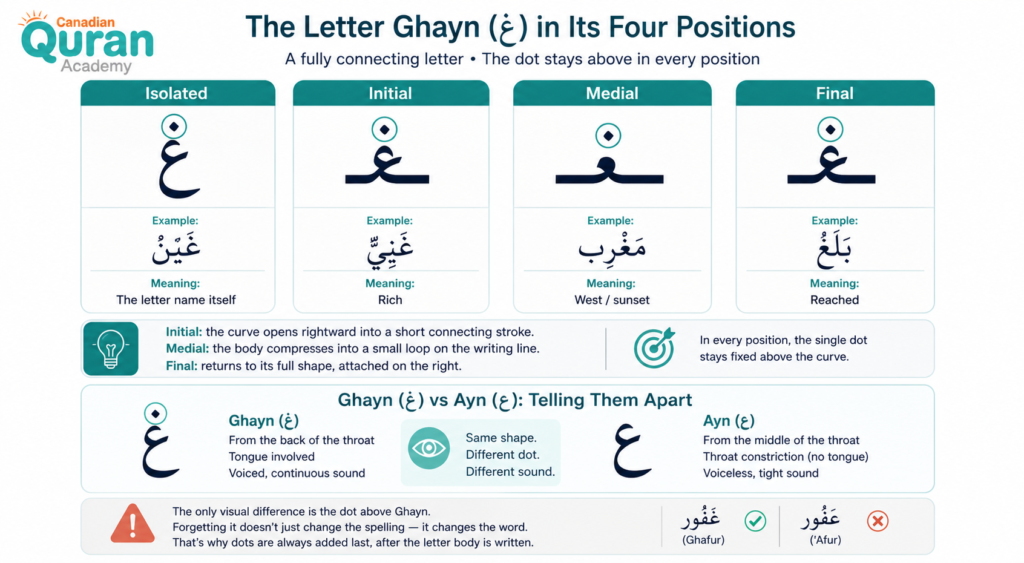
Like most Arabic letters, Ghayn is a fully connecting letter — it joins to letters on both sides of it, and its shape shifts slightly depending on where it falls in a word.
| Position | Form | Example word | Meaning |
| Isolated | غ | غَيْن | The letter name itself |
| Initial | غـ | غَنِيّ | Rich |
| Medial | ـغـ | مَغْرِب | West / sunset |
| Final | ـغ | بَلَغ | Reached |
In its initial form, the curve opens rightward into a short connecting stroke. In the medial form, the body compresses into a small loop sitting on the writing line.
In the final form, it returns to something close to its full isolated shape, attached on the right to the letter before it. In every position, the single dot stays fixed above the curve.
Read also: Letter Kh خ In Arabic – How To Read, Write, And Pronounce It?
Ghayn Vs Ayn (ع): Telling Them Apart On The Page
Ghayn and Ayn share an identical base shape — the only visual difference is the single dot Ghayn carries above it.
But the two letters come from different parts of the throat and sound nothing alike: Ayn is produced from the middle of the throat with a tight, pinched constriction, while Ghayn is produced further back with the tongue involved and a continuous buzz.
Forgetting the dot doesn’t just change the spelling — it changes the word into a different letter entirely, which is why dots in Arabic script are always added last, only after the full body of the letter is written.
What Are Common Arabic Words That Contain The Letter Ghayn غ?
Building vocabulary around Ghayn reinforces both recognition and pronunciation at the same time. These are grouped by theme so you can practice with words you’ll actually use.
Everyday vocabulary with Ghayn
These words show up in daily conversation more than any other group, which makes them the fastest way to turn the sound of Ghayn into something you actually recognize on sight.
- غَنِيّ (ghaniyy) — rich, wealthy
- غُرْفَة (ghurfa) — room
- غَالِي (ghali) — expensive
- غَاب (ghaba) — he was absent
- غَدًا (ghadan) — tomorrow
- غَرِيب (gharib) — strange, foreigner
Nature and Quranic vocabulary with Ghayn
Ghayn also runs through words tied to nature and religious practice, several of which you’ll already recognize once you see where the sound fits.
مَغْرِب (maghrib) means “west” or “sunset” — a word every Muslim recognizes as the name of one of the five daily prayers.
غَيْب (ghayb) means “the unseen,” a term that recurs throughout the Quran.
غَفُور (ghafoor) means “Most Forgiving,” one of the names of Allah, and appears in the frequently repeated pairing غَفُورٌ رَحِيمٌ (Ghafoorur Raheem, “Most Forgiving, Most Merciful”).
Learners who study Modern Standard Arabic and Quranic Arabic side by side often notice the same roots doing double duty — a word like غفر (forgiveness) shows up in daily religious speech and in classical texts alike, which is one reason Canadian Quran Academy structures its Quranic Arabic Course to build vocabulary that transfers directly between the two.
Read Also: The Letter Dadh In Arabic (ض) – How To Pronounce, Write, And Master It
Live Class in Action
Watch how our instructors interact with students in real-time, focusing on interactive methods.
Start Your Quranic Journey in Canada
Join our vibrant community and learn with expert tutors through our flexible online platform.
Claim Your Free TrialHow can you practice the letter Ghayn in Arabic غ at home?
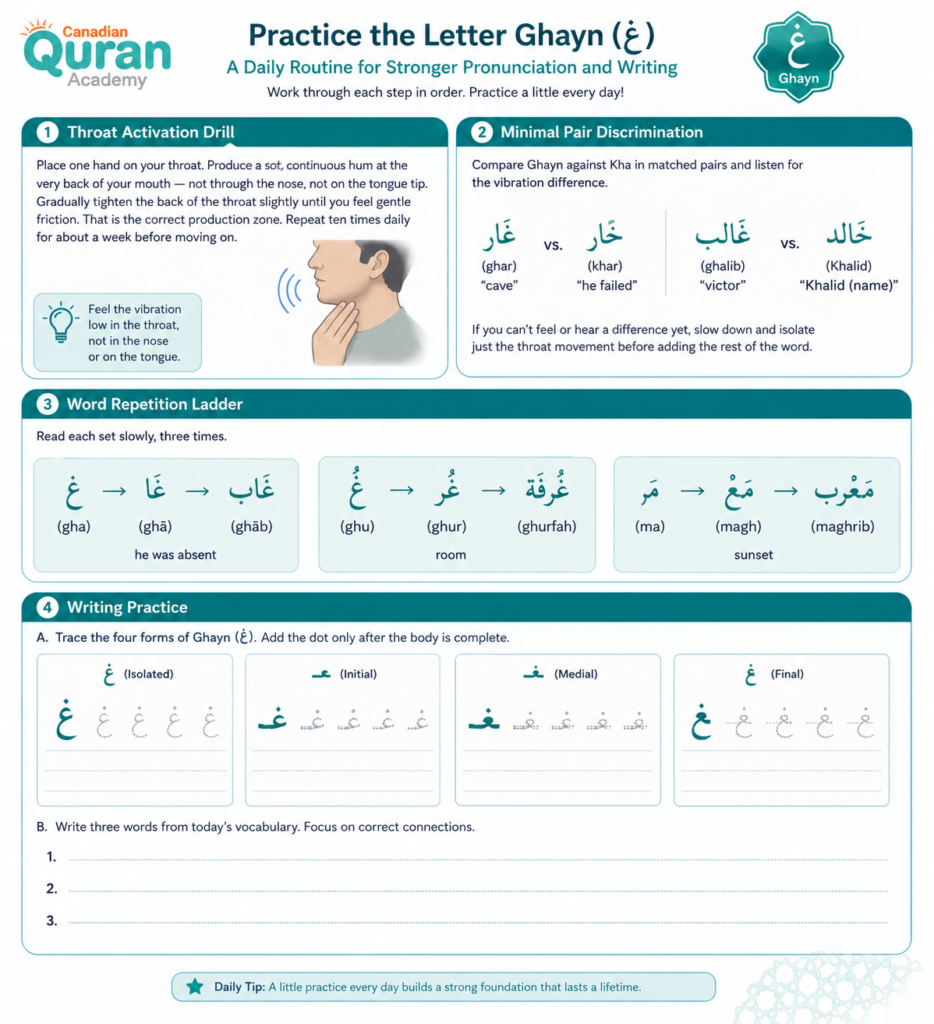
A short daily routine fixes Ghayn faster than occasional long sessions. Work through these in order.
1. Throat activation drill
Place one hand on your throat. Produce a soft, continuous hum at the very back of your mouth — not through the nose, not on the tongue tip. Gradually tighten the back of the throat slightly until you feel gentle friction. That is the correct production zone. Repeat ten times daily for about a week before moving on.
2. Minimal pair discrimination
Compare Ghayn against Kha in matched pairs and listen for the vibration difference: غَار (ghar, “cave”) against خَار (khar, “he failed”); غَالِب (ghalib, “victor”) against خَالِد (Khalid, a personal name). If you can’t feel or hear a difference yet, slow down and isolate just the throat movement before adding the rest of the word.
3. Word repetition ladder
Read this progression slowly, three times each: غَ — غَا — غَاب (he was absent); غُ — غُر — غُرْفَة (room); مَ — مَغْ — مَغْرِب (sunset).
4. Writing practice
Write each of the four forms — غ, غـ, ـغـ, ـغ — ten times on lined paper, adding the dot only after the body of the letter is complete. Then write three full words from the vocabulary above, focusing on connecting the letters correctly rather than speed.
Children benefit especially from tracing large versions of the letter before moving to a pencil, which is the approach used in Canadian Quran Academy’s kids’ Arabic classes within its Online Arabic Academy.
Read Also: The Letter Dadh In Arabic (ض)
Why Does The Letter Ghayn Matter In Quranic Recitation And Tajweed?
In Tajweed, Ghayn belongs to the seven isti’la (elevated) letters, grouped under the mnemonic خُصَّ ضَغْطٍ قِظْ. Every letter in this group must carry tafkheem (heaviness) at all times — never tarqeeq (lightness) — regardless of the vowel attached to it.
A common beginner mistake is softening Ghayn when it appears with a kasrah, out of habit built from lighter letters; the correct approach is to keep the back-of-tongue elevation constant in every context.
A second frequent recitation error is letting Ghayn’s voiced buzz slip into Kha’s unvoiced breathiness during fast recitation. Slowing down and consciously feeling the vocal-cord vibration — the same throat-touch check used earlier — is the most reliable fix.
Ghayn appears in words central to the Quran’s message. In Surah al-Fatihah (1:7), the phrase غَيْرِ الْمَغْضُوبِ عَلَيْهِمْ (ghayril maghdoobi alayhim, “not of those who have earned Your anger”) contains it twice in a single verse recited by every Muslim who prays. Surah Ghafir (40) takes its name from the same root as غَفُور, “The Forgiver.”
Because mispronouncing a throat letter can shift the meaning of a word in recitation, precision here is not just a pronunciation preference — it’s part of reciting correctly.
Canadian Quran Academy’s Classical Arabic Course and grammar-focused Arabic Grammar Course both build this level of phonetic precision into regular lessons, alongside dedicated Tajweed instruction.
Experience Our Classrooms
Don’t just take our word for it—take a look inside! Watch the videos below to experience our engaging teaching methods and vibrant online classrooms firsthand.
Start Your Quranic Journey in Canada
Join our vibrant community and learn with expert tutors through our flexible online platform.
Claim Your Free TrialStart Learning Arabic Letters The Right Way With Canadian Quran Academy
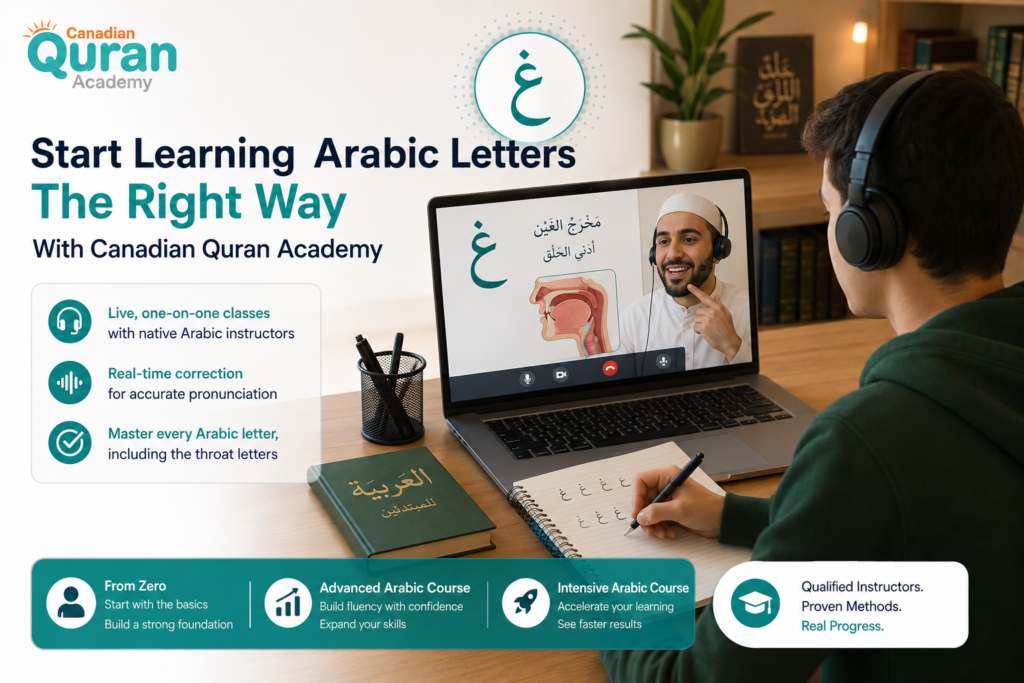
Reading about Ghayn’s makhraj and sifat only gets you partway there — a sound with no English equivalent is genuinely difficult to self-correct without someone listening and adjusting you in real time.
Canadian Quran Academy pairs every student with a qualified, native-speaking instructor who catches substitutions like the hard “g” or the Kha mix-up in the first few sessions, not months in.

Whether you’re an adult starting from zero, working toward fluency through the Advanced Arabic Course, or want to move quickly through the Intensive Arabic Course, Canadian Quran Academy’s structure covers every Arabic letter — including the throat letters most learners struggle with — with the same phonetic precision used in this guide.
Our Arabic Courses:
- Online Arabic Academy
- Online Arabic Course
- Classical Arabic Course
- Arabic Course for Beginners
- Advanced Arabic Course
- Quranic Arabic Course
- Arabic Grammar Course
- Modern Standard Arabic Course
- Fusha Arabic Course
- Business Arabic Course
- Al-Azhar Arabic Course
- Madinah Arabic Course
- Learning Arabic for Non-Arabic Speakers
- Arabic Elementary School
Start Your Quranic Journey in Canada
Join our vibrant community and learn with expert tutors through our flexible online platform.
Claim Your Free TrialConclusion
The letter Ghayn in Arabic غ is a voiced uvular fricative produced at adna al-halq, the part of the throat nearest the mouth — the same articulation point as Kha (خ), but distinguished by continuous vocal-cord vibration. It is the 19th letter of the alphabet, a moon letter, and one of the seven isti’la letters that must always be pronounced heavy in Tajweed.
Most English speakers struggle with Ghayn for the same three reasons: substituting a hard “g,” confusing it with Kha, or under-voicing it entirely. All three are correctable with focused throat-activation practice and the touch-test for vibration.
Beyond pronunciation, recognizing Ghayn’s four written forms and building vocabulary around it — from غُرْفَة to غَفُور — turns an unfamiliar throat sound into one you can read, write, and recite with confidence.
Faqs About The Letter Ghayn In Arabic غ
These are the questions learners ask most often once they’ve started practicing Ghayn on their own, based on where confusion tends to persist even after the basics click.
1. What does the letter Ghayn sound like in English?
The letter Ghayn has no exact English equivalent, but the closest comparisons are a soft, gargling sound at the back of the throat or the “g” in the Spanish word “agua.” It is voiced and continuous, unlike the stopped English hard “g” in “go.”
2. Is Ghayn a throat letter?
Yes, Ghayn is one of six huroof al-halq (throat letters) in Arabic, produced at adna al-halq — the part of the throat closest to the mouth. It shares this exact articulation point with Kha (خ), differing only in voicing.
3. What is the difference between Ghayn and Kha?
Ghayn and Kha are produced at the same throat location, but Ghayn is voiced (majhoor), meaning the vocal cords vibrate throughout the sound, while Kha is voiceless (mahmoos) and produced with breath only. Touching your throat while pronouncing each one reveals the difference immediately.
4. How many written forms does the letter Ghayn have?
Ghayn has four written forms depending on its position in a word: isolated (غ), initial (غـ), medial (ـغـ), and final (ـغ). As a fully connecting letter, it joins to neighboring letters in every position except when standing alone.
5. Why must Ghayn always sound heavy in Tajweed?
Ghayn is one of seven isti’la (elevated) letters in Arabic, and this classification requires tafkheem (heaviness) in every context, regardless of the vowel attached to it. Softening Ghayn — a mistake often made with a kasrah vowel — changes its correct Tajweed pronunciation.
6. Can children learn to pronounce Ghayn correctly?
Yes, children typically learn throat letters like Ghayn through repetition, tracing, and guided listening rather than technical explanation. Canadian Quran Academy’s kids’ classes introduce Ghayn through tracing practice and simple vocabulary before layering in Tajweed rules later.





Leave a Reply