 Arabic
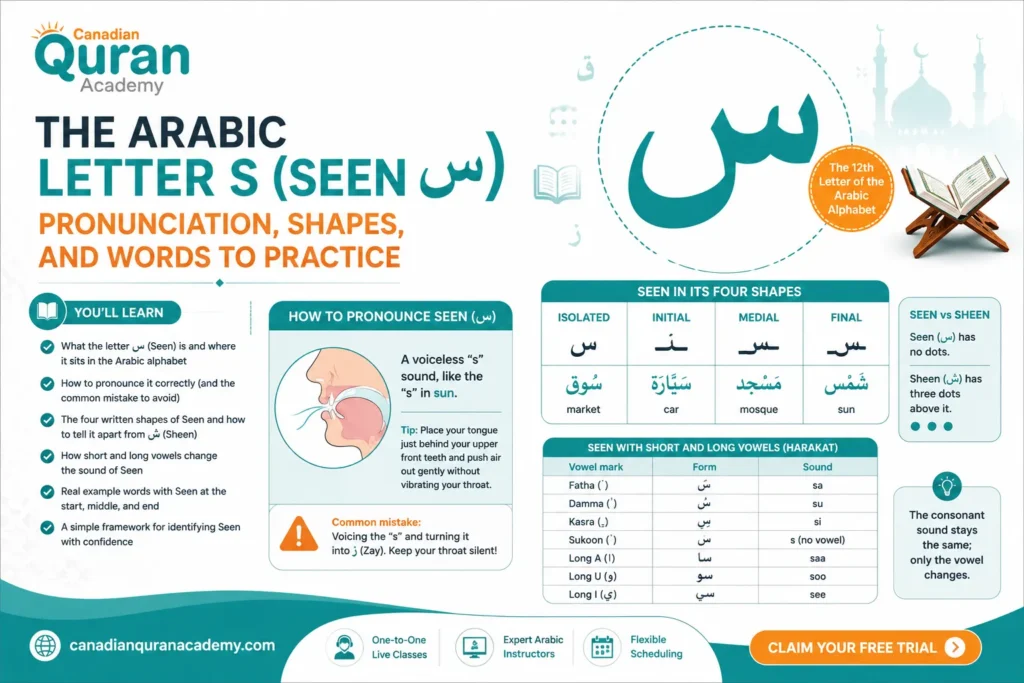
If you’re starting to read Arabic, the Arabic letter S — written س and called Seen — is one you’ll meet in almost every sentence. It’s the twelfth letter in the Arabic alphabet, and understanding how to say it, write it, and recognize it in different word positions is one of the fastest wins for a new reader.
This guide walks through the letter s in Arabic step by step, the way instructors at Canadian Quran Academy introduce it to new students in the beginners’ Arabic track.
By the end, you’ll know how Seen sounds, how its shape changes depending on where it sits in a word, and how to avoid the two mix-ups almost every learner makes early on.
What you’ll learn in this article
- What the letter س (Seen) is and where it sits in the Arabic alphabet
- How to pronounce it correctly, and the one mistake English speakers make most often
- The four written shapes of Seen and how to tell it apart from its lookalike, ش (Sheen)
- How short and long vowels change the sound of Seen
- Real example words with Seen at the start, middle, and end
- A simple framework for identifying Seen with confidence, even in unfamiliar words
What Is the Arabic Letter S (Seen)?
Seen (س) is the twelfth letter of the twenty-eight-letter Arabic alphabet, and it represents the sound of the English “s” in words like sun or simple. It belongs to a small set of letters Arabic teachers call “sun letters” — a grammatical category, not a description of how the letter sounds.
Every Arabic letter has a fixed position in the alphabetical order, a fixed sound, and a behavior when it follows the definite article al- (ال). Seen checks all three boxes in ways that matter for reading fluency, not just spelling.
Seen comes right after ز (Zay) and before ش (Sheen) in the standard Arabic alphabet order. Its neighbors matter: Zay is voiced and buzzy, and Sheen shares its exact base shape.
Knowing what surrounds a letter helps you place it faster when scanning a line of text, which is a habit Quranic Arabic students build early because tajweed rules depend on recognizing letters instantly, not sounding them out one by one.
Why Seen Is Called A “Sun Letter”
A sun letter is a letter that absorbs the “l” sound of the definite article ال when it comes right before it, doubling its own sound instead. Seen is one of these letters.
Take السُّلَّم (the ladder). It is not pronounced “al-sullam” — the ل disappears in speech, and the word is pronounced “as-sullam,” with the س doubled. This is a mechanical rule, not a stylistic choice, and it applies to Seen every single time it follows ال.
Learners who skip this rule tend to sound noticeably non-native even when their vocabulary is strong, because native speakers never pronounce the “l” before a sun letter.
How To Pronounce The Arabic Letter S?
The letter س is pronounced by pushing air across the tip of the tongue, placed just behind the upper front teeth, without vibrating the vocal cords at all. That last part is the whole trick: Seen is a voiceless, sibilant consonant, meaning the sound is pure airflow with no “buzz” behind it.
Say the English word sun and place two fingers on your throat. You’ll feel no vibration during the “s” — that’s the same sensation you want when pronouncing Seen.
Seen belongs to a family of sounds linguists call sibilants — the hissing or buzzing consonants that include س (s), ز (z), and ش (sh). Among these, Seen is the “clean hiss”: no buzz, no added “h” breathiness, just air moving steadily across the tongue for as long as you hold the sound.
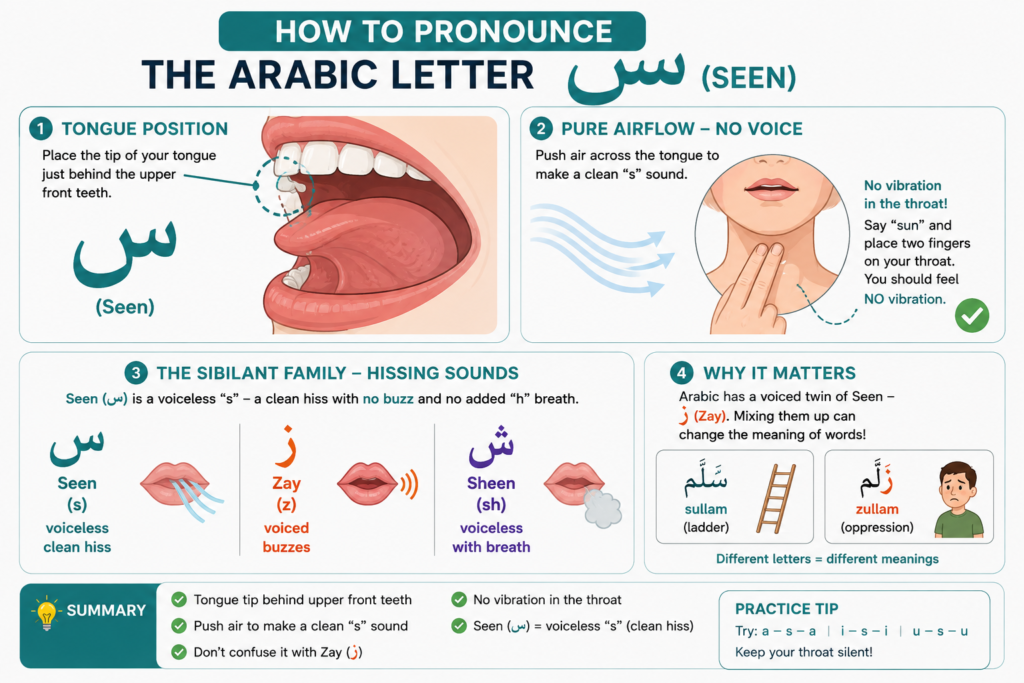
This matters because Arabic has a voiced twin of Seen — ز (Zay) — and confusing the two changes word meanings entirely.
Read also: The Arabic Letter K (ك) – Pronunciation, Shapes, And Meaning Explained
Common Pronunciation Mistake to Avoid
English speakers frequently voice the “s” sound between vowels without noticing — say the word reason aloud and you’ll hear a “z,” not an “s,” even though it’s spelled with an “s.” That habit carries over into Arabic and turns س into ز by accident, especially in longer words like سُلَّم or سُوق.
The fix instructors use in one-on-one lessons is simple: practice Seen only between vowels first (a-s-a, i-s-i) and consciously keep the throat silent, since that’s exactly the position where voicing creeps in unnoticed.
Getting this right early saves a lot of correction later, which is exactly the kind of foundational habit the Arabic Course for Beginners at Canadian Quran Academy is built around — one-on-one feedback on sounds like this from the very first lesson, rather than self-correcting from an app.
Read Also: The Arabic Letter K (ك)
How To Write Seen In Its Four Shapes?
Like every Arabic letter, the Arabic letter S changes shape depending on whether it opens, sits inside, closes, or stands alone in a word. Arabic is a connected script, so these shape changes aren’t decorative — they’re how the letter physically links to its neighbors.
Seen’s distinguishing feature across all four shapes is its base: three small connected humps, sometimes described as “three teeth,” with no dots anywhere on the letter.
Seen At The Start, Middle, And End Of A Word
Here is how the letter s in Arabic looks in each position:
| Position | Shape | Example | Meaning |
| Isolated | س | سُوق | market |
| Initial | سـ | سَيَّارَة | car |
| Medial | ـسـ | مَسْجِد | mosque |
| Final | ـس | شَمْس | sun |
Notice that the initial and medial forms keep the “three teeth” shape fully visible, while the final and isolated forms add a small tail that dips below the line.
This tail is what most reading guides skip over, but it’s the fastest visual cue for spotting Seen at the end of a word before you’ve even sounded it out.
How to Tell Seen Apart from Sheen (ش)?
Seen and Sheen share the exact same base shape in every position — the only difference is dots. Sheen carries three dots directly above the letter; Seen carries none.
This is the single most common letter-recognition error new readers make, because the confusion happens at a glance, before the reader even gets to pronunciation.
Slowing down at unfamiliar words specifically to check for dots above the base shape is a habit worth building deliberately, not something that resolves on its own with more reading.
Read Also: How To Learn Arabic For Quran In Canada?
Live Class in Action
Watch how our instructors interact with students in real-time, focusing on interactive methods.
Start Your Quranic Journey in Canada
Join our vibrant community and learn with expert tutors through our flexible online platform.
Claim Your Free TrialSeen With Short And Long Vowels (Harakat)
Harakat are the small marks placed above or below an Arabic letter to indicate its short vowel sound; without them, a bare Arabic letter S like س carries no vowel at all. Seen’s consonant sound stays the same no matter which vowel mark it carries — only the vowel that follows it changes.
| Vowel mark | Form | Sound | Example |
| Fatha (َ) | سَ | sa | سَفَر (safar – travel) |
| Damma (ُ) | سُ | su | سُكَّر (sukkar – sugar) |
| Kasra (ِ) | سِ | si | سِنّ (sinn – tooth) |
| Sukoon (ْ) | سْ | s (no vowel) | مِسْمَار (mismar – nail) |
Long Vowels: سا, سو, سي
Long vowels stretch the short vowel sound using a second letter — Alif (ا), Waw (و), or Yaa (ي) — held for roughly double the duration of the short version.
سَا (saa) as in سَاعَة (saa’ah – clock), سُو (soo) as in سُوق (suq – market), and سِي (see) as in سِكِّين (sikkin – knife) are the three long-vowel combinations you’ll see most often with Seen.
Getting vowel length right is one of the areas where self-study plateaus fastest, since a short and long vowel can look nearly identical to a new reader on the page. It’s a core focus in the Arabic Grammar Course, where instructors drill vowel length against a live listener rather than a recording.
Read also: How To Pronounce The Arabic Letter Tha (ث) – A Complete Guide
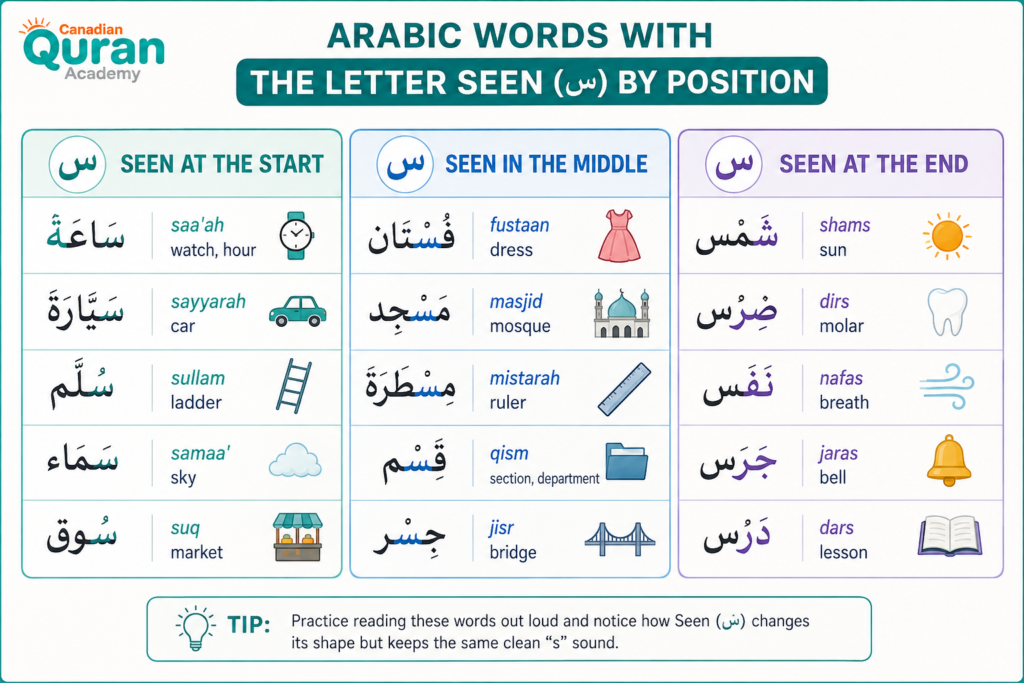
Arabic Words With The Letter Seen By Position
Seeing the Arabic letter S in real words, rather than in isolation, is what makes the shape and sound stick. Below are common words grouped by where Seen falls.
Words Where Seen Comes First:
- سَاعَة (saa’ah) — watch, hour
- سَيَّارَة (sayyarah) — car
- سُلَّم (sullam) — ladder
- سَمَاء (samaa’) — sky
- سُوق (suq) — market
Words Where Seen Comes in the Middle:
- فُسْتَان (fustaan) — dress
- مَسْجِد (masjid) — mosque
- مِسْطَرَة (mistarah) — ruler
- قِسْم (qism) — section, department
- جِسْر (jisr) — bridge
Words Where Seen Comes at the End:
- شَمْس (shams) — sun
- ضِرْس (dirs) — molar
- نَفَس (nafas) — breath
- جَرَس (jaras) — bell
- دَرْس (dars) — lesson
A Simple Framework For Telling Seen Apart From Similar Letters
New readers usually don’t struggle with Seen on its own — they struggle with telling it apart from its neighbors under time pressure, while reading at a normal pace. A quick, repeatable check solves this better than memorizing rules in the abstract.
Run any unfamiliar “three-teeth” letter through three questions, in this order: First, count the dots — zero means Seen, three above means Sheen.
Second, check the position in the word against the shape table above to confirm it’s connected the way Seen should be. Third, if you’re reading aloud, listen for whether the sound buzzes (that’s ز, not س) or stays a clean hiss.
This sequence works because it moves from the fastest visual cue (dots) to the slowest (sound), so you resolve most confusions before you even need to pronounce the word.
Practice Exercise to Test Yourself
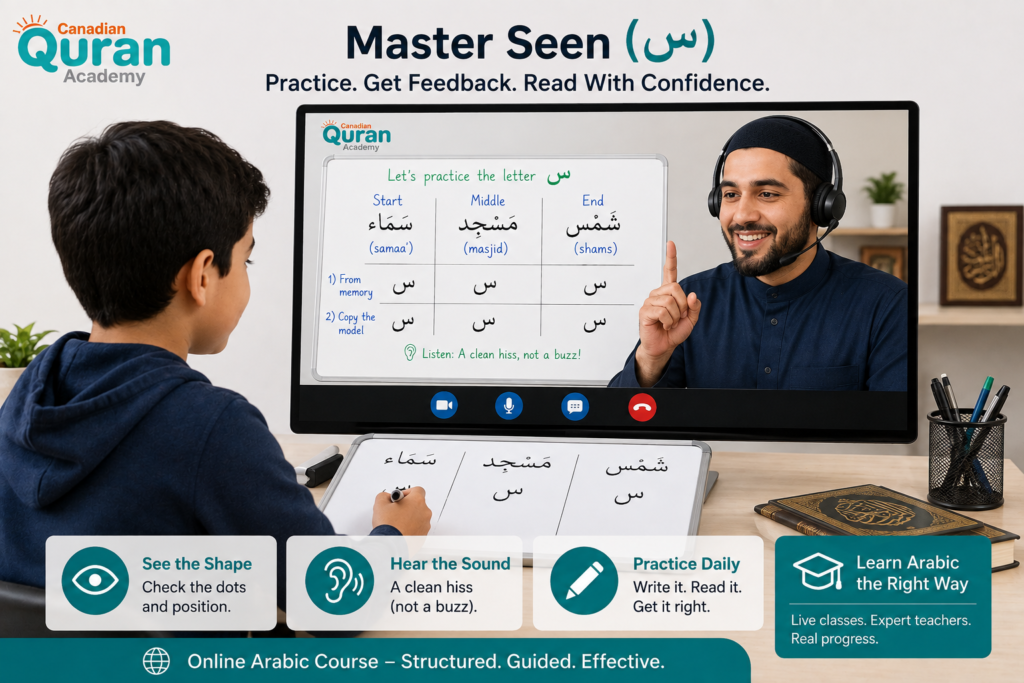
Take three words from the lists above — one with Seen at the start, one in the middle, one at the end — and write each one twice: once from memory, once copying the model. Then read all three aloud, pausing on the Seen sound specifically to check for any voicing creep.
This kind of short, repeated drill across shape and sound together is exactly what the Online Arabic Course structures week by week, rather than covering every letter once and moving on.
Read Also: How To Improve Your Arabic Language Skills In Canada?
Experience Our Classrooms
Don’t just take our word for it—take a look inside! Watch the videos below to experience our engaging teaching methods and vibrant online classrooms firsthand.
Start Your Quranic Journey in Canada
Join our vibrant community and learn with expert tutors through our flexible online platform.
Claim Your Free TrialStart Learning Arabic Letters The Right Way, Starting Today
Letters like Seen are easy to explain but genuinely hard to self-correct — pronunciation habits form fast, and once a mistake feels normal, it’s hard to hear it in your own speech. A live instructor catches it in the first few sessions.
Canadian Quran Academy’s Online Arabic Academy pairs new students with a dedicated teacher for one-on-one sessions, covering everything from alphabet basics like the letter s in Arabic through the Advanced Arabic Course and Quranic Arabic Course for students working toward reading the Quran directly.

Whether you want conversational fluency through the Arabic Conversation Course or formal grammar through the Modern Standard Arabic Course, the path starts with letters like this one.
Our Arabic Courses:
- Online Arabic Academy
- Online Arabic Course
- Classical Arabic Course
- Arabic Course for Beginners
- Advanced Arabic Course
- Quranic Arabic Course
- Arabic Grammar Course
- Modern Standard Arabic Course
- Arabic Conversation / Speaking Course
- Intensive Arabic Course
- Online Arabic Classes for Kids

Start Your Quranic Journey in Canada
Join our vibrant community and learn with expert tutors through our flexible online platform.
Claim Your Free TrialConclusion
The س – Arabic letter s, Seen (س), is a voiceless, dot-free consonant that sounds like the English “s” and changes shape across four positions: isolated, initial, medial, and final. It behaves as a sun letter after ال, doubles under a shadda, and is most often confused with Sheen (dots) and Zay (voicing) — both mix-ups the Three-Point Check above resolves quickly.
Practicing it through real words, in all three positions, is what turns letter recognition into actual reading fluency.
Canadian Quran Academy’s beginner and grammar courses are built around exactly this kind of letter-by-letter foundation, so it holds up once you move into full sentences and Quranic text.

Faqs About The Arabic Letter S (Seen)
These are the questions Canadian Quran Academy instructors hear most often from students first learning the letter س, along with direct answers you can act on right away.
1. Is the Arabic letter س the same as the English letter S?
Yes, س represents the same sound as the English “s” in words like sun or sit. Both are voiceless sibilant consonants produced the same way, with no vocal cord vibration.
2. What is the difference between س (Seen) and ش (Sheen)?
Seen and Sheen share the identical base shape but differ only in dots: Sheen has three dots above the letter, and Seen has none. The sounds differ too — Seen is a plain “s,” while Sheen is an “sh” sound as in shoe.
3. Why is Seen called a sun letter?
Seen is a sun letter because it absorbs the “l” sound of the definite article ال and doubles its own sound instead, so السُّلَّم is pronounced “as-sullam,” not “al-sullam.” This rule applies every time Seen directly follows ال.
4. How many forms does the letter Seen have?
Seen has four written forms: isolated (س), initial (سـ), medial (ـسـ), and final (ـس). The initial and medial forms preserve the full “three teeth” shape, while the final and isolated forms add a small tail below the line.
5. What is the most common mistake when pronouncing Seen?
The most common mistake is accidentally voicing Seen into a “z” sound, a habit carried over from English, where “s” often buzzes between vowels (as in reason). Keeping the throat still and the airflow steady while pronouncing س prevents this.
6. Where can I practice the letter Seen with a live instructor?
Canadian Quran Academy’s Arabic Course for Beginners and Classical Arabic Course both start with letter-by-letter pronunciation and writing practice, with direct feedback in every session rather than self-paced correction.






Leave a Reply