 Arabic
If you’ve started learning Arabic, one of the first surprises is that a single letter can do three completely different jobs. The Arabic letter Waw (و) is exactly that letter.
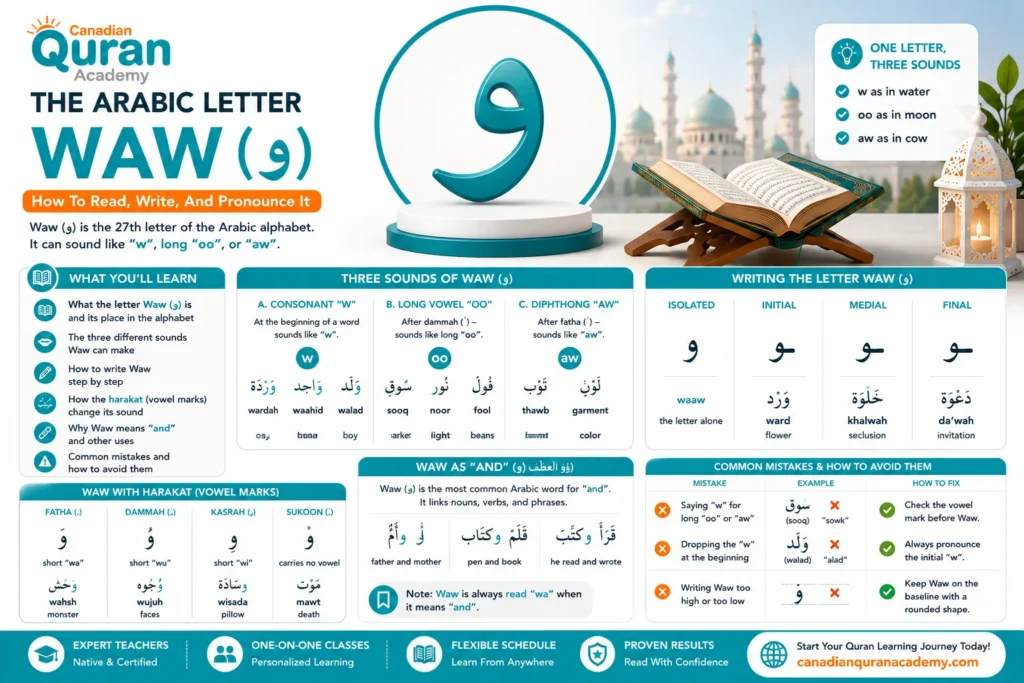
It is the 27th letter of the Arabic alphabet, and depending on where it sits in a word and which vowel mark surrounds it, it can sound like the English “w,” stretch into a long “oo,” or blend into an “aw” sound.
At Canadian Quran Academy, this is one of the first letters new students ask about, because getting it right changes how confidently you read and recite.
This guide walks through everything you need to know about the Arabic letter w: its shape, its three pronunciations, how to write it, the vowel marks that change its sound, and the grammatical role it plays as the word for “and.” Along the way, you’ll see the most common mistakes beginners make with this letter and how to avoid them.
What You’ll Learn In This Article
- What the و – Arabic letter w is and where it sits in the alphabet
- The three different sounds Waw can make, and how to tell them apart
- How to write Waw correctly, stroke by stroke
- How the four harakat (vowel marks) change Waw’s pronunciation
- Why Waw also means “and” — and its other grammatical roles
- The mistakes beginners most often make with this letter
What Is The Arabic Letter Waw (و)?
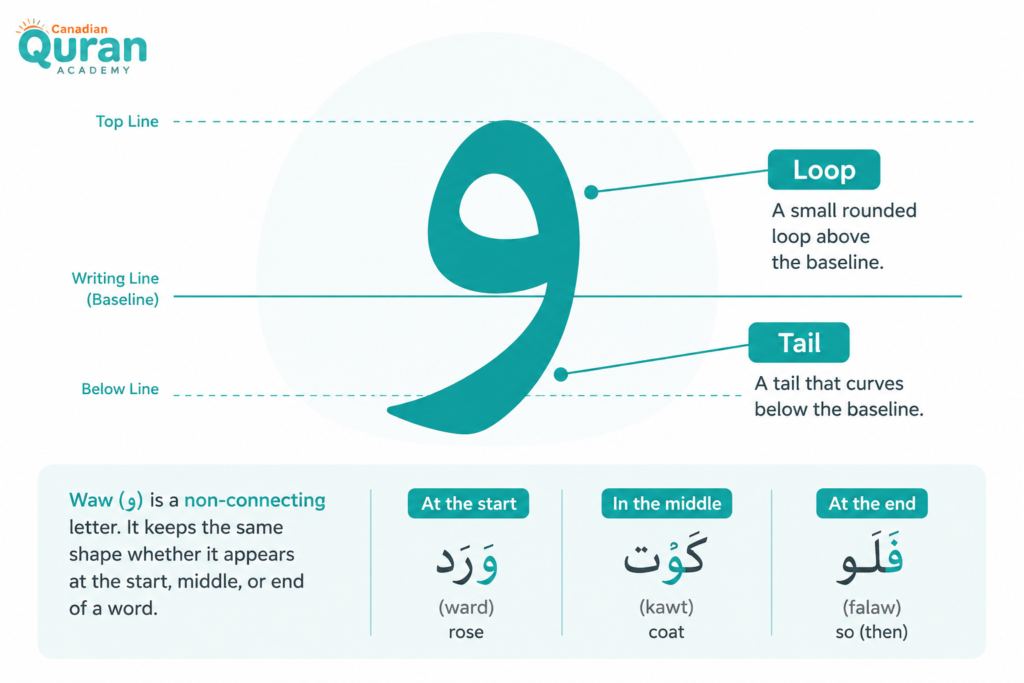
Waw (و) is the 27th letter of the Arabic alphabet. It is written as a small, rounded loop with a tail that curves below the baseline, and in English transliteration it usually appears as “w” or, in some contexts, “waw.”
Waw is unusual because it is not just a consonant. It is one of three “weak letters” (حروف العلة) in Arabic — alongside Alif (ا) and Yaa (ي) — meaning it can function as a long vowel as well as a consonant. That dual role is what makes it worth learning properly rather than skimming past it.
Waw comes after Ha (هـ) and before Yaa (ي) in the standard alphabet order. Its position matters for one practical reason: like Alif, Ra, Zay, Dal, and Thal, Waw belongs to a small group of six letters that never connect to the letter that follows them.
Recognizing this group early saves beginners a lot of confusion when reading connected scripts.
The Basic Shape Of Waw
The shape of Waw is consistent and easy to spot once you know it: a small circular loop sitting on or just above the writing line, with a tail that drops below the line.
Because Waw is a non-connecting letter, it keeps this same rounded shape whether it appears at the start, middle, or end of a word — it only changes slightly depending on whether it connects to a letter before it.
Read Also: The Letter Dh In Arabic ذ
How To Pronounce The Arabic Letter W In Three Ways?
Waw’s pronunciation depends entirely on the harakah (vowel mark) on the letter before it. Once you learn to read that signal, choosing the right sound becomes automatic rather than guesswork.
A. Waw As A Consonant (The “W” Sound)
When Waw appears at the beginning of a word, it almost always functions as a plain consonant, sounding exactly like the English “w” in “water” or “world.”
- وَرْدَة (wardah) — “rose”
- وَاحِد (waahid) — “one”
- وَلَد (walad) — “boy”
B. Waw As A Long Vowel (The “Oo” Sound)
When Waw follows a letter carrying a dammah (ُ) — the small curl-shaped mark that produces a short “u” — it stretches that sound into a long “oo,” similar to the “oo” in “moon.”
- سُوق (sooq) — “market”: the و elongates the “u” sound carried by the س before it
- فُول (fool) — “beans”
- نُور (noor) — “light”
C. Waw As A Diphthong (The “Aw” Sound)
When Waw follows a letter carrying a fathah (َ) — the short diagonal mark for a short “a” — the two combine into an “aw” or “ow” sound, close to the vowel sound in “cow.”
- ثَوْب (thawb) — “garment”
- نَوْم (nawm) — “sleep”
- لَوْن (lawn) — “color”
A simple way to remember this — call it the three-role test — is to check the vowel mark on the letter immediately before the Waw: no vowel-lengthening mark and Waw starts the word, it’s a consonant; a dammah before it, it’s a long “oo”; a fathah before it, it’s an “aw.” This one check resolves almost every ambiguity a beginner runs into.
Getting these three sounds right by ear takes guided repetition, which is exactly why Canadian Quran Academy’s Online Arabic Course pairs each letter with live pronunciation practice rather than leaving students to guess from a textbook.
Waw With Harakat: Fatha, Dammah, Kasrah, And Sukoon
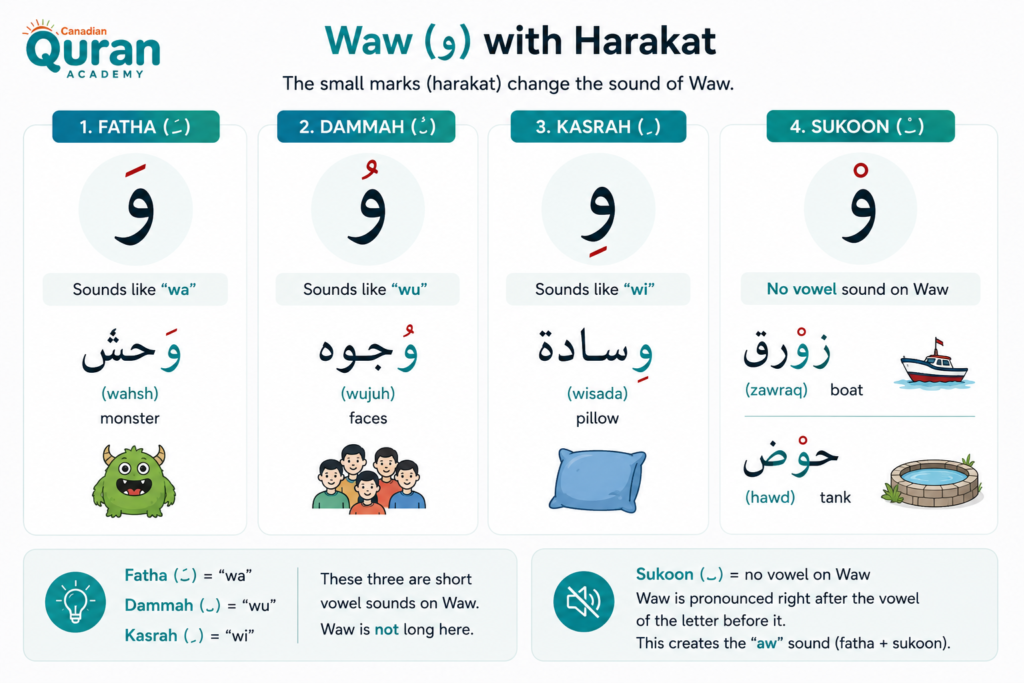
The harakat — the small marks placed above or below a letter — determine exactly how Waw is voiced in a given word. Since Waw can carry any of the four marks, learning them together makes the letter’s behavior predictable instead of memorized case by case.
Waw With Fatha, Dammah, And Kasrah
With a fatha (َ), Waw produces a short, quick “wa” sound, as in وَحش (wahsh — monster). With a dammah (ُ), it produces a short, rounded “wu” sound, as in وُجوه (wujuh — faces).
With a kasrah (ِ), it produces a short “wi” sound, as in وِسادة (wisada — pillow). None of these three is a long vowel on its own — length only appears when Waw itself carries no vowel and instead extends the dammah of the letter before it.
Waw With Sukoon (The Silent Waw)
A sukoon (ْ) marks the absence of a vowel on Waw itself. In this state, Waw is pronounced immediately after the vowel of the preceding letter, without adding a vowel of its own — for example in زوْرق (zawraq — boat) or حوْض (hawd — tank).
This is the same mechanism that produces the “aw” diphthong described earlier: a fathah on the previous letter plus a sukoon on Waw.
Students preparing for Quranic recitation in particular need to hear this distinction, since sukoon on Waw is extremely common in tajweed rules. It’s a recurring focus in Canadian Quran Academy’s Classical Arabic Course, where pronunciation is checked letter by letter with a live instructor rather than left to self-study.
Read Also: The Letter Fa In Arabic ف
Live Class in Action
Watch how our instructors interact with students in real-time, focusing on interactive methods.
Start Your Quranic Journey in Canada
Join our vibrant community and learn with expert tutors through our flexible online platform.
Claim Your Free TrialHow To Write The Arabic Letter Waw (و)?
Writing Waw is straightforward once you know the two rules that govern it: it is a non-connector, and its shape barely changes across positions.
To write Waw, start on the line and draw a small, tight loop in a clockwise motion. Without lifting your pen, extend the end of that loop downward, letting it curve below the line like a tail.
Keep the loop proportionate — not so large that it overwhelms neighboring letters, not so small that it’s hard to distinguish from a dot.
Why Waw Never Connects To The Next Letter?
Because Waw is a non-connector, it only has two practical forms: an isolated/initial form that looks the same whether it stands alone or opens a word, and a medial/final form that connects from the right to whatever comes before it.
This is why you will never see Waw stretched or reshaped to link forward — it simply stops, and the next letter starts fresh beside it.
- Beginning of a word: وَرد (ward — rose)
- Middle of a word: نور (noor — light)
- End of a word: أبو (abu — father of)
The Grammatical Roles Of Waw Beyond Pronunciation
Waw’s importance in Arabic goes past phonetics. In writing and speech, it also carries specific grammatical functions that a reader has to recognize by context, not sound alone.
1. Waw As The Conjunction “And”
The most frequent grammatical use of Waw is as the conjunction “and,” pronounced “wa” when it prefixes a word. This is one of the very first grammatical patterns beginners learn, because it appears constantly in even the simplest sentences.
- قلم و كتاب (qalam wa kitaab) — “a pen and a book”
- أنا وأنت (ana wa anta) — “I and you”
2. The Oath Waw In Classical And Quranic Arabic
In formal and classical Arabic — most notably in the Qur’an — Waw can introduce an oath, roughly translating to “by” when swearing on something.
- وَاللَّهِ (wallaahi) — “By God!”
Recognizing this use matters for anyone reading Quranic Arabic, since an oath Waw changes how a phrase should be understood compared to a simple conjunction.
Read Also: The Arabic Letter Ba (ب)
3. Waw As A Weak Letter In Verb Roots
Waw is also one of Arabic’s three weak letters (حروف العلة), along with Alif and Yaa. Weak letters can shift into one another depending on the grammatical pattern a word takes.
For example, the root ق و ل (“to say”) keeps its Waw visible in يَقُول (yaqul — he is saying), but that same Waw becomes an Alif in قَال (qaala — he said).
Recognizing that an Alif in a verb may actually be a “hidden” Waw from the root is a detail that separates casual learners from students who can actually parse new vocabulary on their own.
Common Mistakes When Learning The Letter Waw
Even though Waw’s shape is simple, a few recurring mix-ups slow learners down. Knowing them in advance means you can watch for them directly.
1. Confusing Waw (و) With Hamza On Waw (ؤ)
A common mistake is mixing up plain Waw with Waw carrying a Hamza on top (ؤ), which represents a glottal stop rather than a “w” or “oo” sound — as in مسؤول (mas’ool — responsible).
The correction is simple: Waw alone is a single curved stroke with no marks above it; Hamza on Waw always has that small glottal-stop symbol sitting on the loop.
2. Missing The Difference Between Consonant And Long-Vowel Waw
Another frequent error is pronouncing every Waw as a hard consonant “w,” even when it’s functioning as a long “oo” vowel. The fix is the same check described earlier: look at the harakah on the letter before the Waw.
A dammah signals a long vowel; no preceding vowel-lengthening context (especially at the start of a word) signals a consonant.
Instructors typically catch this kind of error within the first few sessions of live practice — which is one reason Canadian Quran Academy’s Arabic Course for Beginners builds in one-on-one correction rather than relying only on recorded lessons.
Read Also: How To Learn Arabic For Quran In Canada?
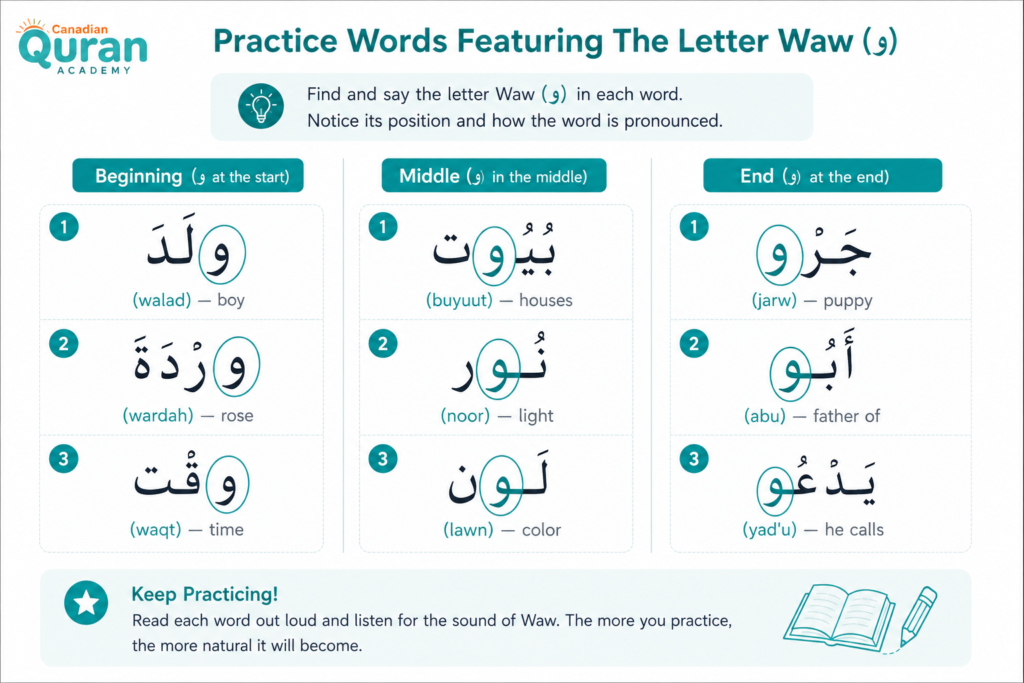
Practice Words Featuring The Letter Waw
Seeing Waw across real words in each position helps the letter’s different sounds become automatic.
- Beginning: وَلَد (walad — boy), وَرْدَة (wardah — rose), وَقْت (waqt — time)
- Middle: بُيُوت (buyuut — houses), نُور (noor — light), لَوْن (lawn — color)
- End: جَرْو (jarw — puppy), أبو (abu — father of), يدعو (yad’u — he calls)
Experience Our Classrooms
Don’t just take our word for it—take a look inside! Watch the videos below to experience our engaging teaching methods and vibrant online classrooms firsthand.
Start Your Quranic Journey in Canada
Join our vibrant community and learn with expert tutors through our flexible online platform.
Claim Your Free TrialStart Speaking Arabic With Confidence
Reading about the letter Waw is a useful first step, but real fluency comes from hearing the three sounds spoken correctly and having a teacher catch your mistakes in real time. That’s the gap between knowing the rules and actually using them in conversation or recitation.
Canadian Quran Academy’s live, one-on-one Arabic classes take you letter by letter — from foundational sounds like Waw through full sentence construction — with instructors who correct your pronunciation as you practice, not after the fact.

Whether you’re starting from zero or refining classical pronunciation for Quranic study, there’s a course built for where you are.
Our Arabic Courses:
- Online Arabic Academy
- Online Arabic Course
- Classical Arabic Course
- Arabic Course for Beginners
- Advanced Arabic Course
- Quranic Arabic Course
- Arabic Grammar Course
- Modern Standard Arabic Course
- Arabic Conversation / Speaking Course
- Intensive Arabic Course
- Online Arabic Classes for Kids
- Arabic Classes for Adults
- Arabic Classes for Ladies
- Fusha Arabic Course
- Business Arabic Course

Start Your Quranic Journey in Canada
Join our vibrant community and learn with expert tutors through our flexible online platform.
Claim Your Free TrialConclusion
The و – Arabic letter w is the 27th letter of the alphabet and one of the most versatile: a consonant “w” sound at the start of words, a long “oo” vowel after a dammah, and an “aw” diphthong after a fathah.
Its shape stays simple and consistent because it never connects forward, and its four harakat — fatha, dammah, kasrah, and sukoon — each shift its sound in a predictable way once you know the pattern to look for.
Beyond pronunciation, Waw carries real grammatical weight as the conjunction “and,” as an oath marker in classical and Quranic Arabic, and as a weak letter that can hide inside verb roots.
Mastering the Arabic letter w means training your ear to catch these signals automatically — something that comes far faster with guided, live practice than with self-study alone. That’s the foundation Canadian Quran Academy builds every beginner course around.

Frequently Asked Questions About The Arabic Letter Waw
The questions below cover the details students ask most often about the letter Waw (و) — its sound, its shape, and how it’s different from similar-looking letters. Each answer gives you the direct point first, so you can use these as a quick reference alongside the sections above.
1. What sound does the Arabic letter Waw (و) make?
Waw makes three possible sounds depending on context: a consonant “w” (as in “water”) at the start of a word, a long “oo” vowel after a letter with a dammah, and an “aw” diphthong after a letter with a fathah.
2. Is Waw a vowel or a consonant in Arabic?
Waw is both. It functions as a consonant when it opens a word or carries its own short vowel, and as one of Arabic’s three long vowels (alongside Alif and Yaa) when it follows a dammah.
3. Does the letter Waw connect to other letters?
Waw only connects to the letter before it, never to the one after it. This makes it a “non-connector,” a feature it shares with five other letters: Alif, Ra, Zay, Dal, and Thal.
4. How many written forms does the letter Waw have?
Waw has two forms rather than the four some connecting letters have: an isolated/initial form (و) and a medial/final form (ـو). Because it never connects forward, its shape stays visually consistent no matter where it appears in a word.
5. What is the difference between Waw (و) and Hamza on Waw (ؤ)?
Waw (و) is a plain letter representing a “w” or “oo” sound, while Hamza on Waw (ؤ) adds a glottal-stop symbol on top and represents a different sound entirely, as in مسؤول (mas’ool — responsible). The shapes look similar at a glance but are pronounced differently.
6. What does Waw mean when it appears at the start of a word?
At the start of a word, Waw is very often the conjunction “and,” pronounced “wa” — for example, وأنت (wa anta — “and you”). Context tells you whether it’s this grammatical use or simply the first consonant of the word itself.






Leave a Reply