 Arabic
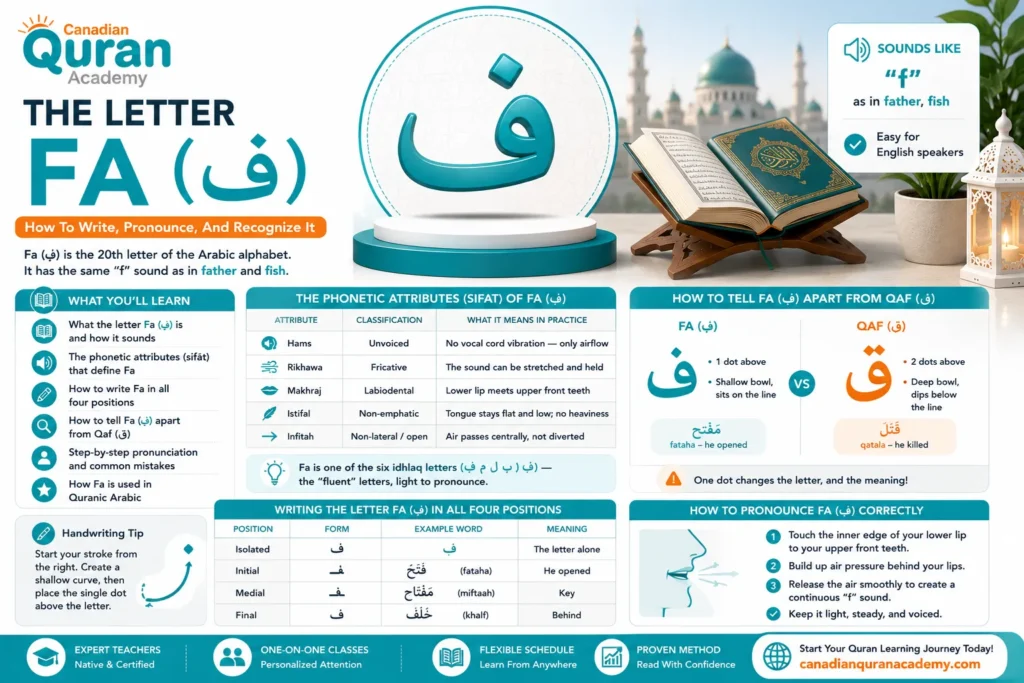
The letter Fa in Arabic ف is the twentieth letter of the Arabic alphabet, and it is also one of the friendliest for English speakers to pick up. It represents the same (f) sound you already make in words like “father” and “coffee,” which means you don’t have to retrain your mouth to say it correctly — you just need to learn where it sits in Arabic script.
This guide walks through everything a learner needs for the letter Fa in Arabic ف: its sound and articulation point, its four written forms, how to tell it apart from the letter it’s most often confused with, and how it behaves in Quranic recitation.
Each section is built to be used on its own, so you can jump straight to writing practice or straight to pronunciation if that’s what you need today.
Canadian Quran Academy teaches this letter, along with the rest of the Arabic alphabet, inside structured lessons rather than isolated flashcard drills — because a letter only really sticks once you’ve written it, heard it, and used it in a real word.
What you’ll learn in this article
- What the letter Fa in Arabic ف sounds like and where it’s articulated in the mouth
- The five phonetic attributes (sifat) that define how Fa should be pronounced in Tajweed
- How to write Fa in its isolated, initial, medial, and final forms
- The one visual detail that separates Fa from the letter Qaf
- A step-by-step pronunciation drill and the mistakes English speakers make most often
- How Fa functions inside Quranic Arabic, including its grammatical role as a connector
What Is The Letter Fa In Arabic ف And How Does It Sound?
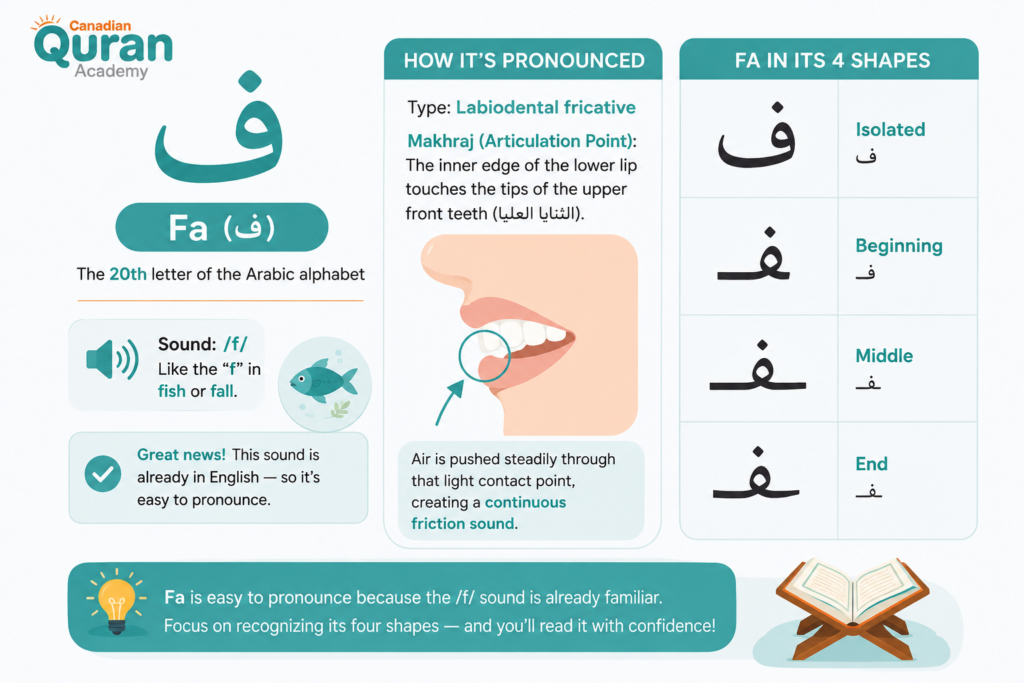
The letter Fa (ف) is the twentieth letter of the Arabic alphabet, and it produces an /f/ sound nearly identical to the English “f” in “fish” or “fall.” Because English already has this exact sound, Fa requires almost no new muscle memory — only a new symbol to recognize.
In Tajweed phonetics, Fa is classified as a labiodental fricative. Its makhraj, or articulation point, is the inner edge of the lower lip meeting the tips of the upper front teeth (الثنايا العليا). Air is pushed steadily through that light contact point, producing a continuous friction sound rather than a stop.
Because the sound is so close to its English equivalent, most beginners get the sound right on the first attempt. Where they slip up is usually in reading the letter’s four written shapes, which is what the rest of this guide focuses on.
The Phonetic Attributes (Sifat) Of The Letter Fa In Arabic
The sifat of a letter are the set of qualities that describe exactly how it should be produced, and they matter most during Quran recitation, where mispronouncing a letter’s character can change how a word is delivered.
| Attribute | Classification | What it means in practice |
| Hams | Unvoiced | No vocal cord vibration — only airflow |
| Rikhawa | Fricative | The sound can be stretched and held |
| Makhraj | Labiodental | Lower lip meets the upper front teeth |
| Istifal | Non-emphatic | The tongue stays flat and low; no heaviness |
| Infitah | Non-lateral / open | Air passes centrally, not diverted |
Fa also belongs to the six idhlaq letters (ف ر م ل ب ن), a group Tajweed scholars describe as the “fluent” letters because they’re produced with the lips and tongue-tip rather than deeper in the throat.
This is one reason Fa-heavy words never sound labored or heavy when recited correctly — the articulation is light by design, not by accident.
Read Also: The Arabic Letter Ba (ب)
How Do You Tell The Letter Fa In Arabic Apart From The Letter Qaf?
Fa (ف) and Qaf (ق) are the two Arabic letters beginners confuse most often, because at a glance both are a loop with a tail. The difference comes down to two details: the number of dots and the depth of the bowl.
Fa carries a single dot above a shallow bowl that sits close to the writing line. Qaf carries two dots above a deeper, rounder bowl that dips noticeably below the line in its isolated and final forms.
A quick way to check yourself: count the dots first, then look at how far the bowl drops — one dot and a shallow curve means Fa; two dots and a deep curve means Qaf.
This distinction isn’t cosmetic.
فتح (fataha, “he opened”) and قتل (qatala, “he killed”) differ by exactly this one dot, so misreading it changes the word’s meaning entirely, not just its pronunciation.
Live Class in Action
Watch how our instructors interact with students in real-time, focusing on interactive methods.
Start Your Quranic Journey in Canada
Join our vibrant community and learn with expert tutors through our flexible online platform.
Claim Your Free TrialWriting The Letter Fa In Arabic ف In All Four Positions
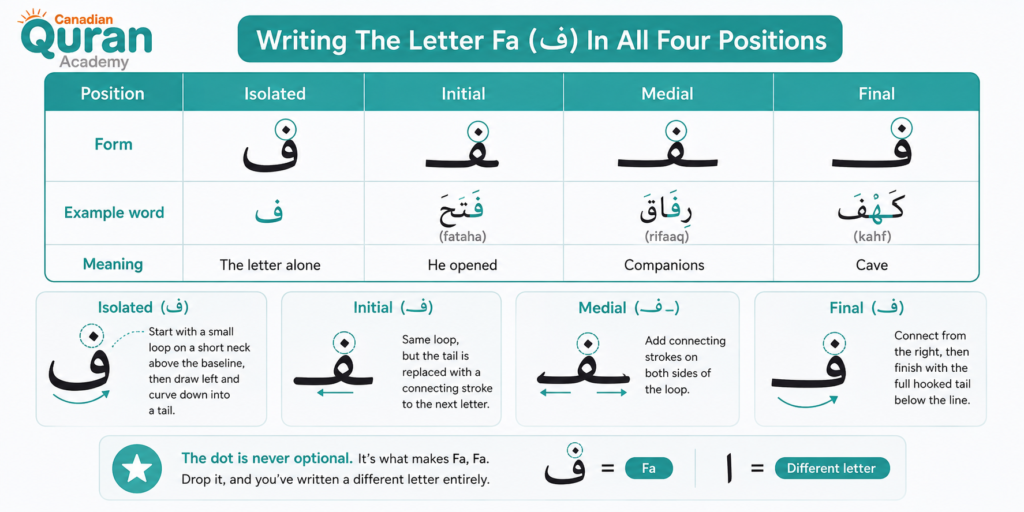
Arabic is a connected script, so most letters — including Fa — change shape depending on where they fall in a word. The core feature of Fa, a curved bowl with one dot above it, stays recognizable across every position, but the tail and connecting strokes shift.
| Position | Form | Example word | Meaning |
| Isolated | ف | ف | The letter alone |
| Initial | فـ | فَتَحَ (fataha) | He opened |
| Medial | ـفـ | رِفَاق (rifaaq) | Companions |
| Final | ـف | كَهْف (kahf) | Cave |
In the isolated form, start with a small loop resting on a short neck above the baseline, then draw the line left before curving it into a tail below the line.
The initial form keeps the same loop but replaces the tail with a connecting stroke to the next letter. The medial form adds a connecting line on both sides of the loop, and the final form connects from the right before finishing with the full hooked tail.
The dot above the loop is never optional. Drop it, and you’ve written a different letter entirely — which is exactly the mix-up covered next.
If tracing four forms per letter feels like a lot to hold in your head, that’s normal — it’s why Canadian Quran Academy’s Arabic Course for Beginners builds handwriting practice into every early lesson instead of leaving it as homework you’re expected to figure out alone.
How Do You Pronounce The Letter Fa In Arabic ف?
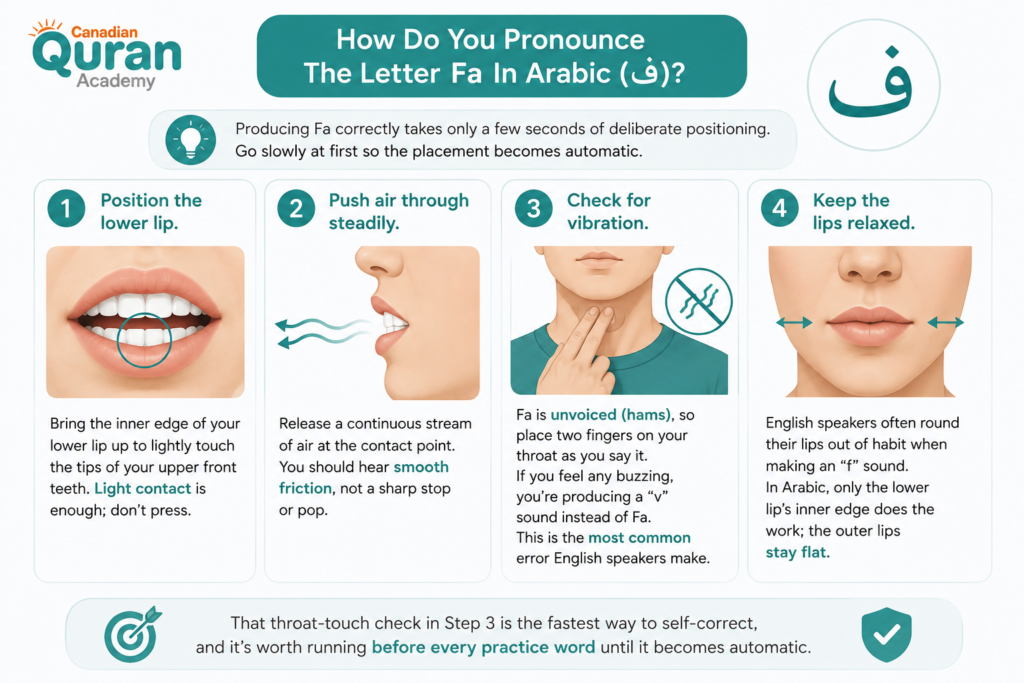
Producing Fa correctly takes only a few seconds of deliberate positioning, and it’s worth doing slowly the first several times so the placement becomes automatic.
Step 1 — Position the lower lip. Bring the inner edge of your lower lip up to lightly touch the tips of your upper front teeth. Light contact is enough; don’t press.
Step 2 — Push air through steadily. Release a continuous stream of air at the contact point. You should hear smooth friction, not a sharp stop or pop.
Step 3 — Check for vibration. Fa is unvoiced (hams), so place two fingers on your throat as you say it. If you feel any buzzing, you’re producing a “v” sound instead of Fa — this is the single most common error English speakers make.
Step 4 — Keep the lips relaxed. English speakers often round their lips out of habit when making an “f” sound. In Arabic, only the lower lip’s inner edge does the work; the outer lips stay flat.
That throat-touch check in Step 3 is the fastest way to self-correct, and it’s worth running before every practice word until it becomes automatic.
What Mistakes Do English Speakers Make Most Often With Fa?
Most errors with this letter come from habits carried over from English rather than any real difficulty in the Arabic sound itself. The table below lists the four mistakes that show up most often, along with the quick fix for each.
| Mistake | What it sounds like | Correction |
| Producing a “v” instead | Voiced fricative | Confirm zero throat vibration with the touch test |
| Pressing the lip too hard | A muffled, stopped sound | Use light, brief contact only |
| Rounding the lips | A distorted, heavier sound | Keep the outer lips relaxed and flat |
| Adding extra air after the sound | An aspirated puff following Fa | Keep the airflow steady, then stop cleanly |
Read also: How To Pronounce And Write The Arabic Letter Ya (ي)
What Are Common Arabic Words With The Letter Fa?
Learning a letter through real vocabulary anchors it far better than repeating the letter in isolation. The letter Fa in Arabic ف appears in hundreds of everyday words, including several used constantly in Islamic and Quranic contexts.
1. Words With Fa At The Beginning
These words open with Fa in its initial form, so the dot sits above a loop that connects straight into the next letter rather than closing into a tail.
| Arabic word | Transliteration | Meaning |
| فَتَحَ | Fataha | He opened |
| فَرَح | Farah | Joy |
| فِيل | Feel | Elephant |
| فَهِمَ | Fahima | He understood |
| فُنْدُق | Funduq | Hotel |
2. Words With Fa In The Middle Or At The End
Here Fa switches to its medial or final shape, which is the version most learners hesitate over first because the loop connects from both sides or finishes with the full hooked tail.
| Arabic word | Transliteration | Meaning | Fa’s position |
| رِفَاق | Rifaaq | Companions | Medial |
| صَحِيفَة | Saheefa | Newspaper / scroll | Medial |
| كَهْف | Kahf | Cave | Final |
| شَرَف | Sharaf | Honor | Final |
| حُرُوف | Huroof | Letters | Final |
Notice that حُرُوف (huroof), the Arabic word for “letters,” contains Fa itself — so every time a student names the alphabet they’re studying, they’re pronouncing this letter.
Vocabulary sticks fastest when it’s practiced out loud with feedback, which is the reason Canadian Quran Academy’s Online Arabic Course pairs every new letter with spoken words in the same session rather than saving pronunciation for later.
How Does The Letter Fa Behave In Quranic Arabic And Tajweed?
The letter Fa in Arabic appears thousands of times across the Quran, and Tajweed treats it with a few specific rules that go beyond its everyday pronunciation.
First, Fa is not one of the qalqalah letters (ق ط ب ج د), so it never receives the bouncing “echo” sound those five letters carry when they land on a sukoon. Fa’s fricative quality means it flows and can be extended, which is the opposite behavior — a distinction worth knowing so you don’t apply qalqalah where it doesn’t belong.
Second, Fa is a moon letter (حرف قمري), not a sun letter. When the definite article “ال” precedes a word starting with Fa, the lam stays fully pronounced: الفَجْر (al-fajr, “the dawn”) is read with a clear “l” sound, unlike sun letters, which absorb the lam entirely.
Third, and this is a detail most beginner material skips entirely: Fa also functions grammatically as فاء السببية, the “Fa of consequence,” a prefix that links a cause to its result across two clauses in Quranic and Classical Arabic.
Recognizing this function matters for comprehension, not just recitation, because it changes how a sentence’s logic reads.
Getting the sound right is only the first layer — reading Fa correctly inside real ayat, including where it functions as a grammatical connector, is a skill that develops through guided recitation.
That’s the kind of detail covered in Canadian Quran Academy’s Classical Arabic Course, where grammar and Quranic usage are taught side by side rather than as separate subjects.
How Can You Practice The Letter Fa In Arabic On Your Own?
Short, repeated drills build recognition faster than long study sessions. These four exercises can be done directly from this page.
Exercise 1 — Letter recognition. Circle every Fa (ف) in this line: ق ف ك ف ب ف ق ف ن ف. This trains your eye to catch the one-dot, shallow-bowl shape quickly.
Exercise 2 — Pronunciation repetition. Say فَرَح — فَهِمَ — فَتَحَ — فِيل — فَقِير aloud five times each, checking for throat vibration after every repetition.
Exercise 3 — Fill in the missing Fa. Complete: ـَرَح (joy), كَهـ (cave), رِـَاق (companions). Answers: فَرَح, كَهْف, رِفَاق.
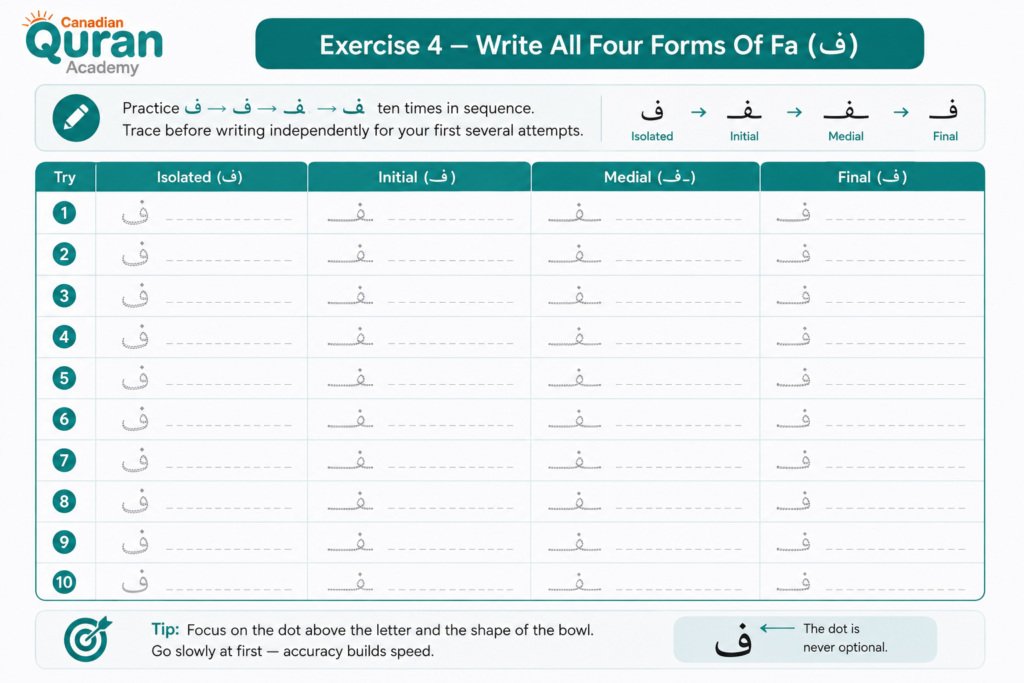
Exercise 4 — Write all four forms. Practice ف → فـ → ـفـ → ـف ten times in sequence, tracing before writing independently for your first several attempts.
Read Also: The Arabic Letter Haa (ه)
Read Also: How To Learn Arabic In 6 Months In Canada?
Experience Our Classrooms
Don’t just take our word for it—take a look inside! Watch the videos below to experience our engaging teaching methods and vibrant online classrooms firsthand.
Start Your Quranic Journey in Canada
Join our vibrant community and learn with expert tutors through our flexible online platform.
Claim Your Free TrialStart Mastering Arabic Letters With A Live Instructor
Working through worksheets alone gets you partway there, but a live instructor catches the small habits — like rounding your lips or pressing too hard — that are nearly impossible to notice on your own.
Canadian Quran Academy structures every lesson around exactly that kind of real-time correction, whether you’re a complete beginner on your first letter or refining Tajweed rules for advanced recitation.

Book your free trial class with Canadian Quran Academy and start reading Arabic with confidence.
Our Arabic Courses:
- Online Arabic Academy
- Online Arabic Course
- Classical Arabic Course
- Arabic Course for Beginners
- Advanced Arabic Course
- Quranic Arabic Course
- Arabic Grammar Course
- Modern Standard Arabic Course
- Arabic Conversation / Speaking Course
- Intensive Arabic Course
- Online Arabic Classes for Kids
- Arabic Elementary School
- Arabic Intermediate School
- Arabic Lessons for Kindergarten

Start Your Quranic Journey in Canada
Join our vibrant community and learn with expert tutors through our flexible online platform.
Claim Your Free TrialConclusion
The letter Fa in Arabic ف is one of the most approachable letters in the alphabet: an /f/ sound you already know, a single dot that sets it apart from Qaf, and four written forms that stay visually consistent once you’ve traced them a few times.
Where learners actually stumble isn’t the sound itself but the small details — the throat-vibration check, the dot count, and Fa’s specific behavior in Tajweed as a moon letter and a non-qalqalah letter.
Once those details are locked in, Fa becomes a stable reference point for reading far more Arabic vocabulary, since it shows up constantly in everyday words and throughout the Quran.
Canadian Quran Academy builds each of these checkpoints into structured lessons, so recognition, writing, and correct pronunciation of the letter Fa in Arabic develop together rather than in isolation.

Frequently Asked Questions About The Letter Fa In Arabic ف
These questions cover the details learners ask most often once they’ve gone through the basics of Fa’s sound, shape, and usage — the kind of follow-up that comes up naturally in a live lesson with Canadian Quran Academy’s instructors.
1. Is the letter Fa in Arabic difficult to pronounce for English speakers?
No, the letter Fa in Arabic ف is one of the easiest Arabic sounds for English speakers because it matches the English “f” almost exactly. The only adjustment needed is keeping the outer lips relaxed instead of rounding them out of habit.
2. What is the main difference between Fa and Qaf?
The main difference between Fa and Qaf is the number of dots and the bowl’s depth. Fa has one dot above a shallow bowl, while Qaf has two dots above a deeper bowl that dips below the line.
3. How can I tell if I’m mispronouncing Fa as a “v” sound?
Place two fingers lightly on your throat while pronouncing Fa. If you feel vibration, you’re voicing the sound and producing a “v” instead of Fa, which is unvoiced. Fa should produce airflow and friction only, with no vibration at all.
4. Is the letter Fa a sun letter or a moon letter in Arabic?
The letter Fa is a moon letter (حرف قمري) in Arabic, meaning the lam in the definite article “ال” stays fully pronounced before it, as in الفَجْر (al-fajr). It does not assimilate the way sun letters do.
5. Does the letter Fa take the qalqalah rule in Tajweed?
No, Fa does not take the qalqalah rule. Qalqalah applies only to the five letters ق ط ب ج د, and Fa’s fricative nature means it flows and can be extended instead of producing the bouncing echo qalqalah letters carry.






Leave a Reply