 Arabic
If you’ve ever tried to say “this” in Arabic and ended up saying something closer to “zis” or “dis,” you’ve run into the letter Dh in Arabic – ذ. It’s one of the sounds English speakers mispronounce most often, not because it’s rare, but because English doesn’t force your tongue into the right position for it.
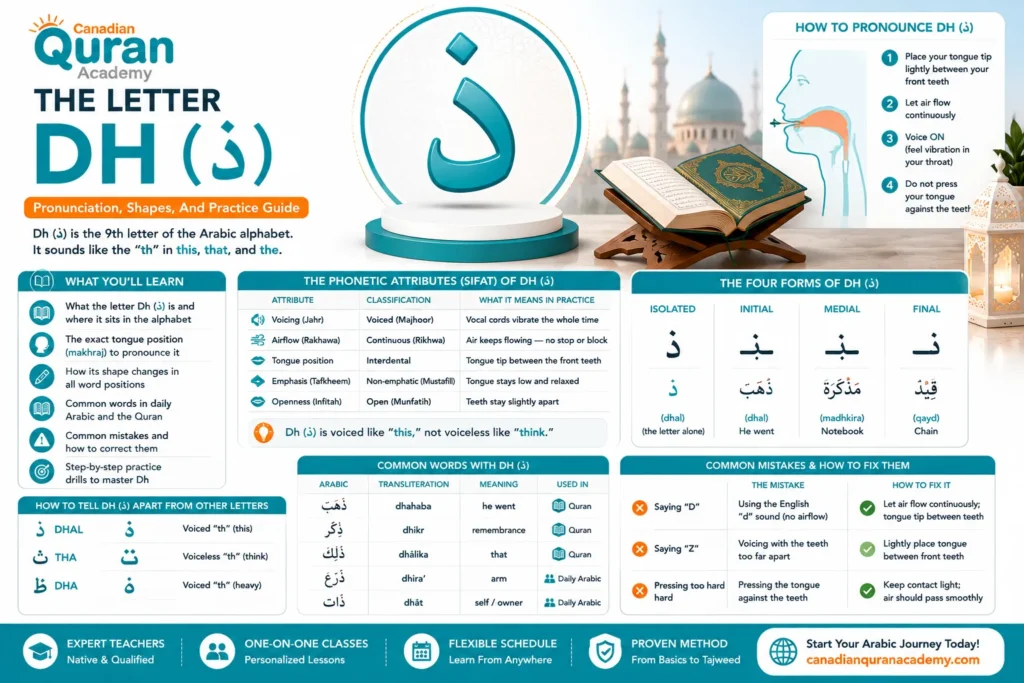
The letter Dh in Arabic – ذ, also written as Dhal or ذال, is the ninth letter of the Arabic alphabet. It carries a voiced “th” sound, the same sound you already make in “this,” “that,” and “the” — you just haven’t connected it to Arabic script yet.
This guide walks through its shape, its exact pronunciation point, how it behaves inside words, and where people usually go wrong with it.
At Canadian Quran Academy, this is one of the first letters students work through carefully, because getting it wrong changes meaning in real Quranic words — not just in theory.
What You’ll Learn in This Article
- What the letter Dh in Arabic – ذ is and where it sits in the alphabet
- The exact tongue position (makhraj) needed to pronounce it correctly
- How its shape changes across the beginning, middle, and end of a word
- Common words that contain Dhal, from everyday speech to Quranic text
- The three mistakes English speakers make most often, and how to fix each one
- Step-by-step drills you can start practicing today
What Is The Letter Dh In Arabic – ذ?
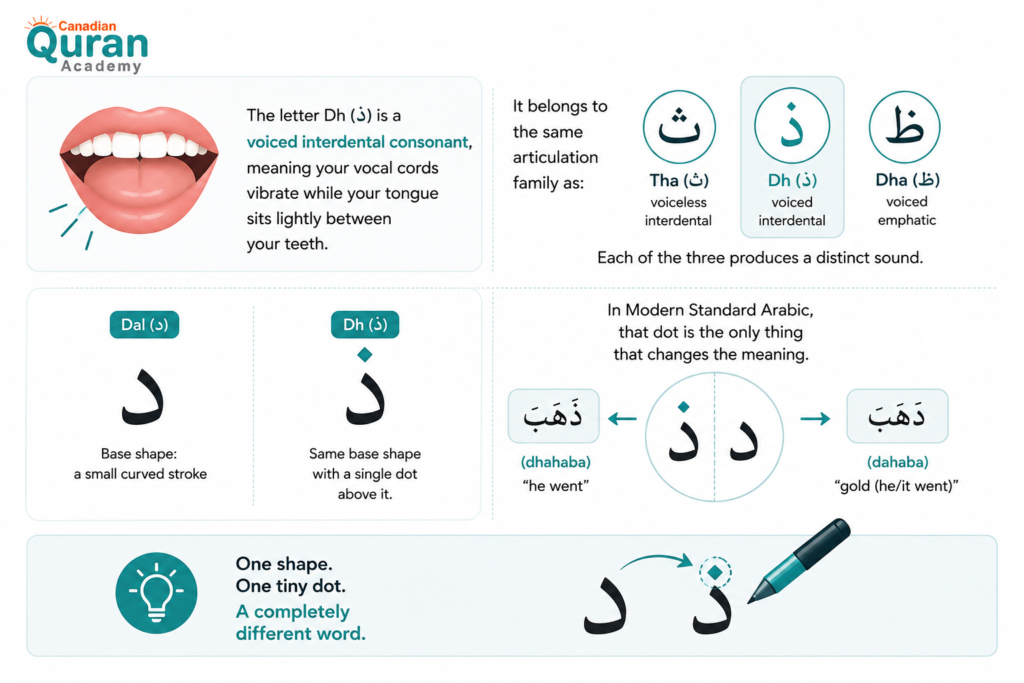
The letter Dh in Arabic – ذ is a voiced interdental consonant, meaning your vocal cords vibrate while your tongue sits lightly between your teeth. It belongs to the same articulation family as ث (tha) and ظ (dha), but each of the three produces a distinct sound.
Dhal shares its base shape with د (dal) — a small curved stroke — and is distinguished by a single dot placed above it. In Modern Standard Arabic, that dot is the only thing separating “he went” (ذَهَبَ) from a completely different, dotless word built on the same skeleton.
Dhal’s Phonetic Family: Dh, Tha, And Dha
Three Arabic letters share the interdental articulation point: ذ (dhal), ث (tha), and ظ (dha). The difference between them comes down to voicing and emphasis, not tongue placement.
Dhal is voiced and non-emphatic, tha is voiceless and non-emphatic, and dha is voiced and emphatic (heavier, with the back of the tongue raised).
Students who are new to Arabic often lump these three together as “the th letters” and guess at which one appears in a word.
Learning them as a set — rather than in isolation — is one of the fastest ways to stop confusing them, and it’s a structure we build into every phonetics session at Canadian Quran Academy’s Learning Arabic for Non-Arabic Speakers course.
How Do You Pronounce The Letter Dh In Arabic?
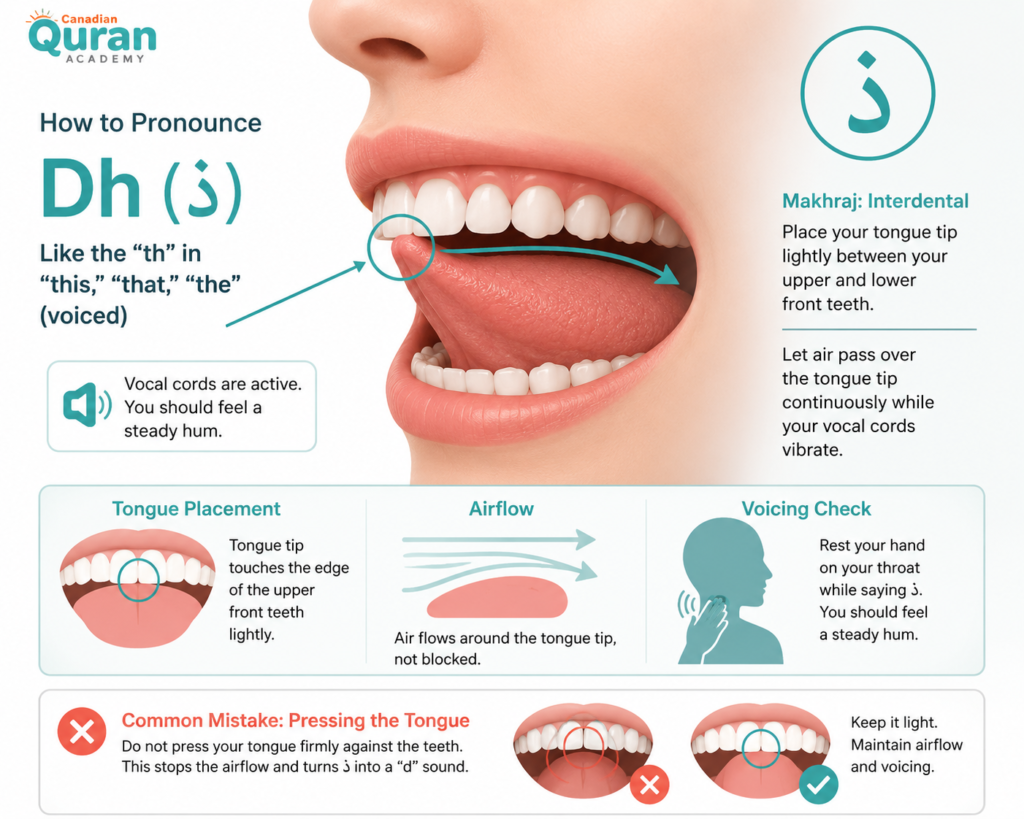
The letter Dh in Arabic – ذ is pronounced like the “th” in the English words “this,” “that,” or “the” — never like the “th” in “think.” The distinguishing feature is voicing: your vocal cords are active the entire time you produce the sound.
Place your tongue tip lightly between your upper and lower front teeth, let air pass over it continuously, and keep your vocal cords vibrating throughout. If you rest your hand on your throat while saying ذ, you should feel a steady hum. If you feel nothing, you’re likely producing ث by mistake.
The makhraj of ذ is interdental — precise and specific, not a general “somewhere near the teeth” location. The tongue tip makes light contact with the edge of the upper front teeth (الثنايا العليا), while air continues to flow around it rather than being blocked.
A common instructor correction here: don’t press. Learners who press the tongue firmly against the teeth end up producing a stopped sound closer to “d,” which cancels the continuous airflow that makes ذ what it is.
The Sifat (Phonetic Attributes) Of Dhal
Classical Arabic phonetics classifies every letter by a fixed set of attributes. Here’s how ذ is classified:
| Attribute | Classification | What It Means in Practice |
| Voicing (Jahr) | Voiced (Majhoor) | Vocal cords vibrate the whole time you say it |
| Airflow (Rakhawa) | Continuous (Rikhwa) | Air keeps flowing — there’s no stop or block |
| Tongue position | Interdental | Tongue tip sits between the front teeth |
| Emphasis (Tafkheem) | Non-emphatic (Mustafil) | Tongue stays low and relaxed, no heaviness |
| Openness (Infitah) | Open (Munfatih) | Teeth stay slightly parted, not clamped shut |
Knowing these five attributes matters beyond theory: each one is a checkpoint. If your ذ sounds flat or unclear, running through this table tells you exactly which attribute you’re missing — usually the continuous airflow or the voicing.
Live Class in Action
Watch how our instructors interact with students in real-time, focusing on interactive methods.
Start Your Quranic Journey in Canada
Join our vibrant community and learn with expert tutors through our flexible online platform.
Claim Your Free TrialRead Also: The Letter Fa In Arabic ف
How Do You Write The Letter Dh (ذ)?
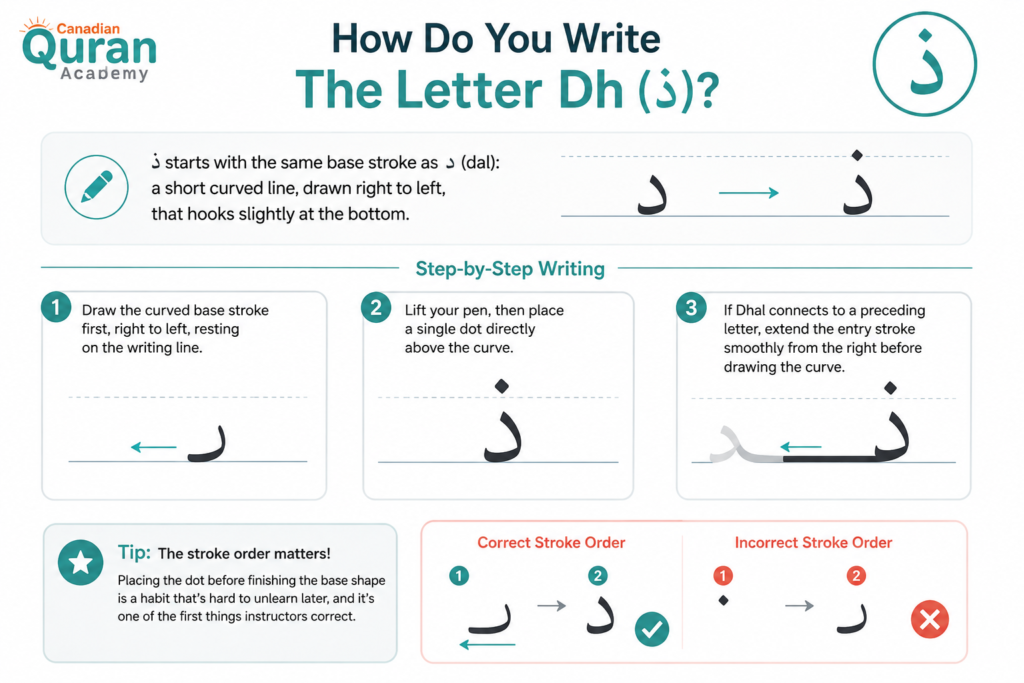
Writing ذ starts with the same base stroke as دال (dal): a short curved line, drawn right to left, that hooks slightly at the bottom. The letter is compact — it doesn’t extend far above or below the baseline.
- Draw the curved base stroke first, right to left, resting on the writing line.
- Lift your pen, then place a single dot directly above the curve.
- If Dhal connects to a preceding letter, extend the entry stroke smoothly from the right before drawing the curve.
The stroke order matters more than it seems. Placing the dot before finishing the base shape is a habit that’s hard to unlearn later, and it’s one of the first things instructors correct in beginner handwriting sessions.
How Does the Letter Dh Change Shape Across Word Positions?
The letter Dh in Arabic – ذ has only two visual shapes, not four, because it is one of seven non-connecting letters in the alphabet — it never links forward to the letter after it.
Because of that rule, its isolated and initial forms look identical, and its medial and final forms look identical too. Once you know this, the shape table stops being something to memorize and becomes something you can predict.
| Position | Shape | What’s Happening |
| Isolated | ذ | Standing alone, full form |
| Initial | ذ | Same as isolated — Dhal never changes to open a connection forward |
| Medial | ـذ | Connects only to the letter before it, then the word continues unattached |
| Final | ـذ | Connects from the preceding letter, word ends here |
Examples of Dhal in Each Position:
- Beginning: ذَهَبَ (dhahaba — “he went”), ذَكِيّ (dhakiyy — “smart”)
- Middle: مَذْهَب (madhhab — “school of thought”), أُسْتاذ (ustaadh — “teacher”)
- End: تِلْمِيذ (tilmeedh — “student”), لَذِيذ (ladheedh — “delicious”)
Reading these three groups side by side is one of the fastest ways to internalize the non-connecting rule — your eye starts to expect the break before you’ve consciously thought about it.
Younger learners in particular benefit from repeated shape-spotting like this before they move to full sentences, which is exactly the pacing used in Canadian Quran Academy’s Arabic Elementary School program.
Read Also: The Arabic Letter Ba (ب)
What Common Words Contain The Letter Dh In Arabic?
Repeated exposure to real words is the fastest route to recognizing any Arabic letter automatically, and ذ appears constantly in both everyday speech and Quranic vocabulary.
1. Words Starting With Dhal
When Dhal opens a word, its shape is clear and unconnected on the left, which makes it one of the easiest positions to spot while reading. The words below are common, high-frequency examples worth memorizing first.
| Arabic Word | Transliteration | Meaning |
| ذَهَبَ | Dhahaba | He went |
| ذَكَرَ | Dhakara | He remembered / mentioned |
| ذِئْب | Dhi’b | Wolf |
| ذَنْب | Dhanb | Sin / fault |
| ذِكْر | Dhikr | Remembrance (of Allah) |
2. Words With Dhal In The Middle Or End
Once Dhal moves inside or to the end of a word, it connects on the right to the letter before it while still refusing to connect forward — the same non-connecting rule covered earlier. These examples show that pattern in real, frequently used words.
| Arabic Word | Transliteration | Meaning |
| هَذَا | Hadha | This (masculine) |
| كَذَلِكَ | Kadhalika | Likewise |
| أَخَذَ | Akhadha | He took |
| تِلْمِيذ | Tilmeedh | Student |
| لَذِيذ | Ladheedh | Delicious |
هَذَا (hadha) deserves particular attention — it’s one of the first words any Arabic learner encounters, and it puts ذ front and center from day one.
How Is The Letter Dh Used In Quranic Recitation?
The letter Dh in Arabic – ذ appears frequently throughout the Quran, and pronouncing it precisely is a matter of correct recitation, not just general fluency. In tajweed, mispronouncing the makhraj of ذ — turning it into a “d” or “z” sound — is classified as لحن جلي (lahn jali), a clear recitation error, when it changes the intended sound of the word.
Consider this ayah:
إِنَّا نَحْنُ نَزَّلْنَا الذِّكْرَ وَإِنَّا لَهُ لَحَافِظُونَ
“Indeed, it is We who sent down the Quran and indeed, We will be its guardian.” (Al-Hijr 15:9)
The word الذِّكْر (al-dhikr) carries ذ with a shaddah, which intensifies and lengthens the sound rather than changing its articulation point. The interdental placement has to hold even under that added emphasis — this is exactly the kind of letter-level detail that separates casual reading from accurate recitation.
Students working through recitation-focused study, rather than general conversation, usually need more repetition on letters like this.
Canadian Quran Academy’s Madinah Arabic Course is built around this kind of classical, letter-by-letter accuracy, using the same methodology historically used at the Islamic University of Madinah.
What Mistakes Do English Speakers Make With The Letter Dh In Arabic?
English speakers tend to make the same three substitution errors with ذ, largely because English has no interdental voiced consonant used the same way. Knowing the pattern in advance makes each one easier to catch in your own speech.
1. Confusing Dh With Z
Both sounds are voiced, which is why this substitution is so common — the ear doesn’t immediately flag the difference. The distinction is tongue placement: “z” is produced with the tongue behind the teeth, while ذ requires the tongue tip between them.
A useful correction drill: say “zoo,” then slide your tongue forward until it just touches the gap between your teeth. That forward slide is the fix.
2. Confusing Dh With D
This substitution is especially common among speakers whose first language doesn’t distinguish fricatives (continuous airflow sounds) from stops (blocked airflow sounds).
Saying ذَنْب (dhanb — “sin”) as if it were a “d” sound removes the interdental fricative entirely and changes the word’s identity, not just its accent.
3. Confusing Dh With Tha (ث)
ذ and ث share the exact same tongue position — the only difference is voicing.
ذ is voiced, ث is voiceless. Hand-on-throat testing is the fastest way to tell them apart while practicing: vibration means you’re saying ذ correctly; silence means you’ve drifted into ث.
It’s also worth knowing that in several spoken Arabic dialects — Levantine Arabic among them — ذ is commonly replaced with د or ز in everyday speech.
That’s a normal dialect feature, not an error, but it’s not the pronunciation taught for Modern Standard Arabic or Quranic recitation, where the interdental sound is preserved.
Read also: How To Pronounce And Write The Arabic Letter Ya (ي)
How Can You Practice The Letter Dh In Arabic?
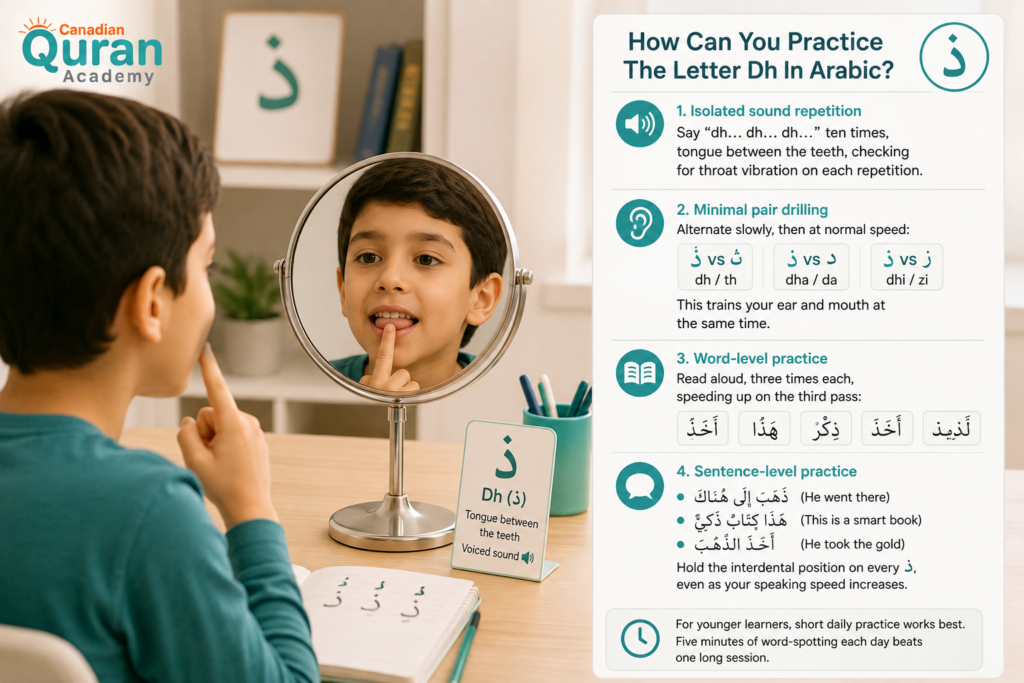
Consistent, layered practice — sound, then pairs, then words, then sentences — builds the muscle memory that reading alone doesn’t.
Isolated sound repetition. Say “dh… dh… dh…” ten times, tongue between the teeth, checking for throat vibration on each repetition.
Minimal pair drilling. Alternate slowly, then at normal speed: dh/th (ذ vs ث), dha/da (ذ vs د), dhi/zi (ذ vs ز). This trains your ear and mouth at the same time, since most learners can hear the difference before they can produce it reliably.
Word-level practice. Read aloud, three times each, speeding up on the third pass: ذَهَبَ, هَذَا, ذِكْر, أَخَذَ, لَذِيذ.
Sentence-level practice. ذَهَبَ إِلَى هُنَاكَ (“He went there”), هَذَا كِتَابٌ ذَكِيّ (“This is a smart book”), أَخَذَ الذَّهَبَ (“He took the gold”). Hold the interdental position on every ذ, even as your speaking speed increases.
For younger learners just starting to recognize Arabic letters, shorter daily repetition — five minutes of word-spotting rather than one long session — tends to stick better than cramming, which is the pacing built into Canadian Quran Academy’s Arabic Lessons for Kindergarten.
Experience Our Classrooms
Don’t just take our word for it—take a look inside! Watch the videos below to experience our engaging teaching methods and vibrant online classrooms firsthand.
Start Your Quranic Journey in Canada
Join our vibrant community and learn with expert tutors through our flexible online platform.
Claim Your Free TrialPractice The Letter Dh In Arabic With Canadian Quran Academy
Reading about tongue placement only gets you so far — a live instructor can hear the exact moment your ذ drifts into “z” or “d” and correct it before it becomes a habit.
Canadian Quran Academy teaches Arabic letters, including the letter Dh in Arabic – ذ, through structured, one-on-one sessions covering makhraj, tajweed accuracy, and real reading practice from day one.

Book your free trial class and get personal feedback on your pronunciation in your very first lesson.
Our Arabic Courses:
- Online Arabic Academy
- Online Arabic Course
- Classical Arabic Course
- Arabic Course for Beginners
- Advanced Arabic Course
- Quranic Arabic Course
- Arabic Grammar Course
- Modern Standard Arabic Course
- Arabic Conversation / Speaking Course
- Intensive Arabic Course
- Online Arabic Classes for Kids
- Arabic Classes for Adults
- Arabic Classes for Ladies
- Fusha Arabic Course
- Business Arabic Course
- Al-Azhar Arabic Course

Start Your Quranic Journey in Canada
Join our vibrant community and learn with expert tutors through our flexible online platform.
Claim Your Free TrialConclusion
The letter Dh in Arabic – ذ is a voiced interdental sound — the same “th” you already produce in “this” and “that” — written as a curved stroke with a single dot above it.
Its shape barely changes across word positions because it never connects forward, its sound is easy to isolate once you know the tongue placement, and the three common substitution errors (z, d, and tha) all have simple, specific fixes.
Whether your goal is everyday conversational Arabic or accurate Quranic recitation, getting ذ right is a small, concrete skill that pays off in every word built on it — from هَذَا to الذِّكْر.
Students at Canadian Quran Academy typically move past this letter within a few structured sessions once they’ve drilled the makhraj and the minimal pairs above; the shape and the shortcuts you learned here should carry you through the rest of the alphabet’s trickier letters too.
For learners progressing beyond the basics, Canadian Quran Academy’s Arabic Intermediate School builds directly on this letter-level foundation.

Frequently Asked Questions
Here are quick, direct answers to the questions learners ask most often about the letter Dh in Arabic – ذ, pulled from common search queries and points this guide didn’t cover in full above.
1. What does the letter Dh mean in Arabic?
The letter Dh, written ذ and called Dhal, doesn’t carry a meaning on its own — it’s a single alphabet letter, like “D” in English. It represents a voiced interdental “th” sound, as in the English words “this” and “that.”
2. How is Dhal (ذ) different from Dal (د)?
Dhal and Dal share the identical curved base shape, but Dhal has a single dot placed above it while Dal has no dot at all. The sounds also differ: Dhal is a continuous voiced “th,” while Dal is a hard stopped “d,” like in the English word “dog.”
3. How can I tell Dhal (ذ) apart from Tha (ث) while speaking?
Both letters use the exact same tongue position between the teeth — the only difference is voicing. Place a hand on your throat: you should feel vibration when saying ذ and no vibration when saying ث.
4. Is Dhal a connecting letter in Arabic script?
No. Dhal is one of seven non-connecting letters in the Arabic alphabet, meaning it never links to the letter that follows it. It only connects to the letter that comes before it, which is why it has just two visual shapes instead of four.
5. Why do some Arabic speakers pronounce Dhal as a Z or D sound?
This happens in several regional dialects, including Levantine Arabic, where ذ commonly shifts to ز or د in casual speech. It’s a normal dialect variation, not an error, but Modern Standard Arabic and Quranic recitation both preserve the original interdental ذ sound.
5. Does mispronouncing Dhal affect Quran recitation?
Yes. In tajweed, substituting a “d” or “z” sound for ذ is classified as لحن جلي (lahn jali), a clear pronunciation error, especially when it changes a word’s meaning. Precise interdental placement is expected in formal recitation even though it’s relaxed in casual dialect speech.






Leave a Reply