 Arabic
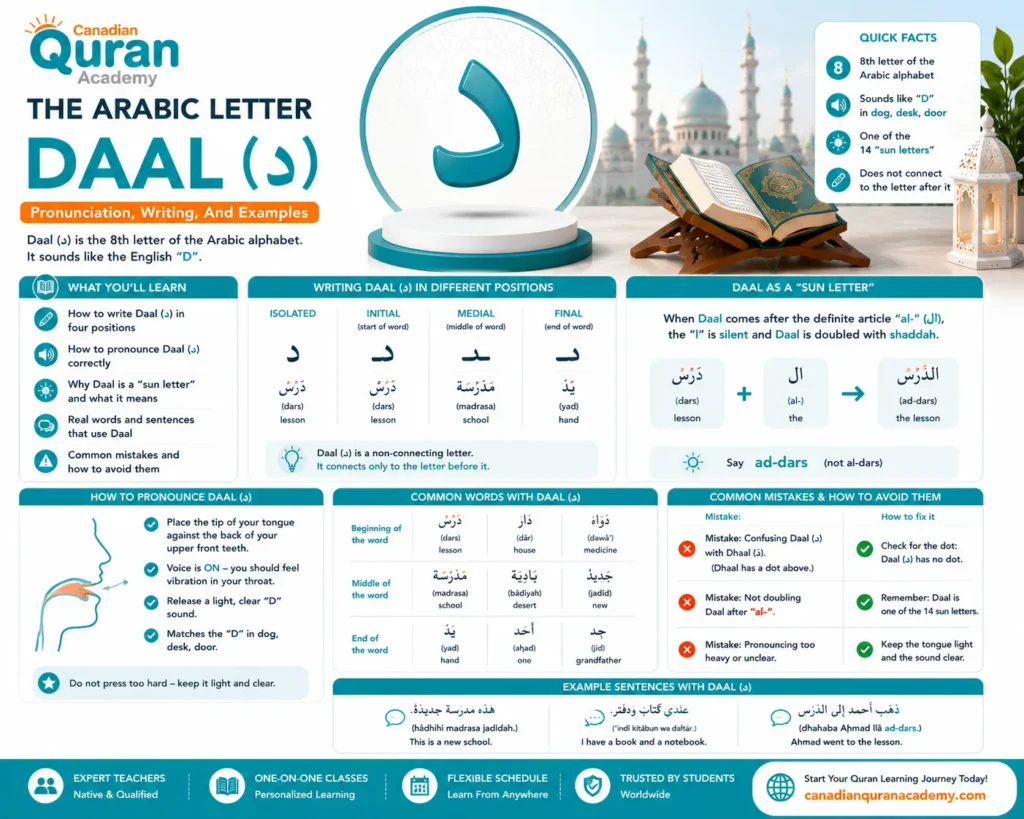
If you’re learning to read and write Arabic, the letter D in Arabic – د (Daal) is one of the easier letters to pick up, and one of the most useful. It shows up in everyday words like مدرسة (school), يد (hand), and دولة (country), and it follows a simple, predictable pattern once you understand its shape and sound.
Daal is the eighth letter of the Arabic alphabet. It has no dots, keeps a nearly identical shape in every position, and sounds almost exactly like the English “D.” That simplicity makes it a good letter to build confidence on early in your Arabic studies.
This guide from Canadian Quran Academy walks you through how to pronounce Daal, how to write it correctly in all four word positions, how it behaves as a “sun letter” in Arabic grammar, and where learners typically go wrong. You’ll also find real word and sentence examples you can start using right away.
What you’ll learn in this article
- How to recognize and write the Letter D In Arabic – د in isolated, initial, medial, and final positions
- How to pronounce Daal correctly and how it differs from the emphatic ض (Dhaad)
- Why Daal is called a “sun letter” and what that means for reading aloud
- Real examples of Daal in Arabic words and full sentences
- The most common mistakes beginners make with Daal, and how to avoid them
What Is The Arabic Letter Daal (د)?
Before you can write or pronounce anything correctly, it helps to look closely at the letter D in Arabic – د (Daal) itself: its shape, its place in the alphabet, and what makes it distinct from similar-looking letters.
Daal is the eighth letter of the 28-letter Arabic alphabet, sitting between ج (Jeem) and ذ (Dhaal). It represents a plain “D” sound and carries no dots or diacritical marks above or below its body.
Understanding Daal’s shape and its place in the alphabet is the starting point before you move on to pronunciation and writing rules, since both depend on recognizing the letter correctly on the Page.
The shape of Daal
The letter د looks like a short vertical stroke with a rounded curve at the top, similar to a small hook. It has no dots, no teeth, and no loops, which sets it apart from letters like ذ (Dhaal) or ر (Raa) that look similar at first glance.
Daal comes right after ج (Jeem) and ه (Haa) in the traditional alphabet order, and directly before ذ (Dhaal), the letter most often confused with it. Knowing this sequence helps when you’re reciting the alphabet or looking up a word in a dictionary organized by letter order.
How To Write The Letter Daal (د) In Different Positions?
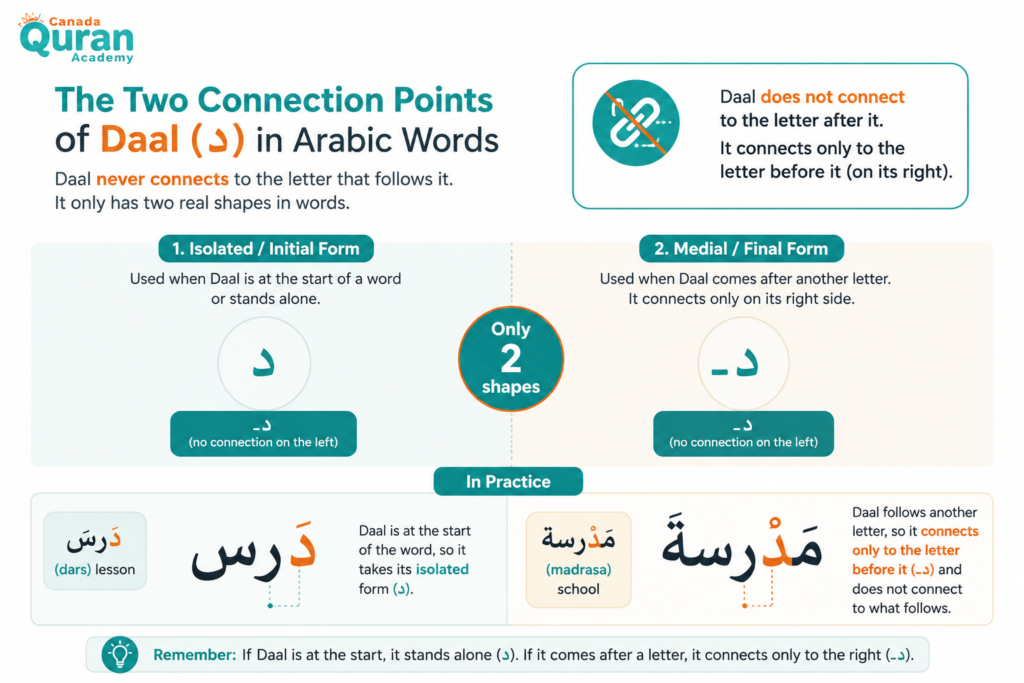
Writing the letter D in Arabic – د (Daal) correctly comes down to one core rule: it belongs to a small group of Arabic letters that never connect to the letter that follows them. This single rule explains almost everything about how Daal behaves on the page, so it’s worth learning before you start copying full words.
Isolated, Initial, Medial, And Final Forms
Most Arabic letters change shape across four positions, but Daal only has two real shapes because it refuses to connect forward:
- Isolated or initial form: د — used when Daal stands alone or opens a word, since it has nothing to connect to on its left
- Medial or final form: ـد — used when Daal follows another letter, connecting only on its right side
You’ll see this in practice in a word like دَرس (dars, lesson), where Daal opens the word in its isolated shape, and in مَدْرسة (madrasa, school), where it connects only to the letter before it and leaves the following letter unattached.
Daal As A Non-Connecting “Sun Letter”
Daal is also one of Arabic’s “sun letters” (الحروف الشمسية), a group of fourteen letters that absorb the “l” sound of the definite article الـ (al-) instead of pronouncing it. When “al-” is added to a word starting with Daal, the lam is silent and the Daal is doubled instead, marked with a shadda in vowelled text.
For example, دَرْس (dars) becomes الدَّرْس, pronounced ad-dars, not al-dars. This rule applies constantly in spoken and recited Arabic, and it’s one of the first grammar patterns students of the Quranic Arabic Course at Canadian Quran Academy are trained to catch by ear, since misreading a sun letter changes how a verse is recited aloud.
A quick self-check worth adopting for every new Arabic letter you meet, including Daal, is what we call the “See–Sound–Sun” check: look at the shape in all its forms, say the sound out loud against a similar letter, then ask whether it’s a sun letter that changes how “al-” is pronounced.
Running new letters through these three questions catches most of the mistakes covered in the next sections before they become habits.
Read Also: The Arabic Letter Jeem (ج)
How To Pronounce The Letter Daal (د)?
Getting the sound right is the next step once you can recognize the letter D in Arabic – د (Daal) on the page. It’s a light, voiced dental “D,” pronounced by placing the tip of the tongue against the back of the upper front teeth while the vocal cords vibrate.
It matches the “D” in the English words “dog,” “desk,” or “door” closely enough that English speakers rarely struggle with it.
Once you can produce the basic sound, the next step is telling it apart from Arabic’s other “D”-like letter, and learning how it shifts slightly with each vowel mark.
Daal vs. Dhaad (ض): sound comparison
ض (Dhaad) is an emphatic letter, produced by pressing the sides of the tongue against the back molars, which gives it a deep, heavy resonance that has no real equivalent in English.
Daal, by contrast, stays light and forward in the mouth. Mixing the two up is a common beginner mistake, and it can change a word’s meaning entirely, so this distinction is worth practicing early with a qualified tutor.
Daal with short and long vowels (harakat)
Daal’s sound shifts slightly depending on the vowel mark (harakat) attached to it:
- دَ with fatha, as in دَرس (dars – lesson)
- دُ with damma, as in دُبّ (dubb – bear)
- دِ with kasra, as in دِين (deen – religion)
- دْ with sukoon, as in مَدْرسة (madrasa – school)
- دا with alif, as in دار (daar – house)
- دي with yaa, as in مدينة (madeena – city)
This is one of the areas where a structured course helps most, since hearing the difference between short and long vowels takes guided listening practice.
The Online Arabic Course at Canadian Quran Academy builds this listening skill through live sessions with a native-speaking instructor, rather than leaving you to guess from written transliteration alone.
Live Class in Action
Watch how our instructors interact with students in real-time, focusing on interactive methods.
Start Your Quranic Journey in Canada
Join our vibrant community and learn with expert tutors through our flexible online platform.
Claim Your Free TrialExamples Of Daal (د) In Arabic Words And Sentences
Seeing the letter D in Arabic – د (Daal) inside real vocabulary is the fastest way to make it stick. Below are examples organized by where Daal falls in the word, followed by full sentences that put it to use.
Words with Daal at the beginning:
- دقيقة (daqiqa) – minute
- دُبّ (dubb) – bear
- دُخان (dukhan) – smoke
- دِين (deen) – religion
- دَولة (dawla) – country
Words with Daal in the middle:
- مدرسة (madrasa) – school
- صندوق (sandouq) – box
- هدوء (hudoo’) – quiet
- هدية (hadiyya) – gift
- قديمة (qadeema) – old
Words with Daal at the end:
- قرد (qird) – monkey
- يد (yad) – hand
- حداد (haddad) – blacksmith
Example sentences using Daal:
- محمد يذهب إلى المدرسة بالدراجة (Mohammed goes to school by bicycle)
- يد الله مع الجماعة (God’s hand is with the group)
- هذه المدينة مليئة بالدخان (This city is full of smoke)
Reading these sentences aloud, rather than only silently recognizing the words, is what turns letter recognition into real reading fluency.
That kind of guided reading practice is exactly what the Arabic Course for Beginners at Canadian Quran Academy is built around, with an instructor correcting pronunciation in real time rather than leaving it to self-study apps.
Read Also: The Arabic Letter Waw (و)
Daal (د) Vs. Dhaal (ذ): Telling The Two Letters Apart
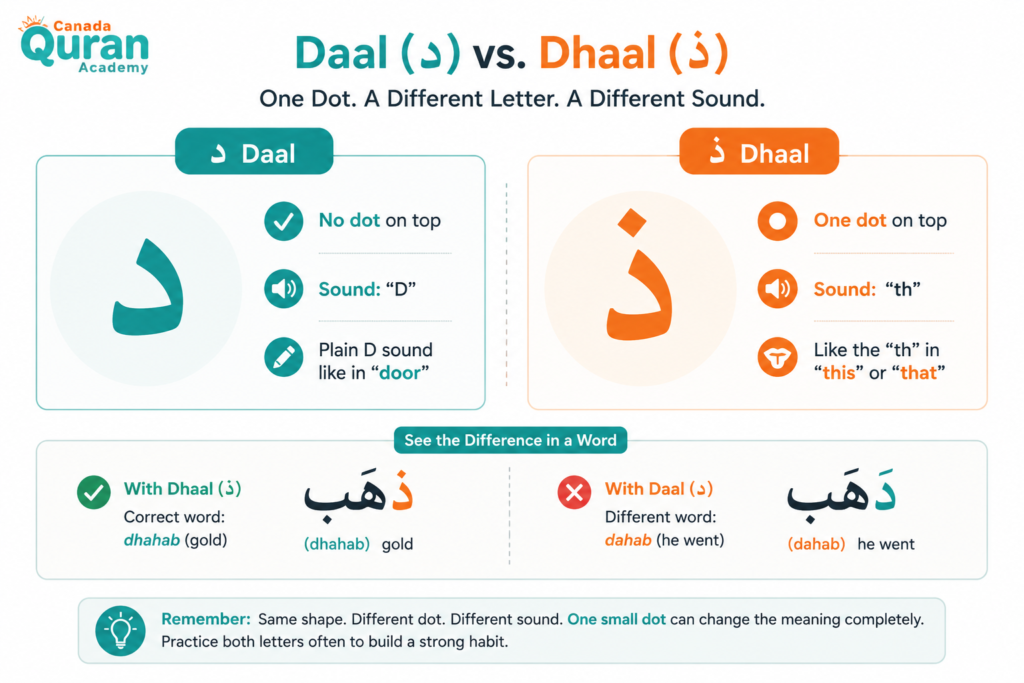
Daal and Dhaal are the two letters beginners mix up most often, since they share the same basic body shape. The only visual difference is a single dot: Dhaal (ذ) carries one dot on top, while Daal (د) has none.
Their sounds are also unrelated. Daal is a plain “D,” while Dhaal is pronounced like the “th” in the English words “this” or “that.”
Writing the word ذهب (dhahab, gold) with a plain Daal instead of a dotted Dhaal changes the word into something else entirely, which is why this pair deserves deliberate, repeated practice rather than a quick glance.
Common Mistakes Learners Make With Daal
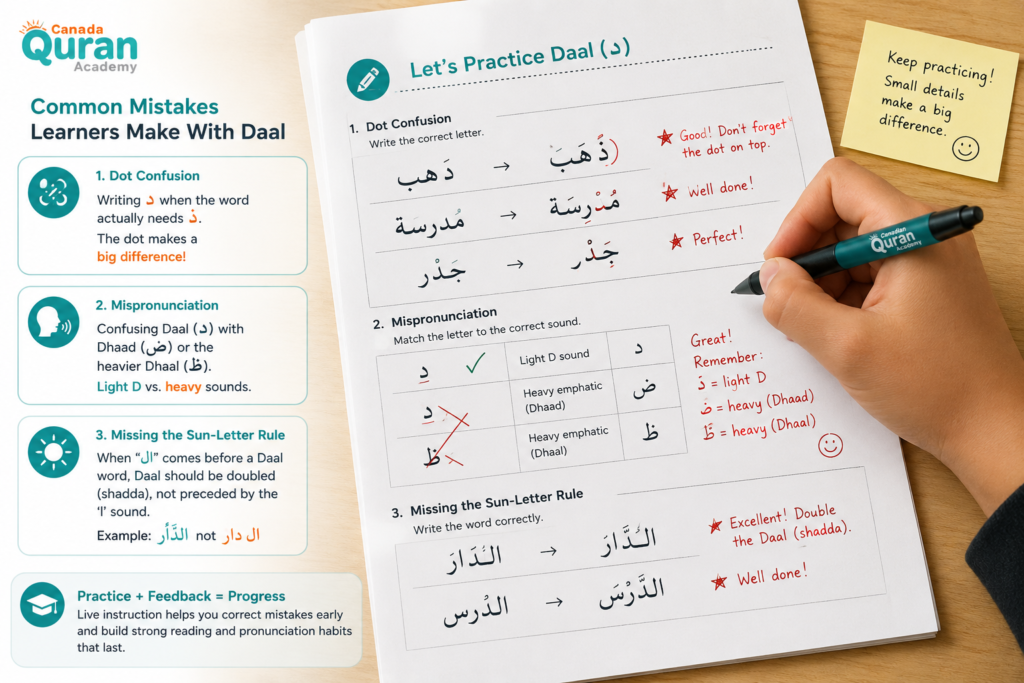
Most confusion around the letter D in Arabic – د (Daal) comes down to a handful of repeat patterns, and knowing them in advance makes them easy to avoid:
- Dot confusion: writing د when the word actually needs ذ, especially in fast handwriting where the dot gets dropped
- Mispronunciation: substituting the heavier ض (Dhaad) sound for the light Daal sound, or the reverse
- Missing the sun-letter rule: pronouncing the lam in الـ before a Daal word instead of doubling the Daal, which is a common recitation error for beginners
Working through these mistakes with feedback from a live instructor, rather than an app that can’t hear your pronunciation, is usually what fixes them for good.
Canadian Quran Academy’s Classical Arabic Course and Advanced Arabic Course both build in this kind of one-on-one correction as students progress from individual letters into full words and sentences.
Read Also: How To Improve Your Arabic Language Skills In Canada?
Read Also: The Letter Dh In Arabic ذ
Experience Our Classrooms
Don’t just take our word for it—take a look inside! Watch the videos below to experience our engaging teaching methods and vibrant online classrooms firsthand.
Start Your Quranic Journey in Canada
Join our vibrant community and learn with expert tutors through our flexible online platform.
Claim Your Free TrialStart Reading And Writing Arabic Letters With Confidence
Learning one letter at a time, the way this guide covers Daal, is exactly how Canadian Quran Academy structures its Arabic program from day one.
You get a certified, native-speaking instructor, a clear path from single letters to full sentences, and live correction instead of guesswork.
Book your free trial with the Canadian Quran Academy today and start building the Arabic reading skills you need for the Quran and everyday conversation.

Our Arabic Courses:
- Online Arabic Academy
- Online Arabic Course
- Classical Arabic Course
- Arabic Course for Beginners
- Advanced Arabic Course
- Quranic Arabic Course
- Arabic Grammar Course
- Modern Standard Arabic Course
- Arabic Conversation / Speaking Course
- Intensive Arabic Course
- Online Arabic Classes for Kids
- Arabic Classes for Adults
- Arabic Classes for Ladies

Start Your Quranic Journey in Canada
Join our vibrant community and learn with expert tutors through our flexible online platform.
Claim Your Free TrialConclusion
The letter D in Arabic – د (Daal) is a simple, dot-free letter that sounds like the English “D” and keeps nearly the same shape across every word position.
Its status as a non-connecting sun letter is the one grammar rule worth memorizing early, since it affects how you read the definite article aloud in everyday speech and in Quranic recitation.
Once you can tell Daal apart from Dhaal (ذ) and Dhaad (ض) and can apply the sun-letter rule automatically, you’ve mastered one of the more approachable letters in the Arabic alphabet, and you’re ready to build on it with the rest of your Arabic reading practice.

Frequently Asked Questions About The Arabic Letter Daal (د)
These are the questions learners ask most often about the letter Daal, covering its position in the alphabet, its pronunciation, and how it compares to similar-looking letters.
1. What is the Arabic letter Daal (د) and where does it sit in the alphabet?
Daal (د) is the eighth letter of the Arabic alphabet, sitting between ج (Jeem) and ذ (Dhaal). It is a non-connecting letter, meaning it never joins the letter that follows it, and it has no dots or additional marks.
2. How do you correctly pronounce the Arabic letter Daal?
Daal is pronounced like the English letter “D” in words such as “dog” or “door,” produced by placing the tongue tip against the upper front teeth. It is a light, voiced dental sound with no emphasis.
3. What is the difference between Daal (د) and Dhaad (ض)?
Daal is a light, standard “D” sound close to English. Dhaad is an emphatic, heavy sound produced by pressing the sides of the tongue against the back molars, with no real English equivalent.
4. What’s the easiest way to stop confusing Daal (د) and Dhaal (ذ)?
The fastest fix is checking for the dot every time: Dhaal (ذ) has one dot on top, Daal (د) has none. Practicing minimal pairs like دهب vs.
ذهب with an instructor who can correct you in real time closes this gap quickly.
5. Does the letter Daal (د) change shape in different word positions?
Daal keeps nearly the same shape everywhere. Because it’s a non-connecting letter, it only has two forms: an isolated/initial shape (د) and a medial/final shape that connects on the right only (ـد).
6. Why is Daal called a “sun letter”?
Daal is a sun letter because it absorbs the “l” sound of the definite article الـ (al-) instead of pronouncing it, doubling the Daal instead. For example, دَرْس becomes الدَّرْس, pronounced ad-dars rather than al-dars.






Leave a Reply