 Arabic
Open any Mus-haf and you’ll notice something odd within the first page: small Arabic letters floating above the text that don’t appear in a newspaper or a novel. This is Arabic punctuation in the Quran, and it works nothing like the commas and periods used in everyday Arabic writing.
At Canadian Quran Academy, this is one of the first things new reciters ask about, because misreading these marks changes the meaning of the verse being recited.
This guide breaks down every keyword a learner searches when trying to understand this topic: the marks themselves, their Arabic names, their English meanings, how they connect to tajweed, and how they differ from standard Arabic punctuation marks used outside the Quran.
Arabic Punctuation In The Quran
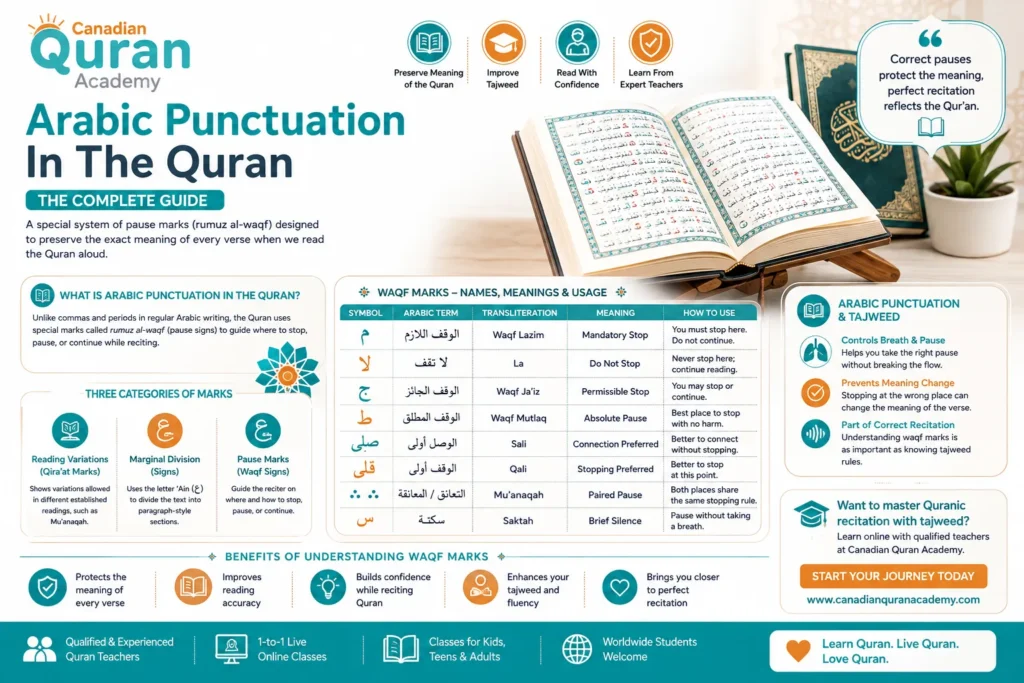
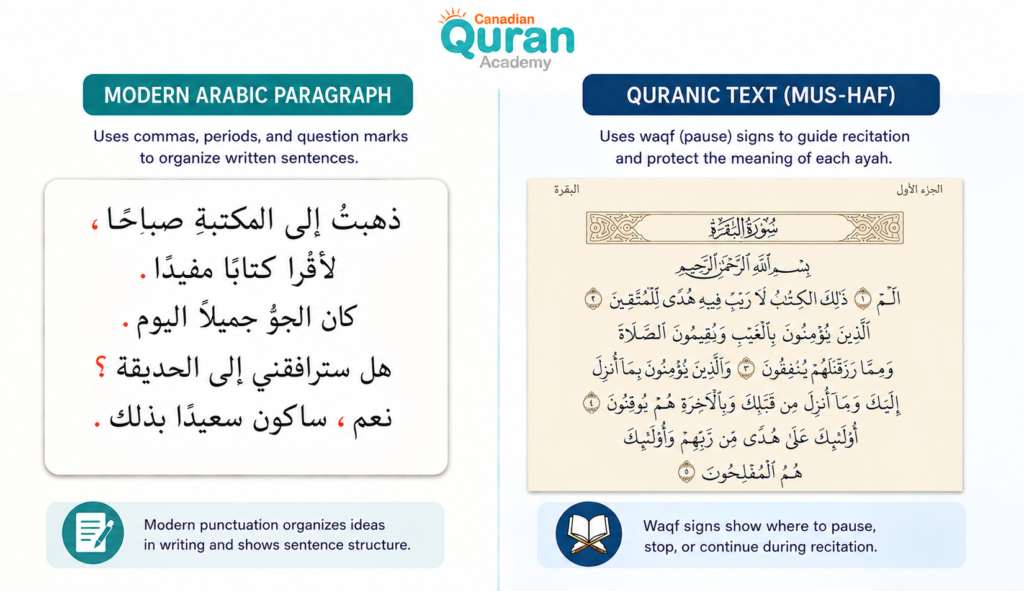
Arabic punctuation in the Quran is a system of small marks placed above the text specifically to guide recitation, not to organize written prose the way commas and periods do in a book or article.
The Quranic text contains no commas, periods, or question marks of the modern kind. Instead, it uses a set of symbols called rumuz al-waqf (pause signs), developed to protect the exact meaning of each ayah when read aloud.
This distinction is the first thing to understand, because a learner who only knows standard Arabic grammar will not automatically be able to read the Mus-haf correctly. The two systems serve different purposes and were built centuries apart.
The Three Categories of Marks in the Quranic Text
Quranic marking falls into three distinct categories. The first shows variations permitted under the different established readings (qira’at), the most notable being the Mu’anaqah. The second is marginal, dividing the text into sections using the letter ain (ع) to mark paragraph-style divisions. T
he third — and the one reciters use most often — is the ordinary set of pause marks that tell the reader where to stop, continue, or pause briefly.
The earliest Quranic manuscripts had little to no punctuation, much like classical Greek and early Latin texts, which also lacked standardized punctuation for centuries.
What sets the Quran apart is timing: Muslim scholars worked out a precise pause system for recitation purposes long before Europe standardized its own punctuation during the era of printing.
This wasn’t stylistic preference — it was necessary to preserve exact meaning across generations of reciters who memorized the text before ever writing it down.
Read also: The Most Used Arabic Words In The Quran – With Meaning And Frequency
Arabic Punctuation Quran Words
Every waqf mark has a proper Arabic name, and knowing these words is what lets a reciter follow instruction from a teacher or a footnoted Mus-haf without confusion.
The mandatory stop is called al-waqf al-lazim (الوقف اللازم). The prohibited stop is simply la (لا), meaning “do not.” The permissible stop is al-waqf al-ja’iz (الوقف الجائز). The absolute pause is al-waqf al-mutlaq (الوقف المطلق).
The paired dots indicating a shared stopping point are called al-mu’anaqah (المعانقة), literally “the embrace.”
| Symbol | Arabic Term | Transliteration |
| م | الوقف اللازم | Waqf Lazim |
| لا | لا تقف | La |
| ج | الوقف الجائز | Waqf Ja’iz |
| ط | الوقف المطلق | Waqf Mutlaq |
| صلى | الوصل أولى | Sali |
| قلى | الوقف أولى | Qali |
| ∴ ∴ | التعانق / المعانقة | Mu’anaqah |
| س | سكتة | Saktah |
Learning these terms in Arabic first, rather than only their English translation, makes it much easier to follow instruction directly from a Quran teacher, since these are the words used during live correction.
Read also: Arabic Noorani Qaida – What It Is, Its Origin, And How To Teach It?
Read Also: How To Learn Arabic In 6 Months In Canada?
Arabic Punctuation Quran With Tajweed
Arabic punctuation in the Quran and tajweed are not separate subjects — they operate together. Tajweed governs how each letter and sound is pronounced; waqf marks govern where the voice stops moving.
A reciter can pronounce every letter with textbook precision and still distort an ayah’s meaning by stopping at a لا or ignoring a مandatory م.
How Waqf Marks Affect Tajweed Practice?
Tajweed instruction typically introduces waqf marks early, because breath control and pause placement are part of correct recitation technique, not an optional add-on taught later.
Saktah, for example, requires the reciter to create a brief silence — roughly the length of one letter — without taking a new breath. Getting this wrong in either direction, holding the silence too long or breathing when the rule forbids it, changes the rhythm tajweed is built to protect.
A common mistake among learners: treating every stop mark as optional simply because they’ve grown used to Ja’iz (ج), which genuinely is flexible. This habit carries over into passages with a Lazim (م) or a Mu’anaqah, where the same casual approach changes what the verse is actually saying.
This is exactly the kind of detail that’s difficult to self-correct. Canadian Quran Academy’s Quranic Arabic Course teaches waqf marks directly inside tajweed practice, so a student learns to recognize each symbol in the context of real recitation rather than as an isolated rule.
Read Also: How To Learn Arabic For Quran In Canada?
Arabic Punctuation Quran in English
For English-speaking learners, the Arabic terms above translate into fairly direct instructions. Waqf Lazim means mandatory stop. La means do not stop. Waqf Ja’iz means permissible stop — either choice is acceptable.
Waqf Mutlaq means absolute pause, signaling that a complete thought has ended even though the wider passage continues. Sali means continuation is preferred, while Qali means stopping is preferred. Mu’anaqah means an embracing stop: two nearby points where the reciter stops at one, never both.
| Symbol | English Meaning |
| م | Mandatory stop |
| لا | Do not stop (except at ayah end) |
| ج | Permissible stop, either choice acceptable |
| ط | Absolute pause, complete thought ends |
| صلى | Continuation preferred |
| قلى | Stopping preferred |
| ∴ ∴ | Stop at one of two paired points, never both |
| س | Brief silence, no new breath |
One caution for English speakers: transliteration systems vary between publishers, so “Waqf Lazim” might appear as “Waqf al-Lazim” or simply “Lazim” in different textbooks. The symbol itself, not the transliteration spelling, is what stays constant across every Mus-haf.
Read also: Verse In Quran About Alcohol In Arabic And English
Quran Punctuation Symbols
Quran punctuation symbols are the small marks placed above specific words in the Mus-haf to guide a reciter through a passage — telling them where to stop completely, where stopping is forbidden, where it’s optional, and where a brief silence is required instead of a full pause.
There are seven core symbols every reciter eventually needs to recognize on sight, and each one carries a different instruction rather than a general suggestion to pause “somewhere around here.”
Each mark is explained individually below, in the order a beginner is most likely to encounter it during regular recitation.
1. Mandatory Stop — Waqf Lazim (م)
The letter م marked above a word means the stop is compulsory. Continuing past this point without pausing changes or obscures the sentence’s meaning. It’s significant enough to also be flagged in the margin as وقف لازم.
2. Prohibited Stop — La (لا)
The sign لا instructs the reciter not to stop, because the clause is grammatically or semantically tied to what follows. The one exception: if لا appears at the very end of an ayah, stopping there is still permitted.
3. Permissible Stop — Ja’iz (ج)
The letter ج marks a point where stopping or continuing are both acceptable, making it the most flexible of the common waqf marks.
4. Absolute Pause — Mutlaq (ط)
The letter ط indicates a complete thought has ended, so stopping is preferred, though the broader passage may continue. Unlike Lazim, skipping it doesn’t corrupt meaning — it just isn’t the ideal choice.
5. Preference Marks — Sali and Qali (صلى / قلى)
صلى means continuing is preferred, though stopping is allowed.
قلى reverses that: stopping is preferred, but continuing is grammatically permissible. These exist because classical scholars recognized that not every pause decision is a strict binary.
6. The Embracing Stop — Mu’anaqah (∴ ∴)
Mu’anaqah describes two people embracing shoulder to shoulder. Three dots appear at two nearby points in the text, and the reciter stops at one of the two — never both, never neither.
A known example appears in Surah Al-Baqarah, verse 2, where the word “fihi” can be linked either to the preceding phrase or the one following it, with both readings considered valid.
7. Saktah and Waqfah — The Silent Pauses
Saktah (س) calls for a very brief silence without a new breath. Waqfah is a longer version of the same idea. Both differ from ordinary stops because the reciter never restarts their breathing — they create a small beat of separation to prevent two words from blending into a false meaning.
Read Also: How To Learn Arabic For Quran In Canada?
Live Class in Action
Watch how our instructors interact with students in real-time, focusing on interactive methods.
Start Your Quranic Journey in Canada
Join our vibrant community and learn with expert tutors through our flexible online platform.
Claim Your Free TrialQuran Punctuation Rules
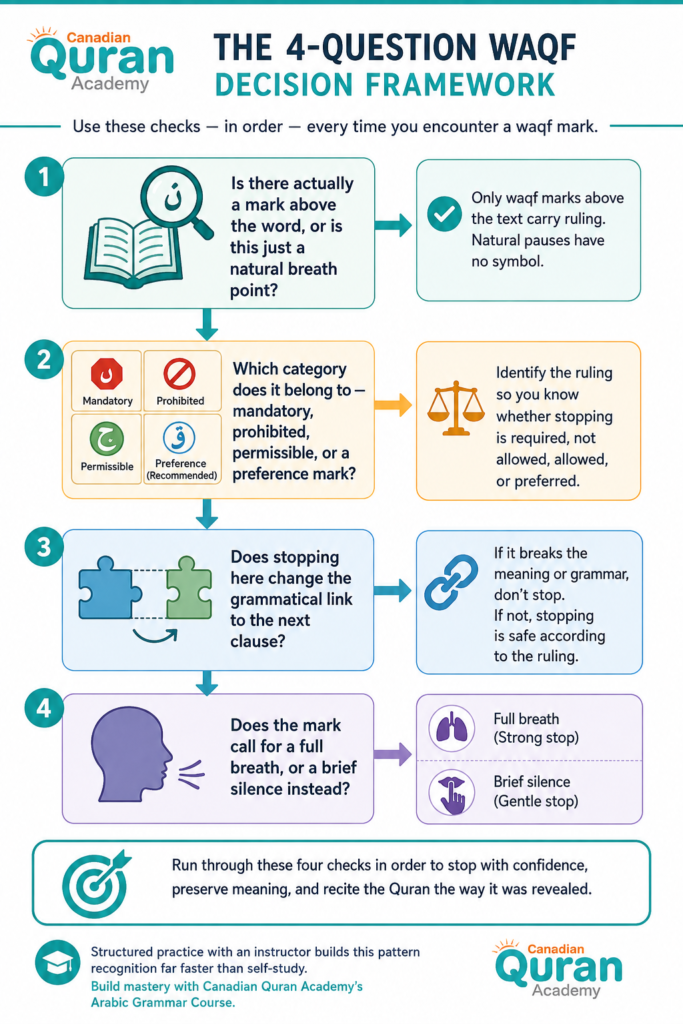
Quran punctuation rules come down to reading each mark as a distinct instruction rather than a general suggestion to “pause somewhere here.” A useful way to apply this consistently is a short framework.
When a reciter meets a mark they don’t immediately recognize, four questions resolve almost every case:
Is there actually a mark above the word, or is this just a natural breath point? Which category does it belong to — mandatory, prohibited, permissible, or a preference mark? Does stopping here change the grammatical link to the next clause? And does the mark call for a full breath, or a brief silence instead?
Running through these checks in order removes the guesswork that causes most misreadings, and it becomes automatic with enough guided repetition.
Structured practice with an instructor, such as through Canadian Quran Academy’s Arabic Grammar Course, builds this pattern recognition far faster than self-study from a book.
Arabic Punctuation Marks
Arabic punctuation marks used in everyday writing — books, newspapers, messages — are a completely separate system from the Quran’s waqf marks, built for organizing written prose rather than guiding recitation.
Comma, Semicolon, And Question Mark
The comma (،) is a mirrored version of the English comma, used to separate clauses or list items. The semicolon (؛) links two related clauses where the second explains or results from the first. The question mark (؟) sits at the end of interrogative sentences and is mirrored because Arabic reads right to left.
Full Stop, Colon, And Other Marks
The full stop (.) marks the end of a declarative sentence, identical in shape to its English counterpart.
The colon (:) introduces lists, quotations, or explanations. Other standard marks include the exclamation mark (!), quotation marks (« » or ” “), parentheses, the ellipsis (…), and the dash (–). None of these appear inside the Quranic text itself.
Read Also: How To Learn Arabic In 5 Minutes In Canada?
Arabic Punctuation List: Full Reference And Common Mistakes
This closing section pulls every symbol covered above into one quick-reference list, so a reciter can check a mark at a glance without searching back through each explanation, followed by the mistakes that trip up most learners once they start applying these marks in real recitation.
| Symbol | System | Function |
| م | Quran (waqf) | Mandatory stop |
| لا | Quran (waqf) | Do not stop |
| ج | Quran (waqf) | Permissible stop |
| ط | Quran (waqf) | Absolute pause |
| صلى / قلى | Quran (waqf) | Preference marks |
| ∴ ∴ | Quran (waqf) | Embracing stop |
| س | Quran (waqf) | Brief silence |
| ، | Standard Arabic | Comma |
| ؛ | Standard Arabic | Semicolon |
| ؟ | Standard Arabic | Question mark |
| . | Standard Arabic | Full stop |
| : | Standard Arabic | Colon |
The most frequent error is stopping at a لا mark mid-ayah out of habit, especially when tired or reading quickly.
A second common mistake is stopping at both points of a Mu’anaqah instead of just one. A third is treating Mutlaq (ط) and Ja’iz (ج) as identical, when Mutlaq specifically signals that a complete thought has closed.
None of these come from a lack of effort — they come from learning the marks as a memorized list rather than practicing them inside real recitation, which is why guided correction from an instructor catches errors that self-study typically misses.
Experience Our Classrooms
Don’t just take our word for it—take a look inside! Watch the videos below to experience our engaging teaching methods and vibrant online classrooms firsthand.
Start Your Quranic Journey in Canada
Join our vibrant community and learn with expert tutors through our flexible online platform.
Claim Your Free TrialLearn Quranic Punctuation And Recitation With Canadian Quran Academy
Recognizing waqf marks on a page is one skill; applying them correctly and confidently while reciting is another.
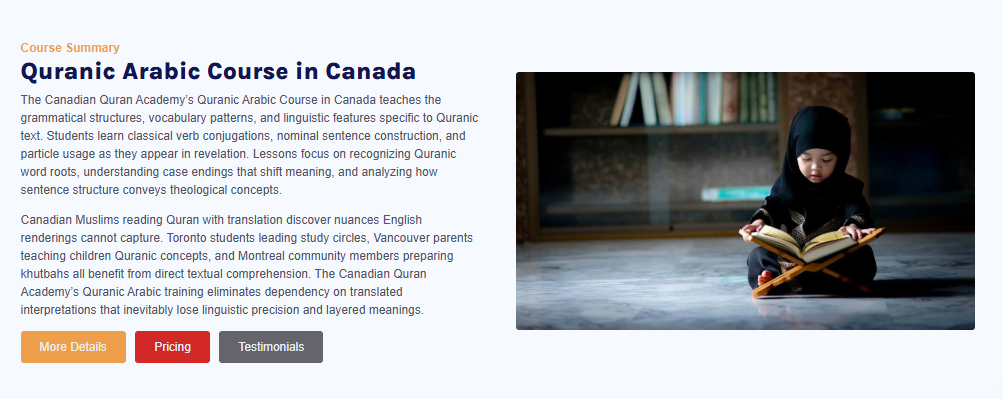
Canadian Quran Academy’s instructors correct pause placement in real time, so mistakes with marks like Waqf Lazim or Mu’anaqah get fixed before they become habits. Start learning Quranic Arabic punctuation and recitation with a qualified instructor today.
Our Arabic Courses:
- Online Arabic Academy
- Online Arabic Course
- Classical Arabic Course
- Arabic Course for Beginners
- Advanced Arabic Course
- Quranic Arabic Course
- Arabic Grammar Course
- Modern Standard Arabic Course
- Arabic Conversation / Speaking Course
- Intensive Arabic Course
- Online Arabic Classes for Kids
Start Your Quranic Journey in Canada
Join our vibrant community and learn with expert tutors through our flexible online platform.
Claim Your Free TrialConclusion
Arabic punctuation in the Quran is a separate system from standard Arabic punctuation marks, built specifically to protect meaning during recitation rather than to organize written prose.
The core symbols — Lazim, La, Ja’iz, Mutlaq, the preference marks, and Mu’anaqah — each carry a distinct instruction, and treating them as interchangeable is where most recitation errors start.
Once a reader knows the Arabic terms, their English meanings, and how they connect to tajweed, reading Quran punctuation rules correctly becomes a habit rather than a guessing game.
Canadian Quran Academy’s instructors teach this directly inside recitation practice, which remains the fastest way to move from recognizing the marks to using them correctly.

Frequently Asked Questions
The questions below cover what learners most often ask about Arabic punctuation in the Quran, beyond what’s already explained above.
1. What is the difference between Arabic punctuation and Quran punctuation marks?
Standard Arabic punctuation marks (commas, periods, question marks) organize modern written Arabic and never appear inside the Quranic text. Quran punctuation symbols are a separate waqf system that tells reciters where to stop, continue, or pause briefly during recitation.
2. What does the mark م mean in the Quran?
The mark م stands for Waqf Lazim, a mandatory stop. Continuing past it without pausing changes or obscures the intended meaning of the ayah.
3. Can I stop at a لا mark in the Quran?
No, unless it appears at the very end of an ayah. The لا mark means the clause is linked to what follows, so stopping mid-ayah at this sign breaks that connection.
4. What is Mu’anaqah in Quran recitation?
Mu’anaqah is a pair of three-dot marks (∴ ∴) placed at two nearby points in the text. The reciter stops at one of the two points, never both, since either construction of the sentence is considered grammatically valid.
5. Are Quran punctuation symbols the same in every Mus-haf?
The core waqf marks — Lazim, La, Ja’iz, Mutlaq, and Mu’anaqah — appear consistently across standard printed Mus-hafs. Minor marginal notations can vary slightly between regional printings, but the primary pause system stays the same.






[…] Understanding Arabic punctuation in the Quran, the waqf and wasl markers that govern stopping and continuation, is equally important, since incorrect pausing fragments meaning and disrupts the very flow that memorization depends on. […]