 Arabic
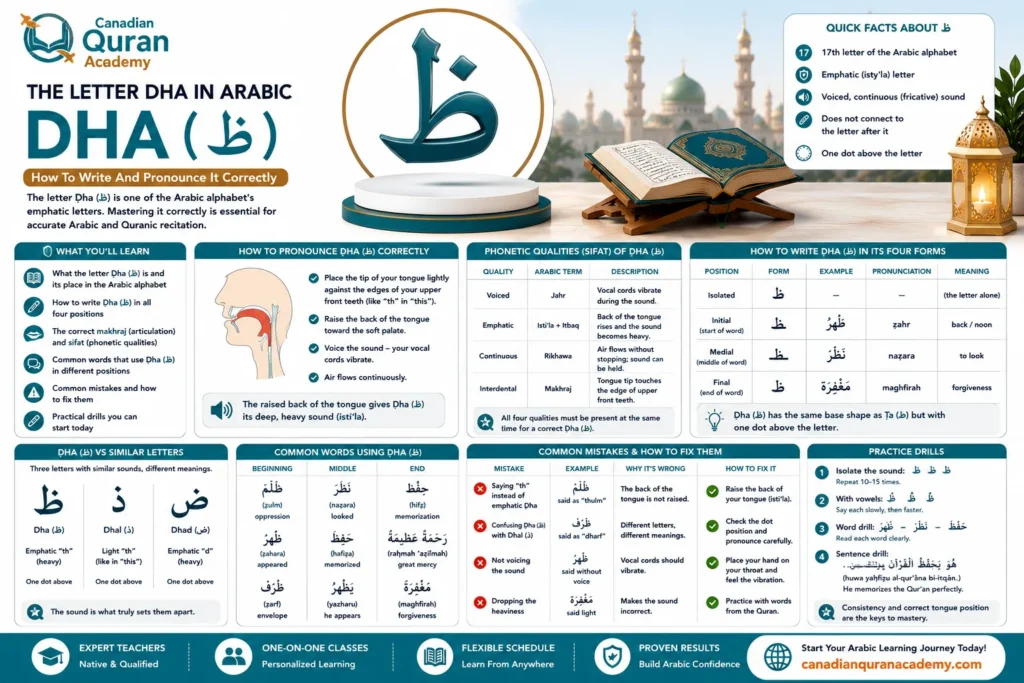
The letter dha in Arabic ظ is often called the hardest letter in the Arabic alphabet, and once you understand why, the reputation makes sense. It has no true equivalent in English, it changes shape four times depending on where it sits in a word, and mixing it up with a similar-looking letter can change the meaning of a sentence entirely.
This guide breaks down exactly what the letter dha in Arabic ظ is, how it’s written in each position, how to produce its sound with the correct tongue placement, and which mistakes trip up almost every English-speaking learner.
At Canadian Quran Academy, this is one of the first emphatic letters we drill with new students, because getting it right early prevents months of correction later.
By the end, you’ll be able to recognize ظ in any word, explain why it sounds different from three other letters that look or sound similar, and practice it using the same method our instructors use in live classes.
What you’ll learn in this article
- What the letter dha in Arabic ظ is and which category of letters it belongs to
- How ظ is written in its isolated, initial, medial, and final forms
- The exact tongue position and phonetic qualities needed to pronounce it correctly
- Common words that use ظ, organized by where the letter falls in the word
- The two mistakes almost every beginner makes, and how to fix each one
- Practical drills you can start using today
What is the letter dha in Arabic ظ?
The letter dha in Arabic ظ is the seventeenth letter of the twenty-eight-letter Arabic alphabet. It belongs to a small group called huroof al-isti’la, or “letters of elevation,” where the back of the tongue rises toward the soft palate during pronunciation, giving the sound a heavier, fuller quality than a plain “th.”
That heaviness isn’t a regional accent or an optional flourish. It’s a defining feature of the letter itself. Drop it, and you’re no longer saying ظ — you’re saying a completely different letter, ذ (dhal), which sounds like the plain “th” in the English word “this.”
This distinction matters most in Quran recitation, where swapping ظ for ذ can change the meaning of a word mid-verse.
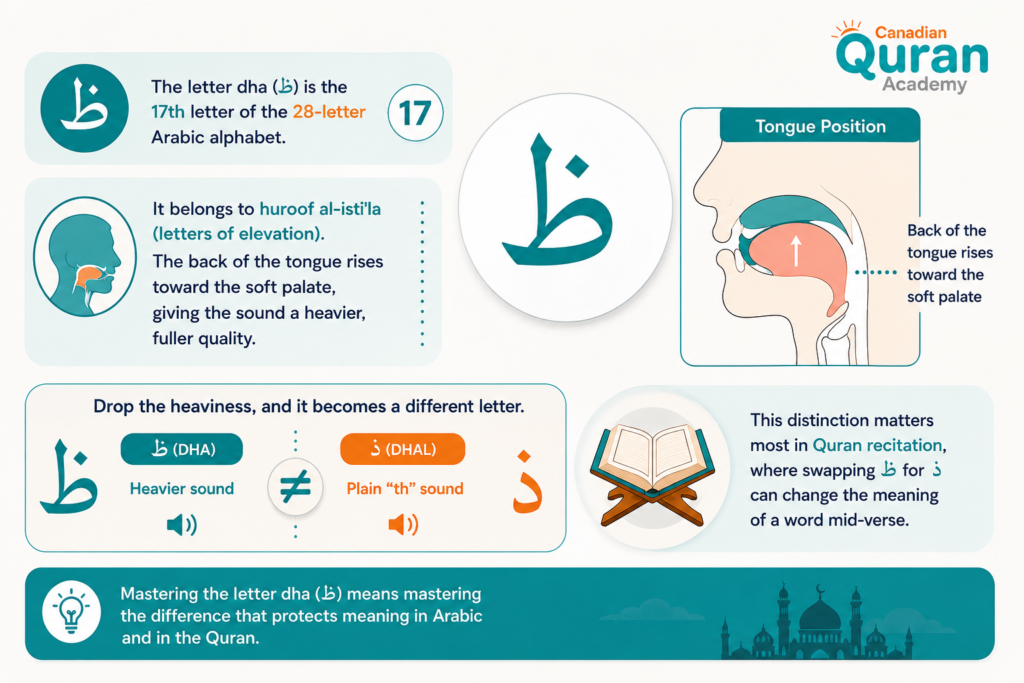
It’s one reason Canadian Quran Academy treats emphatic letters like ظ as a foundational skill rather than an advanced topic, teaching them from a student’s very first lessons rather than saving them for later.
How Do You Pronounce The Letter Dha In Arabic ظ Correctly?
Correct pronunciation of ظ comes down to two things happening at once: the front of the tongue produces a “th” sound, and the back of the tongue rises to add weight and depth. Miss either half, and the sound isn’t quite right.
The makhraj, or articulation point, of the letter dha in Arabic ظ is the tip of the tongue placed lightly against the edges of the upper front teeth — the same starting position as the English “th” in “this.”
From there, you deliberately press the back of the tongue upward toward the soft palate while you voice the sound.
You should feel a slight rounding in your lips and a fuller resonance building toward the back of your throat. That added depth is the isti’la, or elevation, quality that separates ظ from its lighter counterpart ذ.
What Phonetic Qualities (Sifat) Make The Sound Correct?
A correct ظ requires four qualities to be present at the same time. If even one is missing, you’ve produced a different letter.
| Quality | Arabic term | What it means |
| Voiced | Jahr | The vocal cords vibrate throughout the sound |
| Emphatic | Isti’la + it’baq | The back of the tongue rises, filling the mouth with resonance |
| Continuous | Rikhawa | Airflow keeps moving; the sound can be held, not stopped |
| Interdental | (makhraj) | The tongue tip contacts the edge of the upper teeth |
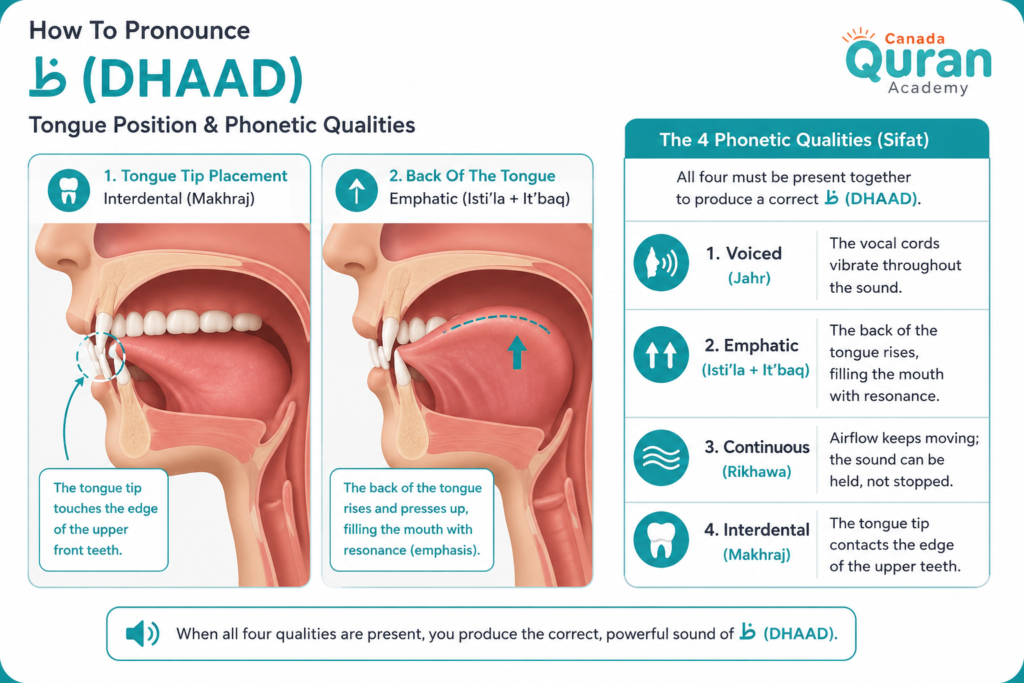
This is exactly the kind of detail that’s difficult to self-correct from a book or app alone, because you can’t always hear your own missing quality.
In our live sessions, Canadian Quran Academy instructors listen for each of these four qualities individually and correct the one that’s slipping, rather than just repeating the word louder.
Read Also: The Letter Ta In Arabic (ط)
How Is The Letter Dha In Arabic ظ Written In Its Four Forms?
Like every letter in the Arabic alphabet, ظ changes shape depending on whether it opens a word, sits in the middle, closes it, or stands alone. The base shape resembles the letter ط (ta), and the single dot placed above it is what makes ظ instantly recognizable.
| Position | Written form | Example word |
| Isolated | ظ | — |
| Initial (start of word) | ظـ | ظَهْر (back / noon) |
| Medial (middle of word) | ـظـ | نَظَر (sight) |
| Final (end of word) | ـظ | حَفِيظ (guardian) |
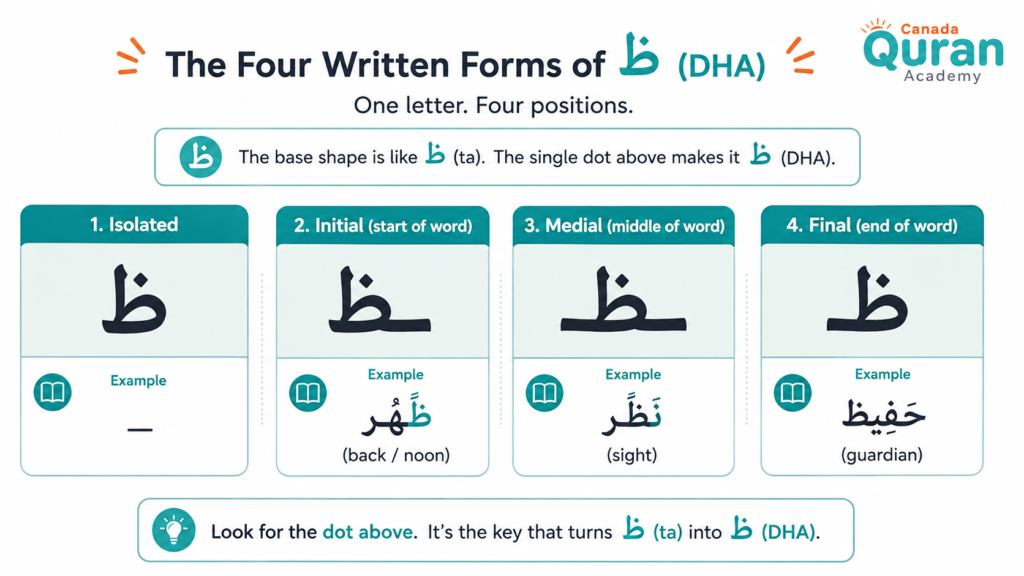
In its initial and medial forms, ظ connects forward to the next letter with a short horizontal stroke. In its final form, it drops a descending tail below the baseline, which is one of the more elegant shapes in Arabic handwriting once you’ve practiced it a few times.
Tracing each form separately before combining them into full words makes reading connected scripts noticeably easier.
Read Also: Letter D In Arabic د
Live Class in Action
Watch how our instructors interact with students in real-time, focusing on interactive methods.
Start Your Quranic Journey in Canada
Join our vibrant community and learn with expert tutors through our flexible online platform.
Claim Your Free TrialCommon Arabic Words That Contain The Letter Dha ظ
Seeing ظ inside real, frequently used words is more useful than memorizing the letter in isolation. Here are ten words where it appears in each of the three connected positions.
| Arabic word | Transliteration | Meaning | Position of ظ |
| ظَهْر | Zahr / Dhahr | Back / noon | Initial |
| ظُلْم | Zulm | Injustice, oppression | Initial |
| ظِلّ | Zill | Shade, shadow | Initial |
| نَظَر | Nazar | Sight, view | Medial |
| عَظِيم | Azeem | Great, magnificent | Medial |
| مُنْتَظِر | Muntazir | Waiting | Medial |
| يَقِظ | Yaqiz | Alert, wakeful | Final |
| حَافِظ | Hafiz | Guardian, one who has memorized the Quran | Final |
| لَفْظ | Lafz | Pronunciation, word | Final |
| نَظِيف | Nazeef | Clean | Medial |
Notice that several of these, like nazar (sight) and hafiz (a memorizer of the Quran), show up constantly in both everyday conversation and religious contexts.
That frequency is exactly why students in our Arabic Elementary School and Arabic Intermediate School programs meet ظ early rather than treating it as a rare letter to worry about later.
Letter Dha ظ Vs Similar Letters: The Two Mistakes To Avoid
English speakers confuse the letter dha in Arabic ظ with two other letters almost every time, and both mistakes are predictable enough that you can train yourself out of them with targeted practice.
Mistake one: replacing ظ with ذ
This is the most common error. A learner places the tongue correctly at the teeth but never raises the back of the tongue, which produces ذ (dhal) — a plain, light “th” — instead of ظ.
The fix is mechanical: after positioning your tongue tip, consciously push the back of your tongue upward before you voice the sound, and hold that position for the full duration of the letter.
Try the minimal pair ذَهَب (dhahaba, “he went”) against ظَهَر (zahara, “he appeared”). Said correctly, the second word should sound noticeably deeper and fuller in the vowel that follows the letter.
Mistake two: confusing ظ with ض
Some learners, especially those who’ve picked up certain regional dialects, treat ظ and ض (dad) as interchangeable because both are emphatic letters.
They are not the same sound.
ظ is interdental, produced at the front teeth; ض is produced from the sides of the tongue against the upper back molars, further back in the mouth.
Practice the pair ظَرْف (zarf, “envelope”) against a word using ض to feel the difference in where the sound originates — front-of-mouth versus back-of-mouth. Recording yourself and comparing against a native speaker is the fastest way to catch this without a live tutor.
Read Also: Arabic Letter Ra (ر)
Practical Tips For Mastering The Letter Dha In Arabic ظ
Knowing the theory behind ظ only carries you so far — the letter becomes natural through repetition, not explanation. The drills below are the same ones Canadian Quran Academy instructors assign between live sessions to turn a correct sound into a reliable habit.
Listen before you speak. Native audio — Quran recitation, news, or podcasts — trains your ear to catch the emphatic quality before you try to produce it yourself.
Record and compare. Say a word with ظ, play it back, and compare it against a native speaker saying the same word. Most learners think they’re producing the sound correctly until they hear the recording.
Drill minimal pairs. Repeating pairs like ذَهَب/ظَهَر or ظَرْف against a ض-based word trains both your ear and your articulatory muscles at the same time.
Watch your mouth in a mirror. Your jaw should drop slightly and your lips round a little when the back of the tongue rises for ظ, compared to a plain “th.”
Get live correction. A native instructor can hear a missing sifah in real time, which is difficult to catch from an app alone.
If you’re introducing a child to Arabic letters rather than learning as an adult, starting them correctly on ظ from day one avoids months of unlearning bad habits later.
Programs like Canadian Quran Academy’s Arabic Lessons for Kindergarten are built specifically to teach emphatic letters through age-appropriate repetition rather than technical explanation.

Experience Our Classrooms
Don’t just take our word for it—take a look inside! Watch the videos below to experience our engaging teaching methods and vibrant online classrooms firsthand.
Start Your Quranic Journey in Canada
Join our vibrant community and learn with expert tutors through our flexible online platform.
Claim Your Free TrialStart Learning Arabic Letters The Right Way With Canadian Quran Academy
Reading about tongue position only gets you so far. The fastest way to correct a sound like the letter dha in Arabic ظ is real-time feedback from a native instructor who can hear exactly which of the four phonetic qualities you’re missing and correct it on the spot.
Canadian Quran Academy offers live, one-on-one and small-group classes for every level, from the Madinah Arabic Course for structured, sequential learning, to programs built specifically for non-Arabic speakers, elementary and intermediate students, and young children just starting out.

Every class is taught by a qualified instructor who corrects pronunciation as it happens, not after the fact.
Our Arabic Courses
- Online Arabic Academy
- Online Arabic Course
- Classical Arabic Course
- Arabic Course for Beginners
- Advanced Arabic Course
- Quranic Arabic Course
- Arabic Grammar Course
- Modern Standard Arabic Course
- Arabic Conversation / Speaking Course
- Intensive Arabic Course
- Online Arabic Classes for Kids
- Arabic Classes for Adults

Start Your Quranic Journey in Canada
Join our vibrant community and learn with expert tutors through our flexible online platform.
Claim Your Free TrialConclusion
The letter dha in Arabic ظ is one of the four emphatic letters in Arabic, produced by touching the tongue tip to the upper teeth while raising the back of the tongue for added depth.
It appears in four written forms depending on its position in a word, shows up in common vocabulary like nazar (sight) and hafiz (guardian), and is most often confused with ذ and ض by English-speaking learners.
None of these challenges are unusual, and none of them require months to fix. With focused practice on tongue position, regular comparison against native speech, and correction from someone who can hear the difference, the letter dha in Arabic ظ becomes just another letter you know how to say.
Canadian Quran Academy builds exactly this kind of correction into every level of Arabic instruction, from a child’s first lesson through advanced study.

Frequently Asked Questions About The Letter Dha In Arabic ظ
These are the questions students ask most often when they first encounter ظ, gathered from real class discussions and common search queries about the letter.
1. Is ظ the 16th or 17th letter of the Arabic alphabet?
Sources vary slightly depending on how the alphabet is counted, but ظ is most commonly listed as the seventeenth letter of the twenty-eight-letter Arabic alphabet. It belongs to the huroof al-isti’la, the group of letters pronounced with an elevated back of the tongue.
2. What is the difference between ظ and ذ?
The difference is the emphatic quality.
ذ (dhal) is a plain “th” sound, like in the English word “this,” produced only at the front of the mouth.
ظ adds a raised back of the tongue, making the sound heavier and giving nearby vowels a fuller, darker quality.
3. What is the difference between ظ and ض?
ظ and ض are both emphatic letters, but they’re produced in different parts of the mouth.
ظ is interdental, made with the tongue tip at the front teeth, while ض is produced from the sides of the tongue against the upper back molars, further back in the mouth.
4. How can I practice the letter ظ at home?
Record yourself saying words containing ظ, compare the recording to a native speaker, and drill minimal pairs like ذَهَب against ظَهَر to isolate the emphatic quality. Practicing in front of a mirror also helps you notice the slight jaw drop and lip rounding that should accompany the sound.
5. Why is the letter dha in Arabic ظ hard for English speakers?
English has no letter that combines a “th” sound with an emphatic, throat-deepened quality, so learners have nothing to draw on from their native language. The fix is training the back of the tongue to rise on cue, which is a new muscle movement rather than a new sound to memorize.
6. Does the Canadian Quran Academy teach the letter dha in Arabic ظ to beginners and kids?
Yes. Canadian Quran Academy introduces emphatic letters like ظ from a student’s earliest lessons, using age-appropriate methods in programs for kindergarten-age children through intermediate-level adult learners, with live instructor feedback at every stage.






Leave a Reply