 Arabic
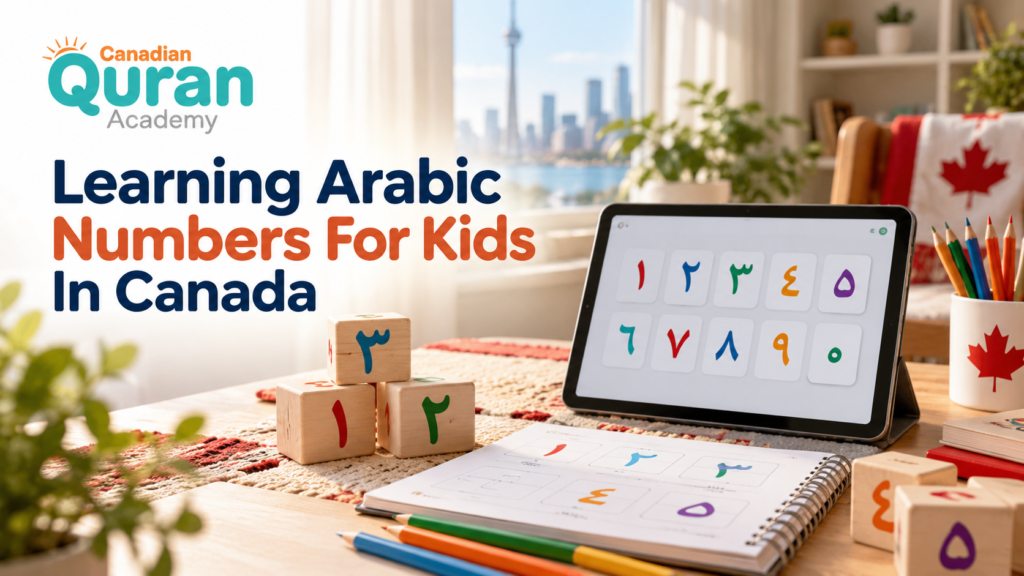
How can a child learn Arabic numbers without turning the lesson into a memorization exercise? For families looking to learn Arabic numbers for kids in Canada, the most effective starting point is often a combination of clear visual symbols, spoken number names, real objects, movement, and short games.
Arabic number learning can also fit naturally into a child’s wider Arabic and Quran education. When children become comfortable recognizing Arabic letters, sounds, words, and symbols, they develop a stronger foundation for future Quranic reading and Arabic language study.
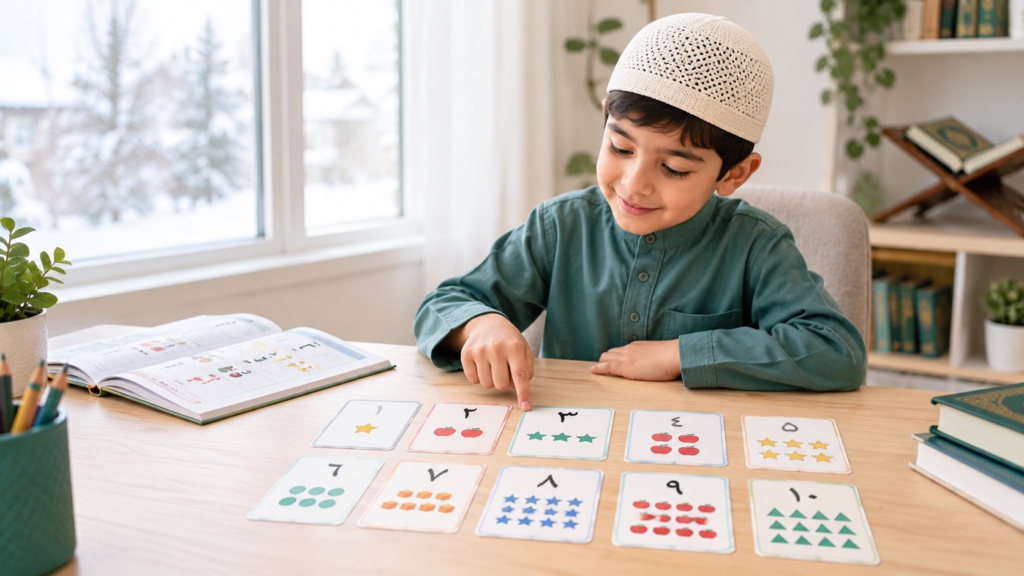
For young children, learning Arabic numbers should involve more than memorizing the appearance of ١, ٢, ٣, and the rest. A child needs to connect the written numeral, the spoken number, and the quantity it represents.
For example, when teaching ٣, show three objects, say the Arabic number, and let the child point to or select the matching numeral. This creates several connections at once: symbol, sound, quantity, and meaning.
Early mathematics research supports this type of hands-on learning. NAEYC recommends games that connect written numerals with quantities, counting, and one-to-one correspondence rather than treating number recognition as an isolated skill.
How to Start Teaching Arabic Numbers From ١ to ١٠
Begin with a small range instead of introducing every number at once. For a beginner, numbers ١–٥ may be enough for the first few sessions before expanding to ٦–١٠.
A simple progression is:
| Arabic numeral | Number |
| ١ | 1 |
| ٢ | 2 |
| ٣ | 3 |
| ٤ | 4 |
| ٥ | 5 |
| ٦ | 6 |
| ٧ | 7 |
| ٨ | 8 |
| ٩ | 9 |
| ١٠ | 10 |
Once children recognize the symbols, introduce the Arabic number words gradually. The goal is not simply to make children repeat a list but to help them understand that the symbol represents a specific quantity.
This distinction matters. A child may be able to recite numbers in order while still struggling to connect ٣ with three objects. Number games provide opportunities to develop both skills.
Read Also: How To Memorize The Quran Without Forgetting in Canada?
1. Match Arabic Numerals With Pictures and Quantities
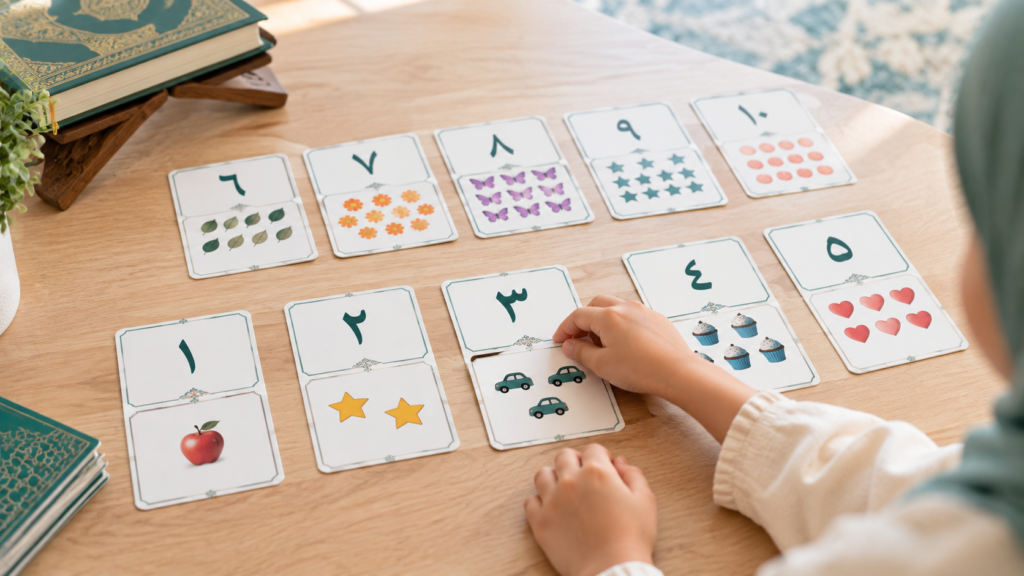
A simple matching activity can use three types of cards:
- Arabic numeral cards.
- Picture or dot cards showing quantities.
- Arabic number-word cards.
Place the cards face up and ask the child to match ٣ with a card showing three apples, three stars, or three dots.
As the child progresses, remove the pictures and ask them to identify the quantity using physical objects. This gradually moves the learner from concrete examples toward recognizing the numeral independently.
NAEYC describes similar numeral-and-quantity matching activities as a way to practice numeral recognition, number names, quantity, and comparison.
2. Use Movement to Make Arabic Numbers Easier to Remember
Children do not have to remain seated to learn numbers. Ask them to jump three times, clap five times, or place seven blocks into a container.
You can say the number in Arabic while the child acts. Then show the corresponding numeral.
This turns an abstract symbol into something the child can hear, see, and physically experience. Play-based activities can also support attention, working memory, and self-regulation, making them useful beyond the immediate lesson.
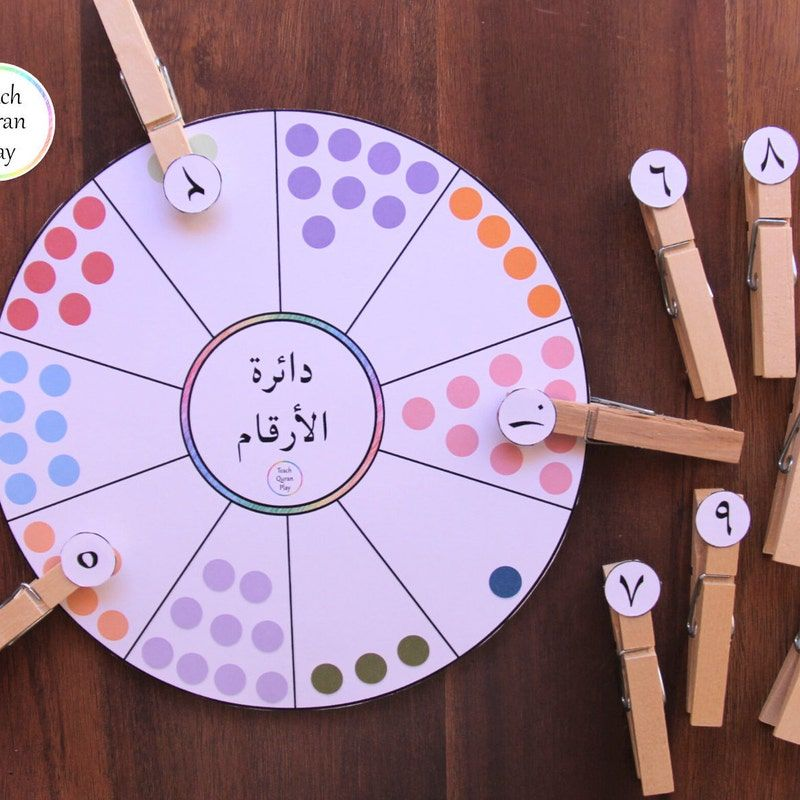
3. Match Arabic Numbers With Everyday Objects
Write ١–١٠ on separate cards. Prepare groups of objects representing each number. For example, place five toy cars beside ٥ and ask, “Which number matches?” Then reverse the activity: show ٧ and ask the child to collect seven objects.
This helps develop one-to-one correspondence—the ability to associate one number word with one object while counting.
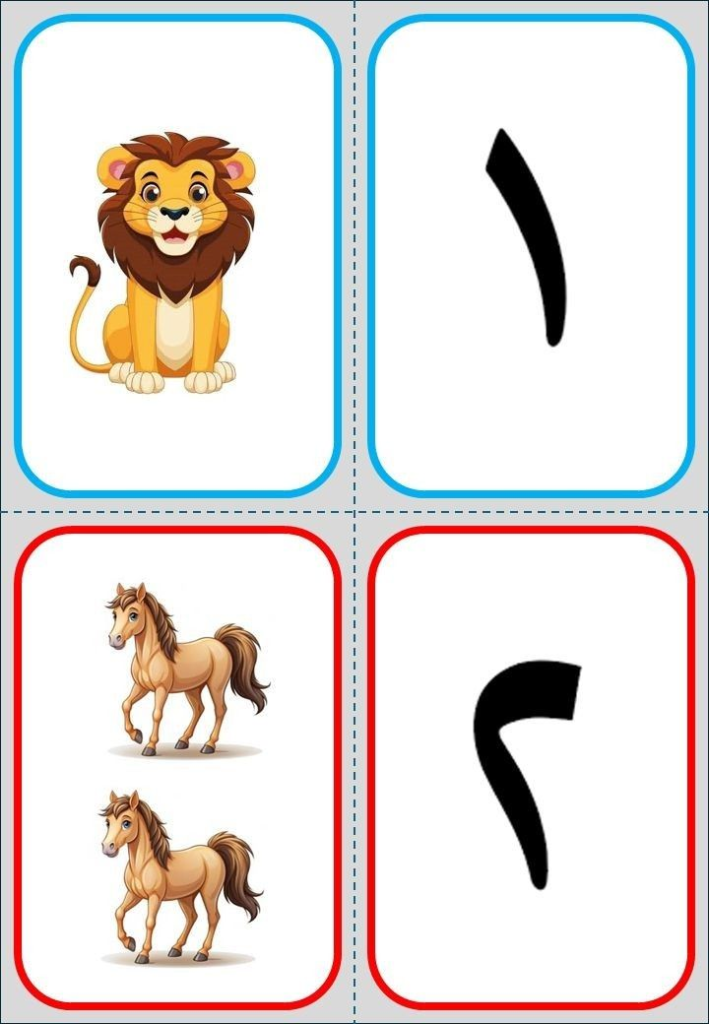
4. Play an Arabic Number Hunt
Turn number practice into a movement game. Hide Arabic numeral cards around the room and call out a number.
If you say أربعة, the child searches for ٤. Once they find it, ask them to collect four objects or perform four actions.
For Canadian families, this can easily become a short activity after school or before an Arabic lesson.
5. Practise Counting With Actions and Movement
Movement makes repetition less monotonous. Ask children to:
- Clap ٣ times.
- Jump ٥ times.
- Tap the table ٧ times.
- Take ١٠ steps.
- Raise ٤ fingers.
The activity can become progressively harder by asking children to identify the written numeral after completing the movement.
6. Build Number Recognition With a Memory Game
Create pairs of cards: one card displays ٨, while the matching card displays eight dots or pictures.
Place the cards face down. Children turn over two cards at a time and try to find matching quantities.
The game combines memory, visual recognition, and number sense. It also gives children repeated exposure without requiring a traditional worksheet.
Read Also: Learn To Read Arabic For Kids In Canada
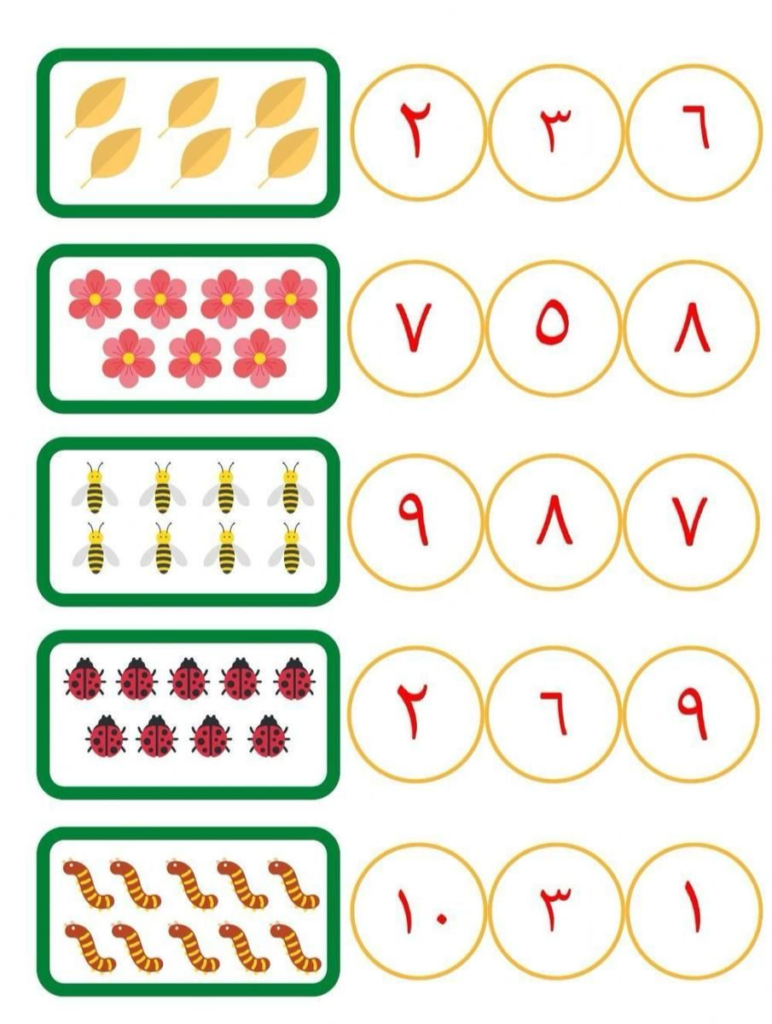
7. Practise Arabic Numbers During Everyday Activities
Arabic number practice does not have to happen only during formal study.
Count pieces of fruit at breakfast, pencils before homework, toys before bedtime, or steps while walking. Ask questions such as, “How many?” “Which number is this?” and “Can you give me three?”
NAEYC emphasizes using concrete objects and everyday mathematical experiences to help young children connect quantities with mathematical ideas.
How Arabic Number Learning Supports Arabic and Quran Skills
For Muslim families, Arabic numbers can become part of a broader Arabic learning routine rather than a completely separate subject.
A child learning Quran may already be learning Arabic letters, vowel marks, pronunciation, and basic vocabulary. Adding short number activities gives them another opportunity to hear and recognize Arabic in a low-pressure context.
The Quran itself contains numbered verses, and Quranic text is organized into surahs, verses, juz, and hizb.
However, learning numbers should complement—not replace—the foundational skills needed for Quran reading, such as Arabic letter recognition and correct pronunciation.
For children beginning Quran education, a structured Noorani Qaida progression can therefore work alongside simple Arabic vocabulary and number games.
The Canadian Quran Academy describes its Noorani Qaida program as progressing through Arabic letter recognition, vowel marks, joining letters, and pronunciation before learners advance toward Quranic text.
If your child is ready to move beyond individual Arabic symbols and begin reading Quran correctly, structured instruction can provide the regular practice and immediate pronunciation correction that games alone cannot provide.
Build a Simple 10-Minute Arabic Learning Routine
You do not need an hour-long lesson every day. A short routine can be more practical for young children.
Try five minutes of Arabic number games followed by five minutes of Arabic letters, vocabulary, or Quran reading. Keep the activities predictable while changing the game so the child remains engaged.
For families in Canada balancing school, homework, Islamic studies, and extracurricular activities, short online sessions can also make it easier to maintain consistency. The Canadian Quran Academy offers flexible online Quran and Arabic instruction for Canadian learners across different provinces and time zones.
Read Also: How To Learn The Quran In Canada?
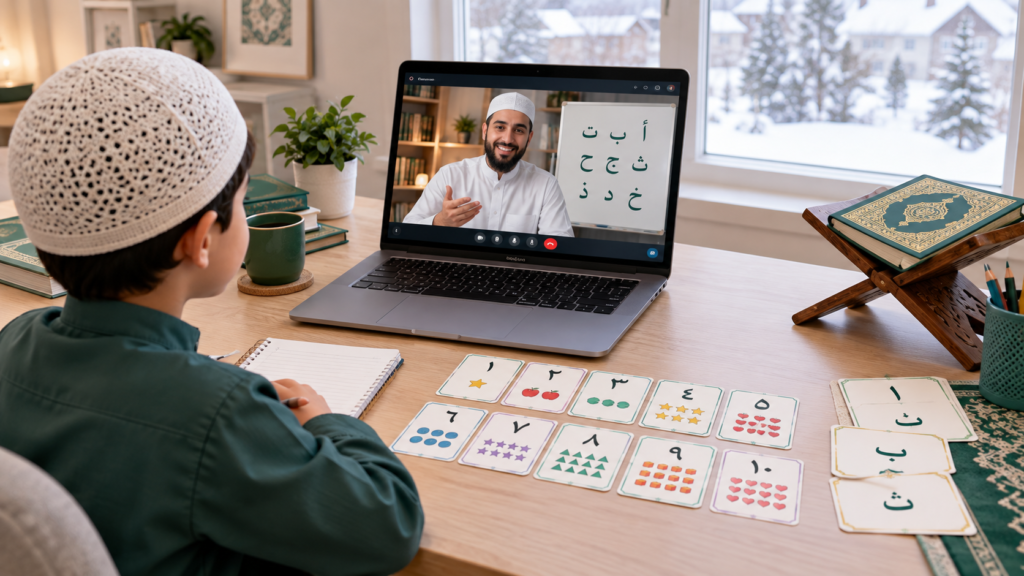
Strengthen Your Child’s Arabic and Quran Foundations
If your child enjoys Arabic games but needs a structured path toward Quran reading, now is a good time to combine playful home practice with qualified instruction.
The Canadian Quran Academy provides online Quran and Arabic education for children and adults, including Quran reading, Tajweed, Hifz, Arabic, and Islamic Studies.
Its instructors provide individualized attention during live lessons, allowing pronunciation and recitation errors to be corrected in real time.
For beginners, the Noorani Qaida Course for Kids in Canada provides a more systematic foundation in Arabic letters, vowel marks, connected forms, and pronunciation. This can complement the short number games families use at home.
Explore Arabic Classes at the Canadian Quran Academy
Live Class in Action
Watch how our instructors interact with students in real-time, focusing on interactive methods.
Start Your Quranic Journey in Canada
Join our vibrant community and learn with expert tutors through our flexible online platform.
Claim Your Free TrialBook a Free Trial and Build Strong Arabic Foundations
Give your child a structured path from Arabic recognition to confident Quran reading with personalized online instruction from the Canadian Quran Academy.
Whether your child is starting with Arabic letters, learning Quran reading, improving Tajweed, or developing broader Arabic skills, lessons can be adapted to their age, current level, and learning goals.
At The Canadian Quran Academy, a free trial is an opportunity to see how your child responds to one-to-one instruction and identify the most suitable starting level before committing to a longer learning plan.
Our Quran Courses
- Quran Online Academy
- Quran Recitation Classes
- Quran Reading Classes
- Online Quran Classes for Kids
- Quran Classes for Adults
- Quran Classes for Female
- Learn Quran Course for Beginners
- Quran Memorization (Hifz) Course
- Hifz Classes for Adults
- Quran Memorization and Hifz Course for Kids
- Quran Hifz Course for Ladies
- Quran Ijazah Program
- Quran Qirat Learning Course
- Quran Tafsir Course
- Noorani Qaida Course
- Noorani Qaida Course for Kids
- Weekend Quran Classes
- Intensive Quran Course
- Al-Azhar Quran Course
- Online Tajweed Classes
- Tajweed Course for Kids
- Tajweed Course for Adults
- Tajweed Course for Ladies

Conclusion
Learning Arabic numbers for kids in Canada works best when children repeatedly connect the numeral, spoken number, and real quantity.
Use matching cards, counting games, movement, everyday objects, memory activities, and short daily routines to make numbers meaningful. For Muslim children, these activities can form one small part of a wider Arabic and Quran learning journey.
The key takeaway is simple: make Arabic numbers visible, audible, physical, and useful. Then gradually build from basic number recognition toward Arabic reading, vocabulary, Quranic pronunciation, and Tajweed with appropriate instruction.
FAQs
What is the best age for learning Arabic numbers?
Children can begin recognizing simple Arabic numerals during the early years, particularly when learning is presented through play. Start with small quantities and gradually introduce more numbers as the child’s recognition and counting skills develop.
How can I teach my child Arabic numbers at home?
Use numeral cards, toys, food, blocks, fingers, and household objects. Show the numeral, say the number in Arabic, and have your child count the matching quantity. Short, repeated activities are often easier to maintain than long lessons.
Should children learn Arabic numbers before learning Quran?
Not necessarily. Arabic number recognition can be useful general Arabic knowledge, but Quran reading primarily requires Arabic letter recognition, sounds, vowel marks, joining letters, and correct pronunciation. A structured Noorani Qaida course can address these foundations.
How can Arabic number games support Quran learning?
Number games do not directly teach Tajweed, but they can make Arabic familiar and enjoyable. They can also be incorporated into a wider routine alongside Arabic vocabulary, letter recognition, Quran reading, and memorization.
Can Canadian children learn Arabic and Quran online?
Yes. Online instruction allows Canadian children to learn from home while fitting lessons around school and family schedules. The Canadian Quran Academy provides live online Quran and Arabic instruction for learners across Canada.
What should children learn after Arabic numbers?
A suitable next step depends on the child’s goal. For Quran learners, Arabic letters, Noorani Qaida, pronunciation, and basic Tajweed are important foundations. For broader language learning, children can progress into Arabic vocabulary, reading, writing, listening, and speaking.





Leave a Reply