 Quran

Are you trying to memorize the Quran but keep losing what you’ve already learned the moment life picks up pace? You memorize five verses on Saturday, skip Monday because of work, and by Thursday those same lines feel foreign again.
The problem isn’t dedication. It’s almost always the method.
Muslims across Canada, in Toronto, Vancouver, Calgary, and cities far from traditional hifz circles, face specific structural obstacles that most general memorization guides don’t account for.
This article walks through 8 proven methods for how to memorize the Quran without forgetting in Canada, drawn from classical hifz pedagogy and adapted to the rhythms of real Canadian life.
Each method below targets a specific weak point in the hifz process. You don’t need all eight simultaneously but the more layers you add, the more durable your memorization becomes.

1. Build Your Quran Memorization on a Sequential Chain
Sequential memorization, known as Al-Hifz Al-Tasalsuli, is the most time-tested method for building retention chains that don’t break. Its core principle: each verse acts as a mnemonic anchor for the next, so no verse is isolated in memory.
The exact daily sequence is as follows: repeat verse 1 aloud at least 20 times until solid, then repeat verse 2 aloud 20 times, then combine both and recite them together 5 times from memory without looking.
Add verse 3 by the same process, combine all three and recite 5 times, and continue through your daily portion.
After completing the day’s section, read the entire portion from the Mushaf 5 times, then recite it from memory 5 more times.
Close the session by reciting it in a voluntary prayer that night — this final step seals the material into the evening’s memory consolidation cycle.
Start Memorizing Quran With Qualified Canadian Instructors

2. Fix Your Tajweed Before You Memorize A Single Verse
This is what separates strong hifz from fragile hifz: your brain encodes what it hears.
If what it hears is mispronounced, that version is the one stored in long-term memory and correcting an embedded mispronunciation later is significantly harder than learning the correct pronunciation first.
Tajweed governs the articulation of every letter, the rules of elongation, and the treatment of letters in combination.
Understanding Arabic punctuation in the Quran, the waqf and wasl markers that govern stopping and continuation, is equally important, since incorrect pausing fragments meaning and disrupts the very flow that memorization depends on.
For students whose first language is English, Quranic pronunciation requires deliberate, guided training.
If letter recognition is still developing, working through an Arabic Noorani Qaida before beginning full verse memorization will save months of correction work later.
Build Your Arabic Reading Foundation With Canada’s Leading Noorani Qaida Course

3. Deploy The Five-Fortresses System Of Memorization As Your Long-Term Shield
Developed by Sheikh Said Hamza, the Five-Fortresses system is the most comprehensive anti-forgetting framework in contemporary hifz methodology.
It treats your memorized Quran not as a linear archive that deteriorates with gaps, but as a fortified compound where every verse is actively defended at multiple levels simultaneously.
For Canadian students struggling with inconsistency, this system is the most complete structural answer to how to memorize the Quran without forgetting in Canada.
Canadian Quran Academy‘s hifz programs are built around this framework, ensuring review is embedded into every student’s plan from the very first lesson not added as an afterthought once forgetting begins.
Read Also: Learning Arabic Numbers For Kids In Canada

A. Understanding The Five Fortresses In Practice
Each fortress is a distinct layer of daily or weekly practice that reinforces the others:
- Continuous Recitation and Listening — Read two ajza daily and listen to at least one hizb from a skilled reciter. Ear-familiarity must precede memorization.
- Preparation — Weekly: read next week’s target pages once daily. Nightly: listen 15 minutes to tomorrow’s section, then read it from the Mushaf 5 times. Pre-session: read the target page aloud 15 minutes immediately before memorizing.
- New Memorization — 15 focused minutes of intensive repetition daily. No skimming.
- Near-Past Review — The 20 pages immediately preceding your current memorization point, reviewed every single day.
- Far-Past Review — Weekly systematic review of all earlier memorization: 40 pages per day through the Quran’s first half, rising to 80 pages per day in the final quarter.
Begin Hifz Training With Female Instructors in Canada Today

B. Making The Five-Fortresses Work In A Busy Canadian Schedule
The typical objection is time. But when mapped to actual minutes, this system averages 60–90 minutes per day when practiced consistently roughly the time most Canadians spend on screens before bed.
The practical solution is one protected daily block rather than scattered attempts throughout the day.
Fajr time, before school or work begins, is the slot most Canadian Muslim families report as both reliable and effective, quiet, free from interruption, and spiritually charged in a way that makes retention feel qualitatively different from afternoon study.
Book a free trial lesson at Canadian Quran Academy TODAY
4. Turn Your Pre-Sleep Hour Into A Memory Vault
Cognitive neuroscience consistently confirms that information reviewed immediately before sleep has a significantly higher probability of transferring from short-term to long-term memory.
Sleep is when the brain consolidates the day’s experiences and what it encounters last is what it prioritizes for retention.
The approach is specific: spend 15–20 minutes listening attentively to the verses you plan to memorize tomorrow. Not passive background audio focused listening with the Mushaf open in your hands.
Then read the same section aloud 5 times before closing the book. When Fajr arrives, the morning session becomes an activation of material your brain has already begun binding overnight.
Students who apply this consistently typically report that their Fajr sessions feel markedly faster and more solid within two weeks of beginning the practice.
Start Your Adult Quran Reading Journey Anywhere in Canada

5. Let Every Salah Become A Review Session
Five daily prayers mean 17 compulsory rak’ahs every single day.
That is 17 built-in retrieval opportunities before you’ve opened your Mushaf, and retrieval practice is, according to memory science, one of the strongest signals the brain uses to determine what information to consolidate long-term.
The working principle is this: whatever you memorized today goes into tonight’s Isha prayer. Whatever you memorized this week goes into your voluntary prayers or Qiyam Al-Layl.
Reciting to Allah what you’ve just learned is not merely a spiritual practice, it is active memory reinforcement, and for many of history’s greatest huffaz, the prayer was where hifz was truly sealed.
Salah also exposes gaps that self-review misses. Reciting without a Mushaf in hand forces full recall, and any hesitation becomes tomorrow’s priority target.
For families building this habit from the beginning, understanding how to learn Quran for kids in Canada shows how early prayer-integrated review can be established — creating retention habits that compound across years.
Enroll Your Child in Hifz Training in Canada Today

6. Build Your Daily Review Chain Of Quran And Never Break It
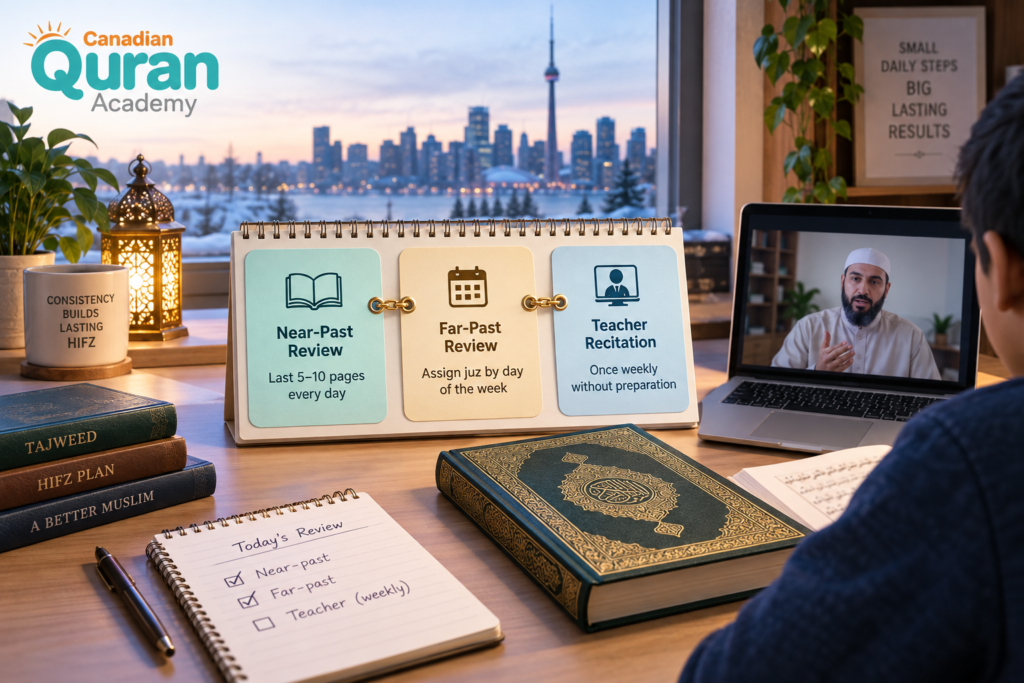
In hifz, this principle protects your entire memorization history more reliably than any single review technique. Your daily review chain operates at three distinct levels simultaneously.
Near-past review: recite the last 5–10 pages from memory, without al Mushaf, every day without exception, this protects your most recent memorization during its most vulnerable first week.
Far-past review: assign specific juz to specific days of the week, rotating through your entire memorization so nothing goes more than 10–14 days without a revisit.
Teacher recitation: once weekly, recite to your instructor without preparation, being heard and corrected by a trained listener activates a different and more durable kind of retention than solo practice alone.
The key practitioner insight here is this: most students count pages memorized and celebrate that number. The students who complete hifz count review sessions maintained because that number is what actually determines what stays.
Read Also: Learn To Read Arabic For Kids In Canada
Live Class in Action
Watch how our instructors interact with students in real-time, focusing on interactive methods.
Start Your Quranic Journey in Canada
Join our vibrant community and learn with expert tutors through our flexible online platform.
Claim Your Free Trial7. Work With A Teacher Who Can Hear Your Every Verse
No method replaces the corrective function of a qualified, live teacher. Pronunciation errors compound silently over weeks and months.
You simply cannot perceive your own mispronunciations the same way a trained ear steeped in Tajweed can identify and correct them in real time.
For Canadians spread across vast geographic distances, how to learn Quran in Canada is now primarily an online question and the answer is clear.
Certified online teachers with live audio sessions can identify specific articulation errors, track your full revision history, and hold you to a structured progression plan that most students genuinely cannot impose on themselves alone.
A qualified teacher does three things that no app or self-study system can replicate: they hear your specific errors, they track your revision history across weeks and months, and they hold you to a plan that doesn’t collapse when life gets difficult.
Canadian Quran Academy‘s certified instructors are available across Canadian time zones, offering one-on-one hifz sessions designed specifically around the scheduling realities of Canadian life.

8. Understand The Meaning Of The Ayas That You Memorize
Decades of memory research confirm that meaningful encoding — learning material through understanding rather than pure repetition — produces dramatically more durable retention.
The Quran is not an arbitrary sound. It is structured divine speech with internal logic, thematic continuity, and semantic relationships that connect verses across pages and surahs.
When you understand what you are memorizing, your brain builds a web of associative anchors, logical, emotional, and contextual.
That web resists forgetting in a way that isolated phonetic sequences simply cannot, because meaning gives the brain reasons to retain the material rather than just instructions to store it.

A. How Meaning Anchors Verses That Repetition Alone Cannot?
Consider the extended passages in Al-Baqarah: understanding how Quranic verses on trust in Allah connect thematically to commandments about prayer.
Which then transitions into legislation on family matters when you know why one verse follows another, you know it from the inside, not just from the page.
The importance of Arabic language in the Quran extends beyond linguistics: Arabic grammar and vocabulary create the scaffolding for meaning-based encoding.
The more you understand the language structurally, the more naturally your brain sequences verses by logical flow rather than by rote page position.
Read Also: How To Learn The Quran In Canada?

B. A Lightweight Meaning-Study Routine That Won’t Slow You Down
You don’t need a formal tafseer education before beginning hifz. A sustainable daily approach looks like this: before each memorization session, spend 5–10 minutes reading a brief translation and one short tafseer paragraph for that day’s portion.
Understand the theme, the context, and the connection to adjacent verses. That is enough to fundamentally shift how your brain encodes the material.
If your Arabic is still developing, how to learn Arabic for Quran in Canada offers a practical parallel-track approach that doesn’t require pausing your hifz.
Even partial vocabulary recognition — becoming familiar with the most used Arabic words in the Quran — transforms how the brain processes verses: from sound sequences into meaningful units that carry their own internal logic and sequence.
Experience Our Classrooms
Don’t just take our word for it—take a look inside! Watch the videos below to experience our engaging teaching methods and vibrant online classrooms firsthand.
Start Your Quranic Journey in Canada
Join our vibrant community and learn with expert tutors through our flexible online platform.
Claim Your Free TrialStart Your Hifz Journey The Right Way With Canadian Quran Academy
Eight structured methods now sit in front of you from sequential chaining and the Five-Fortresses framework, to teacher accountability and meaning-based encoding.
What separates Muslims who complete hifz from those who stall is not talent, age, or free time. It is consistent, guided practice inside a system designed to survive the real pressures of Canadian life.
Canadian Quran Academy offers one-on-one online hifz programs with certified instructors.
Who build custom memorization and review plans, correct your Tajweed in real time, and hold you accountable in your time zone, on your schedule, from anywhere in Canada.
Our Quran Courses
- Quran Online Academy
- Quran Recitation Classes
- Quran Reading Classes
- Online Quran Classes for Kids
- Quran Classes for Adults
- Quran Classes for Female
- Learn Quran Course for Beginners
- Quran Memorization (Hifz) Course
- Hifz Classes for Adults
- Quran Memorization and Hifz Course for Kids
- Quran Hifz Course for Ladies
- Quran Ijazah Program
- Quran Qirat Learning Course
- Quran Tafsir Course
- Noorani Qaida Course
- Noorani Qaida Course for Kids
- Weekend Quran Classes
- Intensive Quran Course
- Al-Azhar Quran Course
- Online Tajweed Classes
- Tajweed Course for Kids
- Tajweed Course for Adults
- Tajweed Course for Ladies
Book a free trial lesson to experience structured, expert-guided hifz before committing to a program.

Conclusion
Every method in this guide rests on one shared truth: the Quran is not designed to be memorized once. It is designed to be returned to, daily, as an act of ongoing relationship with Allah.
The greatest huffaz in history were not people with extraordinary memories. They were people with extraordinary consistency, students who came back to the same pages again and again until those pages became part of them.
The eight methods above, sequential chaining, the Five-Fortresses framework, pre-sleep preparation, Salah-as-review, the unbroken daily chain, Tajweed correction, teacher accountability, and meaning-based encoding form exactly that system.
12 Quran verses about patience have carried believers through harder seasons than a packed Canadian schedule, and Quran verses about not giving up speak directly to the moment when hifz feels impossible.
The promise in Surah Al-Qamar, “We have made the Quran easy to remember” was not a consolation. It was a contract.
Frequently Asked Questions
How Long Does It Take To Memorize The Quran Without Forgetting In Canada?
There is no fixed timeline — it depends entirely on daily commitment and the method used. A student who memorizes half a page per day with consistent review can complete the Quran in approximately four to five years.
Can Adults Memorize The Quran Without Forgetting Just As Well As Children?
Yes — and in some respects, more durably. Adults rely more on meaningful encoding than children do, and meaning-based memorization resists forgetting more strongly than phonetic rote learning.
Do I Need To Know Arabic To Memorize The Quran?
Fluency in Arabic is not required, but a functional understanding of Quranic Arabic — specifically correct letter articulation — is essential. Mispronounced verses are stored incorrectly and are genuinely difficult to correct later.
Is Online Hifz Effective For Students Across Canada?
Yes, provided the classes are live and include real-time audio correction. The critical variable is not the platform — it is whether your teacher can actually hear your recitation, identify errors, and track your progress over time. Passive app-based practice or recorded-audio sessions cannot replicate this.
What Is The Single Biggest Reason People Forget What They Have Memorized?
Neglecting review of older material while pushing forward into new memorization. Moving forward feels like progress — and superficially, it is. But memorization without systematic review decays within days.







[…] Read Also: How To Memorize The Quran Without Forgetting in Canada? […]
[…] Read Also: How To Memorize The Quran Without Forgetting in Canada? […]