 Quran

Thousands of Muslim families across Canada, from Halifax to Victoria, Mississauga to Edmonton, face the same question every year: How to learn the Quran in Canada? Where do we actually begin?
The schedules are demanding, the commutes are long, and the nearest Islamic center might be a forty-minute drive through unpredictable weather.
Yet the desire to connect with the Quran remains constant, for children growing up in Canadian schools, for converts finding their footing, and for families who want to preserve what they carried from home.
This guide gives you eight clear, practical methods each suited to a different lifestyle, age group, and starting point.
Most dedicated learners combine two or three of these. Read through all eight before deciding which fits your situation best.

1. Start Learning The Quran In Canada With A Certified Online Academy
Online Quran academies are the most practical starting point for most Canadian learners. There is no commute, no driving through a Toronto January or arriving late from a Vancouver rush-hour crawl.
Sessions happen live, via video call, with a certified teacher who hears every sound you produce and corrects it immediately.
The best academies for Canadian learners schedule sessions across all time zones, EST, CST, MST, and PST, and offer flexible rescheduling when Canadian winters, school breaks, or work demands intervene.
For a clear picture of what this looks like from the very first session, how to learn Quran in Canada is a dedicated resource worth reading alongside this guide.
Look specifically for teachers who hold an Ijazah — a certified chain of transmission connecting their recitation directly back to the Prophet ﷺ through named scholars.
This credential is not ceremonial. It guarantees that the pronunciation being taught has been formally verified, not self-taught from apps or unaccredited recordings.
Canadian Quran Academy offers one-on-one certified sessions across all Canadian time zones, with free trial classes, for more information explore our Quran classes for Adults in Canada.

Read Also: How To Memorize The Quran Without Forgetting in Canada?
2. Join Weekend Islamic Schools That Give Structure To A Busy Canadian Life
Across Canada, weekend Islamic schools running on Saturdays or Sundays offer structured curricula combining Quran recitation, basic Tajweed, and Islamic studies in a single setting.
For families managing weekday school, extracurricular activities, and full-time work, this is often the most efficient single investment of learning time available.
Before enrolling, visit a class and ask three specific questions: What qualifications do the teachers hold? Which foundational curriculum does the school follow?
And what does measurable progress look like at the three-month mark? A school that answers these questions directly has genuine pedagogical standards. One that deflects them deserves more research.
The fixed weekly schedule, like hockey practice or art class, frames Quran study as a normal, expected part of their week rather than an occasional parental request that can be negotiated away.
Read also: HOW TO LEARN ARABIC FOR QURAN IN CANADA?
3. Learn The Rules Of Tajweed
Tajweed is the codified system of phonetic rules governing how the Quran is recited — the precise articulation of each letter, the correct handling of lengthened vowels, and the rules for pausing and resuming.
It is not an advanced topic to be deferred until later; applied from the very first session, it prevents pronunciation errors from becoming permanent habits that take years to correct.
The most common mistake Canadian learners make is treating Tajweed as optional during the beginner phase. Specific rules, introduced early and applied consistently, build a recitation that is authentic from the ground up rather than corrected after the fact.
A. What Is Tajweed And Why Does It Matter?
The Quran was revealed with specific phonetic qualities that distinguish its Arabic from everyday spoken Arabic. A mispronounced letter can alter a word’s meaning entirely.
Understanding Arabic punctuation in the Quran, including stopping marks, prolongation indicators, and breath symbols, gives learners a visual roadmap through any verse before they’ve mastered every phonetic rule.
Classical scholars of Quranic recitation, including Imam Ibn al-Jazari, held that applying Tajweed correctly in recitation is an individual obligation for every Muslim not an optional refinement for advanced students.
Read Also: Learning Arabic Numbers For Kids In Canada
B. What are The Core Tajweed Rules Every Canadian Student Should Know?
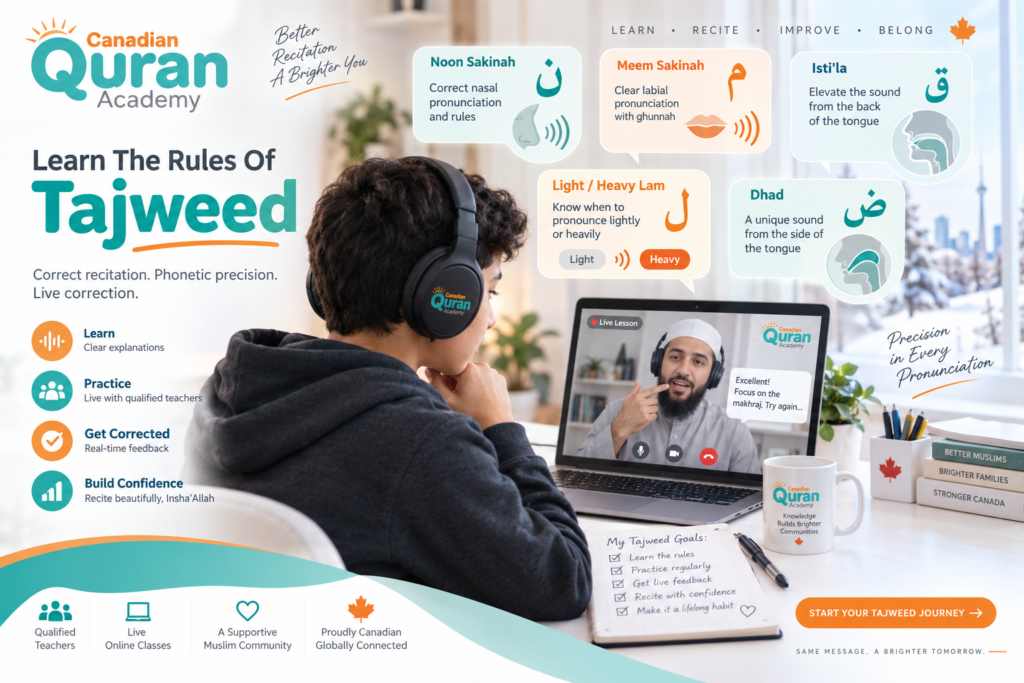
The four rulings for the Noon Sakinah determine what happens when letter n in Arabic ن appears without a vowel at the end of a syllable whether it merges with the next letter, disappears into it, transforms into a Meem, or stays clearly pronounced.
These four outcomes cover the majority of situations a beginner encounters in Juz ‘Amma.
The three rulings for the Meem Sakinah govern what happens when letter m in Arabic (م) appears without a vowel — whether it hides, merges, or sounds clearly — depending entirely on the letter that follows it.
Mastering both sets of rules is the practical foundation of Tajweed for every level.
Letters of elevation (Isti’la), like the letter qaf in Arabic ق, are pronounced with the back of the tongue raised toward the soft palate, producing a heavier, fuller sound.
Distinguishing heavy (mufakhkham) from light (muraqqaq) letters is one of the first genuine markers of authentic Quranic recitation.
Begin Online Tajweed Training Across Canada Today

C. How Online Tajweed Classes In Canada Make This Easier?
Live online sessions allow a teacher to hear the student’s exact pronunciation and correct it in real time. This immediate feedback loop is why certified online instruction consistently outperforms self-study for Tajweed development.
A trained teacher can identify within seconds, for example, whether the Arabic letter lam (ل) is receiving its correct light or heavy treatment in a given context.
The famously difficult the letter dadh in Arabic (ض), often cited as the hardest sound in Arabic for non-native speakers, requires the side of the tongue to press against the upper molars with a specific air flow.
Correctly producing it under real-time correction is far faster than attempting it through solo listening alone.
Two live Tajweed sessions per week, combined with ten to fifteen minutes of daily listening to a master reciter, produces measurable improvement within sixty days for most committed learners.
4. Find The Nearest Local Mosque That Might Be Your Best Classroom
Canada’s major cities host hundreds of mosques and Islamic centers — and most Canadian Muslims consistently underestimate what’s available within driving distance.
Toronto, Mississauga, Ottawa, Calgary, Edmonton, and Vancouver all have Islamic centers running structured Quran programs, from weekend Hifz circles to weekday evening Tajweed classes for adults.
Parents specifically looking for how to learn Quran for kids in Canada will often find that a local mosque program, combined with consistent home practice, produces stronger results than either approach alone.
Adults benefit from mosque circles too. Many centers offer evening circles designed specifically for working adults, timed after Isha, covering the Surahs most commonly recited in prayer.
Exploring 15 Quran verses about prayer while actively improving what you recite in Salah adds a layer of meaning that pure academic study rarely delivers.
Read Also: Learn To Read Arabic For Kids In Canada
Live Class in Action
Watch how our instructors interact with students in real-time, focusing on interactive methods.
Start Your Quranic Journey in Canada
Join our vibrant community and learn with expert tutors through our flexible online platform.
Claim Your Free Trial5. Memorize One Page Of The Quran At A Time
Quran memorization, Hifz, is among the most demanding and most rewarding commitments a Muslim can make.
The approach that consistently works across all ages starts from Juz ‘Amma, progressing through shorter Surahs before the longer portions. This structure builds recitation confidence before memory demands escalate.
The principle most Hifz students learn too late: revision is more important than new memorization. Adding half a page per day means little if the previous ten pages are deteriorating from lack of review.
The strongest Hifz programs, both online and in-person, build systematic revision into every class, not as a bonus but as the structural core of the curriculum.
When the memorization feels genuinely overwhelming, Quran verses about not giving up offer perspectives that no motivational talk can match. The journey itself carries spiritual weight.
12 Quran verses about patience remind every student of Hifz that the effort of carrying this book is recognized before it is completed — the process is part of the reward, not merely the means to it.
Start Memorizing Quran With Qualified Canadian Instructors
6. Start Learning The Noorani Qaida
The Arabic noorani qaida is a beginner’s primer designed specifically to teach correct Quranic pronunciation before the student opens the Mushaf.
It introduces each letter in its isolated, initial, medial, and final forms, then combines them progressively into syllables, words, and short Quranic phrases drawn from actual Quranic text.
Most mispronunciation problems in self-taught learners trace directly back to skipping this step.
Without the Qaida’s systematic letter-to-syllable-to-word progression, learners absorb visual shapes without accurate sounds and develop habits that become progressively harder to correct.
For children, the Noorani Qaida is the standard starting point in most Canadian Islamic schools. For adults completing it with a qualified teacher typically takes two to three months.
That investment returns compound dividends: every subsequent lesson moves faster because the phonetic foundation is solid from the start.
Build Your Arabic Reading Foundation With Canada’s Leading Noorani Qaida Course for Kids in Canada
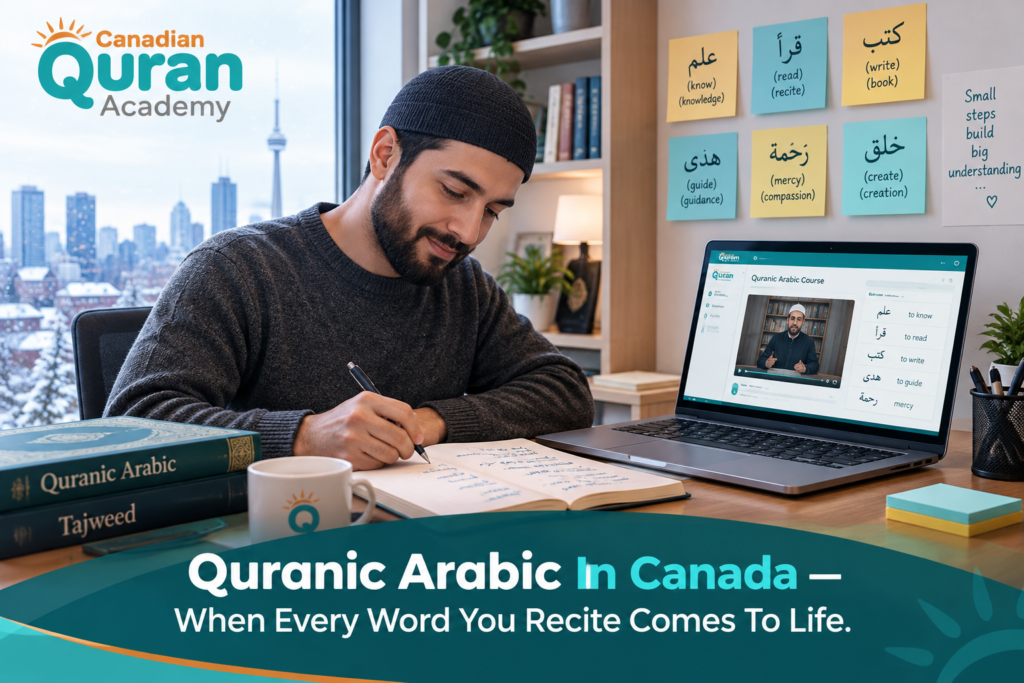
7. Learn Quranic Arabic And Let The Words Speak To Your Heart
Understanding what you recite is not required to recite correctly, but it transforms the experience entirely.
When a student knows that Al-Ghafoor means the Most Forgiving, or that Rabb carries simultaneous connotations of nurturing and sovereignty, the Quran stops being a sequence of memorized sounds and becomes a living message addressed directly to the reader.
The importance of Arabic language in the Quran extends beyond vocabulary. The root system of classical Arabic, in which three-letter roots generate entire families of related meanings, is embedded in how the Quran communicates.
Knowing even three hundred of the most used Arabic words in the Quran unlocks significant comprehension, since the Quran uses a compact core vocabulary with high frequency repetition.
Many Canadian learners ask how to learn Arabic for Quran in Canada specifically, meaning the kind of Arabic study that prioritizes Quranic comprehension over conversational fluency.
Students unsure about which Arabic should I learn in Canada, Modern Standard, dialectal, or Quranic Arabic, will find that for Quran purposes, Quranic Arabic is the clear starting point.
8. Build A Daily Review Habit Because Consistency Beats Intensity
No method, platform, or teacher can replace daily practice. Ten minutes of focused daily review produces more retention than a two-hour session once a week; this is neurologically documented and confirmed by every experienced Quran educator.
The brain consolidates phonetic and textual memory during sleep; without regular triggering, that consolidation doesn’t happen consistently.
The most effective Canadian learners build recitation into existing routines: a few verses after Fajr, listening to a master reciter during the commute, reviewing a Surah before Isha.
Quranic verses on education in Arabic frame the pursuit of Quranic knowledge as an act of worship, not merely an academic task.
Quranic verses on trust in Allah carry a specific reassurance for struggling learners: every sincere effort toward the Quran is seen, and the return is never proportional to what was invested, it is always greater.
Begin Islamic Studies Training Designed for Muslim Women’s Needs
Experience Our Classrooms
Don’t just take our word for it—take a look inside! Watch the videos below to experience our engaging teaching methods and vibrant online classrooms firsthand.
Start Your Quranic Journey in Canada
Join our vibrant community and learn with expert tutors through our flexible online platform.
Claim Your Free TrialBegin Your Quran Journey With Canadian Quran Academy
Every journey starts with a single committed step, and yours can start today. Canadian Quran Academy connects Canadian learners of all ages and levels with Ijazah-certified teachers who understand your schedule, your goals, and the specific realities of learning in Canada, across every province and every time zone.
Whether you’re beginning from zero, refining your Tajweed, guiding your child through Hifz, or returning after years away from regular study, there is a program structured for exactly where you are.
Free trial sessions, flexible scheduling, and certified instruction; all designed for Canadian Muslim life.
Our Quran Courses
- Quran Online Academy
- Quran Recitation Classes
- Quran Reading Classes
- Online Quran Classes for Kids
- Quran Classes for Adults
- Quran Classes for Female
- Learn Quran Course for Beginners
- Quran Memorization (Hifz) Course
- Hifz Classes for Adults
- Quran Memorization and Hifz Course for Kids
- Quran Hifz Course for Ladies
- Quran Ijazah Program
- Quran Qirat Learning Course
- Quran Tafsir Course
- Noorani Qaida Course
- Noorani Qaida Course for Kids
- Weekend Quran Classes
- Intensive Quran Course
- Al-Azhar Quran Course
- Online Tajweed Classes
- Tajweed Course for Kids
- Tajweed Course for Adults
- Tajweed Course for Ladies
Book a free session today at Canadian Quran Academy and start learning the Quran correctly.

Conclusion
Learning the Quran in Canada is genuinely achievable — and more accessible today than at any previous point in history.
The eight methods in this guide are not in competition with each other; most dedicated learners combine two or three simultaneously based on their schedule and goals.
Online academies provide certified instruction and flexible scheduling. Local mosques and weekend schools add community and accountability. The Noorani Qaida builds the phonetic foundation. Tajweed adds precision.
Hifz adds depth. Quranic Arabic adds comprehension. Daily review makes everything stick. The most common mistake Canadian learners make is waiting for the right time or the perfect setup before beginning.
The foundational sequence of how to learn the Quran in Canada, correct letter pronunciation, qualified instruction, consistent daily contact with the text — works regardless of your current level or how crowded your calendar looks right now.
Start with fifteen protected minutes per day. Build from there. The relationship with the Quran you establish through consistent effort today is the one you’ll carry for the rest of your life.
Frequently Asked Questions
Can A Complete Beginner Who Has Never Read Arabic Start Today?
Yes. The Noorani Qaida method is specifically designed for learners with zero prior knowledge of Arabic script. A certified teacher begins with letter recognition and builds systematically from that foundation.
Adults and children with no prior Arabic exposure regularly achieve basic Quranic reading ability within three to four months of consistent study.
What Age Is Best For A Child To Start Quran Education In Canada?
Most Islamic educators recommend beginning with letter recognition between ages four and five. Formal structured classes, including Tajweed introduction and early Hifz preparation, are typically introduced between six and eight.
Children vary significantly, and a teacher’s direct assessment of readiness is more reliable than any fixed age guideline.
How Many Sessions Per Week Does A Beginner In Canada Need?
Two to three live sessions per week, each lasting thirty to forty-five minutes, is the standard recommendation.
Combined with ten to fifteen minutes of daily personal review, this pace produces visible progress within the first four to six weeks. More sessions accelerate results; fewer slow the process significantly.
Is Online Quran Learning As Effective As In-Person Classes?
For the majority of learners, yes, particularly when the teacher holds an Ijazah and provides real-time pronunciation correction.
Both extensive practitioner experience and learner outcomes consistently show that teacher qualifications and student consistency are the two decisive variables, not the delivery format itself.
How Do I Know If A Quran Teacher In Canada Is Properly Qualified?
Ask directly whether the teacher holds an Ijazah and which scholar granted it. A legitimate teacher will name both the scholar and the recitation style (qira’ah) in which the Ijazah was granted.
This certification distinguishes teachers who have been formally verified through a chain of scholarship from those who are self-taught or unverified.
What If I Already Know Some Surahs But Have Tajweed Errors?
This describes a very common situation among Canadian Muslims.
The recommended approach is not to restart from scratch, but to work through your existing memorization with a qualified teacher who identifies and systematically corrects the specific errors.





Leave a Reply