 Arabic
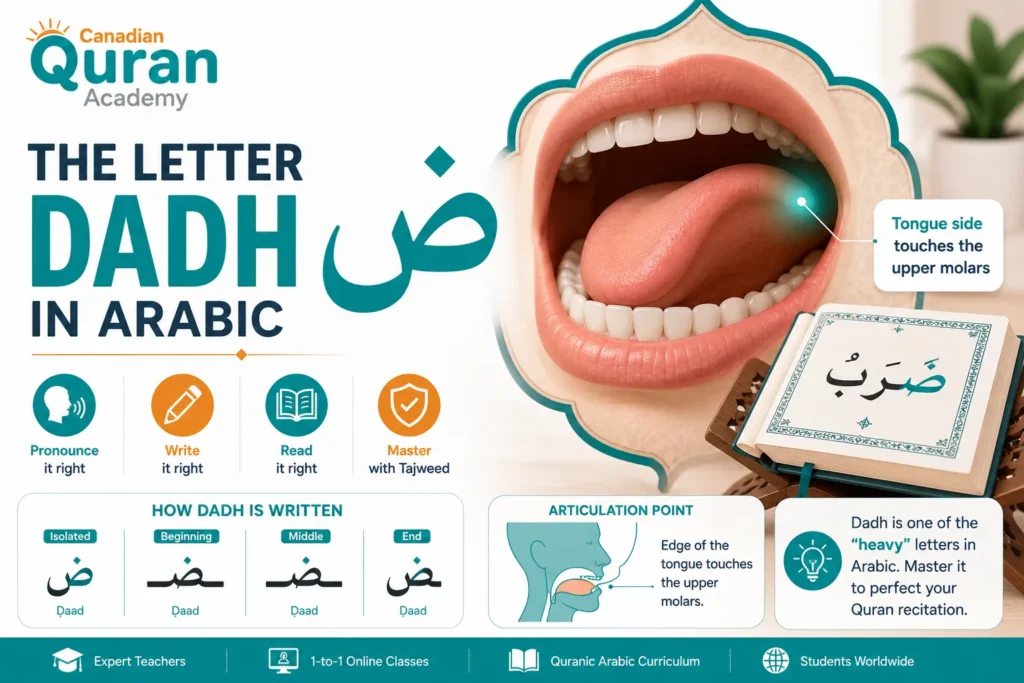
If you’ve started learning Arabic through Canadian Quran Academy, you’ve probably already heard your teacher mention one letter with a special reputation: the letter Dadh in Arabic, written ض. Arabic is traditionally nicknamed lughat ad-dadh — “the language of Dadh” — because this sound is considered unique to Arabic and genuinely difficult for non-native speakers to reproduce.
This guide walks you through everything you need to actually use the letter Dadh correctly: how to pronounce it, how to write it in all four of its forms, how to stop confusing it with its visual twin Saad (ص) and its sound-cousin Zha (ظ), and where you’ll meet it inside real Quranic verses.
What Is the Letter Dadh in Arabic?
The letter Dadh (ضَاد) is the fifteenth letter of the 28-letter Arabic alphabet, sitting immediately after Saad, and it carries an abjad numerical value of 800. Like most Arabic letter names, “Dadh” itself carries no independent meaning — it’s simply the label for the letter, the same way “dee” is just the name of the English letter D.
Inside an actual word, you never pronounce the letter’s name. You produce a short, heavy “ḍ” sound instead. In the word ضَرَبَ (ḍaraba, “he hit”), the Dadh is read as “ḍ,” not as “Dadh.”
Classical grammarians gave Arabic the nickname lughat ad-dadh because they considered this sound distinctive enough that reproducing it accurately became a mark of a skilled reciter or speaker.
This is where the popular phrase “Dadh is the sound of the Quran” comes from — not because the letter appears more often than others, but because pronouncing it correctly is treated as a hallmark of proper Arabic articulation.
Instructors at Canadian Quran Academy still use this as a teaching benchmark: a student who can produce a clean Dadh has usually cleared one of the harder hurdles in Arabic pronunciation.
Where Dadh Sits In The Arabic Alphabet?
Dadh is a consonant (حرف صحيح), meaning it needs a vowel mark to be pronounced and cannot stand alone as a syllable. It belongs to a small group of four “heavy” letters — ض ص ط ظ — known in tajweed as the itbaq (occlusive) letters, all of which require the back of the tongue to press up toward the palate.
How to Pronounce the Letter Dadh?
Getting the ضLetter Dadh in Arabic – right starts in one specific spot in your mouth, not on your tongue tip.
Correct pronunciation depends on locating a makhraj (articulation point) unlike almost any other Arabic letter.
Instead of the tongue tip, Dadh is produced with the edge — or side — of the tongue pressed firmly against the inner surface of the upper molars, extending forward toward the gums. You can use either the right or left side of your tongue, whichever feels more natural.
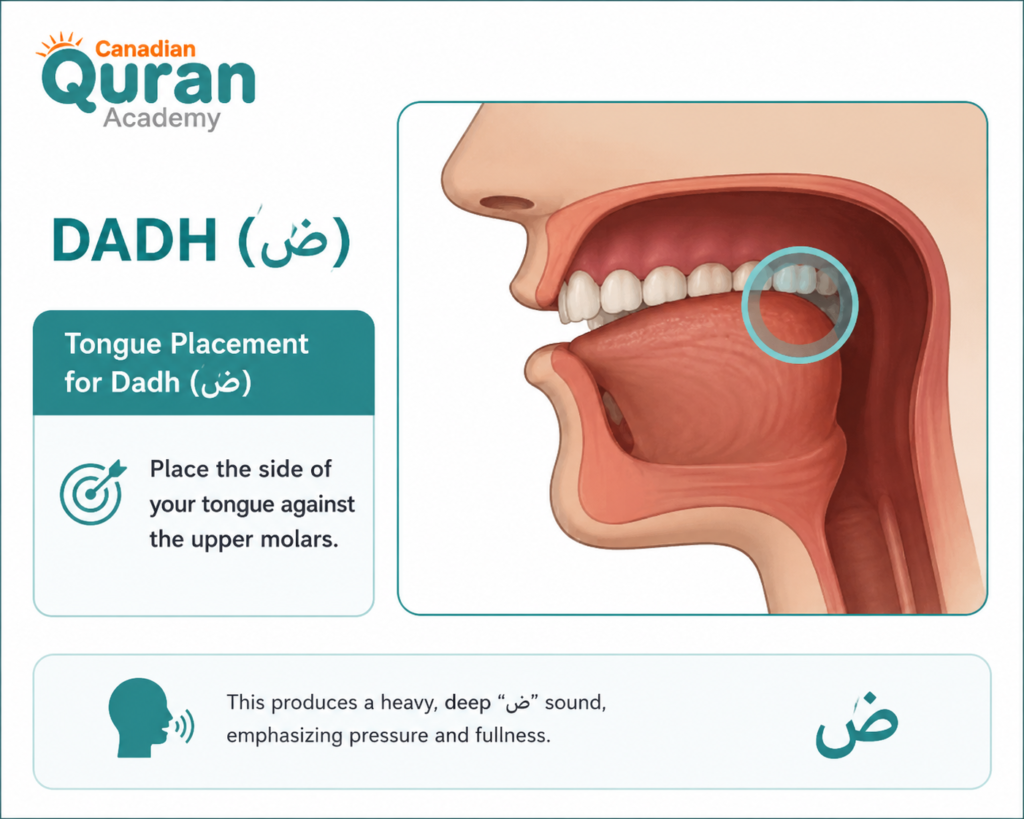
Finding the Correct Tongue Position
A simple way to start: say the letter د (dāl), like the “d” in “dog.” Now imagine making that sound thicker, deeper, and more forceful, and shift it from the tip of your tongue to the side. That shift — from tip to side, and from light to heavy — is the entire technique.
Read also: Arabic Punctuation In The Quran – The Complete Guide
The Voice Qualities That Make Dadh Heavy
Several sifaat (sound characteristics) define Dadh. It is majhoorah (voiced) — your vocal cords vibrate as you say it, unlike its unvoiced counterpart Taa.
It is rikhwah (a continuant), meaning the airflow can be sustained rather than cut off abruptly. Most importantly, Dadh carries isti’la (the back of the tongue rises) together with itbaq (the tongue presses against the palate), which is what gives it the same heavy, “dark” quality found in Saad, Taa, and Zha.
Dadh also has istitalah — an elongation of the sound along the side of the mouth that is unique to this letter alone among all 28.
Common Pronunciation Mistakes
The most frequent beginner error is substituting a plain English “d” — a tip-of-tongue sound with no molar contact and no heaviness.
The second most common mistake is drifting toward Zha (ظ) instead, which happens in certain regional accents too. Neither is technically incorrect Arabic in casual speech, but in tajweed both are treated as distinct letters that can change a word’s meaning if confused in recitation.
Live correction from a teacher is consistently the fastest fix for this — it’s one of the reasons pronunciation drills are built into every level of the Quranic Arabic Course at Canadian Quran Academy, rather than left for students to self-correct from a recording.
Read Also: How To Learn Arabic For Quran In Canada?
Live Class in Action
Watch how our instructors interact with students in real-time, focusing on interactive methods.
Start Your Quranic Journey in Canada
Join our vibrant community and learn with expert tutors through our flexible online platform.
Claim Your Free TrialHow to Write the Letter Dadh in Its Four Forms?
Writing the letter Dadh in Arabic correctly means tracking two things at once: how its shape shifts across four positions, and the one dot that never moves.
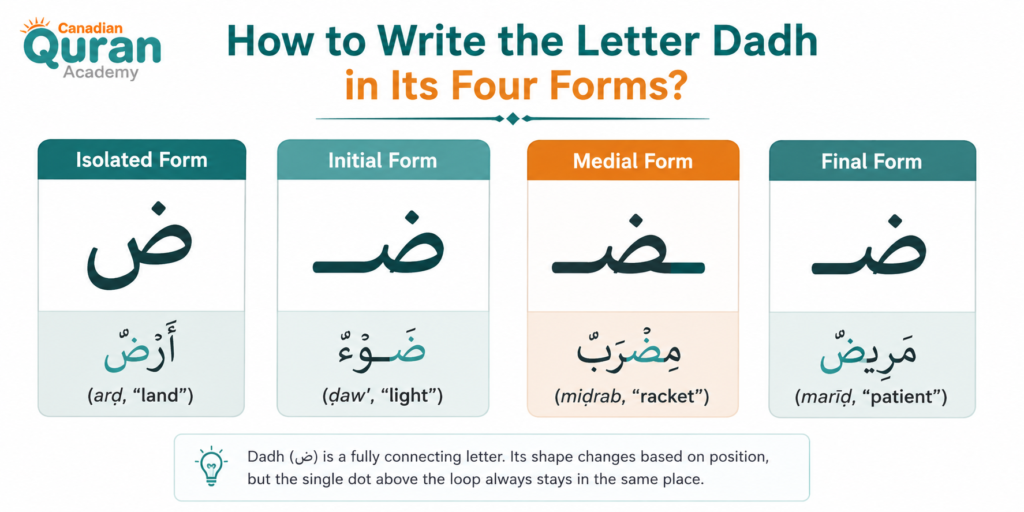
Like its visual twin Saad, Dadh is a fully connecting letter, meaning it links to the letter before and after it. That connection flexes its shape across four positions, while one detail — a single dot above the loop — always stays fixed in place.
In isolated form, Dadh has a rounded loop on the baseline with a tail curving upward to the left, finishing in a small hook, topped by one dot — as in أَرْض (arḍ, “land”). In initial position, the tail drops away and the loop flows directly into the next letter, as in ضَوْء (ḍaw’, “light”).
In medial position, connecting on both sides, the loop compresses further between two connector strokes, as in مِضْرَب (miḍrab, “racket”). In final position, the full tail and hook return, attached to the preceding letter, as in مَرِيض (marīḍ, “patient”).
The One Dot That Changes Everything
Dadh and Saad share the exact same body shape. The only visual difference between them is a single dot placed centrally above Dadh’s loop — never touching the outline, never shifting position across any of the four forms.
Beginners’ most common writing mistake is forgetting that dot entirely, which silently turns a Dadh into a Saad and changes the word’s meaning. The second most common mistake is placing the dot off-center instead of directly above the loop. Because that dot is the only thing separating two entirely different letters, it deserves the same care as the shape itself.
Read also: Arabic Noorani Qaida – What It Is, Its Origin, And How To Teach It?
Dadh vs Saad vs Zha: How to Tell Them Apart
Two confusions dominate this letter, and they’re different problems. Dadh vs Saad is a shape confusion — same body, one dot. Dadh vs Zha is a sound confusion, since both are heavy, voiced letters, but produced in completely different parts of the mouth.
| Feature | Dadh (ض) | Saad (ص) | Zha (ظ) |
| Shape | Loop + tail + one dot above | Loop + tail, no dot | Straight stem with a loop and dot |
| Makhraj | Side of tongue against upper molars | Tongue tip near upper front teeth | Tongue tip between the front teeth |
| Voicing | Voiced (majhoorah) | Unvoiced | Voiced |
| Heaviness | Heavy (tafkheem) | Heavy (tafkheem) | Heavy (tafkheem) |
A practical framework worth keeping in mind whenever you’re unsure which letter you’re looking at or hearing: check the dot (is there one, and is it centered above the loop?), check the makhraj (does the sound come from the side of the tongue against the molars, or from the tongue tip?), and check the weight (is the sound genuinely heavy, or has it thinned out toward a plain “d”?).
If a word passes all three checks, you’re producing — or reading — a correct Dadh. This three-point habit is faster to apply in real time than trying to recall the full sifaat list mid-sentence, and it’s the same sequence instructors walk students through in the Arabic Grammar Course at Canadian Quran Academy when letter-confusion errors show up in reading practice.
Read Also: How To Learn Arabic For Quran In Canada?
Words With The Letter Dadh In Different Positions
Seeing the letter in isolation only teaches you half the picture — recognizing Dadh gets easier once you’ve read it inside real words, where its shape shifts but its heavy sound never does. The table below groups examples by where Dadh sits in the word, so you can practice all three positions side by side.
| Position | Word | Transliteration | Meaning |
| Initial | ضَوْء | ḍaw’ | light |
| Initial | ضِفْدَع | ḍifda’ | frog |
| Initial | ضَباب | ḍabāb | fog |
| Medial | رَمَضان | Ramaḍān | Ramadan |
| Medial | خُضار | khuḍār | vegetables |
| Medial | مِنْضَدَة | minḍadah | table |
| Final | بَيْض | bayḍ | eggs |
| Final | مَريض | marīḍ | patient |
| Final | أَرْض | arḍ | land |
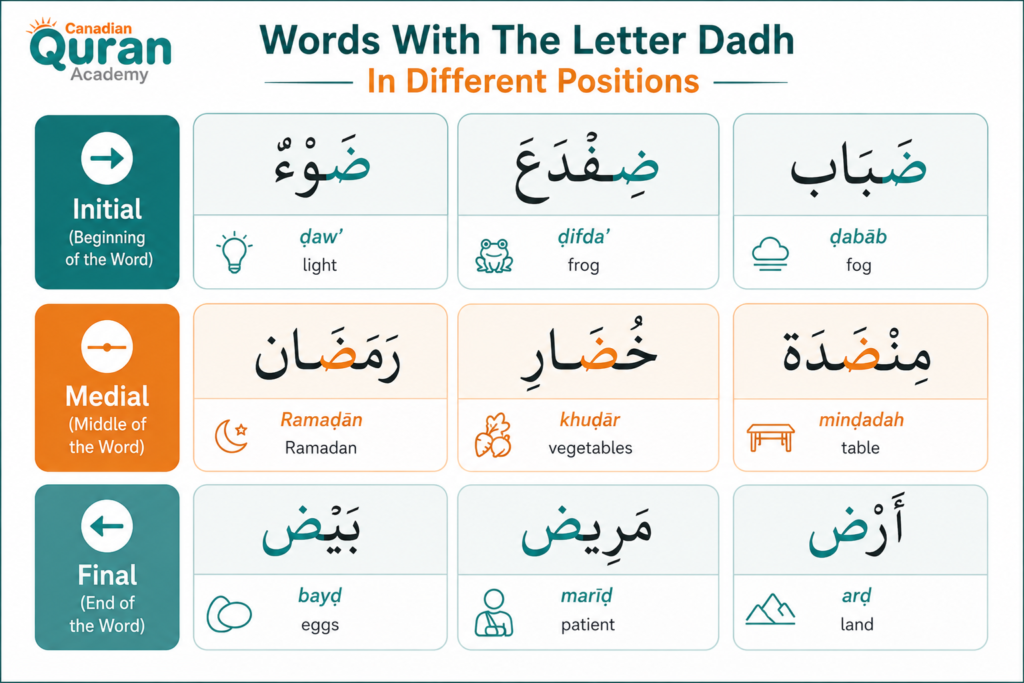
Notice that the heaviness of Dadh doesn’t change based on its position in the word — only the written shape flexes. That consistency is exactly what the itbaq letters are built around.
Read Also: The Importance of Arabic Language in the Quran
The Letter Dadh In Tajweed And The Quran
Reciting the letter Dadh in Arabic correctly matters most inside the Quran itself, where a mispronounced heavy letter can shift a word’s meaning.
Because Dadh’s articulation point exists nowhere else in the alphabet, tajweed teachers typically isolate it for focused drills rather than folding it into general makharij lessons — the goal is confirming a student is genuinely using the side of the tongue, not defaulting to a Zha-like or plain “d” substitute.
Dadh does not carry a dedicated Noon Sakinah or Tanween rule of its own; it falls under the general rules of Idhaar or Ikhfa depending on context, like most letters outside the specific noon-related groups.
It is also not a qalqalah letter, so it should never receive the bouncing “echo” quality given to letters like ق ط ب ج د when they carry sukoon.
Where You’ll Hear Dadh in the Quran?
Dadh appears throughout the Quran in all three word positions. At the start of a word, ضَرَبَ اللَّهُ مَثَلًا (“Allah presents an example”) appears in multiple places, including Surah An-Nahl, verse 75.
In the middle of a word, حَاضِرَة (ḥāḍirah, “present”) appears in Surah Al-Baqarah, verse 282. Most famously, at the end of the final verse of Surah Al-Fatihah — غَيْرِ الْمَغْضُوبِ عَلَيْهِمْ وَلَا الضَّالِّينَ — the word الضَّالِّينَ contains both an initial and a doubled Dadh in a single word, making it one of the most commonly practiced examples of this letter in daily recitation.
Learners who want that kind of close, verse-by-verse correction on their Dadh pronunciation usually get there faster with live feedback than with recordings alone.
That real-time correction loop is the core of how the Quranic Arabic Course at Canadian Quran Academy is structured, and it’s equally useful for adult beginners working through the Arabic Course for Beginners or for children enrolled in Online Arabic Classes for Kids.
Experience Our Classrooms
Don’t just take our word for it—take a look inside! Watch the videos below to experience our engaging teaching methods and vibrant online classrooms firsthand.
Start Your Quranic Journey in Canada
Join our vibrant community and learn with expert tutors through our flexible online platform.
Claim Your Free TrialStart Mastering The Letter Dadh With Live Feedback Today
Reading about tongue placement only gets you so far — Dadh is a letter you correct by ear, with someone listening in real time.
Canadian Quran Academy pairs every student with a qualified instructor who can hear the difference between a genuine Dadh and a near-miss Zha, and correct it on the spot instead of leaving you to guess from a video.

Whether you’re starting from zero with the Online Arabic Course, sharpening recitation through the Classical Arabic Course, or working toward fluent speech with the Arabic Conversation Course, one-on-one correction is what turns a letter like Dadh from a stumbling block into a habit.
Our Arabic Courses:
- Online Arabic Academy
- Online Arabic Course
- Classical Arabic Course
- Arabic Course for Beginners
- Advanced Arabic Course
- Quranic Arabic Course
- Arabic Grammar Course
- Modern Standard Arabic Course
- Intensive Arabic Course
- Online Arabic Classes for Kids
- Arabic Classes for Adults
- Arabic Classes for Ladies
- Fusha Arabic Course
- Business Arabic Course

Start Your Quranic Journey in Canada
Join our vibrant community and learn with expert tutors through our flexible online platform.
Claim Your Free TrialConclusion
The letter Dadh in Arabic is one of the clearest examples of why Arabic pronunciation rewards precision over guesswork. It’s produced at a single, unusual point in the mouth — the side of the tongue against the upper molars — and it’s easy to confuse visually with Saad and audibly with Zha unless you deliberately train your ear and tongue together.
Once you’ve internalized the three-point check (dot, makhraj, weight) and practiced the letter across its four written forms and its short and long vowels, Dadh stops being the intimidating letter it’s reputed to be.
Like every part of learning Arabic, consistent practice — ideally with a teacher correcting you live — is what makes lughat ad-dadh feel natural rather than foreign.

Frequently Asked Questions
Here are the most common questions learners ask about the letter Dadh, along with direct answers you can use for quick review.
1. What is the letter Dadh in Arabic?
The letter Dadh (ض) is the fifteenth letter of the Arabic alphabet, pronounced with the side of the tongue pressed against the upper molars. It is a heavy, voiced consonant, and Arabic is traditionally nicknamed “the language of Dadh” because of how distinctive this sound is.
2. Why is Arabic called the language of Dadh?
Arabic is called lughat ad-dadh because classical scholars considered the Dadh sound uniquely difficult for non-Arabic speakers to reproduce accurately. Pronouncing it correctly has long been treated as a mark of skilled, careful Arabic speech.
3. How do you tell Dadh and Saad apart?
Dadh and Saad share the exact same written shape — a loop and a tail. The only visual difference is a single dot placed above Dadh’s loop. Their sounds also differ: Saad is produced at the tongue tip near the front teeth, while Dadh is produced at the side of the tongue against the molars.
4. Is Dadh the same sound as Zha?
No. Dadh and Zha are both heavy, voiced letters, but their makhraj is different: Zha is produced with the tongue tip between the front teeth, similar to the English “th,” while Dadh is produced at the side of the tongue against the molars. Some regional accents blur the two in casual speech, but classical tajweed treats them as separate letters.
5. Where does the letter Dadh appear in the Quran?
Dadh appears throughout the Quran in all word positions, including the well-known final word of Surah Al-Fatihah, الضَّالِّينَ, which contains both an initial and a doubled Dadh in a single word.
6. Is Dadh a qalqalah letter?
No. Dadh is not one of the qalqalah letters, so it should never be given the bouncing “echo” quality applied to letters like ق ط ب ج د when they carry sukoon.







Leave a Reply