 Arabic
Your child speaks English at school, understands a few Arabic words at home, and still sees the letters in the Qur’an as beautiful shapes rather than sounds. If that sounds familiar, you are in the majority of Muslim households across Canada.
Statistics Canada reports that 286,000 people now speak Arabic most often at home in Canada, a 28% rise between 2016 and 2021.
But speaking a language and decoding its script are two different skills, which is why so many parents look for a clear way to learn to read Arabic for kids in Canada instead of guessing at the method.
This guide covers the right starting age, how live online lessons are structured, which free resources genuinely help, and how to build a ten-minute home routine. It draws on classroom experience with Canadian children in Toronto, Mississauga, Calgary, Ottawa, and Vancouver.
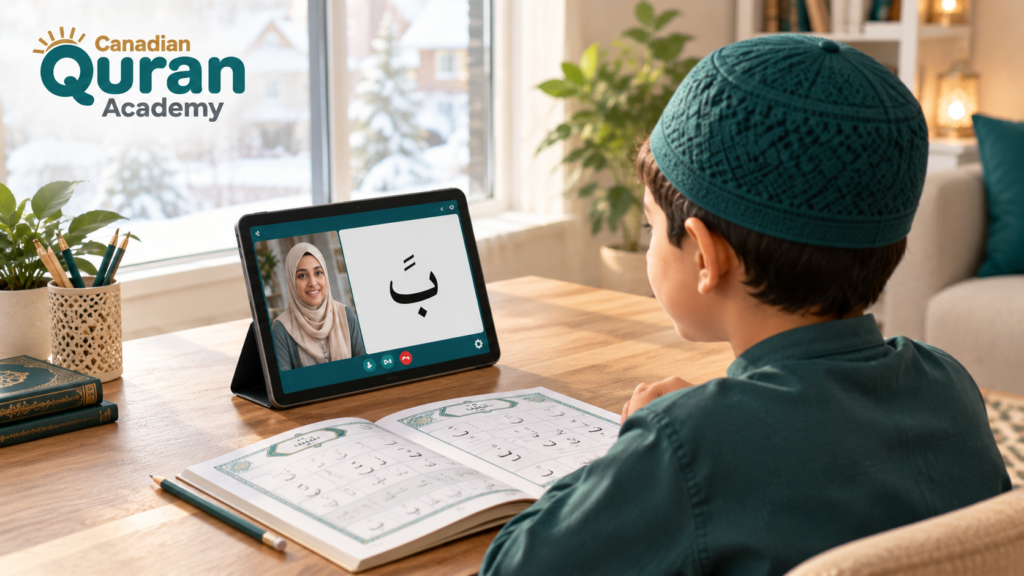
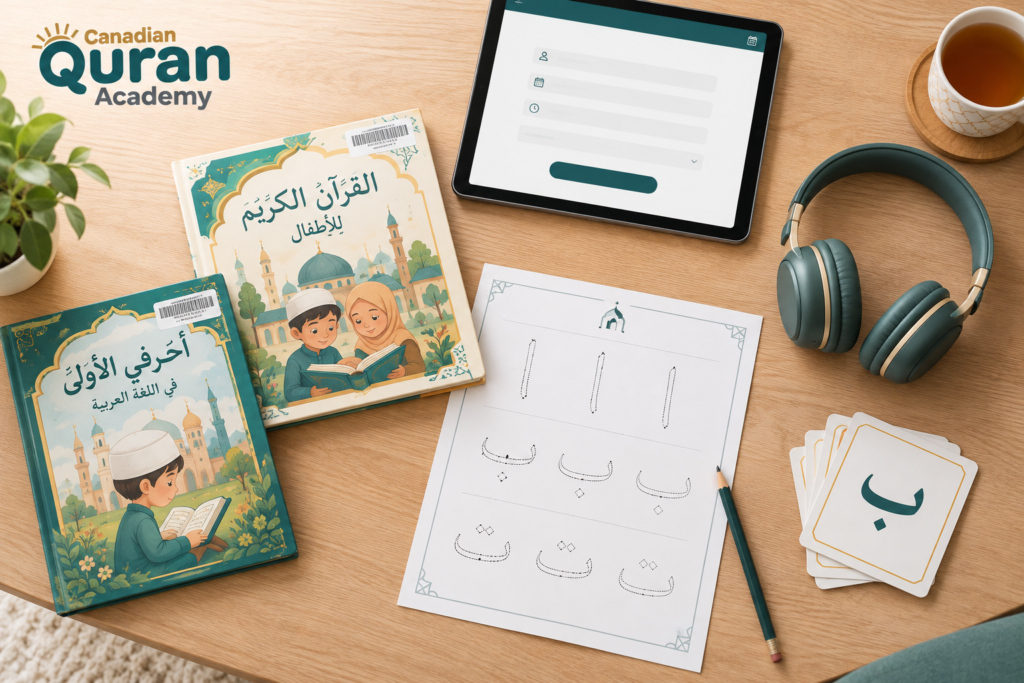
Young child in Canada learning to read Arabic letters on a tablet with an online teacher.
Takeaway — What You Will Learn
- Why reading Arabic is a separate skill from speaking it, and which one to teach first.
- The realistic timeline from letters to reading Qur’anic words
- How live one-on-one online Arabic classes for kids are structured
- Which free Arabic reading resources are worth your time, and where they stop helping
- A daily practice routine that fits a Canadian school schedule
Learn to Read Arabic for Kids in Canada: What Parents Should Know First
Before choosing a course or an app, understand what your child is really being asked to do. Arabic literacy rests on three separate abilities: recognising letter shapes, attaching short vowel sounds to them, and blending those sounds smoothly.
Most children who “know the alphabet” have mastered only the first. Closing the gap between naming letters and reading words is exactly what a structured curriculum is for.
Why Is Reading Arabic Different From Speaking It?
Arabic script runs right to left, most letters change shape depending on their position in a word, and short vowels appear as marks above and below the line rather than as letters. A child can hold a conversation in Arabic and still be unable to read a single line of it.
This is why phonics-based instruction starts with sound-symbol mapping, not vocabulary. Programs such as Noorani Qaida for kids exist for this reason: they isolate letter forms, then vowels, then joined words, in a fixed order that removes guesswork.
Read Also: How To Memorize The Quran Without Forgetting in Canada?
What Age Should a Child Start Reading Arabic?
Between ages four and six for letter recognition, and around six or seven for full word decoding. Children who already read English can start later and often move faster, because they transfer decoding habits they already own.
There is no upper limit. Teachers regularly take nine- and ten-year-olds from zero to fluent Qur’anic reading, using the same phonics sequence with the pacing adjusted.
How Long Does It Take a Child to Read Arabic?
With two live lessons a week plus ten minutes of daily practice, most children finish letter recognition in six to eight weeks and begin reading short Qur’anic words within four to six months.
The variable is consistency, not ability. Two short sessions weekly for a full year outperform daily marathons in month one followed by silence.
Which Comes First: Arabic Literacy or Qur’an Reading?
Start with the shared foundation, then branch. Letters and vowels are identical in both paths, so the first three months look the same whether the goal is conversation or recitation.
After that, families choose a direction. Some continue into Arabic for kids to build vocabulary and conversation, while others move into Tajweed for kids to refine the pronunciation rules of recitation. Many children eventually do both.
Learn to Read Arabic for Kids Online: How Live Classes Actually Work
Online instruction is now the default for Canadian families, and not only for convenience. Live video lets a teacher hear pronunciation in real time, which a recorded video or an app cannot do.
The format that produces results is one-to-one, or a group small enough that every child reads aloud in every session — three or four students at most. Fix the slot after school between 4:00 and 8:00 p.m. local time, or on weekend mornings, and keep it.
What Happens in a One-on-One Arabic Reading Lesson?
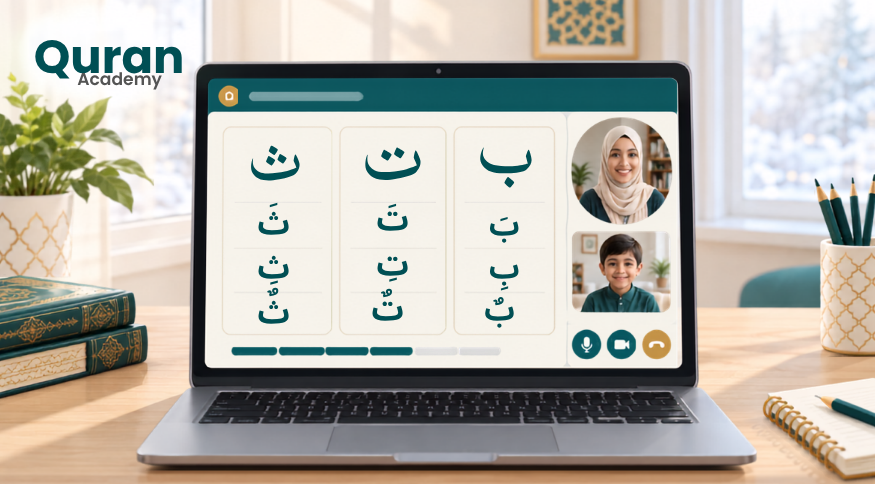
A typical thirty-minute session opens with a two-minute review of the previous lesson’s letters, moves into new material on a shared screen, then closes with guided reading aloud while the teacher corrects articulation.
Homework is deliberately small: one row of letters, or five words. The teacher opens the next lesson wherever the mistakes were, so nothing is left half-learned.
How Do You Judge an Arabic Teacher’s Qualifications?
Ask three questions: Is the teacher a native Arabic speaker? Do they hold a recognised certification such as an Ijazah or an Al-Azhar qualification? Do they have documented experience teaching children specifically?
The third question matters more than parents expect. A scholar with deep knowledge but no experience with seven-year-olds will lose the room in ten minutes, which is why we publish teacher profiles and credentials openly rather than on request.
Read Also: Learning Arabic Numbers For Kids In Canada
Learn to Read Arabic for Kids Online Free: What Genuinely Costs Nothing
There is a real free tier in Arabic education for children, and it is worth using before you spend anything. Used well, free resources handle exposure, motivation, and repetition — everything except correction.
Free Trial Lessons and Placement Assessments
Most reputable academies offer a no-cost trial lesson that doubles as a placement assessment. You learn where your child actually sits, and your child learns whether they like the teacher.
Treat the trial as a diagnostic rather than a sales call. Ask for a specific starting level and a rough timeline afterwards, and book our free trial class or any other on exactly those terms.
Free Arabic Resources Available Across Canada
Public library systems in Toronto, Mississauga, Calgary, and Vancouver hold Arabic children’s books and give free access to language-learning platforms with a library card. Many local masjids also run weekend Qur’an circles at no charge.
Add free letter-tracing worksheets and Qur’anic audio online, and a child gets daily Arabic contact with no subscription at all.
Where Free Options Stop Being Enough
Apps and videos cannot hear your child. They accept a mispronounced letter as correct, and a mispronunciation repeated for six months becomes a habit that takes far longer to unlearn than to prevent.
The practical answer is a blend: free materials for exposure, plus a few live lessons for accuracy.
Read Also: How To Learn The Quran In Canada?
Learn to Read Arabic for Kids Free at Home: A Routine That Holds
You do not need to be fluent in Arabic to support your child’s reading. You need a routine short enough that nobody dreads it and specific enough to target one skill at a time.
1. The Ten-Minute Rule
Ten focused minutes daily beats an hour on Saturday. Attach the session to something that already happens every day, such as after dinner or before bedtime reading.
Keep a visible streak calendar on the fridge and let your child mark it. The marking is often what keeps a six-year-old coming back, not the Arabic.
2. Write the Letters, Don’t Only Tap Them
Handwriting builds letter recognition faster than tapping a screen, because forming a shape encodes it differently from selecting it. Print a tracing sheet, use a whiteboard, or let your child write letters in a tray of flour.
Pair every written letter with its sound spoken aloud. Silent tracing teaches shapes without sounds, which is half the skill.
3. Keep Screen Time Purposeful and Shared
The Canadian Paediatric Society advises limiting screen use for children aged two to five to about an hour a day, and notes that educational content works best when an engaged adult watches alongside the child.
For Arabic, that means sitting beside your child for the first few weeks of lessons, then stepping back. Parents who learn the alphabet a week ahead of their child make the best practice partners, and many of our families book adult and child classes in the same evening block.
Live Class in Action
Watch how our instructors interact with students in real-time, focusing on interactive methods.
Start Your Quranic Journey in Canada
Join our vibrant community and learn with expert tutors through our flexible online platform.
Claim Your Free TrialBook a Free Trial Arabic Reading Class for Your Child Today
Give your child a native-speaking, certified teacher who hears every letter and corrects it on the spot. Canadian Quran Academy teaches online Arabic reading, Noorani Qaida, Tajweed, and Qur’an recitation for kids and adults, scheduled around Canadian school hours in every province.
Book a free trial lesson, and an assigned tutor contacts you to confirm a time that suits your family. Use it as a placement assessment, ask where your child should start, and decide afterwards.
Our Quran Courses
- Quran Online Academy
- Quran Recitation Classes
- Quran Reading Classes
- Online Quran Classes for Kids
- Quran Classes for Adults
- Quran Classes for Female
- Learn Quran Course for Beginners
- Quran Memorization (Hifz) Course
- Hifz Classes for Adults
- Quran Memorization and Hifz Course for Kids
- Quran Hifz Course for Ladies
- Quran Ijazah Program
- Quran Qirat Learning Course
- Quran Tafsir Course
- Noorani Qaida Course
- Noorani Qaida Course for Kids
- Weekend Quran Classes
- Intensive Quran Course
- Al-Azhar Quran Course
- Online Tajweed Classes
- Tajweed Course for Kids
- Tajweed Course for Adults
- Tajweed Course for Ladies

Conclusion
Helping your child learn to read Arabic for kids in Canada comes down to four decisions: start with phonics rather than vocabulary, begin between ages four and seven, use live lessons for correction, and protect a ten-minute daily habit at home.
Free resources have a genuine place in that plan. Library books, masjid circles, worksheets, and Qur’anic audio build exposure at no cost, and a free trial lesson shows where your child stands.
Takeaway Message: Arabic reading is a decoding skill, not a talent. Any child in Canada can acquire it with the right phonics sequence, a teacher who listens, and consistency measured in minutes per day.
FAQs
Can my child learn to read Arabic online for free?
Partly. Free trial lessons, library resources, masjid weekend circles, and printable worksheets cover exposure and practice at no cost. What they cannot replace is a live teacher correcting pronunciation, so most families combine free materials with a few paid lessons.
How many Arabic lessons per week does a child need?
Two thirty-minute lessons per week is the standard recommendation for ages five to twelve. Three works well for faster progress, while one weekly lesson still produces results if daily home practice stays consistent.
Should my child learn Arabic reading or Qur’an memorisation first?
Reading first. Memorising before decoding means learning by imitation, which makes later pronunciation correction much harder. Once a child reads confidently with vowels, memorisation moves considerably faster.
Is online Arabic teaching as effective as in-person classes for kids?
For reading specifically, yes. Online one-to-one and very small group sessions give a child real-time correction that a crowded weekend classroom cannot, and they remove travel time in cities such as Toronto and Calgary.
What is Noorani Qaida?
Noorani Qaida is a structured primer teaching Arabic letters, their positional forms, vowels, and blending in a fixed sequence. It is used worldwide because it isolates one skill at a time and leads directly into reading the Qur’an.





Leave a Reply