 Arabic
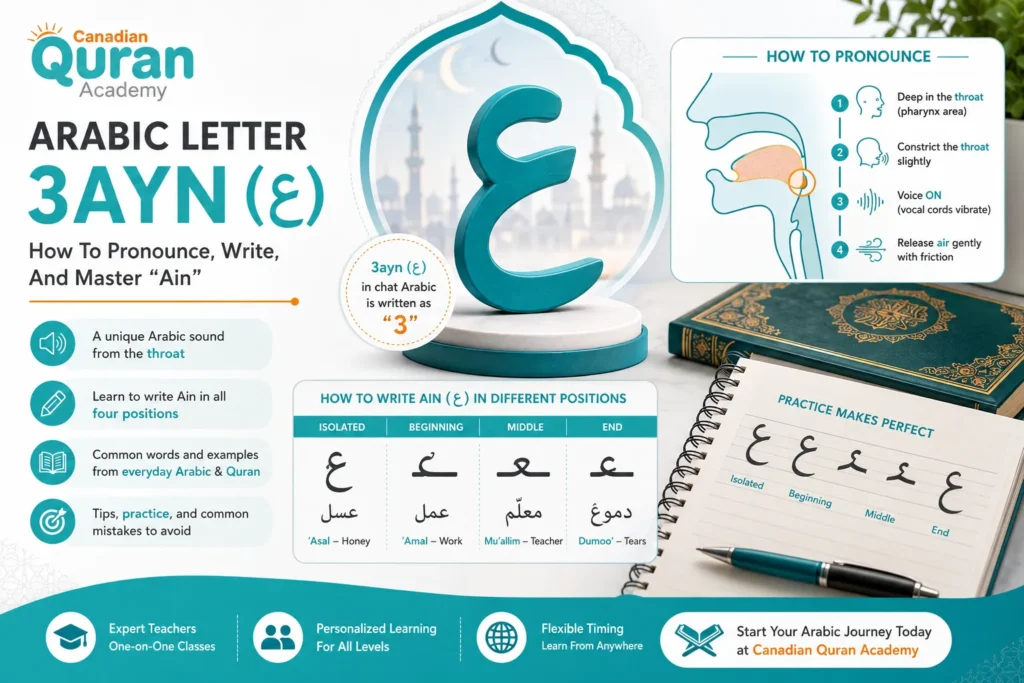
Arabic has a handful of sounds that simply don’t exist in English, and the Arabic letter Ain (ع) is the most famous of them. If you’ve ever seen Arabic written in Latin letters online and wondered why a “3” shows up in the middle of a word, you’ve already met this letter — 3ayn is just the chat-alphabet way of writing ع, because the numeral’s curve mirrors the letter’s shape.
This guide breaks the Arabic letter 3ayn (ع) down into exactly what a beginner needs: how it sounds, how to write it in every position, how it differs from its lookalike غ (Ghayn), and where it shows up in everyday Arabic and Quranic vocabulary.
At Canadian Quran Academy, ع is one of the first “different” letters we drill with new students, because getting it right early makes every word built on it easier to read and recite correctly later.
What you’ll learn in this article
- What the letter 3ayn (ع) is and why it’s written as “3” in chat Arabic
- How to physically produce the ع sound, step by step
- How ع changes shape in the isolated, initial, medial, and final positions
- The difference between ع (Ain) and غ (Ghayn)
- Common Arabic words that use ع, organized by where the letter falls in the word
- Practice tips and common mistakes to avoid as you learn
What Is The Arabic Letter 3ayn (ع)?
The ع – Arabic letter 3ayn is the 18th letter of the Arabic alphabet. It represents a voiced pharyngeal fricative — a sound produced by constricting the pharynx, the middle part of the throat — and it has no equivalent in English or most European languages.
Unlike most Arabic letters, ع carries no dot above or below it, which is one of the easiest ways to tell it apart from its dotted cousin غ (Ghayn).
It’s a consonant, it’s voiced (your vocal cords vibrate when you say it), and it can take any short vowel — Fatha, Dammah, or Kasrah — as well as Tanween or Shaddah, just like other Arabic consonants.
When Arabic speakers text or type without an Arabic keyboard, they use Latin letters and numerals to represent sounds English doesn’t have.
Because the numeral 3 visually resembles the curve of ع, it became the standard stand-in for this letter in what’s called Arabizi (Arabic chat alphabet). So “عربي” (Arabic) often appears online as “3arabi,” and the letter itself is nicknamed “3ayn.”
This is purely a typing convention — it has no effect on pronunciation or spelling in real Arabic script.
Where Ain Sits In The Arabic Alphabet?
Ain falls between غين (Ghayn) and فاء (Fa) in the standard Arabic alphabet order, and it belongs to a small group of letters linguists call the “throat letters” (huroof al-halq), alongside ء, هـ, ح, خ, and غ.
Because these letters share a place of articulation, mastering the Arabic letter Ain (ع) also builds the throat control you’ll need for the rest of that group — one of the reasons instructors introduce it early rather than saving it for later.
Read Also: Letter N In Arabic ن
How To Write The Letter Ain (ع) In Different Positions?
Like every Arabic letter, the Arabic letter Ain (ع) changes shape depending on where it falls in a word, but it keeps its identifying feature — a curved hook with no dot — in every form.
| Position | Form | Example | Meaning |
| Isolated | ع | عسل | ‘Asal – Honey |
| Beginning | عـ | عمل | ‘Amal – Work |
| Middle | ـعـ | معلّم | Mu’allim – Teacher |
| End | ـع | دموع | Dumoo’ – Tears |
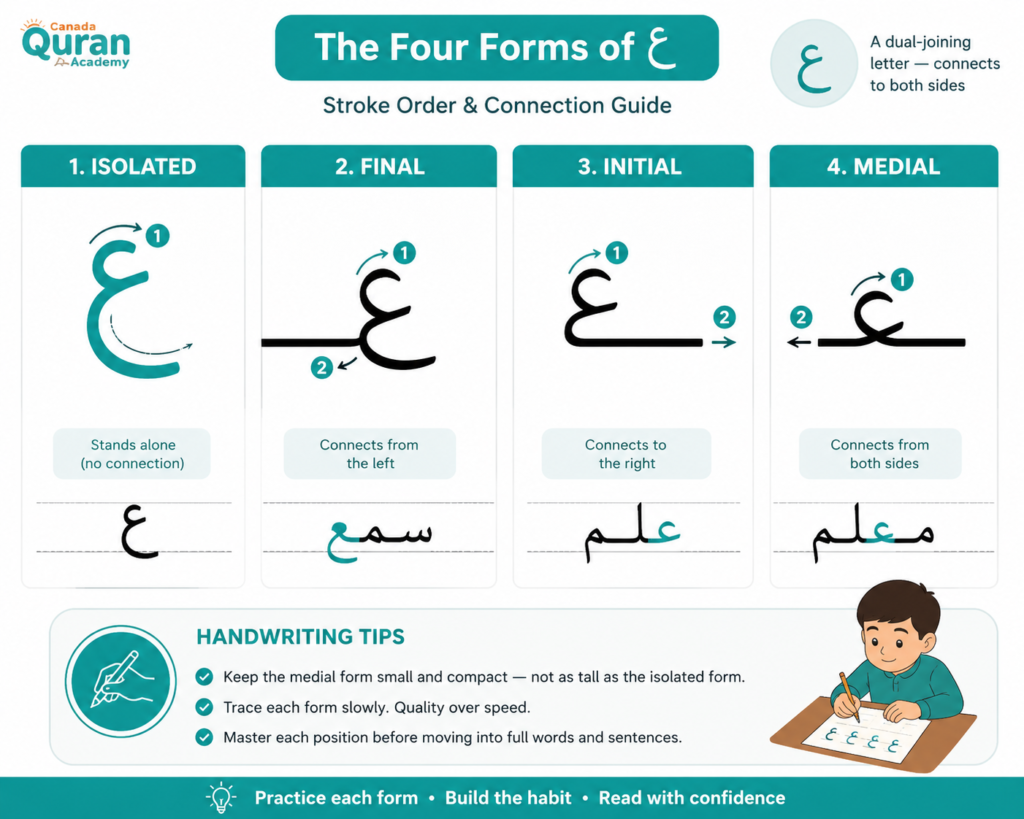
The isolated form looks like a small rounded hook with a tail curving beneath the line. In the initial position, the head of that hook stays the same but the tail shortens and opens to the left, ready to connect to the next letter.
In the medial position, the letter is compressed into a small filled knot with a connecting stroke on both sides. In the final position, it opens back up into a loop with a tail dropping below the line, connecting only on the right to the letter before it.
Handwriting Tips For ع
Because ع is a dual-joining letter — it connects to both the letter before and after it — handwriting practice matters more here than for isolated-only letters.
A common beginner mistake is writing the medial form too large, so it looks like the isolated form instead of a compact connecting knot; slow, traced repetition fixes this faster than fast, uncontrolled writing.
If you’re teaching a child, tracing worksheets that isolate each of the four positions before mixing them into full words work better than jumping straight to full sentences.
If you’re building this skill from home rather than in a structured class, our Learning Arabic for Non-Arabic Speakers course at Canadian Quran Academy walks through exactly this kind of position-by-position letter drilling with a live instructor correcting your writing in real time.
Read Also: The Importance of Arabic Language in the Quran
How To Pronounce The Letter Ain (ع)?
Getting the sound of the Arabic letter 3ayn (ع) right takes throat awareness more than lip or tongue movement, which is exactly why it feels unfamiliar to English speakers at first.
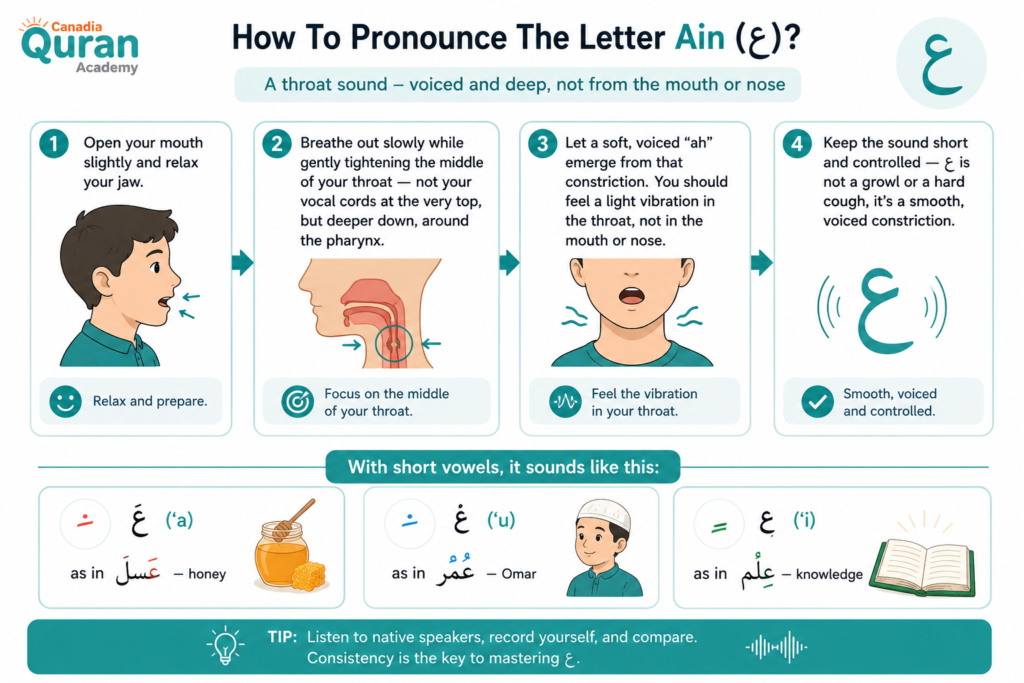
Here’s a simple sequence to build the sound:
- Open your mouth slightly and relax your jaw.
- Breathe out slowly while gently tightening the middle of your throat — not your vocal cords at the very top, but deeper down, around the pharynx.
- Let a soft, voiced “ah” emerge from that constriction. You should feel a light vibration in the throat, not in the mouth or nose.
- Keep the sound short and controlled — ع is not a growl or a hard cough, it’s a smooth, voiced constriction.
With short vowels, it sounds like this: عَ (‘a, as in عَسَل – honey), عُ (‘u, as in عُمَر – Omar), and عِ (‘i, as in عِلْم – knowledge).
Common pronunciation mistakes
Most beginners fall into one of three habits, and knowing them in advance makes correction faster.
The first is replacing ع with a plain glottal stop, the sound of أ (Alef) or ء (Hamza) — this drops the pharyngeal constriction entirely and turns ع into a different letter’s sound.
The second is over-tensing into a cough or gag reflex, which happens when learners try too hard to “feel” the throat and tighten too high up.
The third is under-voicing it, producing a whisper-quiet version that native listeners won’t register as ع at all. A useful practitioner check: say a word with أ and the same word pattern with ع back-to-back — عَلَم vs.
أَلَم — if they sound identical, the constriction isn’t happening yet.
Read Also: Letter M In Arabic (م)
Live Class in Action
Watch how our instructors interact with students in real-time, focusing on interactive methods.
Start Your Quranic Journey in Canada
Join our vibrant community and learn with expert tutors through our flexible online platform.
Claim Your Free TrialAin (ع) Vs. Ghayn (غ): How To Tell Them Apart
Beginners frequently confuse ع and غ because the base shape is nearly identical — the only visual difference is the dot.
| Letter | Name | Sound | Description |
| ع | Ain | A deep, voiced “ah” from the throat | No dot |
| غ | Ghayn | A rough “gh,” similar to the French or German “r” | Has a dot above |
The clearest way to separate them by ear: ع is a smooth, airy constriction, while غ is a rougher, more turbulent friction sound — closer to gargling.
If you’re a French speaker, the way you pronounce the “r” in “rien” is a reasonable starting reference point for غ, but it isn’t a substitute for the Arabic letter 3ayn (ع), which sits further back and lower in the throat with no friction noise.
Common Arabic Words With The Letter Ain
Seeing ع inside real vocabulary — not just isolated on a chart — is what makes the shape and sound click. Below are words grouped by where ع falls, since recognizing position patterns speeds up reading fluency.
Words with Ain (ع) in the initial position:
- عَسَل (‘asal) – honey
- عِلْم (‘ilm) – knowledge
- عَيْن (‘ayn) – eye
- عِنَب (‘inab) – grapes
- عُنْوَان (‘unwan) – address
Words with Ain (ع) in the medial position:
- مُعَلِّم (mu’allim) – teacher
- سَعِيد (sa’eed) – happy
- مَلْعَب (mal’ab) – playground
- شَمْعَة (sham’a) – candle
- سَمِعَ (sami’a) – he heard
Words with Ain (ع) in the final position:
- دُمُوع (dumoo’) – tears
- سَرِيع (saree’) – fast
- نَبْع (nab’) – spring (water source)
- ضَبْع (dab’) – hyena
- جُوع (joo’) – hunger
Worth noticing: عَيْن (‘ayn), the word for “eye,” is also the name of the letter itself — so every time you read or write ع, you’re literally spelling the word “eye.” It’s one of the more memorable coincidences in Arabic and a useful mnemonic for younger learners.
Learners working through structured levels tend to meet these words in a set order — our Arabic Elementary School program introduces initial-position words like عَسَل and عِلْم first, then layers in medial and final forms once the shape is automatic, which mirrors how the Arabic Intermediate School track builds full sentences around them.
Read Also: The Arabic Letter Lam (ل)
Practice Tips And Common Mistakes To Avoid
Mastering the Arabic letter Ain (ع) is a matter of repetition across writing, listening, and speaking together — not any single one of those in isolation.
A decision rule that works well in practice: drill the isolated form until it’s automatic, then initial, then final, then medial last — medial is the hardest to write cleanly because it has to connect on both sides while staying compact, so save it for once your hand already knows the letter’s basic shape.
On the pronunciation side, record yourself saying minimal pairs like عَلَم vs.
أَلَم and play them back; most learners can hear the difference in someone else’s speech well before they can feel it in their own throat.
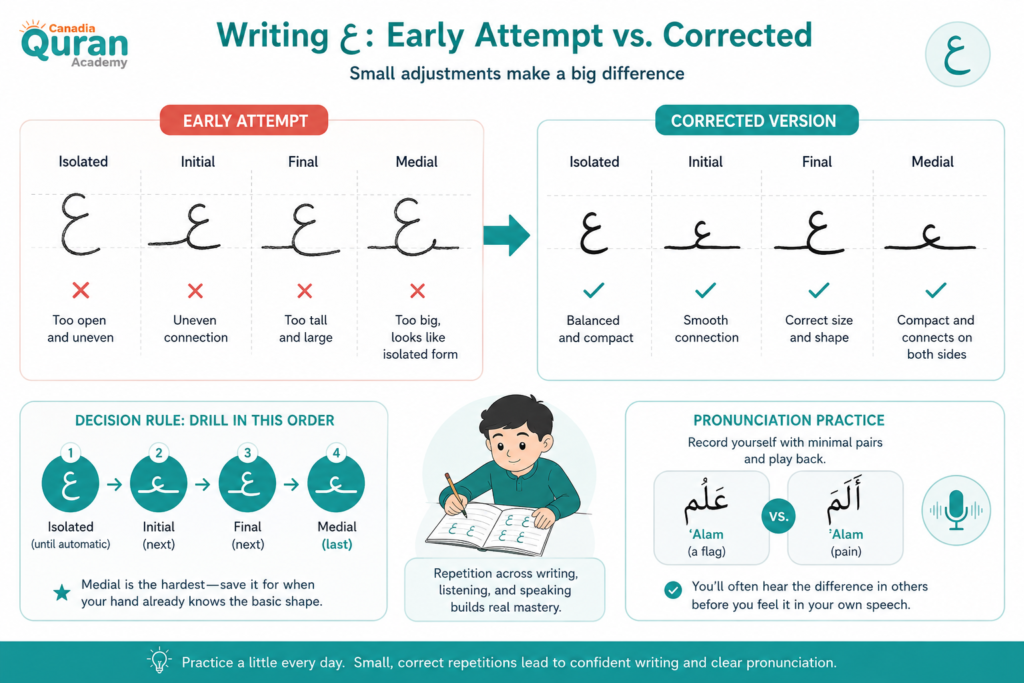
Common mistakes worth watching for: rushing past the isolated form before it’s solid, confusing ع with غ in reading because both look similar at a glance, and avoiding words with ع altogether out of self-consciousness about the sound — which only delays the exposure that fixes it.
Consistent short sessions (10–15 minutes of focused writing and repetition) beat occasional long ones, since throat-based sounds respond to muscle memory built gradually.
For younger children just starting the alphabet, our Arabic Lessons for Kindergarten program paces letters like ع more slowly, using tracing and sound-play before introducing full words, which keeps the throat sound from feeling intimidating this early.
Experience Our Classrooms
Don’t just take our word for it—take a look inside! Watch the videos below to experience our engaging teaching methods and vibrant online classrooms firsthand.
Start Your Quranic Journey in Canada
Join our vibrant community and learn with expert tutors through our flexible online platform.
Claim Your Free TrialStart Learning Arabic With Canadian Quran Academy Today
Reading a guide gets you the theory — a live instructor is what gets your pronunciation of the Arabic letter 3ayn (ع) actually corrected.
Canadian Quran Academy pairs every student with a certified Arabic and Quran teacher who listens to your ع, your غ, and every other letter in real time, and adjusts your practice based on exactly where you’re struggling.

Whether you’re starting from zero as an adult, guiding your child through the alphabet, or moving into full sentence reading, there’s a structured path waiting for you.
Our Arabic Courses
- Online Arabic Academy
- Online Arabic Course
- Classical Arabic Course
- Arabic Course for Beginners
- Advanced Arabic Course
- Quranic Arabic Course
- Arabic Grammar Course
- Modern Standard Arabic Course
- Arabic Conversation / Speaking Course
- Intensive Arabic Course
- Online Arabic Classes for Kids
- Arabic Classes for Adults
- Arabic Classes for Ladies
- Fusha Arabic Course

Start Your Quranic Journey in Canada
Join our vibrant community and learn with expert tutors through our flexible online platform.
Claim Your Free TrialConclusion
The Arabic letter 3ayn (ع) — the sound behind “3ayn” and “3” in chat Arabic — is one of the letters that makes Arabic distinct from every language you may have studied before. It has no dot, it comes from deep in the throat, and it changes shape across four positions the same way most Arabic letters do.
The key takeaway is that ع rewards slow, position-by-position practice far more than it rewards trying to “get it” all at once. Learn the isolated form, then initial, then final, then medial, and pair every writing session with listening and repetition.
Once ع stops feeling foreign, it opens the door to hundreds of common words — from عِلْم (knowledge) to عَيْن (eye) — that you’ll now recognize instantly instead of guessing at.

Frequently Asked Questions About The Letter 3ayn (ع)
The questions below cover what learners most often ask after their first exposure to ع — from what the letter actually is to how it’s typically confused with similar sounds and shapes.
Why is the number 3 used for the letter ع?
The number 3 is used because its curved shape closely mirrors the shape of ع, making it a natural stand-in when typing Arabic sounds using only a Latin keyboard without special characters.
What does “3ayn” mean in Arabic?
“3ayn” is the Arabizi (chat-alphabet) spelling of ع, the 18th letter of the Arabic alphabet. The numeral 3 is used because its shape resembles the curve of ع, and it’s a typing shortcut, not a formal spelling.
How do you pronounce ع in English words?
There’s no true English equivalent to ع. It’s produced by tightening the middle of the throat while voicing a deep “ah,” which is different from any English vowel or consonant, so it’s best learned by ear rather than compared to an English letter.
Where can I practice writing the letter ع?
Tracing worksheets that isolate each of the four positions (isolated, initial, medial, final) are the most effective starting point, followed by copying full words like عَسَل and مُعَلِّم once each shape feels automatic on its own.
What is the difference between ع and غ?
The letter ع (Ain) has no dot and produces a smooth, airy sound from the throat, while غ (Ghayn) has a dot above it and produces a rougher, friction-based sound similar to a French or German “r.”
Why is ع one of the hardest letters for English speakers?
Ain (ع) is difficult because English has no pharyngeal sounds at all — English consonants are produced with the lips, tongue, or vocal cords, not the middle of the throat, so learners have to build an entirely new muscle habit rather than adapt an existing one.






Leave a Reply