 Quran
Quran
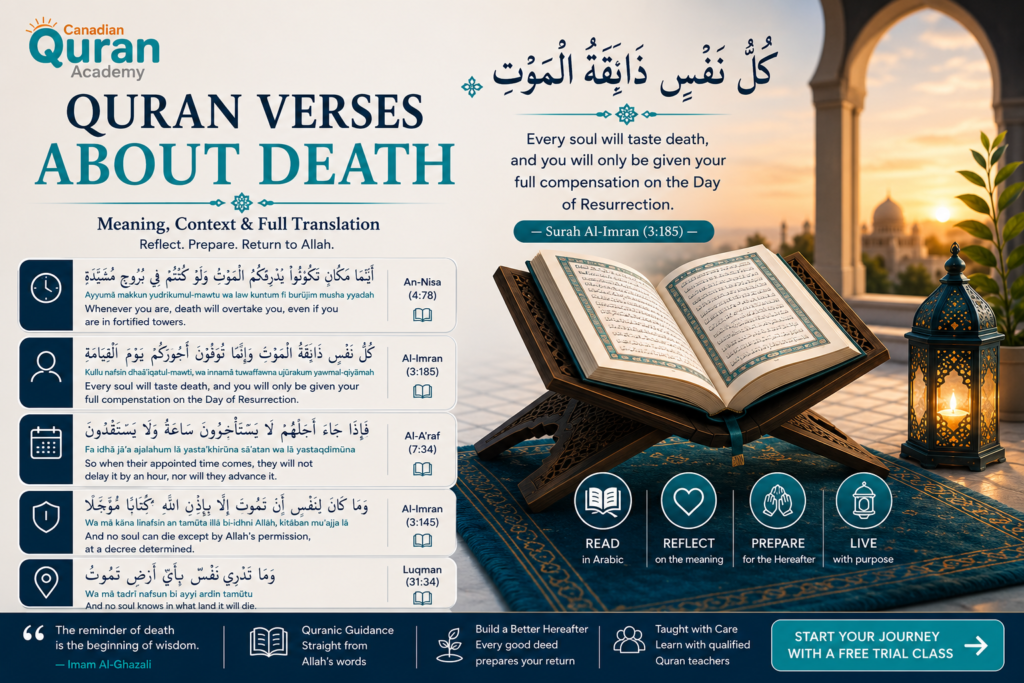
Death appears in the Quran more than 70 times through the root word “mawt” and its derivatives. Quran verses about death in Arabic are not scattered as a single warning — they return across more than twenty surahs, each time addressing a different angle: how certain death is, when and where it happens, what occurs as the soul leaves the body, and why death exists in the first place.
This guide brings together the verses most often searched for on this topic. Each one is given in Arabic with tashkeel, transliteration, English translation, the exact surah and ayah number, and a link to read it in full context on Quran.com. Where a hadith is relevant to the same theme, it’s included with its Arabic wording, its narrator, and a link to Sunnah.com.
The Certainty of Death for Every Soul
The Quran states plainly that physical safety has no bearing on when death arrives. One verse in particular makes this point using the strongest image of protection available at the time it was revealed.
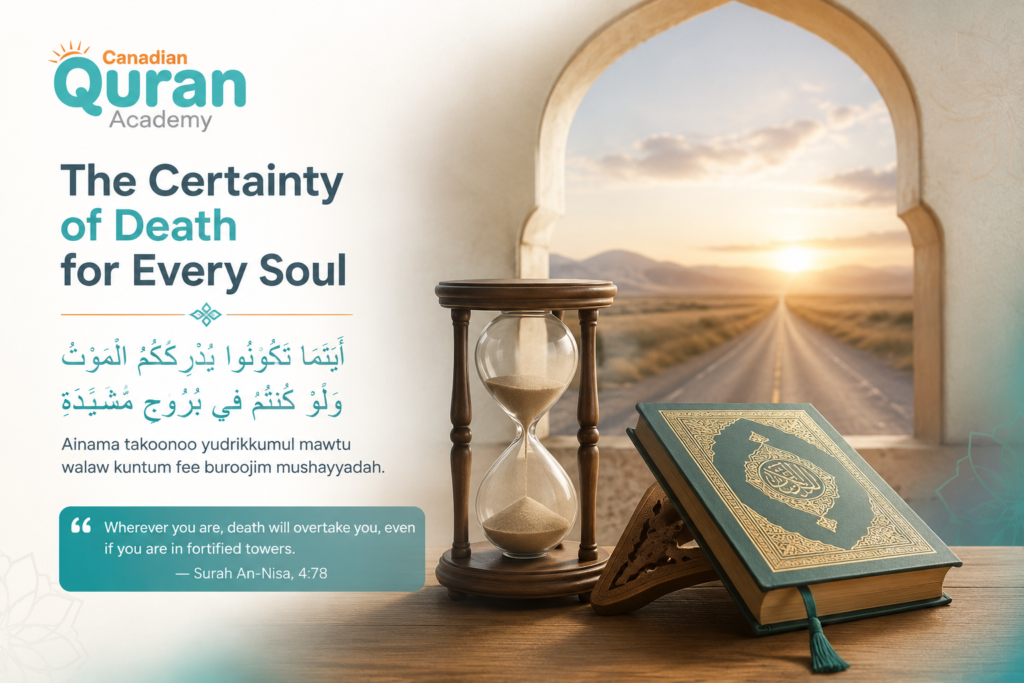
أَيْنَمَا تَكُونُوا يُدْرِككُّمُ الْمَوْتُ وَلَوْ كُنتُمْ فِي بُرُوجٍ مُّشَيَّدَةٍ
Ainama takoonoo yudrikkumul mawtu walaw kuntum fee buroojim mushayyadah.
“Wherever you are, death will overtake you, even if you are in fortified towers.” — Surah An-Nisa, 4:78
This verse was revealed to people who assumed physical safety meant immunity from death. “Fortified towers” was the maximum protection anyone in that era could imagine, which is exactly why the Quran chose that image to close the argument.
Read also: Quran Verses About Charity in Arabic With Translation and Meaning
Every Soul Will Taste Death — the Verse Behind the Phrase
Death is one certainty that no human being can escape. The Quran reminds us of this reality in one of its most well-known verses, shifting our focus from the temporary nature of this world to the eternal life that follows. Rather than inspiring despair, the verse calls believers to prepare for the Day when every deed will be rewarded with complete justice.
كُلُّ نَفْسٍ ذَائِقَةُ الْمَوْتِ ۗ وَإِنَّمَا تُوَفَّوْنَ أُجُورَكُمْ يَوْمَ الْقِيَامَةِ
Kullu nafsin dha’iqatul mawt, wa innama tuwaffawna ujurakum yawmal qiyamah.
“Every soul will taste death, and you will only be given your full compensation on the Day of Resurrection.” — Surah Al-Imran, 3:185
The word kullu (“every”) leaves no soul outside its scope. The phrase repeats almost word for word in Surah Al-Anbiya, 21:35 and again in Surah Al-Jumu’ah, 62:8, which adds that fleeing from death only delays the moment your deeds are revealed. Classical commentators read this repetition as deliberate — the Quran wanted this specific truth impossible to skim past.
If you’re working through verses like this in Arabic for the first time, our online Quran reading course for beginners starts from the letters themselves and builds toward reading full ayat with correct pronunciation.

The Timing and Place of Death Are Fixed
Three verses address timing and location directly, and each closes off a different assumption people commonly make about controlling when or where death happens.
1. The Appointed Time Cannot Be Moved
No matter how carefully people plan their lives, the Quran makes it clear that the moment of death is fixed.
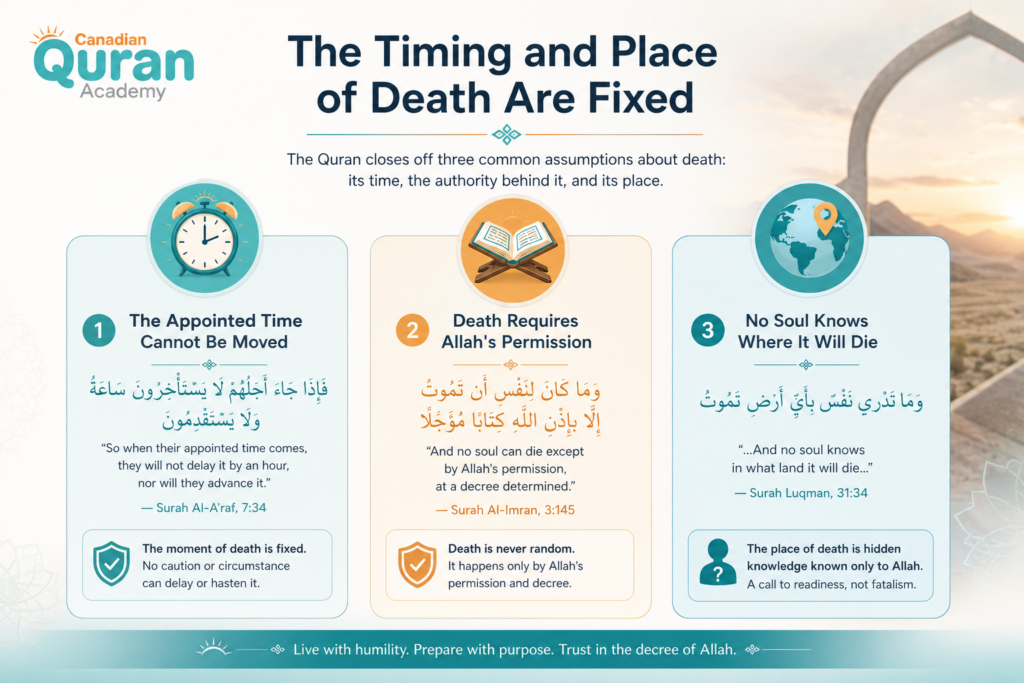
Neither caution nor circumstance can delay or hasten the time Allah has already decreed.
فَإِذَا جَاءَ أَجَلُهُمْ لَا يَسْتَأْخِرُونَ سَاعَةً ۖ وَلَا يَسْتَقْدِمُونَ
“So when their appointed time comes, they will not delay it by an hour, nor will they advance it.” — Surah Al-A’raf, 7:34
The Arabic term ajal refers to a fixed term set in advance, not an estimate. No precaution moves it earlier or later.
2. Death Requires Allah’s Permission
The Quran teaches that death is never a random event. Every soul departs this world only by Allah’s permission, according to a decree that has been perfectly determined.
وَمَا كَانَ لِنَفْسٍ أَنْ تَمُوتَ إِلَّا بِإِذْنِ اللَّهِ كِتَابًا مُؤَجَّلًا
“And no soul can die except by Allah’s permission, at a decree determined.” — Surah Al-Imran, 3:145
Read alongside Surah Al-A’raf, 7:34, this verse adds the second half of the picture: the timing is fixed, and it is fixed by a specific act of divine permission, not a mechanical biological process.
3. No Soul Knows Where It Will Die
While people may choose where they live, travel, or settle, the Quran reminds us that the place of death remains hidden knowledge known only to Allah. This certainty encourages humility and constant readiness rather than dependence on worldly plans.
وَمَا تَدْرِي نَفْسٌ بِأَيِّ أَرْضٍ تَمُوتُ
“…And no soul knows in what land it will die…” — Surah Luqman, 31:34
This verse pairs the unknown place of death with the unknown of tomorrow’s provision. Both are described as knowledge reserved for Allah alone, which is part of why classical scholars read this as a call to live attentively rather than anxiously.
A common misreading here: some readers take this verse as fatalistic — implying planning is pointless. Classical tafsir treats it the opposite way: because the place and timing are hidden, the verse is read as a call to readiness at every moment, not a reason to avoid preparation altogether.
Experience Our Classrooms
Don’t just take our word for it—take a look inside! Watch the videos below to experience our engaging teaching methods and vibrant online classrooms firsthand.
Start Your Quranic Journey in Canada
Join our vibrant community and learn with expert tutors through our flexible online platform.
Claim Your Free TrialRead also: Quran Verses About Angels in Arabic With Translation and Meaning
The Quran Describes the Moment the Soul Leaves the Body
Two verses go beyond the fact of death to describe the mechanism — naming the angels involved and addressing those physically present in the room.
وَهُوَ الْقَاهِرُ فَوْقَ عِبَادِهِ ۖ وَيُرْسِلُ عَلَيْكُمْ حَفَظَةً حَتَّىٰ إِذَا جَاءَ أَحَدَكُمُ الْمَوْتُ تَوَفَّتْهُ رُسُلُنَا وَهُمْ لَا يُفَرِّطُونَ
“And He is the subjugator over His servants, and He sends over you guardian-angels until, when death comes to one of you, Our messengers take him in death, and they do not fail in their duty.” — Surah Al-An’am, 6:61
Surah As-Sajdah then names the responsible angel directly:
قُلْ يَتَوَفَّاكُم مَّلَكُ الْمَوْتِ الَّذِي وُكِّلَ بِكُمْ
“Say: The angel of death, who has been entrusted with you, will take your souls.” — Surah As-Sajdah, 32:11
This is the only verse in the Quran that names Malak al-Mawt (the Angel of Death) by title. Surah Al-Waqi’ah, 56:83–85 shifts to direct address of the people around a dying person: “We are nearer to him than you, but you do not see.” Read together, these verses move from the general mechanism (6:61) to the specific title (32:11) to the felt experience in the room (56:83–85).
Families often start introducing these concepts to children through simplified stories before moving into the Arabic text directly — our Quran course for kids is built around that gradual progression.
Verses like these are also where a structured, intensive Quran study track pays off — moving through several linked ayat in one sitting, rather than one verse at a time, makes it easier to see how they build on each other.

What Happens Immediately After Death: The Barzakh
The Quran names a period between death and resurrection during which the soul is neither in this world nor yet facing final judgment. This period is called the barzakh — a barrier or partition.
وَمِن وَرَائِهِم بَرْزَخٌ إِلَىٰ يَوْمِ يُبْعَثُونَ
Wa min waraa’ihim barzakhun ilaa yawmi yub’athoon.
“And behind them is a barrier until the Day they are resurrected.” — Surah Al-Mu’minun, 23:100
This is the only verse in the Quran that uses the word barzakh in the context of death, which is why it is treated as the foundational textual reference for the concept, even though the details of this period are drawn mostly from hadith rather than the Quran itself.
The Quran’s Position on Worldly Return
The same verse continues by closing off any possibility of returning to worldly life once death has occurred, which is a direct answer to a question the Quran anticipates from the reader.
حَتَّىٰ إِذَا جَاءَ أَحَدَهُمُ الْمَوْتُ قَالَ رَبِّ ارْجِعُونِ لَعَلِّي أَعْمَلُ صَالِحًا فِيمَا تَرَكْتُ ۚ كَلَّا
“Until, when death comes to one of them, he says, ‘My Lord, send me back, that I might do righteousness in that which I left behind.’ No!” — Surah Al-Mu’minun, 23:99–100
The single word kalla (“no”) that opens the response is treated by commentators as one of the sharpest rejections in the Quran’s wording — a flat refusal rather than an explanation, which is why this verse is frequently cited as the Quran’s clearest statement against any request to return once the barzakh has begun.
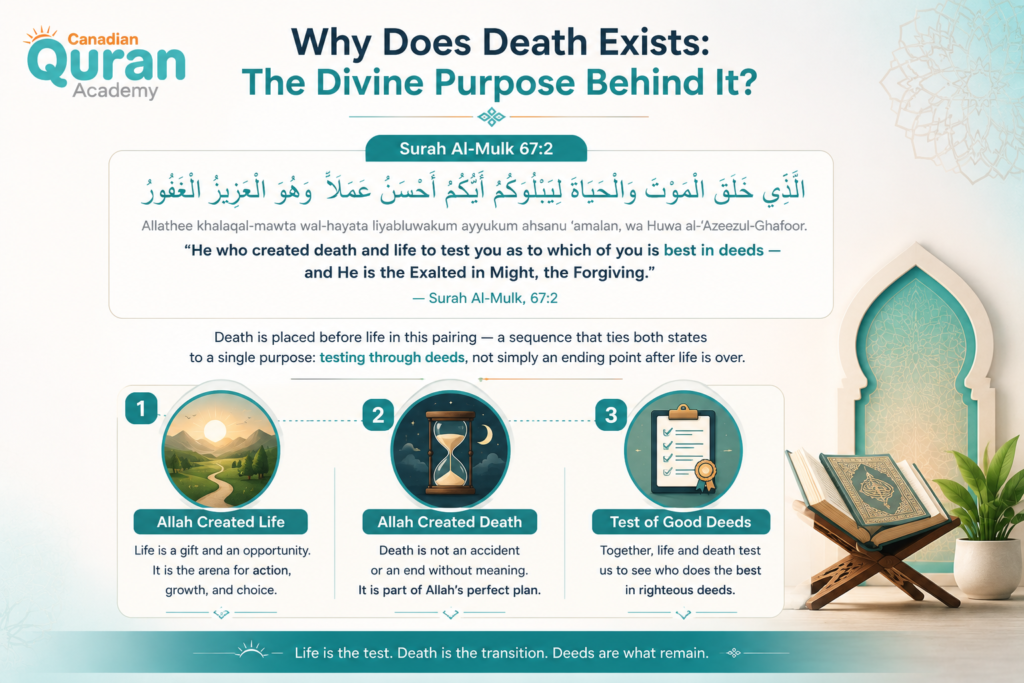
Why Does Death Exists: The Divine Purpose Behind It?
The Quran does not present death as a meaningless end or a tragic interruption. Instead, it reveals that both life and death were intentionally created by Allah, each serving a clear purpose in the greater test of human existence. The following verse explains why death exists and how it fits into Allah’s plan for every soul.
الَّذِي خَلَقَ الْمَوْتَ وَالْحَيَاةَ لِيَبْلُوَكُمْ أَيُّكُمْ أَحْسَنُ عَمَلًا ۚ وَهُوَ الْعَزِيزُ الْغَفُورُ
“He who created death and life to test you as to which of you is best in deeds — and He is the Exalted in Might, the Forgiving.” — Surah Al-Mulk, 67:2
Death is placed before life in this pairing — a sequence that ties both states to a single purpose: testing through deeds, not simply an ending point after life is over.
A Hadith on Remembering Death
Alongside the Quranic verses, one hadith is frequently cited as practical guidance built directly on this theme:
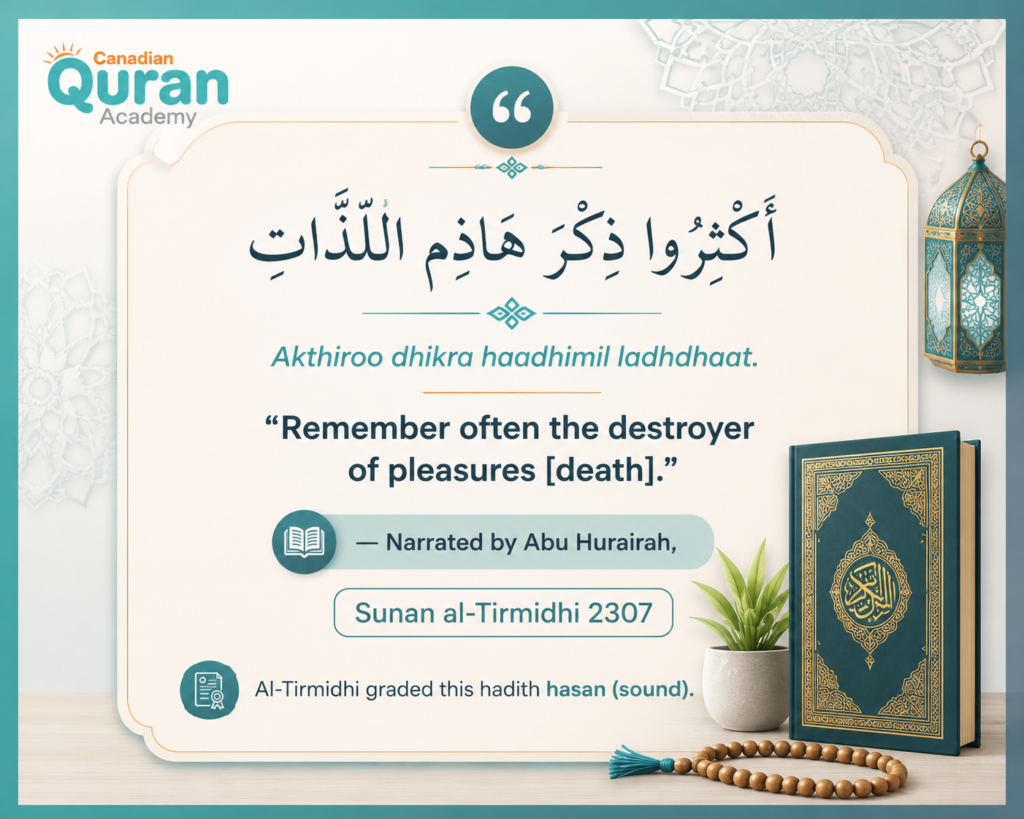
أَكْثِرُوا ذِكْرَ هَاذِمِ اللَّذَّاتِ
Akthiroo dhikra haadhimil ladhdhaat.
“Remember often the destroyer of pleasures [death].”
Al-Tirmidhi graded this hadith hasan (sound). Scholars connect it directly to Surah Al-Mulk, 67:2: if death and life are both a test, remembering death regularly is presented as a practical corrective against complacency, not as a source of fear on its own.
Repeated ayat like Surah Al-Imran, 3:185 and Surah Al-Anbiya, 21:35 are also easier to retain when they’re studied for memorization rather than read once. Our Hifz program is structured around exactly this kind of repeated, thematically linked verse — students often memorize these together because the wording overlaps.
Live Class in Action
Watch how our instructors interact with students in real-time, focusing on interactive methods.
Start Your Quranic Journey in Canada
Join our vibrant community and learn with expert tutors through our flexible online platform.
Claim Your Free TrialStudy These Verses in Depth With Canadian Quran Academy
Reading these verses is the first step — understanding their meaning, context, and proper recitation is what brings them to life.
The Canadian Quran Academy offers:
- Qualified Quran teachers with strong backgrounds in Tajweed and classical Tafsir
- 1-on-1 personalized Quran lessons tailored to your reading level and learning goals
- Step-by-step guidance in correct Quran recitation with practical Tajweed application
- In-depth explanation of Quranic verses through authentic tafsir and thematic study
- Flexible online classes for adults, children, women, and new Muslims across Canada and beyond
Book a free trial class and start reading these verses in their original Arabic.

Our Quran Courses
- Quran Online Academy
- Quran Recitation Classes
- Quran Reading Classes
- Online Quran Classes for Kids
- Quran Classes for Adults
- Quran Classes for Female/Sisters
- Learn Quran for Beginners
- Quran Memorization (Hifz) Course
- Hifz Classes for Adults
- Quran Memorization and Hifz for Kids
- Quran Hifz for Ladies
- Quran Ijazah Program
- Quran Qirat Learning Course
- Quran Tafsir Course
- Noorani Qaida Course
- Noorani Qaida Course for Kids
- Weekend Quran Classes
- Intensive Quran Course
- Al-Azhar Quran Course
- Online Tajweed Classes
- Tajweed Course for Kids
- Tajweed Course for Adults
- Tajweed Course for Ladies/Sisters
Start Your Quranic Journey in Canada
Join our vibrant community and learn with expert tutors through our flexible online platform.
Claim Your Free TrialConclusion
Quran verses about death in Arabic return to four ideas again and again: death is certain for every soul, its timing and location are fixed in advance, the moment itself is described in specific detail rather than left vague, and its stated purpose is to test deeds during life.
The verse behind “every soul will taste death” — Surah Al-Imran, 3:185 — remains the most cited line because it compresses all four ideas into a single sentence, and its near-repetition in Surah Al-Anbiya, 21:35 reinforces that this is a truth the Quran wanted impossible to miss. Reading these verses in Arabic, alongside accurate transliteration and translation, is the starting point. Understanding them in sequence — as the Quran presents them, across separate surahs building on each other — is what turns reading into reflection.
Frequently Asked Questions
What is the most famous Quran verse about death in Arabic?
The most cited verse is Surah Al-Imran, 3:185: كُلُّ نَفْسٍ ذَائِقَةُ الْمَوْتِ (“Every soul will taste death”). It appears almost identically in Surah Al-Anbiya, 21:35, which is why both verses are frequently searched together.
How many times does the Quran mention death?
The root word for death and its derivatives appear more than 70 times across the Quran, covering the certainty of death, its fixed timing, the moment the soul departs, and the purpose behind why death and life were created.
Which verse names the Angel of Death directly?
Surah As-Sajdah, 32:11 is the only verse that names Malak al-Mawt (the Angel of Death) by title: قُلْ يَتَوَفَّاكُم مَّلَكُ الْمَوْتِ الَّذِي وُكِّلَ بِكُمْ. Other verses describe angels taking the soul without using this specific title.
Does the Quran say where or when a person will die?
No. Surah Luqman, 31:34 states that no soul knows in what land it will die, and Surah Al-A’raf, 7:34 confirms the appointed time cannot be delayed or advanced once it arrives. Both are described as knowledge reserved for Allah alone.
Is there a hadith that supports remembering death?
Yes. Abu Hurairah narrated that the Prophet ﷺ said, “Remember often the destroyer of pleasures [death]” (Sunan al-Tirmidhi 2307, graded hasan). Scholars connect it to Surah Al-Mulk, 67:2, treating regular remembrance of death as a practical response to the test described in that verse.
Why does the Quran link death with good deeds instead of just an ending?
Surah Al-Mulk, 67:2 states death and life were both created “to test you as to which of you is best in deeds.” This frames death as the close of an accountability period, not simply a biological endpoint.




Leave a Reply