 Quran
Quran
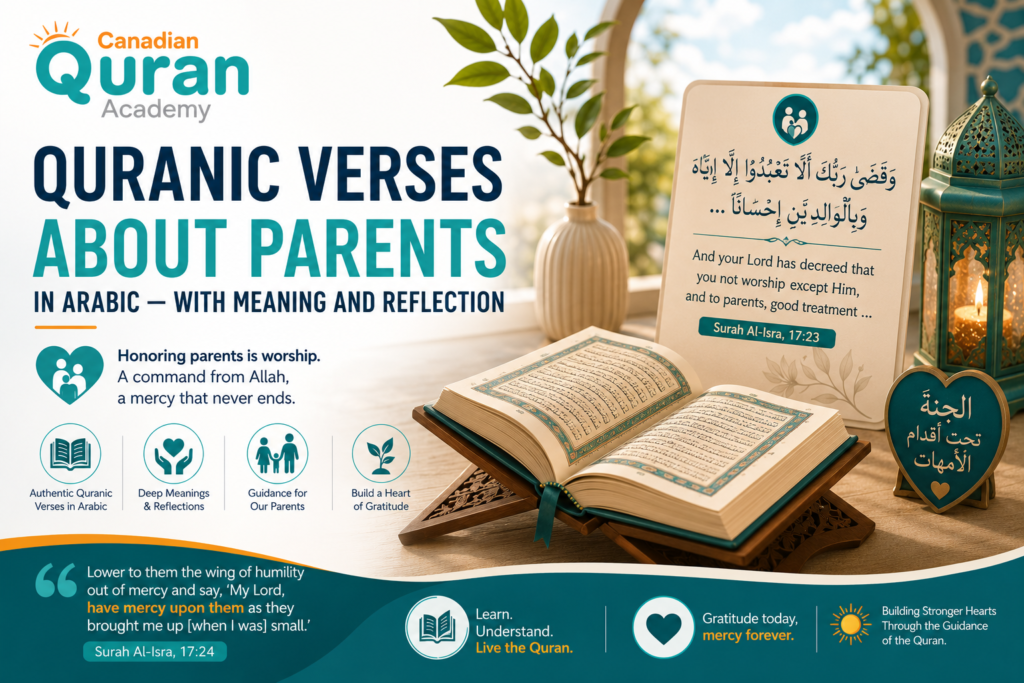
The Quran was revealed to Prophet Muhammad ﷺ over 23 years, and its verses speak directly to moments of hardship, doubt, gratitude, and hope. If you are searching for quran verses in Arabic that you can read, memorize, and reflect on in their original language, this collection gathers 44 of them — grouped by theme, written with full tashkeel, and paired with an accurate English translation. It works as a single reference for quran verses in Arabic with English translation, so you don’t need to jump between separate sources for the Arabic text and the meaning.
Each verse below includes the Arabic text, a transliteration to help with pronunciation, the English meaning, and the exact surah and ayah number so you can look it up yourself. You will also find a short note explaining the context of each verse — something a simple list of quotes usually leaves out.
Quran Verses in Arabic About Allah’s Closeness and Response to Dua
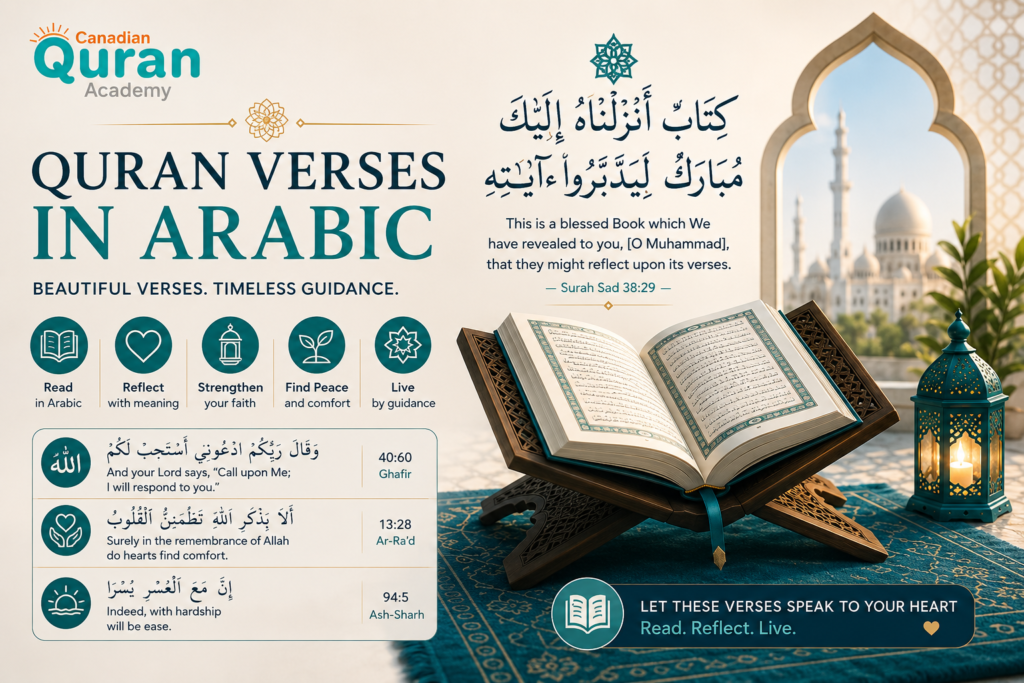
Many people search for quran verses in Arabic specifically because they want a direct answer to a personal dua. These three verses are among the clearest in the Quran on this exact point — Allah is not distant, and He responds.
وَقَالَ رَبُّكُمُ ٱدْعُونِىٓ أَسْتَجِبْ لَكُمْ
“And your Lord says, ‘Call upon Me; I will respond to you.'” (Surah Ghafir 40:60)
This verse is often the first one people learn because it is short, direct, and answers a real need: reassurance that dua is heard.
وَإِذَا سَأَلَكَ عِبَادِى عَنِّى فَإِنِّى قَرِيبٌ ۖ أُجِيبُ دَعْوَةَ ٱلدَّاعِ إِذَا دَعَانِ
“When My servants ask you about Me, I am truly near. I respond to one’s prayer when they call upon Me.” (Surah Al-Baqarah 2:186)
Unlike a general statement, this ayah was revealed as a direct answer to a question the Prophet’s companions asked him about Allah.
قَالَ لَا تَخَافَآ ۖ إِنَّنِى مَعَكُمَآ أَسْمَعُ وَأَرَىٰ
“He said, ‘Fear not. Indeed, I am with you both; I hear and I see.'” (Surah Taha 20:46)
This was said to Prophet Musa and his brother Harun before they confronted Pharaoh — one of the highest-stakes moments in the Quran, which is why the reassurance is so direct. Verses like this one are often among the first that children memorize, which is why a structured Quran program for kids usually starts with short, story-based ayahs before moving to longer surahs.
Begin your child’s Quran journey with a FREE trial class
Read also: The 55 Names of the Holy Quran in Arabic
Beautiful Quran Verses in Arabic for Comfort and Inner Peace
These are the verses most commonly recited or shared when someone is going through a difficult time. Several of them are repeated intentionally within their own surah for emphasis.
وَنُنَزِّلُ مِنَ ٱلْقُرْءَانِ مَا هُوَ شِفَآءٌ وَرَحْمَةٌ لِّلْمُؤْمِنِينَ
“And We send down of the Qur’an that which is healing and mercy for the believers.” (Surah Al-Isra 17:82)
This verse describes the Quran’s own function — not just as guidance, but as something that heals.
ٱلَّذِينَ ءَامَنُوا۟ وَتَطْمَئِنُّ قُلُوبُهُم بِذِكْرِ ٱللَّهِ ۗ أَلَا بِذِكْرِ ٱللَّهِ تَطْمَئِنُّ ٱلْقُلُوبُ
“Those who believe and whose hearts find comfort in the remembrance of Allah. Surely in the remembrance of Allah do hearts find comfort.” (Surah Ar-Ra’d 13:28)
This is one of the most quoted short quran verses in Arabic because the phrase “tatma’innu al-qulub” (hearts find rest) is repeated for emphasis within the same ayah.
فَإِنَّ مَعَ ٱلْعُسْرِ يُسْرًا ﴿٥﴾ إِنَّ مَعَ ٱلْعُسْرِ يُسْرًا ﴿٦﴾
“For indeed, with hardship will be ease. Indeed, with hardship will be ease.” (Surah Ash-Sharh 94:5-6)
Allah states this twice back-to-back in the same short surah — grammatically the same sentence, repeated for weight, not for variety. That repetition is itself a teaching point worth noticing when you recite it.
لَا يُكَلِّفُ ٱللَّهُ نَفْسًا إِلَّا وُسْعَهَا
“Allah does not burden a soul except with that within its capacity.” (Surah Al-Baqarah 2:286)
This ayah closes Surah Al-Baqarah, the longest chapter in the Quran, and is often the last verse memorized by new students because of its comforting, conclusive tone.
وَعَسَىٰٓ أَن تَكْرَهُوا۟ شَيْـًٔا وَهُوَ خَيْرٌ لَّكُمْ ۖ وَعَسَىٰٓ أَن تُحِبُّوا۟ شَيْـًٔا وَهُوَ شَرٌّ لَّكُمْ ۗ وَٱللَّهُ يَعْلَمُ وَأَنتُمْ لَا تَعْلَمُونَ
“Perhaps you hate a thing and it is good for you, and perhaps you love a thing and it is bad for you. And Allah knows, while you know not.” (Surah Al-Baqarah 2:216)
This verse was revealed in the context of fighting during hardship, but it’s widely applied today to any situation where the outcome isn’t what someone hoped for.
لَا تَحْزَنْ إِنَّ ٱللَّهَ مَعَنَا
“Do not grieve; indeed, Allah is with us.” (Surah At-Tawbah 9:40)
This is what the Prophet ﷺ said to Abu Bakr while they were hiding in the cave during the migration to Madinah — spoken in a moment of real danger, not as a general saying.
بَلِ ٱللَّهُ مَوْلَىٰكُمْ ۖ وَهُوَ خَيْرُ ٱلنَّاصِرِينَ
“But no! Allah is your Guardian, and He is the best Helper.” (Surah Ale-Imran 3:150)
If you are getting comfortable with these short quran verses in Arabic, learning to read the Arabic script itself — rather than relying only on transliteration — opens up the entire Quran instead of a handful of shared verses. Structured Qirat courses are built for exactly this step.
مَا وَدَّعَكَ رَبُّكَ وَمَا قَلَىٰ
“Your Lord has not abandoned you, nor has He detested you.” (Surah Ad-Duha 93:3)
This verse was revealed to comfort the Prophet ﷺ during a pause in revelation, when he was worried Allah was displeased with him. It directly answers that fear.
وَلَسَوْفَ يُعْطِيكَ رَبُّكَ فَتَرْضَىٰ
“And your Lord is going to give you, and you will be satisfied.” (Surah Ad-Duha 93:5)
Paired with the verse above, this closes the Prophet’s reassurance with a promise, not just a denial of abandonment.
وَلَا تَهِنُوا۟ وَلَا تَحْزَنُوا۟ وَأَنتُمُ ٱلْأَعْلَوْنَ إِن كُنتُم مُّؤْمِنِينَ
“Do not falter or grieve, for you will have the upper hand, if you are true believers.” (Surah Ale-Imran 3:139)
Read also: How to Learn Quran in Canada?
Live Class in Action
Watch how our instructors interact with students in real-time, focusing on interactive methods.
Start Your Quranic Journey in Canada
Join our vibrant community and learn with expert tutors through our flexible online platform.
Claim Your Free TrialQuran Verses in Arabic on Mercy and Forgiveness
These verses are frequently searched by people who feel they’ve made too many mistakes to be forgiven. The Quran’s answer to that specific fear is unusually direct.
قُلْ يَـٰعِبَادِىَ ٱلَّذِينَ أَسْرَفُوا۟ عَلَىٰٓ أَنفُسِهِمْ لَا تَقْنَطُوا۟ مِن رَّحْمَةِ ٱللَّهِ ۚ إِنَّ ٱللَّهَ يَغْفِرُ ٱلذُّنُوبَ جَمِيعًا ۚ إِنَّهُۥ هُوَ ٱلْغَفُورُ ٱلرَّحِيمُ
“Say, ‘O My servants who have transgressed against themselves, do not despair of the mercy of Allah. Indeed, Allah forgives all sins. He is the Forgiving, the Merciful.'” (Surah Az-Zumar 39:53)
Notice the word “jami’an” (all) — the verse does not list exceptions. This is one reason it’s the most quoted forgiveness verse in the Quran.
إِن يَعْلَمِ ٱللَّهُ فِى قُلُوبِكُمْ خَيْرًا يُؤْتِكُمْ خَيْرًا مِّمَّآ أُخِذَ مِنكُمْ وَيَغْفِرْ لَكُمْ
“If Allah knows any good in your hearts, He will give you something better than what was taken from you, and He will forgive you.” (Surah Al-Anfal 8:70)
فَأَمَّا ٱلَّذِينَ ءَامَنُوا۟ وَعَمِلُوا۟ ٱلصَّـٰلِحَـٰتِ فَيُدْخِلُهُمْ رَبُّهُمْ فِى رَحْمَتِهِۦ
“As for those who believed and did good, their Lord will admit them into His mercy.” (Surah Al-Jathiyah 45:30)
كَتَبَ رَبُّكُمْ عَلَىٰ نَفْسِهِ ٱلرَّحْمَةَ ۖ أَنَّهُۥ مَنْ عَمِلَ مِنكُمْ سُوٓءًۢا بِجَهَـٰلَةٍۢ ثُمَّ تَابَ مِنۢ بَعْدِهِۦ وَأَصْلَحَ فَأَنَّهُۥ غَفُورٌۭ رَّحِيمٌۭ
“Your Lord has decreed upon Himself mercy: that any of you who does wrong out of ignorance and then repents after that and corrects himself — indeed, He is Forgiving and Merciful.” (Surah Al-An’am 6:54)
The condition here is specific: repentance plus correcting your actions, not repentance alone.
إِنَّ ٱللَّهَ يُحِبُّ ٱلتَّوَّٰبِينَ وَيُحِبُّ ٱلْمُتَطَهِّرِينَ
“Indeed, Allah loves those who are constantly repentant and loves those who purify themselves.” (Surah Al-Baqarah 2:222)
وَمَا كَانَ ٱللَّهُ مُعَذِّبَهُمْ وَهُمْ يَسْتَغْفِرُونَ
“And Allah would not punish them while they seek forgiveness.” (Surah Al-Anfal 8:33)
وَمَآ أَصَـٰبَكُم مِّن مُّصِيبَةٍۢ فَبِمَا كَسَبَتْ أَيْدِيكُمْ وَيَعْفُوا۟ عَن كَثِيرٍۢ
“Whatever affliction befalls you is because of what your own hands have committed. And He pardons much.” (Surah Ash-Shura 42:30)
وَرَحْمَتِى وَسِعَتْ كُلَّ شَىْءٍۢ
“But My mercy encompasses all things.” (Surah Al-A’raf 7:156)
An Al-Azhar certified Quran course walks through verses like these with proper tafsir, so the meaning isn’t taken out of context.
Book a FREE trial class in Al-Azhar Quran Course in Canada

Read also: What Is Classical Arabic?
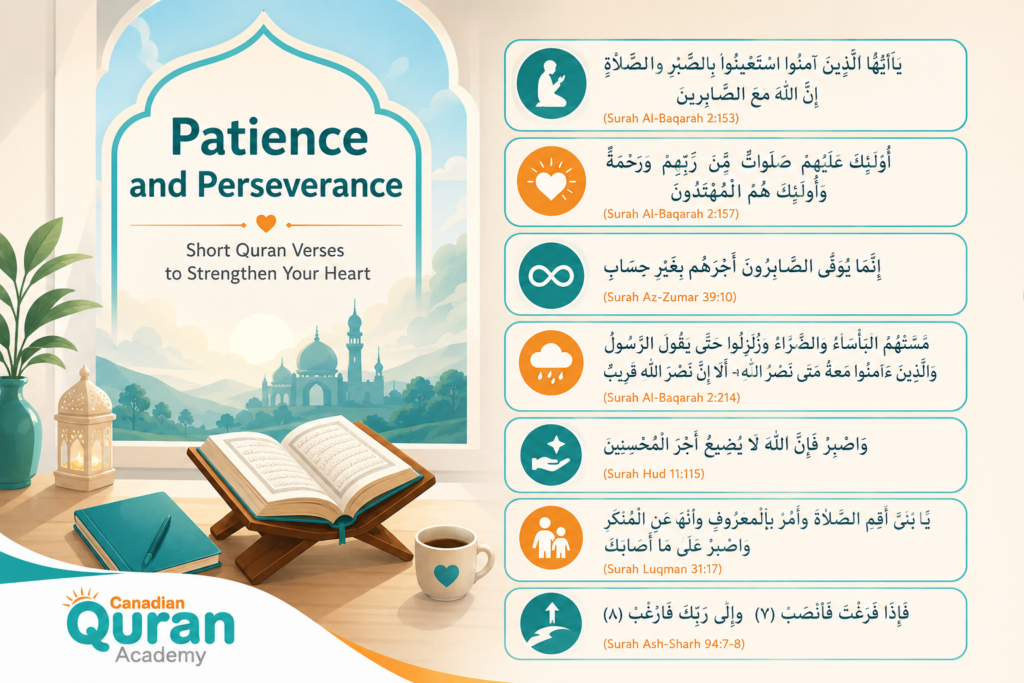
Short Quran Verses in Arabic About Patience and Perseverance
Patience is one of the most repeated themes in the Quran, and these verses are commonly memorized precisely because they’re short enough to recall in the moment they’re needed.
يَـٰٓأَيُّهَا ٱلَّذِينَ ءَامَنُوا۟ ٱسْتَعِينُوا۟ بِٱلصَّبْرِ وَٱلصَّلَوٰةِ ۚ إِنَّ ٱللَّهَ مَعَ ٱلصَّـٰبِرِينَ
“O you who have believed, seek help through patience and prayer. Indeed, Allah is with the patient.” (Surah Al-Baqarah 2:153)
This verse pairs sabr with salah specifically — not with any other action — which is why scholars point to it as the model response to hardship.
أُو۟لَـٰٓئِكَ عَلَيْهِمْ صَلَوَٰتٌۭ مِّن رَّبِّهِمْ وَرَحْمَةٌۭ ۖ وَأُو۟لَـٰٓئِكَ هُمُ ٱلْمُهْتَدُونَ
“Those are the ones upon whom are blessings from their Lord and mercy. And it is those who are the rightly guided.” (Surah Al-Baqarah 2:157)
إِنَّمَا يُوَفَّى ٱلصَّـٰبِرُونَ أَجْرَهُم بِغَيْرِ حِسَابٍۢ
“Indeed, the patient will be given their reward without limit.” (Surah Az-Zumar 39:10)
Most rewards described in the Quran come with some description of measure. This one is a specific exception — it’s stated as having no limit at all.
مَّسَّتْهُمُ ٱلْبَأْسَآءُ وَٱلضَّرَّآءُ وَزُلْزِلُوا۟ حَتَّىٰ يَقُولَ ٱلرَّسُولُ وَٱلَّذِينَ ءَامَنُوا۟ مَعَهُۥ مَتَىٰ نَصْرُ ٱللَّهِ ۗ أَلَآ إِنَّ نَصْرَ ٱللَّهِ قَرِيبٌۭ
“They were touched by poverty and hardship and were shaken until even the messenger and those who believed with him said, ‘When is the help of Allah?’ Unquestionably, the help of Allah is near.” (Surah Al-Baqarah 2:214)
وَٱصْبِرْ فَإِنَّ ٱللَّهَ لَا يُضِيعُ أَجْرَ ٱلْمُحْسِنِينَ
“And be patient! Certainly Allah does not discount the reward of the good-doers.” (Surah Hud 11:115)
يَـٰبُنَىَّ أَقِمِ ٱلصَّلَوٰةَ وَأْمُرْ بِٱلْمَعْرُوفِ وَٱنْهَ عَنِ ٱلْمُنكَرِ وَٱصْبِرْ عَلَىٰ مَآ أَصَابَكَ
“O my son, establish prayer, enjoin what is right, forbid what is wrong, and be patient over what befalls you.” (Surah Luqman 31:17)
This is Luqman the Wise advising his son — one of the few places in the Quran where guidance is framed as a father speaking directly to his child.
فَإِذَا فَرَغْتَ فَٱنصَبْ ﴿٧﴾ وَإِلَىٰ رَبِّكَ فَٱرْغَب ﴿٨﴾
“So when you have finished your duties, then stand up for worship. And to your Lord direct your longing.” (Surah Ash-Sharh 94:7-8)
Read together with the “ease after hardship” verses above, this closes the surah with an instruction: don’t just wait out hardship — once it eases, turn toward worship, not away from it.
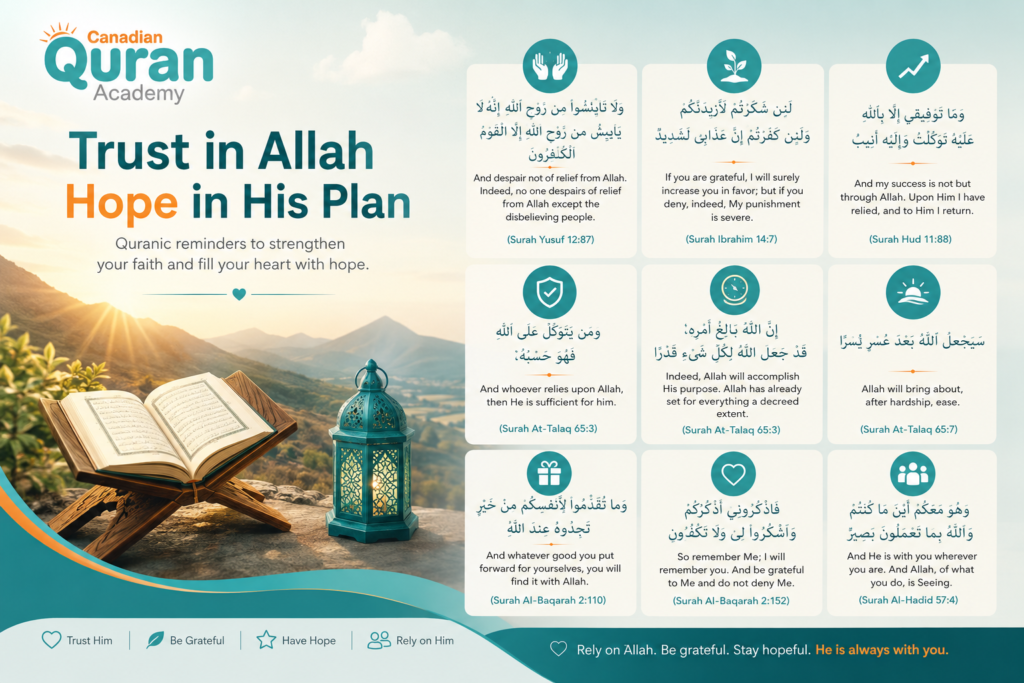
Quran Verses in Arabic on Trust and Hope in Allah
Trusting Allah and maintaining hope are recurring themes throughout the Quran. These Quran verses in Arabic remind believers to rely on Allah, remain grateful, and stay confident in His mercy and perfect plan, even during life’s greatest challenges.
وَلَا تَا۟يْـَٔسُوا۟ مِن رَّوْحِ ٱللَّهِ ۖ إِنَّهُۥ لَا يَا۟يْـَٔسُ مِن رَّوْحِ ٱللَّهِ إِلَّا ٱلْقَوْمُ ٱلْكَـٰفِرُونَ
“And despair not of relief from Allah. Indeed, no one despairs of relief from Allah except the disbelieving people.” (Surah Yusuf 12:87)
This is Prophet Ya’qub speaking to his sons, still holding onto hope for Yusuf’s return years after losing him — the context is what makes this verse land differently than a general statement about hope.
لَئِن شَكَرْتُمْ لَأَزِيدَنَّكُمْ ۖ وَلَئِن كَفَرْتُمْ إِنَّ عَذَابِى لَشَدِيدٌۭ
“If you are grateful, I will surely increase you in favor; but if you deny, indeed, My punishment is severe.” (Surah Ibrahim 14:7)
This verse teaches that sincere gratitude brings Allah’s blessings and increase.
وَمَا تَوْفِيقِىٓ إِلَّا بِٱللَّهِ ۚ عَلَيْهِ تَوَكَّلْتُ وَإِلَيْهِ أُنِيبُ
“And my success is not but through Allah. Upon Him I have relied, and to Him I return.” (Surah Hud 11:88)
A reminder that every success comes only through Allah’s guidance and support.
وَمَن يَتَوَكَّلْ عَلَى ٱللَّهِ فَهُوَ حَسْبُهُۥٓ
“And whoever relies upon Allah, then He is sufficient for him.” (Surah At-Talaq 65:3)
Whoever places complete trust in Allah will always find Him sufficient.
إِنَّ ٱللَّهَ بَـٰلِغُ أَمْرِهِۦ ۚ قَدْ جَعَلَ ٱللَّهُ لِكُلِّ شَىْءٍۢ قَدْرًۭا
“Indeed, Allah will accomplish His purpose. Allah has already set for everything a decreed extent.” (Surah At-Talaq 65:3)
Nothing can prevent Allah’s plan, as everything happens according to His perfect decree.
سَيَجْعَلُ ٱللَّهُ بَعْدَ عُسْرٍۢ يُسْرًۭا
“Allah will bring about, after hardship, ease.” (Surah At-Talaq 65:7)
This verse reassures believers that hardship is always followed by relief.
وَمَا تُقَدِّمُوا۟ لِأَنفُسِكُم مِّنْ خَيْرٍۢ تَجِدُوهُ عِندَ ٱللَّهِ
“And whatever good you put forward for yourselves, you will find it with Allah.” (Surah Al-Baqarah 2:110)
Every good deed is preserved by Allah and will be rewarded in the Hereafter.
فَٱذْكُرُونِى أَذْكُرْكُمْ وَٱشْكُرُوا۟ لِى وَلَا تَكْفُرُونِ
“So remember Me; I will remember you. And be grateful to Me and do not deny Me.” (Surah Al-Baqarah 2:152)
Remembering Allah strengthens faith and brings His mercy and blessings.
وَهُوَ مَعَكُمْ أَيْنَ مَا كُنتُمْ ۚ وَٱللَّهُ بِمَا تَعْمَلُونَ بَصِيرٌۭ
“And He is with you wherever you are. And Allah, of what you do, is Seeing.” (Surah Al-Hadid 57:4)
Allah is always aware of His servants, wherever they are and whatever they do.
Verses Featuring the Dua of the Prophets
The Quran preserves many heartfelt supplications made by the prophets during moments of hardship, hope, and reliance on Allah. These duas are timeless examples of sincerity and trust, teaching believers how to ask Allah for guidance, strength, forgiveness, and success. Memorizing these Quran verses in Arabic allows you to recite the very words spoken by Allah’s prophets in your own daily prayers and moments of need.
رَبَّنَآ ءَاتِنَا فِى ٱلدُّنْيَا حَسَنَةً وَفِى ٱلْـَٔاخِرَةِ حَسَنَةً وَقِنَا عَذَابَ ٱلنَّارِ
“Our Lord, give us in this world that which is good and in the Hereafter that which is good, and protect us from the punishment of the Fire.” (Surah Al-Baqarah 2:201)
This dua is recited by many Muslims after every prayer because it covers both worldly life and the afterlife in a single sentence.
رَبِّ ٱشْرَحْ لِى صَدْرِى ﴿٢٥﴾ وَيَسِّرْ لِىٓ أَمْرِى ﴿٢٦﴾ وَٱحْلُلْ عُقْدَةً مِّن لِّسَانِى ﴿٢٧﴾ يَفْقَهُوا۟ قَوْلِى ﴿٢٨﴾
“My Lord, expand for me my breast. And ease for me my task. And untie the knot from my tongue, so they may understand my speech.” (Surah Ta-Ha 20:25-28)
Musa recited this before the single hardest conversation of his life. It’s often used today before difficult conversations, exams, or public speaking for the same reason.
Quran Verses in Arabic With Moral Lessons and Prophetic Wisdom
The Quran is not only a book of promises and warnings—it is also a complete guide for building character, strengthening faith, and living with wisdom. These Quran verses in Arabic highlight timeless moral lessons, from recognizing Allah’s greatness to embracing righteousness, gratitude, and sincere worship. Learning them in their original Arabic allows their meanings and spiritual impact to become part of daily life.
ٱللَّهُ لَآ إِلَـٰهَ إِلَّا هُوَ ٱلْحَىُّ ٱلْقَيُّومُ ۚ لَا تَأْخُذُهُۥ سِنَةٌۭ وَلَا نَوْمٌۭ
“Allah — there is no deity except Him, the Ever-Living, the Sustainer of existence. Neither drowsiness overtakes Him nor sleep.” (Surah Al-Baqarah 2:255 — Ayat Al-Kursi)
Ayat al-Kursi is widely regarded as the greatest single ayah in the Quran. A well-known hadith in Sahih Bukhari describes Abu Hurairah catching a devil trying to steal from the zakah dates entrusted to him, who taught him to recite Ayat al-Kursi before sleeping so that a guardian from Allah would stay with him until morning — the Prophet ﷺ later confirmed the account was true, even though it came from a devil.
إِنَّ أَكْرَمَكُمْ عِندَ ٱللَّهِ أَتْقَىٰكُمْ
“Indeed, the most noble of you in the sight of Allah is the most righteous of you.” (Surah Al-Hujurat 49:13)
بِسْمِ ٱللَّهِ ٱلرَّحْمَـٰنِ ٱلرَّحِيمِ ﴿١﴾ ٱلْحَمْدُ لِلَّهِ رَبِّ ٱلْعَـٰلَمِينَ ﴿٢﴾ ٱلرَّحْمَـٰنِ ٱلرَّحِيمِ ﴿٣﴾
“In the name of Allah, the Most Merciful, the Especially Merciful. All praise is due to Allah, Lord of the worlds. The Most Merciful, the Especially Merciful.” (Surah Al-Fatiha 1:1-3)
Every one of these opening verses is recited in every unit (rakah) of the five daily prayers, making it the most repeated passage in the entire Quran by any Muslim who prays regularly. It’s usually the very first surah taught in any Quran program for kids, since children recite it in prayer from a young age.
Start Online Quran Classes for Kids in Canada with a FREE Trial Class
Quran Verses in Arabic About Paradise and Eternal Reward
Paradise is one of the Quran’s most powerful promises for those who believe and live righteously. These Quran verses in Arabic describe the eternal reward awaiting the believers, reminding us that every act of faith, patience, and obedience is ultimately rewarded by Allah. Reading and memorizing these verses in their original Arabic helps strengthen both understanding and spiritual connection with the Quran.
وَٱلَّذِينَ ءَامَنُوا۟ وَعَمِلُوا۟ ٱلصَّـٰلِحَـٰتِ أُو۟لَـٰٓئِكَ أَصْحَـٰبُ ٱلْجَنَّةِ ۖ هُمْ فِيهَا خَـٰلِدُونَ
“But they who believe and do righteous deeds — those are the companions of Paradise; they will abide therein eternally.” (Surah Al-Baqarah 2:82)
وَلِمَنْ خَافَ مَقَامَ رَبِّهِۦ جَنَّتَانِ
“But for he who has feared the standing before his Lord are two gardens.” (Surah Ar-Rahman 55:46)
لَهُم مَّا يَشَآءُونَ عِندَ رَبِّهِمْ ۚ ذَٰلِكَ هُوَ ٱلْفَضْلُ ٱلْكَبِيرُ
“Having whatever they will in the presence of their Lord. That is what is the great bounty.” (Surah Ash-Shura 42:22)
Learning to recognize these verses in their original Arabic script — rather than only knowing the translation — is the actual goal behind memorizing quran verses in Arabic. It’s also exactly what a structured, teacher-led Hifz program for adults or a full course through our Quran academy is built to do — working through verses systematically rather than one at a time.
Experience Our Classrooms
Don’t just take our word for it—take a look inside! Watch the videos below to experience our engaging teaching methods and vibrant online classrooms firsthand.
Start Your Quranic Journey in Canada
Join our vibrant community and learn with expert tutors through our flexible online platform.
Claim Your Free TrialLearn Quran Verses in Arabic with Qualified Teachers at Our Quran Academy
Reading and memorizing Quran verses in Arabic becomes easier when you have a clear learning path and a qualified teacher to guide you. Whether your goal is to improve your recitation, understand the meanings of the verses, or begin your Hifz journey, structured instruction helps you make steady, lasting progress.
Our Quran Academy offers:
- Qualified Quran teachers with expertise in Tajweed and Quran recitation
- Personalized one-on-one online classes based on your level and goals
- Flexible scheduling to fit your daily routine
- Programs for adults, children, beginners, and advanced learners
- Step-by-step courses in Quran reading, Tajweed, Hifz, and Quranic Arabic
- A free trial class with no obligation
[Book a free trial class with a certified Quran teacher]

Our Arabic Courses
- Online Arabic Academy
- Online Arabic Course
- Classical Arabic Course
- Arabic Course for Beginners
- Advanced Arabic Course
- Quranic Arabic Course
- Arabic Grammar Course
- Modern Standard Arabic Course
- Arabic Conversation / Speaking Course
- Intensive Arabic Course
- Online Arabic Classes for Kids
- Arabic Classes for Adults
- Arabic Classes for Ladies
- Fusha Arabic Course
- Business Arabic Course
- Al-Azhar Arabic Course
- Madinah Arabic Course
- Learning Arabic for Non-Arabic Speakers
- Arabic Elementary School
- Arabic Intermediate School
- Arabic Lessons for Kindergarten
Start Your Quranic Journey in Canada
Join our vibrant community and learn with expert tutors through our flexible online platform.
Claim Your Free TrialConclusion
The Quran is a source of guidance, comfort, hope, and wisdom for every stage of life. These Quran verses in Arabic are more than beautiful words—they are reminders to strengthen your faith, deepen your connection with Allah, and reflect on His message every day.
Whether you’re seeking peace during difficult times, memorizing your first surah, or working toward a complete Hifz, learning these verses in their original Arabic allows you to experience the Quran as it was revealed. Start with a few verses, recite them regularly, understand their meanings, and build your connection with the Quran one ayah at a time.
Frequently Asked Questions
Which quran verses in Arabic are best for comfort during a hard time?
Surah Ar-Ra’d 13:28 (“hearts find comfort in the remembrance of Allah”), Surah Ash-Sharh 94:6 (“with hardship comes ease”), and Surah Ghafir 40:60 (“call upon Me, I will respond”) are the three most commonly recited for this exact purpose.
Which surah is considered the most motivating in the Quran?
Surah Ash-Sharh (94) is widely cited for this, since it directly addresses a period of hardship the Prophet ﷺ faced and repeats “with hardship comes ease” twice within four short verses.
What is Ayat al-Kursi and why is it recited so often?
Ayat al-Kursi is Surah Al-Baqarah, verse 255, describing Allah’s power and sustaining authority over everything. It’s recited after each prayer based on hadith describing its virtues, found in collections like Sahih Bukhari on Sunnah.com.
Do I need to know Arabic grammar to understand these verses?
No — you can read tashkeel and transliteration to pronounce the verses correctly without first studying grammar. Understanding grammar helps later, once you want to read the Quran without transliteration at all, which is exactly what structured Qirat training is set up to teach.
Can I use these verses in a bio or as a daily reminder?
Yes. Short verses like “Indeed, with hardship comes ease” (94:6) or “Allah does not burden a soul beyond its capacity” (2:286) are commonly used this way because they stand on their own without needing extra context.
How can I make sure I’m pronouncing the Arabic correctly?
Tashkeel marks in written Arabic guide pronunciation, but the safest way to confirm correct recitation is to have a certified teacher listen and correct you directly, rather than relying on transliteration alone.






Leave a Reply