 Quran
Every year, thousands of Muslims across Canada ask the same pressing question: how to learn Quran in English in Canada without needing to master Arabic first?
Whether you are a recent convert in Ottawa, a second-generation Canadian in Toronto who grew up hearing recitation without fully understanding it, or a parent in Vancouver trying to connect your children to their faith.
The Quran was revealed in Arabic, and that fact shapes every serious learning journey.
But understanding what you recite, building a daily relationship with its meaning, and connecting emotionally to its guidance, all of this is fully accessible in English, at every stage of your journey.
Learning the Quran as an English speaker in Canada is not a single task. It is three overlapping journeys unfolding simultaneously.
These journeys start with learning to recite the Arabic correctly, understanding the meaning through English, and gradually building enough Quranic Arabic vocabulary to connect both layers directly.
Most beginners attempt all three at once and quickly feel overwhelmed. The approach that consistently works is sequential, solidify pronunciation first, layer in meaning through a trusted translation, then add vocabulary study when you have a stable base.
1. Start With A Reliable English Translation Of The Quran
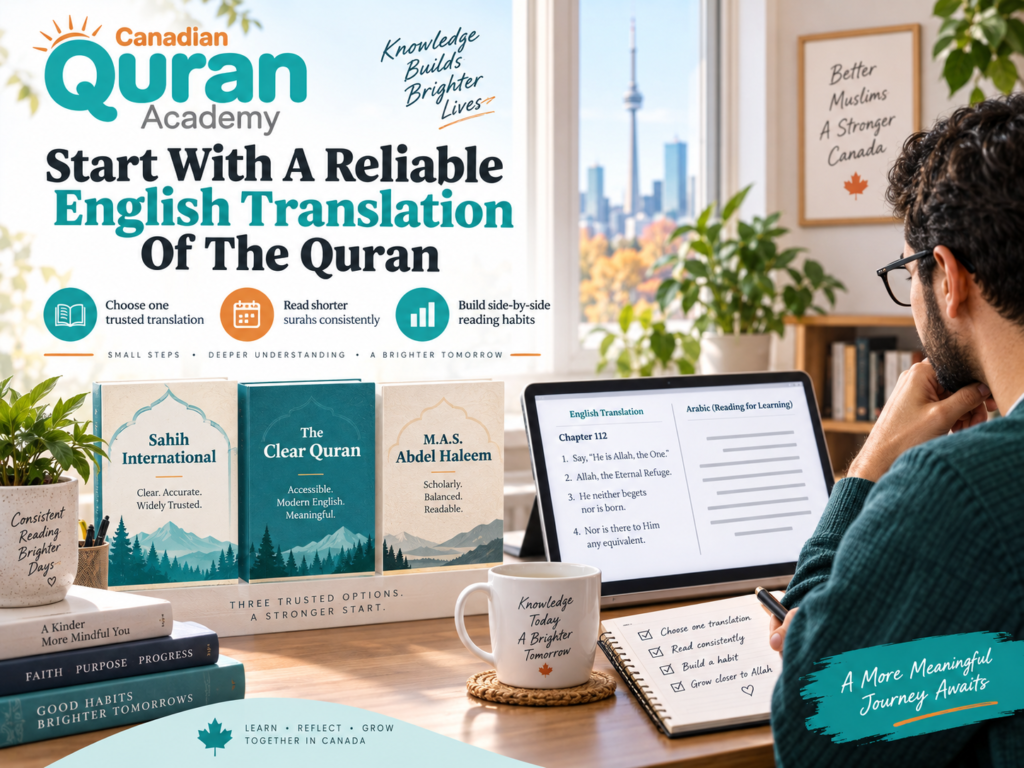
The first practical step for any English speaker is selecting one scholarly English translation and reading it consistently. Can we learn the Quran in English?
Absolutely, English translations of the Quran’s meanings give you direct access to its guidance, its stories, its commands, and its comfort, long before your Arabic reaches any level of proficiency.
Three translations consistently recommended for English-speaking beginners are Sahih International (precise and widely cited), The Clear Quran by Dr. Mustafa Khattab (contemporary, smooth, and reader-friendly).
And the M.A.S. Abdel Haleem Oxford edition (excellent for literary depth). Each serves a different reading preference, but all three are scholarly and reliable.
Resist the urge to switch between multiple translations in your first months. Pick one, read through the shorter surahs fully, and build familiarity before consulting alternatives.
Reading Quran Verses In Arabic alongside an English translation builds the side-by-side reading habit that pays dividends at every later stage.
2. Learn Quranic Pronunciation Before Studying Arabic Grammar
How can an English speaker learn the Quran effectively and avoid the most common early mistake? The answer almost always starts with sound before script, and sound before grammar.
Arabic contains several phonemes absent from English, the letter ض (Dadh), emphatic consonants, and guttural sounds, and mispronouncing them in Quranic recitation changes meaning in a sacred text.
Before tackling grammar rules or vocabulary lists, dedicate four to eight weeks to letter pronunciation and basic tajweed with a qualified teacher.
Even fifteen minutes of daily pronunciation practice with a live instructor accelerates progress faster than any app or self-study method alone.
The Arabic Noorani Qaida is the globally recognized starting framework for non-Arabic beginners. It guides learners systematically from individual letters to connected words in a graduated sequence that makes the Arabic script feel approachable rather than intimidating.
Live Class in Action
Watch how our instructors interact with students in real-time, focusing on interactive methods.
Start Your Quranic Journey in Canada
Join our vibrant community and learn with expert tutors through our flexible online platform.
Claim Your Free Trial3. Join An Online Quran Class Built For English Speakers In Canada
Learning to learn Quran online in English is not about finding any class — it is about finding a class calibrated to your linguistic background, your schedule, and your specific goals.
This is where Canadian geography becomes an advantage rather than a limitation. The global shift to live online Quran education means learners in Calgary or Halifax now have access to elite certified teachers without relocating or commuting.
How to learn Quran for beginners in English requires more than video recordings and PDF workbooks.
It requires a teacher who can explain Arabic pronunciation rules in English, detect errors in real time, and adapt pacing to your individual comfort level — none of which pre-recorded content provides.
Canadian Quran Academy connects English-speaking learners across Toronto, Vancouver, Calgary, and Montreal with certified teachers.
They deliver live, one-on-one sessions tailored specifically for non-Arabic speakers. Every correction is explained in English. Every session is scheduled around Canadian time zones.
Book your free class in Canadian Quran Academy’s Quran Classes for Adults in Canada

A. What To Look For In A Quality Canada-Based Online Quran Course?
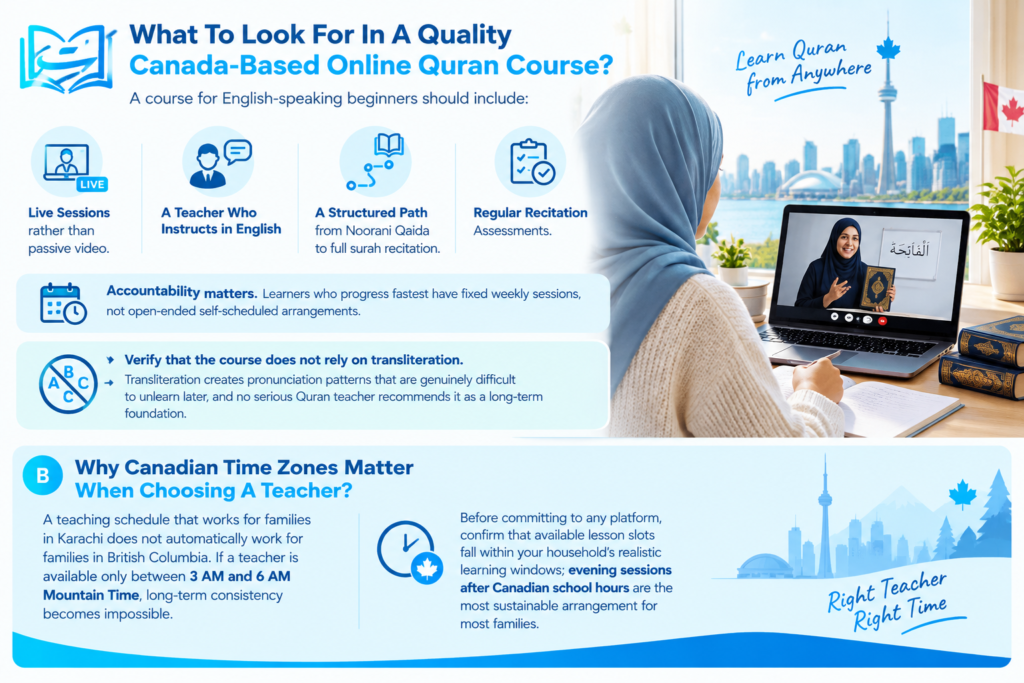
A course for English-speaking beginners should include: live sessions rather than passive video, a teacher who instructs in English, a structured path from Noorani Qaida to full surah recitation, and regular recitation assessments.
Accountability matters, learners who progress fastest have fixed weekly sessions, not open-ended self-scheduled arrangements.
Verify that the course does not rely on transliteration, Roman-letter approximations of Arabic sounds.
Transliteration creates pronunciation patterns that are genuinely difficult to unlearn later, and no serious Quran teacher recommends it as a long-term foundation.
B. Why Canadian Time Zones Matter When Choosing A Teacher?
A teaching schedule that works for families in Karachi does not automatically work for families in British Columbia. If a teacher is available only between 3 AM and 6 AM Mountain Time, long-term consistency becomes impossible.
Before committing to any platform, confirm that available lesson slots fall within your household’s realistic learning windows; evening sessions after Canadian school hours are the most sustainable arrangement for most families.
Read also: How To Learn Quran For Kids In Canada?
4. Use Word-By-Word Tools To Build Quranic Vocabulary
What is the best way to understand the Quran deeply as an English speaker? Word-by-word study, learning precisely what each individual Quranic word means, is one of the highest-leverage habits a beginner can build.
Once you know that Raheem means “the Especially Merciful” and Malik means “the Master,” you stop hearing abstract sounds in Surah Al-Fatiha and start comprehending a direct conversation with God.
Several platforms offer word-by-word Quranic translation: Quran.com’s interlinear view, the Quran Word by Word mobile app, and corpus.quran.com for full grammatical breakdowns.
Engaging with The Most Used Arabic Words In The Quran strategically transforms comprehension speed.
The top 300 recurring Quranic words account for approximately 70% of the text, learning this targeted set is an investment with disproportionate returns relative to the time it takes.
Start the Noorani Qaida Online Course With a Free Trial Now

5. Choose Quranic Arabic Over Classical Arabic Or Modern Standard Arabic
One of the most common and genuinely costly mistakes among English speakers researching how to study Arabic for the Quran is enrolling in Modern Standard Arabic (MSA) courses.
MSA is the formal Arabic of news broadcasts, government documents, and contemporary literature. It is intellectually valuable, but it is not the Quran’s Arabic, and starting with it significantly extends the journey to Quranic comprehension.
Do you have to learn Arabic to understand the Quran at its deepest level? Yes, eventually. But you will ask what type of Arabic should I learn first? Classical, MSA, or Quranic.
For Quran comprehension, the answer is Quranic Arabic, the classical register in which the Quran was revealed, with vocabulary, grammar, and syntax specific to the text itself.
A detailed exploration of these distinctions is available in What Is Classical Arabic, but the practical conclusion is clear: if your primary goal is Quranic understanding, Quranic Arabic courses will reach that goal faster than MSA.
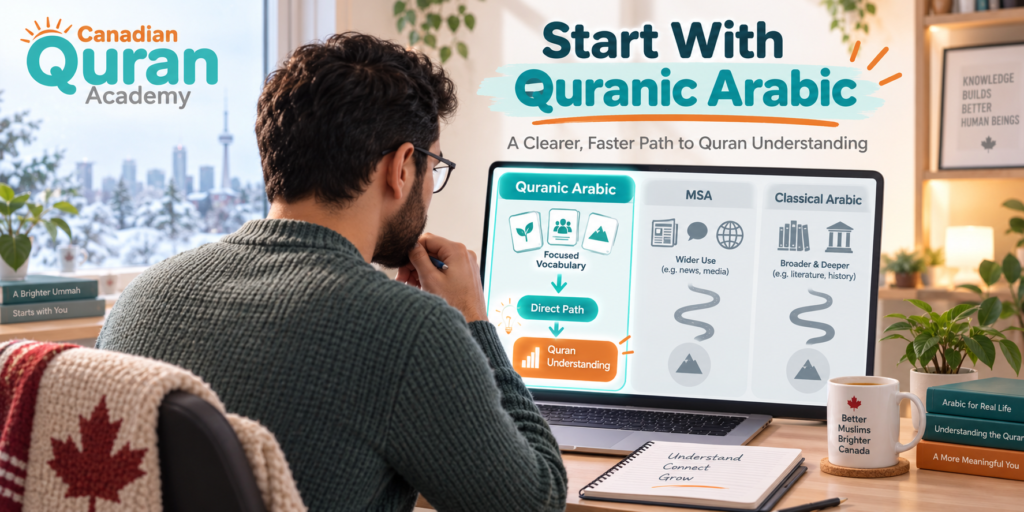
A. What Is The Core Difference Between Quranic Arabic And Modern Standard Arabic?
Quranic Arabic is built on approximately 1,800 root words, from which thousands of Quranic terms derive through known patterns. MSA carries a broader modern vocabulary, technology terms, contemporary idioms, administrative language.
These features simply did not exist in seventh-century Arabia and do not appear in the Quran. Studying MSA first means learning a large amount of material that is irrelevant to your actual goal.
Enroll Now in Modern Standard Arabic Training

B. Why Quranic Arabic Is The Most Direct Path For English Learners?
Because Quranic Arabic is a finite, fully mapped body of language, unlike living languages that expand constantly, its vocabulary can be systematically learned in a manageable timeframe.
The importance of Arabic language in the Quran runs deep, but access to it does not require years of foundational MSA study.
Dedicated Quranic Arabic curricula, such as those available through How to learn Arabic for Quran in Canada, begin with the highest-frequency Quranic roots and expand outward in an order driven by the text itself.
Nurture Faith Through Quranic Learning at The Canadian Quran Academy

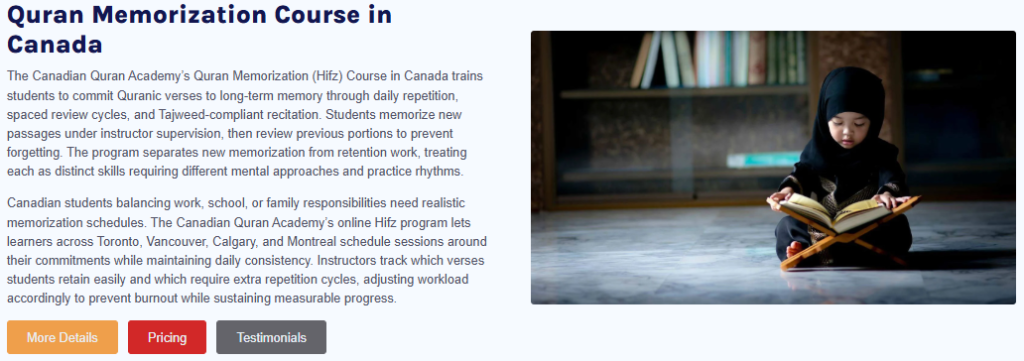
6. Begin Memorizing Even Before You Fully Understand Every Verse
You can ask, Should I start memorizing even if I do not understand every meaning? This question surfaces repeatedly among English-speaking beginners, and the scholarly consensus is consistent: yes, absolutely.
Memorization (hifz) and understanding are complementary journeys, not a locked sequence where comprehension must come before commitment.
The Companions of the Prophet ﷺ would memorize ten verses at a time and study their meanings alongside the memorization, but the oral repetition came first.
For an English speaker, memorizing Surah Al-Ikhlas, Al-Falaq, An-Nas, and Al-Fatiha provides an immediate, functional base for prayer, even before deep meaning has fully settled.
As you study the meaning of what you memorize, through translations, word-by-word tools, and guided instruction, the memorized verses gain emotional weight and spiritual depth.
The two processes reinforce each other in both directions: memorized sounds become meaningful over time, and meaningful understanding becomes permanently memorable.
Start Memorizing Quran With Qualified Canadian Instructors
7. Engage With The Quran Daily While Still On Your Learning Journey
One of the most consistently undervalued pieces of advice for English speakers is this: you do not need to wait until you are “ready” to engage with the Quran.
How to engage with the Quran while not yet finished studying is a practical habit question, not a theological one.
Listen to recitation during your daily commute. Read the translation of one surah every morning. Sit with Quranic Verses on Trust in Allah when you need clarity, or with Quran Verses About Not Giving Up when you feel discouraged.
Daily exposure, even passive, background exposure, accelerates recognition in ways that formal study sessions alone cannot replicate.
When you hear a reciter recite Surah Al-Rahman during a podcast, and you already know that Rahman means “the Most Gracious,” your brain is forming connections that change how you hear the Quran for the rest of your life.
Canadian Quran Academy supports this daily engagement between sessions, weekly reflection prompts, curated recitation audio, and guided translation reading, so that your relationship with the Quran continues developing every day, not only during scheduled class time.
8. Explore Free Resources Honestly And Know When To Invest
Can you learn the Quran in English for free? There are genuinely valuable free tools available to Canadian learners: Quran.com, Al-Quran Cloud, the MuslimPro app, and YouTube channels of reputable scholars.
All offer translation access, recitation audio, and foundational tajweed explanation at no cost. For self-motivated learners with some prior Arabic reading ability, these resources are meaningful complements to structured study.
The honest answer, however, is that free resources alone rarely produce corrected, consistent, accountable progress for complete beginners. Pronunciation errors accumulate without a teacher to catch them in real time.
Motivation loses its momentum without scheduled sessions to anchor it. The transition from passive listening to active, confident recitation almost always requires a qualified human guide at some point in the journey.
The good news for learners in Canada: structured online programs are far more affordable than most people assume.
Canadian Quran Academy offers enrollment options designed to make professional Quran instruction financially accessible, considerably less expensive than in-person private tutoring for learners starting from zero.
Discover Why Canadian Students Pursue Ijazah Certification Through The Canadian Quran Academy?
9. Set A Realistic Timeline For Each Stage Of Your Learning Journey
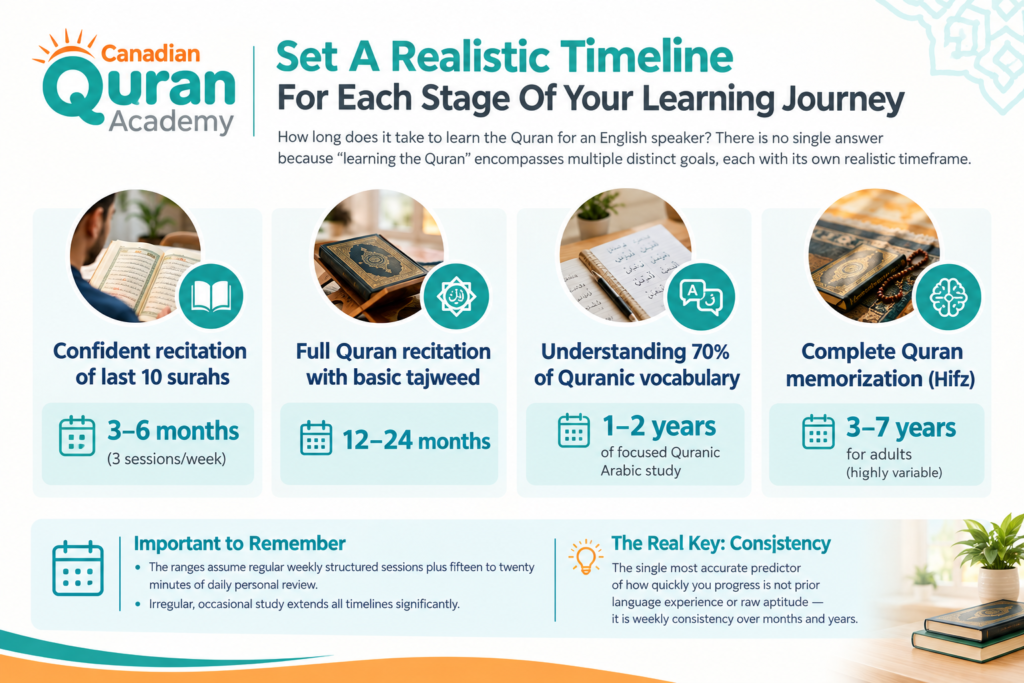
How long does it take to learn the Quran for an English speaker? There is no single answer because “learning the Quran” encompasses multiple distinct goals, each with its own realistic timeframe.
Below is an honest breakdown based on consistent, structured weekly learning:The ranges assume regular weekly structured sessions plus fifteen to twenty minutes of daily personal review. Irregular, occasional study extends all timelines significantly.
| Learning Goal | Realistic Timeline |
| Confident recitation of last 10 surahs | 3–6 months (3 sessions/week) |
| Full Quran recitation with basic tajweed | 12–24 months |
| Understanding 70% of Quranic vocabulary | 1–2 years of focused Quranic Arabic study |
| Complete Quran memorization (Hifz) | 3–7 years for adults (highly variable) |
For learners curious about the Arabic language study component specifically, How long does it took to learn Arabic in Canada provides realistic, Canada-context estimates that account for schedule constraints most Canadians actually face.
The single most accurate predictor of how quickly you progress is not prior language experience or raw aptitude — it is weekly consistency over months and years.
Experience Our Classrooms
Don’t just take our word for it—take a look inside! Watch the videos below to experience our engaging teaching methods and vibrant online classrooms firsthand.
Start Your Quranic Journey in Canada
Join our vibrant community and learn with expert tutors through our flexible online platform.
Claim Your Free TrialBegin Your Quran Journey With Canadian Quran Academy Today
You have read nine practical, actionable steps. The fastest way to move from reading about them to living them is one straightforward decision: schedule your first session with a teacher who already knows how to guide English speakers in Canada.
Canadian Quran Academy is built for exactly this, an online platform offering certified, live, one-on-one Quran instruction for English-speaking Muslims and new Muslims across all Canadian provinces.
Every teacher is qualified. Every session is tailored. Every curriculum starts where you actually are, not where a generic syllabus assumes you should be.
Our Quran Courses:
- Quran Online Academy
- Quran Recitation Classes
- Learn Quran Course for Beginners
- Al-Azhar Quran Course
- Online Tajweed Classes
Begin Your Quranic Journey with The Canadian Quran Academy with a free trial
Conclusion
Learning how to learn Quran in English in Canada is not a single destination, it is a layered, ongoing journey that begins the moment you open a reliable translation or repeat a verse after a qualified teacher.
English-speaking Muslims today have more tools, more access, and more qualified online instructors available than any generation that came before them.
Begin with a trusted English translation, build pronunciation with a live certified teacher, engage daily without waiting for perfection, learn Quranic Arabic vocabulary strategically, and above all — show up with consistency.
Do not wait until your Arabic is fluent to engage with the Quran. Do not wait until you fully understand every verse before beginning to memorize. The Quran meets you where you are, in the language you have, at the stage you are at.
For Muslims in Toronto, Vancouver, Calgary, and every city across Canada, the question is no longer whether to start. It is simply how — and how soon.
Frequently Asked Questions
Can English speakers understand the Quran without learning Arabic?
English speakers can access the Quran’s meanings, guidance, and stories fully through trusted translations, without any prior Arabic knowledge. Translations like Sahih International and The Clear Quran convey the substance of the text accurately.
Do you have to learn Arabic to understand the Quran deeply?
You do not need Arabic to access the Quran’s general meanings — translations make this immediately available. For deep comprehension of nuance, legal derivation, and linguistic miracle, Quranic Arabic study becomes essential over time.
What is the difference between Quranic Arabic, Classical Arabic, and Modern Standard Arabic?
Quranic Arabic is the specific register of the Quran, seventh-century classical Arabic with vocabulary, grammar, and syntax internal to the text. Classical Arabic is the broader category encompassing pre-Islamic and early Islamic literature.
Modern Standard Arabic (MSA) is contemporary formal Arabic used in media and education.
How long does it take for an English speaker to learn to recite the Quran confidently?
Most English-speaking beginners achieve confident recitation of the last ten surahs within three to six months of consistent weekly instruction. Full Quran recitation with foundational tajweed typically takes twelve to twenty-four months.
Complete memorization takes three to seven years for most adults, depending on daily commitment and structured revision with a qualified teacher.
Can you learn the Quran in English for free online?
Several genuinely valuable free resources exist, Quran.com, MuslimPro, and scholarly YouTube channels among them, and they are excellent supplementary tools.
Complete beginners, however, almost always reach a point where corrected, live instruction becomes necessary to avoid pronunciation habits that are difficult to reverse later.
Is it acceptable to memorize the Quran before fully understanding every verse?
Yes, this is both acceptable and actively encouraged by scholars and teachers. Memorization and understanding are parallel, reinforcing journeys rather than a strict sequence. The Companions of the Prophet ﷺ memorized alongside meaning study, not after it.





[…] Read also: How To Learn Quran In English In Canada? […]