 Quran
Quran
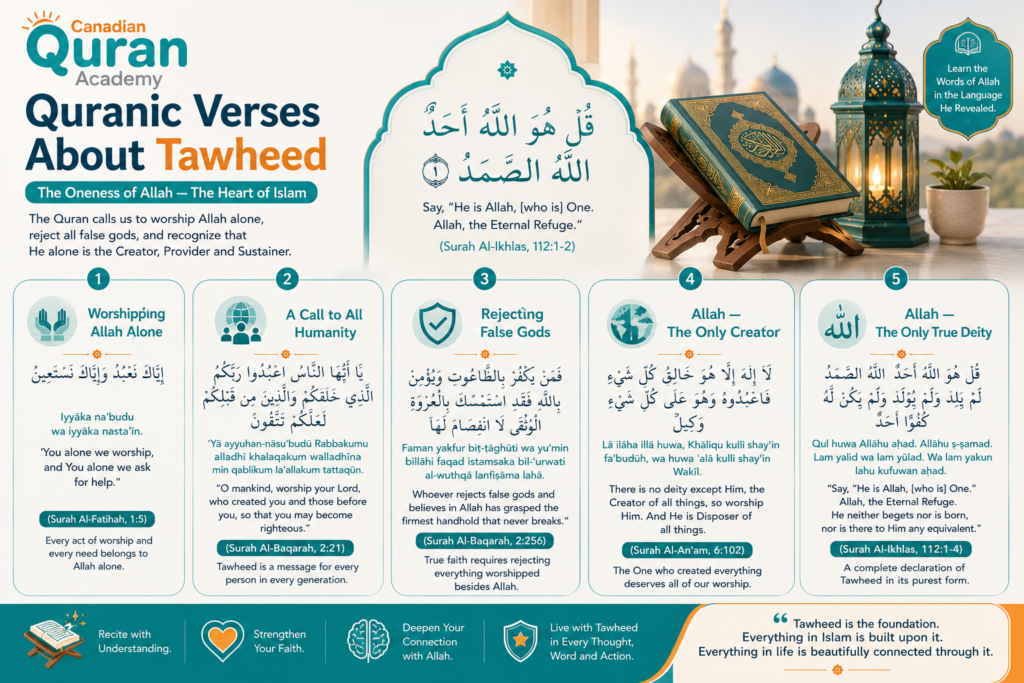
Tawheed is the heart of Islam and the foundation of every believer’s relationship with Allah. Throughout the Quran, Allah repeatedly calls humanity to worship Him alone, reject all forms of shirk, and recognize that He alone is the Creator, Provider, and Sustainer of the universe. These verses form the basis of Islamic belief and remind Muslims that every act of worship should be devoted solely to Allah.
Exploring Quranic verses about Tawheed in Arabic helps Muslims connect with the Quran’s message in its original language while understanding the principles of Allah’s Oneness. In this guide, you’ll discover powerful Quranic verses with the original Arabic text, transliteration, English translation, explanations, and direct Quran references that highlight different aspects of Tawheed.
1. A Quranic Verse About Worshipping Allah Alone
Every act of worship in Islam begins with recognizing that Allah alone deserves our devotion. This verse from Surah Al-Fatihah is among the most frequently recited verses in the Quran and serves as a daily declaration of Tawheed for every Muslim.
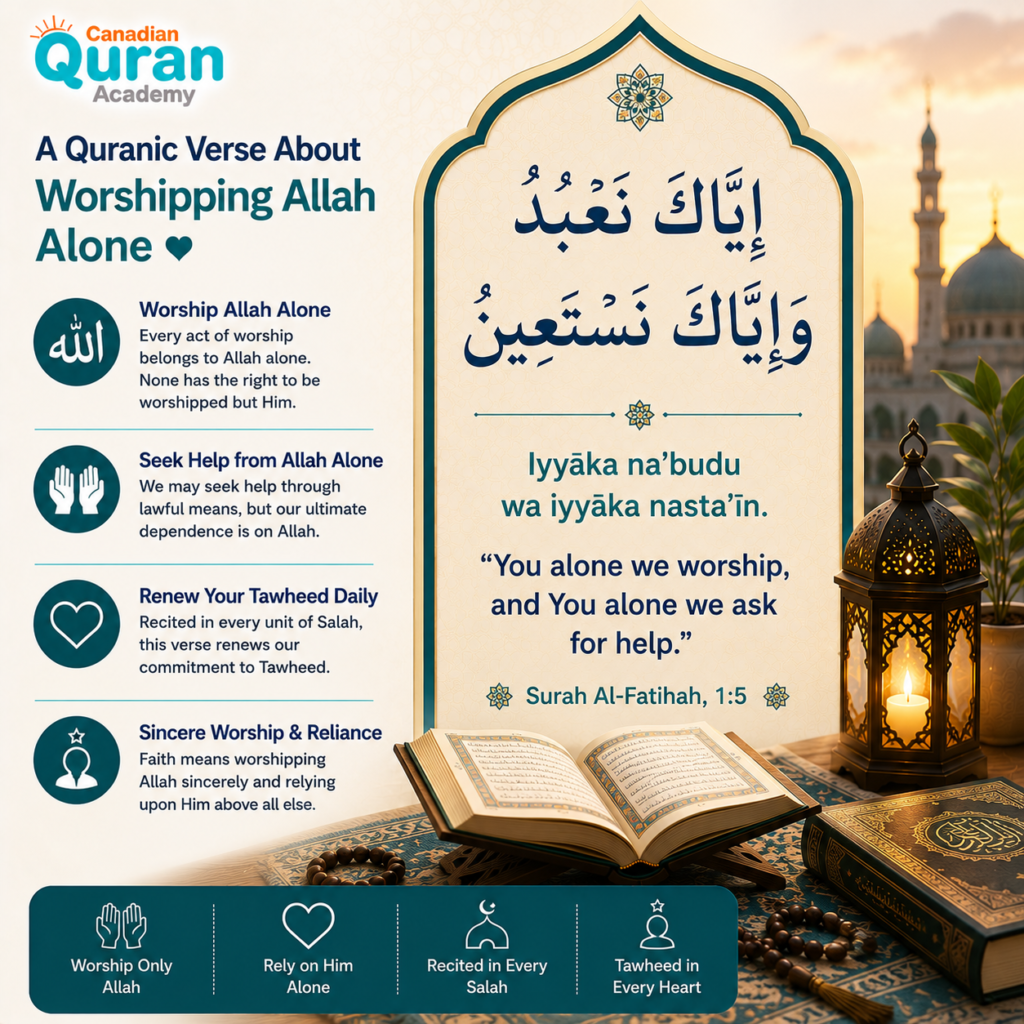
إِيَّاكَ نَعۡبُدُ وَإِيَّاكَ نَسۡتَعِينُ
Iyyāka na’budu wa iyyāka nasta’īn.
“You alone we worship, and You alone we ask for help.” Surah Al-Fatihah, 1:5
This verse beautifully summarizes the believer’s relationship with Allah. It begins by affirming that every form of worship—whether prayer, supplication, remembrance, or obedience—belongs to Allah alone. Nothing and no one should share that devotion.
The verse then reminds believers that while they may seek help through lawful means, their ultimate dependence remains with Allah. Every prayer, every difficulty, and every hope should lead the heart back to Him.
Because Muslims recite this verse in every unit of Salah, it constantly renews their commitment to Tawheed. It is a reminder that faith is not simply believing in Allah’s existence but worshipping Him sincerely and relying upon Him above all else.
2. A Quranic Verse Calling All Humanity to Worship One Lord
The Quran repeatedly invites every human being—not only Muslims—to recognize Allah as their Creator and worship Him alone. This verse presents Tawheed as a universal message for all people.
يَـٰٓأَيُّهَا ٱلنَّاسُ ٱعۡبُدُواْ رَبَّكُمُ ٱلَّذِي خَلَقَكُمۡ وَٱلَّذِينَ مِن قَبۡلِكُمۡ لَعَلَّكُمۡ تَتَّقُونَ
Yā ayyuhan-nāsu’budū Rabbakumu alladhī khalaqakum walladhīna min qablikum la’allakum tattaqūn.
“O mankind, worship your Lord, who created you and those before you, so that you may become righteous.” Surah Al-Baqarah, 2:21
Unlike many verses addressed specifically to believers, this verse begins with the words “O mankind,” showing that Tawheed is a message for every person. Allah invites all humanity to worship Him because He is the Creator of every generation.
The verse links worship directly to creation. Since Allah alone created mankind and sustains every living being, He alone deserves worship. This simple but powerful connection appears throughout the Quran as one of the strongest proofs of Allah’s Oneness.

The verse concludes by explaining that sincere worship leads to taqwa—a deep awareness of Allah that influences every aspect of a believer’s life. Through Tawheed, faith becomes more than a belief; it becomes a way of living with purpose, gratitude, and obedience.
Read More: Quranic Verses About Arabic Language
3. A Quranic Verse About Rejecting False Gods
Believing in Allah alone also means turning away from everything that is worshipped besides Him. This verse explains that true faith is built upon rejecting false gods before embracing belief in Allah.
لَآ إِكۡرَاهَ فِي ٱلدِّينِۖ قَد تَّبَيَّنَ ٱلرُّشۡدُ مِنَ ٱلۡغَيِّۚ فَمَن يَكۡفُرۡ بِٱلطَّـٰغُوتِ وَيُؤۡمِنۢ بِٱللَّهِ فَقَدِ ٱسۡتَمۡسَكَ بِٱلۡعُرۡوَةِ ٱلۡوُثۡقَىٰ لَا ٱنفِصَامَ لَهَاۗ وَٱللَّهُ سَمِيعٌ عَلِيمٌ
Lā ikrāha fid-dīn. Qad tabayyana ar-rushdu minal-ghayy. Faman yakfur biṭ-ṭāghūti wa yu’min billāhi faqad istamsaka bil-‘urwatil-wuthqā lanfiṣāma lahā. Wallāhu Samī’un ‘Alīm.
“There shall be no compulsion in religion. The right course has become clear from the wrong. Whoever rejects false gods and believes in Allah has grasped the firmest handhold that never breaks. And Allah is All-Hearing, All-Knowing.” Surah Al-Baqarah, 2:256
This verse explains that embracing Tawheed involves two essential steps. The first is rejecting Taghut—anything that is worshipped, obeyed, or elevated to a position that belongs only to Allah. The second is placing sincere faith in Allah alone.
The Quran describes this commitment as holding onto the firmest handhold, a powerful image of stability and security. A believer whose heart is attached only to Allah finds strength and guidance even during life’s greatest challenges.
Live Class in Action
Watch how our instructors interact with students in real-time, focusing on interactive methods.
Start Your Quranic Journey in Canada
Join our vibrant community and learn with expert tutors through our flexible online platform.
Claim Your Free Trial4. A Quranic Verse Declaring Allah as the Only Creator
One of the strongest foundations of Tawheed is recognizing that Allah alone created everything that exists. This verse leaves no doubt that the Creator of the heavens and the earth is the only One worthy of worship.
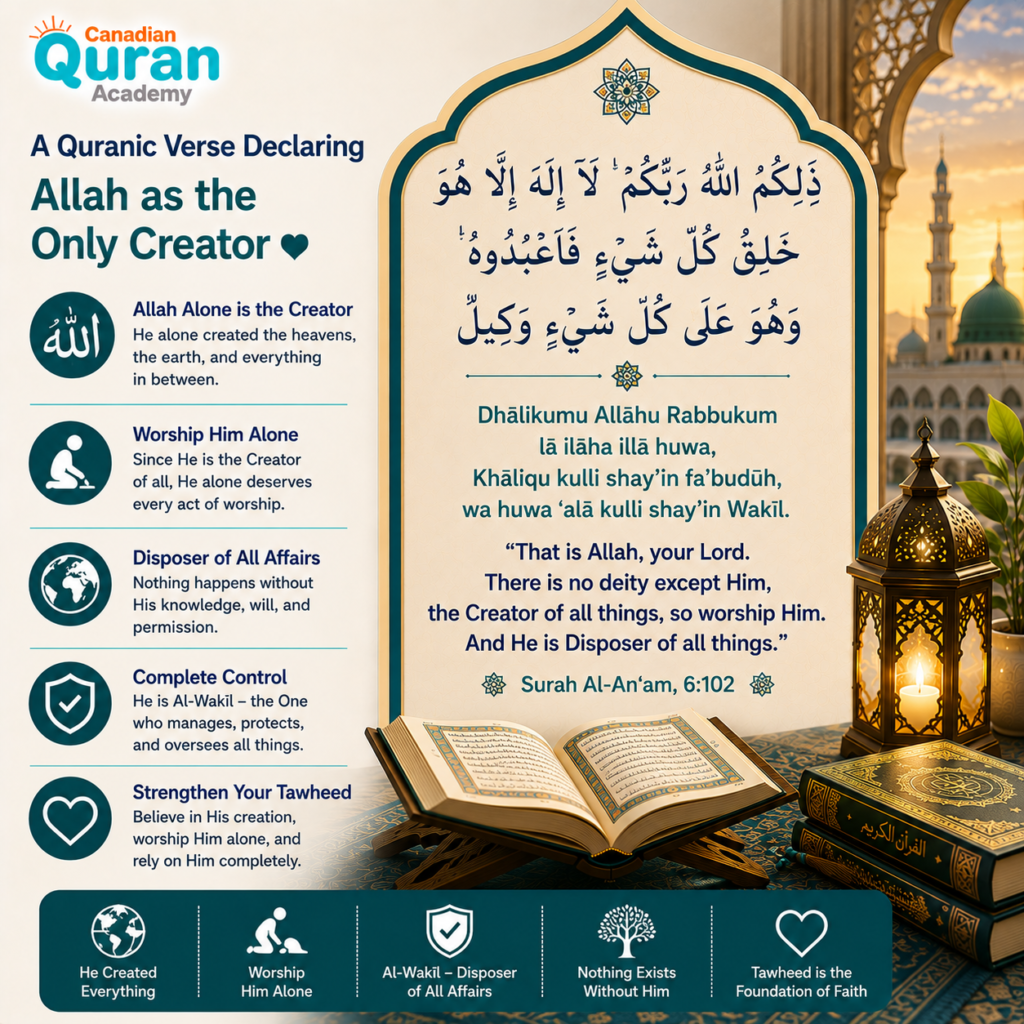
ذَٰلِكُمُ ٱللَّهُ رَبُّكُمۡۖ لَآ إِلَٰهَ إِلَّا هُوَۖ خَٰلِقُ كُلِّ شَيۡءٖ فَٱعۡبُدُوهُۚ وَهُوَ عَلَىٰ كُلِّ شَيۡءٖ وَكِيلٞ
Dhālikumu Allāhu Rabbukum lā ilāha illā huwa, Khāliqu kulli shay’in fa’budūh, wa huwa ‘alā kulli shay’in Wakīl.
“That is Allah, your Lord. There is no deity except Him, the Creator of all things, so worship Him. And He is Disposer of all things.” Surah Al-An’am, 6:102
This verse presents one of the clearest arguments for Tawheed. Allah identifies Himself as the Creator of all things, then immediately commands people to worship Him alone. The connection is straightforward: the One who created everything deserves every act of worship.
The verse also describes Allah as Al-Wakil—the One who manages and oversees all affairs. Every blessing, every provision, and every event occurs by His knowledge and permission. Nothing in creation exists independently of Him.
Read More: Quran Verses for Broken Hearts in Arabic
5. A Quranic Verse Forbidding Shirk Above All Sins
Among Allah’s greatest commands is the instruction never to associate partners with Him. Before mentioning many other obligations, the Quran first establishes Tawheed as the foundation upon which every righteous deed is built.
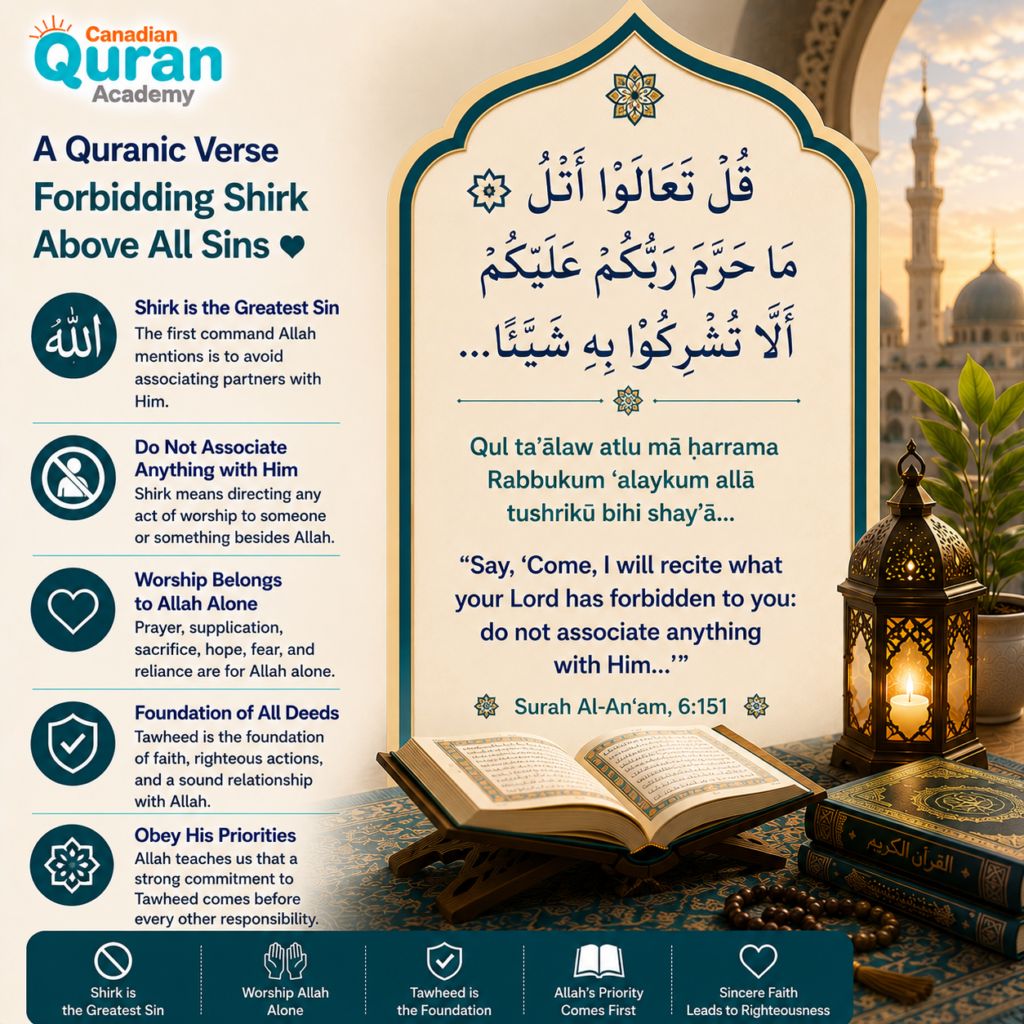
۞قُلۡ تَعَالَوۡاْ أَتۡلُ مَا حَرَّمَ رَبُّكُمۡ عَلَيۡكُمۡۖ أَلَّا تُشۡرِكُواْ بِهِۦ شَيۡـٔٗا…
Qul ta’ālaw atlu mā ḥarrama Rabbukum ‘alaykum allā tushrikū bihi shay’ā…
“Say, ‘Come, I will recite what your Lord has forbidden to you: do not associate anything with Him…'” Surah Al-An’am, 6:151
This verse introduces a list of Allah’s greatest commands, yet the very first instruction is to avoid shirk. That order is significant because it shows that preserving Tawheed is more important than any other obligation.
Shirk means directing any form of worship to someone or something besides Allah. Whether it is prayer, supplication, sacrifice, or seeking unseen help, every act of worship belongs exclusively to Him.
By opening this passage with the prohibition of shirk, Allah teaches believers that a sound relationship with Him comes before every other responsibility. When Tawheed is firmly established in the heart, it becomes the foundation for righteous character, sincere worship, and obedience throughout every aspect of life.
6. A Quranic Verse About the Message of Every Prophet
Although prophets lived in different lands and across different centuries, the message they delivered never changed. Every messenger called people to worship Allah alone and reject every false object of worship.
وَمَآ أَرۡسَلۡنَا مِن قَبۡلِكَ مِن رَّسُولٍ إِلَّا نُوحِيٓ إِلَيۡهِ أَنَّهُۥ لَآ إِلَٰهَ إِلَّآ أَنَا۠ فَٱعۡبُدُونِ
Wa mā arsalnā min qablika mir rasūlin illā nūḥī ilayhi annahu lā ilāha illā Anā fa’budūn.
“We never sent any messenger before you without revealing to him: ‘There is no deity except Me, so worship Me.'” Surah Al-Anbiya, 21:25
This verse beautifully summarizes the mission of every prophet sent by Allah. Despite differences in time, place, and community, each messenger delivered the same essential invitation: worship Allah alone.
The verse demonstrates that Tawheed is not unique to one nation or one period in history. It was the message of Prophet Nuh, Prophet Ibrahim, Prophet Musa, Prophet Isa, and finally Prophet Muhammad (peace be upon them all). While the laws given to different nations varied, Learning the stories of the prophets through our Quran Tafsir and Islamic Studies Courses helps bring these verses to life.

7. A Quranic Verse Showing That Allah Alone Provides
The Quran frequently invites people to reflect on the countless blessings they receive every day. This verse reminds us that the One who provides sustenance, controls life and death, and governs the universe is Allah alone. Recognizing these signs strengthens a believer’s conviction in Tawheed and inspires sincere worship.
قُلۡ مَن يَرۡزُقُكُم مِّنَ ٱلسَّمَآءِ وَٱلۡأَرۡضِ أَمَّن يَمۡلِكُ ٱلسَّمۡعَ وَٱلۡأَبۡصَٰرَ وَمَن يُخۡرِجُ ٱلۡحَيَّ مِنَ ٱلۡمَيِّتِ وَيُخۡرِجُ ٱلۡمَيِّتَ مِنَ ٱلۡحَيِّ وَمَن يُدَبِّرُ ٱلۡأَمۡرَۚ فَسَيَقُولُونَ ٱللَّهُۚ فَقُلۡ أَفَلَا تَتَّقُونَ
Qul man yarzuqukum minas-samā’i wal-arḍi amman yamliku as-sam’a wal-abṣāra wa man yukhrijul-ḥayya minal-mayyiti wa yukhrijul-mayyita minal-ḥayyi wa man yudabbirul-amr. Fasayaqūlūna Allāh. Faqul afalā tattaqūn.
“Say, ‘Who provides for you from the heaven and the earth? Who controls hearing and sight? Who brings the living out of the dead and the dead out of the living? Who governs every affair?’ They will say, ‘Allah.’ Say, ‘Will you not then fear Him?'” Surah Yunus, 10:31
Instead of making a direct statement, Allah asks a series of questions that lead to an obvious answer. Every source of provision, every blessing of sight and hearing, and every event in the universe is under His control. Even those who denied the Prophet ﷺ admitted that Allah alone possesses these powers.
The verse teaches that acknowledging Allah’s Lordship should naturally lead to worshipping Him alone. If He is the One who provides food, gives life, causes death, and manages every affair, then no created being deserves to be worshipped alongside Him.
For believers, this verse encourages daily reflection on Allah’s blessings. Every meal, every breath, and every answered prayer is a reminder that our Provider is one. Recognizing this reality strengthens gratitude, trust, and sincere devotion to Allah alone.
8. A Quranic Verse About the Universal Call to Tawheed
The message of Tawheed was never limited to one prophet or one nation. Allah sent messengers to every community with the same essential invitation: worship Him alone and stay away from false gods.
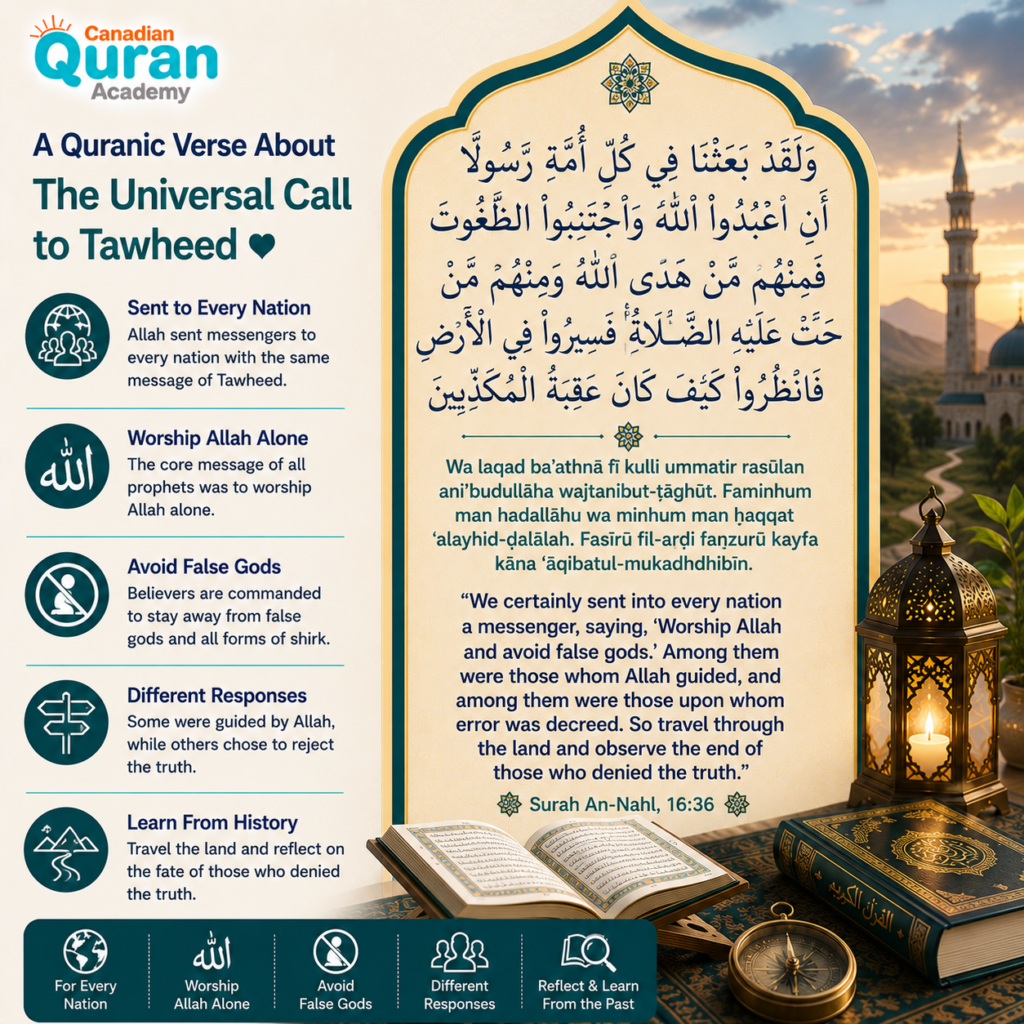
وَلَقَدۡ بَعَثۡنَا فِي كُلِّ أُمَّةٖ رَّسُولًا أَنِ ٱعۡبُدُواْ ٱللَّهَ وَٱجۡتَنِبُواْ ٱلطَّـٰغُوتَۖ فَمِنۡهُم مَّنۡ هَدَى ٱللَّهُ وَمِنۡهُم مَّنۡ حَقَّتۡ عَلَيۡهِ ٱلضَّلَٰلَةُۚ فَسِيرُواْ فِي ٱلۡأَرۡضِ فَٱنظُرُواْ كَيۡفَ كَانَ عَٰقِبَةُ ٱلۡمُكَذِّبِينَ
Wa laqad ba’athnā fī kulli ummatir rasūlan ani’budullāha wajtanibut-ṭāghūt. Faminhum man hadallāhu wa minhum man ḥaqqat ‘alayhid-ḍalālah. Fasīrū fil-arḍi fanẓurū kayfa kāna ‘āqibatul-mukadhdhibīn.
“We certainly sent into every nation a messenger, saying, ‘Worship Allah and avoid false gods.’ Among them were those whom Allah guided, and among them were those upon whom error was decreed. So travel through the land and observe the end of those who denied the truth.” Surah An-Nahl, 16:36
This verse highlights the universality of Tawheed. Allah’s guidance reached every nation through messengers who all delivered the same central message: worship Allah alone and reject everything that is falsely worshipped.
The verse also reminds readers that people responded differently. Some accepted the truth and were guided by Allah, while others rejected the message despite receiving clear evidence. Their stories remain as lessons for future generations.
By reflecting on this verse, believers understand that Tawheed has always been the heart of divine revelation. Regardless of culture, language, or time period, Allah’s invitation has remained unchanged, calling people to sincere worship and complete submission to Him alone.
Read More: Quran Verses About Women’s Clothing in Arabic
9. A Quranic Verse About Worshipping Allah Alone
Some of the strongest Quranic verses about Tawheed are those in which Allah directly declares His Oneness. This verse, revealed to Prophet Musa (Moses, peace be upon him), leaves no doubt about who alone deserves worship.
إِنَّنِيٓ أَنَا ٱللَّهُ لَآ إِلَٰهَ إِلَّآ أَنَا۠ فَٱعۡبُدۡنِي وَأَقِمِ ٱلصَّلَوٰةَ لِذِكۡرِيٓ
Innanī anā Allāhu lā ilāha illā Anā fa’budnī wa aqimiṣ-ṣalāta lidhikrī.
“Indeed, I am Allah. There is no deity except Me, so worship Me and establish prayer for My remembrance.” Surah Ta-Ha, 20:14
This verse contains one of the clearest declarations of Allah’s absolute Oneness in the Quran. Before commanding Prophet Musa to establish prayer, Allah first affirms, “There is no deity except Me.” This sequence shows that correct belief is the foundation upon which every act of worship is built.
Prayer is then mentioned as one of the greatest expressions of Tawheed because it combines remembrance, humility, gratitude, and complete submission to Allah. Every sincere prayer renews a believer’s commitment to worshipping Allah alone.Understanding the Arabic words of these verses can make your worship more meaningful. Our Quranic Arabic Courses help students connect directly with the language of the Quran.
Experience Our Classrooms
Don’t just take our word for it—take a look inside! Watch the videos below to experience our engaging teaching methods and vibrant online classrooms firsthand.
Start Your Quranic Journey in Canada
Join our vibrant community and learn with expert tutors through our flexible online platform.
Claim Your Free TrialLearn Quranic Verses About Tawheed with Canadian Quran Academy
Reading Quranic verses about Tawheed in Arabic is the first step toward strengthening your understanding of Islam’s most important belief. Learning these verses with qualified Quran teachers helps you recite them correctly, understand their meanings in context, and reflect on how the Quran teaches the Oneness of Allah through its words.
At Canadian Quran Academy, we offer:
- Qualified Quran teachers experienced in Quran recitation, Tajweed, and Tafsir
- One-on-one online classes tailored to your learning level and goals
- Step-by-step Quran reading and Quranic Arabic lessons to help you understand the meanings of Allah’s words
- Flexible schedules for children, adults, beginners, and advanced learners
- Courses in Quran recitation, Tajweed, Hifz, Quranic Arabic, and Islamic Studies
- A free trial class with no obligation
Book your free trial class today and deepen your understanding of the Quran while learning the beautiful verses of Tawheed with experienced Quran teachers.
Our Quran Courses
- Quran Online Academy
- Quran Recitation Classes
- Quran Reading Classes
- Online Quran Classes for Kids
- Noorani Qaida Course
- Noorani Qaida Course for Kids
- Weekend Quran Classes
- Intensive Quran Course
- Al-Azhar Quran Course
- Online Tajweed Classes
- Tajweed Course for Kids
- Tajweed Course for Adults
- Tajweed Course for Ladies

Start Your Quranic Journey in Canada
Join our vibrant community and learn with expert tutors through our flexible online platform.
Claim Your Free TrialConclusion
The Quranic verses about Tawheed in Arabic remind every believer that the message of the Quran begins with recognizing Allah’s absolute Oneness. From the opening chapter of the Quran to the stories of the prophets, Allah repeatedly calls humanity to worship Him alone, reject every form of shirk, and place complete trust in their Creator.
By reading these verses in their original Arabic, reflecting on their meanings, and studying them with knowledgeable teachers, Muslims can strengthen their faith and develop a deeper connection with Allah’s guidance. Every verse about Tawheed reinforces the timeless truth that sincere worship belongs to Allah alone, making it the foundation of a believer’s life and the key to success in this world and the Hereafter.
Frequently Asked Questions
Below are answers to some of the most frequently asked questions about Quranic verses about Tawheed in Arabic, their meanings, and how they help strengthen a Muslim’s faith and understanding of Allah’s Oneness.
1. What are the most important Quranic verses about Tawheed in Arabic?
Some of the most well-known Quranic verses about Tawheed in Arabic include Surah Al-Fatihah (1:5), Surah Al-Baqarah (2:21–22), Surah Al-An’am (6:102), Surah Ta-Ha (20:14), and Surah Al-Anbiya (21:25). These verses emphasize Allah’s Oneness, His right to be worshipped, and His role as the Creator and Sustainer of all things.
2. What does Tawheed mean in Islam?
Tawheed is the belief that Allah is One and has no partners. It means recognizing that Allah alone created the universe, controls every affair, and deserves every act of worship, including prayer, supplication, trust, and obedience.
3. Why is Tawheed considered the foundation of Islam?
Tawheed is the foundation of Islam because every prophet called people to worship Allah alone. The acceptance of all acts of worship depends on sincere belief in Allah’s Oneness and avoiding every form of shirk (associating partners with Him).
4. Why should I read Quranic verses about Tawheed in Arabic?
Reading Quranic verses about Tawheed in Arabic allows you to experience Allah’s words in their original language. While translations help explain the meanings, the Arabic text preserves the Quran’s eloquence, precision, and powerful expressions exactly as they were revealed.
5. Which surah focuses most on Tawheed?
Many surahs emphasize Tawheed, including Surah Al-Ikhlas, Surah Al-An’am, Surah Al-Baqarah, Surah Ta-Ha, and Surah Al-Anbiya. Each highlights different aspects of Allah’s Oneness, His attributes, and the importance of worshipping Him alone.
6. How can I better understand Quranic verses about Tawheed?
The best way is to study the Quran with qualified teachers who can explain the Arabic text, Tafsir, and the context of each verse. Learning Quranic Arabic also helps you appreciate the meanings and linguistic beauty of the Quran more deeply.






Leave a Reply