 Quran
Quran
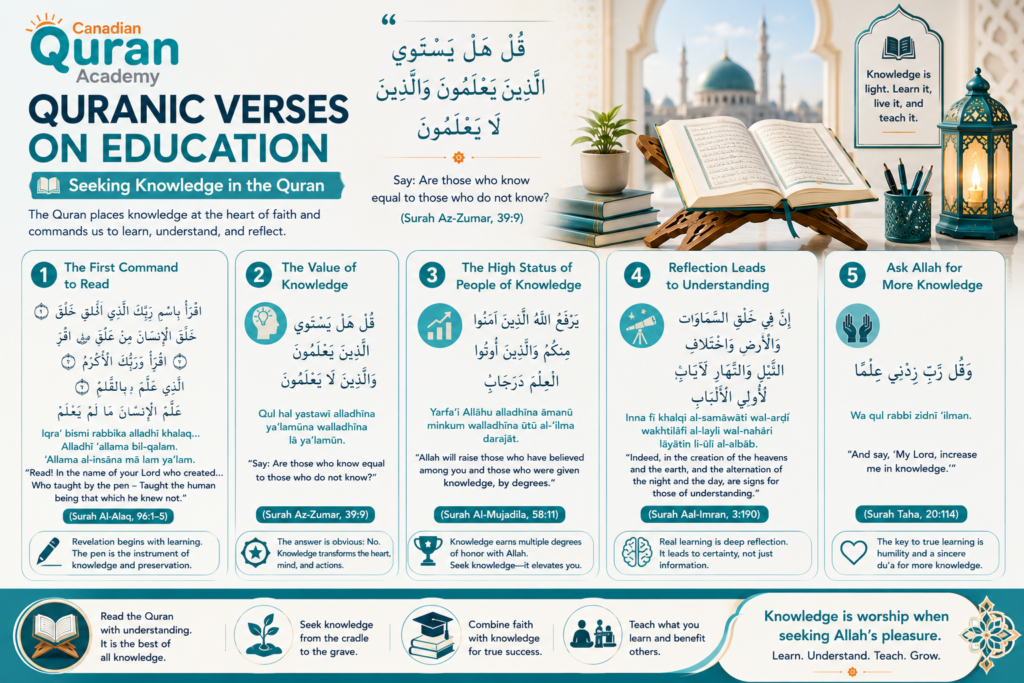
The very first word Allah revealed to humanity was not a command to pray, fast, or give charity It was “Iqra'” — Read.
That single word, delivered in the Cave of Hira to an unlettered Prophet ﷺ, set the entire mission of Islam in motion. And it was not coincidental. It was a statement about the nature of this faith: a religion whose foundation is knowledge, reflection, and the relentless pursuit of understanding.
Yet many Muslims today complete years of secular education while remaining strangers to the Book that Allah called light, healing, and guidance. They recite verses in Arabic without knowing their meanings. They perform prayers without understanding what they are saying to their Lord.
This article walks through the most significant Quranic verses on education in Arabic, unpacks their meanings, and shows how each verse shapes the Islamic vision of what it means to truly learn.
The First Quranic Verses on Education in Arabic: Surah Al-Alaq
The revelation of the Quran did not begin with theology. It began with an instruction to engage with learning.
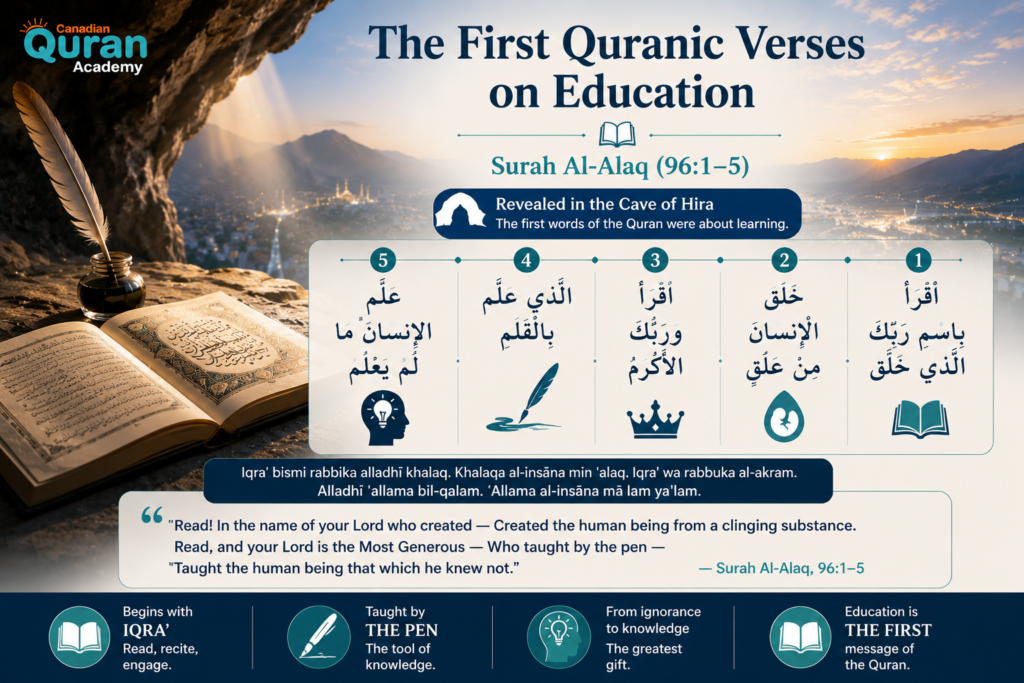
In the Cave of Hira, Jibreel (عليه السلام) appeared to the Prophet Muhammad ﷺ and delivered the first five verses of the Quran — and every single one of them is about education, knowledge, and the pen.
اقْرَأْ بِاسْمِ رَبِّكَ الَّذِي خَلَقَ ﴿١﴾ خَلَقَ الْإِنسَانَ مِنْ عَلَقٍ ﴿٢﴾ اقْرَأْ وَرَبُّكَ الْأَكْرَمُ ﴿٣﴾ الَّذِي عَلَّمَ بِالْقَلَمِ ﴿٤﴾ عَلَّمَ الْإِنسَانَ مَا لَمْ يَعْلَمْ ﴿٥﴾
Iqra’ bismi rabbika alladhī khalaq. Khalaqa al-insāna min ʿalaq. Iqra’ wa rabbuka al-akram. Alladhī ʿallama bil-qalam. ʿAllama al-insāna mā lam yaʿlam.
“Read! In the name of your Lord who created — Created the human being from a clinging substance. Read, and your Lord is the Most Generous — Who taught by the pen — Taught the human being that which he knew not.”— Surah Al-Alaq, 96:1–5
Notice what Allah chose to highlight first: not His power, not paradise, not prohibitions. He opens with iqra’ (read/recite), moves to ʿallama bil-qalam (taught by the pen), and closes with the gift of knowledge from ignorance.
The word iqra’ in Arabic does not mean only “read a text.” Its root (q-r-a) carries the meaning of gathering, reciting, proclaiming, and engaging actively with content. Allah is commanding not passive reception but active intellectual engagement — from the very first moment of revelation.
The pen (al-qalam) is the instrument of recording and preservation. By mentioning it in the third divine communication ever sent to humanity, the Quran establishes that writing, scholarship, and the transmission of knowledge are sacred acts.

Read More: Quranic Verses About Tawheed in Arabic
A Quranic Verse About the Value of Knowledge
One verse in the Quran frames the question of education in the most direct terms possible — as a rhetorical challenge with a self-evident answer.
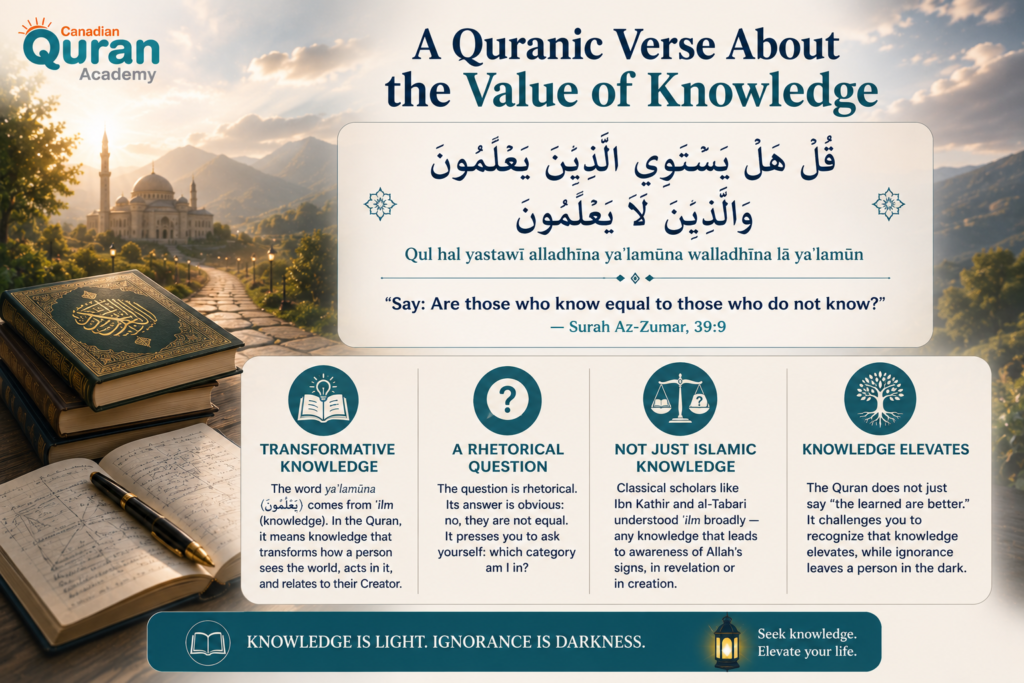
قُلْ هَلْ يَسْتَوِي الَّذِينَ يَعْلَمُونَ وَالَّذِينَ لَا يَعْلَمُونَ
Qul hal yastawī alladhīna yaʿlamūna walladhīna lā yaʿlamūn
“Say: Are those who know equal to those who do not know?” — Surah Az-Zumar, 39:9
The Arabic word at the center of this verse is yaʿlamūna (يَعْلَمُونَ), from the root ʿilm. In the Quran, ʿilm is not data storage. It is transformative knowledge — the kind that changes how a person sees the world, acts in it, and relates to their Creator.
The question is rhetorical. Its answer is obvious: no, they are not equal. But the Quran does not just say “the learned are better.” It frames it as a question you must answer — pressing you to place yourself and ask: which category am I in?
This is also one of the most frequently misunderstood verses in discussions about education in Islam. It does not only refer to Islamic knowledge. Classical commentators including Ibn Kathir and al-Tabari understood ʿilm here broadly — any knowledge that leads to awareness of Allah’s signs, whether in revelation or in creation.
Experience Our Classrooms
Don’t just take our word for it—take a look inside! Watch the videos below to experience our engaging teaching methods and vibrant online classrooms firsthand.
Start Your Quranic Journey in Canada
Join our vibrant community and learn with expert tutors through our flexible online platform.
Claim Your Free TrialA Quranic Verse Affirming the High Status of the People of Knowledge
The Quran does not merely praise knowledge in the abstract. It describes a concrete spiritual and social elevation that comes to those who learn and believe.
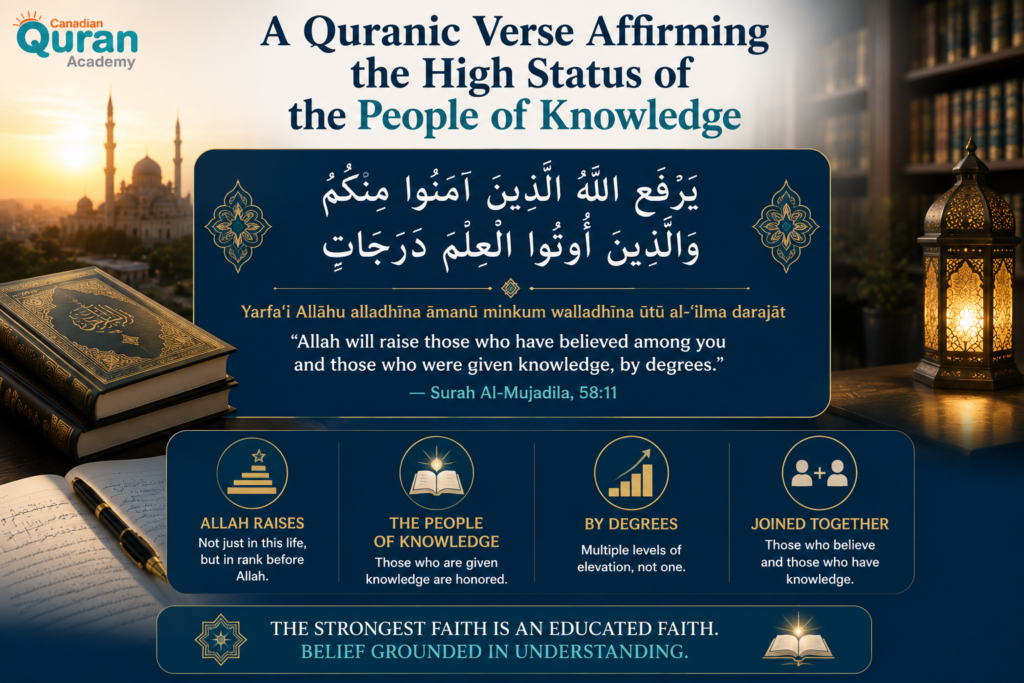
يَرْفَعِ اللَّهُ الَّذِينَ آمَنُوا مِنكُمْ وَالَّذِينَ أُوتُوا الْعِلْمَ دَرَجَاتٍ
Yarfaʿi Allāhu alladhīna āmanū minkum walladhīna ūtū al-ʿilma darajāt
“Allah will raise those who have believed among you and those who were given knowledge, by degrees.” — Surah Al-Mujadila, 58:11
The word darajāt (دَرَجَاتٍ) — “degrees” or “ranks” — is plural. Not one elevation, but multiple, compounding levels of distinction before Allah. And notice how the verse joins two groups: those who believe, and those who were given knowledge. The implication is that the strongest faith is an educated faith — belief grounded in understanding, not only in habit or culture.
This verse has a direct practical implication: seeking Quranic education is not supplementary to being a good Muslim. According to this verse, it is part of how a believer becomes elevated before Allah. Whether you begin with Quran memorization or formal study of Islamic sciences, the act of seeking knowledge is itself an act of worship.
Read More: Quranic Verses on Cleanliness in Arabic
A Quranic Verse on Reflection and Understanding
A critical distinction runs through the Quranic verses on education: the difference between collecting facts and actually thinking.
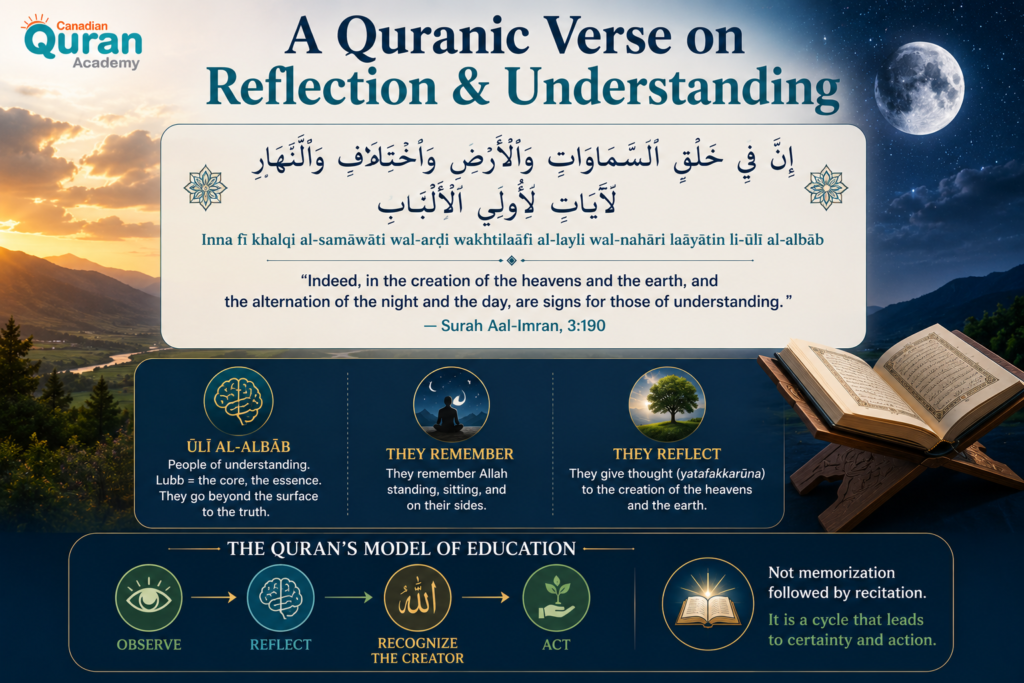
إِنَّ فِي خَلْقِ السَّمَاوَاتِ وَالْأَرْضِ وَاخْتِلَافِ اللَّيْلِ وَالنَّهَارِ لَآيَاتٍ لِّأُولِي الْأَلْبَابِ
Inna fī khalqi al-samāwāti wal-arḍi wakhtilaāfi al-layli wal-nahāri laāyātin li-ūlī al-albāb
“Indeed, in the creation of the heavens and the earth, and the alternation of the night and the day, are signs for those of understanding.”
Ūlī al-albāb (أُولِي الْأَلْبَابِ) — “people of understanding” or “people of deep mind” — appears repeatedly across the Quran. Lubb in Arabic refers to the core or kernel of something, the essence. So ūlī al-albāb are those who get to the core of things, who do not stop at surfaces.
The verse immediately following describes these people as those who “remember Allah standing, sitting, and on their sides, and give thought (yatafakkarūna) to the creation of the heavens and the earth.” Observation leads to remembrance. Remembrance leads to reflection. Reflection leads to deeper certainty.
The Quran’s model of education is not memorization followed by recitation. It is a cycle: observe → reflect → recognize the Creator → act.
The High Status of the People of Knowledge in the Quran
Not knowing is never presented as shameful in the Quran. Refusing to seek knowledge, however, is.
فَاسْأَلُوا أَهْلَ الذِّكْرِ إِن كُنتُمْ لَا تَعْلَمُونَ
Fasʾalū ahla al-dhikri in kuntum lā taʿlamūn
“So ask the people of the message if you do not know.”
Ahl al-dhikr (أَهْلَ الذِّكْرِ) — “people of knowledge” or “people of the reminder” — refers to those who carry authentic knowledge and have the depth to transmit it correctly. This verse creates an entire culture of seeking: it normalizes not knowing, and it positions the qualified teacher as an essential pillar of an educated community.
One practical implication that most articles on this topic miss: this verse imposes a communal obligation. If there are no knowledgeable people in a community, the community as a whole has failed its Quranic duty. This is why supporting qualified Islamic education — for yourself and your children — is not personal preference. It is a response to a Quranic command.

The Only “Increase” the Prophet ﷺ Was Commanded to Ask For
Among all the blessings a person could ask of Allah, the Quran recorded exactly one supplication that the Prophet ﷺ was directly commanded to make — and it was not for wealth, health, or victory.
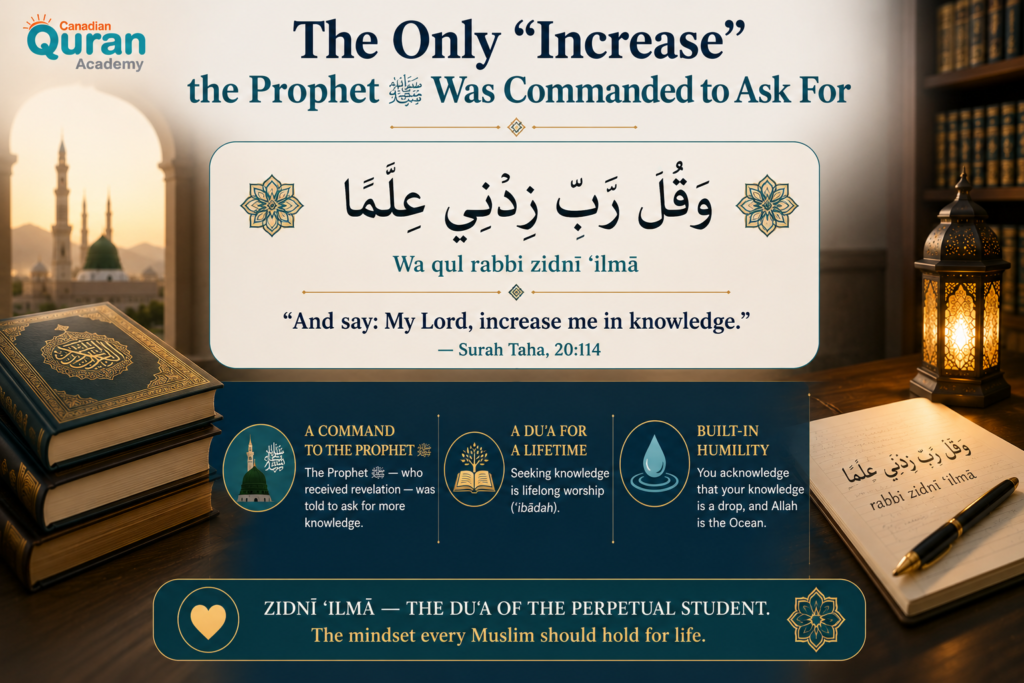
وَقُل رَّبِّ زِدْنِي عِلْمًا
Wa qul rabbi zidnī ʿilmā
“And say: My Lord, increase me in knowledge.” — Surah Taha, 20:114
This supplication frames knowledge-seeking as a lifelong act of ʿibādah (worship). The Prophet ﷺ — who received direct revelation from Allah — was told to ask for more knowledge. If he needed that reminder, the rest of us need it far more.
The du’a also carries a built-in humility: no matter how much you know, you are acknowledging that what you have is a drop, and that the Source of all knowledge is Allah alone. Zidnī ʿilmā is the du’a of the perpetual student — the mindset every Muslim should hold for life.
Experience Our Classrooms
Don’t just take our word for it—take a look inside! Watch the videos below to experience our engaging teaching methods and vibrant online classrooms firsthand.
Start Your Quranic Journey in Canada
Join our vibrant community and learn with expert tutors through our flexible online platform.
Claim Your Free TrialRead More: Quran Verses About Women’s Clothing in Arabic
Continue Your Quran Learning Journey with Canadian Quran Academy
The verses explored in this article show that the Quran places knowledge, reflection, and understanding at the heart of a believer’s relationship with Allah. Learning to read the Quran in its original Arabic allows you to appreciate its vocabulary, grammar, and meanings far beyond what a translation alone can offer.
At Canadian Quran Academy, you’ll study with qualified instructors through structured online programs designed to help you read, understand, and connect with the Quran.
- Read the Quran confidently with correct pronunciation and Tajweed.
- Understand Quranic Arabic through vocabulary, grammar, and verse-by-verse explanations.
- Study with qualified teachers, including Al-Azhar-certified instructors.
- Choose from programs for children, adults, beginners, and advanced learners.
- Enjoy personalized one-on-one online lessons that match your pace and goals.
- Attend classes on a flexible schedule designed for students across Canada.
- Start with a FREE trial class before enrolling.
Book your FREE trial class today and begin exploring the Quran with greater confidence, understanding, and appreciation.
Our Quran Courses
- Quran Online Academy
- Quran Recitation Classes
- Quran Reading Classes
- Online Quran Classes for Kids
- Quran Classes for Adults
- Quran Classes for Female
- Learn Quran Course for Beginners
- Quran Memorization (Hifz) Course
- Hifz Classes for Adults
- Quran Memorization and Hifz Course for Kids
- Quran Hifz Course for Ladies
- Quran Ijazah Program
- Quran Qirat Learning Course
- Quran Tafsir Course
Start Your Quranic Journey in Canada
Join our vibrant community and learn with expert tutors through our flexible online platform.
Claim Your Free TrialConclusion
The Quranic verses on education in Arabic form a coherent, layered vision of what it means to truly know. From the command to read in Surah Al-Alaq, to the challenge of whether the learned and the ignorant can be equal in Surah Az-Zumar, to the locks-on-hearts warning in Surah Muhammad — the Quran consistently insists that faith without knowledge is incomplete, and knowledge without reflection is hollow.
Three things stand out across all these verses. First, ʿilm in the Quran is transformative — it is knowledge that changes how you live, not only what you know. Second, the Quran models a dual-track education: the signs of Allah in scripture and the signs of Allah in creation, both pointing to the same source. Third, the goal of all knowledge, as Surah Fatir makes explicit, is khashyah — awe before Allah. That is the measure of genuine education in Islam.
The Quran is not asking you to become a scholar. It is asking you to remain a student — for life.
Frequently Asked Questions
The Quran’s guidance on education extends beyond acquiring information to include reflection, wisdom, and seeking knowledge from qualified teachers. Below are concise answers to the most frequently asked questions about Quranic verses on education.
What is the first Quranic verse about education?
The first Quranic verse about education is Surah Al-Alaq, 96:1: “Iqra’ bismi rabbika alladhī khalaq” — “Read in the name of your Lord who created.” It was the first revelation sent to the Prophet ﷺ, establishing knowledge and reading as the foundation of the Islamic mission before any ritual or law was revealed.
What does the Quran say about seeking knowledge?
The Quran repeatedly emphasizes seeking knowledge as a religious duty. In Surah Az-Zumar, 39:9, Allah asks whether the learned and the ignorant can be equal — making the value of knowledge explicit. In Surah Al-Mujadila, 58:11, Allah promises to raise believers and the knowledgeable in rank. In Surah Taha, 20:114, the Prophet ﷺ is directly commanded to ask Allah for more knowledge.
What is the Quranic verse about reflection and understanding?
Surah Aal-Imran, 3:190 calls on ūlī al-albāb — “people of understanding” — to see the signs of Allah in the creation of the heavens and the earth. Surah Muhammad 47:24 goes further, warning against those who do not practice tadabbur (deep reflection on the Quran), describing their state as hearts with “locks” on them.
Is education an obligation for all Muslims according to the Quran?
The Quran presents the pursuit of knowledge as a duty for every believer. Surah Al-Alaq opens with a command to all of humanity to read. Surah Al-Mujadila elevates those with knowledge alongside those with faith. Surah Al-Anbiya 21:7 commands Muslims who do not know to ask those who do — establishing not just individual obligation, but communal responsibility toward education.
What does the Quran say about teachers and scholars?
Surah Al-Anbiya, verse 7, directly commands believers to seek out ahl al-dhikr — the people of knowledge — when they do not know. Surah At-Tawbah 9:122 goes further, commanding that a portion of every community dedicate itself to deep understanding (tafaqquh) of the religion and then return to teach others. This verse is the Quranic foundation for the role of the Islamic scholar.
What is the Arabic du’a for knowledge from the Quran?
The Quranic du’a for knowledge is found in Surah Taha, 20:114: رَبِّ زِدْنِي عِلْمًا (Rabbi zidnī ʿilmā) — “My Lord, increase me in knowledge.” It is the only supplication the Prophet ﷺ was directly commanded to make for an increase of something, making it one of the most significant du’as a Muslim can recite.




Leave a Reply