 Quran
Quran
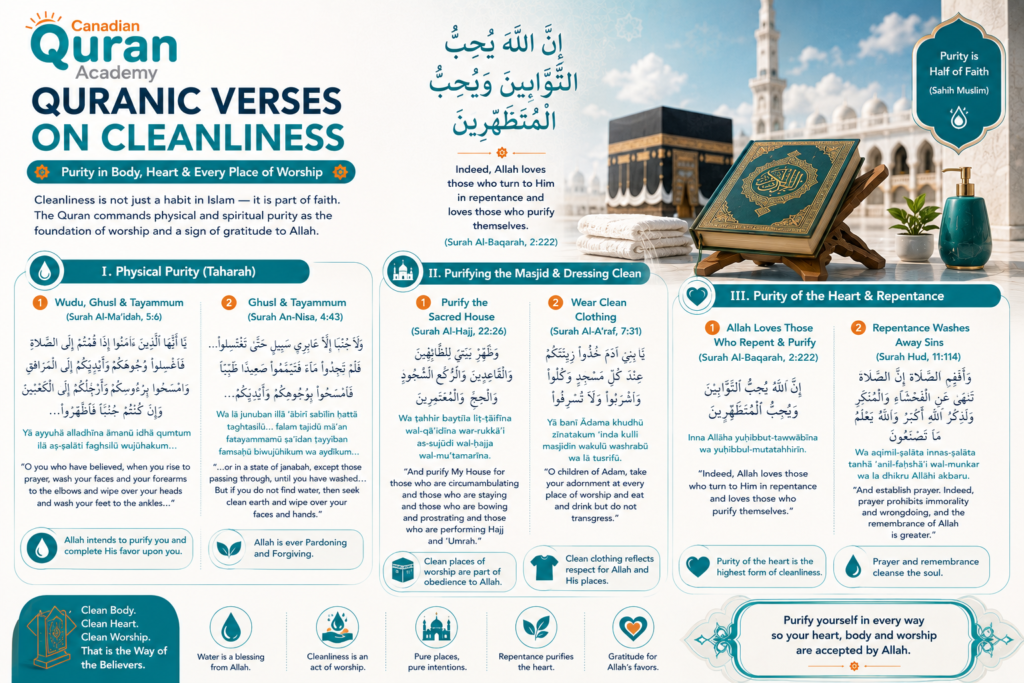
Few topics in the Quran are as practical and spiritually rich as cleanliness. If you search for Quranic verses on cleanliness in Arabic, you will find that the Quran does not treat hygiene as a secondary concern — it places physical and spiritual purity at the foundation of worship itself. From the wording of Wudu instructions in Surah Al-Ma’idah to the cosmic image of purifying rain in Surah Al-Furqan, the Arabic text carries a depth that translation alone rarely captures.
This guide collects the most important verses on cleanliness in their original Arabic with full tashkeel, transliteration, and a short commentary on what each verse is actually doing linguistically — so you can read these ayat correctly, not just approximately.
Quranic Verses on Physical Purity Tahara in Arabic
Physical purity in the Quran is not optional — it is a prerequisite for the most important act of worship a Muslim performs every day.
The Quran addresses Wudu, Ghusl, and Tayammum across two primary ayat. Both appear in Medinan surahs, revealed at a time when the Muslim community was building its daily structure of worship — which tells you that these instructions were given practically, not theoretically.
1. The Quran’s Complete Guidance on Wudu, Ghusl, and Tayammum
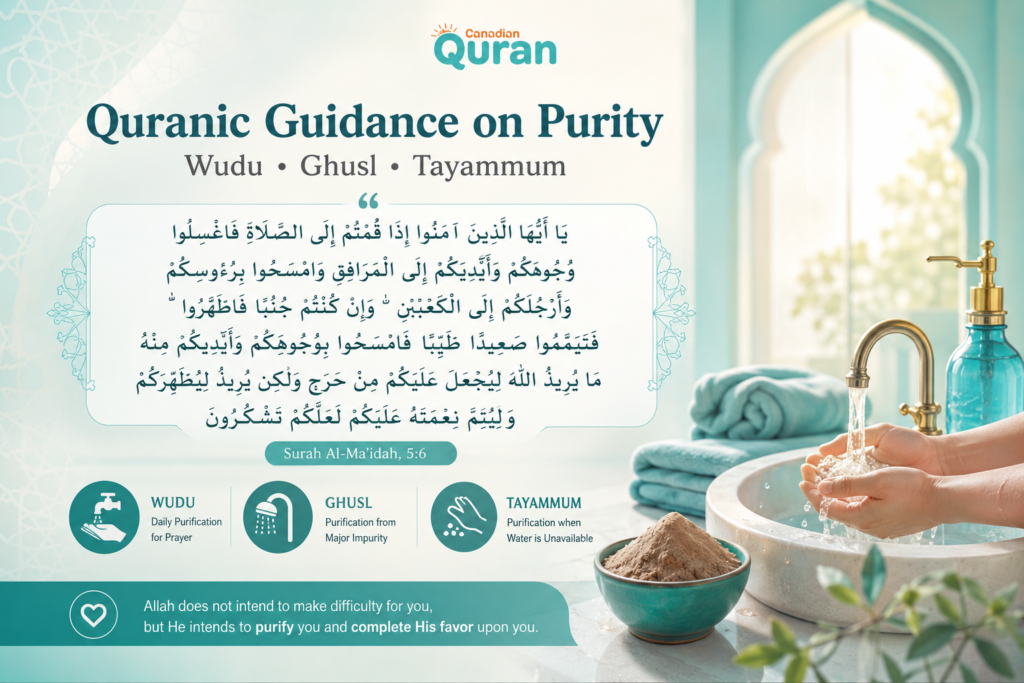
This is the most detailed single verse on physical cleanliness in the entire Quran. It covers Wudu for ordinary states, Ghusl for major ritual impurity, and Tayammum when water is unavailable — all in one ayah.
يَا أَيُّهَا الَّذِينَ آمَنُوا إِذَا قُمْتُمْ إِلَى الصَّلَاةِ فَاغْسِلُوا وُجُوهَكُمْ وَأَيْدِيَكُمْ إِلَى الْمَرَافِقِ وَامْسَحُوا بِرُءُوسِكُمْ وَأَرْجُلَكُمْ إِلَى الْكَعْبَيْنِ ۚ وَإِن كُنتُمْ جُنُبًا فَاطَّهَّرُوا ۚ وَإِن كُنتُم مَّرْضَىٰ أَوْ عَلَىٰ سَفَرٍ أَوْ جَاءَ أَحَدٌ مِّنكُم مِّنَ الْغَائِطِ أَوْ لَامَسْتُمُ النِّسَاءَ فَلَمْ تَجِدُوا مَاءً فَتَيَمَّمُوا صَعِيدًا طَيِّبًا فَامْسَحُوا بِوُجُوهِكُمْ وَأَيْدِيكُم مِّنْهُ ۚ مَا يُرِيدُ اللَّهُ لِيَجْعَلَ عَلَيْكُم مِّنْ حَرَجٍ وَلَٰكِن يُرِيدُ لِيُطَهِّرَكُمْ وَلِيُتِمَّ نِعْمَتَهُ عَلَيْكُمْ لَعَلَّكُمْ تَشْكُرُونَ
Yā ayyuhā alladhīna āmanū idhā qumtum ilā aṣ-ṣalāti faghsilū wujūhakum wa-aydiyakum ilā al-marāfiqi wamsaḥū biru’ūsikum wa-arjulakum ilā al-kaʿbayni wa-in kuntum junuban faṭṭahharū wa-in kuntum marḍā aw ʿalā safarin aw jāʾa aḥadun minkum min al-ghāʾiṭi aw lāmastumu an-nisāʾa falam tajidū māʾan fatayammamū ṣaʿīdan ṭayyiban famsaḥū biwujūhikum wa-aydīkum minh. Mā yurīdu Allāhu li-yajʿala ʿalaykum min ḥarajin wa-lākin yurīdu li-yuṭahhirakum wa-li-yutimma niʿmatahu ʿalaykum laʿallakum tashkurūn.
“O you who have believed, when you rise to [perform] prayer, wash your faces and your forearms to the elbows and wipe over your heads and wash your feet to the ankles. And if you are in a state of janabah, then purify yourselves. But if you are ill or on a journey or one of you comes from the place of relieving himself or you have contacted women and do not find water, then seek clean earth and wipe over your faces and hands with it. Allah does not intend to make difficulty for you, but He intends to purify you and complete His favor upon you that you may be grateful.” — Surah Al-Ma’idah, 5:6
One detail that stands out when reading this verse in Arabic: the closing phrase uses the root ط-هـ-ر (ṭ-h-r, purity) twice — first as لِيُطَهِّرَكُمْ (to purify you) and then the act of Wudu itself is framed not as a ritual obligation but as an act of divine generosity completing His blessing. This shifts the meaning significantly — physical cleanliness in the Quran is not a burden; it is described as نِعْمَة (ni’ma, favor). If you want to study how this Arabic root works across different grammatical forms in the Quran, the Intensive Quran Course at Canadian Quran Academy is structured exactly for that kind of close textual reading.
2. Ghusl and Tayammum in Surah An-Nisa
This earlier Meccan revelation addresses the same practices from a different angle — beginning with a prohibition, then providing the solution.
يَا أَيُّهَا الَّذِينَ آمَنُوا لَا تَقْرَبُوا الصَّلَاةَ وَأَنتُمْ سُكَارَىٰ حَتَّىٰ تَعْلَمُوا مَا تَقُولُونَ وَلَا جُنُبًا إِلَّا عَابِرِي سَبِيلٍ حَتَّىٰ تَغْتَسِلُوا ۚ وَإِن كُنتُم مَّرْضَىٰ أَوْ عَلَىٰ سَفَرٍ أَوْ جَاءَ أَحَدٌ مِّنكُم مِّنَ الْغَائِطِ أَوْ لَامَسْتُمُ النِّسَاءَ فَلَمْ تَجِدُوا مَاءً فَتَيَمَّمُوا صَعِيدًا طَيِّبًا فَامْسَحُوا بِوُجُوهِكُمْ وَأَيْدِيكُمْ ۗ إِنَّ اللَّهَ كَانَ عَفُوًّا غَفُورًا
Yā ayyuhā alladhīna āmanū lā taqrabū aṣ-ṣalāta wa-antum sukārā ḥattā taʿlamū mā taqūlūna wa-lā junuban illā ʿābirī sabīlin ḥattā taghtasilū wa-in kuntum marḍā aw ʿalā safarin aw jāʾa aḥadun minkum min al-ghāʾiṭi aw lāmastumu an-nisāʾa falam tajidū māʾan fatayammamū ṣaʿīdan ṭayyiban famsaḥū biwujūhikum wa-aydīkum. Inna Allāha kāna ʿafuwwan ghafūrā.
“O you who have believed, do not approach prayer while you are intoxicated until you know what you are saying or in a state of janabah, except those passing through [a place of prayer], until you have washed [your whole body]. And if you are ill or on a journey or one of you comes from the place of relieving himself or you have contacted women and do not find water, then seek clean earth and wipe over your faces and your hands [with it]. Indeed, Allah is ever Pardoning and Forgiving.” — Surah An-Nisa, 4:43
Notice that both 5:6 and 4:43 use the phrase صَعِيدًا طَيِّبًا (ṣaʿīdan ṭayyiban, clean earth) for Tayammum. The repetition across two different surahs is deliberate — it is how the Quran establishes legal consistency in its language, a pattern that becomes obvious when you read both verses side by side in Arabic rather than in separate translated excerpts.

Experience Our Classrooms
Don’t just take our word for it—take a look inside! Watch the videos below to experience our engaging teaching methods and vibrant online classrooms firsthand.
Start Your Quranic Journey in Canada
Join our vibrant community and learn with expert tutors through our flexible online platform.
Claim Your Free TrialRead More: Quran Verses About Soulmates in Arabic
Verses on Purifying the Masjid and Dressing Cleanly for Prayer
Beyond personal purity, the Quran extends the command of cleanliness to the places of worship themselves.

The command to purify the Ka’bah appears twice in the Quran — once addressed to Ibrahim (AS) alone, once to Ibrahim and Isma’il (AS) together — emphasizing that cleanliness of the house of Allah is not incidental but foundational.
1. The Quranic Command to Ibrahim (AS) to Purify the Ka’bah
The Quran presents the purification of the Ka’bah as a direct divine command to Prophet Ibrahim (AS). Through this verse, Allah emphasizes that the House of Worship must remain pure and welcoming for all who perform Tawaf, prayer, bowing, and prostration.
وَإِذْ بَوَّأْنَا لِإِبْرَاهِيمَ مَكَانَ الْبَيْتِ أَن لَّا تُشْرِكْ بِي شَيْئًا وَطَهِّرْ بَيْتِيَ لِلطَّائِفِينَ وَالْقَائِمِينَ وَالرُّكَّعِ السُّجُودِ
Wa-idh bawwaʾnā li-Ibrāhīma makāna al-bayti an lā tushrika bī shayʾan wa-ṭahhir baytiya liṭ-ṭāʾifīna wal-qāʾimīna war-rukkaʿi as-sujūd.
“And [mention, O Muhammad], when We designated for Abraham the site of the House, [saying], ‘Do not associate anything with Me and purify My House for those who perform Tawaf and those who stand [in prayer] and those who bow and prostrate.'” — Surah Al-Hajj, 22:26
The command طَهِّرْ (ṭahhir, purify) is in the imperative form — direct, immediate, unconditional. Classical scholars of Tafsir note that the purification commanded here covers both ḥissī (physical cleanliness from filth and idols) and maʿnawī (spiritual purity through correct worship). The two cannot be separated in the Quran’s understanding of the masjid.
2. The Command to Ibrahim and Isma’il (AS) Together
In Surah Al-Baqarah (2:125), Allah renews the command by addressing both Ibrahim (AS) and Isma’il (AS), emphasizing their shared responsibility in preparing the Ka’bah for worship. The verse also broadens the focus by mentioning those who stay in the Sacred Mosque for devotion, highlighting the enduring importance of maintaining a pure place of worship.
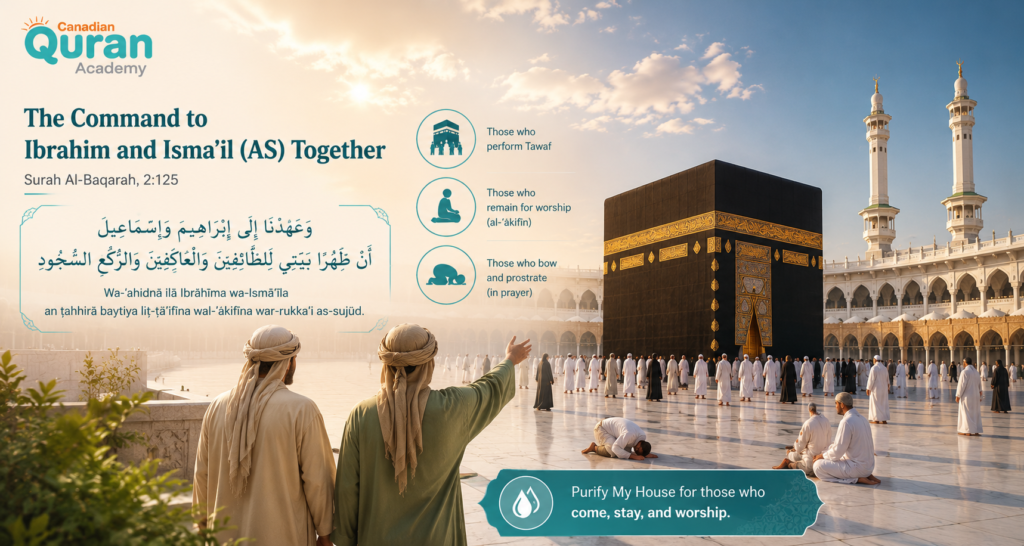
وَعَهِدْنَا إِلَىٰ إِبْرَاهِيمَ وَإِسْمَاعِيلَ أَن طَهِّرَا بَيْتِيَ لِلطَّائِفِينَ وَالْعَاكِفِينَ وَالرُّكَّعِ السُّجُودِ
Wa-ʿahidnā ilā Ibrāhīma wa-Ismāʿīla an ṭahhirā baytiya liṭ-ṭāʾifīna wal-ʿākifīna war-rukkaʿi as-sujūd.
“And We charged Abraham and Ishmael, [saying], ‘Purify My House for those who perform Tawaf and those who are staying [there] for worship and those who bow and prostrate [in prayer].'” — Surah Al-Baqarah, 2:125
This second mention adds الْعَاكِفِينَ (al-ʿākifīn, those who remain for Iʿtikaf) to the first — a detail that expands the people for whom the House must be clean, from worshippers passing through to those staying for extended worship.
3. The Quran’s Early Command to Purify Garments
Among the earliest revelations to Prophet Muhammad ﷺ was a command that linked personal cleanliness with his prophetic mission. In Surah Al-Muddaththir, Allah instructs him to purify his garments, emphasizing that outward purity accompanies spiritual devotion from the very beginning of Islam.
يَا أَيُّهَا الْمُدَّثِّرُ ﴿١﴾ قُمْ فَأَنذِرْ ﴿٢﴾ وَرَبَّكَ فَكَبِّرْ ﴿٣﴾ وَثِيَابَكَ فَطَهِّرْ ﴿٤﴾ وَالرُّجْزَ فَاهْجُرْ ﴿٥﴾
Yā ayyuhā al-muddaththir. Qum fa-andhir. Wa-rabbaka fakabbir. Wa-thiyābaka faṭahhir. War-rujza fahjur.
“O you who covers himself [with a garment]. Arise and warn. And your Lord glorify. And your garments purify. And uncleanliness avoid.” — Surah Al-Muddaththir, 74:1–5
This is among the earliest Meccan revelations. The command وَثِيَابَكَ فَطَهِّرْ (purify your garments) comes directly alongside the commands to worship and warn — proof that from the very first moments of revelation, physical cleanliness was inseparable from the prophetic mission itself.
Read More: Quran Verses for Broken Hearts in Arabic
Quranic Verses on Inner Purity
Physical purity in the Quran is never the endpoint — it points toward something deeper.
The Quran uses the same root ط-هـ-ر for both washing the body and cleansing the heart, making the connection grammatically explicit in a way that English translation cannot fully show.
1. The Quran’s Teaching on Purity of the Heart
In Surah Al-Ahzab (33:53), the Quran connects modest conduct with the purity of the heart. Rather than focusing only on outward actions, the verse highlights how proper boundaries help preserve sincerity, respect, and spiritual cleanliness for everyone involved.
وَإِذَا سَأَلْتُمُوهُنَّ مَتَاعًا فَاسْأَلُوهُنَّ مِن وَرَاءِ حِجَابٍ ۚ ذَٰلِكُمْ أَطْهَرُ لِقُلُوبِكُمْ وَقُلُوبِهِنَّ
Wa-idhā saʾaltumūhunna matāʿan fasʾalūhunna min warāʾi ḥijābin. Dhālikum aṭharu li-qulūbikum wa-qulūbihinn.
“And when you ask [his wives] for something, ask them from behind a partition. That is purer for your hearts and their hearts.” — Surah Al-Ahzab, 33:53
The comparative form أَطْهَرُ (aṭharu, purer) is significant here. It does not say this practice is “required” or “obligatory” as the primary framing — it says it is purer. The Quran uses the language of purity to describe social and moral boundaries, treating inner cleanliness with the same vocabulary as ritual cleanliness.

2. The People of Quba: A Model of Purity
In Surah At-Tawbah (9:108), Allah praises the people of Quba for their commitment to purification and cleanliness. Their love of purity is presented as a noble quality that earns Allah’s love, highlighting the close connection between outward cleanliness and sincere faith.
لَّمَسْجِدٌ أُسِّسَ عَلَى التَّقْوَىٰ مِنْ أَوَّلِ يَوْمٍ أَحَقُّ أَن تَقُومَ فِيهِ ۚ فِيهِ رِجَالٌ يُحِبُّونَ أَن يَتَطَهَّرُوا ۚ وَاللَّهُ يُحِبُّ الْمُطَّهِّرِينَ
La-masjidun ussisa ʿalā at-taqwā min awwali yawmin aḥaqqu an taqūma fīh. Fīhi rijālun yuḥibbūna an yataṭahharū. Wallāhu yuḥibbu al-muṭṭahhirīn.
“A mosque founded on righteousness from the first day is more worthy for you to stand in. Within it are men who love to purify themselves; and Allah loves those who purify themselves.” — Surah At-Tawbah, 9:108
Classical commentators, including Ibn Kathir, note that this verse was revealed in praise of the people of Quba who combined Wudu with Istinja using water — a level of purification beyond what was standard in Arabia at the time. The phrasing وَاللَّهُ يُحِبُّ الْمُطَّهِّرِينَ (Allah loves those who purify themselves) frames cleanliness not as compliance but as a quality that draws Allah’s love — a significant distinction.
3. The Quran’s Purification of Ahl Al-Bayt
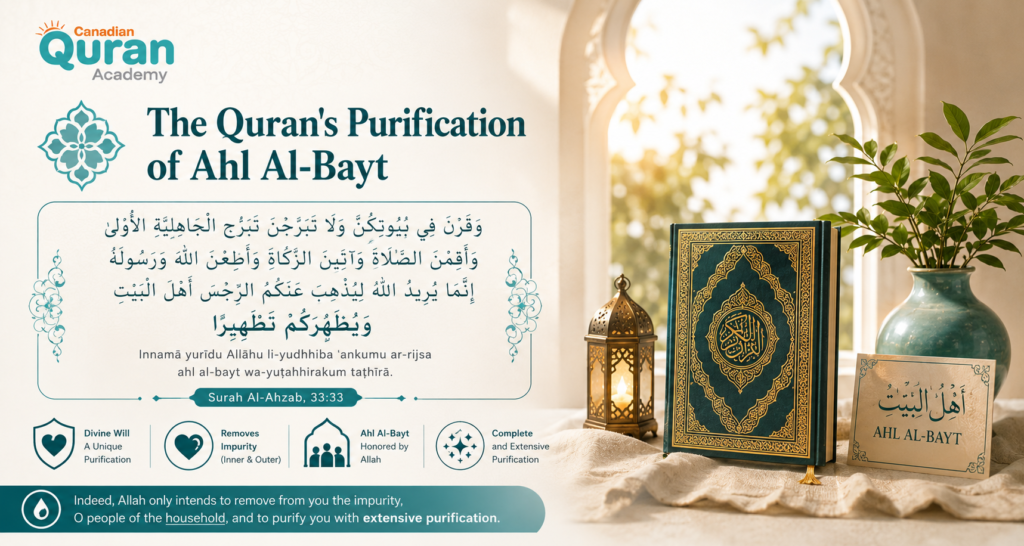
The Quran presents the purification of Ahl Al-Bayt as a unique expression of Allah’s divine will. Through powerful and emphatic language, this verse underscores a comprehensive form of purity that embraces both the inner character and outward conduct.
وَقَرْنَ فِي بُيُوتِكُنَّ وَلَا تَبَرَّجْنَ تَبَرُّجَ الْجَاهِلِيَّةِ الْأُولَىٰ وَأَقِمْنَ الصَّلَاةَ وَآتِينَ الزَّكَاةَ وَأَطِعْنَ اللَّهَ وَرَسُولَهُ ۚ إِنَّمَا يُرِيدُ اللَّهُ لِيُذْهِبَ عَنكُمُ الرِّجْسَ أَهْلَ الْبَيْتِ وَيُطَهِّرَكُمْ تَطْهِيرًا
…Innamā yurīdu Allāhu li-yudhhiba ʿankumu ar-rijsa ahl al-bayt wa-yuṭahhirakum taṭhīrā.
“…Indeed, Allah only intends to remove from you the impurity [of sin], O people of the [Prophet’s] household, and to purify you with [extensive] purification.” — Surah Al-Ahzab, 33:33
The phrase تَطْهِيرًا at the end is a verbal noun (masdar) used for emphasis — often translated as “extensive purification” or “complete purification.” This is the Quran intensifying a word with itself, a rhetorical device (called توكيد) that signals the purification described here is comprehensive and complete, covering every dimension of purity.
Live Class in Action
Watch how our instructors interact with students in real-time, focusing on interactive methods.
Start Your Quranic Journey in Canada
Join our vibrant community and learn with expert tutors through our flexible online platform.
Claim Your Free TrialRead More: Quranic Verses About Parents in Arabic
Deepen Your Understanding of the Quran with Canadian Quran Academy
Reading the Quran in Arabic is only the first step. True understanding comes from recognizing its vocabulary, grammar, and the linguistic patterns that give each verse its full meaning.
At Canadian Quran Academy, our expert-led courses help children and adults read the Quran confidently while exploring the language behind its message. Through personalized one-on-one lessons, you’ll learn to understand the Arabic of verses on purity, worship, and every other topic in the Quran.
- Qualified, experienced 1-on-1 Quran instructors
- Flexible class schedules for Canadian time zones
- Programs for children, adults, beginners, and advanced learners
- Free trial lesson with no commitment
Book your FREE trial class today and begin reading—and understanding—the Quran in the language Allah revealed it.

Our Quran Courses
- Quran Online Academy
- Quran Recitation Classes
- Quran Reading Classes
- Online Quran Classes for Kids
- Quran Classes for Adults
- Quran Classes for Female
- Learn Quran Course for Beginners
- Quran Memorization (Hifz) Course
- Hifz Classes for Adults
- Quran Memorization and Hifz Course for Kids
- Quran Hifz Course for Ladies
- Quran Ijazah Program
- Quran Qirat Learning Course
- Quran Tafsir Course
Start Your Quranic Journey in Canada
Join our vibrant community and learn with expert tutors through our flexible online platform.
Claim Your Free TrialConclusion
The Quranic verses on cleanliness in Arabic cover three distinct levels: physical purity through Wudu, Ghusl, and Tayammum; the cleanliness of the places where Allah is worshipped; and the inner, spiritual purity of the heart. What holds all three together is a single Arabic root — ط-هـ-ر — which the Quran deploys across every dimension of the concept, from washing the face before prayer to purifying the soul from sin.
What translation cannot fully show is how these verses reinforce each other linguistically. Words like طَهُورًا, أَطْهَرُ, يُطَهِّرَكُمْ, and الْمُطَّهِّرِينَ all share this root, building a consistent vocabulary of purity that runs from the earliest Meccan revelations to the Medinan legal instructions. Reading these ayat in Arabic — with tashkeel, with attention to verb forms and case endings — is what makes that pattern visible.
Frequently Asked Questions
Understanding the Quran’s teachings on cleanliness often raises questions about the meanings of its verses, Arabic vocabulary, and practical applications. The answers below provide clear, evidence-based explanations to help deepen your understanding.
What is the most important Quranic verse on cleanliness?
Surah Al-Ma’idah, 5:6 is the most comprehensive. It covers Wudu, Ghusl, and Tayammum in a single ayah, and closes by stating that Allah’s purpose in these instructions is to purify believers and complete His favor upon them — framing physical cleanliness as a divine gift, not a burden.
What Arabic root is used for cleanliness in the Quran?
The primary root is ط-هـ-ر (ṭ-h-r), which appears across the Quran in multiple forms: طَهُور (pure water that purifies), يُطَهِّرَكُمْ (He purifies you), الْمُطَّهِّرِينَ (those who purify themselves), and تَطْهِيرًا (complete purification). Recognizing this root across different forms is one of the key benefits of studying Quranic Arabic directly.
Does the Quran address inner purity as well as physical cleanliness?
Yes. The Quran uses the same ط-هـ-ر root for both. Surah Al-Ahzab, 33:53 describes the Hijab as أَطْهَرُ لِقُلُوبِكُمْ (purer for your hearts), and Surah At-Tawbah, 9:108 praises men who love to purify themselves, closing with وَاللَّهُ يُحِبُّ الْمُطَّهِّرِينَ (Allah loves those who purify themselves).
Why does the Quran command the purification of the Ka’bah twice?
The command appears in Surah Al-Hajj, 22:26 addressed to Ibrahim (AS) alone, and again in Surah Al-Baqarah, 2:125 addressed to both Ibrahim and Isma’il (AS). The second mention adds الْعَاكِفِينَ (those who stay for Iʿtikaf) to the list — expanding the scope of who the House must be kept clean for.
What is the difference between طاهر (ṭāhir) and طهور (ṭahūr) in the Quran?
طَاهِر means something that is itself pure. طَهُور is the intensive form — it means something that is pure and also capable of purifying other things. The Quran uses طَهُورًا specifically for rain water in Surah Al-Furqan, 25:48, and Islamic jurisprudence uses this distinction to determine which types of water are valid for Wudu.
How can I learn to read these verses correctly in Arabic?
Correct recitation requires knowing the short vowels (tashkeel), the rules of Tajweed, and enough basic Arabic grammar to recognize how verb forms like فَاطَّهَّرُوا or يَتَطَهَّرُوا function in context.






Leave a Reply