 Quran
Quran
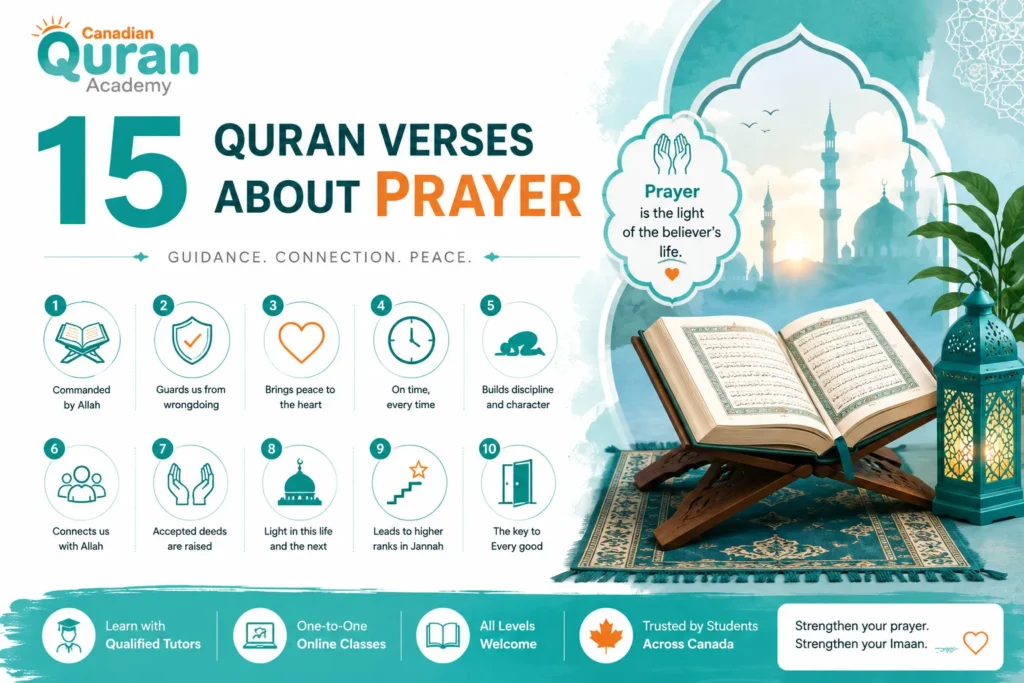
Prayer is the first thing a believer will be asked about on the Day of Judgment, and it is the act Allah mentions most often when describing the righteous throughout the Quran.
If you have searched for Quran verses about prayer in Arabic, you are likely trying to understand not just what Salah looks like, but why the Quran keeps returning to it — in Makkah and Madinah, in commands, in warnings, and in the stories of the prophets themselves.
This article gathers the core Quran verses about prayer in Arabic, each with its transliteration, English meaning, and a short explanation of what it teaches. At Canadian Quran Academy, this is the same material our tutors walk students through when teaching tafsir and correct recitation, so you are getting a structured, classroom-style breakdown rather than a random list of ayat.
By the end, you will be able to recognize these verses when you hear them recited, understand the Arabic terms they use for prayer, and see how the Quran builds a complete picture of Salah — from the first command to establish it, to the warning against neglecting it.
The Quran Verses About Prayer That Command Believers To Establish Salah
Before looking at individual ayat, it helps to know one Arabic detail that changes how you read every verse here: the Quran almost never says “they pray” (yusallun). It says “they establish the prayer” (yuqeemoona as-Salah). That single word, iqamah, comes from the same root used for building something upright and load-bearing — a pillar.
1. Establishing Prayer As A Mark Of True Believers
This first ayah opens the Quran’s description of the righteous, and prayer appears immediately after belief itself.
الَّذِينَ يُؤْمِنُونَ بِالْغَيْبِ وَيُقِيمُونَ الصَّلَاةَ وَمِمَّا رَزَقْنَاهُمْ يُنفِقُونَ
Alladheena yu’minoona bilghaibi wa yuqeemoona as-Salah wa mimma razaqnahum yunfiqoon.
“Who believe in the unseen, establish prayer, and spend out of what We have provided for them.” (Quran 2:3)
Iqamah means performing Salah with its pillars, its timing, and its focus intact — not rushing through the motions, but making it a fixed, load-bearing part of daily life.
2. Guarding The Prayers, Especially The Middle One
This verse shifts from establishing prayer to actively protecting it once it becomes a habit.
حَافِظُوا عَلَى الصَّلَوَاتِ وَالصَّلَاةِ الْوُسْطَىٰ وَقُومُوا لِلَّهِ قَانِتِينَ
Hafidhu ‘ala as-salawati was-salati al-wusta wa qoomoo lillahi qaniteen.
“Guard strictly the prayers, especially the middle prayer, and stand before Allah in a devout manner.” (Quran 2:238)
The command word here, hafidhu, shares a root with hifz — the same word used for Quran memorization. It means active protection, not passive habit. Most scholars identify the “middle prayer” as Asr, since it falls in the middle of a busy day, exactly when a person is most tempted to delay it.
3. Establishing Prayer At Both Ends Of The Day
This ayah ties the five daily prayer times directly to their effect on a person’s character.
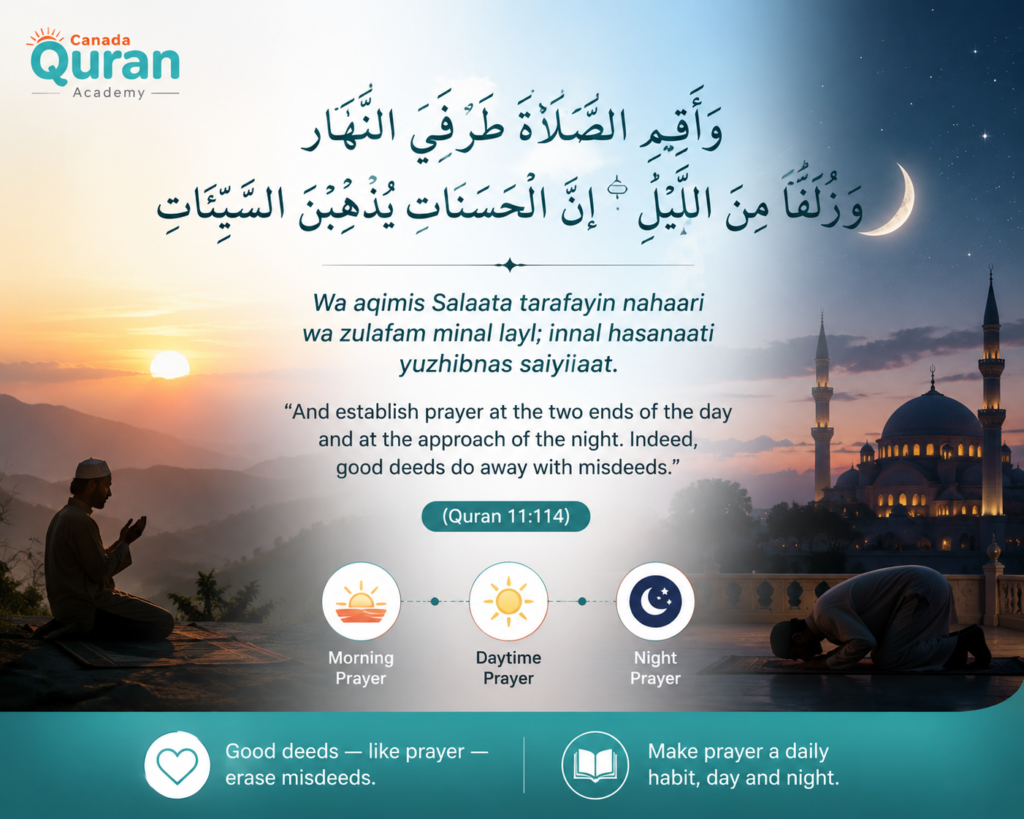
وَأَقِمِ الصَّلَاةَ طَرَفَيِ النَّهَارِ وَزُلَفًا مِّنَ اللَّيْلِ ۚ إِنَّ الْحَسَنَاتِ يُذْهِبْنَ السَّيِّئَاتِ
Wa aqimis Salaata tarafayin nahaari wa zulafam minal layl; innal hasanaati yuzhibnas saiyi aat.
“And establish prayer at the two ends of the day and at the approach of the night. Indeed, good deeds do away with misdeeds.” (Quran 11:114)
The five daily prayers are, in effect, structured around this instruction — the day bookended by worship, with the good of each prayer working against the mistakes made in between.
Understanding what these words mean is one step; being able to recite them with the correct Arabic pronunciation is another.
Many students only realize how much nuance they were missing once they start reading the Quran with a qualified tutor — something our Quran Reading Classes are built around, for students who want to read fluently before moving into memorization.
Read also: 12 Quran Verses About Patience In Arabic And English
Read Also: Quran Verses About Sadaqah in Arabic
Quran Verses On The Heart And Soul Of Prayer
This section moves from the command to pray toward the inner state the Quran expects to accompany it. A prayer performed on time but without presence is still incomplete, which is why the Quran addresses khushoo’ — humility of the heart during Salah — directly.
1. Humility In Prayer As A Mark Of Success
This verse opens Surah Al-Mu’minun by defining what separates a successful believer from someone who merely goes through the motions.
قَدْ أَفْلَحَ الْمُؤْمِنُونَ الَّذِينَ هُمْ فِي صَلَاتِهِمْ خَاشِعُونَ
Qad aflaha al-mu’minoon. Alladheena hum fee salatihim khashi’oon.
“Certainly will the believers have succeeded: they who are during their prayer humbly submissive.” (Quran 23:1-2)
Khushoo’ is defined by classical scholars as a stillness that comes from awareness — when the heart is genuinely humbled before Allah, the body follows: the gaze lowers, the voice softens, and fidgeting stops on its own.
2. Seeking Help Through Patience And Prayer
This ayah pairs Salah with patience as the two tools the Quran offers for handling life’s difficulties.
وَاسْتَعِينُوا بِالصَّبْرِ وَالصَّلَاةِ ۚ وَإِنَّهَا لَكَبِيرَةٌ إِلَّا عَلَى الْخَاشِعِينَ
Wasta’eenu bis-sabri was-Salah; wa innaha lakabeeratun illa ‘ala al-khashi’een.
“And seek help through patience and prayer, and indeed, it is difficult except for the humbly submissive.” (Quran 2:45)
Allah is honest in this verse: prayer combined with patience is described as heavy, lakabeeratun, except for those whose hearts are already softened. The Quran does not promise Salah will feel effortless — it promises it will feel lighter as khushoo’ grows.
A common mistake students make when trying to build khushoo’ is treating it as a mood they wait to feel rather than a skill built through understanding.
Once you know what you are reciting — the actual meaning of Al-Fatihah, or the surah you repeat in every rak’ah — the humility tends to follow naturally, because you are no longer just producing sounds.
Read also: Letter A (أ) In Arabic – The Complete Guide To Alif
Live Class in Action
Watch how our instructors interact with students in real-time, focusing on interactive methods.
Start Your Quranic Journey in Canada
Join our vibrant community and learn with expert tutors through our flexible online platform.
Claim Your Free TrialQuran Verses On The Power And Protection Of Prayer
This section covers what the Quran says Salah actually does for a person beyond the act of worship itself — its practical effect on behavior and its role as remembrance.
1. Prayer As A Shield Against Wrongdoing
This verse states directly what a properly performed prayer is meant to prevent.
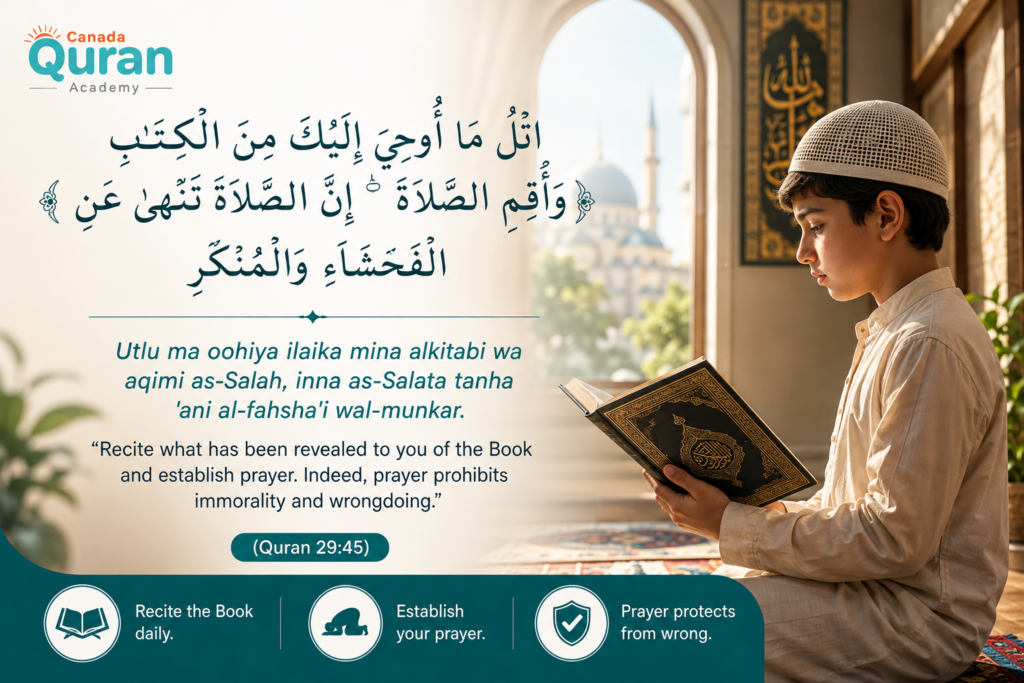
اتْلُ مَا أُوحِيَ إِلَيْكَ مِنَ الْكِتَابِ وَأَقِمِ الصَّلَاةَ ۖ إِنَّ الصَّلَاةَ تَنْهَىٰ عَنِ الْفَحْشَاءِ وَالْمُنكَرِ
Utlu ma oohiya ilaika mina alkitabi wa aqimi as-Salah, inna as-Salata tanha ‘ani al-fahsha’i wal-munkar.
“Recite what has been revealed to you of the Book and establish prayer. Indeed, prayer prohibits immorality and wrongdoing.” (Quran 29:45)
The mechanism here is straightforward rather than mystical: a Salah performed with real focus builds a habit of accountability that carries into the rest of the day. If someone finds themselves struggling with a specific bad habit, this verse suggests looking first at the quality of their prayer, not just the habit in isolation.
2. Prayer Established For The Remembrance Of Allah
This ayah gives the actual reason Allah states for the command to pray, spoken directly to Musa (peace be upon him).
إِنَّنِي أَنَا اللَّهُ لَا إِلَٰهَ إِلَّا أَنَا فَاعْبُدْنِي وَأَقِمِ الصَّلَاةَ لِذِكْرِي
Innanee ana Allahu la ilaha illa ana fa’budnee wa aqimi as-Salata li-dhikree.
“Indeed, I am Allah. There is no deity except Me, so worship Me and establish prayer for My remembrance.” (Quran 20:14)
The reason given is li-dhikree — “for My remembrance.” Five structured pauses a day exist specifically to interrupt the noise of daily life and reset attention toward Allah.
Read Also: Letter Z ز In Arabic – How To Write, Pronounce, And Master Zay
Quran Verses On The Rulings Of Prayer In Arabic
This section moves from the meaning and spirit of Salah to its legal conditions. Salah in the Quran is not only described spiritually — specific verses lay out its rulings (ahkam), including purification, travel, and prayer during danger.
1. Purification Before Prayer
This verse sets out the physical preparation required before Salah, step by step.
يَا أَيُّهَا الَّذِينَ آمَنُوا إِذَا قُمْتُمْ إِلَى الصَّلَاةِ فَاغْسِلُوا وُجُوهَكُمْ وَأَيْدِيَكُمْ إِلَى الْمَرَافِقِ وَامْسَحُوا بِرُءُوسِكُمْ وَأَرْجُلَكُمْ إِلَى الْكَعْبَيْنِ
Yaaa aiyuhal lazeena aamanoo izaa qumtum ilas Salaati faghsiloo wujoohakum wa Aidiyakum ilal maraafiqi wamsahoo biru’oosikum wa arjulakum ilal ka’bayn.
“O you who have believed, when you rise to perform prayer, wash your faces and your forearms to the elbows and wipe over your heads and wash your feet to the ankles.” (Quran 5:6)
This verse continues in the same ayah to describe tayammum (dry purification) for situations where water is unavailable, or when a person is ill or traveling. The rule of thumb it ends on is telling: Allah does not intend hardship, but purification.
Read also: The Arabic Letter Taa (ت) – Pronunciation, Writing, And Meaning
2. Shortening prayer while traveling
This ayah introduces the concession given to travelers, which forms the basis of a specific fiqh ruling.
وَإِذَا ضَرَبْتُمْ فِي الْأَرْضِ فَلَيْسَ عَلَيْكُمْ جُنَاحٌ أَن تَقْصُرُوا مِنَ الصَّلَاةِ
Wa izaa darabtum fil ardi falaisa ‘alaikum junaahun an taqsuroo minas Salaah.
“And when you travel throughout the land, there is no blame upon you for shortening the prayer.” (Quran 4:101)
The Arabic term here, qasr, is the source of the fiqh ruling that allows travelers to shorten four-rak’ah prayers to two. It is framed as a concession — “no blame upon you” — not a weakening of the obligation itself.
3. Prayer in times of fear
This ayah addresses an extreme circumstance: how to maintain Salah while a group is in active danger.
(وَإِذَا كُنتَ فِيهِمْ فَأَقَمْتَ لَهُمُ ٱلصَّلَوٰةَ فَلْتَقُمْ طَآئِفَةٌ مِّنْهُم مَّعَكَ وَلْيَأْخُذُوٓا أَسْلِحَتَهُمْ فَإِذَا سَجَدُوا فَلْيَكُونُوا مِن وَرَآئِكُمْ وَلْتَأْتِ طَآئِفَةٌ أُخْرَىٰ لَمْ يُصَلُّوا فَلْيُصَلُّوا مَعَكَ وَلْيَأْخُذُوا حِذْرَهُمْ وَأَسْلِحَتَهُمْ…)
Wa izaa kunta feehim fa aqamta lahumus Salaawaata faltaqum taa’ifatun minhum ma’aka wal ya’khuzoo aslihatahum fa izaa sajadoo falyakoonoo min waraa’ikum wal ta’ti taa’ifatun ukhraa lam yusalloo falyusalloo ma’aka wal ya’khuzoo hizrahum wa aslihatahum.
“When you ˹O Prophet˺ are ˹campaigning˺ with them and you lead them in prayer, let one group of them pray with you—while armed. When they prostrate themselves, let the other group stand guard behind them. Then the group that has not yet prayed will then join you in prayer—and let them be vigilant and armed…” (Quran 4:102)
It describes the “prayer of fear” (Salat al-Khawf), where a group in a state of danger prays in shifts, half standing guard while the other half prays, then switching. It is one of the clearest examples in the Quran of Salah being adapted to real circumstances without ever being dropped entirely — the obligation flexes in form but never disappears.
Getting these rulings right in practice — knowing exactly how much to shorten, when tayammum applies, how to structure fear prayer — is exactly the kind of detail a structured curriculum covers properly, which is why many adult students eventually move from self-study into a guided track like our Quran Classes for Adults or Learn Quran Course for Beginners.
Quran Verses That Warn Against Neglecting Prayer
This section covers the other side of the Quran’s teaching on Salah: what happens when prayer is delayed, performed carelessly, or abandoned. The Quran balances every promise about prayer with an equally direct warning.
1. Neglecting prayer and following desires
This verse describes what filled the gap once a later generation stopped valuing prayer.
فَخَلَفَ مِن بَعْدِهِمْ خَلْفٌ أَضَاعُوا الصَّلَاةَ وَاتَّبَعُوا الشَّهَوَاتِ ۖ فَسَوْفَ يَلْقَوْنَ غَيًّا
Fakhalafa min ba’dihim khalfun ada’oo as-Salata wattaba’oo ash-shahawat, fasawfa yalqawna ghayyā.
“But there came after them successors who neglected prayer and pursued desires; so they are going to meet evil.” (Quran 19:59)
The sequence in this verse is deliberate: neglect of prayer is named first, and pursuit of desires follows as a consequence, not a separate problem. When the anchor of Salah is lost, the vacuum gets filled by something else.
2. Woe to those heedless of their prayer
This ayah is not directed at people who abandon prayer — it targets something more subtle.
فَوَيْلٌ لِّلْمُصَلِّينَ الَّذِينَ هُمْ عَن صَلَاتِهِمْ سَاهُونَ
Fawaylun lil-musalleen. Alladheena hum ‘an salatihim sahoon.
“So woe to those who pray, who are heedless of their prayer.” (Quran 107:4-5)
Classical commentators explain sahoon (heedlessness) as delaying prayer past its time without excuse, rushing through it without stillness, or praying only to be seen. The body performs Salah; the heart is somewhere else.
3. We were not of those who prayed
This verse is a conversation set in the Hereafter, where the reason for punishment is stated in the sinners’ own words.
مَا سَلَكَكُمْ فِي سَقَرَ قَالُوا لَمْ نَكُ مِنَ الْمُصَلِّينَ
Ma salakakum fee saqar? Qaloo lam naku mina al-musalleen.
“What has caused you to enter Saqar? They will say, ‘We were not of those who prayed.'” (Quran 74:42-43)
The first reason given for entering the Hellfire is not prayer missed occasionally — it is not belonging to “those who prayed” at all. Salah functions here as an identity marker, not just an action, which is part of why the Quran treats its neglect so seriously.
Read Also: Quran Verses for Broken Hearts in Arabic
Quran Verses On Teaching Prayer To Your Family
This section covers a responsibility the Quran places on believers directly: passing Salah on to the people in their household.
1. Enjoining prayer upon your household
This verse instructs believers to actively teach and reinforce prayer within their own family, not assume it will happen on its own.
وَأْمُرْ أَهْلَكَ بِالصَّلَاةِ وَاصْطَبِرْ عَلَيْهَا ۖ لَا نَسْأَلُكَ رِزْقًا ۖ نَّحْنُ نَرْزُقُكَ
Wa’mur ahlaka bis-salati wastabir ‘alayha; la nas’aluka rizqan, nahnu narzuquk.
“And enjoin prayer upon your family and be steadfast therein. We ask you not for provision; We provide for you.” (Quran 20:132)
The command word wastabir is a stronger form of patience than the ordinary sabr — it implies sustained, repeated effort. Waking children for Fajr or reminding a household about Salah rarely works as a one-time instruction; the verse anticipates that and asks for persistence, not a single conversation.
2. The reward of those constant in prayer
This closing verse describes the long-term consistency the Quran rewards, rather than a single moment of devotion.
إِلَّا الْمُصَلِّينَ الَّذِينَ هُمْ عَلَىٰ صَلَاتِهِمْ دَائِمُونَ
Illal-musalleen. Alladheena hum ‘ala salatihim da’imoon.
“Except for those who pray, those who are constant in their prayer.” (Quran 70:22-23)
Da’imoon describes prayer as a constant state, not an occasional event, and the same passage closes by praising those who guard (yuhafizoon) their prayer’s timing and pillars — the same root seen earlier in Surah Al-Baqarah 2:238.
Consistency across a lifetime, not intensity in a single moment, is what the Quran rewards here.
A simple way to hold all of this together is what could be called the establish–humble–guard pattern running through these verses: Salah is first commanded (iqamah), then given its inner life (khushoo’), then protected over time (hifz).
Miss any one of the three and the picture is incomplete — recited without meaning, felt without structure, or performed occasionally without becoming a fixed part of life.
Experience Our Classrooms
Don’t just take our word for it—take a look inside! Watch the videos below to experience our engaging teaching methods and vibrant online classrooms firsthand.
Start Your Quranic Journey in Canada
Join our vibrant community and learn with expert tutors through our flexible online platform.
Claim Your Free TrialStart Reciting The Quran’s Verses On Prayer Correctly Today
This is a direct invitation, not another explanation: here is how to move from reading about these verses to actually reciting them well.
You do not need to guess at pronunciation or rely on translated meaning alone. Book a free trial class with a certified Canadian Quran Academy tutor and start learning proper Tajweed, correct Arabic pronunciation, and the meaning behind the verses you recite five times a day.

Whether you are a complete beginner, a parent looking for Online Quran Classes for Kids, or a sister looking for a comfortable, structured environment through our Quran Classes for Female, there is a track built for where you are starting from.
Our Quran Courses:
- Quran Classes for Adults
- Quran Classes for Female
- Learn Quran Course for Beginners
- Quran Memorization (Hifz) Course
- Hifz Classes for Adults
- Quran Memorization and Hifz Course for Kids
- Quran Hifz Course for Ladies
- Quran Ijazah Program
- Quran Qirat Learning Course
- Quran Tafsir Course
- Noorani Qaida Course
- Noorani Qaida Course for Kids
- Weekend Quran Classes
- Intensive Quran Course
- Al-Azhar Quran Course

Start Your Quranic Journey in Canada
Join our vibrant community and learn with expert tutors through our flexible online platform.
Claim Your Free TrialConclusion
This closing section pulls the five categories of verses back into one picture, and states the one takeaway worth remembering.
The Quran’s verses about prayer in Arabic form a complete picture once read together: Salah is commanded and established (iqamah), given life through humility (khushoo’), described as protection and remembrance, laid out in clear rulings for purification and travel, and defended with direct warnings against neglect.
None of these angles works in isolation — a prayer performed on time but without presence, or one felt deeply but never guarded consistently, is still missing something the Quran asks for.
Reading these ayat in Arabic, alongside their transliteration and meaning, is the first real step toward praying with more understanding rather than by rote. From there, the natural next step is learning to recite them correctly — which is where structured, one-on-one instruction with Canadian Quran Academy makes the difference that self-study usually cannot.
Frequently asked questions
Here are direct answers to the questions most often asked alongside “Quran verses about prayer in Arabic,” to fill in anything this article did not already cover in full.
What is the most important Quran verse about prayer?
There is no single “most important” verse, but Quran 2:238 (“Guard strictly the prayers, especially the middle prayer”) is among the most cited, since it commands active protection of Salah rather than passive habit. Verses like 2:3 and 23:1-2 are equally central because they define what establishing prayer and praying with khushoo’ actually mean.
How many verses in the Quran mention prayer (Salah)?
The Quran mentions Salah and its derivatives (such as yuqeemoona as-Salah and musalleen) well over 90 times across dozens of surahs. This article covers a representative core set, grouped by theme, rather than every single occurrence.
What does “Aqim al-Salah” mean in Arabic?
“Aqim al-Salah” (أَقِمِ الصَّلَاةَ) means “establish the prayer,” using the command form of the root qama, meaning to stand upright or make firm. It is used instead of a simpler word for “pray” to emphasize performing Salah fully and consistently, not just going through its motions.
What is khushoo’ in Salah?
Khushoo’ is humility and presence of heart during prayer, described in Quran 23:1-2 as a mark of successful believers. It is built through understanding what is being recited, not through forcing physical stillness alone.
Can I learn to recite these Quran verses about prayer correctly online?
Yes. Canadian Quran Academy offers live, one-on-one online sessions covering correct pronunciation, Tajweed rules, and the meaning of the verses you recite in Salah, suitable for complete beginners through advanced students.
Do Quran verses about prayer apply the same way to travelers and the sick?
No — the Quran provides specific concessions, such as shortening prayer while traveling (4:101) and using tayammum instead of wudu when water is unavailable or a person is ill (5:6). These are treated as mercies built into the obligation, not exceptions that weaken it.







Leave a Reply