 Quran
Quran
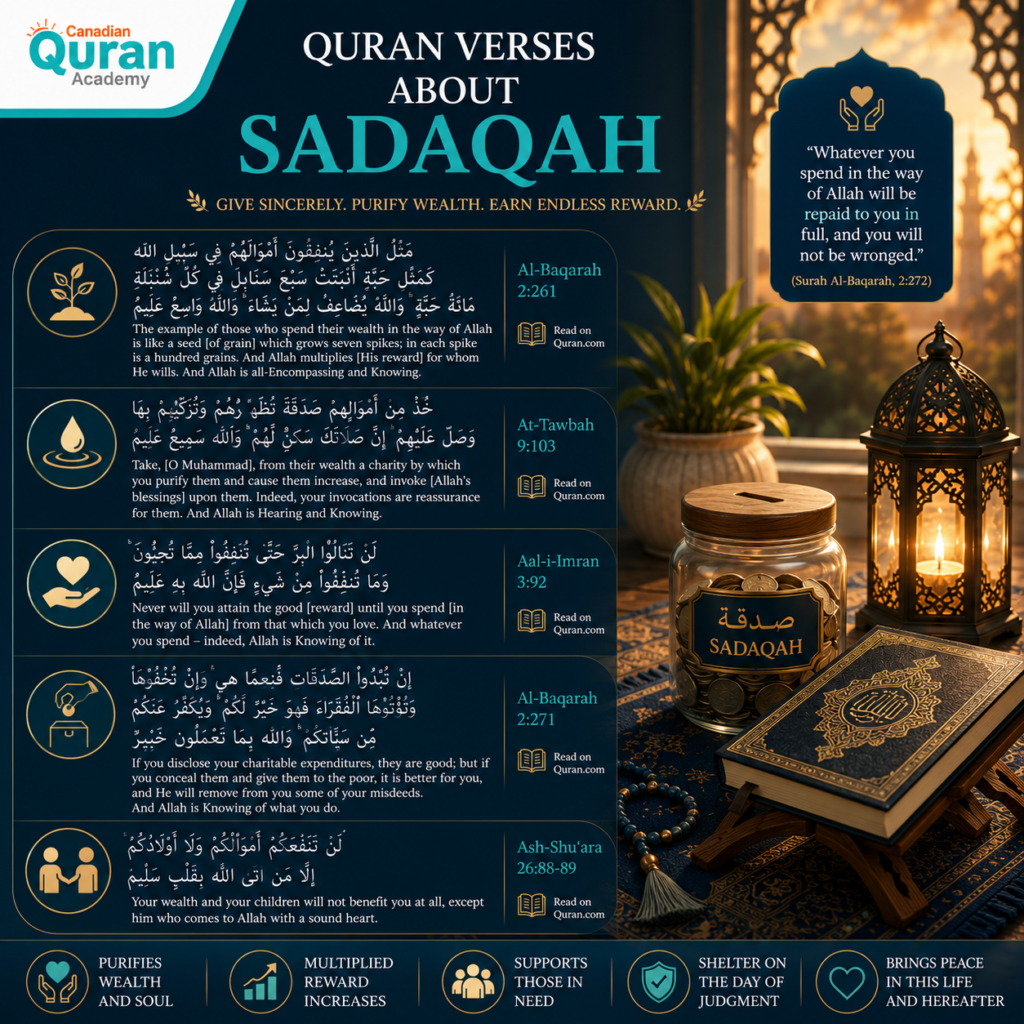
Sadaqah (صَدَقَةٌ) is one of the most repeated ideas in the Quran, and the word itself appears in 19 different verses. Reading quran verses about sadaqah in Arabic, alongside their English meaning, shows how consistently the Quran links charity to sincerity, purification, and reward.
This article collects the clearest Quranic verses on sadaqah and infaq (spending in Allah’s cause), each shown in Arabic with tashkeel, in English translation, and with the exact surah and ayah number linked to quran.com. No hadith are used here — every reference below comes directly from the Quran.
Why the Quran Links Charity to Multiplied Reward?
Sadaqah in the Quran is not treated as a simple transaction. It is described as an investment that grows, using the image of a single seed producing hundreds of grains.
1. The Seed That Grows Into Seven Hundred
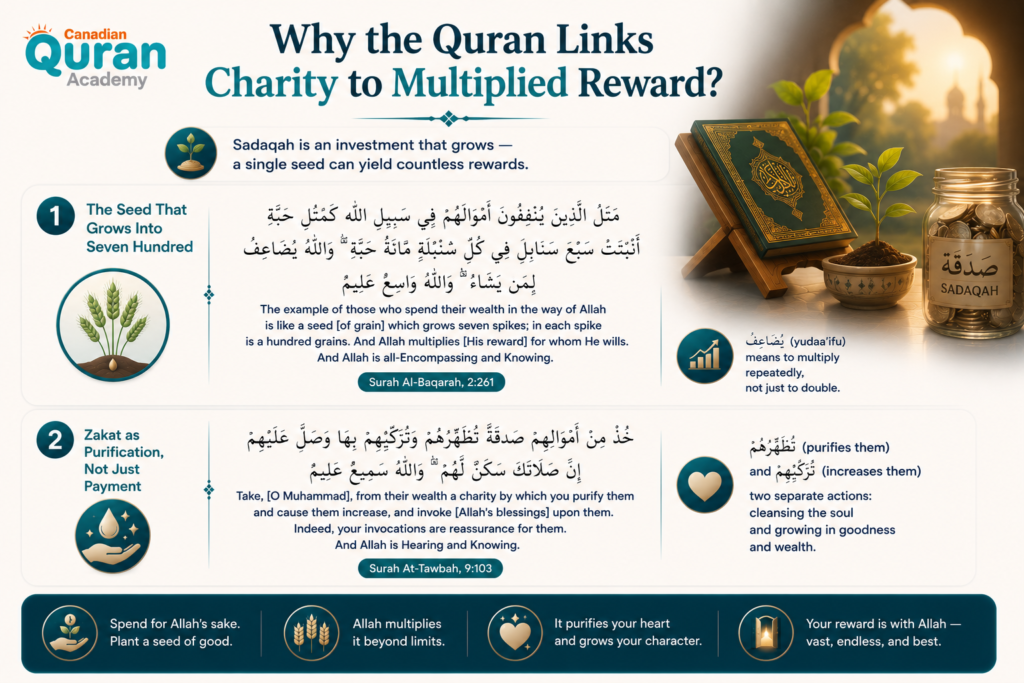
The Quran defines the reward of spending for Allah’s sake through an agricultural image rather than a fixed number, since the multiplication has no set ceiling.
مَّثَلُ الَّذِينَ يُنفِقُونَ أَمْوَالَهُمْ فِي سَبِيلِ اللَّهِ كَمَثَلِ حَبَّةٍ أَنبَتَتْ سَبْعَ سَنَابِلَ فِي كُلِّ سُنبُلَةٍ مِّائَةُ حَبَّةٍ ۗ وَاللَّهُ يُضَاعِفُ لِمَن يَشَاءُ ۗ وَاللَّهُ وَاسِعٌ عَلِيمٌ
“The example of those who spend their wealth in the way of Allah is like a seed [of grain] which grows seven spikes; in each spike is a hundred grains. And Allah multiplies [His reward] for whom He wills. And Allah is all-Encompassing and Knowing.” (Surah Al-Baqarah, 2:261)
The verb يُضَاعِفُ (yudaa’ifu) means to multiply repeatedly, not just to double. This is one of the clearest quran verses about sadaqah in Arabic showing that the return on charity is open-ended rather than fixed.
2. Zakat as Purification, Not Just Payment
Because the root ز ك و behind the word “zakat” carries the meaning of growth and cleansing, this verse frames charity as something that changes the giver, not only the receiver.
خُذْ مِنْ أَمْوَالِهِمْ صَدَقَةً تُطَهِّرُهُمْ وَتُزَكِّيهِم بِهَا وَصَلِّ عَلَيْهِمْ ۖ إِنَّ صَلَاتَكَ سَكَنٌ لَّهُمْ ۗ وَاللَّهُ سَمِيعٌ عَلِيمٌ
“Take, [O Muhammad], from their wealth a charity by which you purify them and cause them increase, and invoke [Allah’s blessings] upon them. Indeed, your invocations are reassurance for them. And Allah is Hearing and Knowing.” (Surah At-Tawbah, 9:103)
تُطَهِّرُهُمْ (purifies them) and تُزَكِّيهِم (increases/sanctifies them) are two separate verbs in this ayah, which is why classical commentators treat zakat as both a cleansing act and a growth mechanism for wealth and character.
If tracing root words like ز ك و across the Quran interests you, our Quranic Arabic course is built around exactly this kind of word-by-word analysis rather than surface-level translation.
Enroll in a FREE Trial Class for Quranic Arabic in Canada

Read More: Quran Verses About Peace in Arabic
How the Quran Describes Sincere Giving?
The Quran teaches that sincere charity is measured by more than the amount given. It emphasizes the quality of what is offered, the sincerity behind it, and the willingness to give from what one truly values for the sake of Allah.
1. Give From What Is Good, Not What You Would Refuse Yourself
The Quran encourages believers to offer the best of what Allah has provided. Charity should reflect gratitude and sincerity, not an attempt to dispose of items that have little value or would not be accepted for oneself.
يَا أَيُّهَا الَّذِينَ آمَنُوا أَنفِقُوا مِن طَيِّبَاتِ مَا كَسَبْتُمْ وَمِمَّا أَخْرَجْنَا لَكُم مِّنَ الْأَرْضِ ۖ وَلَا تَيَمَّمُوا الْخَبِيثَ مِنْهُ تُنفِقُونَ وَلَسْتُم بِآخِذِيهِ إِلَّا أَن تُغْمِضُوا فِيهِ ۚ وَاعْلَمُوا أَنَّ اللَّهَ غَنِيٌّ حَمِيدٌ
“O you who have believed, spend from the good things which you have earned and from that which We have produced for you from the earth. And do not aim toward the defective therefrom, spending [from that] while you would not take it [yourself] except with closed eyes. And know that Allah is Free of need and Praiseworthy.” (Surah Al-Baqarah, 2:267)
طَيِّبَاتِ (tayyibat) means good, wholesome things — not merely lawful ones. The verse closes by reminding the reader that Allah is غَنِيٌّ (Free of need), so the standard of giving exists for the giver’s benefit, not Allah’s.
2. Reaching True Righteousness Through What You Love
True generosity involves sacrifice, not convenience. The Quran teaches that giving from the possessions we value most is a sign of sincere faith and a path toward attaining complete righteousness.
لَن تَنَالُوا الْبِرَّ حَتَّىٰ تُنفِقُوا مِمَّا تُحِبُّونَ ۚ وَمَا تُنفِقُوا مِن شَيْءٍ فَإِنَّ اللَّهَ بِهِ عَلِيمٌ
“Never will you attain the good [reward] until you spend [in the way of Allah] from that which you love. And whatever you spend – indeed, Allah is Knowing of it.” (Surah Aal-i-Imran, 3:92)
الْبِرَّ (al-birr) covers righteousness and goodness in a broad sense, and this verse conditions it specifically on giving from what is loved, moving charity from an obligation into an act of excellence (ihsan).
Why the Quran Prefers Concealed Charity?
The Quran values not only the act of giving but also the intention behind it. While both public and private charity are permissible, it explains why giving quietly is often the more rewarding path.
1. Giving in Secret Is Described as Better
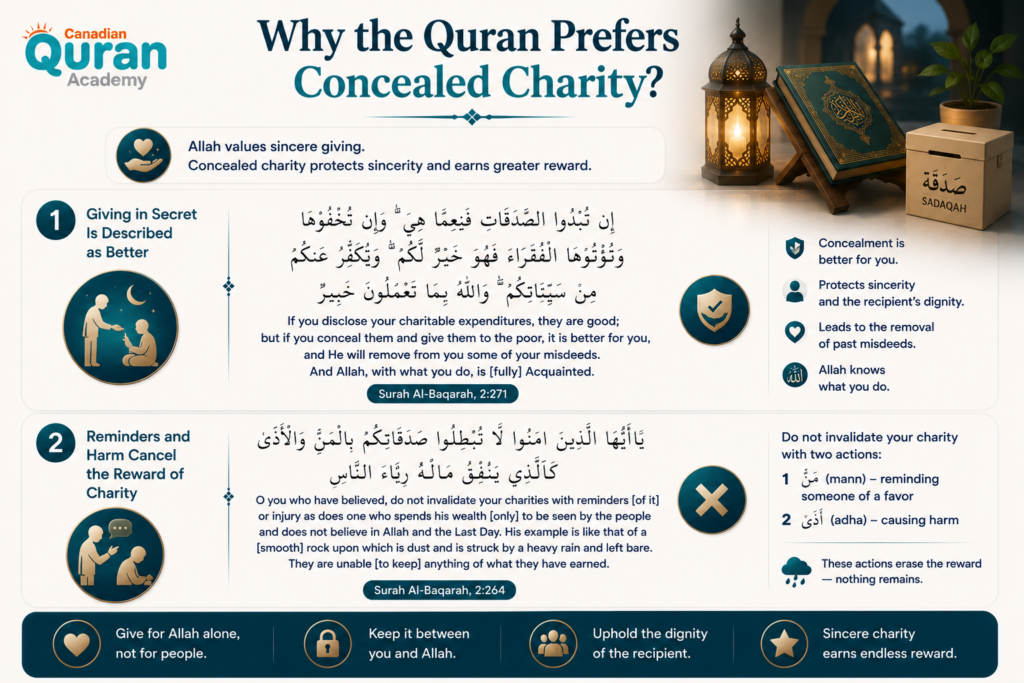
The Quran directly compares public and private charity, concluding that concealed giving carries greater spiritual benefit. It protects sincerity, preserves the recipient’s dignity, and keeps the reward solely for Allah’s sake.
إِن تُبْدُوا الصَّدَقَاتِ فَنِعِمَّا هِيَ ۖ وَإِن تُخْفُوهَا وَتُؤْتُوهَا الْفُقَرَاءَ فَهُوَ خَيْرٌ لَّكُمْ ۚ وَيُكَفِّرُ عَنكُم مِّن سَيِّئَاتِكُمْ ۗ وَاللَّهُ بِمَا تَعْمَلُونَ خَبِيرٌ
“If you disclose your charitable expenditures, they are good; but if you conceal them and give them to the poor, it is better for you, and He will remove from you some of your misdeeds. And Allah, with what you do, is [fully] Acquainted.” (Surah Al-Baqarah, 2:271)
تُخْفُوهَا (conceal it) is described as خَيْرٌ لَّكُمْ (better for you), specifically because concealment removes the risk of seeking praise, and the verse ties this act directly to the removal of past misdeeds.
2. Reminders and Harm Cancel the Reward of Charity
A charitable gift should end with the act of giving, not continue through reminders or humiliation. The Quran warns that hurting the recipient or seeking recognition afterward can nullify the spiritual reward of charity.
يَا أَيُّهَا الَّذِينَ آمَنُوا لَا تُبْطِلُوا صَدَقَاتِكُم بِالْمَنِّ وَالْأَذَىٰ كَالَّذِي يُنفِقُ مَالَهُ رِئَاءَ النَّاسِ
“O you who have believed, do not invalidate your charities with reminders [of it] or injury as does one who spends his wealth [only] to be seen by the people and does not believe in Allah and the Last Day. His example is like that of a [smooth] rock upon which is dust and is struck by a heavy rain and left bare. They are unable [to keep] anything of what they have earned.” (Surah Al-Baqarah, 2:264)
مَنٌّ (mann, reminding someone of a favor) and أَذَىٰ (adha, causing harm) are named as the two specific actions that erase the reward — this is a rare case where the Quran gives a precise mechanism for how a good deed can be nullified, rather than a general warning.
Live Class in Action
Watch how our instructors interact with students in real-time, focusing on interactive methods.
Start Your Quranic Journey in Canada
Join our vibrant community and learn with expert tutors through our flexible online platform.
Claim Your Free TrialRead More: Quranic Verses About Water in Arabic
Consistency in Giving and Freedom From Stinginess
The Quran encourages charity as a lifelong habit rather than an occasional act. It praises those who give consistently and teaches that true generosity begins with overcoming the soul’s natural tendency toward stinginess.
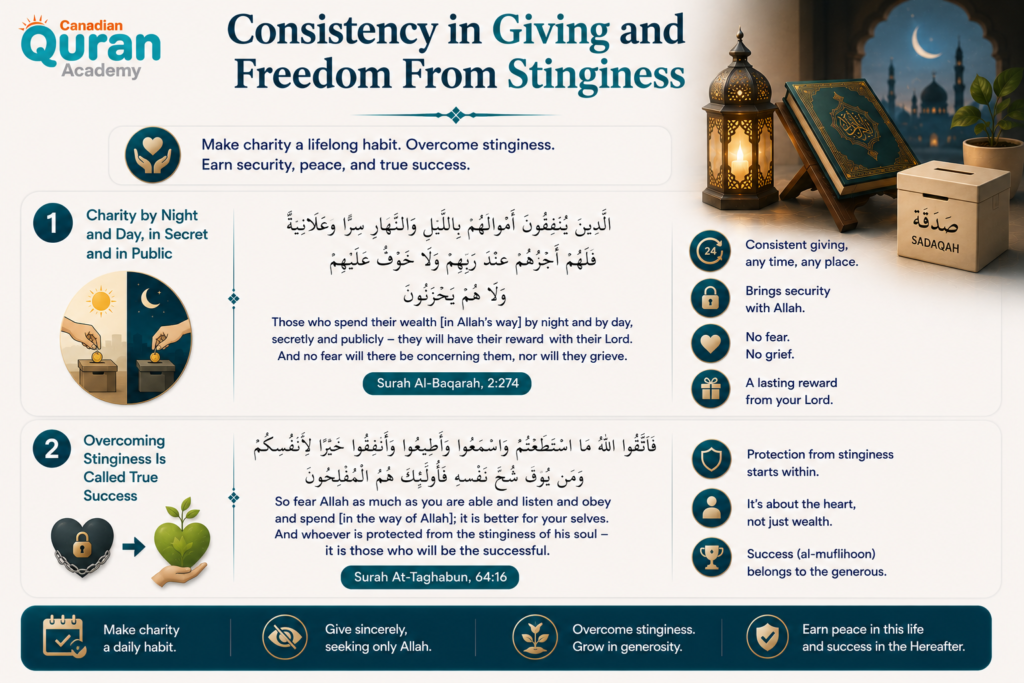
1. Charity by Night and Day, in Secret and in Public
The Quran honors believers who make charity a regular part of their lives, regardless of the time or circumstance. Their consistency reflects sincere devotion and is rewarded with lasting security and peace from Allah.
الَّذِينَ يُنفِقُونَ أَمْوَالَهُم بِاللَّيْلِ وَالنَّهَارِ سِرًّا وَعَلَانِيَةً فَلَهُمْ أَجْرُهُمْ عِندَ رَبِّهِمْ وَلَا خَوْفٌ عَلَيْهِمْ وَلَا هُمْ يَحْزَنُونَ
“Those who spend their wealth [in Allah’s way] by night and by day, secretly and publicly – they will have their reward with their Lord. And no fear will there be concerning them, nor will they grieve.” (Surah Al-Baqarah, 2:274)
The pairing of لَا خَوْفٌ (no fear) with وَلَا هُمْ يَحْزَنُونَ (nor will they grieve) is a specific Quranic formula reserved for people whose state with Allah is secure — it appears attached to consistent givers here rather than a one-time act of charity.
2. Overcoming Stinginess Is Called True Success
Generosity is not only about wealth but also about the condition of the heart. The Quran identifies freedom from greed and stinginess as a defining quality of those who achieve true success in this life and the Hereafter.
فَاتَّقُوا اللَّهَ مَا اسْتَطَعْتُمْ وَاسْمَعُوا وَأَطِيعُوا وَأَنفِقُوا خَيْرًا لِّأَنفُسِكُمْ ۗ وَمَن يُوقَ شُحَّ نَفْسِهِ فَأُولَٰئِكَ هُمُ الْمُفْلِحُونَ
“So fear Allah as much as you are able and listen and obey and spend [in the way of Allah]; it is better for your selves. And whoever is protected from the stinginess of his soul – it is those who will be the successful.” (Surah At-Taghabun, 64:16)
شُحَّ نَفْسِهِ (the stinginess of one’s own soul) is framed as an internal condition to be protected from, not simply a lack of money — the verse makes success (الْمُفْلِحُونَ) conditional on overcoming that trait specifically.
Understanding how a single Arabic root like ش ح ح shapes an entire verse’s meaning is part of what our Islamic studies courses work through alongside tafsir and Quranic vocabulary.
Book a FREE Trial Class for Our Islamic Studies Courses in Canada

Read More: Quranic Verses About Tawheed in Arabic
Charity, Equal Reward, and Pure Intention
The Quran concludes its guidance on charity by focusing on the giver rather than the gift. It emphasizes that Allah rewards sincere generosity equally, regardless of gender, and values intentions that seek His pleasure alone.
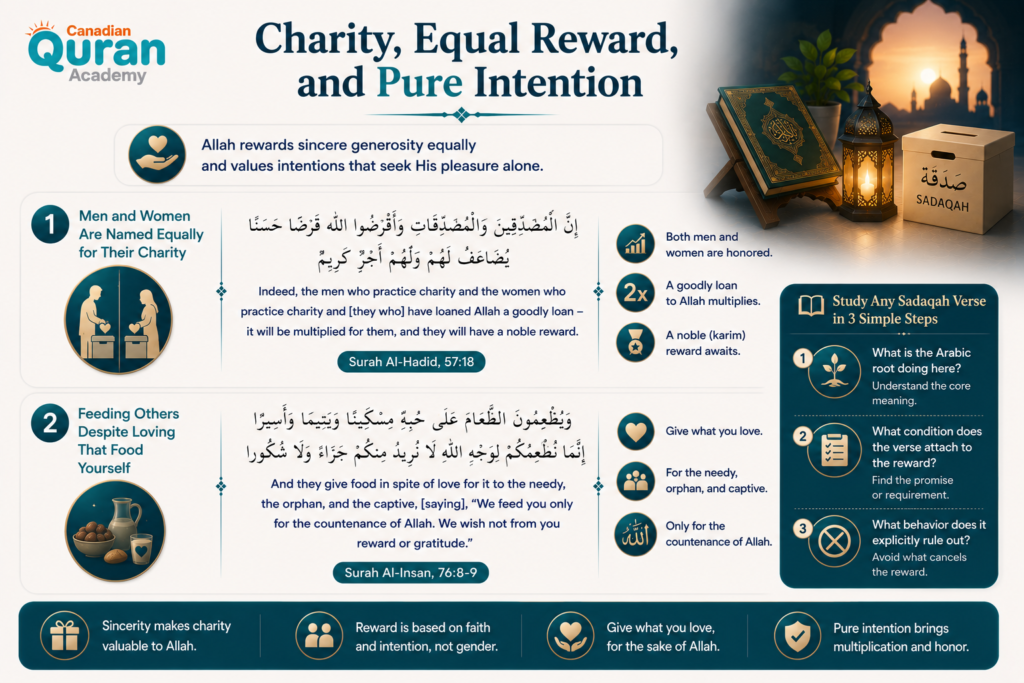
1. Men and Women Are Named Equally for Their Charity
The Quran explicitly recognizes both believing men and believing women for their charitable giving. By naming them together, it affirms that the promise of multiplied reward is based on faith and sincerity, not on gender.
إِنَّ الْمُصَّدِّقِينَ وَالْمُصَّدِّقَاتِ وَأَقْرَضُوا اللَّهَ قَرْضًا حَسَنًا يُضَاعَفُ لَهُمْ وَلَهُمْ أَجْرٌ كَرِيمٌ
“Indeed, the men who practice charity and the women who practice charity and [they who] have loaned Allah a goodly loan – it will be multiplied for them, and they will have a noble reward.” (Surah Al-Hadid, 57:18)
قَرْضًا حَسَنًا (a goodly loan) is a repeated Quranic image where spending is framed as a loan to Allah — one that is described here as multiplied (يُضَاعَفُ) with a reward described as كَرِيمٌ (noble/honorable), not merely large.
2. Feeding Others Despite Loving That Food Yourself
The highest form of charity is giving what you value while expecting nothing in return. The Quran presents this as a model of pure sincerity, where every act of generosity is done solely to earn Allah’s pleasure rather than human recognition or gratitude.
وَيُطْعِمُونَ الطَّعَامَ عَلَىٰ حُبِّهِ مِسْكِينًا وَيَتِيمًا وَأَسِيرًا إِنَّمَا نُطْعِمُكُمْ لِوَجْهِ اللَّهِ لَا نُرِيدُ مِنكُمْ جَزَاءً وَلَا شُكُورًا
“And they give food in spite of love for it to the needy, the orphan, and the captive, [saying], ‘We feed you only for the countenance of Allah. We wish not from you reward or gratitude.'” (Surah Al-Insan, 76:8-9)
لِوَجْهِ اللَّهِ (for the countenance/face of Allah) is a specific phrase used elsewhere in the Quran to mark the highest standard of sincerity — action done for no audience and no expectation of thanks at all.
A quick way to check your own understanding of a verse like this is to ask three questions before reciting or applying it: what is the Arabic root doing here, what condition does the verse attach to the reward, and what behavior does it explicitly rule out. Running any sadaqah verse through those three questions is a simple framework for moving from reading a translation to actually studying the ayah.
Experience Our Classrooms
Don’t just take our word for it—take a look inside! Watch the videos below to experience our engaging teaching methods and vibrant online classrooms firsthand.
Start Your Quranic Journey in Canada
Join our vibrant community and learn with expert tutors through our flexible online platform.
Claim Your Free TrialStudy These Quran Verses in Their Original Arabic at The Canadian Quran Academy
Reading a translation of these Quran verses is an excellent starting point—but understanding their Arabic wording, grammar, and deeper meanings comes through structured study with a qualified teacher rather than self-study alone.
The Canadian Quran Academy offers:
- Qualified Quran and Arabic instructors with expertise in Quranic Arabic, Tajweed, and Tafsir
- Personalized 1-on-1 online sessions tailored to your reading level and learning goals
- Structured lessons that combine Quran recitation, Quranic Arabic, vocabulary, and verse-by-verse understanding
- Flexible scheduling across all Canadian time zones, including mornings, evenings, and weekends
- Programs for adults, children, beginners, and students seeking a deeper understanding of the Quran
- A free trial lesson with no commitment required
Book your free trial lesson at The Canadian Quran Academy and start studying these verses in the original Arabic with confidence and expert guidance.

Our Quran Courses
- Quran Online Academy
- Quran Recitation Classes
- Quran Reading Classes
- Online Quran Classes for Kids
- Quran Classes for Adults
- Quran Classes for Female/Sisters
- Learn Quran for Beginners
- Quran Memorization (Hifz) Course
- Hifz Classes for Adults
- Quran Memorization and Hifz for Kids
- Quran Hifz for Ladies
- Quran Ijazah Program
- Quran Qirat Learning Course
- Quran Tafsir Course
- Noorani Qaida Course
- Noorani Qaida Course for Kids
- Weekend Quran Classes
- Intensive Quran Course
- Al-Azhar Quran Course
Start Your Quranic Journey in Canada
Join our vibrant community and learn with expert tutors through our flexible online platform.
Claim Your Free TrialConclusion
The Quran’s verses on sadaqah repeat a consistent pattern: charity is described as multiplied rather than fixed, tied to sincerity rather than amount, and strongest when given without reminders, harm, or any expectation of thanks. Verses like 2:261, 9:103, 2:271, and 76:8-9 each add a distinct condition — growth, purification, concealment, and pure intention — that together form a fuller picture than any single ayah alone.
Reading these quran verses about sadaqah in Arabic, alongside their English meaning, makes the underlying conditions clearer than translation alone can, since words like تُزَكِّيهِم and قَرْضًا حَسَنًا carry weight that a single English word cannot fully carry. Returning to these verses in the original Arabic is a practical way to keep both the meaning and the intention behind sadaqah in view.
FAQs
What is the Arabic word for charity in the Quran?
The Quran uses several terms for charity, most commonly صَدَقَةٌ (sadaqah) for voluntary or general charity and الزَّكَاة (zakat) for the obligatory charity that is one of the five pillars of Islam. Both share the root ص د ق or ز ك و, connected to truthfulness and purification respectively.
How many times is sadaqah mentioned in the Quran?
The word صَدَقَة (sadaqah) and its forms appear in 19 verses across the Quran, covering topics from its reward and etiquette to its distribution among the poor, travelers, and those in debt, as outlined in Surah At-Tawbah, 9:60.
Is it better to give charity secretly or openly according to the Quran?
According to Surah Al-Baqarah, 2:271, concealed charity is described as better, since it removes the risk of seeking recognition. The same surah still allows open giving, describing it as good, just not as strongly preferred as private giving to the poor.
What cancels the reward of charity in the Quran?
Surah Al-Baqarah, 2:264 states that reminding a recipient of a favor (مَنّ) or causing them harm (أَذَى) invalidates the reward of that charity, comparing it to a rock left bare after rain washes away a thin layer of dust.
Does the Quran require giving from what you love?
Yes. Surah Aal-i-Imran, 3:92 states that true righteousness (al-birr) is not attained until a person spends from what they genuinely love, not merely from surplus or unwanted possessions.






Leave a Reply