 Quran
Quran
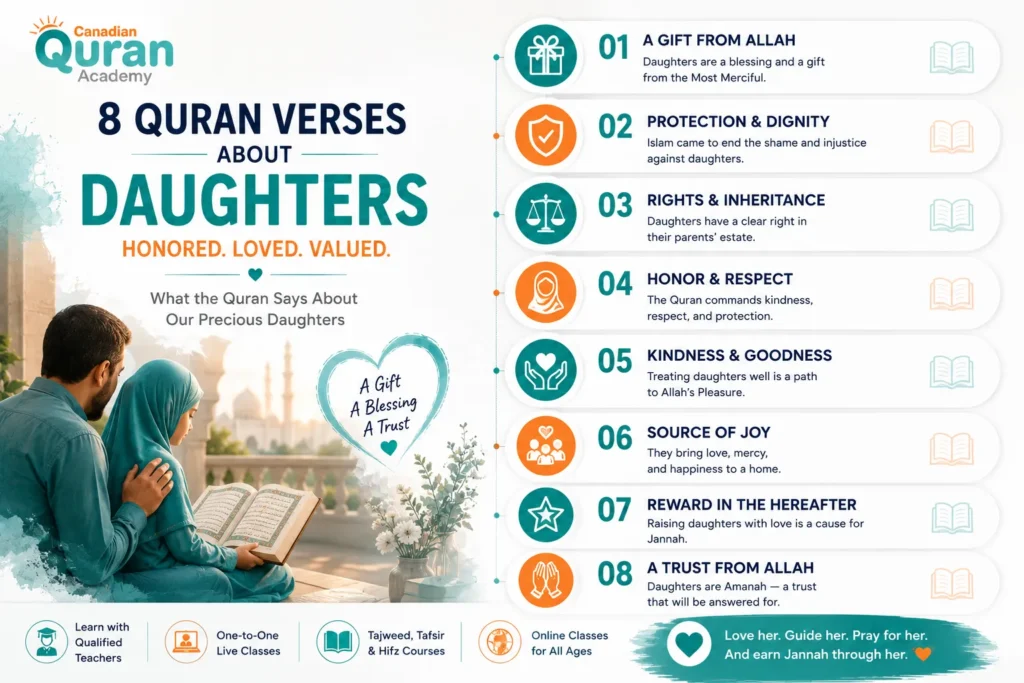
Many parents searching for Quran verses about daughters in Arabic want more than a translation — they want to see the exact wording Allah used, understand the historical context behind it, and know how to explain these verses to their own children.
This guide brings together the clearest verses in the Quran about daughters, shown in Arabic with their English meaning and the context scholars give for each one.
At Canadian Quran Academy, this kind of question comes up often from parents enrolled in our Quran classes for kids and Quran classes for female students — they want their children to grow up knowing that the Quran speaks of daughters with honor, not as a burden.
1. Daughters Described As A Gift From Allah
This is the verse most often cited when discussing daughters in the Quran, because it places the female child first in Allah’s description of His gifts to parents. It’s usually the first result people find when they look up Quran verses about daughters in Arabic.
لِّلَّهِ مُلْكُ السَّمَاوَاتِ وَالْأَرْضِ ۚ يَخْلُقُ مَا يَشَاءُ ۚ يَهَبُ لِمَن يَشَاءُ إِنَاثًا وَيَهَبُ لِمَن يَشَاءُ الذُّكُورَ
“To Allah belongs the dominion of the heavens and the earth. He creates what He wills. He bestows female children to whom He wills and bestows male children to whom He wills.” Surah Ash-Shura (42:49–50)
Classical commentators note that Allah mentions daughters (إِنَاثًا) before sons (الذُّكُورَ) in this verse — the opposite order of everyday Arabic speech at the time, where sons were always named first. That word order is itself read as a correction of the culture’s bias.
2. Rejecting the Shame of a Daughter’s Birth
This passage directly confronts how pre-Islamic Arabs reacted to the news of a daughter’s birth, then exposes the contradiction in their own beliefs.
وَيَجْعَلُونَ لِلَّهِ الْبَنَاتِ سُبْحَانَهُ وَلَهُمْ مَا يَشْتَهُونَ
“And they attribute daughters to Allah — exalted is He — while for themselves is what they desire [sons].” Surah An-Nahl (16:57)
وَإِذَا بُشِّرَ أَحَدُهُم بِالْأُنثَىٰ ظَلَّ وَجْهُهُ مُسْوَدًّا وَهُوَ كَظِيمٌ يَتَوَارَىٰ مِنَ الْقَوْمِ مِن سُوءِ مَا بُشِّرَ بِهِ ۚ أَيُمْسِكُهُ عَلَىٰ هُونٍ أَمْ يَدُسُّهُ فِي التُّرَابِ ۗ أَلَا سَاءَ مَا يَحْكُمُونَ
“And when one of them is informed of the birth of a female, his face becomes dark, and he suppresses grief. He hides from the people because of the ill of which he was informed — should he keep her in humiliation or bury her in the dust? Unquestionably, evil is what they decide.” Surah An-Nahl (16:58-59)
The verse names two real practices of the time — public humiliation of the family, and burying infant girls alive. Allah calls the entire judgment “evil” (سَاءَ مَا يَحْكُمُونَ), making this one of the clearest direct condemnations in the Quran of mistreating daughters.
Read also: Verse In Quran About Alcohol In Arabic And English
Read Also: Quran Verses About Humanity in Arabic
3. Inheritance Rights for Daughters
This verse establishes a daughter’s legal share of her family’s estate, at a time when women in Arabia typically inherited nothing at all.
يُوصِيكُمُ اللَّهُ فِي أَوْلَادِكُمْ ۖ لِلذَّكَرِ مِثْلُ حَظِّ الْأُنثَيَيْنِ ۚ فَإِن كُنَّ نِسَاءً فَوْقَ اثْنَتَيْنِ فَلَهُنَّ ثُلُثَا مَا تَرَكَ ۖ وَإِن كَانَتْ وَاحِدَةً فَلَهَا النِّصْفُ
“Allah instructs you concerning your children: for the male, what is equal to the share of two females. But if there are only daughters, two or more, for them is two-thirds of what the deceased left. And if there is only one, for her is half.” Surah An-Nisa (4:11)
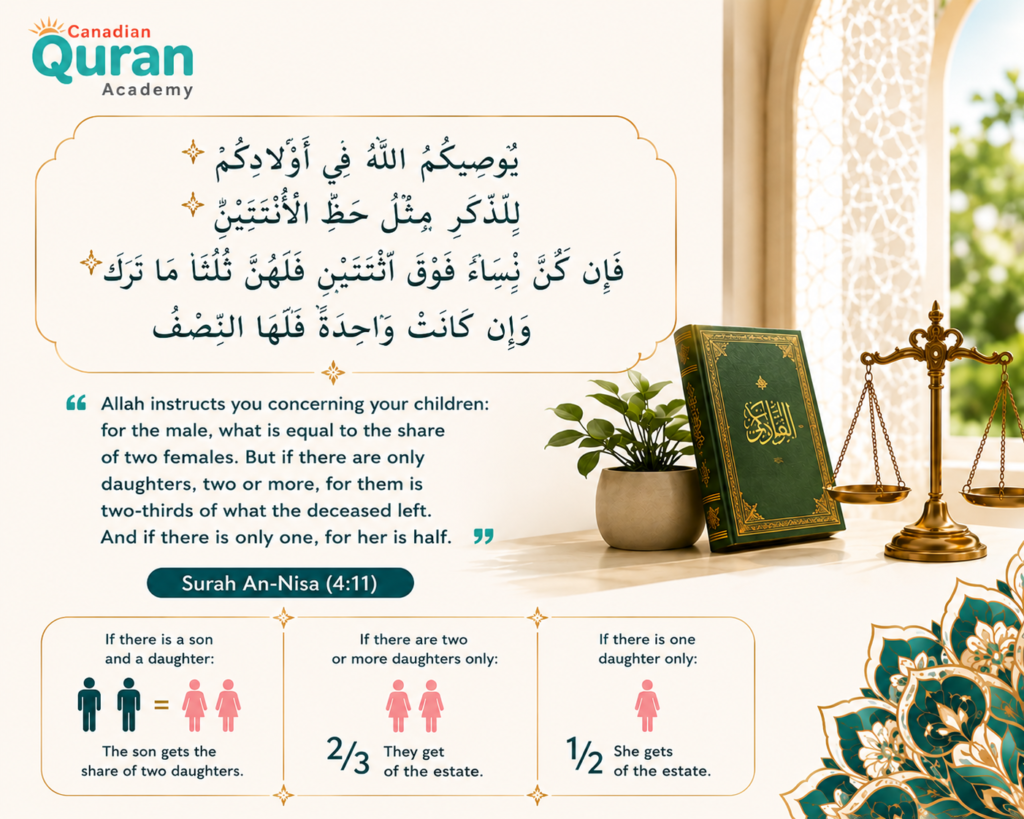
Before this verse, women in pre-Islamic Arabia typically inherited nothing at all. Guaranteeing daughters a fixed, protected share — regardless of how many daughters or what the family wanted — was a legal first. This is the verse most Islamic inheritance law (فرائض) is built on.
4. Protection and Modesty for Daughters
This verse addresses the Prophet’s own daughters by name, setting an instruction meant to protect them in public.
يَا أَيُّهَا النَّبِيُّ قُل لِّأَزْوَاجِكَ وَبَنَاتِكَ وَنِسَاءِ الْمُؤْمِنِينَ يُدْنِينَ عَلَيْهِنَّ مِن جَلَابِيبِهِنَّ ۚ ذَٰلِكَ أَدْنَىٰ أَن يُعْرَفْنَ فَلَا يُؤْذَيْنَ
“O Prophet, tell your wives and your daughters and the women of the believers to bring down over themselves part of their outer garments. That is more suitable that they will be known and not be abused.” Surah Al-Ahzab (33:59)
This is one of the few verses where the Prophet Muhammad’s own daughters (بَنَاتِكَ) are named directly. Scholars read the instruction as protective rather than restrictive — it exists so daughters can be recognized and left unbothered in public.
Understanding a verse like this in its original Arabic changes how it reads — words like جَلَابِيبِهِنَّ carry nuance that translations flatten. This is exactly why Canadian Quran Academy’s Quran Classes for Female students spend real time on Quranic Arabic vocabulary, not just recitation.
Live Class in Action
Watch how our instructors interact with students in real-time, focusing on interactive methods.
Start Your Quranic Journey in Canada
Join our vibrant community and learn with expert tutors through our flexible online platform.
Claim Your Free Trial5. The Buried Daughter Will Be Asked
This verse is set on the Day of Judgment and confronts one of the darkest practices of pre-Islamic Arabia.
وَإِذَا الْمَوْءُودَةُ سُئِلَتْ بِأَيِّ ذَنبٍ قُتِلَتْ
“And when the female infant buried alive is asked, for what sin she was killed.” Surah At-Takwir (81:8–9)
الْمَوْءُودَةُ refers specifically to a baby girl buried alive by her family — a documented practice among some pre-Islamic tribes.
The verse places this among the events of the Day of Judgment, and the question is addressed to the child, not the parents, which commentators read as the strongest possible statement of her innocence.
Read also: 15 Quran Verses About Prayer In Arabic And English
6. Equal Standing Before Allah
This verse doesn’t mention daughters by name, but it sets the principle scholars use to explain why sex is not a measure of worth in the Quran.
يَا أَيُّهَا النَّاسُ إِنَّا خَلَقْنَاكُم مِّن ذَكَرٍ وَأُنثَىٰ وَجَعَلْنَاكُمْ شُعُوبًا وَقَبَائِلَ لِتَعَارَفُوا ۚ إِنَّ أَكْرَمَكُمْ عِندَ اللَّهِ أَتْقَاكُمْ
“O mankind, indeed We have created you from male and female and made you peoples and tribes that you may know one another. Indeed, the most noble of you in the sight of Allah is the most righteous of you.” Surah Al-Hujurat (49:13)
This verse doesn’t mention daughters by name, but it’s the foundational text scholars use to argue that a person’s worth in the Quran is measured by piety (تقوى) — not by sex, and not by whether a household has sons or daughters.
Read also: Quran Verses About Ramadan In Arabic And English
7. The Birth of Maryam
This verse describes a mother’s reaction to giving birth to a daughter she hadn’t expected, and what Allah says about it.
فَلَمَّا وَضَعَتْهَا قَالَتْ رَبِّ إِنِّي وَضَعْتُهَا أُنثَىٰ وَاللَّهُ أَعْلَمُ بِمَا وَضَعَتْ وَلَيْسَ الذَّكَرُ كَالْأُنثَىٰ وَإِنِّي سَمَّيْتُهَا مَرْيَمَ وَإِنِّي أُعِيذُهَا بِكَ وَذُرِّيَّتَهَا مِنَ الشَّيْطَانِ الرَّجِيمِ
“So when she delivered her, she said, ‘My Lord, I have delivered a female.’ And Allah was most knowing of what she delivered, and the male is not like the female. And I have named her Mary, and I seek refuge for her in You, and [for] her descendants, from Satan, the expelled.” Surah Aal-Imran (3:36)
Maryam’s mother expected a son and had dedicated the unborn child to temple service; a daughter wasn’t the expected outcome.
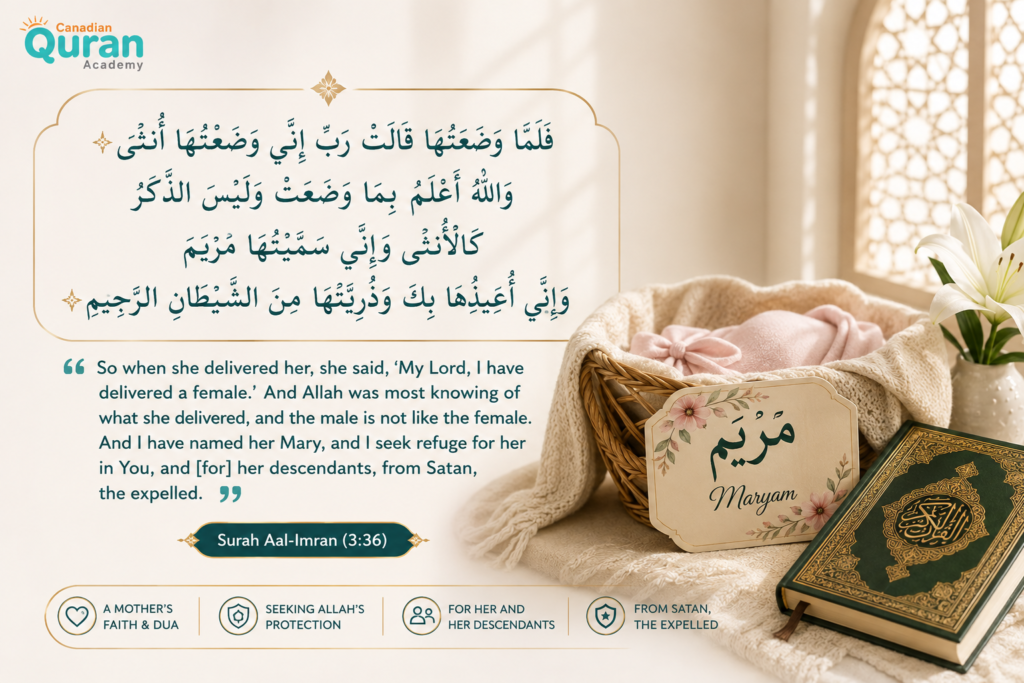
The Quran’s response — “the male is not like the female” — is read by most scholars as Allah affirming that Maryam’s role would be even greater than what her mother had planned for a son. She becomes the only woman named directly in the Quran, and the 19th surah is named after her.
Read Also: Quran Verses About Hope In Arabic
8. The Daughters of Prophet Shu’ayb
This story shows two daughters managing their family’s responsibilities with modesty and sound judgment in a public setting.
وَلَمَّا وَرَدَ مَاءَ مَدْيَنَ وَجَدَ عَلَيْهِ أُمَّةً مِّنَ النَّاسِ يَسْقُونَ وَوَجَدَ مِن دُونِهِمُ امْرَأَتَيْنِ تَذُودَانِ
“And when he came to the water of Madyan, he found there a group of people watering their flocks, and he found besides them two women holding back their flocks.” Surah Al-Qasas (28:23)
The two daughters in this story are shown managing their family’s flocks with modesty and composure in a crowded public space — the Quran describes them respectfully, and the passage that follows has them recommend Musa (Moses) for work based on his strength and trustworthiness, a detail scholars often cite as an example of sound, practical judgment.
Experience Our Classrooms
Don’t just take our word for it—take a look inside! Watch the videos below to experience our engaging teaching methods and vibrant online classrooms firsthand.
Start Your Quranic Journey in Canada
Join our vibrant community and learn with expert tutors through our flexible online platform.
Claim Your Free TrialRead also: 15 Quran Verses About Prayer In Arabic And English
Enroll Your Daughter In Quran Classes At Canadian Quran Academy
Reading these Quran verses about daughters in Arabic is a start. Understanding them in the language they were revealed in — and reciting them correctly — is what makes them stick.
Canadian Quran Academy’s certified instructors teach children and adults to read, recite, and understand Quranic Arabic directly, without relying only on translation.
Families often start with our Quran Reading Classes or Online Quran Classes for Kids, then move into Quran Memorization (Hifz) Course once the fundamentals are solid. Adults who want to build this same understanding from scratch can begin with the Learn Quran Course for Beginners.
Our Quran Courses:
- Quran Recitation Classes
- Quran Reading Classes
- Online Quran Classes for Kids
- Quran Classes for Adults
- Quran Classes for Female
- Learn Quran Course for Beginners
- Quran Memorization (Hifz) Course
- Hifz Classes for Adults
- Quran Memorization and Hifz Course for Kids
- Quran Hifz Course for Ladies
- Quran Ijazah Program
- Quran Qirat Learning Course
- Quran Tafsir Course
Start Your Quranic Journey in Canada
Join our vibrant community and learn with expert tutors through our flexible online platform.
Claim Your Free TrialConclusion
The Quran verses about daughters in Arabic, taken together, tell a consistent story: daughters are named as a direct gift from Allah in the opening verse above, the pre-Islamic shame around their birth is condemned by name in the verses that follow, their inheritance is legally protected, and two of the Quran’s most respected female figures — Maryam and the daughters of Shu’ayb — are held up as models of righteousness and good judgment.
No verse ranks a daughter beneath a son; several go out of their way to correct exactly that assumption.
For a parent or student who wants to hold on to this, the one line worth remembering is from Surah Al-Hujurat: worth in the Quran is measured by piety, not by whether a child is born a son or a daughter.
Canadian Quran Academy’s classes exist to help families read these verses for themselves, in Arabic, rather than through translation alone.

Frequently Asked Questions
Below are direct answers to the questions most often asked alongside “Quran verses about daughters in Arabic,” covering inheritance, the Quran’s language, and specific stories mentioned in the text.
1. How many verses in the Quran mention daughters directly?
The Quran does not give a single fixed count, but at least eight passages address daughters directly or through the closely related term “females” (إناث), spanning the surahs covered above: Ash-Shura, An-Nahl, An-Nisa, Al-Ahzab, At-Takwir, Al-Hujurat, Aal-Imran, and Al-Qasas.
2. Does the Quran favor sons over daughters?
No verse in the Quran states that sons are preferred over daughters. Among the Quran verses about daughters in Arabic covered here, the gift verse lists daughters before sons, and the equality verse states that honor before Allah is based on piety, not sex.
3. What does the Quran say about burying daughters alive?
Two of the verses above directly condemn the pre-Islamic practice of burying infant girls alive, calling the judgment behind it “evil” and stating the buried child will be asked on the Day of Judgment for what sin she was killed.
4. Do daughters inherit in Islam according to the Quran?
Yes. The inheritance verse above guarantees daughters a fixed share — two-thirds of the estate if there are two or more daughters and no sons, or half if there is only one daughter — a legal right they did not have before this verse was revealed.
5. Which women are named directly in the Quran?
Maryam (Mary), mother of Isa (Jesus), is the only woman named directly in the Quran, introduced in the verse above at her birth as a daughter. Surah Maryam, the 19th chapter, is named after her.
6. Is it better to learn these verses in Arabic or in translation?
Scholars recommend learning the Arabic wording alongside translation, since terms like الْمَوْءُودَةُ or جَلَابِيبِهِنَّ carry precise legal and historical meaning that a single English word cannot fully capture. Canadian Quran Academy’s Quranic Arabic instruction is built specifically around closing that gap.





Leave a Reply