 Arabic
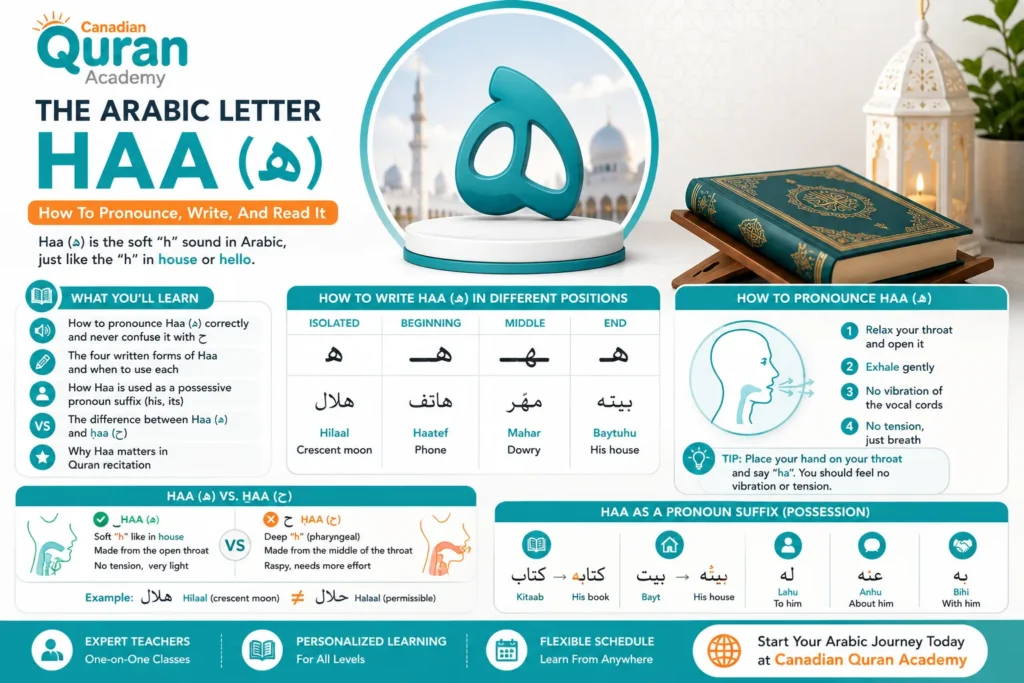
Look at هو (huwa, “he”) and حب (hubb, “love”). Both start with a sound English speakers write as “h” — but in Arabic, these are two completely different letters. The Letter h in Arabic (ه) is the soft, breathy “h” sound you already know from English words like house and hello, and it’s one of the first letters every new student has to get right.
Haa (ه) is the 26th letter of the Arabic alphabet. It represents a light “h” produced by exhaling gently through an open throat, with no friction and no tension anywhere in the mouth or neck. In the Abjad numeral system, it carries the value 5.
This guide covers how to pronounce haa correctly, its four written shapes, its grammatical role as a possessive suffix, and the two letters students confuse it with most.
At Canadian Quran Academy, this is a letter we spend real time on with beginners, because mixing it up with a similar-looking letter changes the meaning of a word — and in Quran recitation, that matters.
What you’ll learn in this article
- How to correctly pronounce the Arabic letter Haa (ه) and never confuse it with ح again
- The four written forms of haa — isolated, initial, medial, and final — and exactly when to use each
- How haa is pronounced when it’s attached as a possessive pronoun suffix (his, its)
- The simple test that tells haa apart from taa marbuta (ة) every time
- Why haa matters specifically for Quran recitation, not just everyday conversation
What Is The Arabic Letter Haa (ه)?
Haa (ه) is a voiceless glottal fricative — a sound made by pushing air through a relaxed, open throat with no vibration of the vocal cords. It sits in the same phonetic family as the English “h,” which is why English speakers usually pick it up faster than any other Arabic letter.
Haa is also a dual-joining letter, meaning it connects to letters on both its right and left sides when it sits inside a word. That single fact explains why its shape shifts so much depending on where it falls — a topic the next section breaks down in full.
The makhraj (articulation point) of haa (ه) is described in traditional Arabic phonetics as أقصى الحلق — the outermost part of the throat, closest to the mouth. To produce it, relax your jaw, open your throat, and let air flow out, the same way you’d start the English words hair, hat, or inhale.
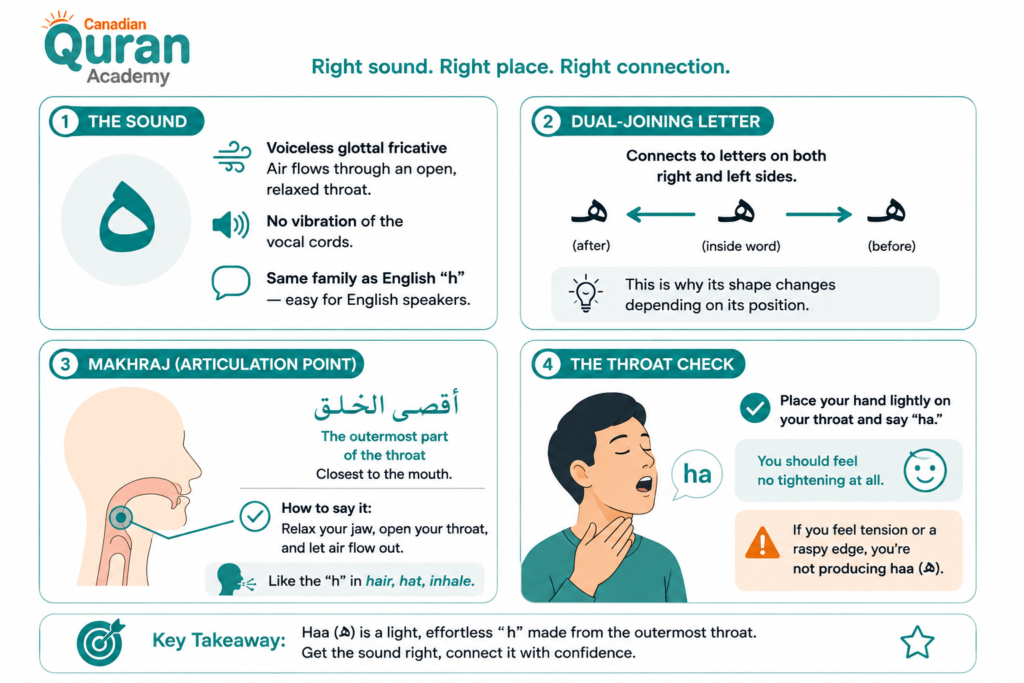
Try this check: place a hand lightly on your throat and say “ha.” You should feel no tightening at all. If you feel any tension or a raspy edge to the sound, you’re drifting toward a different letter, not haa.
Haa (ه) Vs. The Pharyngeal Letter ح
The letter most often confused with haa is ح (commonly transliterated ḥaa), and this is the single most important distinction to learn early. Ḥaa is produced by constricting the pharynx — the middle of the throat — to create a raspy, breathy sound with no equivalent in English.
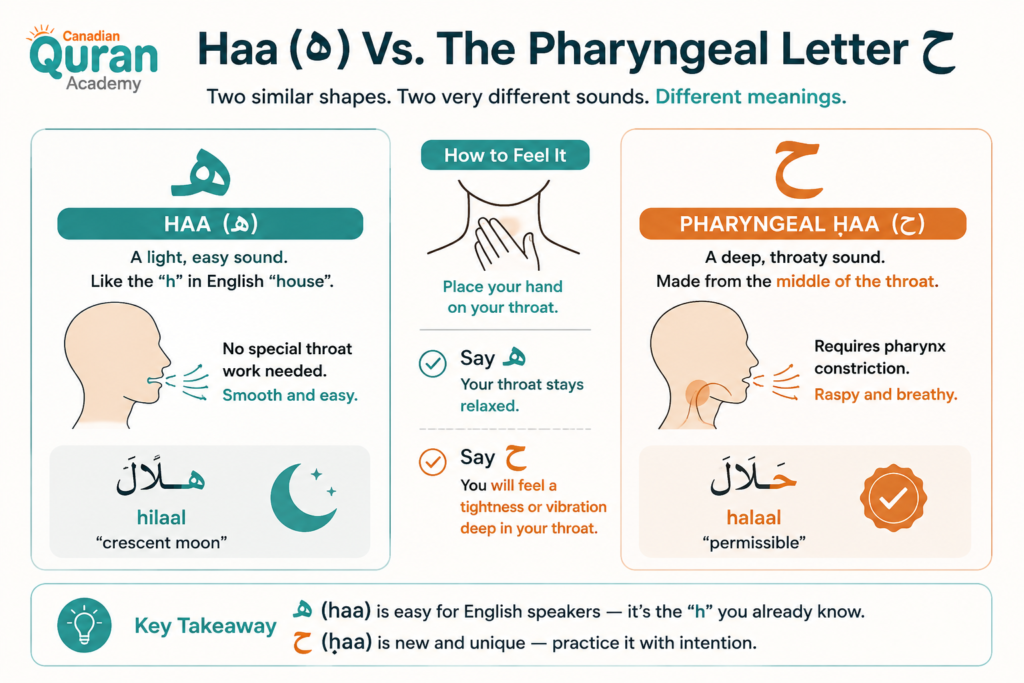
Mixing up ه and ح changes meaning outright.
هلال (hilaal) means “crescent moon,” while حلال (halaal) means “permissible.” Practice minimal pairs like this one out loud, with a hand on your throat, until you can feel the difference rather than just hear it.
Haa is easy for English speakers precisely because it needs no special throat work. Ḥaa is the letter that actually takes practice — treat haa as the sound you already know, and save your effort for the letter that’s genuinely new.
Read Also: Arabic Letter 3ayn (ع)
Pronouncing Haa With Arabic Vowels
The هـ – Arabic letter haa doesn’t change with vowels the way some Arabic letters do — but the short vowel attached to it does shape how the syllable is spoken. With fatha, it’s a short “ha” as in هذا (haadha, “this”).
With damma, it’s “hu” as in هو (huwa, “he”). With kasra, it’s “hi” as in هي (hiya, “she”). With sukoon, it’s a light, unvoweled “h” with no following vowel sound at all.
Haa as a pronoun suffix (هاء الضمير)
Haa’s most frequent grammatical job is as the third-person masculine singular suffix, attached to nouns, verbs, and prepositions to mean “his,” “its,” or “him.” كتاب (kitaab, “book”) becomes كتابه (kitaabuhu, “his book”); بيت (bayt, “house”) becomes بيته (baytuhu, “his house”).
It attaches to prepositions the same way: له (lahu, “to him”), عنه (anhu, “about him”), به (bihi, “with him”). These constructions appear constantly in both spoken Arabic and written text, which is exactly why the pronoun suffix deserves early, deliberate attention rather than being left to pick up passively.
The vowel before this suffix haa determines how it’s pronounced — “hu” after a damma, “hi” after a kasra, “ha” after a fatha — and these patterns are fully predictable once you know the rule, not something to memorize word by word.
In Quran recitation specifically, tajweed rules add one more layer: when this pronoun haa falls between two vowel sounds — as in لَهُ أَجْرٌ — it’s given a slight prolongation known as silat al-haa, extending the “hu” briefly rather than clipping it short.
Reciters who skip this small extension are usually the ones who sound rushed rather than fluent, even when every individual letter is technically correct.
Live Class in Action
Watch how our instructors interact with students in real-time, focusing on interactive methods.
Start Your Quranic Journey in Canada
Join our vibrant community and learn with expert tutors through our flexible online platform.
Claim Your Free TrialCommon Mistakes When Pronouncing And Writing Haa
The most frequent error is substituting ح for ه or vice versa, which changes real words into other real words rather than just sounding “off.” The fix is always the same: check for throat tension, and if you feel any, you’re saying the wrong letter.
A second common mistake is over-separating the pronoun suffix, saying “bay-tu-hu” with hard breaks instead of the smooth “baytuhu” a native speaker would produce. Record yourself and compare against a native model rather than guessing at the rhythm.
A third mistake is visual: confusing the final haa (ـه) with taa marbuta (ة), which looks almost identical but changes both sound and grammar. The next section gives you a permanent fix for this exact confusion.
Adult learners tend to fix these mistakes fastest with direct, real-time correction rather than self-study alone, which is the core value of a live Fusha Arabic Course — an instructor hears the slip the moment it happens, before it becomes a habit.
Read Also: Letter N In Arabic ن
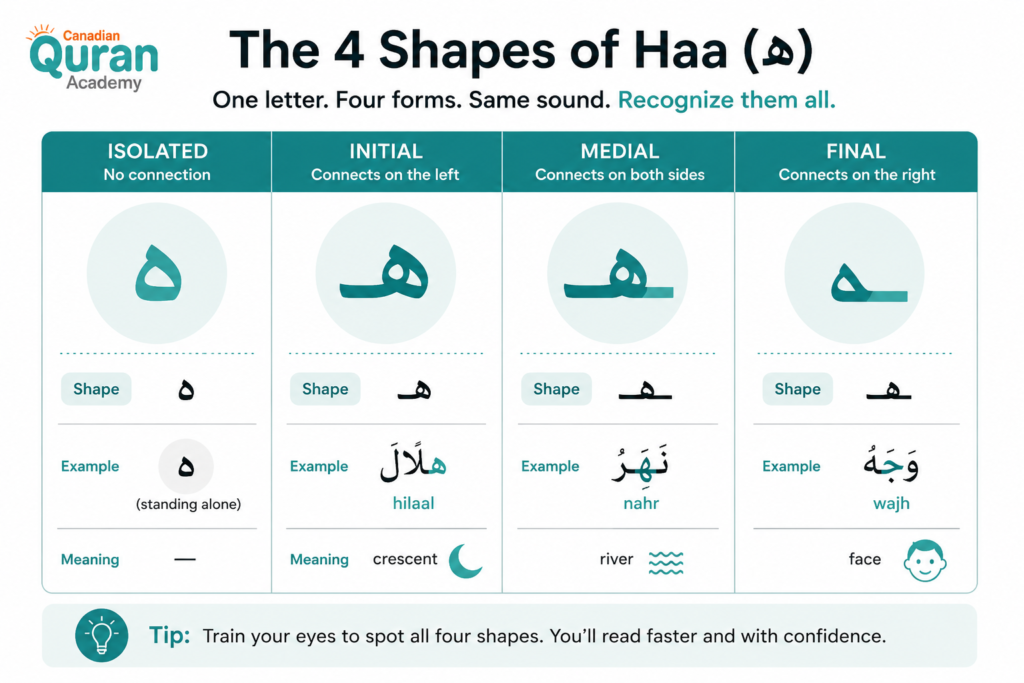
The Four Written Forms Of The Letter Haa
Because haa is a dual-joining letter, it takes a different shape depending on whether a letter connects to it from the right, the left, both, or neither. Recognizing all four forms on sight is what separates a hesitant reader from a fluent one.
| Position | Shape | Example | Meaning |
| Isolated | ه | ه (standing alone) | — |
| Initial | هـ | هلال | crescent |
| Medial | ـهـ | نهر | river |
| Final | ـه | وجه | face |
How to write each form correctly?
The isolated form looks like a small closed loop or oval sitting on the writing line — many students picture it as a tiny smiley face, which is a genuinely useful memory hook.
The initial form keeps that same loop shape but adds a short connecting line extending left, ready to join the next letter — you’ll see it opening words like هدية (hadiyya, “gift”) and هاتف (haatif, “phone”).
The medial form is the one beginners misread most often. It’s a small figure that looks like a bow tie or a shallow “w” sitting on the line, with connecting strokes on both sides — visible in مهم (muhimm, “important”) and شهر (shahr, “month”).
The final form usually appears as a loop attached to a connecting tail from the letter before it, as in وجه (wajh, “face”) and فقه (fiqh, “religious jurisprudence”).
Structured feedback from an instructor speeds this up considerably; it’s one of the reasons families enroll their children in Online Arabic Classes for Kids rather than relying on apps alone, since a live teacher catches the exact moment a medial haa starts drifting toward a final one.
Read Also: Letter M In Arabic (م)
Haa (ه) Vs. Taa Marbuta (ة): How To Tell Them Apart?
Taa marbuta (ة) is a final haa shape with two dots added above it, and the two are genuinely easy to mix up on the page. The dots are the only visual difference, but the grammatical and phonetic gap between them is significant.
Taa marbuta marks feminine nouns and adjectives. In pause form — when a speaker stops at the end of a phrase — it’s silent, sounding like a plain “h” with no following vowel. In connected speech, followed by a case ending, it’s pronounced as a clear “t.”
Haa, by contrast, is always pronounced as “h” — in every position, in every context, with no silent version.
مدرسة (madrasa, “school”) ends in taa marbuta and goes quiet in pause form, while كتابه (kitaabuhu, “his book”) ends in haa and stays fully voiced.
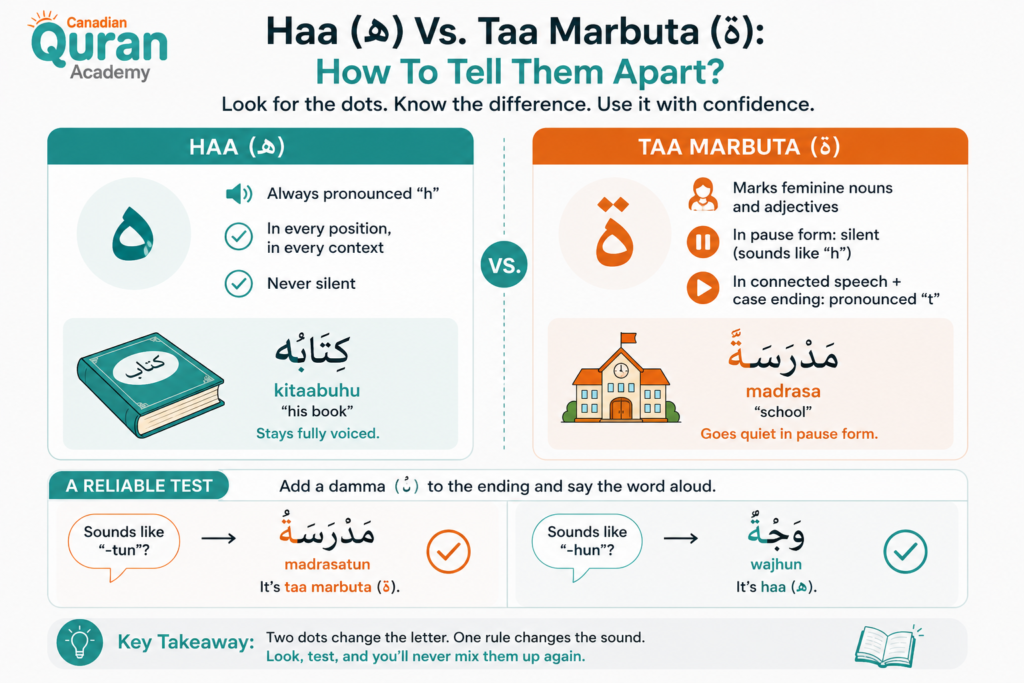
A reliable test: add a damma to the ending and say the word aloud. If it now sounds like “-tun,” you’re looking at taa marbuta — مدرسةٌ (madrasatun).
If it sounds like “-hun,” it’s haa — وجهٌ (wajhun). This one check resolves the confusion faster than trying to memorize which words are feminine.
Read Also: How to Write Quran in Arabic?
Common Arabic Words With The Letter Haa
Seeing haa across real vocabulary, in each of its four positions, builds recognition faster than studying the shapes alone. A few high-frequency examples:
- هو (huwa) — “he,” initial haa, one of the very first pronouns beginners learn
- هنا (hunaa) — “here,” initial haa, essential for describing location
- مهم (muhimm) — “important,” medial haa, a common adjective
- نهر (nahr) — “river,” medial haa
- وجه (wajh) — “face,” final haa
- فهم (fahm) — “understanding,” medial haa, a word you’ll see often in religious study contexts
- كتابه (kitaabuhu) — “his book,” final haa functioning as a possessive suffix
Experience Our Classrooms
Don’t just take our word for it—take a look inside! Watch the videos below to experience our engaging teaching methods and vibrant online classrooms firsthand.
Start Your Quranic Journey in Canada
Join our vibrant community and learn with expert tutors through our flexible online platform.
Claim Your Free TrialStart Learning Arabic Letters The Right Way With Canadian Quran Academy
Reading about the four shapes of the هـ – Arabic letter haa is useful. Reading them correctly, at speed, in real Quranic and conversational text, takes guided practice with a teacher who can hear and see exactly where you’re slipping.
Canadian Quran Academy runs live, one-on-one and small-group Arabic classes built around exactly this kind of letter-by-letter accuracy, before moving on to full sentences and recitation.

Whether you’re a complete beginner or brushing up specific skills, there’s a course structured for where you actually are.
Our Arabic Courses:
- Online Arabic Academy
- Online Arabic Course
- Classical Arabic Course
- Arabic Course for Beginners
- Advanced Arabic Course
- Quranic Arabic Course
- Arabic Grammar Course
- Modern Standard Arabic Course
- Arabic Conversation / Speaking Course
- Madinah Arabic Course
- Learning Arabic for Non-Arabic Speakers
- Arabic Elementary School
- Arabic Intermediate School
- Arabic Lessons for Kindergarten

Start Your Quranic Journey in Canada
Join our vibrant community and learn with expert tutors through our flexible online platform.
Claim Your Free TrialConclusion
The هـ – Arabic letter haa (ه) is one of the more approachable letters for English speakers, since its sound matches the familiar English “h” almost exactly. What takes real work is everything around that sound: recognizing its four written forms, pronouncing it correctly as a possessive suffix, and reliably telling it apart from ح and ة.
Master those three skills — the shapes, the suffix, and the two look-alikes — and haa stopped being a source of hesitation and becomes one of the letters you read without thinking.
That’s the standard Canadian Quran Academy holds students to before moving on to full verses and connected recitation.

Frequently asked questions about the letter haa
Here are direct answers to the questions students ask most often about the Arabic letter Haa (ه), covering the mix-ups and edge cases this guide’s sections above address in more depth.
1. Is haa (ه) ever silent in Arabic?
No, haa is always pronounced in standard Arabic, in every position and every context. This is what separates it from taa marbuta (ة), which does go silent in pause form.
2. How do you know which of the four haa shapes to use?
Use the Two-Connection Check: ask whether a letter before it connects in and whether a letter after it connects out. The combination of those two answers — no/no, no/yes, yes/yes, or yes/no — tells you isolated, initial, medial, or final.
3. Is haa a sun letter or a moon letter?
Haa is a moon letter, so the definite article ال in front of a haa-initial word is pronounced fully as “al-,” with no assimilation into the following letter.
4. What’s the real difference between ه and ح?
Haa (ه) is a light, breathy “h” made with an open, relaxed throat, while ح is produced by constricting the pharynx to create a deeper, raspier sound with no English equivalent. Confusing them changes word meanings, as in هلال (“crescent”) versus حلال (“permissible”).
5. What does the haa suffix mean when attached to a word?
Attached to a noun, verb, or preposition, haa functions as the third-person masculine singular suffix, meaning “his,” “its,” or “him,” as in كتابه (kitaabuhu, “his book”).
6. How can I stop confusing haa with taa marbuta?
Add a damma to the word’s ending and say it aloud — if it sounds like “-tun,” it’s taa marbuta; if it sounds like “-hun,” it’s haa. This test resolves the confusion faster than trying to memorize which nouns are feminine.






Leave a Reply