 Quran
Quran
Ask a room of parents at any Canadian masjid what they hope for their children, and “becoming a hafiz” comes up again and again. It is one of the most respected achievements in Muslim life — and one of the most misunderstood.
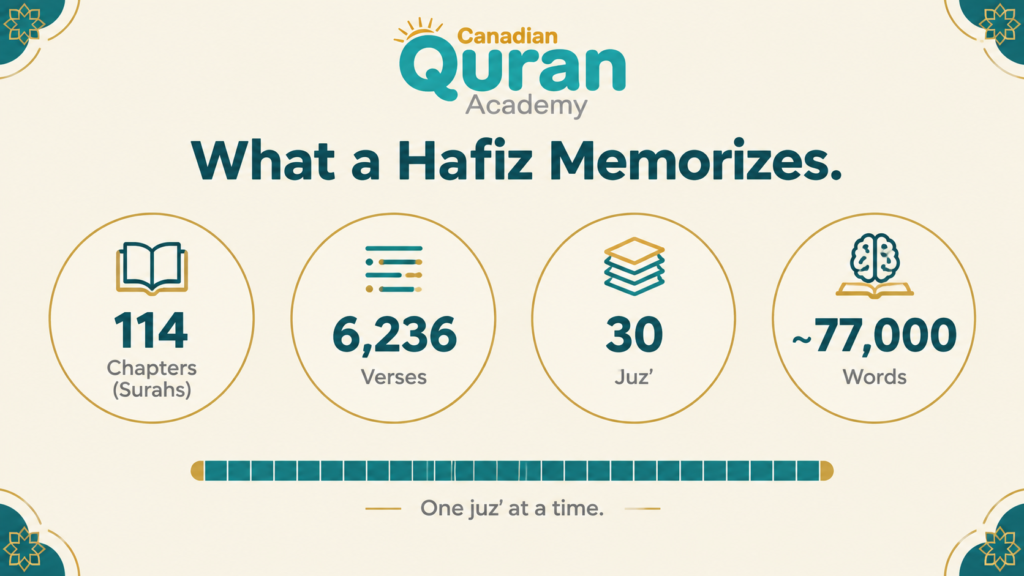
So, who is a hafiz? In simple terms, a hafiz is a person who has memorized the entire Quran — all 114 chapters and 6,236 verses — and can recite them accurately from memory. The word carries weight far beyond a certificate on a wall.
This guide answers the questions people actually search for: what a hafiz is in Islam, what the title means in English, how many huffaz exist worldwide, which countries lead, and how those numbers have grown over the years.
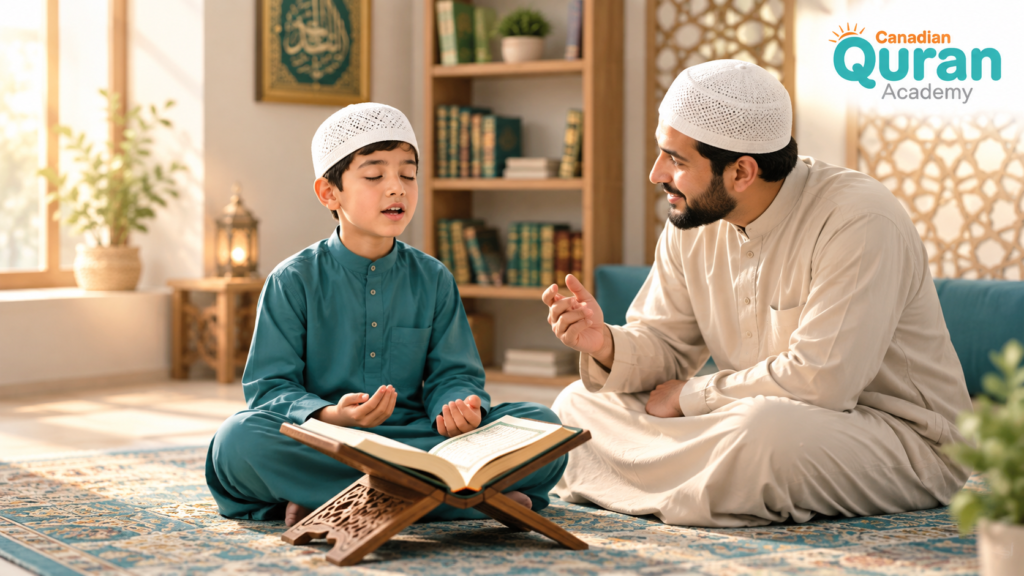
Takeaway — What You Will Learn
- The precise meaning of hafiz in Islam and its closest translation in English.
- Which countries produce the most Quran memorizers, and how rankings change by method.
- How hafiz numbers have grown over recent decades, including among girls and women.
- What the hifz journey realistically looks like for a learner in Canada.
Who Is a Hafiz?
A hafiz is a Muslim who has committed the complete text of the Quran to memory and can recall it precisely, in order, with correct pronunciation. The title is not given for partial memorization or for reading fluency alone.
The Quran contains 114 surahs, 6,236 verses, and roughly 77,000 words, arranged into 30 sections called juz’. Holding that entire text in active memory is the defining requirement.
A hafiz is a guardian of the Quranic text — someone who preserves it internally rather than only on the page. The feminine form is hafiza, used for women and girls who complete the same memorization.
The role is active, not archival. A hafiz who stops reviewing will lose accuracy, which is why daily revision, called muraja’ah, continues for life after the memorization itself is finished.
What Is a Hafiz in Islam?
In Islam, a hafiz carries a preservation trust. The Quran was transmitted orally before it was widely written down, and memorization has protected its wording across fourteen centuries and every continent.
That is why huffaz hold visible community roles. They lead Taraweeh prayers in Ramadan, teach children, and are addressed with honorifics such as shaykh or ustadh in many cultures.
Islamic scholarship also distinguishes memorization from mastery of recitation. A hafiz is expected to apply tajweed — the rules governing how each Arabic letter is articulated — so the text is delivered as it was received.
Hafiz Meaning in English
The meaning of hafiz in English is “guardian,” “protector,” or “one who preserves,” from the Arabic root ḥ-f-ẓ, which means to guard or to keep safe. In religious usage, it is translated as “memorizer of the Quran.”
Note the nuance: the English word “memorizer” undersells it. The Arabic term implies custody and responsibility, not simply the mental feat of recall.
If your child is at the earliest stage of this path, accurate letter pronunciation comes first. Structured Noorani Qaida and Quran reading lessons build the foundation that every hifz program depends on.
Read Also: Quran Recitation Tutors In Canada – Recitation, Reading, And Word-By-Word Lessons
How Many Hafiz Are There in the World?
There is no verified global count. No government, university, or international body maintains a worldwide register of huffaz, so every “total” you encounter is an estimate built from partial national data.
Widely circulated figures range from several million to over ten million people. These numbers spread through articles and social posts without a traceable methodology behind them.
Why There Is No Official Global Count of Huffaz
Memorization is certified locally, not centrally. A student may be tested by a single teacher, a neighbourhood madrasah, a national board, or a state ministry — and none of these share one database.
Definitions also differ. Some institutions certify memorization alone; others require full tajweed mastery, an oral examination before a panel, or a documented chain of transmission.
What Documented Hafiz Numbers Tell Us by Country
Country-level records are far more reliable than global totals. Pakistan’s Wafaq ul Madaris board has reported certifying more than one million huffaz since 1982, at roughly 78,000 per year in recent periods.
Saudi Arabia has been reported to certify around 5,000 huffaz annually through its formal programs, while Iran runs graded national memorization examinations with recognized qualification levels.
For scale, Pew Research Center placed the global Muslim population at about 1.85 billion in 2020. Even a generous estimate of ten million huffaz would represent well under one percent of Muslims worldwide.
Read Also: Why Do Muslims Memorize The Quran?
Hafiz Statistics and Certification Numbers Worldwide
Hafiz statistics worldwide are best read as indicators of institutional activity rather than headcounts of individuals. What is being counted is usually certifications issued, not people currently able to recite.
Understanding what a statistic measures prevents the two most common errors: treating estimates as facts, and comparing countries that count in completely different ways.
What Global Hafiz Statistics Actually Measure
Most published figures count exam passes in a given year. A student certified in 2015 stays in the cumulative total whether or not they have maintained their memorization since.
Others count enrolment rather than completion, which is a very different metric. Completion rates vary widely by country and institution.
Female Hafiz Participation Around the World
Female participation is now substantial and rising. Pakistan’s board figures have included roughly 14,000 girls among its annual certifications, a share that was far smaller a generation ago.
Online learning has accelerated this shift, particularly in North America and Europe, where one-to-one female teachers can be matched with students regardless of geography.
Live Class in Action
Watch how our instructors interact with students in real-time, focusing on interactive methods.
Start Your Quranic Journey in Canada
Join our vibrant community and learn with expert tutors through our flexible online platform.
Claim Your Free TrialRead Also: What We Learn From The Quran
Number of Hafiz by Country
The number of hafiz by country tracks three factors: total Muslim population, the strength of the madrasah system, and whether the state funds or certifies memorization formally.
No single ranking is authoritative, but the same regions appear consistently across reported data.
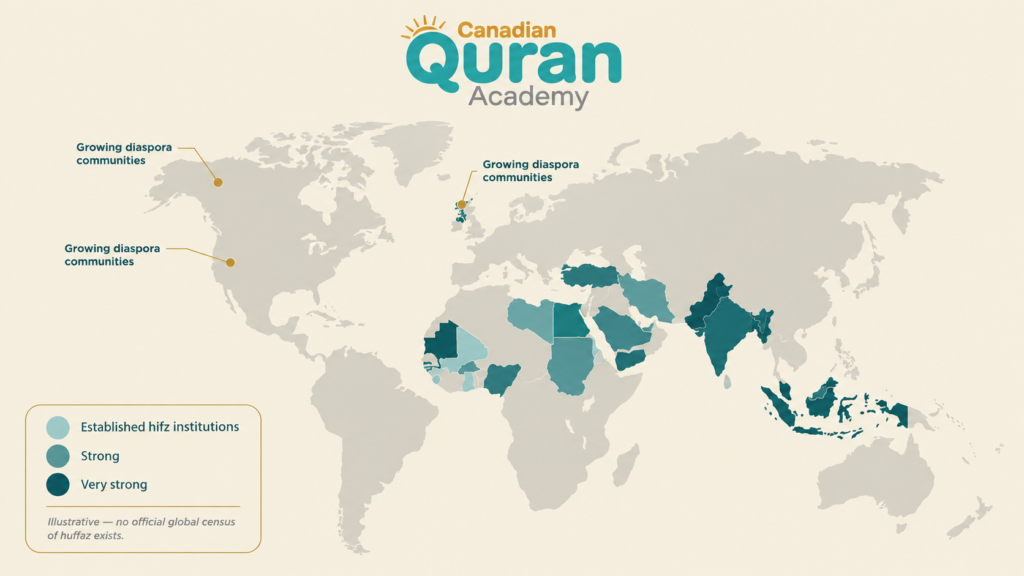
a. South Asia
Pakistan, India, and Bangladesh together host the largest concentration of hifz institutions in the world. Pakistan’s certification figures are the best-documented of any country, thanks to its national madrasah boards.
Bangladesh has become highly visible in international Quran competitions, and its hifz madrasah network has expanded significantly over the past two decades.
b. The Arab World and Middle East
Saudi Arabia, Egypt, Yemen, and Libya have long-established memorization cultures supported by mosque-based halaqat and state Quran authorities. Egypt’s Al-Azhar system remains a global reference point for recitation standards.
Libya and Mauritania are frequently cited for high per-capita memorization rather than large absolute totals, reflecting small populations with dense Quranic schooling traditions.
c. Southeast Asia and Africa
Indonesia, the world’s largest Muslim-majority country, supports hifz through its pesantren network and national competitions. Malaysia and Turkey run state-supported memorization programs with formal certification.
Across West Africa, Nigeria, Mali, Senegal, and Sudan maintain Quranic schooling traditions that predate national statistics entirely.
Read Also: What Is The Reward For Becoming A Hafiz?
Countries with the Most Hafiz
By absolute numbers, the countries with the most hafiz are generally reported as Pakistan, Indonesia, Bangladesh, India, Egypt, Nigeria, and Saudi Arabia — broadly mirroring the largest Muslim populations.
The picture changes completely when you measure differently, which is why two credible sources can name different leaders.
Absolute Numbers Versus Population Share
Large countries dominate raw totals simply because of scale. Pakistan and Indonesia will appear at the top of almost any absolute list before institutional quality is even considered.
Per-capita rankings tell a different story. Smaller nations such as Libya, Mauritania, and Yemen are repeatedly described as having exceptionally high proportions of huffaz relative to population size.
Why Diaspora Communities Are Undercounted
Canada, the United States, and the United Kingdom rarely appear in these lists, yet their hafiz numbers are growing steadily.
Statistics Canada recorded nearly 1.8 million Muslims in Canada in 2021 — 4.9% of the population, more than double the 2001 share.
Much of this learning happens through weekend schools, private tutors, and online academies that no national board tracks. If you are pursuing hifz from Toronto, Calgary, or Vancouver, a structured Quran memorization program with consistent one-to-one supervision replaces the daily halaqah that students overseas take for granted.
Ranking of Quran-Memorizing Countries
Any ranking of Quran-memorizing countries depends entirely on the criteria chosen. There is no agreed international standard, so rankings should be read as descriptive, not definitive.
Here is how the main approaches differ in practice.
The Four Common Ranking Methods
Rankings are usually built on total certified huffaz, huffaz per capita, annual certification rate, or international competition results. Each produces a different leaderboard.
Competition results are the most transparent measure, since events such as Dubai’s and Saudi Arabia’s international Quran awards publish their winners publicly each year.
How to Read Ranking Claims Critically
Ask three questions of any list: who counted, what counted as completion, and over what period. A ranking that cannot answer these is repeating a number rather than reporting one.
Credible sources name their board or ministry and their year. Vague claims about “millions of huffaz” with no institution cited do not meet that bar.
How Hafiz Numbers Have Grown Worldwide Over the Years
The growth of hafiz numbers over the years has been steady and, since the 2000s, notably faster. Three forces explain most of it: population growth, institutional expansion, and digital access.
Each has changed who can realistically attempt hifz — and at what age.
1. Muslim Population Growth and the Expansion of Hifz Institutions
The global Muslim population grew by 347 million between 2010 and 2020, the fastest increase of any major religious group. A larger base naturally produces more memorization students.
Formal certification systems also matured. Pakistan’s cumulative figure of over a million certified huffaz since 1982 reflects a board that simply did not exist in that form beforehand.
2. How Digital Learning Has Expanded Access to Quran Memorization
Recorded recitations, memorization apps, and live video classes removed geography as a barrier. A student in Ottawa can now study with a certified teacher in Cairo on a fixed daily schedule.
This has been transformative for Muslim families in the West, where full-time hifz schools are scarce, and commuting is often impractical.
3. Growing Hafiz Numbers Alongside Higher Recitation Standards
More huffaz have also meant more attention to recitation accuracy. Families increasingly seek teachers with a documented Ijazah certification — an authorized chain of transmission connecting the teacher’s recitation back through generations.
That standard matters, because memorization without correct tajweed preserves the words while losing the manner in which they were meant to be recited.
Experience Our Classrooms
Don’t just take our word for it—take a look inside! Watch the videos below to experience our engaging teaching methods and vibrant online classrooms firsthand.
Start Your Quranic Journey in Canada
Join our vibrant community and learn with expert tutors through our flexible online platform.
Claim Your Free TrialStart Your Hifz Journey With Expert Tajweed and Recitation Classes
Memorizing the Quran is achievable at any age — with the right teacher, a realistic daily plan, and correct pronunciation from day one.
Canadian Quran Academy offers live one-to-one Tajweed and Quran recitation classes for children and adults across Canada. Certified male and female teachers build your recitation foundation first, then guide you through a structured memorization plan with daily review and flexible scheduling.
Sessions fit Canadian time zones, and your first trial class is free.
Book Your Free Trial Class Today
Our Quran Courses
- Quran Online Academy
- Quran Recitation Classes
- Quran Reading Classes
- Online Quran Classes for Kids
- Quran Classes for Adults
- Quran Classes for Female
- Learn Quran Course for Beginners
- Quran Memorization (Hifz) Course
- Hifz Classes for Adults
- Quran Memorization and Hifz Course for Kids
- Quran Hifz Course for Ladies
- Quran Ijazah Program
- Quran Qirat Learning Course
- Quran Tafsir Course
- Noorani Qaida Course
- Noorani Qaida Course for Kids
- Weekend Quran Classes
- Intensive Quran Course
- Al-Azhar Quran Course
- Online Tajweed Classes
- Tajweed Course for Kids
- Tajweed Course for Adults
- Tajweed Course for Ladies
Conclusion
A hafiz is someone who has memorized the entire Quran and carries the responsibility of preserving it accurately — the hafiz meaning in English being “guardian” or “protector,” not merely “memorizer.”
Pakistan, Indonesia, Bangladesh, Egypt, and Nigeria lead in absolute numbers, while Libya, Mauritania, and Yemen stand out per capita — and the totals keep rising, driven by population growth, stronger institutions, and online learning.
Takeaway Message: Who is a hafiz is answered by commitment, not by statistics. The global count is uncertain — but your own path is not. It begins with correct tajweed, a consistent daily schedule, and a qualified teacher who reviews with you every single day.
FAQs
How long does it take to become a hafiz?
Most full-time students complete hifz in two to four years. Part-time learners studying alongside school or work typically need four to seven years, depending on daily memorization volume and review consistency.
Can adults become hafiz, or is it only for children?
Yes. Children often memorize faster, but adults bring stronger comprehension, self-discipline, and Arabic understanding — advantages that make retention more durable over the long term.
Do you need to speak Arabic to become a hafiz?
No. Many huffaz are non-Arabic speakers from Pakistan, Indonesia, Turkey, and Canada. What is required is accurate Arabic pronunciation through tajweed, which is taught separately from language fluency.
What is the difference between a hafiz and a qari?
A hafiz has memorized the complete Quran. A qari specializes in the art of beautiful, technically precise recitation. Many people hold both titles, but neither requires the other.
How many hafiz are there in Canada?
No official figure exists. Statistics Canada recorded nearly 1.8 million Muslims in Canada in 2021, and memorization is taught through mosques, weekend schools, and online academies that are not centrally tracked.
Does a hafiz lose memorization over time?
Yes, without regular review. Retention depends on daily muraja’ah — structured revision. Most established programs schedule ongoing review sessions for years after the initial memorization is completed.






Leave a Reply