 Quran
Quran
Walk into any Islamic centre in Toronto, Calgary, or Halifax during Ramadan, and you will hear it: a nine-year-old standing behind the imam, reciting pages of the Quran without opening a single book. Parents watching often ask the same quiet question — why do Muslims memorize the Quran at all, when a copy sits in every phone?
The answer goes deeper than tradition. Memorization, known in Arabic as hifz, is how the Quran has been preserved word for word for more than fourteen centuries, and it remains one of the most personal acts of worship a Muslim can offer.
For families raising children in Canada, hifz has taken on a second role too. It builds concentration, strengthens Arabic literacy, and gives kids a confident connection to their faith in a country where they are a religious minority.
This article explains the reasons behind Quran memorization, what it does for both children and adults, how long it realistically takes, and the method teachers actually use to make it stick.
Takeaway — What You’ll Learn
- The main religious, historical, and practical reasons Muslims memorize the Quran.
- How hifz supports memory, focus, and Arabic language skills in children.
- Why adults start memorizing later in life — and why it still works.
- A realistic timeline and a proven daily method for memorizing the Quran.
- Answers to the questions parents in Canada ask most before enrolling.
Why Do Muslims Memorize the Quran?
Muslims memorize the Quran to preserve the revelation exactly as it was received, to draw closer to Allah through worship, and to carry the text with them in prayer and daily life. It is an act of devotion, an act of preservation, and a lifelong discipline all at once.
Those three motivations overlap in practice, but each one answers a different part of the question. Here is how teachers usually explain them to new students.
1. Preserving the Quran Word for Word
The Quran was revealed orally and transmitted through recitation long before it was widely written down. Memorization was the primary safeguard, and it still is.
Because millions of huffaz (people who have memorized the entire Quran) carry the same 114 surahs in the same order, any error in a printed copy would be caught immediately. The text is protected by human memory, not only by paper.
2. Worship and Closeness to Allah
Reciting from memory is considered an act of worship in itself. The student is not just storing information — they are repeating words they believe to be divine speech.
Many students describe hifz as the most sustained spiritual practice of their lives. It requires daily attention, humility, and patience, and those qualities carry over into everything else.
3. Carrying the Quran Through Daily Life
A Muslim prays five times a day, and every prayer includes Quran recited from memory. The more a person has memorized, the richer those prayers become.
Beyond salah, memorized verses surface during grief, gratitude, travel, and difficulty. That portability is a large part of why memorization has never been replaced by the printed page.
Read Also: Quran Recitation Tutors In Canada – Recitation, Reading, And Word-By-Word Lessons
Reading, Reciting, and Memorizing Are Not the Same Skill
Many new students assume memorization is the first step. It is actually the third, and skipping ahead is the most common reason people stall.
Reading means decoding Arabic letters correctly. Recitation adds tajweed — the rules of pronunciation, elongation, and pausing that govern how the Quran is read aloud. Memorization then locks in what has already been pronounced correctly.
This ordering matters enormously. A verse memorized with the wrong pronunciation has to be unlearned before it can be relearned, which is why structured tajweed and recitation circles exist as their own stage of study at Canadian Quran Academy, before a student begins serious hifz.
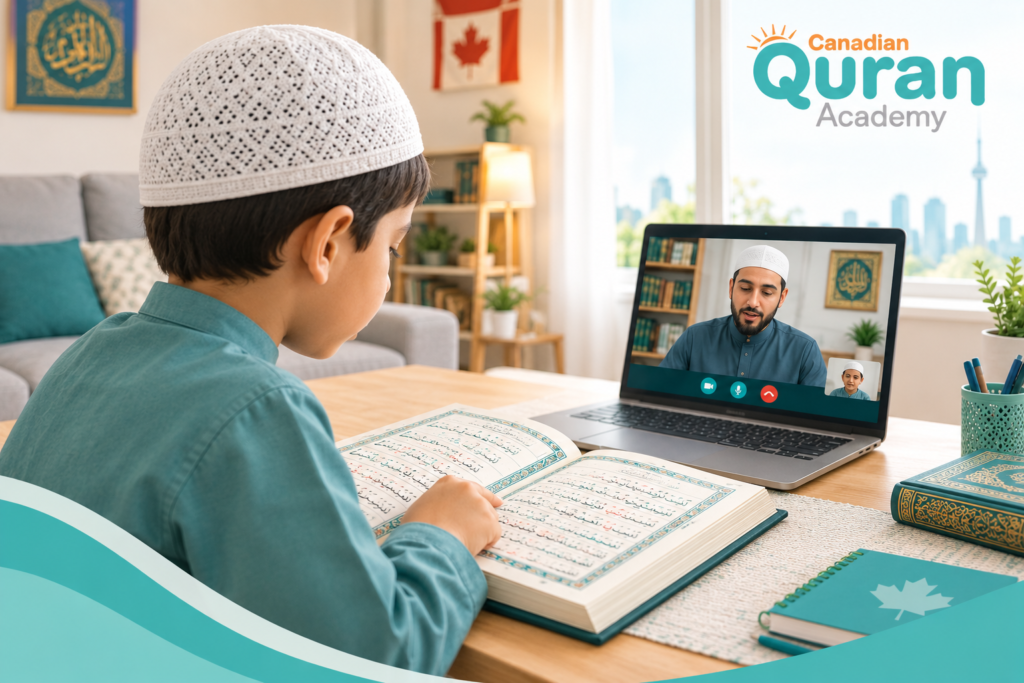
Live Class in Action
Watch how our instructors interact with students in real-time, focusing on interactive methods.
Start Your Quranic Journey in Canada
Join our vibrant community and learn with expert tutors through our flexible online platform.
Claim Your Free TrialWhat Quran Memorization Does for Children?
Parents rarely enrol a child in hifz for academic reasons, but the academic side is real and worth understanding.
a. Focus, Memory, and Language Skills
Hifz trains a child to sit with one task, repeat it deliberately, and return to it the next day. That is sustained-attention practice in an age of very short attention spans.
It also builds a large Arabic vocabulary through exposure, and it strengthens phonological awareness — the ability to hear and reproduce fine sound differences, which supports reading in any language.
b. Identity and Confidence for Muslim Kids in Canada
Children in Canadian schools are often the only Muslim in the room. Knowing surahs by heart gives them something concrete and personal to hold onto.
Kids who complete even a few juz’ typically speak about their faith with more ease and less self-consciousness. The confidence comes from competence, not from being told to be proud.
c. Starting at the Right Age
Most teachers begin structured memorization between ages six and ten, once a child can read Arabic letters fluently. Younger children can absolutely start with short surahs by listening and repeating.
There is no single correct starting age. What matters far more is consistency, and a teacher who adjusts the daily portion to the child rather than to a fixed schedule.
Read Also: Who is a Hafiz?
Why Adults Memorize the Quran Too?
Adults memorize the Quran for the same religious reasons children do, plus one more: many of them regret not having done it earlier and decide it is not too late.
Adult learners have real advantages. They understand meaning faster, they can connect verses to context, and they choose to be there — motivation that no child-focused program can manufacture.
The trade-off is time. Adults juggle work, family, and commutes, which is why evening and weekend classes, and short daily portions, tend to succeed where ambitious plans fail. Many adults at the academy begin with recitation and tajweed refinement first, then move into memorization once their pronunciation is secure.
How Long Does It Take to Memorize the Quran?
With consistent daily study, most students complete the full Quran in three to five years. A student memorizing one page per day with proper revision can finish in roughly two to three years; one who memorizes a few lines daily will take longer, and that is perfectly normal.
Speed depends on four things: prior Arabic reading ability, daily consistency, quality of revision, and teacher feedback. Consistency outweighs the other three combined.
Partial memorization is also a complete goal in itself. Juz’ Amma, Surah Al-Baqarah, Surah Al-Kahf, or Surah Al-Mulk are meaningful milestones, and many Muslims stop there deliberately.
Read Also: What We Learn From The Quran
How Muslims Memorize the Quran: The Method That Works
Effective hifz is not about talent. It follows a repeatable structure that has been refined by teachers for generations.
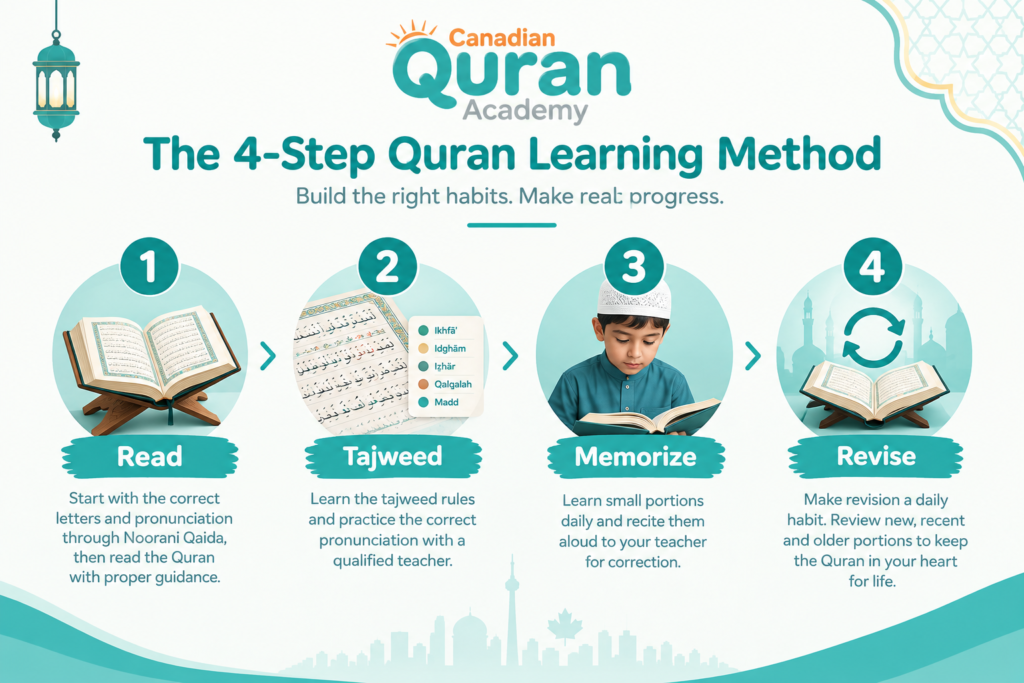
1. Build the Foundation with Tajweed First
Correct pronunciation is set before memorization begins. A student learns the letters through Noorani Qaida, then applies tajweed rules under a teacher who listens and corrects.
This foundation is not optional. It is the difference between memorizing correctly once and correcting mistakes for years.
2. Memorize Small Portions Daily
A short daily portion — five lines, half a page, one page — repeated many times beats a long weekly session. The brain consolidates what it revisits often.
Students recite the new portion aloud to a teacher every session, because errors caught on day one never become habits.
3. Treat Revision as the Real Work
Muraja’ah, or revision, is where most of the effort goes. A common structure is new memorization, plus recent revision from the past week, plus older revision from earlier juz’.
Without revision, memorization leaks. With it, the Quran stays retrievable for life. This is the single biggest reason a one-on-one recitation and tajweed circle with a qualified teacher outperforms self-study — someone is tracking what you memorized last month, not just today.
Read Also: What Is The Reward For Becoming A Hafiz?
Common Challenges and How to Get Past Them
Almost every student hits the same three walls, and each has a practical fix. Forgetting older portions usually means the revision load is unbalanced — the fix is less new material, more review.
Losing motivation is often a pacing problem rather than a faith problem, and a smaller daily target restores momentum.
Mispronunciation that keeps returning nearly always traces back to a weak tajweed foundation, which is why teachers send students back to focused recitation work rather than pushing forward.
Experience Our Classrooms
Don’t just take our word for it—take a look inside! Watch the videos below to experience our engaging teaching methods and vibrant online classrooms firsthand.
Start Your Quranic Journey in Canada
Join our vibrant community and learn with expert tutors through our flexible online platform.
Claim Your Free TrialBook a Free Trial Class and Start Your Quran Journey This Week
Canadian Quran Academy runs live one-on-one Quran recitation and tajweed circles for kids, adults, and ladies across every Canadian time zone. Certified teachers with Ijazah correct your recitation in real time, set a daily portion that fits your schedule, and track your revision so nothing slips.
Flexible evening and weekend slots. Start with a free trial class and see the difference a qualified teacher makes.
Our Quran Courses
- Quran Online Academy
- Quran Recitation Classes
- Quran Reading Classes
- Online Quran Classes for Kids
- Quran Classes for Adults
- Quran Classes for Female
- Learn Quran Course for Beginners
- Quran Memorization (Hifz) Course
- Hifz Classes for Adults
- Quran Memorization and Hifz Course for Kids
- Quran Hifz Course for Ladies
- Quran Ijazah Program
- Quran Qirat Learning Course
- Quran Tafsir Course
- Noorani Qaida Course
- Noorani Qaida Course for Kids
- Weekend Quran Classes
- Intensive Quran Course
- Al-Azhar Quran Course
- Online Tajweed Classes
- Tajweed Course for Kids
- Tajweed Course for Adults
- Tajweed Course for Ladies

Conclusion
So, why do Muslims memorize the Quran? Because memorization preserves the revelation exactly, deepens worship, and puts the Quran within reach at every moment of daily life — in prayer, in hardship, and in gratitude.
For children, hifz builds focus, Arabic literacy, and a confident Muslim identity in a Canadian context. For adults, it turns a long-postponed intention into a daily practice that fits around real life.
Takeaway Message: Quran memorization is not a test of talent. It is a foundation of correct recitation, a small daily portion, and honest revision — supported by a teacher who listens. Start with tajweed, stay consistent, and the memorization follows.
FAQs
Is memorizing the Quran obligatory for Muslims?
No. Memorizing the entire Quran is not obligatory for every Muslim. Every Muslim does memorize short portions, such as Surah Al-Fatihah, because they are required for daily prayer. Complete hifz is a highly encouraged voluntary act.
Can you memorize the Quran without knowing Arabic?
Yes. Many huffaz worldwide are not Arabic speakers and memorize by reading and reciting the Arabic text correctly. Learning Arabic meaning alongside memorization does make retention easier and the experience more meaningful, so many students study both.
What is the best age to start Quran memorization?
Most teachers recommend beginning structured memorization between ages six and ten, once a child reads Arabic letters fluently. Younger children can start earlier with short surahs by listening and repeating. Adults can begin at any age with no disadvantage in outcome.
How much of the Quran should I memorize each day?
Start with three to five lines a day and increase only when revision feels comfortable. One page per day is a strong pace for a committed student. The correct amount is the largest portion you can still revise the following week properly.
Why is tajweed necessary before memorizing the Quran?
Tajweed sets correct pronunciation before verses are stored in memory. Memorizing with incorrect pronunciation means unlearning and relearning later, which takes far longer than learning it properly the first time.
Can adults memorize the Quran while working full time?
Yes. Adults commonly memorize in short daily sessions of twenty to thirty minutes, often early morning or after evening prayer. Online classes with flexible scheduling make consistency realistic around work and family commitments.






Leave a Reply