 Quran
Quran
Nearly 1.8 million people in Canada identified as Muslim in the 2021 Census — 4.9% of the population, more than double the share recorded in 2001. Behind that number sits a very ordinary family question: who will teach my child, or me, to recite the Quran correctly?
Finding qualified Quran recitation tutors used to mean living close to a masjid with a weekend program. Today, most Canadian families learn online with an Ijazah-certified teacher who works around Toronto evenings or Vancouver mornings.
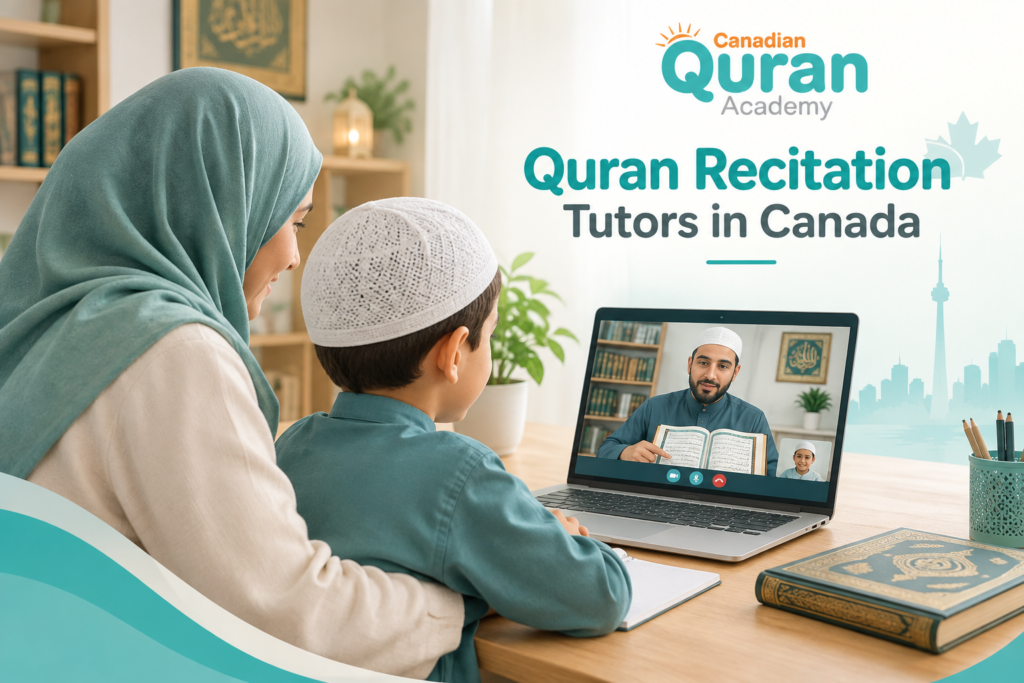
This guide explains what recitation tutors, Quran reading tutors, and word-by-word teachers each do, how their lessons differ, and how to choose the right one for a five-year-old or a working adult.
You will also find a simple checklist of what to ask during a trial lesson, so you can judge a tutor before you commit to a schedule.
Takeaway — What You Will Learn
- The difference between a Quran recitation tutor, a reading tutor, and a word-by-word teacher — and which one you actually need.
- What Ijazah certification means and why it matters when you compare tutors in Canada.
- How lessons are structured for children and for adult beginners, week by week.
- Realistic timelines for reading fluently and reciting with correct Tajweed.
- The exact questions to ask during a free trial session before you enrol.
Quran Recitation Tutors: What They Teach and Who Needs One
Recitation tutoring is for students who can already decode Arabic script but want their pronunciation to be accurate and beautiful. The focus shifts from what this letter says to whether this letter is coming from the right place in the mouth.
Most Canadian learners arrive at this stage after finishing Noorani Qaida, or after years of reading habits that quietly drifted off course.
What Does A Quran Recitation Tutor Actually Teach?
A recitation tutor teaches Makharij (the articulation points of each Arabic letter), Sifaat (letter characteristics), and the applied rules of Tajweed — Noon Sakinah, Meem Sakinah, Madd elongations, and Qalqalah.
The lesson is diagnostic rather than lecture-based. You recite, the tutor listens for a specific error, corrects it, and has you repeat the phrase until the correction becomes automatic.
Good tutors also model the passage first. Hearing an accurate Quran recitation before attempting it is how the ear learns, and the ear leads the tongue.
Who Benefits Most From Recitation Tutoring?
Three groups gain the most: learners preparing to lead prayer, students beginning Hifz who need a clean foundation before memorising, and adults who learned as children and never had their mistakes corrected.
Parents often notice the third case in themselves while helping a child with homework. It is a common, and very fixable, starting point.
How Can You Tell A Qualified Recitation Tutor From An Unqualified One?
A qualified tutor holds an Ijazah — a certification confirming they recited the entire Quran to a teacher whose own chain of transmission is documented back through generations of scholars.
Ask directly which Ijazah the tutor holds and under which Sheikh. A serious teacher answers that question easily. This is the single strongest filter you can apply.
Fluency in English or French matters too. A tutor who understands why an English speaker confuses ha and haa corrects it far faster than one who only hears the mistake. Academies like Canadian Quran Academy screen for both credentials and bilingual teaching ability, which is why their recitation classes suit families raising children in a mixed-language home.
How Is A Typical Recitation Lesson Structured?
Sessions usually run 30 to 60 minutes, one-on-one, two to three times a week. The tutor opens with a review, introduces one new rule, applies it to a short passage, then assigns practice.
Between sessions, many tutors ask students to send an audio recording. That habit alone tends to double the pace of improvement, because errors get caught within days instead of weeks.
Read Also: Why Do Muslims Memorize The Quran?
Quran Reading Tutors: Building the Skill From the First Letter
Reading tutors work one level earlier. Their job is to take a student from recognising nothing on the page to reading a Surah independently, and the method is deliberately slow at the start.
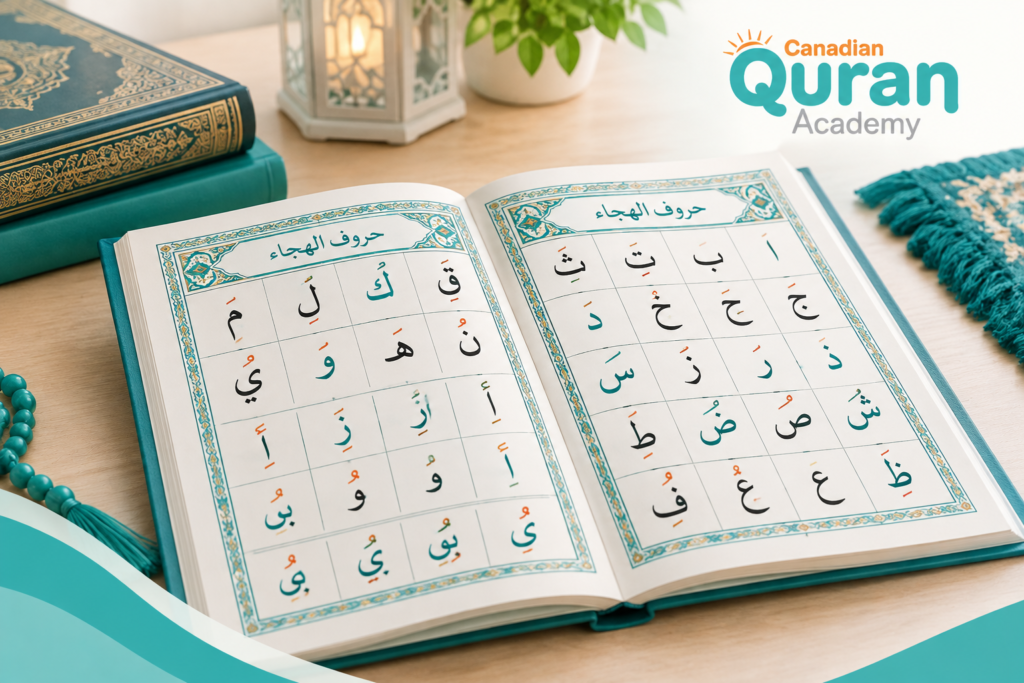
If you or your child cannot yet read Arabic script without transliteration, this is where to begin.
How Do Quran Reading Tutors Teach Absolute Beginners?
They start with letter recognition in all three positions — initial, medial, and final — because Arabic letters change shape depending on where they sit in a word.
Next come the Harakat (Fatha, Kasra, Damma), then Sukoon and Shaddah, then joining letters into short words. Only after that do students open the Mushaf.
The sequence never varies, and skipping ahead is the most common reason adult learners stall and quit.
Read Also: Who is a Hafiz?
Is Noorani Qaida Still The Best Starting Method?
Yes, for most beginners. Noorani Qaida is a structured primer that isolates one skill per stage and drills it before moving on, which is exactly what a new reader needs.
It works equally well for a six-year-old and a thirty-six-year-old — the pacing changes, not the content.
How Do Lessons Differ For Kids And Adults?
Children learn best in short, repetitive, high-energy sessions of 25 to 30 minutes, with visual cues and plenty of praise. Their strength is imitation; their limit is attention span.
Adults can handle 45 to 60 minutes and benefit from understanding the why behind a rule. Their strength is analysis; their obstacle is usually self-consciousness about being a beginner.
This is why dedicated Quran reading tutors keep separate tracks for kids’ classes and adult classes rather than teaching everyone from one script.
Read more about our Quran courses
Live Class in Action
Watch how our instructors interact with students in real-time, focusing on interactive methods.
Start Your Quranic Journey in Canada
Join our vibrant community and learn with expert tutors through our flexible online platform.
Claim Your Free TrialHow Long Does It Take To Read The Quran Fluently?
With two to three lessons a week and consistent practice, most beginners read simple Surahs within three to six months and read fluently within nine to eighteen months.
Consistency matters more than session length. Twenty minutes daily outperforms two hours once a week, every time.
Word-by-Word Quran Teacher in Canada: Meaning Alongside Pronunciation
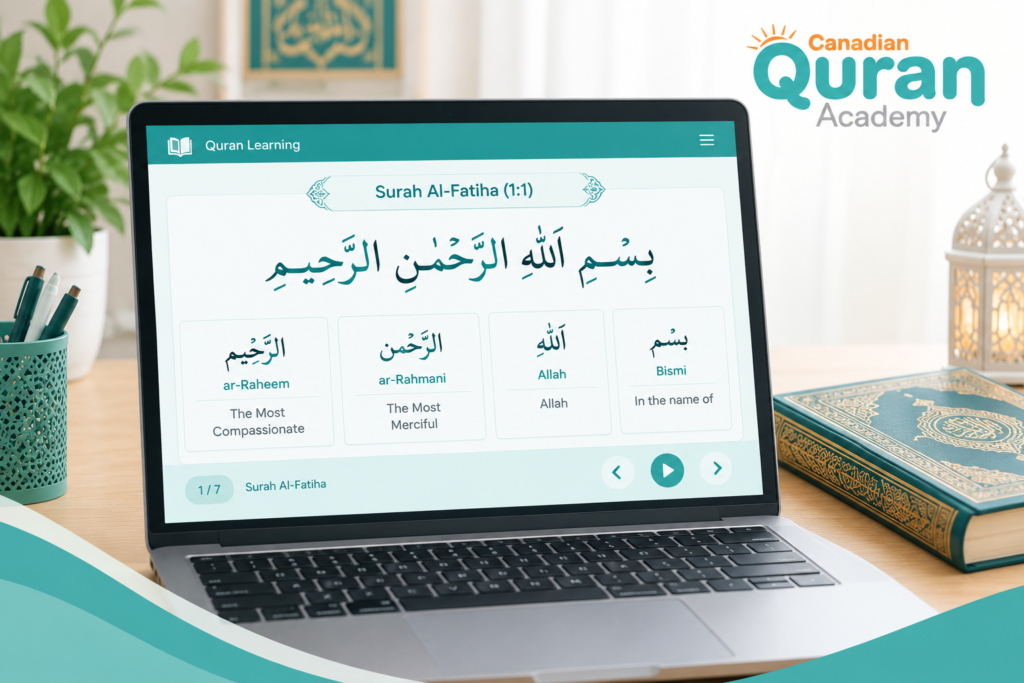
A word-by-word Quran teacher in Canada does something the other two do not: they attach meaning to each word as the student recites it. Pronunciation and comprehension develop together instead of years apart.
For learners who do not speak Arabic — which describes most Muslims raised in Canada — this changes the experience of reading entirely.
What does word-by-word teaching involve?
The teacher takes a verse, breaks it into individual words, and gives the meaning, the root, and the grammatical role of each one before the student recites the full verse.
Over time, students start recognising recurring vocabulary. Roughly a few hundred words cover a large share of the Quranic text, so progress compounds quickly.
Why Does This Approach Suit Canadian Learners?
Because it solves the disconnection problem. Many students can recite a page perfectly and understand none of it, and that gap is what eventually erodes motivation.
Connecting sound to meaning also improves recitation quality on its own. When you know a phrase ends a thought, you pause in the right place naturally.
Should You Choose Word-By-Word Or Standard Recitation Lessons?
Choose standard recitation lessons if your priority is correcting pronunciation for prayer or preparing for Hifz. Choose word-by-word if you want to understand what you are reading and hold your attention in Salah.
Many families run both: recitation twice a week and one word-by-word session. If you are unsure which suits your level, a placement assessment during a free trial will answer it in one sitting — Canadian Quran Academy runs these before recommending a track.
Read Also: What We Learn From The Quran
How to Choose the Right Quran Tutor in Canada
Credentials get you a shortlist. The practical details decide whether lessons actually survive past month two.
Check Whether the Tutor’s Schedule Fits Canadian Time Zones
Canada spans six time zones, and most qualified tutors teach from overseas. Confirm that your tutor’s availability covers your evenings and weekends, not just early mornings.
Ask what happens when a lesson is missed. Academies that offer makeup sessions save families from paying for skipped weeks during exams, travel, or Ramadan.
What Parents Should Look for in a Quran Tutor for Children
Look for a tutor who keeps a young child engaged for the full session, sends short progress notes to parents, and allows you to observe the class.
Ask whether the same tutor teaches every session. Rotating teachers is the fastest way to lose a child’s momentum.
What to Ask During a Free Quran Trial Lesson
Ask about the Ijazah, the curriculum for your specific level, the expected timeline, and how progress will be measured and reported.
Then listen to how the tutor corrects one of your mistakes. That single moment tells you more than any brochure. Canadian Quran Academy offers a free trial for exactly this reason — you evaluate the teacher before any commitment.
Read Also: What Is The Reward For Becoming A Hafiz?
Experience Our Classrooms
Don’t just take our word for it—take a look inside! Watch the videos below to experience our engaging teaching methods and vibrant online classrooms firsthand.
Start Your Quranic Journey in Canada
Join our vibrant community and learn with expert tutors through our flexible online platform.
Claim Your Free TrialStart Your Quran Recitation Journey With a Free Trial Lesson
Book a free trial session with a certified Quran recitation tutor at Canadian Quran Academy and get a personalised placement assessment for you or your child — no payment details, no obligation.
You will be matched with an Ijazah-holding teacher who fits your time zone, your level, and your goals, whether that means correcting Tajweed, learning to read from the first letter, or studying the Quran word by word. Flexible scheduling, one-on-one attention, and makeup sessions are included from day one.
Our Quran Courses
- Quran Online Academy
- Quran Recitation Classes
- Quran Reading Classes
- Online Quran Classes for Kids
- Quran Classes for Adults
- Quran Classes for Female
- Learn Quran Course for Beginners
- Quran Memorization (Hifz) Course
- Hifz Classes for Adults
- Quran Memorization and Hifz Course for Kids
- Quran Hifz Course for Ladies
- Quran Ijazah Program
- Quran Qirat Learning Course
- Quran Tafsir Course
- Noorani Qaida Course
- Noorani Qaida Course for Kids
- Weekend Quran Classes
- Intensive Quran Course
- Al-Azhar Quran Course
- Online Tajweed Classes
- Tajweed Course for Kids
- Tajweed Course for Adults
- Tajweed Course for Ladies

Conclusion
Choosing between Quran recitation tutors, reading tutors, and word-by-word teachers is simply a question of where you are standing right now. Beginners start with reading and Noorani Qaida, existing readers refine pronunciation through recitation lessons, and learners who want comprehension add a word-by-word track.
Across all three, the same factors decide results: an Ijazah-certified teacher, one-on-one attention, a schedule that fits Canadian life, and short, consistent practice between sessions.
Take-away message: the right Quran recitation tutors will not only correct your Makharij and Tajweed — they will match the method to your level, so that progress feels steady instead of overwhelming. Start with a trial lesson, ask the four questions above, and build from there.
FAQs
How much do Quran recitation tutors cost in Canada?
Online one-on-one rates typically fall between CAD $10 and $25 per session, depending on lesson length and frequency. Most academies offer monthly packages that reduce the per-session cost, and family discounts are common.
Can I learn Quran recitation online as effectively as in person?
Yes. Recitation is an audio-based skill, and one-on-one video lessons give each student far more speaking time than a group class at a masjid. Screen sharing also lets tutors highlight rules directly on the text.
What age should a child start Quran reading lessons?
Most children are ready between ages 4 and 6, when they can sit for a short focused session and imitate sounds accurately. Starting with 25-minute lessons two or three times weekly works better than longer, less frequent classes.
Do I need to learn Arabic before studying the Quran?
No. Quran reading tutors teach the script and pronunciation without requiring conversational Arabic. If you also want to understand the text, a word-by-word teacher builds Quranic vocabulary alongside your recitation.
Are female Quran tutors available for sisters and girls?
Yes. Most established academies, including Canadian Quran Academy, provide qualified female teachers for sisters and for young girls whose families prefer it, across recitation, reading, and Hifz programs.
How many lessons per week do I need to make real progress?
Two to three sessions weekly is the standard recommendation. Anything less makes retention difficult between lessons, while daily short practice at home matters just as much as the lessons themselves.





Leave a Reply