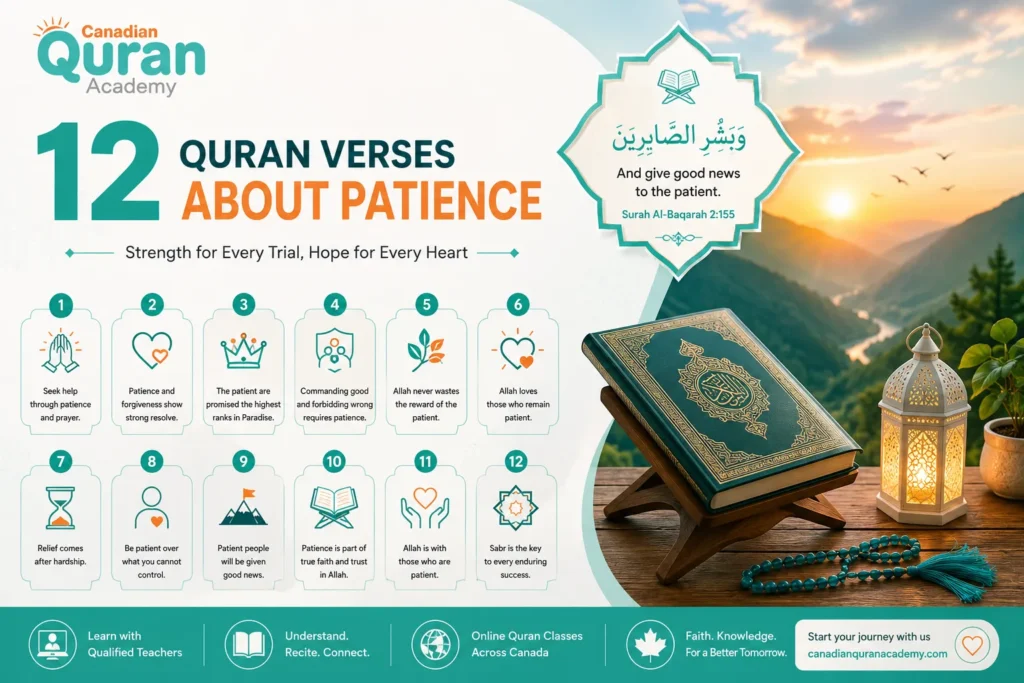
 Quran
Quran
Ask a parent in Toronto or Calgary why they enrolled their child in Quran classes, and the answer is rarely “to finish the book.” They want their child to carry something. That “something” is the real question behind what we learn from the Quran, and it deserves a clearer answer than a list of rules.
The Quran teaches belief, character, history, law, and language all at once. A seven-year-old and a forty-year-old can read the same verse and walk away with different lessons, both of them correct.
This article breaks down what readers actually take from the Quran at different ages, why recitation quality shapes understanding, and how Muslim families across Canada keep their learning steady through busy school terms and work weeks.
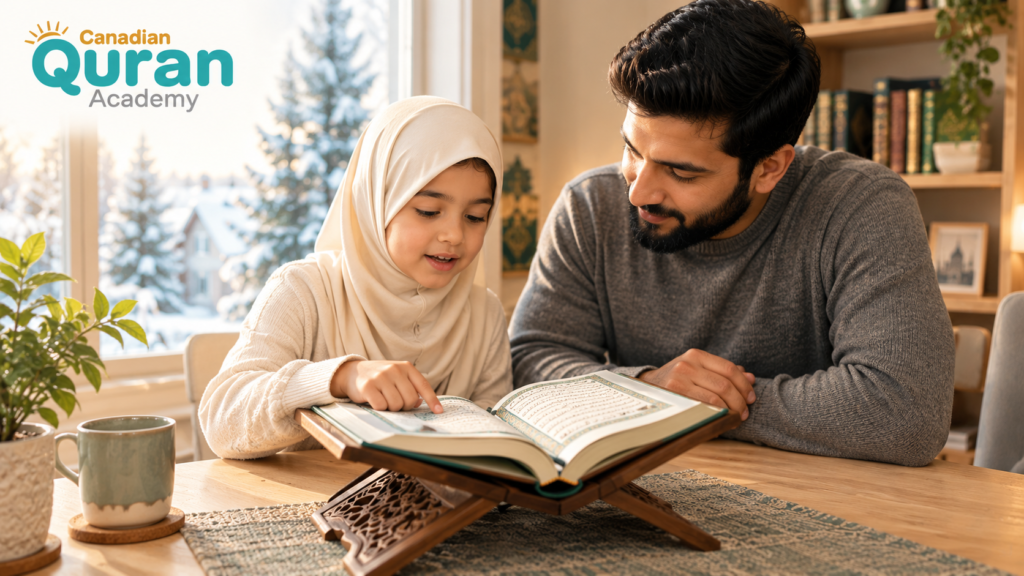
A father and his daughter reading the Quran together at a table in a Canadian home
Take Away — What You Will Learn
- The five areas of knowledge the Quran covers, from belief to language.
- The specific lessons children absorb from early Quran study, and the ones adults tend to discover later.
- Why Tajweed rules protect meaning and are not decoration.
- How to build a weekly Quran routine that survives a Canadian school and work schedule.
- Practical answers to the questions most families ask before they start.
What Does the Quran Teach Us About Life and Faith?
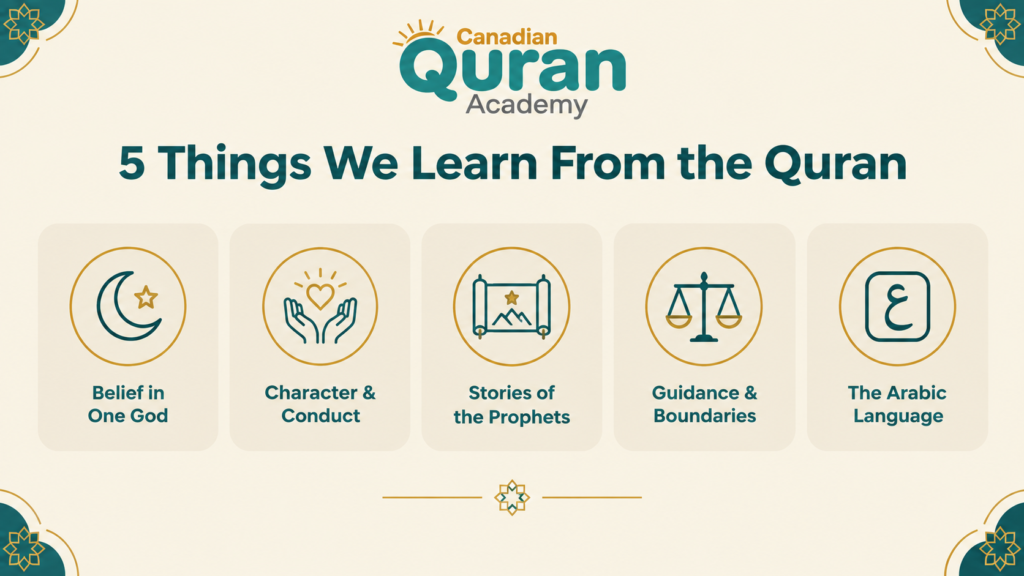
What we learn from the Quran falls into five connected areas: who God is, how to treat people, what happened to earlier nations, what is permitted and prohibited, and the Arabic language that carries all of it. Most students meet these areas in a different order, but they eventually meet all of them.
The order matters less than the depth. A student who memorizes without meaning holds one layer. A student who reads translation without recitation holds another. Long-term study joins them.
1. Learning Tawheed and Understanding Allah’s Attributes
The Quran’s most repeated subject is tawheed, the oneness of God. Verses such as Surah Al-Ikhlas compress the entire theology of Islam into four short lines that a child can hold and a scholar can write volumes about.
Readers learn the divine names too. Ar-Rahman, Al-Hakeem, Al-Ghafoor. Each name teaches a quality worth reflecting on, and together they shape how a believer expects to be treated by their Creator.
2. Learning Good Character and Daily Islamic Conduct
A large portion of the Quran addresses behaviour: speech, honesty, keeping trusts, managing anger, treating parents and neighbours well. Surah Al-Hujurat alone tackles gossip, suspicion, mockery, and false news.
These lessons land differently at different ages. A child learns not to lie. An adult learns why the Quran ties truthfulness to the health of an entire community.
3. Learning from the Stories of the Prophets
Narratives of Yusuf, Musa, Ibrahim, and Maryam make up a significant share of the text. They are not told as bedtime stories but as case studies in patience, trust, and consequence.
Children remember the events. Older students notice the structure: what the prophet was tested with, how he responded, and what changed as a result.
4. Learning Islamic Guidance, Laws, and Boundaries
The Quran sets out worship, family rights, inheritance, contracts, and financial ethics. These sections teach readers that Islam treats a business dealing and a prayer as parts of the same life.
Students studying this material usually need a teacher. Verses of ruling are connected to context, abrogation, and prophetic explanation, which is where guided classes earn their place.
5. Learning Islamic Guidance, Laws, and Boundaries
Anyone who reads the Quran regularly builds Arabic vocabulary without a textbook. Roots repeat, patterns recur, and after a year of steady recitation, familiar words start arriving with their meanings attached.
This is why many students at Canadian Quran Academy who begin with recitation later add Quranic Arabic. Once you hear the language every day, you want to understand it directly rather than through translation.
Read Also: Quran Recitation Tutors In Canada – Recitation, Reading, And Word-By-Word Lessons
What Children Learn from Studying the Quran at an Early Age
Children take three things from early Quran study: accurate pronunciation, memory capacity, and a sense of identity that holds up outside the home.
Pronunciation is the one that has a deadline. Young learners reproduce Arabic sounds such as ع, ح, ض, and ظ far more easily than adults do, because their speech habits are still forming.
Memory is the second. Regular hifz work trains sustained attention, which teachers in Canada often notice showing up in schoolwork as well.
The third is quieter. A child in Mississauga or Surrey who can recite Surah Al-Fatiha correctly in front of family carries a confidence that lessons on Islam alone do not produce. Structured Tajweed classes for kids build that confidence in short, age-appropriate sessions rather than long lectures.
What Adults Gain When They Return to Quran Study
Adults usually come back to the Quran with a specific gap. They read fluently but were never taught the rules, or they memorized as children and lost most of it, or they converted and started from the alphabet.
The discovery is almost always the same: meaning arrives faster than expected once recitation improves. When a reader stops fighting the letters, attention moves to the message.
Adult learners also report a practical benefit. Prayer changes when you understand the surah you are reciting, and that alone motivates many students to book a first class.
Read Also: What Is The Reward For Becoming A Hafiz?
Why Tajweed Is Important for Preserving Quranic Meaning
Tajweed is not ornamentation. It is the set of rules that preserves how each letter is pronounced, and in Arabic, a shifted letter can shift a meaning entirely.
Reading قلب (heart) as كلب (dog) is the standard example teachers use, and it makes the point quickly. Precision is a matter of accuracy, not aesthetics.
Rules such as idgham, ikhfa, madd, and qalqalah also govern rhythm and pause. Where you stop in a verse can change which clause modifies which, so pausing correctly is part of reading correctly.
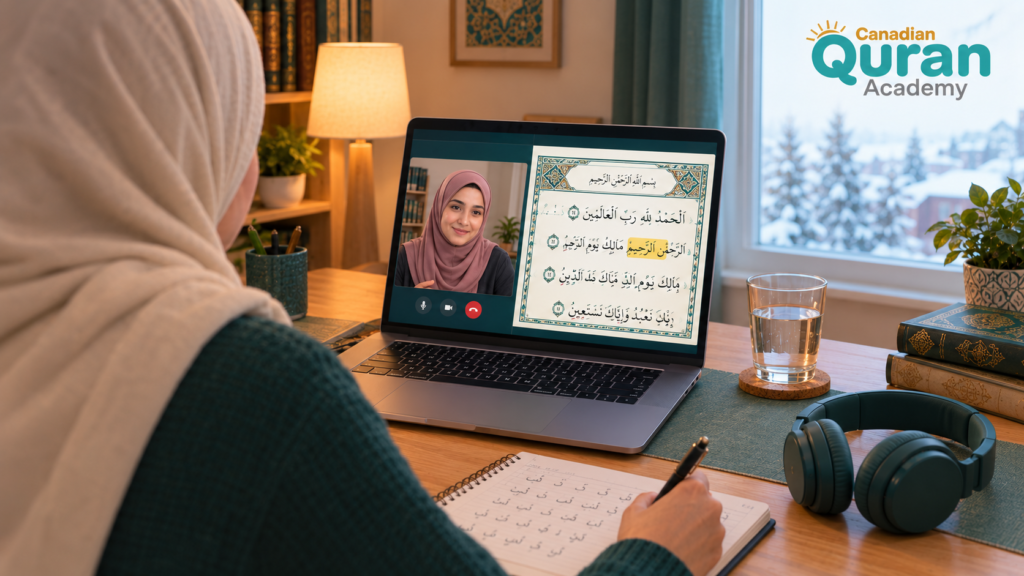
This is difficult to self-teach from videos. A live teacher hears the error you cannot hear yourself, which is the core reason Tajweed classes for adults at Canadian Quran Academy are delivered one-to-one rather than through recordings.
Read Also: Why Do Muslims Memorize The Quran?
How Muslim Families in Canada Can Maintain Consistent Quran Learning
Nearly 1.8 million people in Canada identified as Muslim in the 2021 Census, roughly 4.9% of the population. Access to a qualified Quran teacher, though, still varies a great deal by city and neighbourhood.
Families who stay consistent tend to do three things. They pick fixed weekly slots instead of “whenever we can,” they keep sessions short for younger children, and they choose a teacher whose schedule matches Canadian time zones rather than one requiring 5 a.m. calls.
1. Build a Weekly Quran Learning Routine That Lasts
Two or three sessions of 30 to 45 minutes usually beat one long weekend session. Spacing keeps recitation fresh and reduces the review burden each time.
Between classes, ten minutes of daily reading is enough for most students. Consistency outperforms intensity in both memorization and pronunciation.
2. Choose the Right Quran Teacher and Starting Level
Complete beginners generally start with Noorani Qaida, which builds letter recognition before moving to full verses. Readers who already recite move directly into applied Tajweed with a diagnostic session first.
A free trial class is the fastest way to find out which level fits, and it takes one session rather than a term.
Read Also: Who is a Hafiz?
Live Class in Action
Watch how our instructors interact with students in real-time, focusing on interactive methods.
Start Your Quranic Journey in Canada
Join our vibrant community and learn with expert tutors through our flexible online platform.
Claim Your Free TrialStart Tajweed Classes That Make Every Verse Clearer
Book a free trial session with Canadian Quran Academy and recite for a certified teacher who will tell you exactly where your pronunciation stands.
Classes run one-to-one, at times that fit Canadian schedules, for children from age five and adults at every level, with separate female teachers available for sisters and girls. You choose the pace, the schedule, and the teacher.
Our Quran Courses
- Quran Online Academy
- Quran Recitation Classes
- Quran Reading Classes
- Online Quran Classes for Kids
- Quran Classes for Adults
- Quran Classes for Female
- Learn Quran Course for Beginners
- Quran Memorization (Hifz) Course
- Hifz Classes for Adults
- Quran Memorization and Hifz Course for Kids
- Quran Hifz Course for Ladies
- Quran Ijazah Program
- Quran Qirat Learning Course
- Quran Tafsir Course
- Noorani Qaida Course
- Noorani Qaida Course for Kids
- Weekend Quran Classes
- Intensive Quran Course
- Al-Azhar Quran Course
- Online Tajweed Classes
- Tajweed Course for Kids
- Tajweed Course for Adults
- Tajweed Course for Ladies
Start Your Quran Memorization Journey Today — Book Your Free Trial Class

Conclusion
What we learn from the Quran spans belief, character, prophetic history, practical guidance, and the Arabic language, and these layers open gradually rather than all at once.
Children gain accurate pronunciation and confidence at the age when both are easiest to build, while adults tend to gain understanding and a deeper prayer.
Tajweed sits underneath all of it. Correct recitation is what keeps the meaning intact, and it is the one part of Quran study that genuinely requires a listening teacher.
Takeaway Message: The Quran gives back in proportion to how carefully it is read. Learn the sounds properly, keep a steady weekly routine, and the meanings follow.
FAQs
What is the main lesson of the Quran?
The central lesson is tawheed, the oneness of God, and the accountability that follows from it. Every other theme in the Quran, from honesty in business to kindness toward parents, connects back to that foundation.
What age should a child start learning the Quran?
Most teachers recommend starting between ages four and six with sound recognition and short surahs. Children at this age imitate Arabic pronunciation naturally, which makes correcting letters far easier than it will be later.
Can I learn the Quran without knowing Arabic?
Yes. Students begin by learning the Arabic script and sounds through Noorani Qaida, which does not require any prior knowledge of the language. Understanding of vocabulary and grammar is added afterwards, and many learners recite accurately long before they speak Arabic.
Is Tajweed obligatory when reciting the Quran?
Yes. Scholars distinguish between the rules that prevent clear mistakes in letters and vowels, which are required, and the finer rules of embellishment, which are recommended. In practice, learning Tajweed properly covers both without needing to separate them.
How long does it take to learn to read the Quran correctly?
An adult beginner attending two structured sessions a week typically reads simple verses within three to six months. Fluent, rule-accurate recitation usually takes one to two years of consistent practice with a teacher.
What do adults gain from Quran classes that self-study misses?
A teacher catches pronunciation errors that the reader cannot hear, corrects pauses that change meaning, and adjusts the pace to the student’s level. Self-study is useful for review, but it rarely fixes an error the student does not know they are making.





Leave a Reply