 Quran
Your child can name every character in their favourite mobile game, but forgets the third ayah of Surah Al-Mulk by Thursday. Sound familiar?
That gap is not a discipline problem. It is a practice design problem, and it is exactly what Quran learning games are built to solve.
Play turns passive repetition into active recall, and active recall is what moves an ayah from short-term memory into lasting hifz.
This guide explains what Quran learning games actually are, the learning science behind why they work, which formats suit kids versus adults, and how to fold them into a weekly routine without letting them replace a qualified teacher.
1. Word and Verse Sequencing Games
This is the simplest Quran learning game to run and one of the most effective. The screen shows an ayah up to a certain point and stops, and the learner picks the correct following word from a short list of options.
Free browser projects such as Pdemia’s Quran recitation game run an entire surah this way, from the first word to the last.
Its value lies in the direction of recall. Memorization is a forward chain: each word cues the next one. Recognizing an ayah on a page feels like knowing it, but producing the next word from a blank screen is the only honest test of whether it is memorized.
To set it up, keep three answer options for beginners and raise it to six or eight for stronger students. The quality of the game depends almost entirely on the distractors, so pull the wrong options from the same surah or a similar ayah rather than picking random words. Near-misses are what force precision.
Use this one for revision rather than first-time memorization. Material learned three to seven days ago sits in the ideal window. Note the words where the learner hesitates before answering, because hesitation marks a weak link in the chain long before an actual mistake appears in recitation.
Read Also: Quran Learning Tools For Kids
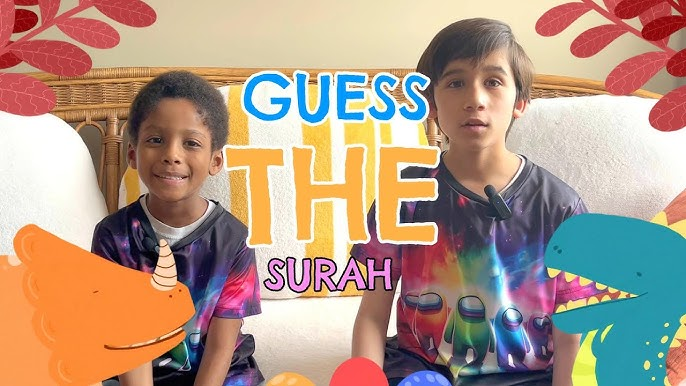
2. Guess the Surah Listening Game
Here the learner hears a short recitation clip and identifies which surah it comes from, and at a higher level, roughly where in the surah it sits. Platforms like AyaKids include this format alongside timed audio challenges.
Listening games build the layer of memory that hifz actually runs on. Children absorb sound far more reliably than script, and repeated exposure to a skilled qari trains the ear for madd lengths, ghunnah, and correct stopping points before those rules are ever explained formally.
Build playlists one juz at a time. Begin with clips of about ten seconds from a single reciter, then shorten them to three or four seconds, then rotate between reciters so that recognition depends on the text rather than a familiar voice.
The best variation is to avoid the opening ayah. Children often memorize surah openings as labels without knowing the body of the surah, so clips taken from the middle reveal what is genuinely learned. This game also needs no screen at all, which makes it ideal for car journeys and bedtime.
3. Flipped-Card Surah Matching
This is the familiar memory game applied to Quranic content. Cards sit face down in a grid, and the learner flips two at a time, trying to pair a surah name with its number, its meaning, its opening ayah, or its Makki or Madani classification.
The skill it develops is navigation rather than recitation. Students who memorize well but cannot locate a surah lose time in every revision session and struggle to follow along in a halaqah. This game quietly builds a mental index of the Mushaf.
Use twelve to sixteen cards for younger children and twenty-four to thirty for older ones. Choose one pairing type per round instead of mixing them, because a deck that pairs names with numbers and meanings at the same time becomes confusing rather than challenging.
Printed cards work just as well as a digital version and remove screen time entirely. Many families keep a laminated deck on the kitchen table, which turns a five-minute wait before dinner into review without anyone needing to announce that study is starting.
Read Also: The Quran Learning Journey
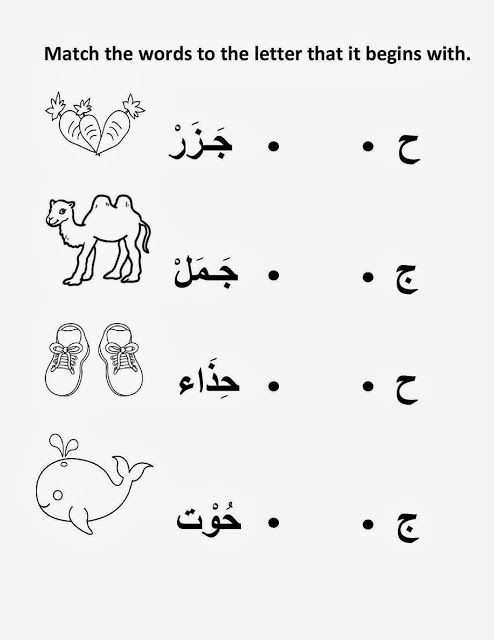
4. Arabic Letter Matching
This belongs to the pre-reading stage and suits children between roughly four and six years old. The child matches identical letters, connects a letter to its sound, picks out a target letter from a group, or matches the initial, medial, and final forms of the same letter.
That last variation matters more than it appears. Arabic letters change shape depending on where they fall in a word, and this is the single most common stumbling block for new readers. Meeting the different forms as a matching puzzle prevents the confusion that otherwise surfaces months later.
Introduce four to six letters at a time and add a new one only once the current set is answered automatically. Colourful physical cards, magnetic letters, or a simple tap-to-match app all work equally well at this stage.
The objective is familiarity, not memorization, so keep each round short and easy enough that the child succeeds without an adult sitting beside them. Playful letter recognition at home pairs naturally with structured Noorani Qaida instruction, where a teacher establishes correct pronunciation from the first letter.
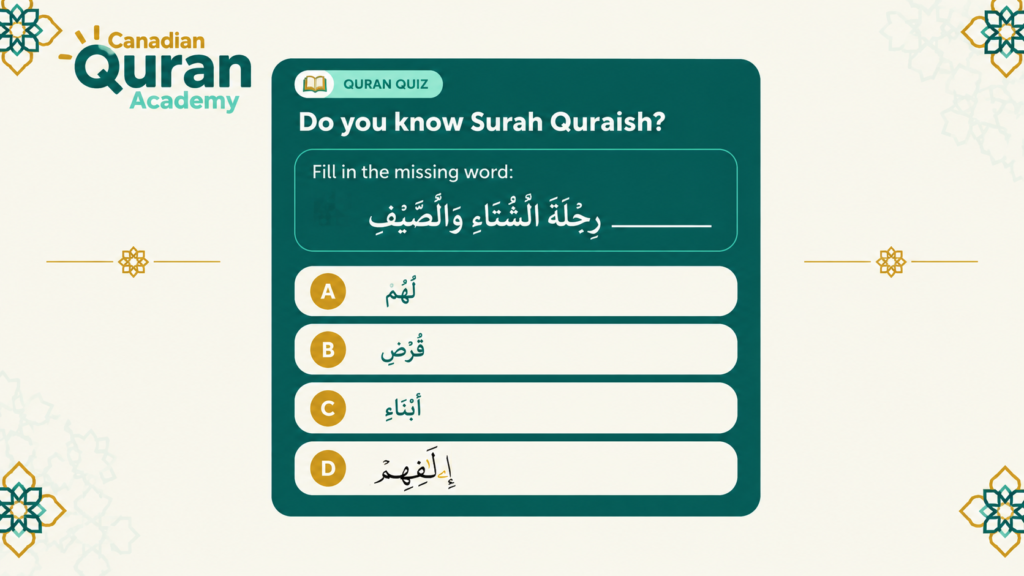
5. Missing-Word Fill-In Game
Although this looks similar to the sequencing game, it trains something different. The full ayah is displayed with one or two words removed from the middle, and the learner supplies what is missing rather than predicting what comes next.
Removing words from inside an ayah exposes the parts learners glide over. Conjunctions and particles such as و، ف، إنّ and مِن are recited on autopilot, and they are precisely where most hifz errors hide. A blank in the middle of a familiar line forces the learner to slow down and look.
Begin by removing one content word, such as a noun or verb, from each ayah. Then move to removing particles, then to two or three blanks in a single ayah, and finally to typing the answer instead of choosing it from options.
This format suits Juz Amma review particularly well. A child can revise a specific surah in two or three minutes without reciting the whole passage aloud every time, which keeps daily revision realistic on school nights.
6. Ayah-Sorting Challenge
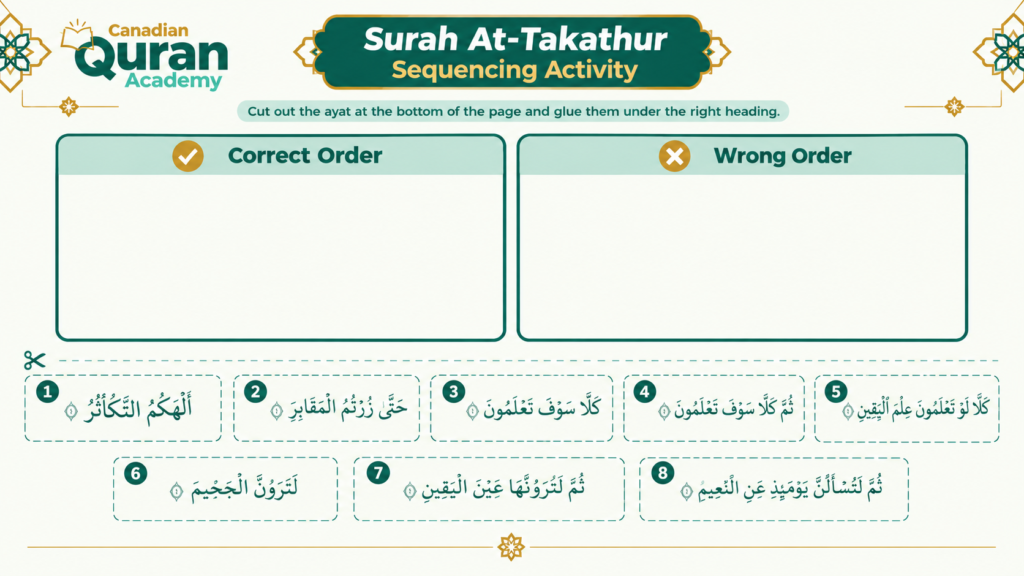
In this game, the learner receives several ayat, or the halves of one long ayah, in the wrong order and rebuilds the correct sequence. It works as printed cards, as a drag-and-drop activity, or simply as lines rearranged on a screen.
Where the sequencing game works at the level of individual words, this one works at the level of the surah’s structure. It answers a different question: not “what word comes next” but “how does this passage unfold?” Both skills are needed, and students are often much stronger at one than the other.
Start with four to six ayat for beginners and ten to twelve for stronger students. A gentle timer adds energy for older children, but accuracy should always be scored ahead of speed. Ten to fifteen minutes is enough before concentration starts to slip.
For a richer version, ask the learner to explain why one ayah follows another, or to sort a set by theme rather than by order. Connecting sequence to meaning gives the memory something to hold onto beyond raw repetition.
7. Mushaf Line-Rebuilding Game
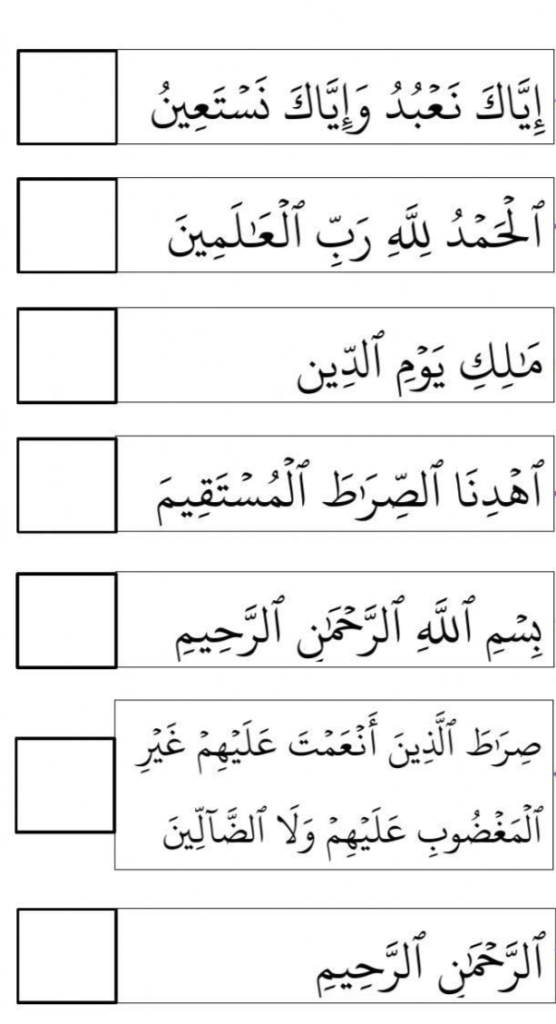
This game takes a real Mushaf page, splits it into its individual lines, shuffles them, and asks the student to restore the page. Digital versions do the same thing directly on the page image, keeping the original script and layout intact.
It targets page-position memory, the visual snapshot that experienced huffaz rely on when they recall where an ayah sits on the page. Students who memorize only by sound can recite correctly and still lose their place the moment they open the Mushaf.
Always use the student’s own edition, most commonly the fifteen-line Madani layout, so that the line positions match what they study every day. A photocopied page, cut into strips and laminated, is all the equipment this needs.
Once the basic version becomes easy, remove a line entirely and ask which one is missing, or insert a deliberate error and ask the student to find it. Error-spotting is considerably harder than reordering and reveals gaps that a smooth recitation can hide.
Read Also: Quran Learning Apps
8. Mutashabihat Verse Puzzle
Mutashabihat are passages that read almost identically but differ in a word, an order, or an ending. In this puzzle, the learner is given two similar passages side by side and must identify the difference, complete the missing word, or match each phrase to the surah it belongs to.
For anyone carrying a large amount of memorized text, these similar verses cause the majority of revision errors. Ordinary repetition actually makes the problem worse, because it reinforces the shared wording rather than the point where the two passages separate.
The most useful version of this game is personal rather than generic. Keep a running list of the confusions the learner actually makes, then build the puzzle from that list, highlighting the differing word first and hiding it once the contrast is clear.
Adding a memory hook helps the difference stick, whether that is a distinguishing feature of the surah or a short note on the meaning. Adult students benefit from this game more than any other, especially when it is paired with a few minutes of tafsir on the same passage.
Live Class in Action
Watch how our instructors interact with students in real-time, focusing on interactive methods.
Start Your Quranic Journey in Canada
Join our vibrant community and learn with expert tutors through our flexible online platform.
Claim Your Free Trial9. Quranic Root Word Game
For adult learners, Quran games can move past memorization and into meaning. A root-word game asks learners to group words that share the same three-letter root, match words to their meanings, or build a family of related words from a single root.
The efficiency here is striking. Quranic vocabulary is heavily repeated, and a few hundred roots account for the large majority of the text.
Once you recognize a root, dozens of previously opaque words across the Mushaf become partly understandable at first glance.
A practical structure is one root per week. Find its occurrences, chart the derived forms, and note how the meaning shifts across them. As a card game, place the root in the centre and have players lay down derived words, scoring a point for each correct meaning.
Meaning gives memory something to anchor to, which is why comprehension-based games often outperform pure drilling for adults.
These activities pair naturally with Quranic Arabic study, where recurring roots and grammar patterns are taught systematically rather than picked up by chance.
Read Also: Quran Hifz Quotes
Why Quran Learning Games Work
Matching the format to the learner’s stage prevents the two most common failures: boredom and overwhelm. Games are not a shortcut around effort. They are a delivery system for the two study habits that decades of memory research consistently support.
A good Quran learning game should reinforce a specific skill—such as Arabic recognition, ayah sequencing, memorization, or vocabulary—without making the learner feel like they are simply doing another worksheet.
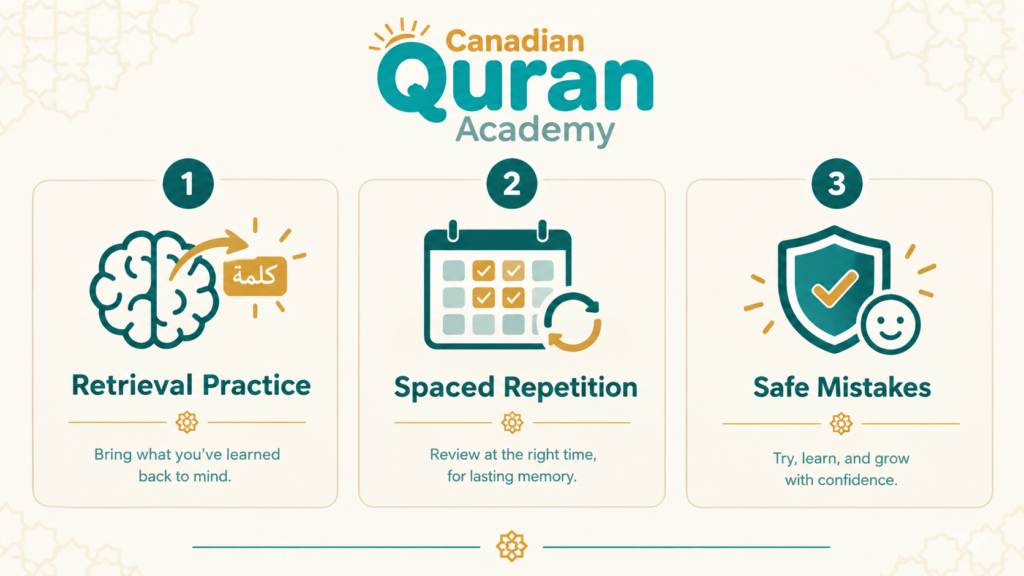
1. Retrieval Practice
Every time a learner is forced to produce the next word instead of recognizing it on a page, the memory trace strengthens. Researchers call this the testing effect, and it is well documented by cognitive scientists at The Learning Scientists.
A game is simply retrieval practice with immediate feedback and a score attached.
2. Spaced Repetition
Good games recycle earlier surahs into later rounds. That spacing — revisiting material just as it starts to fade — is far more efficient than massed repetition in one long sitting.
Ten minutes daily across six days beats a single hour on Sunday, every time.
3. Low-Stakes Mistakes
A wrong answer in a game costs nothing. That psychological safety matters enormously for children who freeze when reciting in front of a teacher or a halaqah group.
Once confidence is built at home, that same child recites far more fluently in class. This is one reason our instructors in Tajweed classes for kids often recommend a short daily game as a warm-up before the lesson begins.
Do Quran Learning Games Work for Adults Too?
Yes — and often better than for children, because adults can consciously target their weak points.
Adult learners typically struggle with three things: distinguishing similar verses, maintaining older memorized portions, and reading fluency in unvowelled script. Games built around mutashabihat and word-recall address all three directly.
The one adjustment adults should make is depth. Pairing a vocabulary game with a five-minute tafsir reading of the same passage roughly doubles retention, because meaning gives memory something to anchor to.
How to Use Quran Learning Games Without Replacing a Teacher
Games build recall. They cannot correct your makhraj, and this is the single most important limitation to understand.
No app can hear that you are pronouncing ض as د, or that your ghunnah is a beat too short. Pronunciation errors learned in isolation become extremely hard to unlearn later — which is why every serious Quran memorization program keeps a live teacher in the loop.
The productive arrangement is simple. The teacher introduces and corrects; the game reinforces between lessons. Think of it as homework the child asks to do.
Experience Our Classrooms
Don’t just take our word for it—take a look inside! Watch the videos below to experience our engaging teaching methods and vibrant online classrooms firsthand.
Start Your Quranic Journey in Canada
Join our vibrant community and learn with expert tutors through our flexible online platform.
Claim Your Free TrialStart a Free Trial Class and Turn Practice Into Real Progress
Games make Quran study enjoyable — a certified teacher makes it correct. At Canadian Quran Academy, our Al-Azhar-qualified instructors combine structured tajweed and hifz curricula with the kind of playful, encouraging teaching style that keeps children coming back to the screen willingly.
Every student begins with a free assessment session. We listen to your child’s current recitation, identify the specific pronunciation and retention gaps, and build a personalized plan around them — including which practice activities will help most between lessons.
Classes run one-to-one in flexible slots built around Canadian school hours, from Toronto and Mississauga to Calgary and Vancouver. Male and female teachers are available, with a progress report after every session.
Our Quran Courses
- Quran Online Academy
- Quran Recitation Classes
- Quran Reading Classes
- Online Quran Classes for Kids
- Quran Classes for Adults
- Quran Classes for Female
- Learn Quran Course for Beginners
- Quran Memorization (Hifz) Course
- Hifz Classes for Adults
- Quran Memorization and Hifz Course for Kids
- Quran Hifz Course for Ladies
- Quran Ijazah Program
- Quran Qirat Learning Course
- Quran Tafsir Course
- Noorani Qaida Course
- Noorani Qaida Course for Kids
- Weekend Quran Classes
- Intensive Quran Course
- Al-Azhar Quran Course
- Online Tajweed Classes
- Tajweed Course for Kids
- Tajweed Course for Adults
- Tajweed Course for Ladies

Conclusion
Quran learning games work because they replace passive rereading with active recall, spaced across the week and delivered with immediate feedback. That combination is what memory research supports, and it is what makes an ayah stay learned rather than half-remembered.
Choose games that match your learner’s age, verify the text and audio quality before installing anything, and keep sessions short and daily rather than long and occasional.
Takeaway message: Quran learning games are a powerful support for memorization, not a substitute for correction. Pair fifteen playful minutes at home with a qualified teacher who can hear and fix your child’s recitation, and progress becomes both faster and far more enjoyable.
FAQs
Are Quran learning games permissible in Islam?
Yes. Scholars generally permit educational tools that help learners engage with the Quran respectfully, as long as the text is treated with adab, the audio is accurate, and the activity does not trivialize the Quran. Avoid games that use Quranic text as scoring tokens, background decoration, or entertainment prizes.
At what age can a child start Quran learning games?
Around age four, beginning with Arabic letter recognition and surah-name matching rather than memorization. Formal hifz games work best from about age seven, once the child reads Arabic letters confidently. Follow the child’s reading readiness, not their birthday.
Can Quran games help my child learn tajweed?
They help with recognition and listening, but not with articulation. A game can train your child to hear a correct ghunnah or qalqalah; only a teacher can hear and correct how your child produces it. Use games for the ear and a live instructor for the mouth.
How much time should kids spend on Quran learning games daily?
Ten to fifteen minutes is the sweet spot for most children under twelve. Beyond that, attention drops and the session becomes screen time rather than study time. Short daily sessions outperform long weekend blocks by a wide margin.
Are free Quran learning games as good as paid apps?
Often, yes. Several excellent browser-based games are free and ad-free, built by volunteers for educational purposes. What matters is text accuracy, audio quality, and the absence of advertising — not the price tag.
Do Quran learning games work for non-Arabic speakers?
They work well for memorization and recognition, since those skills rely on sound and pattern rather than comprehension. Non-Arabic speakers get considerably more from them when paired with basic Quranic Arabic study, which turns meaningless syllables into meaningful words.
What Are Quran Learning Games?
Quran learning games are interactive activities — digital or offline — that ask the learner to actively produce or arrange Quranic text, rather than simply read or listen to it.






Leave a Reply