 Arabic

Picture this: your child points at the family cat and says “qitta” for the first time, with no prompting. Arabic has just stopped being a school subject and become part of home.
That moment is easier to reach than most parents think. Building Arabic vocabulary for kids works best when words come in small, meaningful groups tied to the people, objects, and routines your child already loves.
At the Canadian Quran Academy, we have watched a handful of everyday words give Canadian Muslim children the confidence to speak, read, and feel closer to the Quran. The right words, taught in the right order, make all the difference.
This guide gives you a clear starting list, the exact Arabic words with pronunciation, and simple home activities that make each word stick.
1. Greetings And Polite Words In Arabic Vocabulary For Kids
Greetings are the natural first chapter of Arabic vocabulary for kids because children use them all day long. Below are the key greetings, the polite words that follow, and a simple routine to make them automatic.
a. Everyday Arabic Greetings For Children
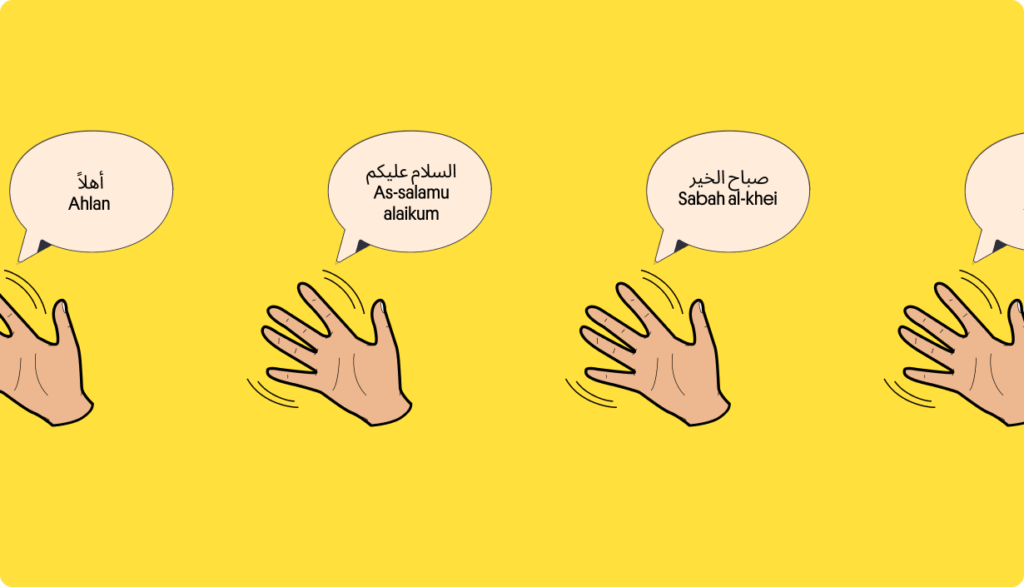
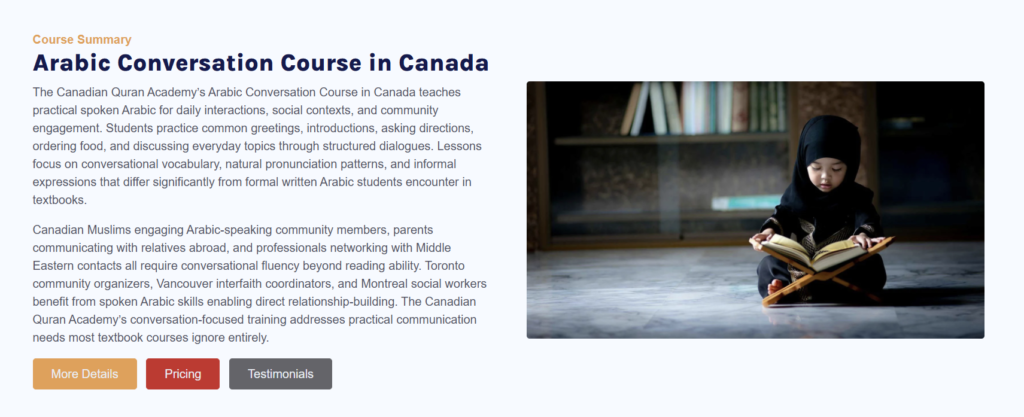
Start with “As-salamu alaykum” (السلام عليكم), meaning “peace be upon you,” and its reply “Wa alaykum as-salam” (وعليكم السلام). Kids love having a special phrase to say whenever someone walks into the room.
Next, add “Marhaba” (مرحبا) for a casual hello, “Sabah al-khayr” (صباح الخير) for good morning, and “Masa’ al-khayr” (مساء الخير) for good evening. The reply to good morning is “Sabah an-nur” (صباح النور), “morning of light.”
Finish the set with “Ma’a as-salama” (مع السلامة), meaning goodbye. Teach every greeting together with its reply so your child learns real exchanges rather than isolated words.
b. Polite Words Kids Can Use Daily
Four words cover most polite moments: “Min fadlak” (من فضلك) for please, “Shukran” (شكرا) for thank you, “Afwan” (عفوا) for you’re welcome, and “Asif” (آسف) for sorry.
“Min fadlak” changes slightly depending on who you speak to: “min fadlak” to a boy and “min fadlik” to a girl. Young kids don’t need the grammar rule yet. Use the right form yourself and they will pick up the pattern.
Tie these words to routines your child already has: “shukran” at the dinner table, “afwan” when passing a toy, “asif” after a bump. Using a word in the moment it’s needed works better than any flashcard drill.
Ready to turn “marhaba” into full conversations? The Arabic Conversation Course in Canada at the Canadian Quran Academy helps kids speak Arabic with real confidence, one friendly session at a time.
How To Practice Greetings At Home
Pick one “greeting of the week” and use it every time the family meets. Once it comes naturally, add the next phrase. Adding words slowly builds confidence without overwhelming your child.
Role-play with puppets or stuffed animals. One toy knocks on a pretend door and says “as-salamu alaykum,” and your child answers. Switching roles lets them practise both sides of the conversation.
Praise effort, not perfection. If your child says “shukran” with a strong English accent, celebrate it and repeat the correct sound naturally in your reply.
Don’t miss: How to Learn Quran for Kids in Canada
2. Family Members Vocabulary In Arabic
Family words come next because they name the people your child loves most. This section covers the immediate family, the precise extended-family terms Arabic is known for, and playful ways to practise them.
a. Core Family Words In Arabic
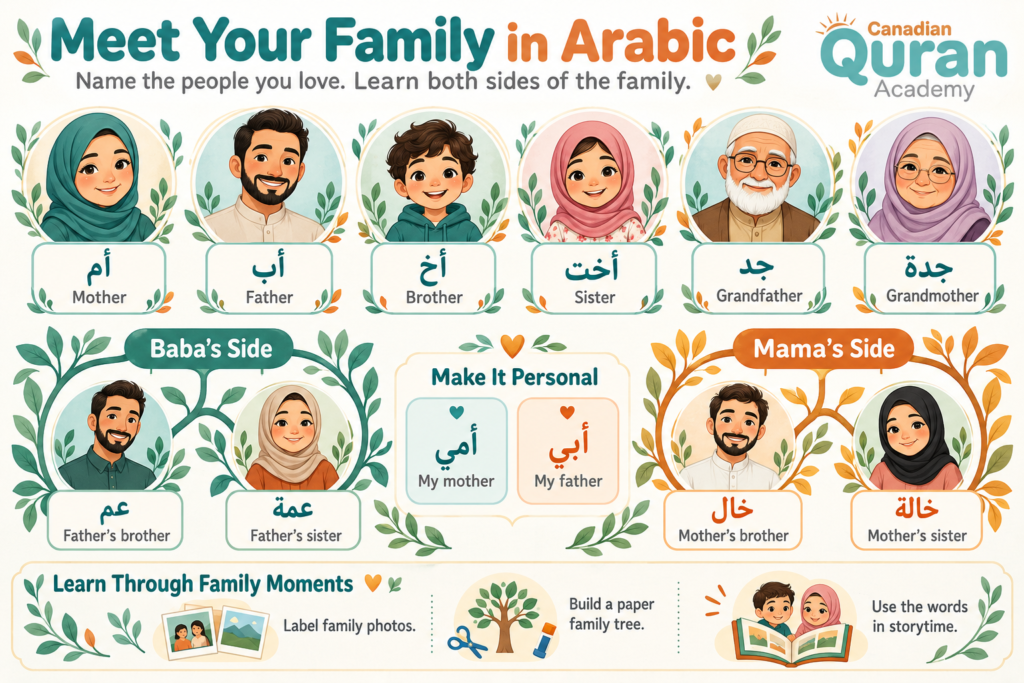
The essentials are “Umm” (أم) for mother, “Ab” (أب) for father, “Akh” (أخ) for brother, and “Ukht” (أخت) for sister. Many Arabic-speaking families also use the softer “Mama” (ماما) and “Baba” (بابا).
Add “Jadd” (جد) for grandfather and “Jadda” (جدة) for grandmother. The feminine form often adds an “-a” sound (ة), a pattern your child will meet again and again in Arabic.
Add “my” with a simple “-i” ending: “ummi” (أمي) means my mother, “abi” (أبي) my father, and “akhi” (أخي) my brother. With this one ending, kids can start describing their own family straight away.
b. Uncles, Aunts, And Cousins In Arabic
Arabic is more precise than English here. Your father’s brother is “‘amm” (عم), his sister is “‘amma” (عمة), your mother’s brother is “khal” (خال), and her sister is “khala” (خالة).
Children often find this distinction exciting. Draw two sides of a family tree, Baba’s side and Mama’s side, and help your child place each relative on the right branch.
Cousins follow the same logic. “Ibn ‘ammi” (ابن عمي) is my paternal uncle’s son, and “bint khalati” (بنت خالتي) is my maternal aunt’s daughter. Older kids enjoy working these out like puzzles.
c. Fun Ways To Teach Family Words
Use family photos as flashcards. Point to each face and ask “Man hadha?” (من هذا؟), meaning “Who is this?”, so your child answers with the Arabic word.
Build a paper family tree on the fridge. Label each person in Arabic script with the transliteration underneath. Your child will see the words every day without any formal study.
Bring family words into storytime with Arabic picture books from your public library.
The Toronto Public Library, for example, offers books in 40 languages, including Arabic, as explained in its guide to multilingual collections at the library, and your local branch can show you its own world languages shelf.
You might also like: IS ARABIC WORTH LEARNING IN CANADA?
3. Colors In Arabic
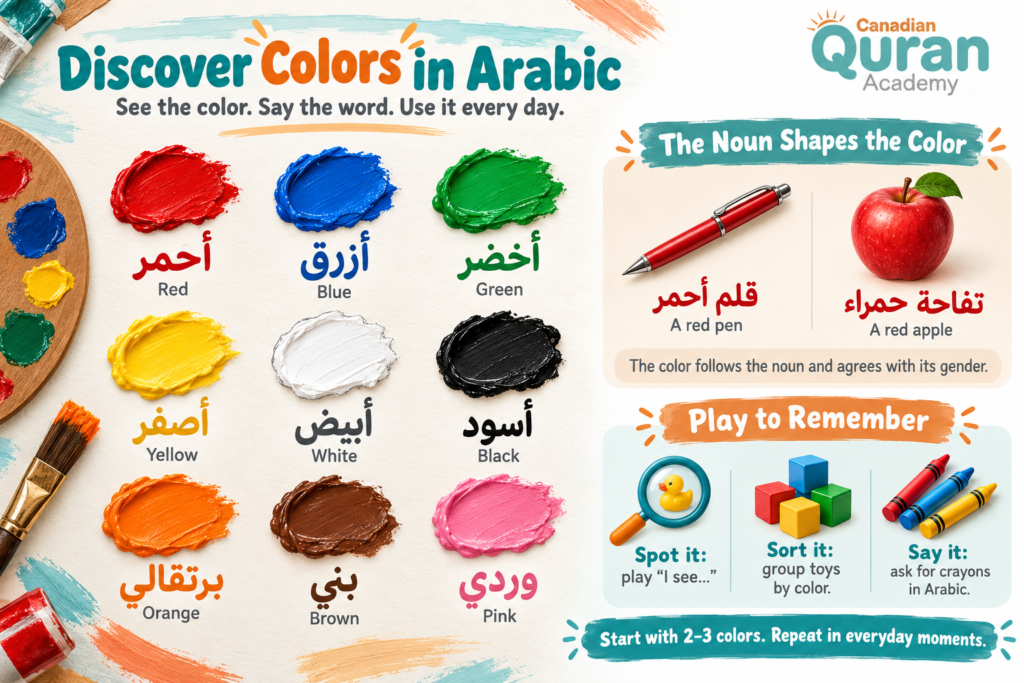
Colors are everywhere and easy to point at, which makes them perfect for young learners. Here are the basic colors, how they change with gender, and activities that help your child remember them.
a. Basic Colors In Arabic
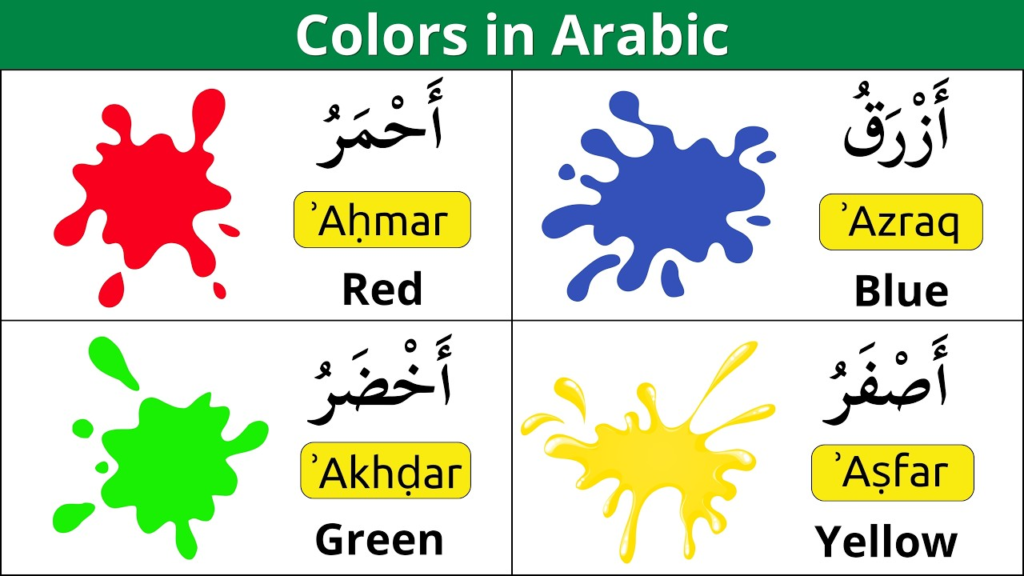
Start with six core colors: “ahmar” (أحمر) red, “azraq” (أزرق) blue, “akhdar” (أخضر) green, “asfar” (أصفر) yellow, “abyad” (أبيض) white, and “aswad” (أسود) black.
Then add everyday extras: “burtuqali” (برتقالي) orange, “bunni” (بني) brown, and “wardi” (وردي) pink. The “-i” ending turns a noun into a color: “burtuqal” (orange, the fruit) becomes “burtuqali.”
Teach two or three colors at a time, not all nine at once. Learning a few colors well keeps your child motivated and avoids mixing up similar-sounding words like “asfar” and “akhdar.”
b. Masculine And Feminine Color Forms
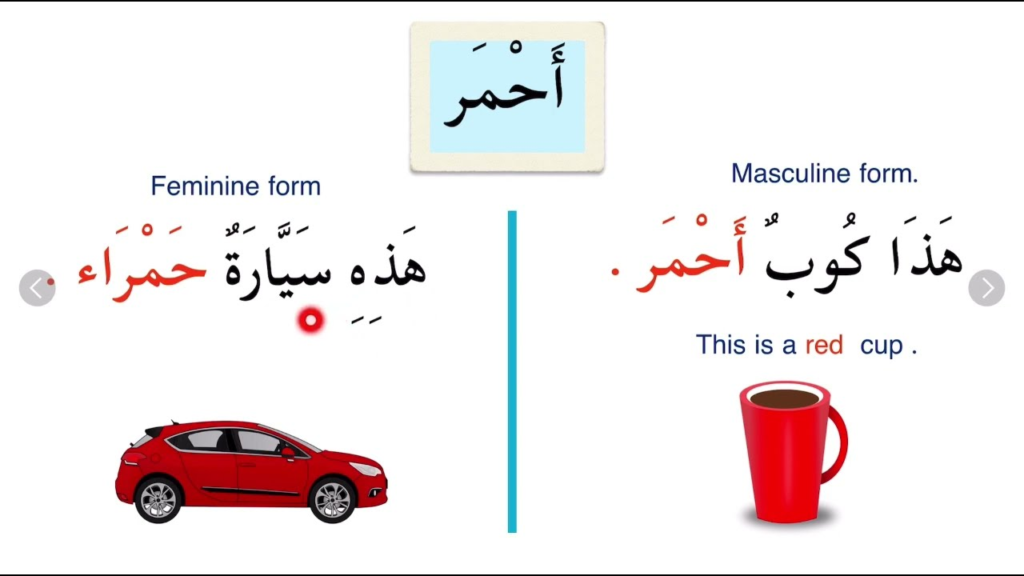
Most basic colors have a feminine form used with feminine nouns: “hamra'” (حمراء), “zarqa'” (زرقاء), “khadra'” (خضراء), “safra'” (صفراء), “bayda'” (بيضاء), and “sawda'” (سوداء).
Compare “qalam ahmar” (قلم أحمر), a red pen, with “tuffaha hamra'” (تفاحة حمراء), a red apple. The noun’s gender decides the color’s form, and in Arabic the color comes after the noun.
For young children, simply use the correct pairs every time. Older kids can spot the pattern themselves, and that discovery makes later grammar lessons feel familiar.
Curious minds love patterns, and Arabic is full of them. The Arabic Grammar Course in Canada by the Canadian Quran Academy explains rules like gender agreement in a clear, step-by-step way.
c. Color Activities That Build Memory
Play “Ana ara…” (أنا أرى), meaning “I see…”, around the house. Say “Ana ara something azraq!” and let your child hunt for a blue object and name it in Arabic.
Sort toys, crayons, or fruit into colored bowls while saying each color aloud. Sorting with their hands links the word to both touch and sight.
At coloring time, ask for crayons only by their Arabic names. Short, regular Arabic-only moments build vocabulary faster than one long lesson a week.
Worth checking out: The Importance of Arabic Language in the Quran
Live Class in Action
Watch how our instructors interact with students in real-time, focusing on interactive methods.
Start Your Quranic Journey in Canada
Join our vibrant community and learn with expert tutors through our flexible online platform.
Claim Your Free Trial4. Numbers From One To Ten In Arabic
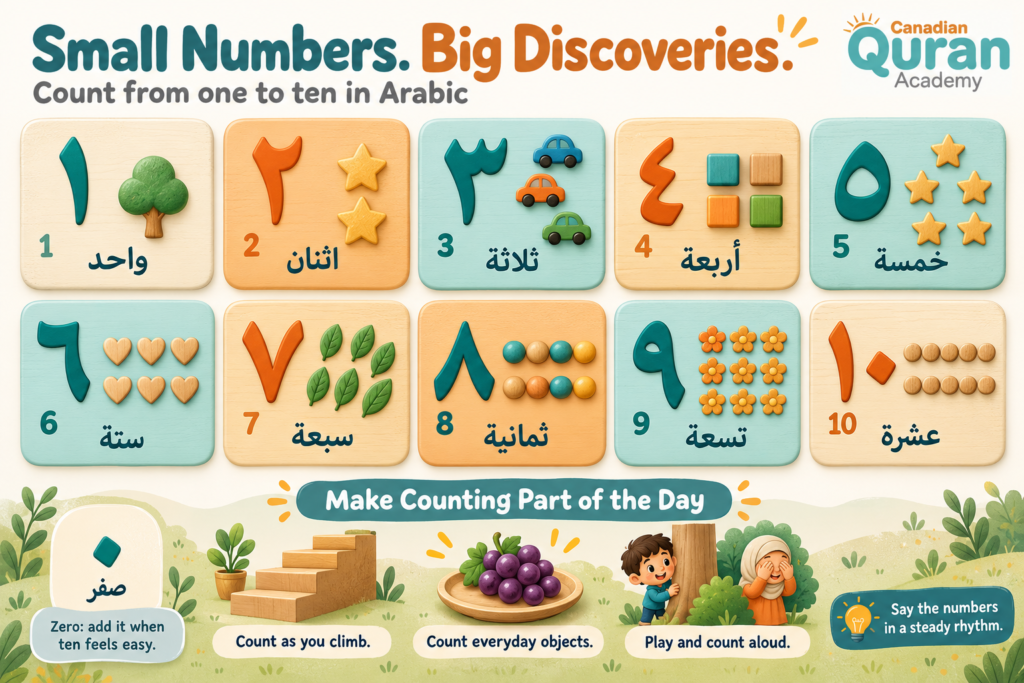
Numbers give kids an instant sense of achievement because they can count everything around them. Below are the numbers one to ten, how Arabic digits look, and games that make counting a daily habit.
a. Counting From One To Ten In Arabic
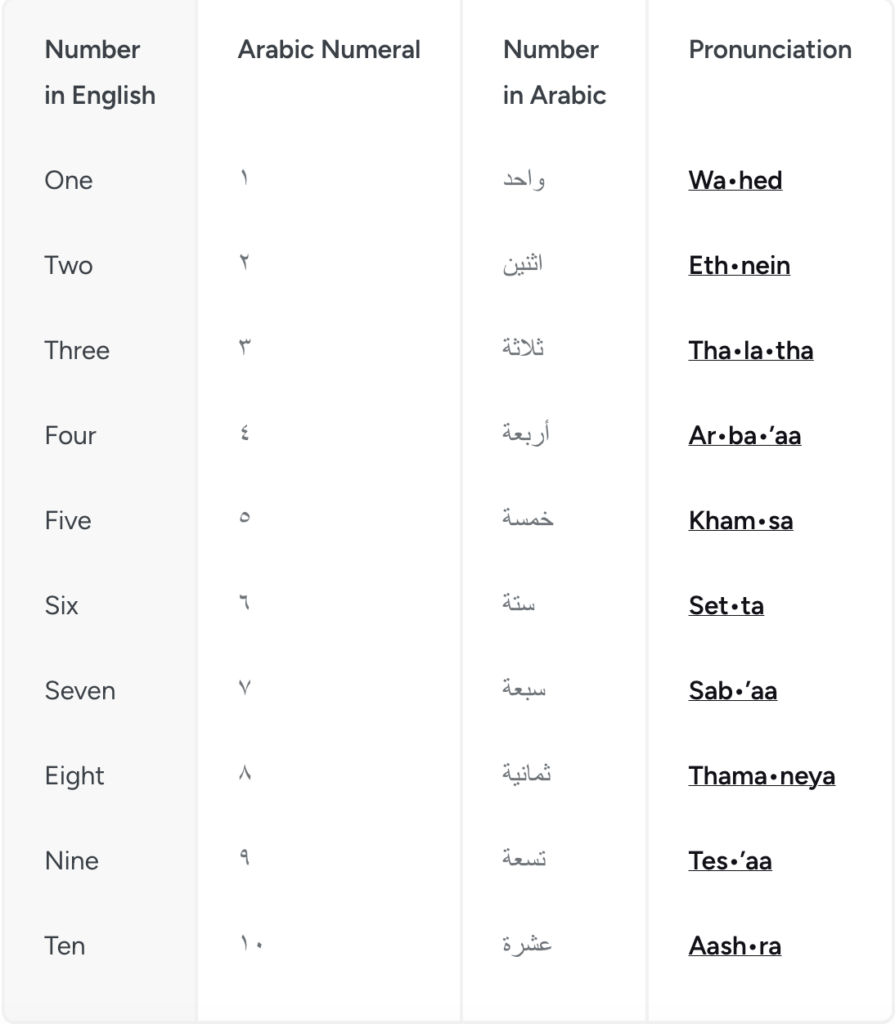
The first five are “wahid” (واحد) 1, “ithnan” (اثنان) 2, “thalatha” (ثلاثة) 3, “arba’a” (أربعة) 4, and “khamsa” (خمسة) 5. Count on fingers so your child can feel each number.
The next five are “sitta” (ستة) 6, “sab’a” (سبعة) 7, “thamaniya” (ثمانية) 8, “tis’a” (تسعة) 9, and “‘ashara” (عشرة) 10. Add “sifr” (صفر) for zero once the rest feel easy.
Chant the numbers in a steady rhythm, like a song. Rhythm helps children remember harder sounds, such as the deep “‘ayn” in “arba’a” and “sab’a.”
b. Arabic Digits And How They Are Written
Many Arab countries use Eastern Arabic digits: ١ ٢ ٣ ٤ ٥ ٦ ٧ ٨ ٩ ١٠. Showing them early helps kids read page numbers in Arabic storybooks and in the Mushaf.
Here’s a fact kids love: Arabic words are written right to left, but numbers are written left to right. For a closer look at how the script itself works, Britannica’s overview of the Arabic alphabet covers its 28 letters and right-to-left direction.
Another proud moment: the digits 0–9 your child uses in English are widely called “Arabic numerals” because they reached Europe through the Arab world. Kids are delighted to learn they already use an Arabic gift every day.
Every word your child learns at home deserves a clear path forward. The Online Arabic Course in Canada at the Canadian Quran Academy builds reading, writing, and vocabulary step by step with patient live tutors.
c. Counting Games For Daily Practice
Count everything: stairs as you climb, grapes on a plate, buttons on a coat. With daily counting, all ten numbers soon come without effort.
Play hide-and-seek in Arabic. The seeker counts aloud from “wahid” to “‘ashara.” Kids repeat the full sequence again and again without feeling like they are studying.
Dual-language picture books make counting even more fun. As the library’s Arabic at Your Library post points out, families can borrow Arabic-English editions of favourites like The Very Hungry Caterpillar, so your child can count each fruit in Arabic as the caterpillar eats.
Further reading: Quran Verses About Teachers in Arabic
5. Animals In Arabic
Animals hold children’s attention like little else, which makes this group one of the most enjoyable parts of Arabic vocabulary for kids. Here are pets and farm animals, wild animals, and the animals your child will meet in the Quran.
A. Pets And Farm Animals In Arabic
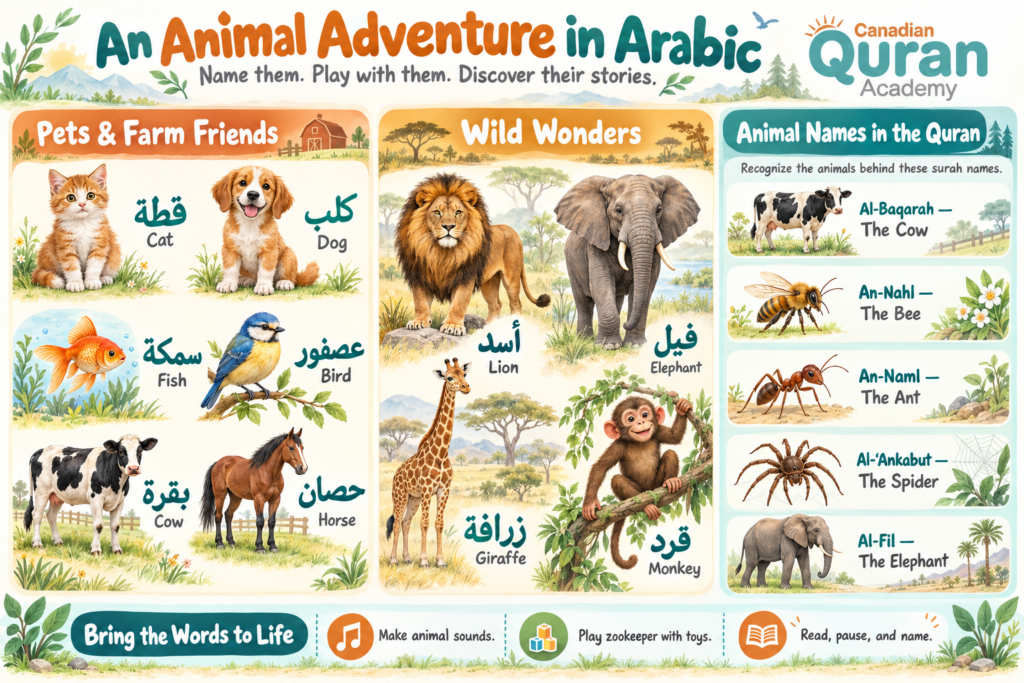
Begin with familiar animals: “qitta” (قطة) cat, “kalb” (كلب) dog, “samaka” (سمكة) fish, and “‘usfur” (عصفور) bird. These are the animals kids see most in daily life and in picture books.
Then visit the farm: “baqara” (بقرة) cow, “hisan” (حصان) horse, “kharuf” (خروف) sheep, and “dajaja” (دجاجة) chicken. Make each animal’s sound as you say the word to double the fun.
Ask “Madha yaqul al-kalb?” (ماذا يقول الكلب؟), meaning “What does the dog say?” Simple question-and-answer games train your child’s listening alongside their vocabulary.
B. Wild Animals Kids Love To Name
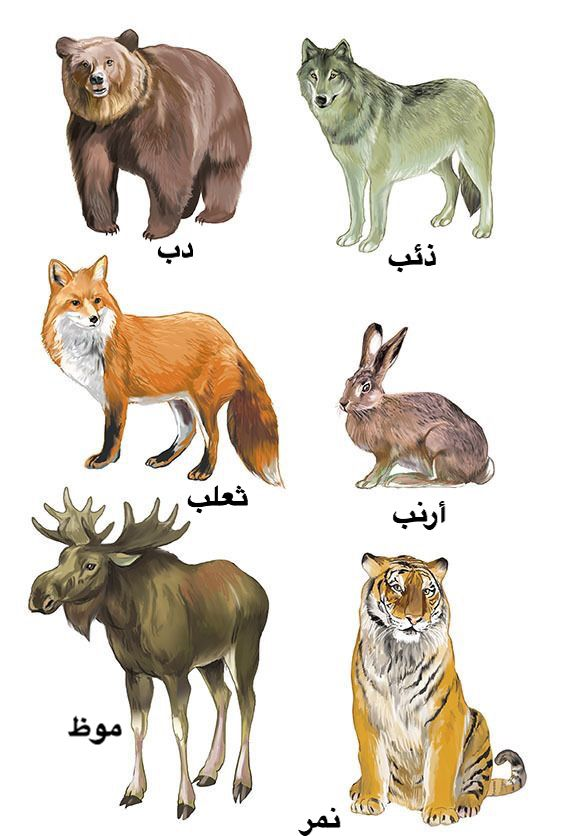
Wild animals bring big excitement: “asad” (أسد) lion, “fil” (فيل) elephant, “zarafa” (زرافة) giraffe, “qird” (قرد) monkey, and “dubb” (دب) bear.
Use stuffed animals or a toy zoo to act out scenes. Let your child be the zookeeper who introduces each animal to the family by its Arabic name.
Picture books and animal shows become vocabulary lessons when you pause and ask for the Arabic word. A few minutes like this every day adds up quickly over a month.
For ready-made stories, the free Arabic Storybooks collection from the Global Storybooks network offers 40 illustrated stories with Arabic text and audio narration, sorted into five reading levels. Start with Level 1, keep it to about ten minutes, then act out the story offline.
C. Animals Named In The Quran
Several surahs are named after animals: Al-Baqarah (the Cow), An-Nahl (the Bee), An-Naml (the Ant), Al-‘Ankabut (the Spider), and Al-Fil (the Elephant).
Once your child knows “baqara” and “fil,” these surah names suddenly make sense. That connection makes Quran memorization feel more personal and meaningful.
Share short, age-appropriate stories behind these surahs, such as the people of the elephant in Surah Al-Fil. A story gives each new word something to hang on to in your child’s memory.
Let your child hear these words in recitation too. Play Surah Al-Fil with free audio on Quran.com and challenge them to catch the word “fil” (elephant) in the very first verse.
Recommended reading: Why Is the Quran in Arabic?
6. Islamic Expressions And Quranic Words
For Muslim families, this group joins language and faith. It covers the Islamic phrases kids say every day, simple words they hear in the Quran, and why learning the names of things matters in Islam.
A. Daily Islamic Phrases For Kids
Teach “Bismillah” (بسم الله) before eating or starting anything, and “Alhamdulillah” (الحمد لله) after a meal or when hearing good news.
Older kids enjoy seeing where “Bismillah” comes from. The Quranic Arabic Corpus, a free project linked to the University of Leeds, breaks down every word of Al-Fatihah with transliteration and meaning on its word-by-word page for the first verse.
Add “In sha’ Allah” (إن شاء الله) for future plans, “Masha’ Allah” (ما شاء الله) when admiring something, and “Subhan Allah” (سبحان الله) when amazed by Allah’s creation.
Finish with “Jazak Allahu khayran” (جزاك الله خيرا), a beautiful way to thank someone. These phrases build vocabulary and good manners at the same time.
B. Simple Quranic Words Children Hear Often
Many simple nouns appear often in the Quran: “kitab” (كتاب) book, “nur” (نور) light, “shams” (شمس) sun, “qamar” (قمر) moon, “sama'” (سماء) sky, and “ard” (أرض) earth.
Point to the sun, moon, and sky on family walks and name them in Arabic. Later, when your child hears these words in recitation, they will recognize them with real excitement.
When your child is ready to move from single words to short passages, explore our collection of short and beautiful Quran verses in Arabic, a gentle next step.
C. Learning The Names Of Things In Islam
Allah Almighty says:
“وَعَلَّمَ ءَادَمَ ٱلۡأَسۡمَآءَ كُلَّهَا ثُمَّ عَرَضَهُمۡ عَلَى ٱلۡمَلَٰٓئِكَةِ فَقَالَ أَنۢبِـُٔونِي بِأَسۡمَآءِ هَٰٓؤُلَآءِ إِن كُنتُمۡ صَٰدِقِينَ”
“He taught Adam the names of all things, then He presented them to the angels and said, ‘Tell Me the names of these, if what you say is true?'” (Surah Al-Baqarah, 2:31)
This verse shows that knowing the names of things was among the first knowledge Allah gave humankind. When you teach your child that “shams” is the sun, you are passing on one of the oldest forms of learning.
Allah Almighty also says:
“إِنَّآ أَنزَلۡنَٰهُ قُرۡءَٰنًا عَرَبِيّٗا لَّعَلَّكُمۡ تَعۡقِلُونَ”
“Indeed, We have sent it down as an Arabic Quran so that you may understand.” (Surah Yusuf, 12:2)
The Quran was revealed in Arabic so that it could be understood. Every word your child learns brings them one step closer to understanding Allah’s words directly, not just reciting them.
No Arabic at home? Your child can still thrive. The Learning Arabic for Non Arabic Speakers in Canada program at the Canadian Quran Academy is built for families starting from zero.
The Canadian Quran Academy Turns Single Words Into Real Arabic
Word lists are a great start, but children only really own a word when they use it in conversation. That is where the Canadian Quran Academy makes the difference: our live, one-on-one online classes turn the vocabulary you begin at home into real, confident Arabic.
Arabic is a global language. UNESCO’s World Arabic Language Day page notes that more than 400 million people use it daily. Our tutors make sure your child learns it in a way that fits Canadian family life.
Each lesson matches your child’s pace. If your daughter has mastered colors but struggles with numbers, her tutor adjusts the next session instead of following a fixed script. This personal attention is hard to get in a crowded classroom.
What sets us apart is that we teach Quran and Arabic under one roof. The Arabic vocabulary for kids your child learns here doesn’t stay in a notebook: it shows up again in Quran lessons, so everyday words and sacred words strengthen each other.

Experience Our Classrooms
Don’t just take our word for it—take a look inside! Watch the videos below to experience our engaging teaching methods and vibrant online classrooms firsthand.
Start Your Quranic Journey in Canada
Join our vibrant community and learn with expert tutors through our flexible online platform.
Claim Your Free TrialBook Your Child’s First Arabic Class Today!
Your child has already taken the first step. Every “shukran,” every “wahid,” and every “qitta” shows they are ready for more. Now is the time to give that curiosity the guidance it deserves.
Enroll with the Canadian Quran Academy and pair your child with a dedicated tutor who makes Arabic fun, structured, and connected to the Quran. Flexible online scheduling means lessons fit around school, sports, and family time anywhere in Canada.
Our Arabic Courses:
- Online Arabic Academy
- Online Arabic Course
- Classical Arabic Course
- Arabic Course for Beginners
- Advanced Arabic Course
- Quranic Arabic Course
- Arabic Grammar Course
- Modern Standard Arabic Course
- Arabic Conversation / Speaking Course
Don’t let these early words fade. Contact the Canadian Quran Academy today, book your child’s first class, and watch a few home-learned words grow into a language they will carry for life.
Start Your Quranic Journey in Canada
Join our vibrant community and learn with expert tutors through our flexible online platform.
Claim Your Free TrialConclusion
Arabic vocabulary for kids doesn’t start with a textbook. It starts with “as-salamu alaykum” at the front door, “ummi” and “abi” around the dinner table, “ahmar” at colouring time, “wahid” to “‘ashara” on the stairs, and “qitta” when the family cat walks by. Phrases like “Bismillah” and “Alhamdulillah” then tie all of these everyday words to faith.
The six word groups in this guide work because they name the things your child already sees, touches, and loves. Teach a few words at a time, connect each one to a daily routine, and use games instead of drills. Five playful minutes a day will do more than one long weekly lesson, and every word your child says on their own is worth celebrating.
Those words also lead somewhere bigger. When your child recognizes “fil” in Surah Al-Fil or “nur” and “shams” in recitation, the Quran starts to become something they understand, not just sounds they repeat. Allah taught Adam the names of all things, and each name you teach your child continues that same tradition of learning.
Pick one word group this week and start with the first word. Keep going, and soon you’ll hear your child say an Arabic word on their own, just like “qitta,” and you’ll know it’s become part of their language at home.
Frequently Asked Questions
What Arabic Words Should Kids Learn First?
Kids should start with greetings and polite words like “as-salamu alaykum” and “shukran,” then move on to family, colors, numbers, and animals. At the Canadian Quran Academy, tutors follow this natural order so every new word builds on the one before.
At What Age Can Kids Start Learning Arabic Vocabulary?
Children can start learning simple Arabic words as soon as they begin speaking, using songs, pictures, and play. The Canadian Quran Academy offers age-appropriate lessons that turn early curiosity into lasting, structured progress.
How Many New Arabic Words Should A Child Learn Each Week?
Three to five new words a week works well for most young children, as long as they review earlier words regularly. Tutors at the Canadian Quran Academy set this pace for each child, so they never feel rushed or bored.
Can Kids Learn Arabic Vocabulary If Parents Don’t Speak Arabic?
Yes. With guided lessons and a few home routines, children can build strong Arabic vocabulary even in English-speaking homes. The Canadian Quran Academy designs its classes for non-Arabic-speaking families and gives parents simple ways to support practice.
How Does Arabic Vocabulary Help Kids Understand The Quran?
Many everyday Arabic words, like “kitab,” “nur,” and “shams,” appear often in the Quran, so kids start recognizing meanings during recitation. The Canadian Quran Academy connects Arabic and Quran lessons so your child understands what they recite, not just how to recite it.





Leave a Reply