 Arabic
Ever noticed how your child recites a whole cartoon after two viewings, yet forgets yesterday’s Arabic letters? The difference isn’t ability. It’s fun. That’s exactly why Arabic games for kids work so well: they turn practice into something children ask for.
At The Canadian Quran Academy, we see it every week. A child who struggles with flashcards suddenly remembers ten new words after one round of a silly matching game, because the brain holds on to what feels like play.
The real challenge for busy parents is finding games that are quick to set up and actually build reading, listening, and speaking skills.
This guide gives you six tried-and-tested games, from first letters to full sentences, plus free apps, websites, and storybooks to stretch each one further.
1. Arabic Letter Hunt – The Best Starter Among Arabic Games For Kids
The letter hunt is the easiest way to begin, because it needs no prior knowledge and turns the whole house into a classroom. Among all Arabic games for kids, it builds the most important first skill: instantly recognizing each of the 28 letters.
Arabic is used daily by more than 400 million people, as highlighted on UNESCO’s World Arabic Language Day page, so giving your child a strong alphabet base opens a very big door. Here’s how to run the hunt step by step.
How To Set Up A Letter Hunt At Home
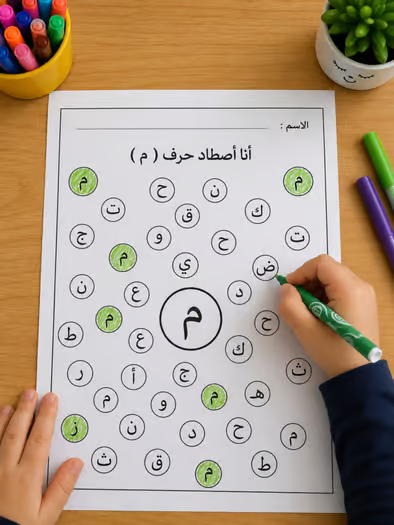
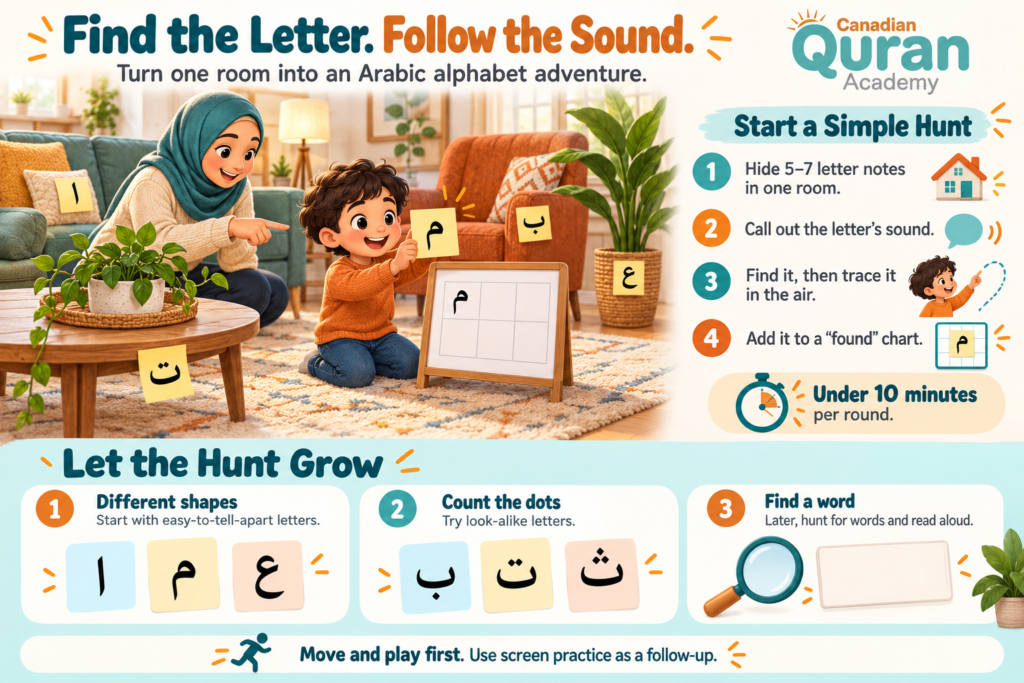
Write five to seven Arabic letters on sticky notes and hide them around one room. Start with letters that look very different, such as ا (alif), ب (baa), م (meem), and ع (ain), so your child isn’t confused early on.
Call out a letter by its sound, not its name: “Find the letter that says mmm!” When your child finds it, ask them to trace it in the air before sticking it on a “found” chart.
Keep each round under ten minutes. Ending while your child still wants more is the secret to them asking for the game again tomorrow.
Simple Ways To Level Up The Hunt
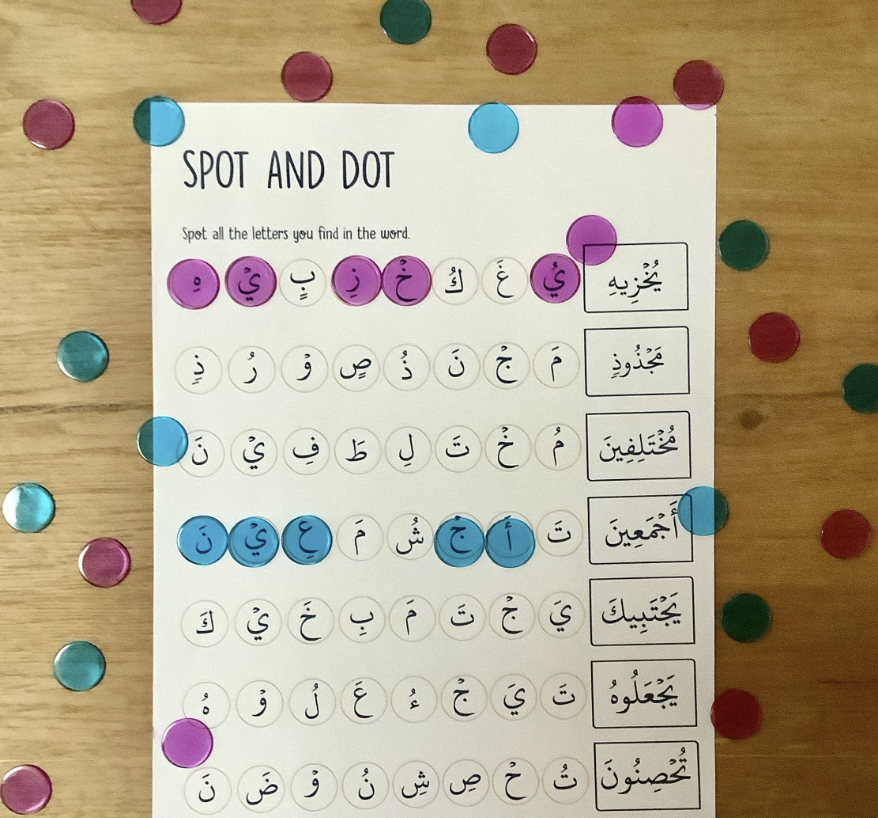
Once your child knows the isolated letters, hide letters in their different forms. Arabic letters change shape at the beginning, middle, and end of a word, so hiding بـ and ـبـ next to ب teaches this naturally.
Next, try “sound families.” Hide letters that share a shape but differ in dots, like ب ت ث. Your child must count dots to pick the right one, which sharpens visual attention for reading later.
For older kids, hide short words instead of letters. Ask them to find a word that starts with a specific letter, then read it aloud. The hunt grows with your child instead of becoming boring.
Free Apps That Bring The Letter Hunt To Screens
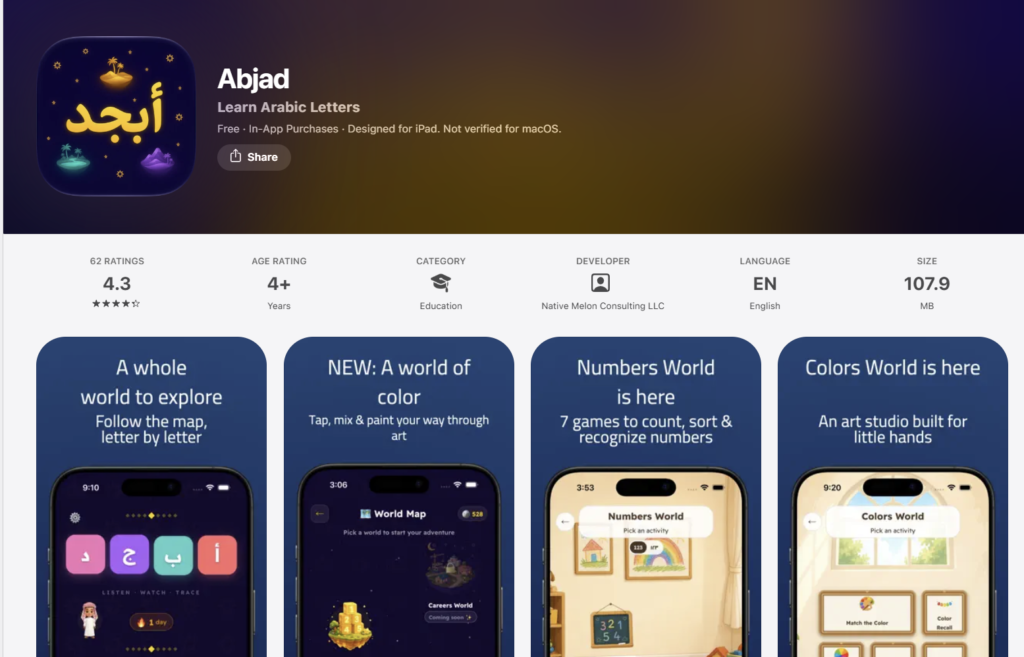
When you want a quiet digital follow-up, Abjad is a strong pick. It’s free to download on Google Play and the App Store, ad-free, and offers letter tracing, matching, and memory mini-games for ages 2 to 5.
For iPad users, Nimnim is completely free with no ads or in-app purchases. You can find it on the App Store listing for Nimnim, where letter and word puzzles come with native Arabic narration.
Use these apps as a reward after the physical hunt, not as a replacement. Screen-based Arabic games for kids work best when they repeat what your child already practiced with their hands and body.
Read also: How to Learn Quran for Kids in Canada
2. Short Vowel Sound Games For Early Reading
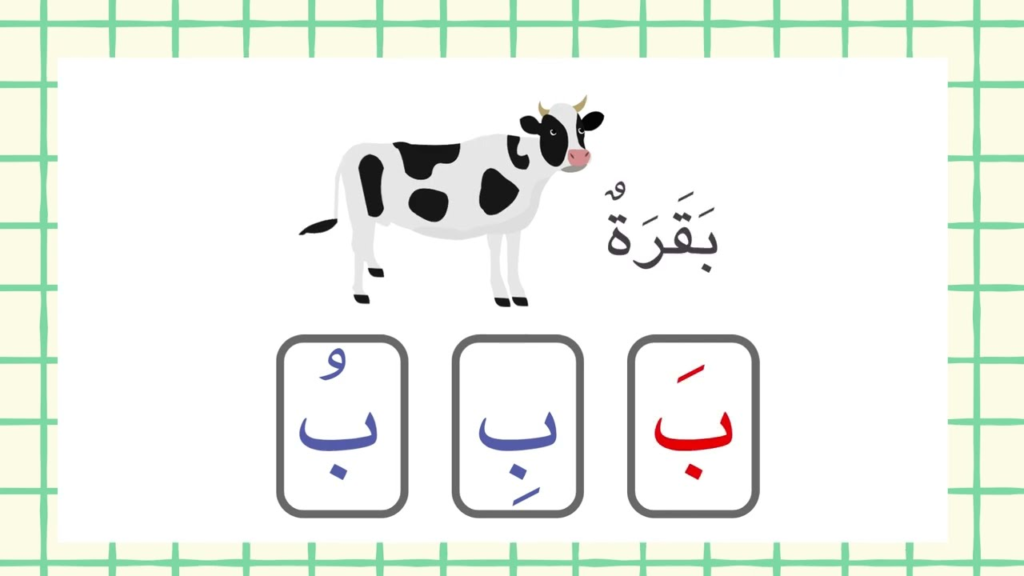
Once letters are familiar, the next step is sound. Arabic reading depends on three short vowels (harakat), and games that make these sounds physical help children blend letters into syllables much faster.
These games suit kids aged 4 to 7 who know most letters but still read slowly, and each needs only paper and a marker.
The Fatha, Kasra, And Damma Jump Game
Draw three large circles on paper and place them on the floor. Mark one with a fatha (ـَ) on top, one with a kasra (ـِ) below, and one with a damma (ـُ) on top.
Say a syllable like “bi” or “mu” and let your child jump to the matching circle. Fatha gives an “a” sound, kasra an “i” sound, and damma a “u” sound, so they’re listening and moving at the same time.
Switch roles after a few rounds. When your child calls out syllables for you, they practice pronunciation and check your answer at once.
Sound Matching With Picture Cards
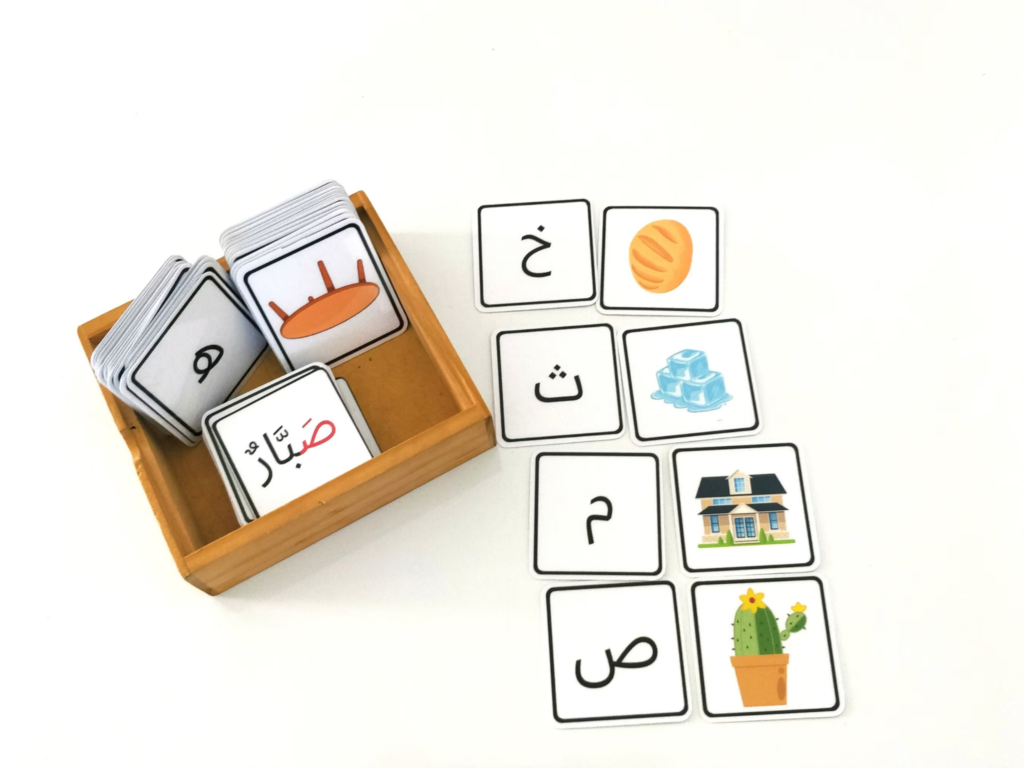
Make simple picture cards of everyday words: بَاب (baab, door), قَلَم (qalam, pen), and شَمْس (shams, sun). Put the first letter with its vowel on separate cards.
Your child picks a picture, says the word, and finds the card with the opening sound. If they choose بَ for بَاب, they keep the pair. The player with the most pairs at the end wins.
This game quietly trains the ability to hear individual sounds in a word, a skill teachers rely on when moving children toward fluent reading.
Connecting Sound Games To Reading The Quran
For Muslim families, these sound games are a direct bridge to reading the Quran with confidence. Every vowel your child masters through play is one they’ll recognize on the page later.
Allah (Glory be to Him) says:
“إِنَّآ أَنزَلۡنَٰهُ قُرۡءَٰنًا عَرَبِيّٗا لَّعَلَّكُمۡ تَعۡقِلُونَ”
“Indeed, We have sent it down as an Arabic Quran so that you may understand.” Surah Yusuf 12:2
This verse reminds us the Quran was revealed in Arabic to be understood, not only recited. To help your child move toward the Quran’s classical language, The Canadian Quran Academy offers a Fusha Arabic Course that builds that foundation step by step.
Here’s a simple follow-up: after each jump game, open a short surah your child already knows and ask them to point to every fatha on the page. The game moves straight from the floor to the Mushaf.
Live Class in Action
Watch how our instructors interact with students in real-time, focusing on interactive methods.
Start Your Quranic Journey in Canada
Join our vibrant community and learn with expert tutors through our flexible online platform.
Claim Your Free Trial3. Arabic Vocabulary Memory Match
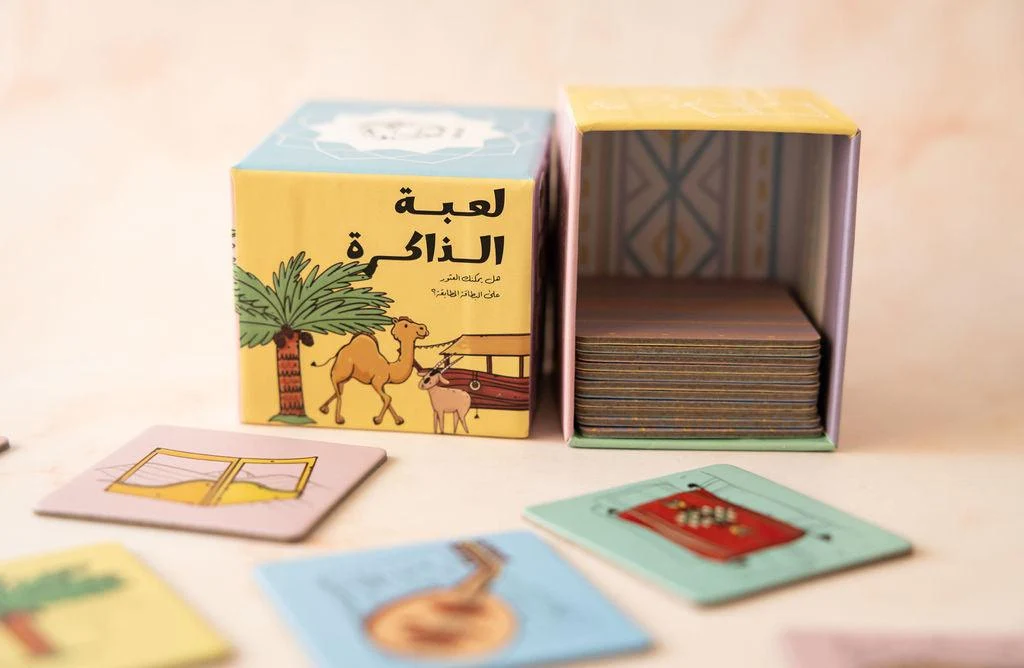
Memory match is a classic for a reason: it combines concentration, repetition, and friendly competition. Of all the Arabic games for kids in this list, it’s the fastest way to grow vocabulary in themed groups.
The setup takes about fifteen minutes, and the same cards can be reused for months.
Building Themed Card Sets
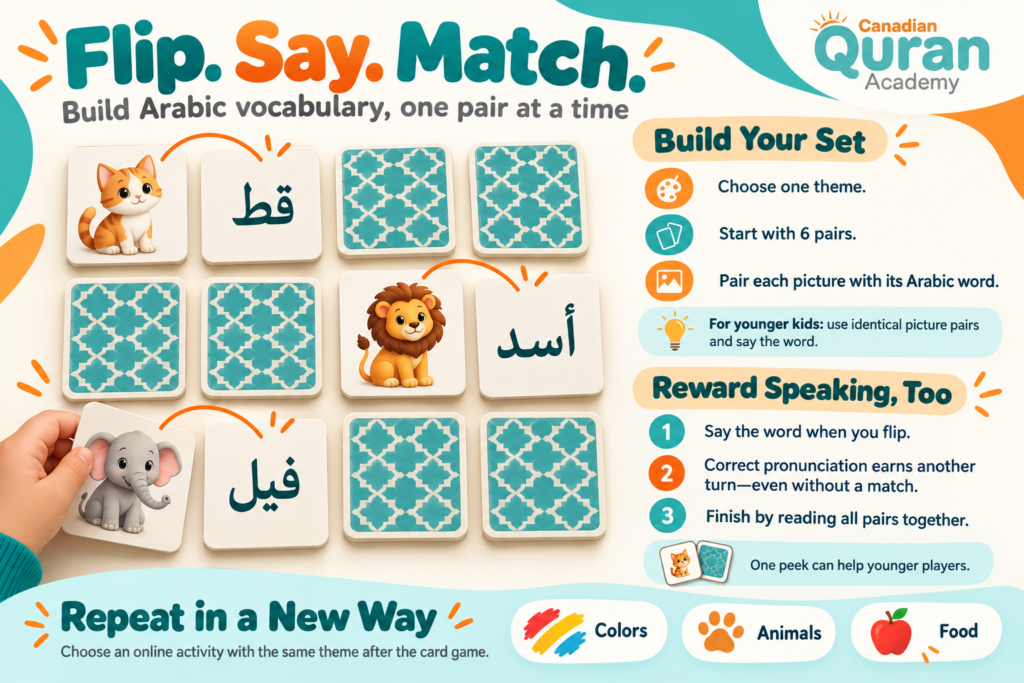
Choose one theme per set so new words stay connected in your child’s memory. Good starters are colors (أَحْمَر red, أَزْرَق blue, أَخْضَر green), animals (قِطّ cat, أَسَد lion, فِيل elephant), and food (تُفَّاح apples, خُبْز bread, حَلِيب milk).
Make two cards for each word: one with the picture and one with the Arabic word. For younger kids, use two identical picture cards instead and say the word aloud each time a card flips.
Start with six pairs and increase gradually, because a short, winnable game matters more than difficulty in the early weeks.
Rules That Keep Every Round Fair And Fast
Every player must say the Arabic word aloud when flipping a card. If they say it correctly, they keep the turn even when the pair doesn’t match. This rewards speaking, not only memory. Give younger siblings a “helper card” they can use once to peek. It keeps them in the game and avoids tears.
End every round by laying out all pairs and reading them together. This 30-second review is where most of the long-term learning happens.
Free Websites And Apps For Vocabulary Play
For extra practice, the free Digital Dialects Arabic games collection offers browser games for numbers, colors, animals, fruits, vegetables, and common phrases, with audio for each word.
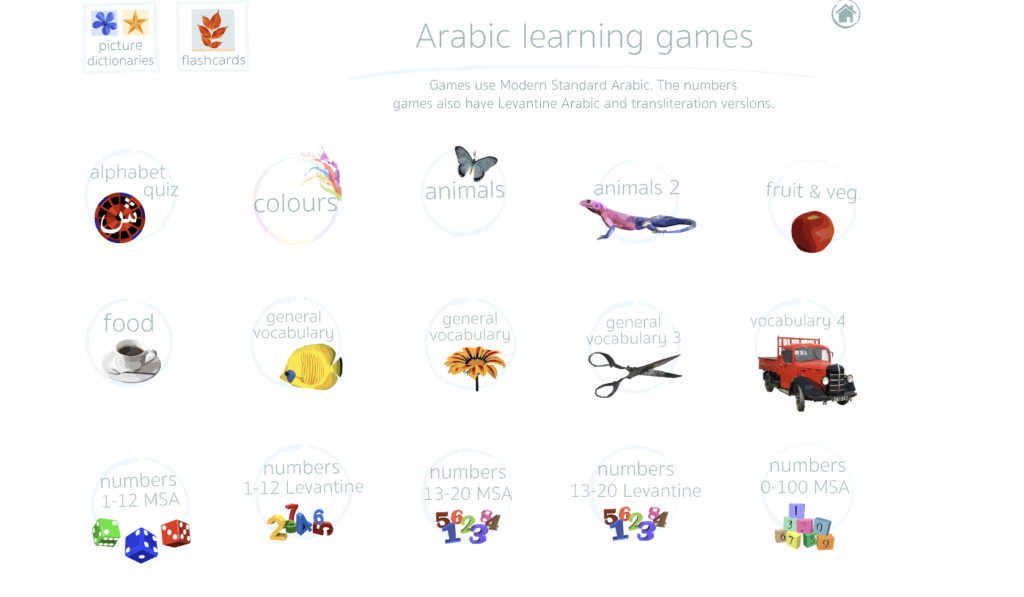
Teachers and parents also share free, ready-to-play quizzes, wheels, and matching activities in the Wordwall community library of Arabic alphabet activities, which run directly in a browser.
To get the most from these sites, pick the online game that matches the card set you just played, such as colors after a colors round. Seeing the same words in a new format helps your child remember them better.
Recommended reading: The Importance of Arabic Language in the Quran
4. Arabic Simon Says And Movement Games
Movement games are ideal for energetic kids who can’t sit still for cards or worksheets. They train listening comprehension, which is often the most neglected skill in heritage-language learning.
They also suit mixed-age groups: toddlers copy actions while older kids give commands.
Action Words To Start With
Begin with five clear commands: قُمْ (stand up), اِجْلِسْ (sit down), اِقْفِزْ (jump), اِمْشِ (walk), and دُرْ (turn around). Say each one slowly and act it out together first.
Then play the classic way. Commands that start with “قَالَ سَعِيد” (Saeed says) must be followed, and commands without it must be ignored. Anyone who moves on the wrong command sits out one round.
Add one new action word each week, and within a month your child will follow many commands without translation.
Body Parts Listening Challenge
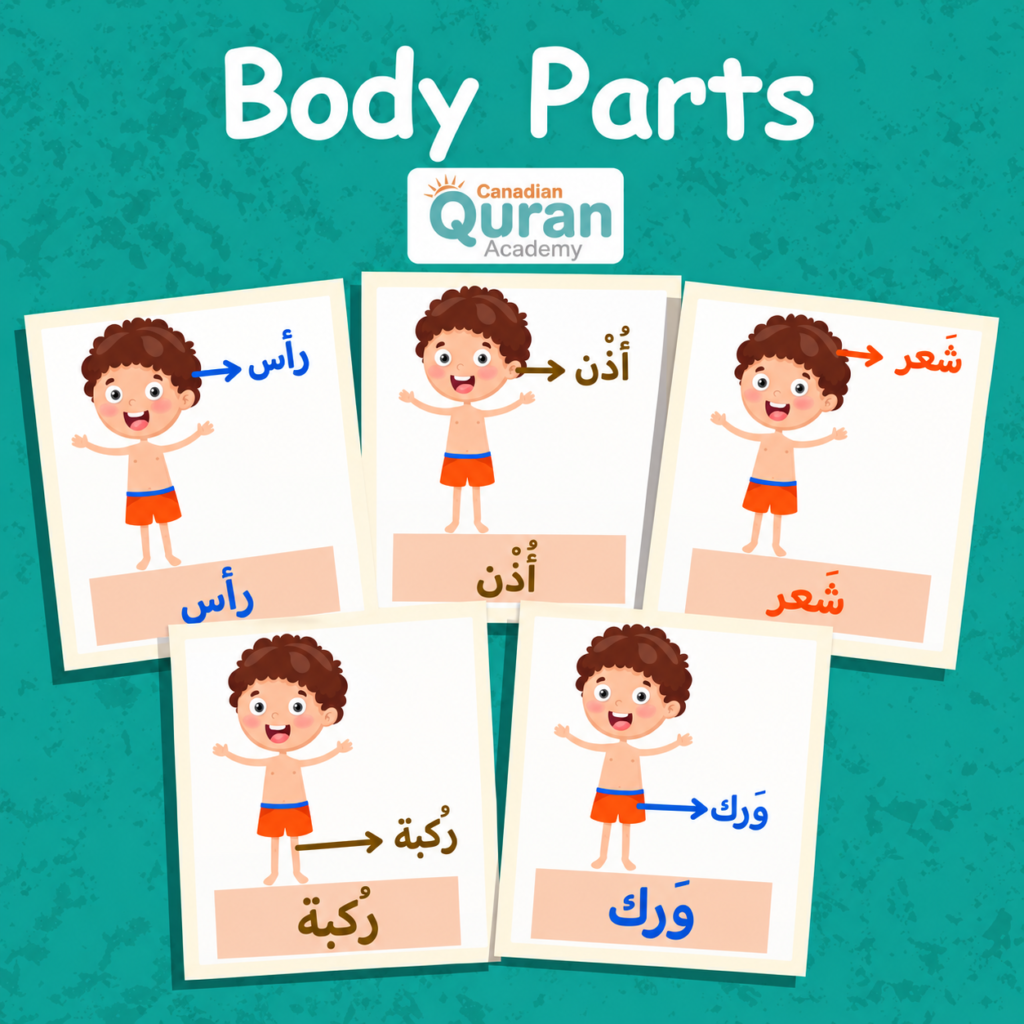
Switch the commands to body parts: رَأْس (head), يَد (hand), عَيْن (eye), أُذُن (ear), أَنْف (nose), and قَدَم (foot). Say “اِلْمِسْ رَأْسَكَ” (touch your head) and watch them respond.
Speed it up gradually. When kids have to react quickly, they stop translating in their heads and start understanding Arabic directly, which is exactly the goal.
Once they’re confident, let your child lead. Giving commands pushes them from listening to speaking.
Why Movement Helps New Words Stick
Linking a word to a physical action gives the brain two paths to remember it: the sound and the movement. That’s why movement-based Arabic games for kids often outperform flashcards for young learners.
To make this work at home, always pair each new word with the same gesture every time. When your child hears اِقْفِزْ and jumps on cue for a week, the word and the action become one memory that’s hard to forget.
Ready to move from single words to real conversations? The Canadian Quran Academy’s Arabic Conversation Course helps children use the words they’ve learned in everyday dialogue with a teacher.
Don’t miss: WHY LEARN ARABIC IN CANADA?
5. Arabic Storytelling And Role-Play Games
Storytelling games push children beyond single words into connected speech. They’re the stage where kids start using Arabic creatively instead of just repeating it. They work best from age 5 upward, though younger children can join with gestures.
Story Dice With Arabic Prompts
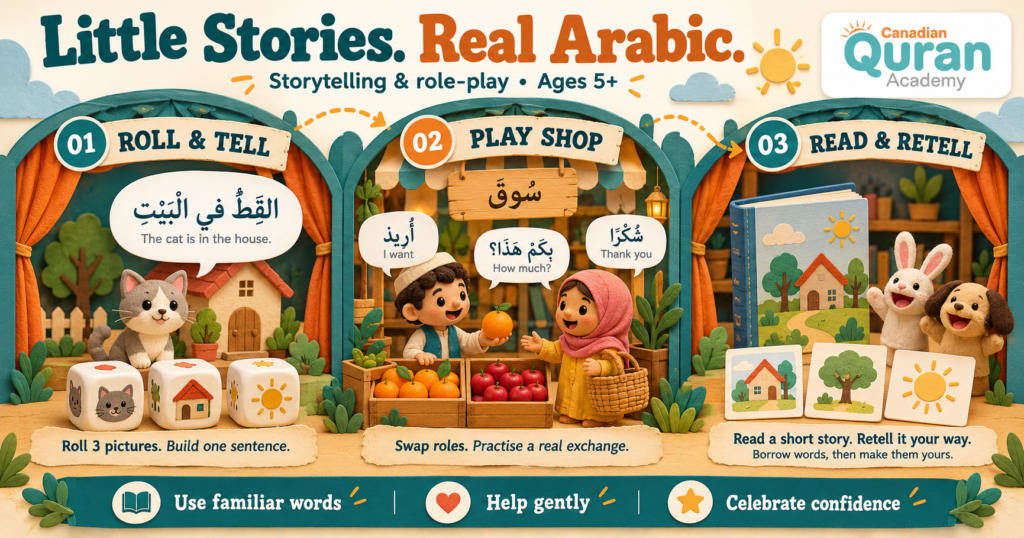
Take a few ordinary dice and tape a small picture on each face: a cat, a house, the sun, a tree, a ball, and a boy. Each picture should match an Arabic word your child already knows.
Your child rolls three dice and tells a short story using those words in Arabic. A beginner might say “القِطُّ في البَيْتِ” (the cat is in the house), and that counts as a full win. Help with missing words, but don’t correct every mistake. Confidence comes first; accuracy follows with gentle modeling.
The Pretend Market Role-Play
Set up a “سُوق” (market) with toy fruit or real items from the kitchen. One person is the seller and the other the buyer, and all trading must happen in Arabic.
Teach three key phrases first: أُرِيدُ (I want), بِكَمْ هَذَا؟ (how much is this?), and شُكْرًا (thank you). With these, children can already complete a full exchange.
Rotate roles and change the shop each week, from a bakery to a toy store. Every new shop brings fresh vocabulary without feeling like a lesson.
If English is the main language at home and you’re unsure where to start, The Canadian Quran Academy’s Learning Arabic for Non Arabic Speakers program is designed for families exactly like yours.
Free Arabic Storybooks To Fuel Story Time
Reading short stories before playing gives children words and sentence patterns to borrow. The Canada-based Global Storybooks Arabic collection offers free illustrated stories with audio across five reading levels.
Read one story together, then ask your child to retell it using story dice or puppets. Retelling is one of the most effective ways to turn passive listening into active speaking.
6. Word-Building And Sentence Scramble Games For Older Kids
Children aged 8 and up enjoy games with a real challenge. Word-building and sentence games introduce the logic of Arabic, especially its root system and sentence order.
These games work best after your child can read short words on their own. A few cards, a pencil, and a timer are all you need to turn grammar into a friendly competition.
The Three-Letter Root Puzzle
Most Arabic words grow from a three-letter root. Write the root ك ت ب on a card, then show your child how it builds كَتَبَ (he wrote), كِتَاب (book), كَاتِب (writer), and مَكْتَب (desk or office).
Turn it into a race. Give a root and a timer of one minute, and each player writes or says as many related words as they can. Points go to valid words, with a bonus for words no one else found.
This game feels like a puzzle, but it builds a powerful skill: guessing the meaning of new words from their roots, which speeds up reading comprehension later.
Sentence Scramble Race
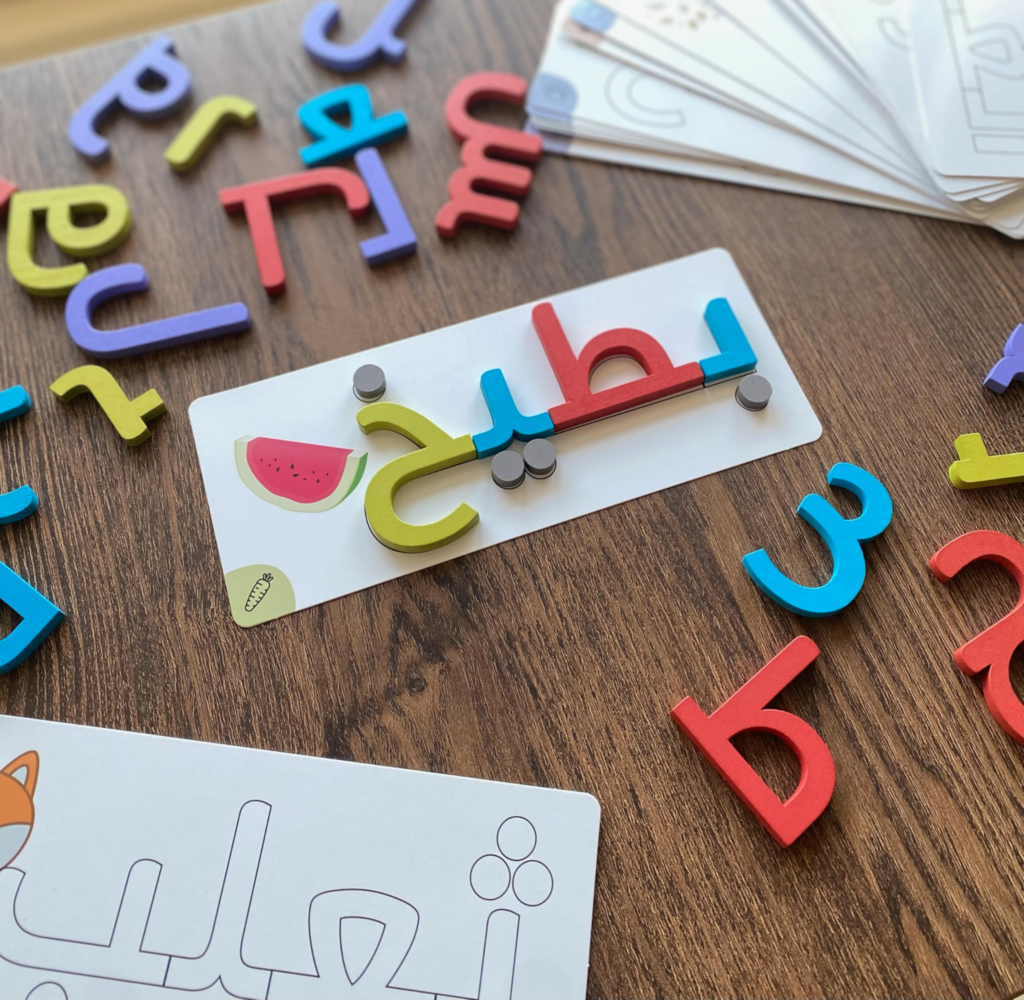
Write a short sentence such as ذَهَبَ الوَلَدُ إِلَى المَدْرَسَةِ (the boy went to school) and cut it into word cards. Mix them and let your child rebuild the sentence against a timer.
Start with three-word sentences and grow to six or seven. Include sentences that begin with a verb and others that begin with a noun, so your child notices both patterns.
If your child enjoys spotting how sentences are built, The Canadian Quran Academy’s Arabic Grammar Course explains these rules clearly and keeps the same hands-on spirit.
Arabic Word Bingo For Family Game Night
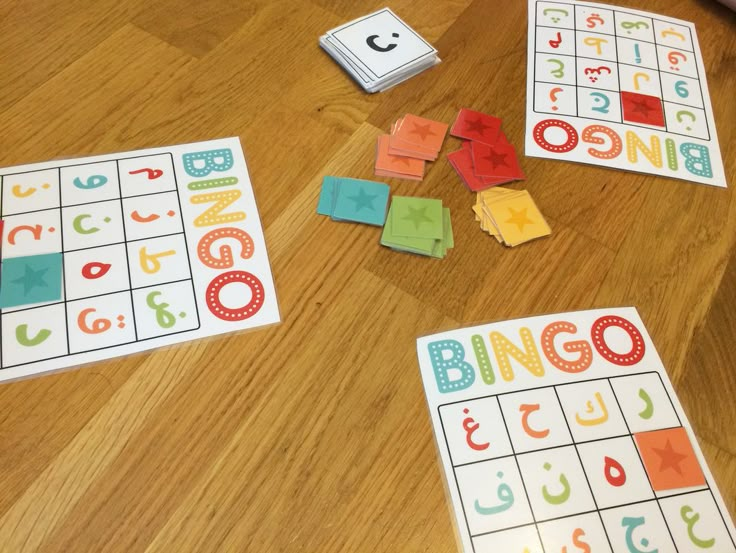
Make bingo cards with sixteen Arabic words from themes your child has learned. One person calls out the meaning in English, and players mark the matching Arabic word.
For advanced players, call the word in Arabic and ask them to say its meaning. Small prizes, like choosing the next family movie, keep energy high.
Bingo is one of those Arabic games for kids that the whole family can play together, so parents learn alongside their children and the language becomes part of home life.
Discover more here: WHAT ARE THE BENEFITS OF LEARNING ARABIC IN CANADA?
Turn Game Time Into Real Progress With The Canadian Quran Academy
Games spark interest, but steady progress needs a clear path. The Canadian Quran Academy combines the playful energy your child loves with a structured curriculum that moves from letters to reading, speaking, and understanding.
Our teachers bring the spirit of the best Arabic games for kids into live lessons, using sound games, picture cards, role-play, and quick challenges, so classes feel familiar and fun from the very first session.
Each class follows a level-based plan, so you always know what your child has mastered and what comes next. Flexible online scheduling also fits around school, sports, and weekends, with no long drives after a busy day.
Parents stay in the loop, and you’re welcome to share your child’s favorite home games with the teacher. For one clear starting point, our Online Arabic Course grows with your child, from first letters to full sentences.

Experience Our Classrooms
Don’t just take our word for it—take a look inside! Watch the videos below to experience our engaging teaching methods and vibrant online classrooms firsthand.
Start Your Quranic Journey in Canada
Join our vibrant community and learn with expert tutors through our flexible online platform.
Claim Your Free TrialStart Your Child’s Arabic Journey Today!
You’ve seen how a sticky note, a few dice, or a game of Simon Says can teach real Arabic. Now imagine pairing that energy with a teacher who knows exactly how to guide your child to the next level.
Book a session with The Canadian Quran Academy today and let our teachers assess your child’s level, understand their personality, and build a learning plan that feels like play.
Our Arabic Courses:
- Online Arabic Classes for Kids
- Arabic Classes for Adults
- Arabic Classes for Ladies
- Fusha Arabic Course
- Business Arabic Course
- Al-Azhar Arabic Course
- Madinah Arabic Course
- Learning Arabic for Non-Arabic Speakers
- Arabic Elementary School
- Arabic Intermediate School
- Arabic Lessons for Kindergarten
Don’t wait for the “perfect time” to begin. Every week of fun practice adds up, so reach out to The Canadian Quran Academy now and give your child the gift of Arabic.

Start Your Quranic Journey in Canada
Join our vibrant community and learn with expert tutors through our flexible online platform.
Claim Your Free TrialConclusion
Each of the Arabic games for kids in this guide builds a different skill. The letter hunt teaches your child to recognize all 28 letters on sight. Vowel jumps and sound matching turn fatha, kasra, and damma into syllables they can read. Memory match grows vocabulary one theme at a time, and Simon Says trains the ear to understand Arabic without translating.
What these games have in common is that your child doesn’t feel like they’re studying. When learning feels like play, children ask for more, and the words stay with them long after the game is over. Ten minutes a few times a week will do more than a long session your child dreads.
Games also lead somewhere bigger. Every vowel your child jumps to and every word they flip in memory match is one they’ll recognize later on the pages of the Mushaf, which brings them closer to understanding the Quran, not just reciting it.
Choose one game tonight. Use a free app or storybook to add variety, and invite the whole family to join. Over time, laughter and a few sticky notes can turn into Arabic your child reads, speaks, and keeps for life.
One more thing: the last item in your FAQ section is empty, so you may want to add a question or remove the bullet before publishing.
Frequently Asked Questions
At What Age Can Kids Start Playing Arabic Games?
Children can start simple sound and letter games from around age 2 or 3. The Canadian Quran Academy adapts its kids’ lessons to each age, so even young learners enjoy playful, structured classes.
Can Non-Arabic-Speaking Parents Use These Games?
Yes, most games only require learning a few words alongside your child. The Canadian Quran Academy supports English-speaking families with clear guidance, so parents can practice confidently at home.
How Often Should We Play Arabic Games Each Week?
Three to four short sessions of ten to fifteen minutes work well for most children. Pairing them with weekly classes at The Canadian Quran Academy keeps progress steady and motivation high.
Are Free Arabic Learning Apps Enough On Their Own?
Free apps are excellent for practice, but they rarely correct pronunciation or build speaking skills. The Canadian Quran Academy fills that gap with live teachers who listen, correct, and guide your child.
Does The Canadian Quran Academy Teach Arabic To Kids Online?
Yes, The Canadian Quran Academy offers live online Arabic classes for children across Canada. Lessons blend games and structured learning, so your child builds reading, writing, and speaking skills from home.





Leave a Reply