 Quran
Quran
Women’s clothing is mentioned in the Quran through several complementary verses that explain the principles of modest dress, appropriate adornment, and the purpose of clothing in Islam. Rather than focusing on a single verse, the Quran addresses different garments such as the khimar and jilbab, while also highlighting clothing as a means of dignity, protection, and righteousness.
Reading these Quranic verses together provides a clearer understanding of how the Quran approaches women’s clothing as part of a broader framework of faith and character. Studying the original Arabic alongside its translation and explanation also helps reveal the precise meanings of key Quranic terms and the context in which each verse was revealed.
Quran Verses About Teachers in Arabic on Learning and Knowledge
Before the Quran speaks about teachers, it speaks about learning. The very first verses revealed to the Prophet Muhammad ﷺ were not a law or a command — they were about reading, writing, and a Lord who teaches. That choice tells you everything about where knowledge sits in the Quran’s worldview.
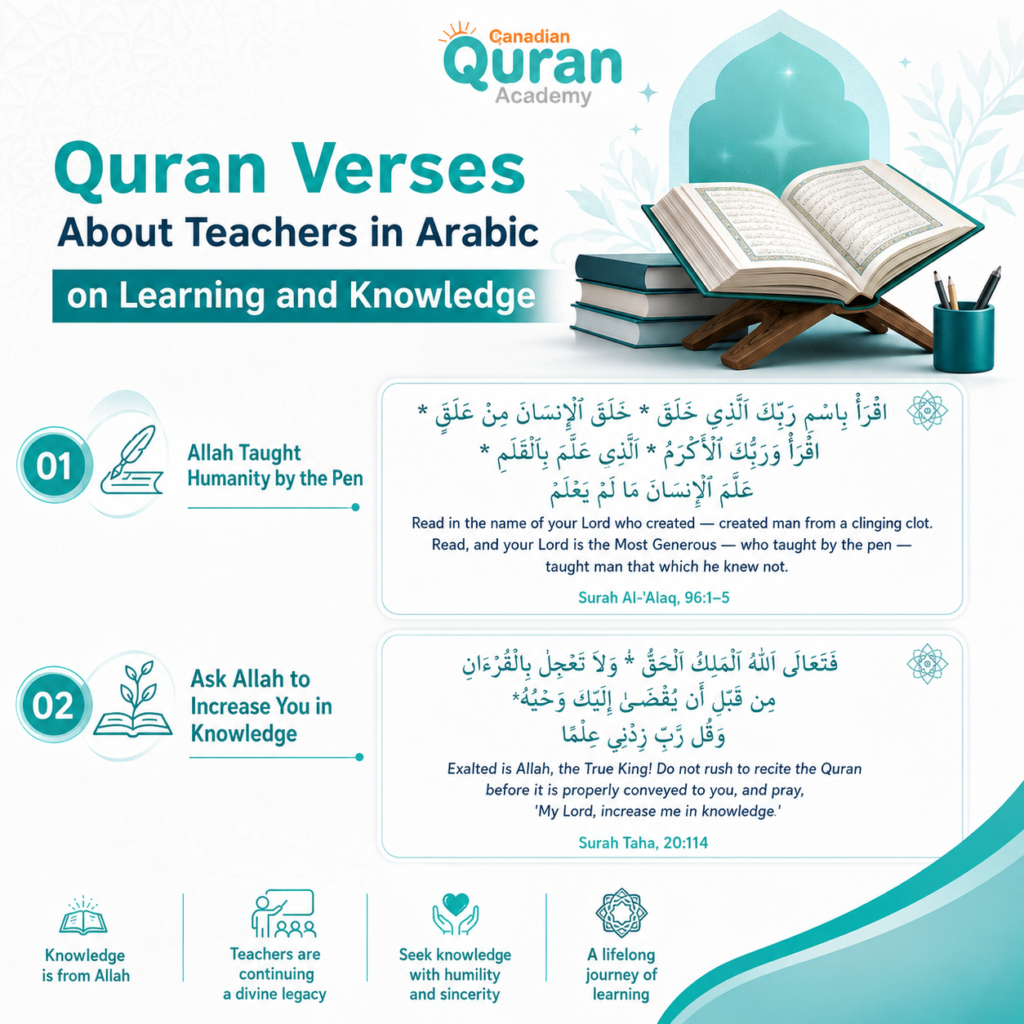
1. Allah Taught Humanity by the Pen
The Quran opens its message by highlighting the importance of learning, showing that knowledge is the starting point of faith and personal growth. These first revealed verses remind both teachers and students that every beneficial lesson ultimately comes from Allah.
اقْرَأْ بِٱسْمِ رَبِّكَ ٱلَّذِى خَلَقَ * خَلَقَ ٱلْإِنسَـٰنَ مِنْ عَلَقٍ * اقْرَأْ وَرَبُّكَ ٱلْأَكْرَمُ * ٱلَّذِى عَلَّمَ بِٱلْقَلَمِ * عَلَّمَ ٱلْإِنسَـٰنَ مَا لَمْ يَعْلَمْ
“Read in the name of your Lord who created — created man from a clinging clot. Read, and your Lord is the Most Generous — who taught by the pen — taught man that which he knew not.” Surah Al-‘Alaq, 96:1–5
These are traditionally held to be the first words revealed of the Quran, and it is worth sitting with what they chose to open with. Not a command to fight, not a ruling on worship — a command to read, followed immediately by a description of Allah as the one who taught humanity “by the pen,” a tool for writing and passing on knowledge. The verse ends by reminding man that everything he knows, he was taught. Nothing here is self-generated. In Islamic thought, this sets teaching as the very first act of divine mercy toward humanity, and it frames every human teacher afterward as someone continuing a chain that begins with Allah Himself.
2. Ask Allah to Increase You in Knowledge
No matter how much knowledge a person gains, the Quran teaches that there is always more to learn. This powerful supplication reminds every student and teacher that seeking knowledge is a lifelong journey guided by humility and dependence on Allah.
فَتَعَـٰلَى ٱللَّهُ ٱلْمَلِكُ ٱلْحَقُّ ۗ وَلَا تَعْجَلْ بِٱلْقُرْءَانِ مِن قَبْلِ أَن يُقْضَىٰٓ إِلَيْكَ وَحْيُهُۥ ۖ وَقُل رَّبِّ زِدْنِى عِلْمًا
“Exalted is Allah, the True King! Do not rush to recite the Quran before it is properly conveyed to you, and pray, ‘My Lord, increase me in knowledge.'” Surah Taha, 20:114
This is the only verse in the Quran where the Prophet ﷺ is directly instructed to ask for more of something — and that something is knowledge. He is told to slow down, not rush the revelation, and instead ask Allah for increase. For anyone studying, teaching, or memorizing the Quran, this ayah sets the tone: knowledge is not something you finish acquiring. It’s a continuous request, a prayer said by the most knowledgeable of all creation.

Read More: Quran Verses About Soulmates in Arabic
Quran Verses About Teachers in Arabic on the Honor of Knowledge
After emphasizing the importance of learning, the Quran highlights the elevated status of those who possess and share beneficial knowledge. These verses show that scholars and teachers are honored not because of their position, but because they guide others with knowledge that benefits both this life and the Hereafter.
1. Allah Raises Those Given Knowledge
The Quran consistently emphasizes the importance of knowledge, learning, and teaching as foundations of faith and righteous living.
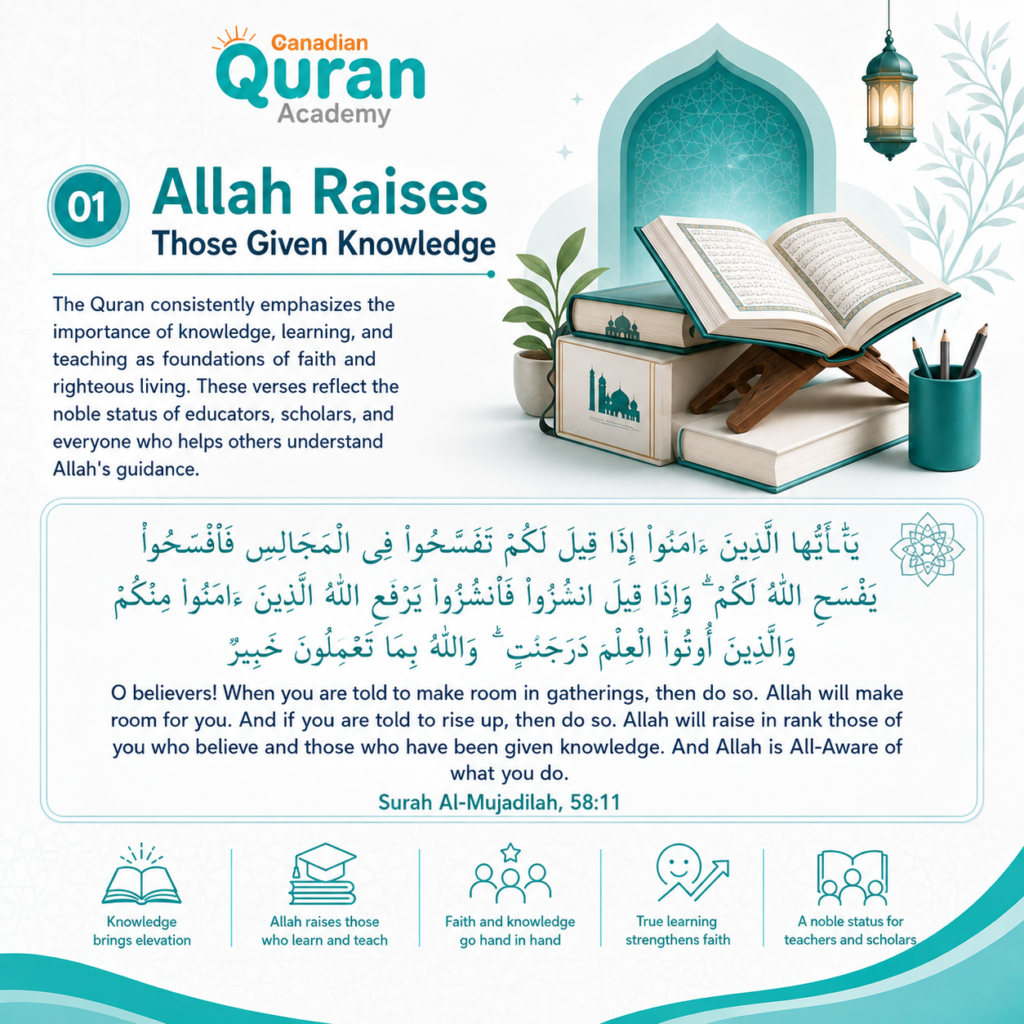
These Quran verses about teachers in Arabic reflect the noble status of educators, scholars, and everyone who helps others understand Allah’s guidance.
يَـٰٓأَيُّهَا ٱلَّذِينَ ءَامَنُوٓا۟ إِذَا قِيلَ لَكُمْ تَفَسَّحُوا۟ فِى ٱلْمَجَـٰلِسِ فَٱفْسَحُوا۟ يَفْسَحِ ٱللَّهُ لَكُمْ ۖ وَإِذَا قِيلَ ٱنشُزُوا۟ فَٱنشُزُوا۟ يَرْفَعِ ٱللَّهُ ٱلَّذِينَ ءَامَنُوا۟ مِنكُمْ وَٱلَّذِينَ أُوتُوا۟ ٱلْعِلْمَ دَرَجَـٰتٍۢ ۚ وَٱللَّهُ بِمَا تَعْمَلُونَ خَبِيرٌۭ
“O believers! When you are told to make room in gatherings, then do so. Allah will make room for you. And if you are told to rise up, then do so. Allah will raise in rank those of you who believe and those who have been given knowledge. And Allah is All-Aware of what you do.” Surah Al-Mujadilah, 58:11
This verse begins by teaching the etiquette of gatherings before revealing a broader principle: Allah raises people through faith and knowledge. The pairing is significant because the Quran places knowledge alongside belief as a reason for spiritual elevation, showing that true learning strengthens faith rather than existing apart from it.
2. The Honor of Knowledge
The Quran repeatedly reminds believers that knowledge is one of the greatest qualities a person can possess. This verse draws a clear distinction between those who seek understanding and those who remain unaware, highlighting why learning and teaching hold such a respected place in Islam.
قُلْ هَلْ يَسْتَوِى ٱلَّذِينَ يَعْلَمُونَ وَٱلَّذِينَ لَا يَعْلَمُونَ ۗ إِنَّمَا يَتَذَكَّرُ أُو۟لُوا۟ ٱلْأَلْبَـٰبِ
“Say, ‘Are those who know equal to those who do not know?’ None will be reminded except people of understanding.” Surah Az-Zumar, 39:9
This is a rhetorical question, and the Quran expects no answer other than “no.” The verse doesn’t say those who know are simply better off — it frames the gap as so obvious that only a person truly without understanding could fail to see it. In context, the ayah is describing a person devoted to worship and reflection at night, in contrast with someone heedless of it. But it has become one of the most quoted verses in Islamic education generally, used to argue for the value of seeking knowledge and, by extension, the value of those who teach it.
Experience Our Classrooms
Don’t just take our word for it—take a look inside! Watch the videos below to experience our engaging teaching methods and vibrant online classrooms firsthand.
Start Your Quranic Journey in Canada
Join our vibrant community and learn with expert tutors through our flexible online platform.
Claim Your Free TrialRead More: Quran Verses About Sadaqah in Arabic
Quran Verses About Teachers in Arabic on the Mission of the Prophets
If knowledge is honored and its holders are raised in rank, the Quran goes one step further: it describes the prophets themselves as teachers, sent specifically to instruct people in the Book and in wisdom.
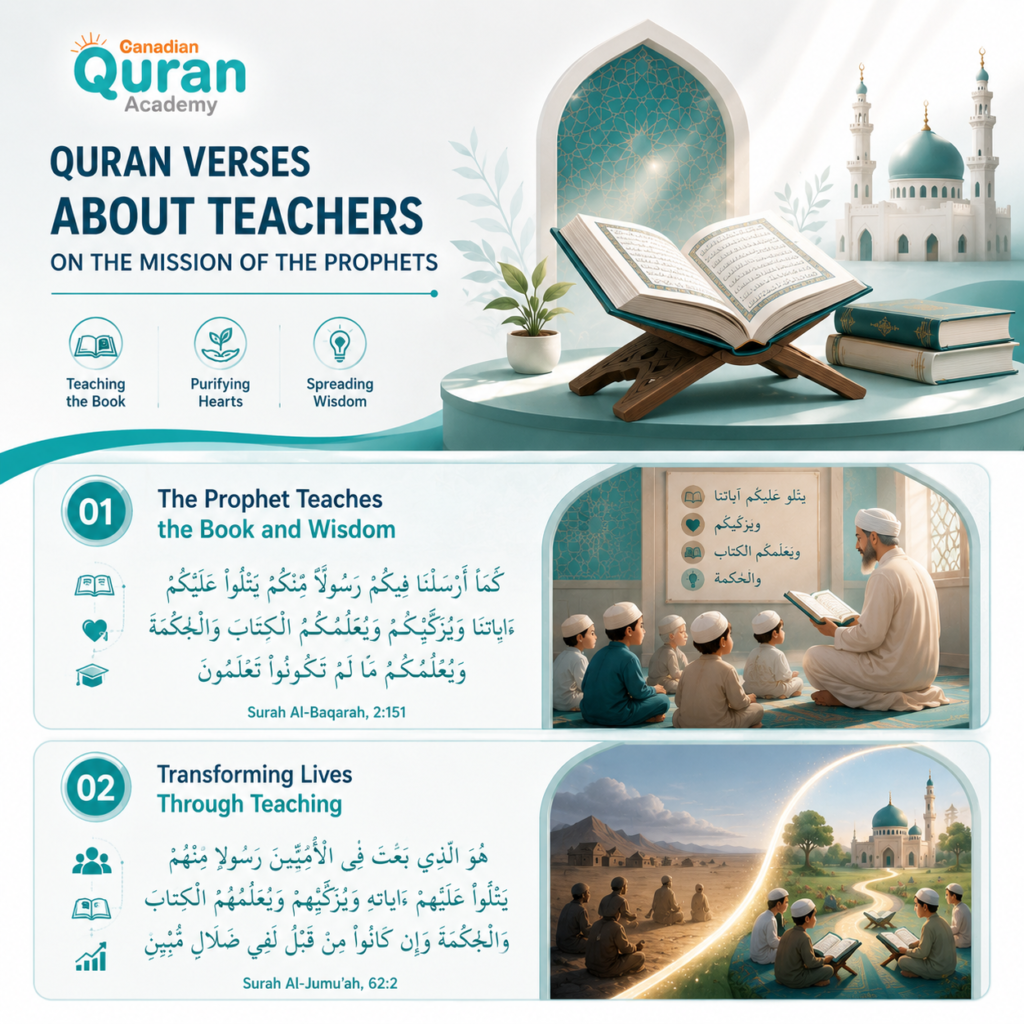
1. The Prophet Teaches the Book and Wisdom
The Quran presents Prophet Muhammad ﷺ as the ultimate teacher, entrusted with far more than delivering revelation. His mission combined reciting Allah’s words, nurturing faith, and teaching the Book and wisdom, creating a complete model of Islamic education.
كَمَآ أَرْسَلْنَا فِيكُمْ رَسُولًۭا مِّنكُمْ يَتْلُوا۟ عَلَيْكُمْ ءَايَـٰتِنَا وَيُزَكِّيكُمْ وَيُعَلِّمُكُمُ ٱلْكِتَـٰبَ وَٱلْحِكْمَةَ وَيُعَلِّمُكُم مَّا لَمْ تَكُونُوا۟ تَعْلَمُونَ
“Just as We have sent among you a messenger from yourselves reciting to you Our verses and purifying you and teaching you the Book and wisdom and teaching you that which you did not know.” Surah Al-Baqarah, 2:151
Notice the sequence in this verse: recitation, purification, then teaching — twice. The Prophet ﷺ’s mission is described almost like a curriculum, moving from reciting the words, to refining character, to instructing in the Book itself, and finally to teaching things people had no prior knowledge of at all. This is one of the clearest verses describing what a teacher’s role should actually look like — not just transmitting information, but purifying character alongside it. It’s a model many programs for children still build around, pairing recitation with character education rather than treating them as separate goals.

2. Transforming Lives Through Teaching
The Prophet’s mission demonstrates that true education has the power to transform individuals and entire communities. Through teaching the Quran and wisdom, he guided people from ignorance to faith, establishing a lasting example for every teacher.
هُوَ ٱلَّذِى بَعَثَ فِى ٱلْأُمِّيِّـۧنَ رَسُولًۭا مِّنْهُمْ يَتْلُوا۟ عَلَيْهِمْ ءَايَـٰتِهِۦ وَيُزَكِّيهِمْ وَيُعَلِّمُهُمُ ٱلْكِتَـٰبَ وَٱلْحِكْمَةَ وَإِن كَانُوا۟ مِن قَبْلُ لَفِى ضَلَـٰلٍۢ مُّبِينٍۢ
“He is the one who raised among the unlettered people a messenger from themselves, reciting to them His verses, purifying them, and teaching them the Book and wisdom — although they were before in clear error.” Surah Al-Jumu’ah, 62:2
This verse pointedly describes the people the Prophet ﷺ was sent to as “unlettered” — meaning they could not read or write, and had no organized system of learning. Out of that state, the Quran says, Allah raised up someone to teach them the Book and wisdom, moving an entire community from “clear error” to guidance through education. It’s a powerful statement about what a teacher can do with a community that starts with nothing. For families researching an intensive Quran program for their children, this verse is often cited as the model: recitation, purification, and teaching happening together rather than as separate stages.
Quran Verses About Teachers in Arabic on Wisdom and Guidance
Knowledge alone is not enough in Islam. The Quran repeatedly pairs knowledge with hikmah (wisdom), showing that a true teacher not only conveys information but also helps others understand when, why, and how to apply it. Wisdom transforms knowledge into righteous action, making education a means of guidance rather than simply the accumulation of facts.
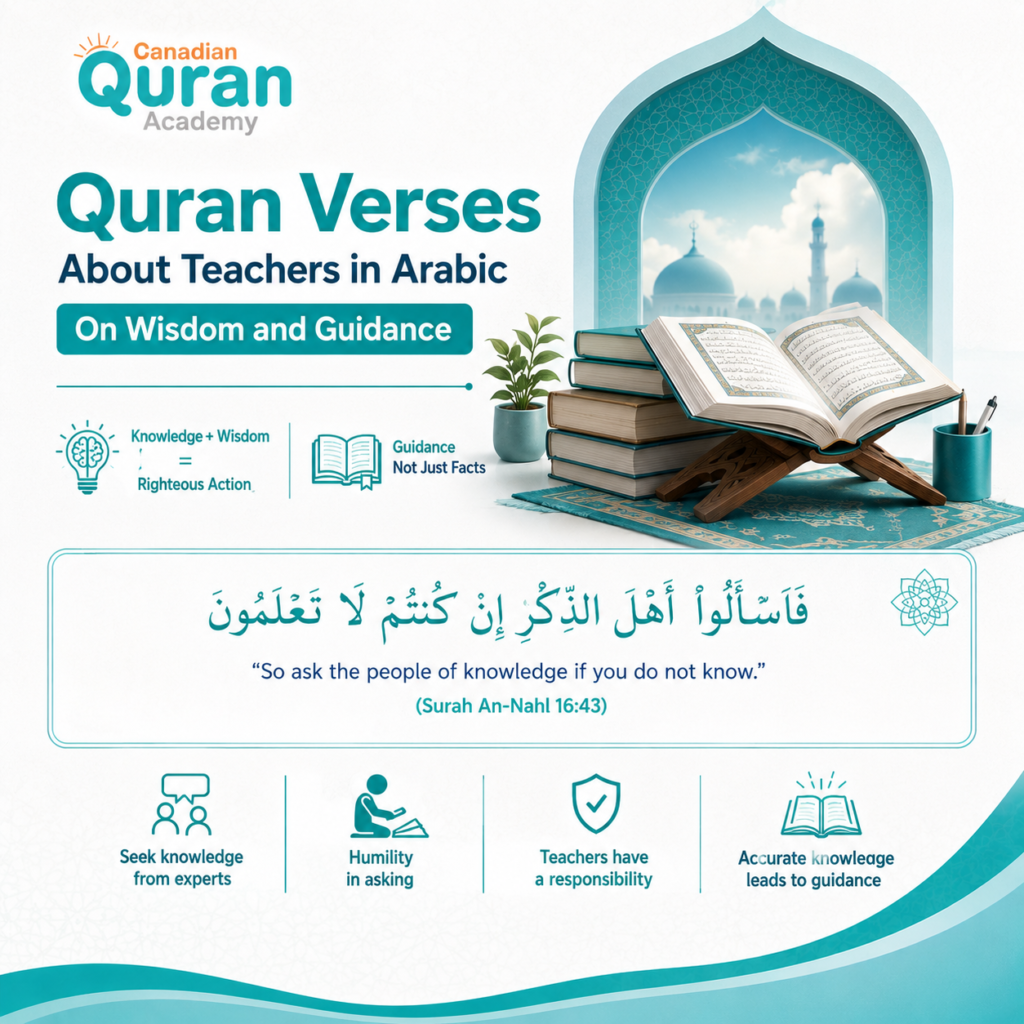
Ask the People of Knowledge
Throughout the Quran, believers are encouraged to seek knowledge from reliable sources rather than relying on assumptions or personal opinions. This verse establishes a timeless principle: true learning begins with asking those who possess authentic knowledge.
فَاسْأَلُوا أَهْلَ الذِّكْرِ إِن كُنتُمْ لَا تَعْلَمُونَ
“So ask the people of knowledge if you do not know.” (Surah An-Nahl 16:43)
This short verse establishes one of the most important principles of Islamic education: those who do not know should seek guidance from those who do. Rather than encouraging people to guess or speak without knowledge, the Quran directs believers to consult qualified scholars and teachers.
For students, this verse teaches humility. No one is expected to know everything, and seeking answers from knowledgeable people is itself an act of wisdom. Islam encourages asking questions because sincere questions are often the beginning of genuine understanding.
For teachers, this verse is also a reminder of responsibility. People place their trust in educators when they seek guidance, so teachers must ensure that what they teach is accurate, authentic, and based on sound evidence. A teacher’s words can influence beliefs, worship, and daily decisions, making honesty and careful preparation essential qualities.
This ayah also highlights the importance of preserving chains of knowledge. Throughout Islamic history, scholars learned from qualified teachers, who themselves learned from earlier generations, creating a continuous tradition that protected the authenticity of Islamic knowledge.
Book a FREE session with one of our Ijazah-certified teachers
Read More: Quran Verses About Women’s Clothing in Arabic
Why Reading These Quran Verses in Arabic Matters?
Every verse above loses something in translation, and it’s worth being specific about what.
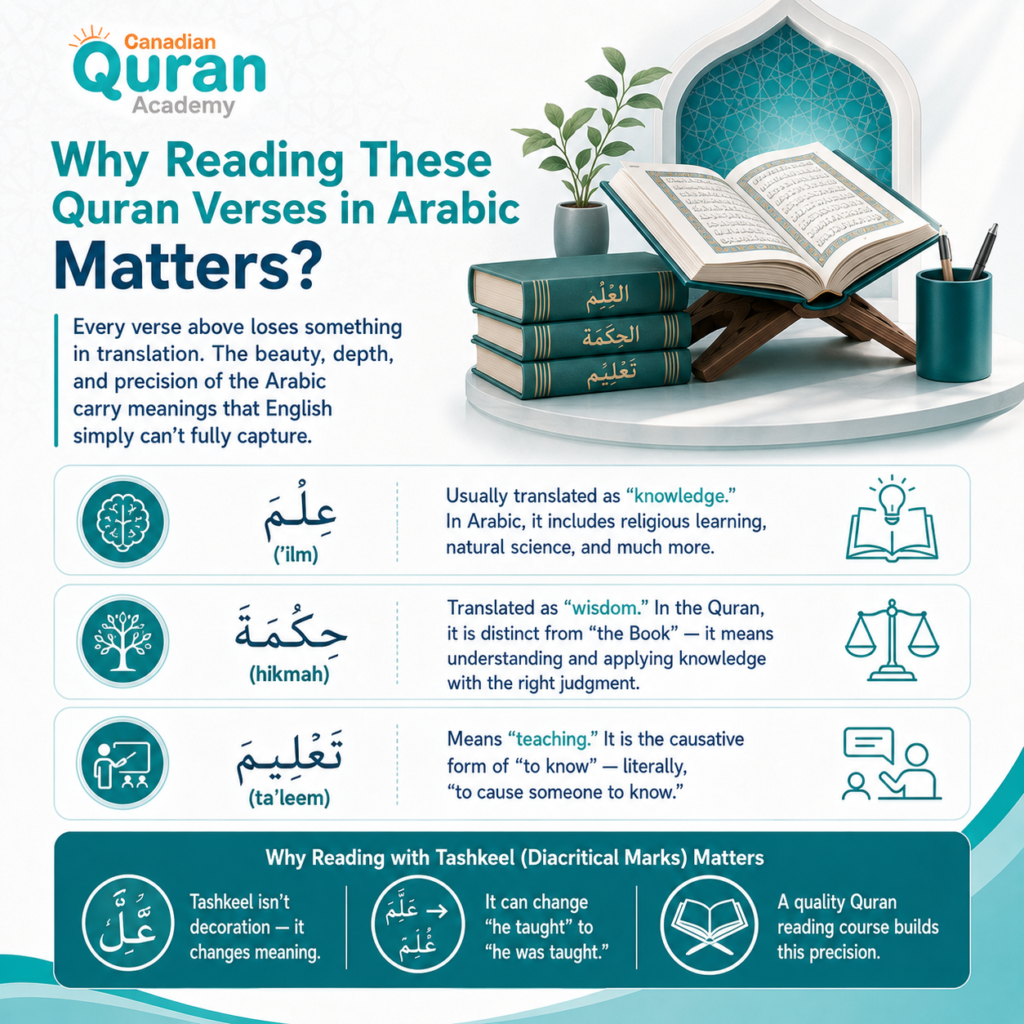
Take the word عِلْم (‘ilm) — usually translated as “knowledge.” In Arabic it carries a precision and depth that English “knowledge” doesn’t fully capture; it’s the term used for everything from religious learning to natural science. Then there’s حِكْمَة (hikmah), translated as “wisdom” — but in the Quran it’s paired with “the Book” as something distinct from it, suggesting understanding and correct application, not just information. And تَعْلِيم (ta’leem), “teaching,” is a causative form of the verb “to know” — literally, “to cause someone to know.”
None of these distinctions survive cleanly in translation. That’s one reason reading the ayahs with correct tashkeel matters — the diacritical marks aren’t decoration, they change verb tense, subject, and sometimes meaning entirely. A verse read without tashkeel can be mispronounced in a way that shifts “he taught” into “he was taught,” for example. This is exactly the kind of detail covered in a solid Quran reading course — not just sounding out letters, but learning to read with the precision the text itself demands.
Live Class in Action
Watch how our instructors interact with students in real-time, focusing on interactive methods.
Start Your Quranic Journey in Canada
Join our vibrant community and learn with expert tutors through our flexible online platform.
Claim Your Free TrialLearn Quranic Arabic with Canadian Quran Academy
Reading Quran verses about teachers in Arabic becomes far more meaningful when you can understand the original words of Allah and recite them with confidence.
At Canadian Quran Academy, students of all ages learn to read the Quran correctly while building a strong foundation in Quranic Arabic and Tajweed under the guidance of qualified instructors.
When you join Canadian Quran Academy, you’ll benefit from:
- Certified Quran teachers with expertise in Tajweed and Quranic Arabic.
- Personalized one-to-one online lessons for children and adults.
- Step-by-step instruction in Quran reading, pronunciation, and Arabic fundamentals.
- Structured Quran memorization and revision programs.
- Flexible class timings designed for students across Canada.
- A FREE trial class with no obligation.
Book your FREE trial class today and start reading, understanding, and reciting the Quran with confidence under the guidance of experienced teachers.
Our Quran Courses
- Quran Online Academy
- Quran Recitation Classes
- Quran Reading Classes
- Online Quran Classes for Kids
- Quran Classes for Adults
- Quran Classes for Female
- Learn Quran Course for Beginners
- Quran Memorization (Hifz) Course
- Hifz Classes for Adults
- Quran Memorization and Hifz Course for Kids
- Quran Hifz Course for Ladies
Start Your Quranic Journey in Canada
Join our vibrant community and learn with expert tutors through our flexible online platform.
Claim Your Free TrialConclusion
The Quran presents teaching as one of the noblest responsibilities a person can undertake. From the very first revelation commanding humanity to read, to the repeated descriptions of the Prophet Muhammad ﷺ teaching the Book and wisdom, the Quran places education at the heart of Islamic civilization.
The seven verses discussed in this article demonstrate that knowledge is a blessing, teachers are entrusted with a great responsibility, and students are encouraged to pursue learning throughout their lives. The Quran honors scholars, encourages asking knowledgeable people when guidance is needed, and reminds believers that every increase in beneficial knowledge brings them closer to Allah.
Frequently Asked Questions
If you’re looking for more information about what the Quran says regarding teachers, knowledge, and education, these frequently asked questions provide quick, clear answers based on the Quran’s teachings.
Does the Quran mention teachers directly?
The Quran does not use the modern word “teacher” as a profession. However, it frequently speaks about teaching, learning, scholars, wisdom, and describes Allah as the One who teaches and the prophets as teachers of the Book and wisdom.
What is the best Quran verse about teaching?
Many scholars consider Surah Al-‘Alaq (96:1–5)to be the most significant passage about teaching because it contains the first revelation and emphasizes reading, writing, and learning.
Which Quran verse encourages seeking knowledge?
One of the clearest verses is:
وَقُل رَّبِّ زِدْنِي عِلْمًا
“And say, ‘My Lord, increase me in knowledge.'” (20:114)
It teaches Muslims to continually seek beneficial knowledge throughout their lives.
Which Quran verse honors scholars?
Surah Al-Mujadilah (58:11)states that Allah raises those who believe and those who have been given knowledge in rank, highlighting the honored status of scholars and educators.
Why should I read Quran verses in Arabic?
Reading the Quran in Arabic allows you to appreciate its precise wording, eloquence, and linguistic beauty. It also improves Quran recitation, strengthens memorization, and deepens your understanding of Allah’s message in its original language.




Leave a Reply