 Quran
Every year, thousands of Muslims across Canada commit to one of the most profound spiritual achievements in Islam, memorizing the entire Quran.
From Toronto to Vancouver, from Halifax to Calgary, the goal is being achieved by students of every age, background, and schedule.
If you have been asking how to become a hafiz in Canada while managing work, studies, or family responsibilities, this guide is written specifically for you. It maps out a realistic, actionable path through every stage of the journey.
What makes this guide different is its grounding in the Canadian experience; the scheduling realities, the available programs, and the specific points where memorization efforts most often stall.
Starting the hifz journey takes more than motivation, it takes a structured plan. These ten steps reflect the practical realities of memorizing the Quran within the demands of a busy Canadian life.

1. Start With A Solid Tajweed Foundation
Tajweed is the foundation of accurate Quran memorization. Without correct pronunciation, what you memorize becomes flawed and difficult to correct later. Start Tajweed training before you attempt a single verse.
Tajweed covers the articulation points (Makhaarij) of each Arabic letter, elongation rules (Madd), and stopping etiquette (Waqf). These rules determine whether your recitation is accepted or rejected by a qualified scholar.
Many Canadian students begin memorizing before they can pronounce ض or ظ correctly. This creates embedded errors requiring months of remediation. Fix pronunciation first — it saves far more time than rushing into memorization.
Enroll in a dedicated Tajweed program for at least 3–6 months before starting Hifz. A certified teacher will identify your weak letters and give you targeted drills to correct them systematically and permanently.

Read also: How To Learn Qirat Of Quran In Canada?
2. Enroll In A Structured Online Hifz Program
A structured Hifz program removes the guesswork from your memorization journey. It provides a clear syllabus, accountability checkpoints, and a certified teacher who tracks your progress from Juz’ 1 to Juz’ 30.
Online programs are the most practical option for Muslims across Canada’s provinces. You attend live sessions from home, eliminating commute barriers whether you live in Toronto, Calgary, or rural New Brunswick.
Not all online programs are equal. Look for programs offering daily live recitation reviews, weekly revision sessions, and a clear policy on handling students who fall behind schedule.
If you want to learn Quran in Canada through a structured, teacher-led pathway, Canadian Quran Academy offers tiered Hifz programs for children and adults with flexible scheduling across all time zones.
Begin Your Ijazah Certification Journey in Canada
3. Listen To Your Assigned Portion Every Day
Audio exposure is one of the most underused tools in Hifz. Listening to your assigned verses repeatedly before memorizing encodes the sound and rhythm of each ayah deeply in your memory first.
Use a single reciter and maintain that voice throughout your entire Hifz journey. The brain links memory to sound patterns, switching reciters mid-journey creates confusion and slows retention significantly.
Listen during commutes, while cooking, or before sleep. A Canadian student memorizing Surah Al-Baqarah can passively absorb 20+ repetitions of each verse daily, with no extra time carved out.
Set your phone to loop the day’s portion at low volume during background activity. This passive reinforcement builds audio-muscular memory, by the time you sit to memorize, the verse already feels familiar.
Live Class in Action
Watch how our instructors interact with students in real-time, focusing on interactive methods.
Start Your Quranic Journey in Canada
Join our vibrant community and learn with expert tutors through our flexible online platform.
Claim Your Free Trial4. Choose A Certified And Experienced Hifz Teacher
The teacher you choose determines how far you go and how fast you get there. A certified Hifz teacher is trained to teach memorization systematically, not simply someone who memorized the Quran themselves.
Your teacher must hold an Ijazah, a documented chain of transmission linking their recitation back to the Prophet ﷺ. This credential verifies pronunciation accuracy and scholarly accountability no self-study method can replace.
For younger students, the teacher choice matters even more. Children need patient, encouraging instructors using age-appropriate techniques. Canadian Quran Academy‘s Hifz for Kids program pairs students with teachers trained specifically in child-centered Hifz instruction.
Evaluate a teacher through a trial session before committing. Ask about their review methodology, how they handle struggling students, and whether Tajweed is integrated into memorization as a combined, inseparable component.
5. Set A Daily Memorization Target You Will Actually Maintain
One of the most common mistakes in Hifz is setting an ambitious target in week one, then collapsing by week three. Your daily target must match your real life — not your ideal life.
Most successful Huffaz memorize between 3 and 10 lines per day, consistently, over 2–5 years. The range varies by age, schedule, and prior Quran fluency. Consistency always outperforms intensity in Hifz.
Begin with 3–5 lines per day. Hold that pace for a full month. If retention is strong, increase by 2 lines — but only after proving consistency at the current level for four continuous weeks.
Write your daily target on a visible surface — your desk, mirror, or phone lock screen. Visual commitment creates psychological pressure to follow through, improving daily completion rates across all age groups reliably.
Begin Your Quran Memorization Journey in Canada Today
6. Build A Three-Tier Daily Review System
Memorizing new verses without reviewing old ones is the fastest way to forget the Quran. A three-tier review system ensures nothing you memorize disappears while you continue adding new material each day.
Tier 1 is Today’s Sabaq, recite your new verses 20 times before the session ends. Tier 2 is Recent Sabaq, review the last 7 days of memorization fluently, without hesitation or prompting.
Tier 3 is Manzil, a rotating revision of your full memorized portion. Divide it into 7 equal sections and recite one section per day, cycling through the entire memorized body every single week.
This three-tier system is used in traditional Hifz madrasas worldwide. It prevents the “sieve problem” — memorizing new pages while old pages fade — the most common reason students never complete Hifz.
7. Schedule Your Memorization In The Post-Fair Window
The post-Fajr period, between Fajr prayer and sunrise, is consistently identified in classical Islamic scholarship as the highest-quality memorization window. The mind is rested, the environment is quiet, and distractions are minimal.
During this window, cortisol levels peak naturally, sharpening focus and encoding efficiency. Fresh-morning memory formation is neurologically stronger because the brain hasn’t yet accumulated the full cognitive load of the day.
Even 20–30 focused minutes post-Fajr outperform 90 distracted afternoon minutes. Protecting this window from email, social media, and conversation is a non-negotiable discipline for any serious Hifz student in Canada.
Pair each session with sincere intention. As the 12 Quran Verses About Patience remind us, endurance in ibadah carries layered rewards — and consistent Hifz is among the most demanding acts a Muslim undertakes.
Start Your Hifz Journey With Female Tutors in Canada

8. Join Your Hifz Accountability Circle
A Hifz accountability circle is a small group of 3–6 students who share daily progress, flag missed sessions, and recite to one another regularly. Social commitment dramatically increases daily completion rates and long-term retention.
Reciting to another person is not the same as reciting alone. Peer recitation exposes gaps you didn’t know existed, mispronounced words or skipped passages you had been glossing over unconsciously without a listener to catch them.
For younger students, a peer group turns Hifz from a solitary obligation into a shared achievement. Canadian Quran Academy‘s Quran classes for kids include group recitation components that build both community and memorization durability simultaneously.
If no local group exists, form one online. A weekly 30-minute video call with two or three fellow Hifz students, where each person recites to the group, produces the full accountability effect reliably.
Enroll your child in Noorani Qaida classes for kids at Canadian Quran Academy.

9. Protect The Spiritual Conditions That Support Memorization
Hifz is not purely an academic task, it is worship that responds to spiritual conditions. Classical scholars documented that sins and spiritual disconnection directly weaken memorization and retention capacity measurably over time.
Guard your eyes, your speech, and your time. Students who maintain regular prayer, lower their gaze, and limit entertainment consistently report stronger retention than those treating Hifz as a purely academic memorization exercise.
Make sincere du’a before every session, ask Allah to facilitate the Quran as He promises in Surah Al-Qamar (54:17). The Quranic verses on trust in Allah reinforce this principle as a daily memorization strategy.
Review your intentions regularly. Hifz for status or external pressure rarely survives hardship. Hifz sincerely for the sake of Allah, reconnected at every session, creates the resilience that carries students through difficult plateaus.
Perfect Your Quranic Recitation With Canada’s Leading Academy

10. Track Your Progress And Mark Every Completed Juz’
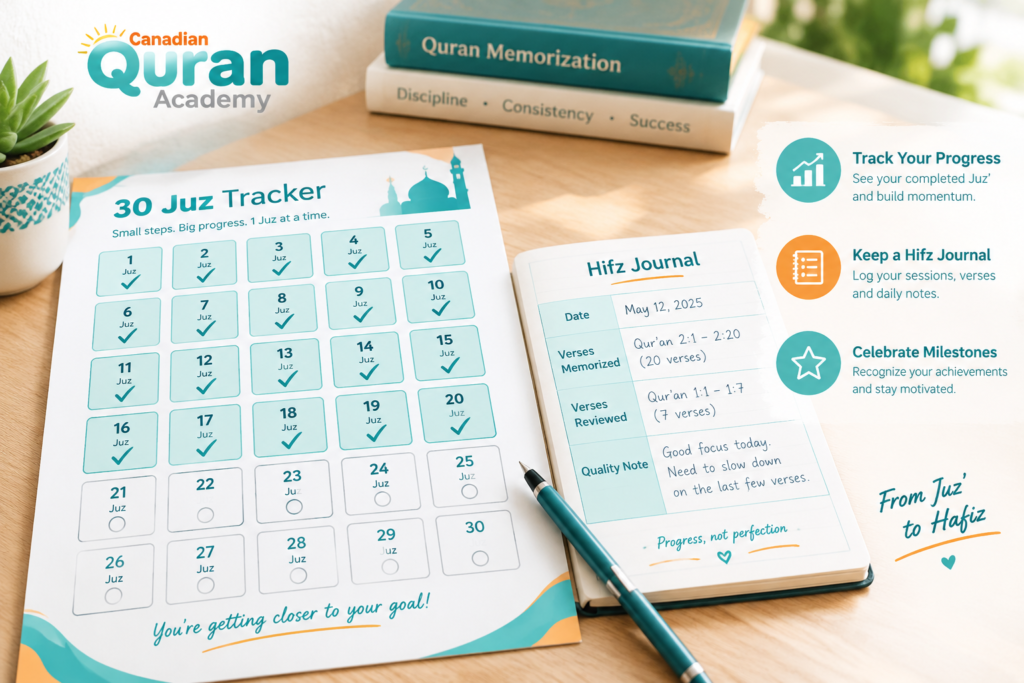
Progress tracking transforms an abstract 30-Juz’ mountain into a visible, measurable journey. When students can see what they’ve completed, they build momentum, identify patterns, and stay motivated through inevitable difficult periods.
Use a physical Hifz tracker, a printed 30-box grid where each box represents one Juz’. Mark each Juz’ upon completion. The visible evidence of progress creates neurological reward signals that reinforce daily attendance and effort.
Record each daily session in a Hifz journal: date, verses memorized, verses reviewed, and a one-line quality note. This log reveals which days you perform best and which Surahs need additional revision cycles.
Celebrate milestones deliberately. When you complete Juz’ 5 or the halfway point, acknowledge it within your family or community. Named milestones shift your identity from someone memorizing to a Hafiz in progress.
Understanding What It Truly Means To Become Hafiz El Quran
Many students begin their hifz journey with genuine enthusiasm but without a clear picture of what becoming hafiz el Quran actually demands. Honest expectations established at the start prevent the most preventable form of dropout.
This section defines what the title genuinely means, how long it realistically takes for students in Canada, and how to integrate the process into daily life without burning out.
A. The True Definition Of A Hafiz
A hafiz is someone who has memorized all 114 surahs and 6,236 verses of the Quran and can recite any portion from memory, at any point in the text, with accurate tajweed and without hesitation.
Completion of memorization is only the first stage. True hifz requires active review for the rest of one’s life.
The Prophet ﷺ described the Quran as something that escapes memory faster than a camel breaks free from its restraints, it demands lifelong tending.
Start Your Child’s Online Quran Reading Education in Canada

B. The Realistic Hifz Timeline For Students In Canada
Most dedicated students memorize the Quran in two to four years when committing to one page per day. Students with strong Arabic reading ability and consistent daily time can realistically complete the journey in 18 to 24 months.
Full-time Islamic school students sometimes finish in one year, but this requires setting aside nearly all other major commitments.
For working Canadians and students within the school system, a two-to-three year timeline with structured daily effort is both realistic and achievable.
C. Integrating Hifz Into A Busy Canadian Lifestyle
Canada’s academic calendar, long work hours, winter conditions, and multicultural environment all present unique factors for the hifz student. The most effective approach is integration, not separation from regular life.
Build hifz into your existing routine rather than creating time blocks that compete with your daily schedule. Recite during your commute. Review at lunch. Let children hear you practicing at home.
Parents beginning this journey with their children will find practical, age-appropriate guidance through resources on how to learn Quran for kids in Canada, covering approaches suited to different stages of early Quran education.
The Hifz Pathways Available To Muslims Across Canada
Canada’s Muslim community has access to a wider range of memorization pathways than at any previous point in its history. Understanding the options before committing to one significantly improves both fit and completion rates.
Each pathway has distinct strengths depending on your age, location, schedule, and learning preference.
A. Online Hifz Programs
Online programs offer the broadest access, available to students in every province, including remote areas and smaller cities where local Islamic infrastructure is limited.
Flexible scheduling accommodates shift workers, full-time students, and parents managing young households.
Canadian Quran Academy provides foundational pathways through Noorani Qaida classes for new readers and dedicated Tajweed classes for kids as preparatory steps before full hifz enrollment.
These courses build the precise foundation that makes memorization both faster and more accurate.

B. Mosque And Islamic School Programs
Most major Canadian cities host mosque-based hifz programs meeting several days per week. Community-based learning adds peer motivation and the structured environment of a traditional halaqah setting.
Full-time Islamic schools in cities such as Mississauga, Brampton, Surrey, and Calgary integrate provincial curriculum requirements with daily hifz hours.
These are particularly well-suited to school-age children whose families prioritize Quran memorization alongside standard academic achievement.
C. Weekend And Summer Intensive Programs
Weekend hifz circles and summer intensive programs serve working adults and university students who cannot commit to daily schedules.
These formats are ideal for launching the memorization habit, accelerating a specific juz’, or completing focused review blocks.
Several Canadian Islamic centers run dedicated summer hifz camps where students memorize multiple juz’ across six to eight concentrated weeks.
This structured jumpstart frequently carries enough momentum to sustain a longer-term online program through the academic year.
Experience Our Classrooms
Don’t just take our word for it—take a look inside! Watch the videos below to experience our engaging teaching methods and vibrant online classrooms firsthand.
Start Your Quranic Journey in Canada
Join our vibrant community and learn with expert tutors through our flexible online platform.
Claim Your Free TrialBegin Your Hifz Journey With Canadian Quran Academy Today
Canadian Quran Academy connects students from every Canadian province with certified, experienced hifz instructors through a structured, proven online curriculum.
Programs are available for children, adults, and complete beginners at every skill level.
Whether you are starting from the very first step, preparing your child for their hifz journey, or returning to strengthen memorization already in progress, there is a program structured for your exact situation and schedule.
Our Quran Courses:
- Quran Online Academy
- Learn Quran Course for Beginners
- Quran Hifz Course for Ladies
- Weekend Quran Classes
- Intensive Quran Course
- Online Tajweed Classes
Enroll Now and Begin Memorizing with a Free Trial

Conclusion
Becoming a hafiz in Canada is entirely achievable and Muslims across this country are proving it every year, in every province.
The resources available today, from structured online programs to community mosque circles, make this journey more accessible than at any previous point in Canadian Islamic history. The ten steps in this guide are not theoretical ideals.
They address the actual challenges Canadian hifz students face: irregular schedules, geographic limitations, the difficulty of finding qualified teachers, and the critical importance of sustained daily review.
What separates students who complete the journey from those who do not is rarely talent or natural ability. It is structure, consistency, the right support system, and the willingness to prioritize a small, sacred portion of each day for Allah’s words.
Whether you begin today, next week, or next Ramadan, whether you are eight years old or forty-five, the path of how to become hafiz el Quran starts with one decision. Canadian Quran Academy is here to make sure that decision leads somewhere.
Frequently Asked Questions
How Long Does It Take To Become A Hafiz In Canada?
Most students complete the full Quran in two to four years memorizing one page per day. Students with strong Arabic reading skills and consistent daily commitment often finish in 18 to 24 months.
Can Adults Become A Hafiz In Canada?
Yes. Adults of any age can and do memorize the Quran. While children tend to memorize more quickly, adults bring discipline, focus, and personal motivation that compensate effectively. Many Canadian adults complete hifz in their thirties and forties.
Is Online Hifz As Effective As In-Person Learning?
Yes, when the program includes qualified certified teachers, regular live recitation sessions, and structured review tracking. Many students across Canada complete their entire hifz journey through online instruction without any in-person component.
What Is The Best Age To Start Hifz In Canada?
Islamic tradition recommends beginning between five and twelve years of age when memory is most receptive. There is no upper age limit. Canadian Quran Academy offers programs designed for each age group and skill level.
Do I Need To Know Arabic Before Starting Hifz?
You do not need to speak Arabic. You do need to read Arabic script with basic fluency before beginning memorization. Programs like Noorani Qaida are designed specifically to build this foundational reading skill before hifz enrollment begins.
How Many Pages Must A Hafiz Memorize?
The standard Uthmani print Quran contains 604 pages. A hafiz memorizes all of them — 114 surahs and 6,236 verses — and can recite the complete text from memory with accurate tajweed.







Leave a Reply