 Quran
Quran
When the weight of a decision feels unbearable, when the outcome is out of your hands, when fear and uncertainty crowd the heart — Islam has a name for the state that answers all of it: Tawakkul (التَّوَكُّل).
Tawakkul is not passive resignation. It is the active, deliberate choice to take every reasonable step available to you, and then place the outcome entirely in Allah’s hands — because you know, with certainty, that His hands are the only ones capable of holding it.
The root و-ك-ل (Waw-Kaf-Lam) from which Tawakkul derives appears dozens of times across the Quran. That frequency is itself a message: this is not a peripheral concept. It is woven into the fabric of what it means to be a believer.
This guide presents ten of the most powerful Quranic verses on trust in Allah in Arabic, complete with full tashkeel, transliteration, surah name, verse number, and a direct link to each verse — so you can read them, understand them, and carry them with you.
1. A Quranic Verse on Trust in Allah as the Believer’s Defining Trait
The Quran does not present Tawakkul as an occasional practice for difficult moments. It presents it as a continuous, defining characteristic of the true believer.
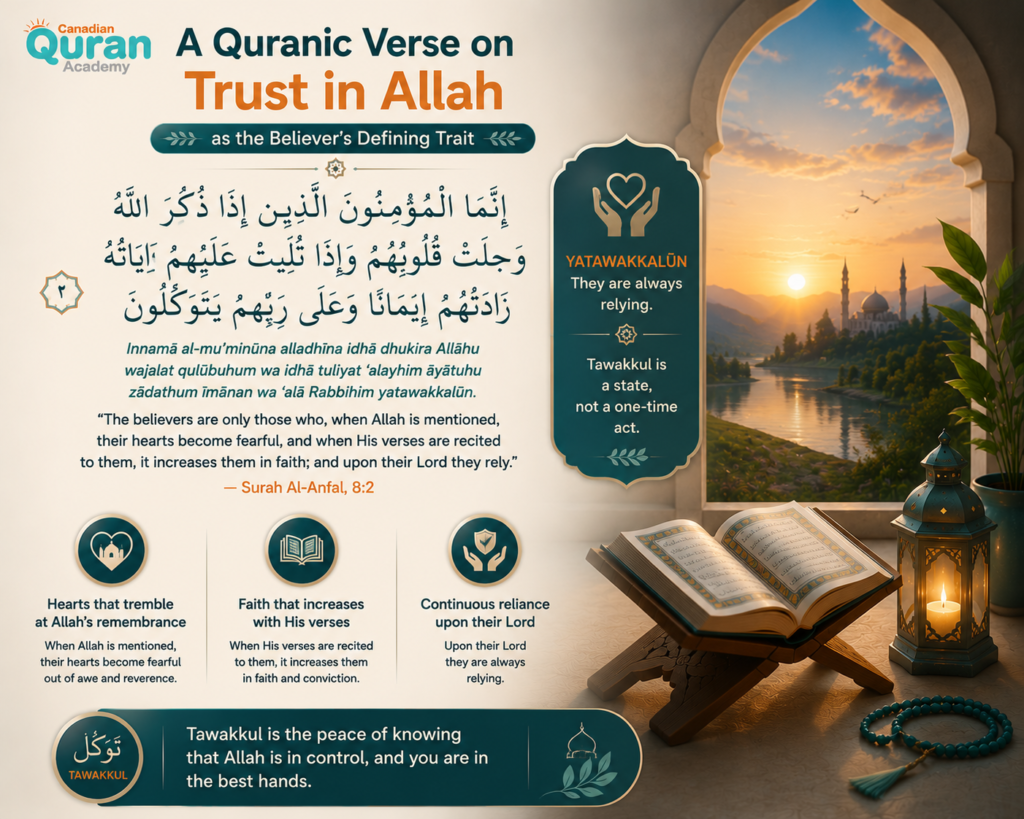
إِنَّمَا الْمُؤْمِنُونَ الَّذِينَ إِذَا ذُكِرَ اللَّهُ وَجِلَتْ قُلُوبُهُمْ وَإِذَا تُلِيَتْ عَلَيْهِمْ آيَاتُهُ زَادَتْهُمْ إِيمَانًا وَعَلَىٰ رَبِّهِمْ يَتَوَكَّلُونَ
Innamā al-mu’minūna alladhīna idhā dhukira Allāhu wajalat qulūbuhum wa idhā tuliyat ‘alayhim āyātuhu zādathum īmānan wa ‘alā Rabbihim yatawakkalūn.
“The believers are only those who, when Allah is mentioned, their hearts become fearful, and when His verses are recited to them, it increases them in faith; and upon their Lord they rely.” — Surah Al-Anfal, 8:2
Three qualities are listed together as the marks of a true believer: hearts that tremble at Allah’s remembrance, faith that increases when His verses are recited, and continuous reliance upon their Lord. The verb يَتَوَكَّلُونَ (yatawakkalūn) is in the present-continuous form — not “they relied once” but “they are always relying.” It is a state, not an act.
Memorizing this verse in Arabic is deeply rewarding because its three qualities become a personal checklist — and each one feeds the others. Trembling hearts drive you to His verses; His verses increase your faith; increased faith makes Tawakkul feel natural.
2. A Quranic Verse on Deciding Firmly, Then Trusting in Allah
One of the most common misconceptions about Tawakkul is that it means doing nothing and waiting. This verse corrects that directly.
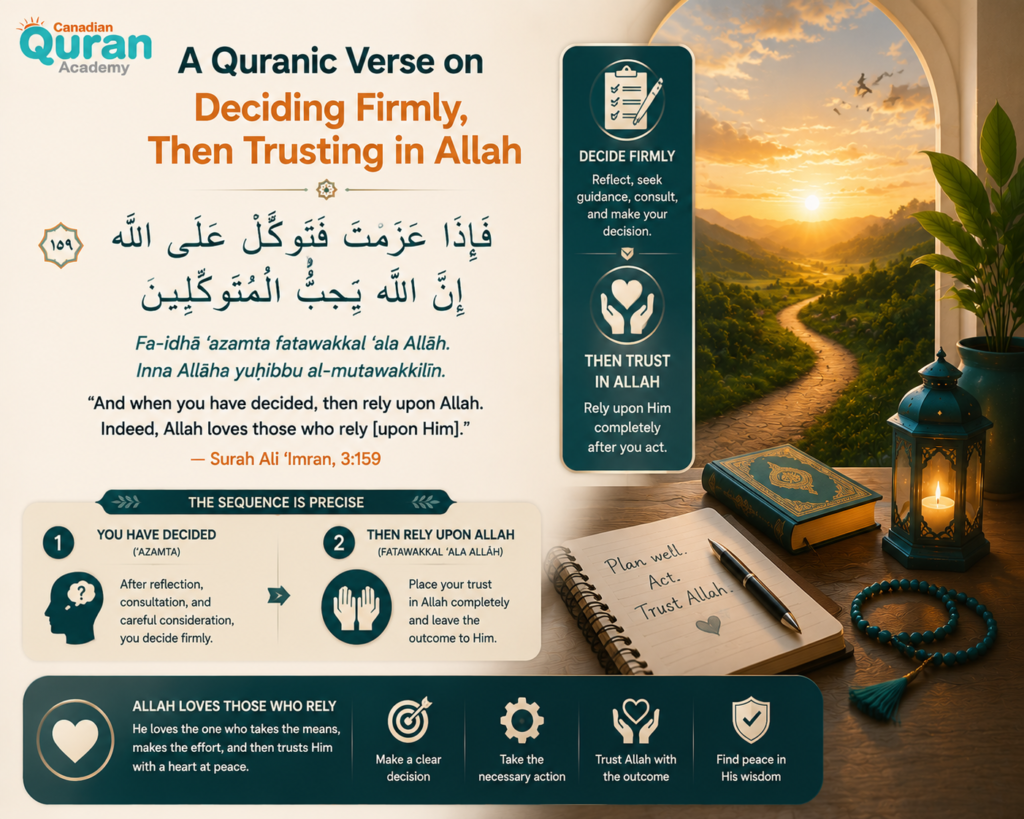
فَإِذَا عَزَمْتَ فَتَوَكَّلْ عَلَى اللَّهِ ۚ إِنَّ اللَّهَ يُحِبُّ الْمُتَوَكِّلِينَ
Fa-idhā ‘azamta fatawakkal ‘ala Allāh. Inna Allāha yuḥibbu al-mutawakkilīn.
“And when you have decided, then rely upon Allah. Indeed, Allah loves those who rely [upon Him].” — Surah Ali ‘Imran, 3:159
The sequence here is precise and deliberate. First comes عَزَمْتَ (‘azamta) — you have resolved, decided firmly, after consultation and reflection. Then, and only then, comes the command: فَتَوَكَّلْ عَلَى اللَّهِ (fatawakkal ‘ala Allāh) — rely upon Allah. Tawakkul follows decision and effort; it does not replace them.
And the consequence of this practice? إِنَّ اللَّهَ يُحِبُّ الْمُتَوَكِّلِينَ (inna Allāha yuḥibbu al-mutawakkilīn) — Allah loves those who rely upon Him. Earning the love of Allah is the highest possible outcome of any human act, and this verse ties it directly to the practice of Tawakkul.
Read More: Quran Verses About Sadaqah in Arabic
3. A Quranic Verse on Complete Trust in Allah
This verse does not suggest that Tawakkul is a good addition to faith. It presents it as inseparable from faith itself.
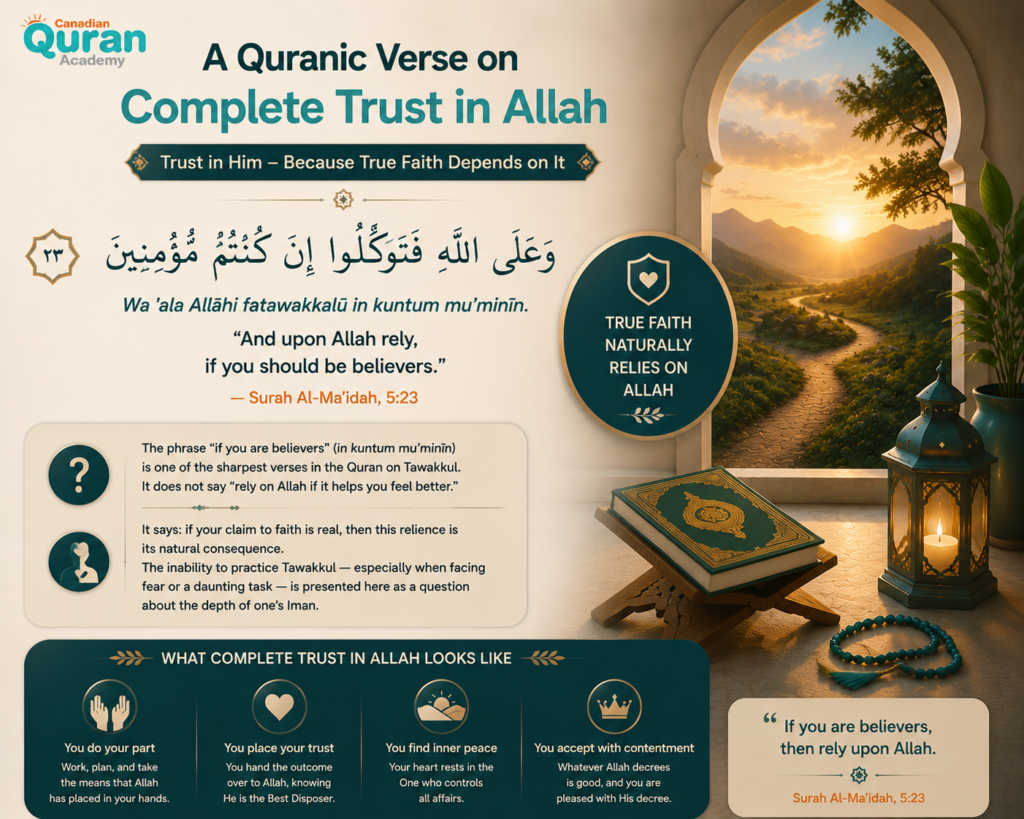
وَعَلَى اللَّهِ فَتَوَكَّلُوا إِن كُنتُم مُّؤْمِنِينَ
Wa ‘ala Allāhi fatawakkalū in kuntum mu’minīn.
“And upon Allah rely, if you should be believers.” — Surah Al-Ma’idah, 5:23
The conditional clause إِن كُنتُم مُّؤْمِنِينَ (in kuntum mu’minīn — if you are believers) is one of the sharpest verses in the Quran on this subject. It does not say “rely on Allah if it helps you feel better.” It says: if your claim to faith is real, then this reliance is its natural consequence. The inability to practice Tawakkul — especially when facing fear or a daunting task — is presented here as a question about the depth of one’s Iman.
Understanding why a verse is worded the way it is — why the conditional comes at the end rather than the beginning, why the verb is placed after the prepositional phrase — is the kind of insight that studying Quranic Arabic directly unlocks. The Qirat courses at Canadian Quran Academy build the precise recitation foundation that makes reading these distinctions in the original text possible.
Discover the Beauty of Quran Qira’at with a FREE Trial Class
4. A Quranic Example of Complete Trust in Allah
When the Prophets faced opposition and threat, their response was not fear — it was this declaration. It stands as one of the most powerful statements of Tawakkul in the entire Quran.
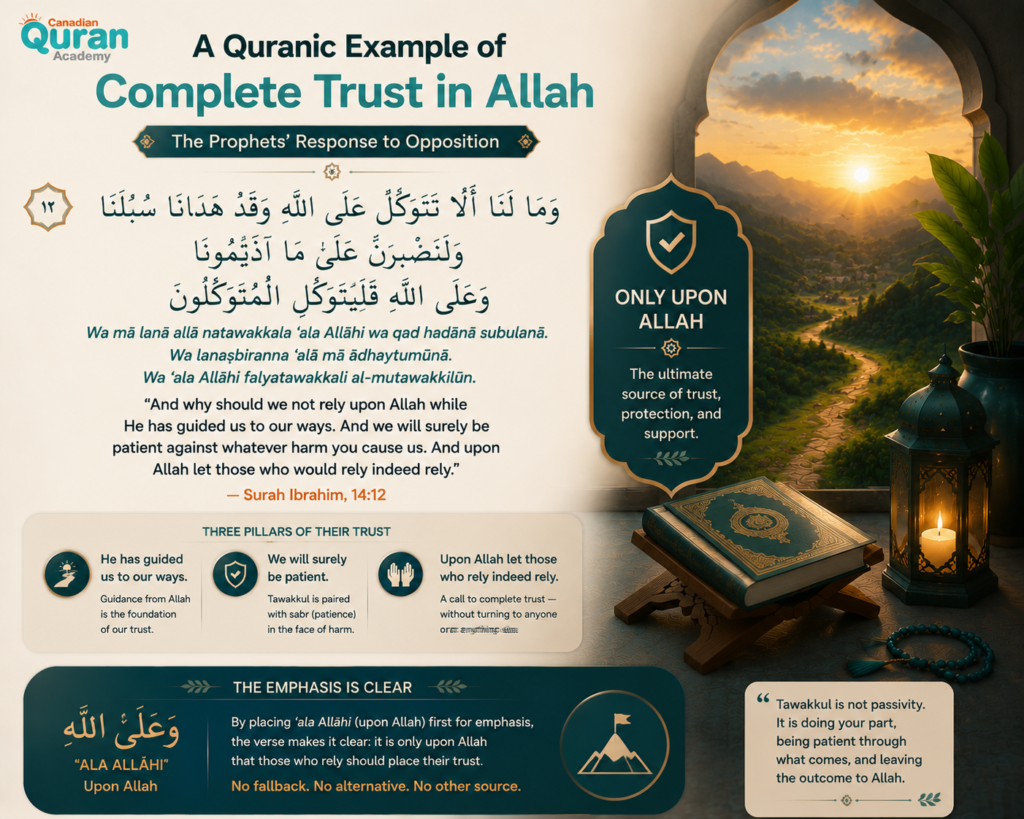
وَمَا لَنَا أَلَّا نَتَوَكَّلَ عَلَى اللَّهِ وَقَدْ هَدَانَا سُبُلَنَا ۚ وَلَنَصْبِرَنَّ عَلَىٰ مَا آذَيْتُمُونَا ۚ وَعَلَى اللَّهِ فَلْيَتَوَكَّلِ الْمُتَوَكِّلُونَ
Wa mā lanā allā natawakkala ‘ala Allāhi wa qad hadānā subulanā. Wa lanaṣbiranna ‘alā mā ādhaytumūnā. Wa ‘ala Allāhi falyatawakkali al-mutawakkilūn.
“And why should we not rely upon Allah while He has guided us to our ways. And we will surely be patient against whatever harm you cause us. And upon Allah let those who would rely indeed rely.” — Surah Ibrahim, 14:12
The Arabic structure of the final sentence is built for emphasis. By placing عَلَى اللَّهِ (‘ala Allāhi — upon Allah) before the verb, it signals exclusivity: it is only upon Allah that those who rely should place their trust. No fallback, no secondary source of security.
The verse also pairs Tawakkul with ṣabr (patience under harm), showing that they travel together. When the outcome is in Allah’s hands, patience in the face of difficulty becomes possible — because you are not waiting for a human to fix things; you are waiting on Allah, whose timing and wisdom are perfect.
Experience Our Classrooms
Don’t just take our word for it—take a look inside! Watch the videos below to experience our engaging teaching methods and vibrant online classrooms firsthand.
Start Your Quranic Journey in Canada
Join our vibrant community and learn with expert tutors through our flexible online platform.
Claim Your Free TrialRead More: Quranic Verses on Shukr in Arabic and English
5. A Quranic Verse Stating That Allah Is Sufficient for the One Who Trusts Him
Before any description of how to practice Tawakkul, the Quran establishes why it makes sense — by telling you exactly what you receive when you place your reliance on Allah.
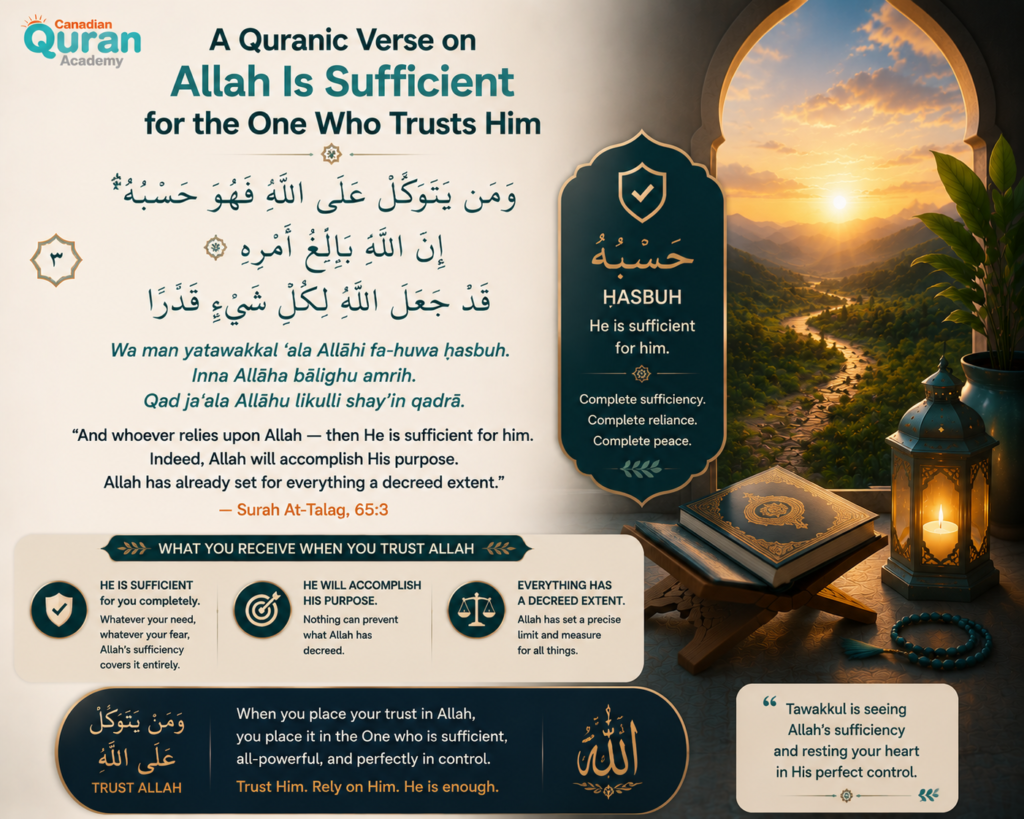
وَمَن يَتَوَكَّلْ عَلَى اللَّهِ فَهُوَ حَسْبُهُ ۚ إِنَّ اللَّهَ بَالِغُ أَمْرِهِ ۚ قَدْ جَعَلَ اللَّهُ لِكُلِّ شَيْءٍ قَدْرًا
Wa man yatawakkal ‘ala Allāhi fa-huwa ḥasbuh. Inna Allāha bālighu amrih. Qad ja’ala Allāhu likulli shay’in qadrā.
“And whoever relies upon Allah — then He is sufficient for him. Indeed, Allah will accomplish His purpose. Allah has already set for everything a decreed extent.” — Surah At-Talaq, 65:3
The word حَسْبُهُ (ḥasbuh) means He is sufficient for him — not partially, not conditionally, but completely. Whatever the need, whatever the fear, Allah’s sufficiency covers it entirely when Tawakkul is genuine.
The verse then adds two grounding truths. First: Allah accomplishes His purpose — بَالِغُ أَمْرِهِ (bālighu amrih) — meaning nothing He has decreed can be stopped or diverted. Second: everything already has a set measure and time — قَدْرًا (qadrā). These two additions are not just comfort; they are the rational foundation of Tawakkul. When you know that outcomes are already in the most capable hands, and that every matter has its appointed time, anxiety over results becomes irrational. Tawakkul is the sane response to these two facts.
6. A Quranic Verse on Trust Grounded in Allah’s Mercy
This verse links Tawakkul directly to one of Allah’s most beloved names — a reminder that our trust is not blind, but grounded in knowledge of who He is.
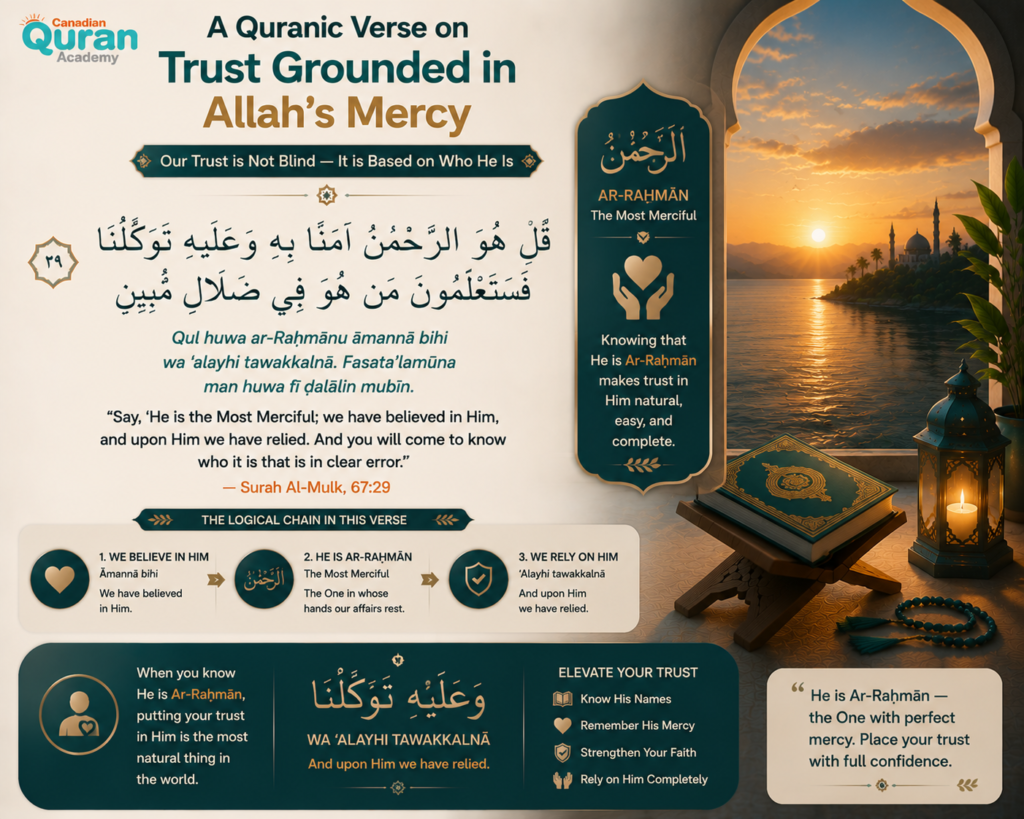
قُلْ هُوَ الرَّحْمَـٰنُ آمَنَّا بِهِ وَعَلَيْهِ تَوَكَّلْنَا ۖ فَسَتَعْلَمُونَ مَنْ هُوَ فِي ضَلَالٍ مُّبِينٍ
Qul huwa ar-Raḥmānu āmannā bihi wa ‘alayhi tawakkalnā. Fasata’lamūna man huwa fī ḍalālin mubīn.
“Say, ‘He is the Most Merciful; we have believed in Him, and upon Him we have relied. And you will come to know who it is that is in clear error.'” — Surah Al-Mulk, 67:29
The structure is a direct equation: belief in Ar-Raḥmān leads immediately to reliance upon Him.
وَعَلَيْهِ تَوَكَّلْنَا (wa ‘alayhi tawakkalnā) follows آمَنَّا بِهِ (āmannā bihi) without pause. This is not a coincidence of wording — it is a logical chain. When you truly internalize that the One in whose hands your affairs rest is the Most Merciful, placing trust in Him stops being difficult and becomes the most natural thing in the world.
Tawakkul grounded in knowledge of Allah’s names and attributes is structurally stronger than Tawakkul based on habit or tradition. This is one reason why Tafsir courses at Canadian Quran Academy are so valuable for building lasting reliance — understanding who Allah is transforms how you trust Him.

Explore the Meanings of the Quran with a FREE Tafsir Trial Class
7. A Quranic Verse on Worship and Trust in Allah
This verse draws an explicit connection between two acts that are usually discussed separately: worship and reliance.
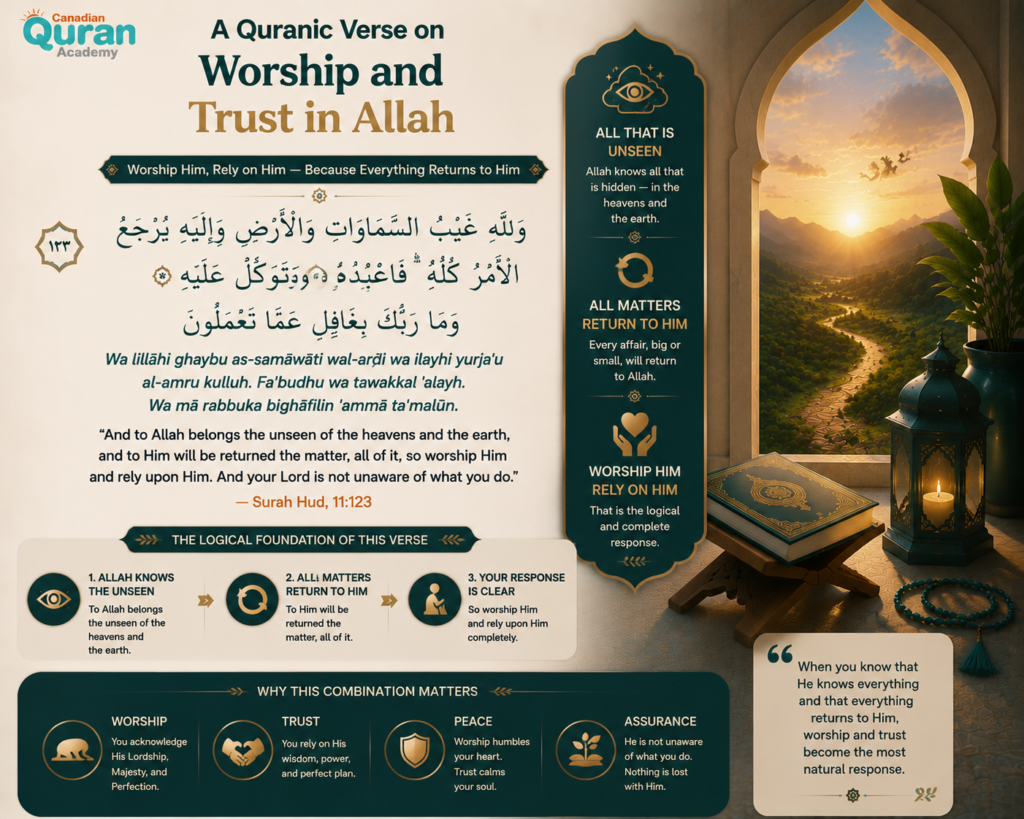
وَلِلَّهِ غَيْبُ السَّمَاوَاتِ وَالْأَرْضِ وَإِلَيْهِ يُرْجَعُ الْأَمْرُ كُلُّهُ ۖ فَاعْبُدْهُ وَتَوَكَّلْ عَلَيْهِ ۚ وَمَا رَبُّكَ بِغَافِلٍ عَمَّا تَعْمَلُونَ
Wa lillāhi ghaybu as-samāwāti wal-arḍi wa ilayhi yurja’u al-amru kulluh. Fa’budhu wa tawakkal ‘alayh. Wa mā rabbuka bighāfilin ‘ammā ta’malūn.
“And to Allah belongs the unseen of the heavens and the earth, and to Him will be returned the matter, all of it, so worship Him and rely upon Him. And your Lord is not unaware of what you do.” — Surah Hud, 11:123
The verse builds its conclusion from two established premises: Allah holds all that is unseen, and all matters return to Him. Given those two facts, the logical conclusion is stated plainly: فَاعْبُدْهُ وَتَوَكَّلْ عَلَيْهِ (fa’budhu wa tawakkal ‘alayh) — worship Him and rely upon Him. The two commands are inseparable because they share the same foundation: He is the only One with complete knowledge and complete control.
The closing reminder — وَمَا رَبُّكَ بِغَافِلٍ عَمَّا تَعْمَلُونَ (your Lord is not unaware of what you do) — is both a comfort and a call to consistency. Your effort is seen. Your worship is seen. Your sincere Tawakkul is seen. Nothing done for Allah is invisible to Him.
8. A Quranic Verse on Seeking Peace and Trusting Allah
Tawakkul is not reserved for personal struggles. This verse shows it at work in one of the most externally demanding situations a person can face.
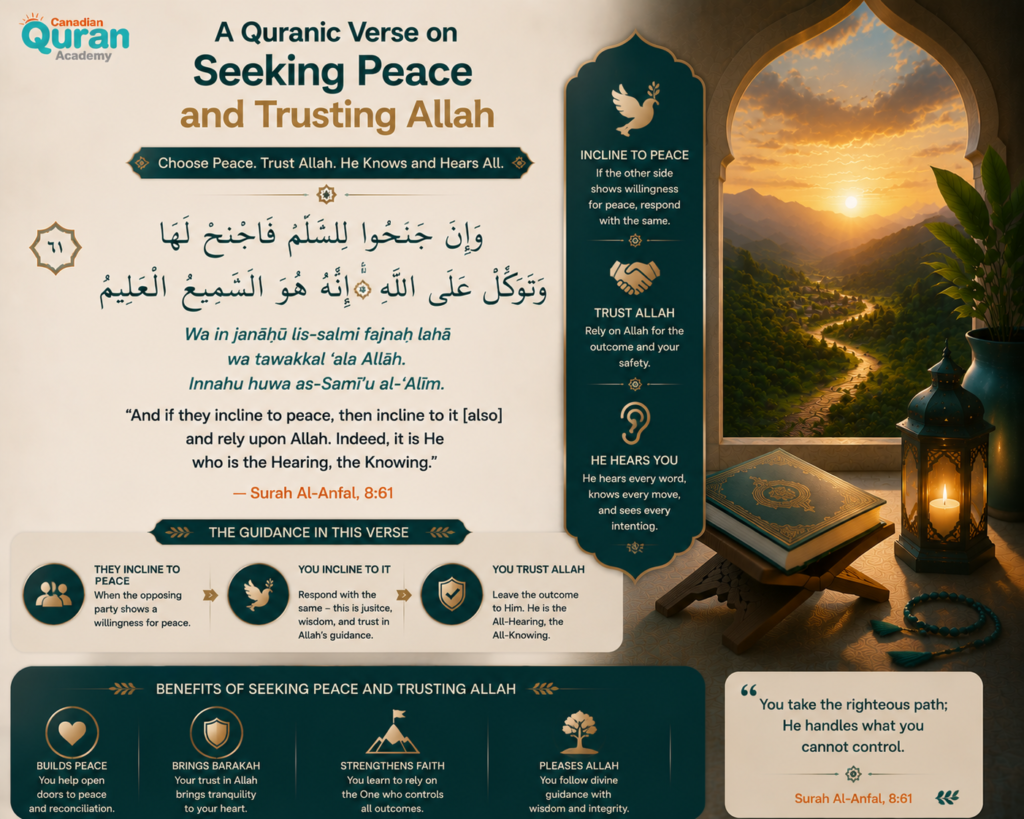
وَإِن جَنَحُوا لِلسَّلْمِ فَاجْنَحْ لَهَا وَتَوَكَّلْ عَلَى اللَّهِ ۚ إِنَّهُ هُوَ السَّمِيعُ الْعَلِيمُ
Wa in janаḥū lis-salmi fajnaḥ lahā wa tawakkal ‘ala Allāh. Innahu huwa as-Samī’u al-‘Alīm.
“And if they incline to peace, then incline to it [also] and rely upon Allah. Indeed, it is He who is the Hearing, the Knowing.” — Surah Al-Anfal, 8:61
When an opposing party shows inclination toward peace, the instruction is not suspicion — it is reciprocity: incline toward it. But the instruction does not stop there. The spiritual backbone of that choice is immediately provided: وَتَوَكَّلْ عَلَى اللَّهِ (wa tawakkal ‘ala Allāh) — rely upon Allah for the outcome and your safety. You take the righteous path; He handles what you cannot control.
The verse closes with two of Allah’s names: السَّمِيعُ (as-Samī’ — the All-Hearing) and الْعَلِيمُ (al-‘Alīm — the All-Knowing). These are not decorative additions. They are the specific attributes that make Tawakkul rational in exactly this situation — when you cannot know another’s true intentions, the One who hears every word and knows every hidden motive does.
Read More: Quranic Verses on Salah in Arabic and English
9. The Quranic Balance Between Planning and Tawakkul
The story of Prophet Yaqub (Jacob, peace be upon him) contains one of the most practical and complete demonstrations of Tawakkul in the entire Quran — action followed immediately by complete reliance.
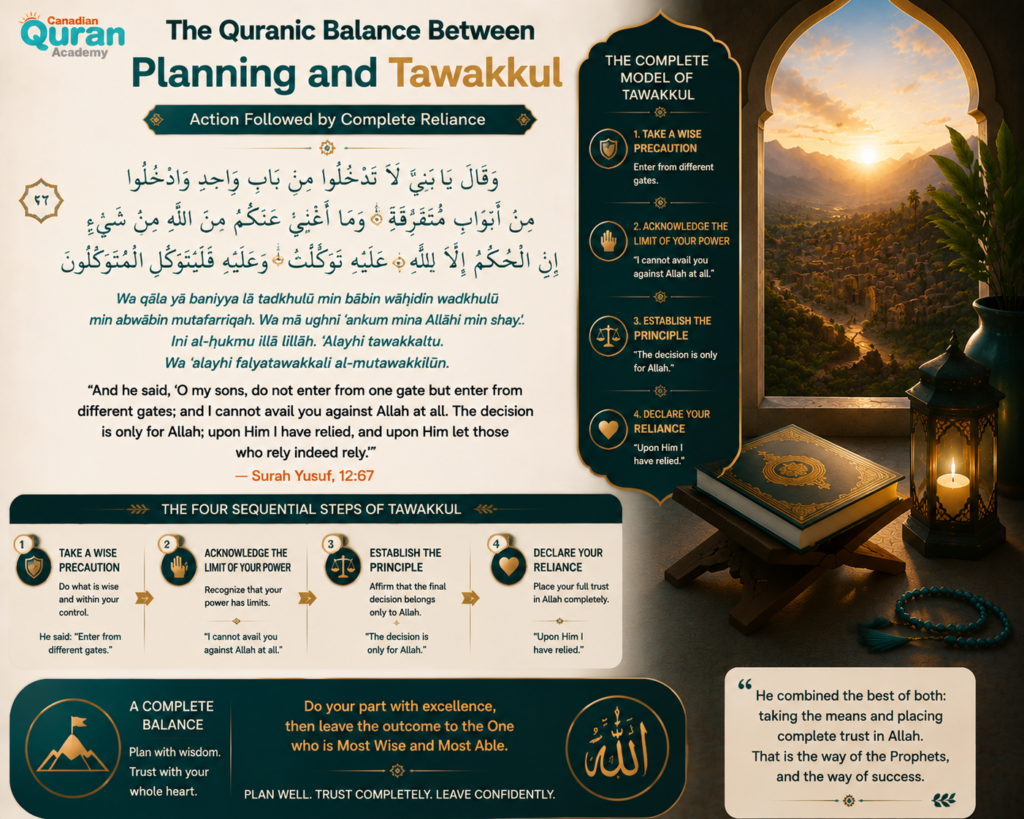
وَقَالَ يَا بَنِيَّ لَا تَدْخُلُوا مِن بَابٍ وَاحِدٍ وَادْخُلُوا مِنْ أَبْوَابٍ مُّتَفَرِّقَةٍ ۖ وَمَا أُغْنِي عَنكُم مِّنَ اللَّهِ مِن شَيْءٍ ۖ إِنِ الْحُكْمُ إِلَّا لِلَّهِ ۖ عَلَيْهِ تَوَكَّلْتُ ۖ وَعَلَيْهِ فَلْيَتَوَكَّلِ الْمُتَوَكِّلُونَ
Wa qāla yā baniyya lā tadkhulū min bābin wāḥidin wadkhulū min abwābin mutafarriqah. Wa mā ughnī ‘ankum mina Allāhi min shay’. Ini al-ḥukmu illā lillāh. ‘Alayhi tawakkaltu. Wa ‘alayhi falyatawakkali al-mutawakkilūn.
“And he said, ‘O my sons, do not enter from one gate but enter from different gates; and I cannot avail you against Allah at all. The decision is only for Allah; upon Him I have relied, and upon Him let those who rely indeed rely.'” — Surah Yusuf, 12:67
This verse contains the complete model of Tawakkul in four sequential steps. First, take a wise precaution — enter from different gates to avoid drawing attention. Second, acknowledge the limit of your own power — وَمَا أُغْنِي عَنكُم مِّنَ اللَّهِ مِن شَيْءٍ (I cannot avail you against Allah at all). Third, establish the principle — إِنِ الْحُكْمُ إِلَّا لِلَّهِ (the decision is only for Allah). Fourth, declare your personal reliance — عَلَيْهِ تَوَكَّلْتُ (upon Him I have relied).
The closing عَلَيْهِ فَلْيَتَوَكَّلِ الْمُتَوَكِّلُونَ — “upon Him let those who rely indeed rely” — reads as an invitation to every believer in every era to join this declaration. For those building the Quran memorization practice that makes such verses immediately accessible in moments of real need, Hifz for adults at Canadian Quran Academy is designed exactly for this stage of the journey.

Achieve Your Hifz Goals with a FREE Trial Class for Adults
10. Trust in Allah as a Protection Against Shaytan
This verse introduces a dimension of Tawakkul that is rarely discussed — its function as a spiritual shield.

إِنَّهُ لَيْسَ لَهُ سُلْطَانٌ عَلَى الَّذِينَ آمَنُوا وَعَلَىٰ رَبِّهِمْ يَتَوَكَّلُونَ
Innahu laysa lahu sulṭānun ‘ala alladhīna āmanū wa ‘alā Rabbihim yatawakkalūn.
“Indeed, there is for him no authority over those who have believed and rely upon their Lord.” — Surah An-Nahl, 16:99
Shaytan’s authority — سُلْطَانٌ (sulṭān), meaning dominion, power, ability to control — is categorically removed from two groups: those who believe, and those who rely upon their Lord. The verse combines both with the conjunction وَ (wa — and), presenting them as a single compound condition. It is the believer who also practices Tawakkul who is shielded.
The mechanism is clear: when the heart is anchored to Allah — when its trust, its hope, and its fear are directed toward Him alone — Shaytan’s primary entry points are closed. His whispers of doubt, anxiety, and false dependency find no foothold in a heart that has already surrendered its outcomes to Allah.
Live Class in Action
Watch how our instructors interact with students in real-time, focusing on interactive methods.
Start Your Quranic Journey in Canada
Join our vibrant community and learn with expert tutors through our flexible online platform.
Claim Your Free TrialStrengthen Your Tawakkul with Canadian Quran Academy
Reading Quranic verses about Tawakkul is only the first step. A deeper connection comes from understanding their Arabic, reciting them with proper Tajweed, and applying their guidance in everyday decisions, challenges, and moments of uncertainty. When you truly understand Allah’s words, trust in Him becomes a lived reality rather than a concept.
At Canadian Quran Academy, our experienced teachers provide personalized online Quran classes designed to help students of all ages understand, recite, and reflect on the Quran. Whether you’re beginning with Quranic Arabic, improving your Tajweed, or seeking a deeper understanding of Allah’s guidance, our structured lessons support your journey every step of the way.
Start your Quran learning journey with Canadian Quran Academy today and build a lifelong connection with the Book of Allah.

Our Quran Courses
- Quran Online Academy
- Quran Recitation Classes
- Quran Reading Classes
- Online Quran Classes for Kids
- Quran Classes for Adults
- Quran Classes for Female
- Learn Quran Course for Beginners
- Quran Memorization (Hifz) Course
- Hifz Classes for Adults
Start Your Quranic Journey in Canada
Join our vibrant community and learn with expert tutors through our flexible online platform.
Claim Your Free TrialConclusion
These ten Quranic verses on trust in Allah build a complete and demanding picture of what Tawakkul actually is. It is not a feeling of calm that arrives passively. It is an active, deliberate anchoring of the heart to Allah — after effort, after planning, after taking every wise step available — in the full knowledge that He is sufficient, that He is All-Hearing and All-Knowing, and that His decree has already accounted for everything.
Allah promises that He is ḥasbuh — completely sufficient — for the one who truly relies on Him (65:3). He states that He loves those who practice Tawakkul (3:159). He presents it as a defining trait of the believer (8:2), a condition of faith (5:23), and a shield against Shaytan’s authority (16:99). And in the example of Prophet Yaqub (12:67), He shows us exactly what it looks like to plan wisely and then surrender the outcome completely.
May these verses be more than knowledge — may they become the posture your heart returns to every time the outcome leaves your hands.
Frequently Asked Questions
Tawakkul is one of the Quran’s most profound teachings, yet it is often misunderstood. These frequently asked questions clarify what the Quran says about trusting Allah, taking the means, and the promises attached to true reliance.
What is Tawakkul in Islam according to the Quran?
Tawakkul is complete reliance and trust in Allah — placing the outcome of your affairs entirely in His hands after taking every reasonable action available to you. The Quran never presents it as passivity. In Surah Ali ‘Imran 3:159, the command to rely upon Allah comes after the act of deciding firmly, establishing that Tawakkul follows effort, not replaces it.
How many times is Tawakkul mentioned in the Quran?
The root و-ك-ل (Waw-Kaf-Lam) and its derivatives — including tawakkul, tawakkal, yatawakkal, mutawakkilūn, and wakīl — appear approximately 70 times across the Quran. This frequency places Tawakkul among the most repeatedly emphasized qualities in the entire scripture.
What is the difference between Tawakkul and laziness?
Tawakkul is precisely the opposite of laziness. In Surah Yusuf 12:67, Prophet Yaqub first instructs his sons to take a specific precaution — entering from different gates — and then declares his reliance on Allah. Action comes first; Tawakkul covers what action cannot. Doing nothing and calling it Tawakkul is not the Quranic model.
Does Tawakkul protect a believer from Shaytan?
Yes — directly. Surah An-Nahl 16:99 states that Shaytan has no authority over those who believe and rely upon their Lord. When the heart’s trust, hope, and fear are directed entirely toward Allah, Shaytan’s primary points of entry — anxiety, false dependency, and doubt — lose their grip.
What does Allah promise those who practice Tawakkul?
Three distinct promises appear across the verses covered in this article. In Surah At-Talaq 65:3, Allah promises complete sufficiency for the one who relies on Him. In Surah Ali ‘Imran 3:159, He promises His love for those who rely upon Him. And in Surah An-Nahl 16:99, He promises protection from Shaytan’s authority for the believer who practices Tawakkul.






Leave a Reply