 Arabic
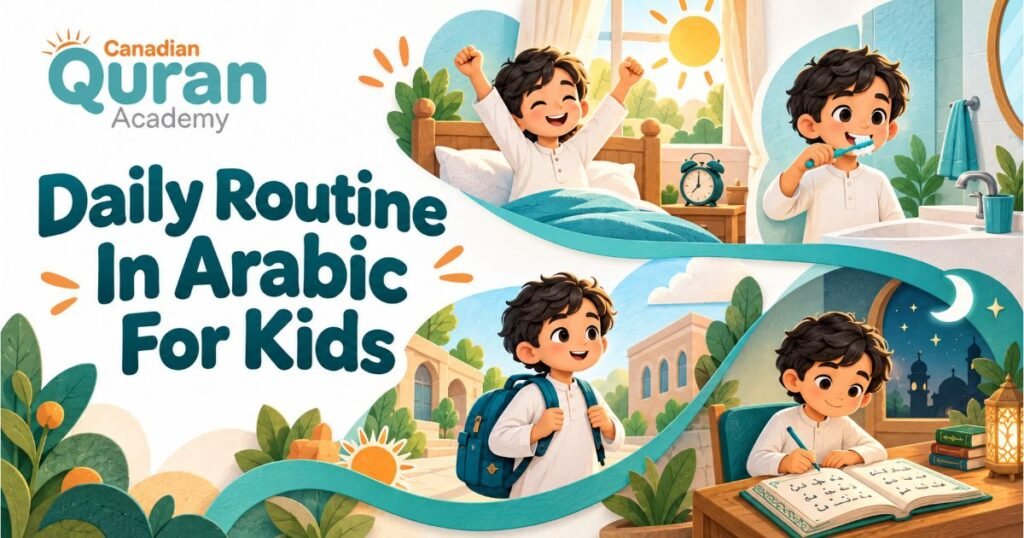
Your child already lives an Arabic lesson every single day — they just say it in English. Waking up, brushing teeth, praying, eating, playing, sleeping. Teaching a daily routine in Arabic for kids simply relabels moments that already repeat.
That is why The Canadian Quran Academy builds its children’s Arabic pathway around the clock rather than around abstract grammar charts. Words attached to real actions stay. Words on a flashcard fade by Friday.
In the next few minutes you will get the vocabulary, the phrasing, the printable structure, and the short exercises that turn an ordinary Tuesday into a full Arabic practice session.
No memorization marathon required. Just five predictable moments, used well.
Key Highlights of This Article:
- The reason routine-based vocabulary outperforms isolated word lists for young learners.
- Ready-to-use morning, school, and evening Arabic words with meaning and transliteration.
- A three-step home method that fits into an existing family schedule.
- Printable chart ideas plus short practice questions with answers.
Why A Daily Routine In Arabic For Kids Beats Random Word Lists
Before we reach the vocabulary tables, it helps to understand why this approach works. A daily routine in Arabic for kids succeeds because it borrows structure that already exists in your home instead of demanding new study time.
1. Routine Turns Arabic Into A Predictable Daily Anchor
Children thrive on predictability, and language is no exception. When a word always appears at the same moment, the brain stops treating it as new information and starts treating it as part of the event itself.
Pediatric guidance echoes this. As explained in this parenting resource from the American Academy of Pediatrics, “children do best when routines are regular, predictable and consistent”.
Apply that principle to language and the result is powerful. Your child is not “studying Arabic” at 7:00 a.m. They are eating breakfast, and Arabic happens to be the soundtrack.
Your child’s morning already speaks Arabic — we just teach them the words.
Book a free trial in Online Arabic Classes for Kids with The Canadian Quran Academy.
2. Natural Repetition Builds Long-Term Memory
A routine word is repeated roughly 365 times a year without a single worksheet. That frequency is impossible to reproduce in a weekly class alone.
Early childhood is also the ideal window. According to the official developmental guidance published by the National Institute on Deafness and Other Communication Disorders, “the first 3 years of life, when the brain is developing and maturing, is the most intensive period for acquiring speech and language skills”.
Repetition also lowers pressure. Nobody feels tested when a parent simply says الفُطُور while placing a plate on the table.
3. Everyday Vocabulary Connects Arabic To Worship
Daily routine Arabic is not separate from faith — it overlaps with it constantly. Fajr, wudu, meals, bedtime: each one carries authentic Arabic your child will use for life.
Allah, the Exalted, says:
“وَجَعَلْنَا نَوْمَكُمْ سُبَاتًا وَجَعَلْنَا اللَّيْلَ لِبَاسًا وَجَعَلْنَا النَّهَارَ مَعَاشًا”
“And made your sleep for rest, and made the night as a cover, and made the day for livelihood.” — Surah An-Naba 78:9–11
That rhythm of night and day is the same rhythm your vocabulary plan follows. Families who want to deepen this link often pair language practice with the Islamic Studies Courses for Kids offered at The Canadian Quran Academy.
Related read: Letter Ghayn In Arabic غ – Pronunciation, Positions, And Meaning
Core Daily Routine Vocabulary In Arabic For Kids With Meaning
Here is the working vocabulary, grouped by the time of day it belongs to. Each entry gives the Arabic script, the transliteration, and the daily routine in Arabic for kids in English so parents who do not read Arabic can still coach confidently.
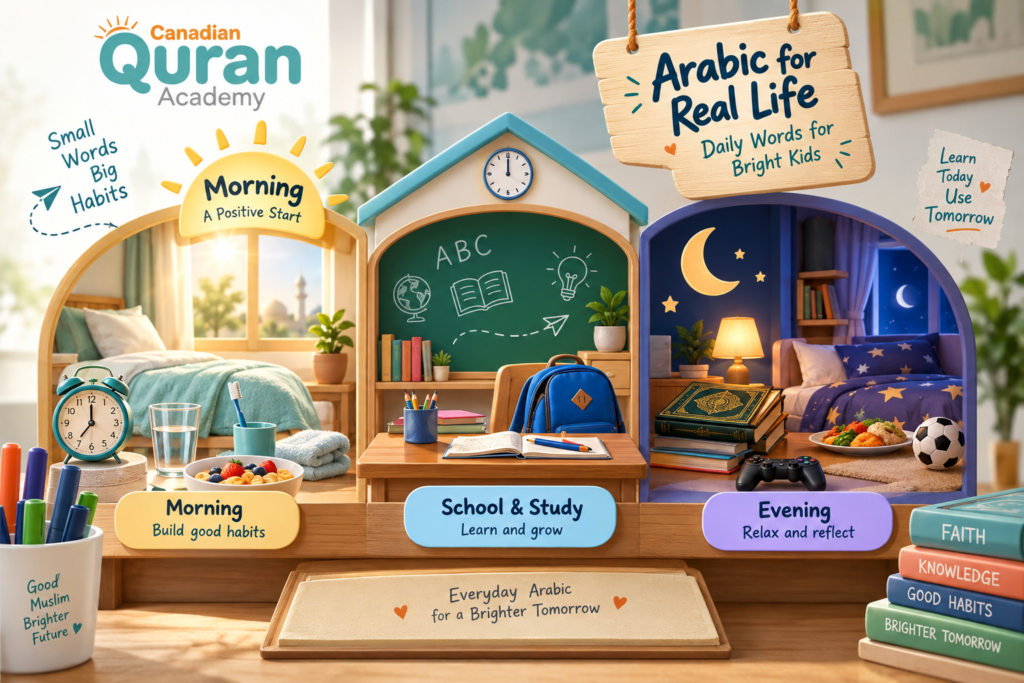
1. Morning Words And Phrases (الصَّبَاح)
Mornings are the strongest teaching slot because the sequence never changes. Introduce three words this week, not fifteen.
| Arabic | Transliteration | English Meaning |
| أَسْتَيْقِظُ | astayqiẓu | I wake up |
| أُصَلِّي الفَجْر | uṣallī al-fajr | I pray Fajr |
| أَغْسِلُ وَجْهِي | aghsilu wajhī | I wash my face |
| أُنَظِّفُ أَسْنَانِي | unaẓẓifu asnānī | I brush my teeth |
| أَتَنَاوَلُ الفُطُور | atanāwalu al-fuṭūr | I eat breakfast |
The very first word of the day can be a dua. The Prophet ﷺ used to say upon waking:
“الْحَمْدُ لِلَّهِ الَّذِي أَحْيَانَا بَعْدَ مَا أَمَاتَنَا وَإِلَيْهِ النُّشُورُ”
“All praise is for Allah who gave us life after having taken it from us, and unto Him is the resurrection.” — Sahih al-Bukhari 6312
2. School And Study Words (المَدْرَسَة)
The school block adds action verbs, which is exactly what young learners need to start forming sentences rather than naming objects.
| Arabic | Transliteration | English Meaning |
| أَذْهَبُ إِلَى المَدْرَسَة | adhhabu ilā al-madrasah | I go to school |
| أَقْرَأُ | aqra’u | I read |
| أَكْتُبُ | aktubu | I write |
| المُعَلِّم | al-muʿallim | the teacher |
| أَعُودُ إِلَى البَيْت | aʿūdu ilā al-bayt | I return home |
Once these verbs are comfortable, your child can swap the object and build dozens of new sentences. Reading practice pairs naturally with our guide to the most used Arabic words in the Quran. Keep corrections light. Fluency first, precision second.
Small mouths, big words — and a teacher who makes both easy.
The Arabic Lessons for Kindergarten program at The Canadian Quran Academy starts exactly here.

3. Evening And Bedtime Words (المَسَاء)
Evenings are calmer, which makes them ideal for longer phrases and gentle review of everything learned since morning.
| Arabic | Transliteration | English Meaning |
| أَلْعَبُ | alʿabu | I play |
| الوَاجِب المَنْزِلِيّ | al-wājib al-manzilī | homework |
| العَشَاء | al-ʿashāʾ | dinner |
| أَقْرَأُ القُرْآن | aqra’u al-Qurʾān | I read Quran |
| أَنَامُ | anāmu | I sleep |
Mealtime carries its own sunnah vocabulary. The Prophet ﷺ instructed a young boy at the table:
“يَا غُلاَمُ سَمِّ اللَّهَ، وَكُلْ بِيَمِينِكَ وَكُلْ مِمَّا يَلِيكَ”
“O boy! Mention the Name of Allah, eat with your right hand, and eat of the dish what is nearer to you.” — Sahih al-Bukhari 5376
You may also be interested in: Quran Verses In Arabic – Beautiful And Short 44 Verses
How To Build A Daily Routine In Arabic For Kids At Home
Vocabulary without a delivery system disappears fast. This three-step method keeps a daily routine in arabic for kids with meaning running even on busy weeks, and it takes under ten minutes a day in total.
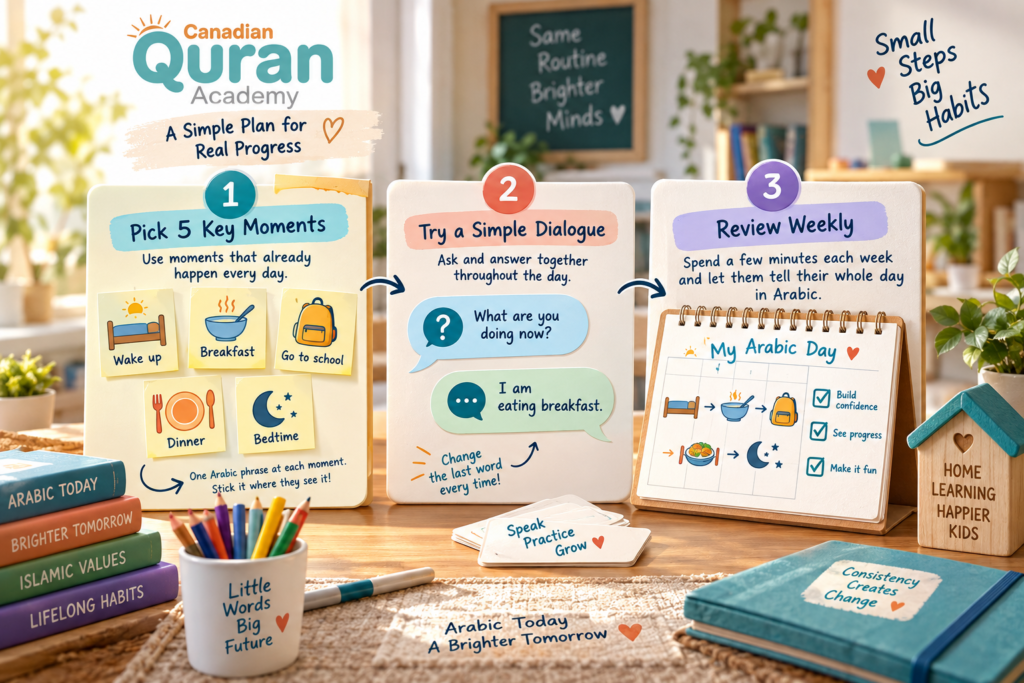
Step One — Choose Five Anchor Moments
Pick five moments that already happen without negotiation: waking, breakfast, leaving for school, dinner, and bedtime. These are your fixed teaching slots.
Assign one Arabic phrase to each anchor and nothing more. Five phrases per week is thirty-five sentences by the end of the month. Write them on a sticky note at the location itself — the bathroom mirror, the fridge, the door. The environment does half the teaching.
Step Two — Use A Short Question-And-Answer Script
Move from single words to dialogue as early as possible. The simplest script is two lines, asked at any anchor moment.
Ask: مَاذَا تَفْعَلُ الآن؟ (Mādhā tafʿalu al-ān?) — “What are you doing now?”
Answer: أَنَا أَتَنَاوَلُ الفُطُور (Anā atanāwalu al-fuṭūr) — “I am eating breakfast.”
Swap only the final word each time. Your child learns sentence structure without ever being taught a grammar rule.
Step Three — Review Once A Week
Friday works well. Spend five minutes asking your child to narrate their whole day in Arabic, in order, using whatever they remember.
Gaps in the narration show you exactly which anchor needs another week. This is assessment without a test. Celebrate the recall, not the accuracy. Confidence is the resource you are protecting.
From single words to full conversations — in one term. Let The Canadian Quran Academy take over with the Arabic Conversation Course.
Live Class in Action
Watch how our instructors interact with students in real-time, focusing on interactive methods.
Start Your Quranic Journey in Canada
Join our vibrant community and learn with expert tutors through our flexible online platform.
Claim Your Free TrialPrintable Charts And Practice Exercises For Daily Routine Arabic
A visual chart converts scattered practice into something your child can see and tick off. Below is how to design one and how to test it properly.
What To Put On A Daily Routine In Arabic For Kids Printable
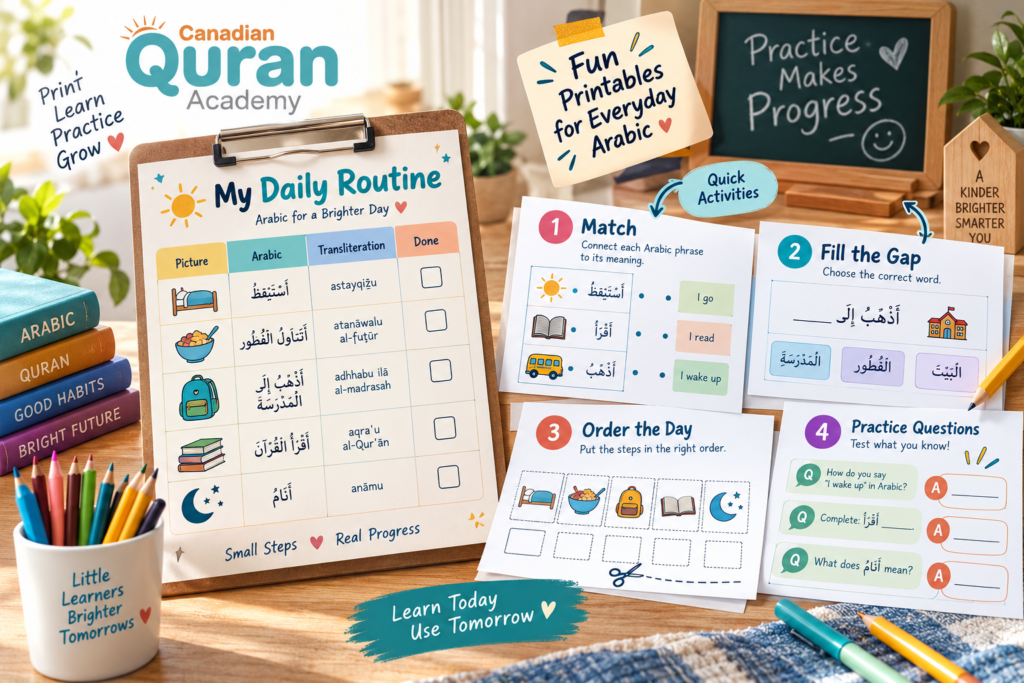
An effective daily routine in Arabic for kids printable uses four columns: a picture, the Arabic phrase, the transliteration, and a checkbox. Nothing else.
Order the rows by time of day, not alphabetically. The chart should read like the child’s actual morning. Print it large and hang it at your child’s eye level. A chart on the fridge at adult height is a chart nobody reads.
Five-Minute Exercises Your Child Can Finish Alone
Short and finishable beats long and abandoned. Rotate between three formats so the practice never feels identical two days running.
- Match: Arabic phrase on the left, English meaning on the right.
- Fill the gap: أَذْهَبُ إِلَى ______ with a small word bank.
- Order the day: cut five phrases into strips and sequence them.
Each of these takes three to five minutes and requires no supervision once the format is familiar.
Practice Questions With Answers
Here is a quick daily routine in Arabic for kids with answers set you can use tonight. Read the question aloud, then check together.
Q1. How do you say “I wake up” in Arabic?
A1. أَسْتَيْقِظُ — astayqiẓu.
Q2. Complete: أَقْرَأُ ______ (I read the Quran).
A2. القُرْآن — al-Qurʾān.
Q3. What does anāmu (أَنَامُ) mean?
A3. I sleep — the final anchor of the day.
If your child needs stronger letter recognition before written exercises, start with our explainer on Arabic Noorani Qaida – What It Is, Its Origin, And How To Teach It?.
Give Your Child A Structured Arabic Path With The Canadian Quran Academy
Home practice is powerful, but it has a ceiling. Somewhere around the fiftieth phrase, most parents hit the same wall: pronunciation drift, no progression plan, and no one to correct the small errors before they harden.
That is the gap The Canadian Quran Academy was built to close. Every learner here studies one-to-one with a qualified native teacher at fixed weekly times.
There is no group pace to fall behind, and no rotating instructor learning your child’s name again each month. That consistency mirrors the routine principle this entire article is built on — the same teacher, the same slot, the same expectations, week after week.
Lessons are scheduled around your family’s timetable, including evenings and weekends across Canadian time zones. The children’s Arabic track at The Canadian Quran Academy deliberately begins with the language of the day: waking, eating, praying, playing, sleeping.
Grammar arrives later, attached to sentences the child can already say — which is why our students start speaking in short, correct sentences long before they meet a single grammar table.
Children who need a slower on-ramp can begin with the Arabic Course for Beginners and move up the moment they are ready.
What ties it all together is visibility. You receive plain-language progress updates showing which phrases your child has mastered, which need review, and what is coming next — no jargon, no vague “doing well.”
That means your home routine and the classroom stay perfectly aligned, so you always know which five phrases to reinforce this week.
Parents also get direct access to the teacher for questions between sessions, which is exactly how a daily routine in Arabic for kids turns from a home experiment into a real learning path.
Experience Our Classrooms
Don’t just take our word for it—take a look inside! Watch the videos below to experience our engaging teaching methods and vibrant online classrooms firsthand.
Start Your Quranic Journey in Canada
Join our vibrant community and learn with expert tutors through our flexible online platform.
Claim Your Free TrialStart Your Child’s First Arabic Routine Lesson Today!
Book your child’s free trial lesson with The Canadian Quran Academy now. In thirty minutes, a qualified teacher will assess your child’s current level and hand you a personalized starting point — at no cost and with no commitment.
You will leave that session with a clear plan: which anchor moments to target first, which phrases to introduce this week, and how quickly your child can move toward full sentences. Most families see their child narrating their morning in Arabic within the first month.
Our Arabic Courses:
- Online Arabic Academy
- Online Arabic Course
- Classical Arabic Course
- Arabic Course for Beginners
- Advanced Arabic Course
- Quranic Arabic Course
Choose your preferred time, meet your teacher, and turn tomorrow morning into the first lesson. Visit The Canadian Quran Academy and reserve the slot that fits your family.

Start Your Quranic Journey in Canada
Join our vibrant community and learn with expert tutors through our flexible online platform.
Claim Your Free TrialConclusion
Teaching a daily routine in Arabic for kids is not about adding another subject to an already full schedule. It is about relabeling moments that already repeat — waking, washing, praying, eating, studying, playing, sleeping — with the words your child will carry for life.
You now have the vocabulary grouped by time of day, a three-step home method, a printable chart structure, and practice questions with answers. The ingredients are simple; consistency is the multiplier.
The ultimate takeaway: five phrases, five anchors, every single day. Do that for one month and your child will not have memorized Arabic — they will have lived it.
Frequently Asked Questions
What Are 100 Common Arabic Words Used Daily?
A practical 100-word core covers greetings, family, food, time, places, and about thirty high-frequency verbs — enough for a child to handle most everyday situations. The Canadian Quran Academy sequences that core across the first term so nothing is learned out of context.
What Are 10 Basic Arabic Words?
Start with: السَّلَامُ عَلَيْكُم (peace be upon you), نَعَم (yes), لَا (no), مَاء (water), طَعَام (food), بَيْت (house), أُمّ (mother), أَب (father), كِتَاب (book), and شُكْرًا (thank you). These ten open the door to hundreds of simple sentences your child can build immediately.
What Is “Everyday” In Arabic?
“Everyday” is كُلَّ يَوْم (kulla yawm), and the adjective form “daily” is يَوْمِيّ (yawmī). Both appear constantly in routine sentences, which is why teachers at The Canadian Quran Academy introduce them in the very first lessons.
What Is The Best Daily Routine For Children?
The best routine is short, predictable, and tied to fixed daily anchors — wake, pray, eat, study, play, sleep — rather than packed with activities. Once that skeleton is stable, adding one Arabic phrase per anchor costs nothing extra and doubles the routine’s value.
What Is A Morning Routine For Kids?
A strong morning routine is a fixed sequence of five or six steps: wake, pray, wash, dress, eat, and leave — always in the same order. Attaching one Arabic phrase to each step turns that sequence into daily language practice without adding a single minute.
How To Create A Daily Routine For Kids?
Anchor the routine to events that already happen, keep it to five or six steps, and display it visually at your child’s eye level. Consistency matters far more than length, which is why The Canadian Quran Academy schedules lessons at the same fixed weekly slot for every learner.






Leave a Reply